InfiniSplat v2: the points stay where Depth Anything 3 put them, and opacity does the cleaning
mdjsonmcp2026-10-17 · 19 min · 3d · gaussian-splatting · depth-estimation · point-cloud · benchmarks
A 1:57 narrated explainer, drawn in code. Every number and picture in it is this article's own; the sources are below.
› transcript
Hi, I'm Mortise! Today: how a splatting model cleans a noisy point cloud without moving a single point. Leave the geometry alone. Every point stays where the depth model put it. The network only learns how visible each one is. The images go into a frozen copy of Depth Anything 3. It predicts depth and a camera for every view. Back-project every pixel to get a point cloud. Good on average, noisy at every edge. A second copy, with only its last ten blocks trained, feeds a small head: rotation, scale, opacity and colour, per pixel. Centres come only from the depth. The head never outputs a position. Then three cheap steps. Divide by the average point distance, so a street and a table look alike. Snap Gaussians to a grid and average each cell. Delete anything nearly transparent. That is where the noise goes. The tempting fix is letting the network nudge points onto surfaces. In the paper's tests, renders got worse. Frozen positions leave the loss one way out: shape, colour and opacity. Labelled with true depth, inconsistent points pile up near zero opacity. Everything else sits near one. So the threshold clears the mid-air haze and leaves the shelf alone. About half the inconsistent points vanish, and less than a tenth of everything. On perceptual error it leads clearly. On plain pixel accuracy, one baseline still edges it out. Opacity can delete what floats in front of a surface. It cannot move a surface the depth model got wrong. Frozen depth for position, learned attributes for the rest, and a threshold that cleans. Every source is in the full article. I'm Mortise. Bye!
Why read this
Solidtop 85%Shows from the code and weights that v2 never moves a point; opacity is the denoiser. Rechecks the 25.8% claim, the missing refiner, and a three-way licence.
- Original analysis
- A new technique
- Explained from first principles
3D & spatialNeeds a workstation GPUMixed licencesResearch paper
How this was scored
- Is it new?
- 2 of 3: A real new idea, method or capability
- Can I trust it?
- 2 of 3: Measures key facts from files, code or configs
- Can I run it?
- 1 of 3: API-only, gated or restrictive licence
- Will I understand it?
- 2 of 3: Mechanism from first principles with figures
- Can I act on it?
- 1 of 3: General advice
- Will it last?
- 1 of 3: Relevant for months
- Does it affect many?
- 1 of 3: A specialist community
- Only here?
- 2 of 3: A teardown or measurement few others did
Score 56 of 100, ranked 399 of 577 rated articles. Each question is answered 0–3 by hand, and a 3 is rare. How articles are scored
The post that announced it, from Sida Peng on 16 October 2026, says the interesting part in one line: InfiniSplat v2 "can produce high-quality 3D Gaussian Splatting, even when the base geometry model yields noisy point clouds."
The obvious reading is that v2 repairs the point cloud: pulls stray points back onto surfaces, learns offsets, denoises geometry. It does none of that. The release code puts every Gaussian centre exactly where a frozen Depth Anything 3 depth pixel back-projects, and the paper's own ablation shows that letting the network move points makes the renders worse. What v2 learns is everything except position, and the attribute doing the cleaning is opacity.
I read the paper (arXiv:2610.20341, 14
October 2026), the v1 paper (arXiv:2608.02437),
the release at zju3dv/InfiniSplat
(commit a4d3f8b, 15 October), the Hugging Face Space's source, and the header
of the 6.60 GB checkpoint at
Edisoneh/InfiniSplat-v2
through an HTTP range request. I did not run the model: it needs an NVIDIA GPU
and this machine has none. Numbers below are measured (I read them from a
file), reported (the authors' figure, not re-run) or reasoned (my
arithmetic on the other two).
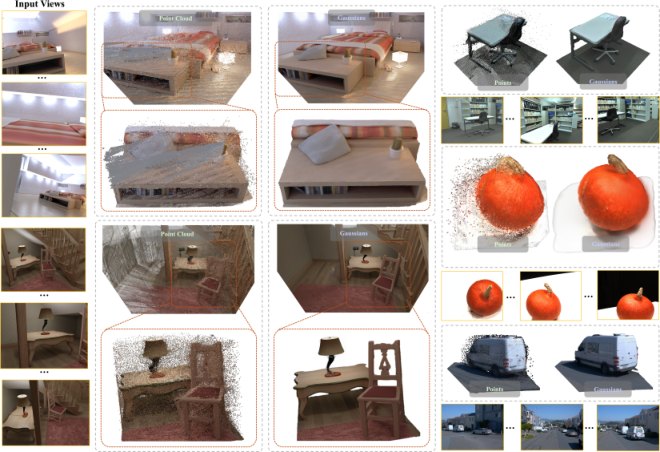
The base geometry model, and why its points are noisy
A geometry foundation model (DUSt3R, VGGT, π³, Depth Anything 3) takes a set of images and predicts, per view, a depth map and a camera. Back-project every pixel through its camera and you get a point cloud in one frame. The site has covered this family from several sides: DA3 in a ROS 2 node, streaming reconstruction on DA3-style backbones, and two roundups of feed-forward reconstruction papers and the classical geometry being bolted back on.
In v2 the "base geometry model" is concretely DA3NESTED-GIANT-LARGE-1.1
(reported, Appendix A.2), and the release's config.json instantiates the
DA3 network with a vitg backbone whose features are tapped at layers 19, 27,
33 and 39 (measured). It runs at a long side of 518 pixels by default, with
2 to 32 views on the command line and up to 50 with --max-views (measured,
cli.py and the README).
Those point clouds are good on average and bad at the edges. Per-view depth maps disagree slightly, so the same wall arrives as several sheets. Depth networks smooth across silhouettes, so pixels at an object boundary land in mid-air between the object and what is behind it. A lidar does not have this failure in the same form (its range is a time of flight, not an inference, as the Hesai Kosmo piece covers), but a camera-only pipeline lives with it. Render the raw cloud from a new angle and those flying points become the haze you see in the left half of each pair above.
What v2 actually predicts
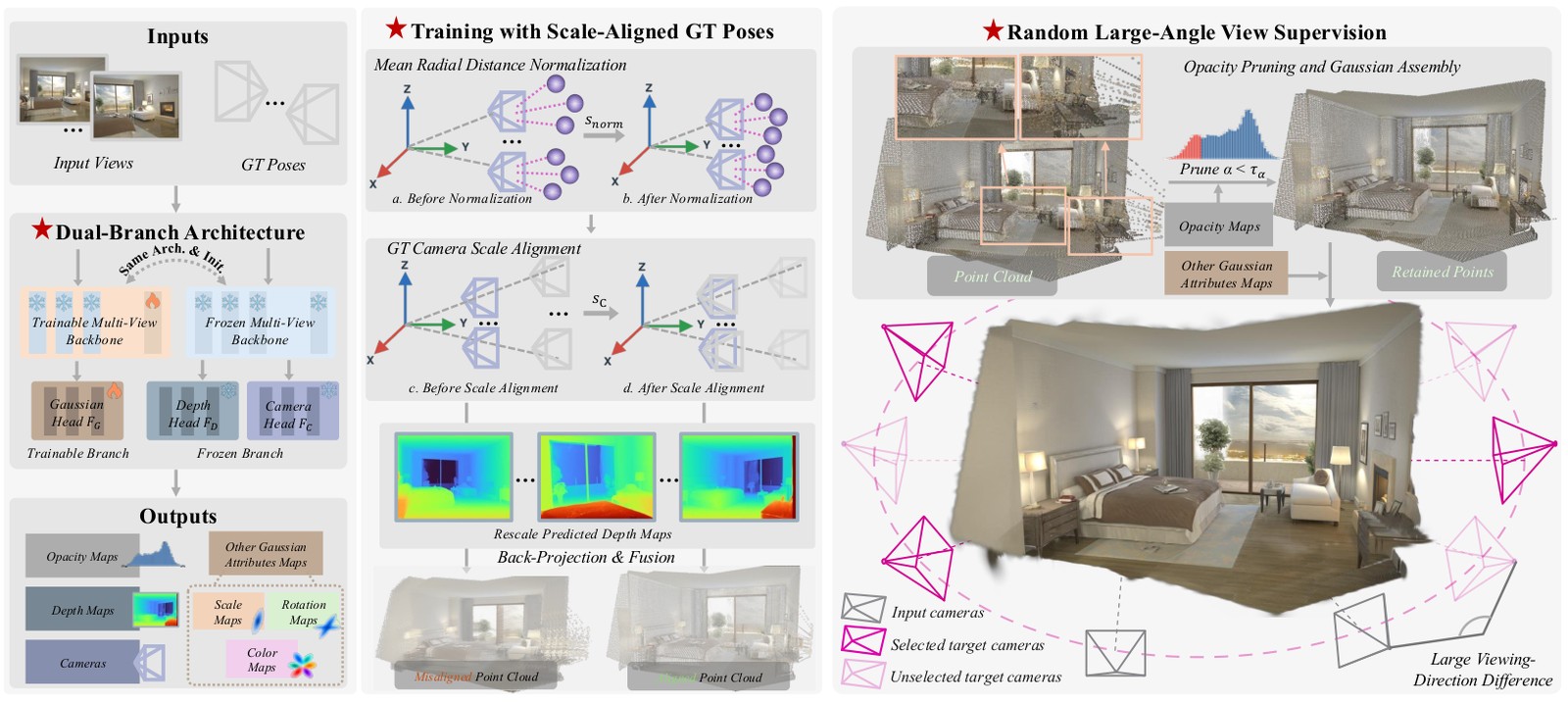
The whole inference path is about 1,460 lines of Python in
InfiniSplat_v2/src/infinisplat/ (measured: 1,462 with wc -l). Reading
it top to bottom:
Two copies of DA3. model.py builds the DA3 network twice from the same
config. The geometry branch is frozen and supplies depth and cameras. The
appearance branch keeps only its backbone tokens (its head is replaced with
nn.Identity() in the released format) and feeds four layers of 1,536-wide
features through four Linear(1536, 2048) projections into a DPT-style decoder
(measured). The paper's reason for two branches is its first finding:
jointly fine-tuning geometry and attributes degrades geometry, because the
rendering loss is happy to move points to cover for bad colours.
One Gaussian per pixel, with no position output. The Gaussian head is
small: a 3×3 convolution from 128 to 256 channels, a ReLU, and a 1×1
convolution to 11 channels (measured, gaussians.py, confirmed by the
gaussian_head.layers.2.weight [11, 256, 1, 1] tensor in the checkpoint
header). The 11 channels split as 4 for a rotation quaternion, 3 for log-scale,
1 for opacity and 3 for a colour residual:
# InfiniSplat_v2/src/infinisplat/gaussians.py (release a4d3f8b)
rotation, scale, opacity, sh = torch.split(raw, [4, 3, 1, 3], -1)
rgb = images[0].permute(0, 2, 3, 1).reshape(-1, 3).float()
return dict(quats=rotation / (rotation.norm(dim=-1, keepdim=True) + 1e-8),
            scales=scale.exp().clamp_max(.3), opacities=opacity[:, 0].sigmoid(),
            sh=(((rgb - .5) / SH_C0).to(sh.dtype) + sh)[:, None], base_rgb=rgb)
Three things in those lines. Colour starts at the input pixel's own RGB and
the network predicts only a correction to the zeroth-order spherical
harmonic, so v2 has no view-dependent colour at all (the site's
piece on splat colour covers what
higher-order SH costs). Scale is capped at 0.3 in the normalised scene unit.
And there is no means output: back in model.py, the centres are assigned
from depth_to_world_coords_points(depth, poses, K), the frozen depth
unprojected through the cameras, after the head has run.
Normalise, merge, prune. Depth and camera translations are divided by the mean distance of all back-projected points from the reference camera, which the paper calls Mean Radial Distance Normalization:
where is a back-projected point and the predicted depth of view . So the scene's unit is "average distance to the stuff", and the 0.3 scale cap means no Gaussian is wider than about a third of that.
Then every view's Gaussians, 518 × 392 of them for a 4:3 image at the default
size (203,056 per view, so about 6.5 million for 32 views; reasoned), go
through merge(). It snaps centres to a voxel grid whose side is 1.4 times the
median Gaussian scale, averages every attribute inside each occupied voxel, and
drops anything whose averaged opacity is under 0.01 (measured). The export
keeps every survivor; there is no count cap.
One mismatch I could not resolve: Appendix A.2 says voxel merging "uses a side
length of 0.004 in the scale-normalized reconstruction frame", while the
release computes it per scene as median * 1.4, and pipeline.py refuses to
load a config whose voxel_multiplier is not 1.4 (measured). The two can
agree for a typical scene, but they are different rules.
Why opacity is the denoiser
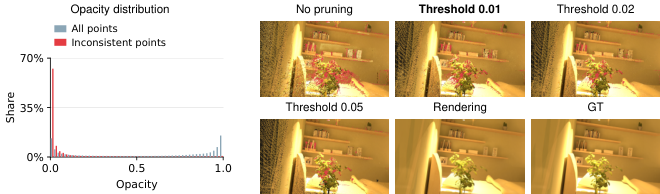
Positions are frozen, so the only way the network can make a flying point stop hurting the render is to make it transparent. That is the paper's third finding, and the one the tweet is about: trained with image losses only, the attribute branch learns to give low opacity to points that are inconsistent across views.
The authors test it on held-out Hypersim scenes with labels that never look at opacity: a point is inconsistent if it sits in free space that ground-truth depth says at least two views looked straight through, and matches no observed surface depth. That labelled 36,125 points. At the 0.01 threshold, pruning removes 51.8% of the inconsistent points but only 7.5% of all points, and keeps 93.3% of the surface-consistent ones (reported, Section 4.3 and Appendix B.4).
The toy below is that mechanism in a 2D side view. Three cameras look at a
wall and a box. Their depth is wrong the way depth networks are wrong: the two
rays just past each edge of the box bleed into mid-air, and the slider adds
noise and occasional spikes. Nothing moves a point. Opacity comes from a
cross-view test (does another camera's predicted depth say it saw through
this spot?), which is my hand-written stand-in for the learned head; the merge
rule (1.4 times the median scale) and the 0.01 prune follow gaussians.py.
Two things fall out of playing with it. At zero noise the edge bleed alone makes 4 of the 120 points inconsistent, and the test removes all 4: the flying-pixel problem exists before any random noise does. And as the noise grows, most damaged points become uncertain rather than inconsistent: they are behind or slightly off the true surface, where no camera has seen through them, and opacity has no reason to remove them. That is the toy's version of the paper's own limitation, "fixed centers cannot correct severe errors in predicted geometry." Opacity removes what is in front of a surface. A surface in the wrong place stays in the wrong place.
The ablation backs the decision to freeze positions (reported, Table 2, ETH3D and DTU, before refinement):
| variant | ETH3D LPIPS | DTU LPIPS | what changes |
|---|---|---|---|
| v2 | 0.4339 | 0.2070 | frozen geometry, fixed centres |
| w/o G | 0.5204 | 0.2695 | geometry branch fine-tuned too |
| w/ O | 0.4998 | 0.2826 | geometry frozen, head predicts 3D offsets |
| w/o C | 0.5017 | 0.3237 | predicted cameras for training back-projection |
| w/o V | 0.4533 | 0.2295 | local instead of large-angle target views |
Freezing geometry cuts LPIPS by 16.6% on ETH3D and 23.2% on DTU against fine-tuning it, and ground-truth cameras at training time cut DTU LPIPS by 36.1% (reported, and reasoned: all three reproduce from the table to the stated digit). Learned offsets, the thing you would add first if you wanted to "clean" a point cloud, are worse than no offsets on both datasets.
The other two training changes are about what the loss can see. Using predicted cameras to build points but ground-truth cameras to render targets leaves a pose residual the network tries to paint over; v2 back-projects with ground-truth cameras, rescaled by an Umeyama fit to the normalised predicted trajectory. And target views near the inputs leave a Gaussian's thickness unconstrained, so 70% of samples draw targets from the half of candidate views farthest in optical-axis angle from any input, which moves the mean minimum angle from 12.34° to 17.97° (reported, Appendix A.1).
What changed from v1
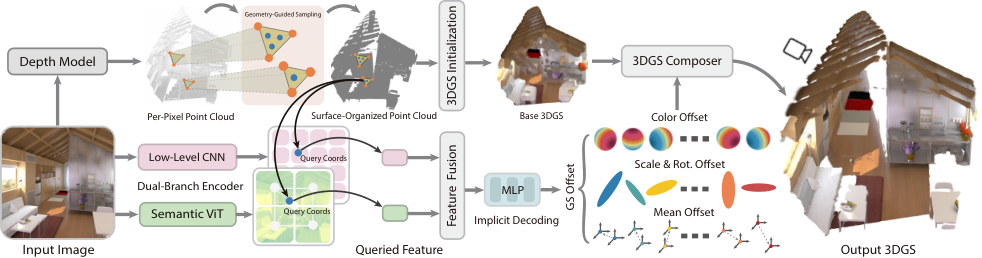
The first InfiniSplat (arXiv:2608.02437,
SIGGRAPH Asia 2026) is a different model for a different input: one RGB image,
optionally with a lidar depth map. The image-only variant takes its depth from Depth Pro, the lidar variant from ZJU3DV's InfiniDepth (measured, the two encoders in InfiniSplat_v1/src/model/encoder/).
| v1 | v2 | |
|---|---|---|
| input | 1 image, optional lidar depth | 2 to 50 images, posed or not |
| geometry | Depth Pro, or InfiniDepth with lidar | frozen DA3 giant branch |
| where Gaussians sit | geometry-guided supports, off the pixel grid | one per pixel, then voxel-merged |
| position | base point plus a learned, bounded offset | back-projected depth, never moved |
| decoder | implicit MLP queried at support coordinates | DPT decoder on the pixel grid |
| carried over | large-angle target supervision | large-angle target supervision, made a sampling rule |
The direction is a little surprising. v1's paper argues against pixel-aligned Gaussians, which it says "remain weakly coupled to underlying scene surfaces", and v2 goes back to them because a multi-view geometry model already gives coherent surfaces and the job left is attributes. v2's limitations section concedes the cost: "Pixel-aligned prediction also produces redundancy not fully removed by voxel merging." The idea that survives from v1 is the training signal, supervision from views far from the input.
The checkpoint, read from its header
The safetensors header is 145,360 bytes and lists 1,160 stored tensors, all
float32, totalling 1,649,014,290 parameters in a 6,596,202,528-byte file
(measured). config.json adds 565 tensor_aliases: names the loader
fills by pointing at an already-stored tensor (measured).
| module | stored parameters |
|---|---|
appearance.backbone (40-block ViT-g) | 1,136.5M |
geometry.backbone (blocks 30 to 39 only) | 283.4M |
appearance.cam_enc | 114.5M |
geometry.head (DualDPT, depth) | 50.1M |
geometry.cam_dec | 18.9M |
| Gaussian feature decoder, projections, head | about 45M |
The aliases are the interesting part. Every tensor of geometry blocks 0 to 29
points at the matching appearance block; only blocks 30 to 39 are stored twice
(measured). That is the paper's "only the last K Transformer blocks of the
attribute branch are fine-tuned", with K = 10, written in the weights: the
first 30 blocks are byte-identical between the frozen and trainable copies, so
configure_inference() checks them with torch.equal and runs them once
(shared_prefix_blocks). The aliases cover 967.7M parameters, so the network
as constructed has about 2.62 billion (reasoned: 1,649.0M + 967.7M).
There are no refiner tensors. The paper's best rows, marked Ours∗, add three
steps of a learned refiner (a KNN Transformer over the Gaussians, fed rendering
gradients from the input views). The checkpoint's top-level modules are the
two DA3 branches, the projections, the feature decoder and the Gaussian head,
and model.forward ends at merge() (measured). The Space imports the
same model.py (measured, identical file). What you can run is the
feed-forward model, the row labelled Ours.
"Unbounded", and what it rests on
The tweet says "unbounded free-viewpoint rendering"; the paper does not use
the word. In the code it means the absence of a box: there is no near or far
plane, no scene AABB and no background model. The voxel grid is sized from the
points' own minimum and maximum, with a guard that raises an error rather than
overflow 64-bit cell indices (measured, gaussians.py). Scale comes from
the mean point radius, not from a preset. So a street and a tabletop go through
identical code.
What it does not mean is unlimited input. The CLI caps a single pass at 50
views. The paper's KITTI street scene, a sequence of over 1,000 frames, was built "using sliding
windows" (reported, Appendix B.6), and no windowing or stitching code is in
the release (measured). For long sequences, the bounded-memory streaming
methods in this roundup are the
closer fit today. The output is an SH0 .ply in normalised units, which
PlayCanvas's splat-transform turns into a standalone HTML viewer (the same
tool behind the SOG format).
Checking the headline numbers
The evaluation is six datasets (DL3DV, ETH3D, NRGBD, Mip-NeRF 360, RE10K, DTU), 4, 8 and 16 input views with four held-out targets each, and LPIPS and DISTS as primary metrics "following SHARP" (reported). The same trained model is scored with and without poses.
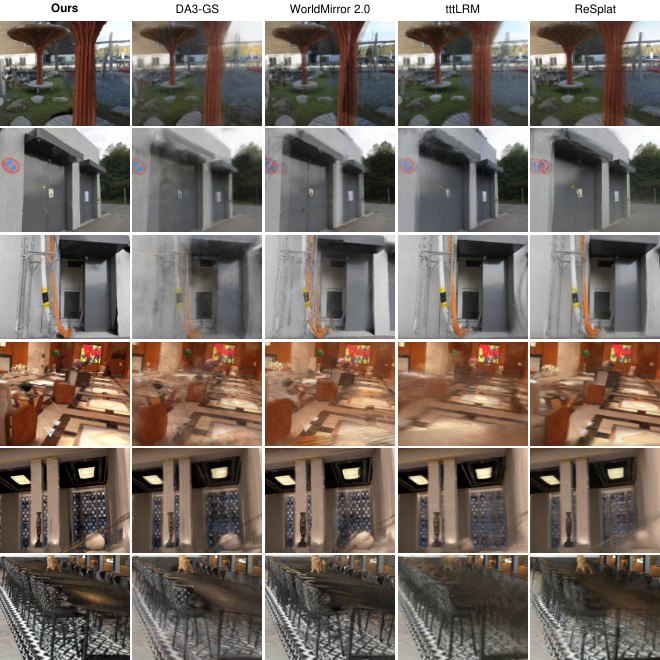
Six-dataset means with poses supplied (reported, Table 1 and Appendix Table 4; lower LPIPS and DISTS are better, higher PSNR is better):
| method | LPIPS | DISTS | PSNR (dB) |
|---|---|---|---|
| v2, feed-forward (released) | 0.2472 | 0.1163 | 20.28 |
| v2 + refiner (not released) | 0.2392 | 0.1159 | 20.93 |
| ReSplat | 0.3333 | 0.1794 | 20.91 |
| WorldMirror 2.0 | 0.3517 | 0.1734 | 17.72 |
| DepthSplat | 0.3718 | 0.1993 | 18.91 |
| DA3-GS | 0.4237 | 0.1965 | 16.85 |
From Table 1, the six-dataset mean LPIPS with poses is 0.2472 against ReSplat's 0.3333, and mean DISTS 0.1163 against WorldMirror 2.0's 0.1734 (reported). Those give the abstract's 25.8% and 32.9% exactly (reasoned). Without poses, 0.3026 against WorldMirror 2.0's 0.3757 and 0.1341 against 0.1935, the 19.5% and 30.7% the text claims (reasoned). I also recomputed each "Mean" column as the plain average of its six datasets, and it matches for every pose-conditioned method to four decimals, with one digit of rounding on DepthSplat (reasoned).
Per cell, the feed-forward model beats the best baseline in 22 of the 24 dataset-by-metric cells. The two it loses: pose-free DTU LPIPS (0.3898 against WorldMirror 2.0's 0.3812) and pose-conditioned RE10K LPIPS (0.1202 against ReSplat's 0.1191) (reasoned, from Table 1).
The fine print is the metric choice. In Appendix Table 4, ReSplat's pose-conditioned mean PSNR is 20.91 dB and SSIM 0.7117; v2's feed-forward output is 20.28 dB and 0.6988 (reported). v2 only passes ReSplat on PSNR with the refiner, at 20.93 dB, a margin of 0.02 dB, and the refiner is the part not released. Pose-free, DA3-GS has a higher mean SSIM (0.6463) than v2's feed-forward 0.6423 (reported). None of this undoes the result: the LPIPS and DISTS gaps are large, and the qualitative figures show the sharper texture those metrics reward. But "state of the art" here is a perceptual-metric statement, and the PSNR column says ReSplat is still the more faithful reconstruction per pixel when poses are given. All baselines were run by the authors on their splits (reported); none of this is independent.
Speed: the feed-forward network takes 5.619 s for eight views at 1022 × 756 and
0.564 s at 378 × 280 on one NVIDIA H20 (reported, Table 9, neural modules
only). That is 7.3 times the pixels for 9.96 times the time (reasoned), the
super-linear growth you expect from global attention over every view's tokens.
Training was 25,000 steps on 16 H20s, about 48 hours, plus 13 hours for the
refiner stage, on a mix of Hypersim (60%), ScanNet++ (30%) and Raw3D (10%)
(reported). The paper reports no memory figure. The weights alone are 6.60
GB in float32 and the loader keeps them in float32, autocasting activations to
bfloat16 on CUDA (measured, pipeline.py and model.py). The Space
declares ZeroGPU hardware and a 60-second GPU budget per call (measured,
the Space API and quota.py). I have not run either.
The licence is three licences
- The code is ZJU3DV's Project Registration License v1.0: free for
research, education, evaluation and personal use; free for any
organisation's project use too, but only after registering the project
through a Google Form (measured,
LICENSE). - Two retained source files (
decoder.py,geometry.py) are adapted from Tencent's HunyuanWorld-Mirror, whose community licence ships inLicense.txt. That licence defines its territory as worldwide excluding the EU, the UK and South Korea (measured).da3_order.pyis Apache-2.0 from DA3. - The weights have no licence field on their Hugging Face card
(measured). They are fine-tuned from
DA3NESTED-GIANT-LARGE-1.1, which is CC BY-NC 4.0 on its own card (measured), so I would treat them as non-commercial until the authors say otherwise (reasoned, not legal advice).
One loose end: THIRD_PARTY.md says "Public redistribution of this local
candidate and its weights has not been marked approved", while
release_manifest.json in the same directory has "public_approved": true
(measured). The second is presumably the newer statement.
Where it fits
- license
- custom
- branch
- main
- tests
- none found
- source
- 2.3 MB
- commit date
- 2026-10-15
by size of tracked source at this commit, file counts in brackets; docs, data and vendored trees excluded
local clone, 2026-10-17 at a4d3f8b — branch, commit, commitDate, fileCount, hasTests, languages, license, licenseFile, shallow
shallow clone: counts describe the pinned tree, not the history
If you have a DA3-quality point cloud and want something that renders from angles the cameras never saw, v2's design is the lesson more than the checkpoint: keep the geometry model frozen, keep centres where it put them, let the rendering loss shape and fade the Gaussians, and supervise from far views so it has to. It is one forward pass, it accepts unposed photos, and its cleaning step is a threshold anyone can audit.
It is bounded by its base model in exactly the way its title suggests. A surface DA3 places wrong stays wrong, because no Gaussian can move. Colour is one RGB per Gaussian, so reflections bake in. The best numbers need a refiner that is not released. And for commercial work, the weights' DA3 ancestry matters more than the registration form.