2026-09-22 · 13 min · 3d · gaussian-splatting · paper · explainer · benchmarks
There is a failure mode in feed-forward 3D Gaussian Splatting that every benchmark table in the field is structurally bad at showing, and VoxelTTO (arXiv:2609.21498, 18 September 2026) is built around it.
Here is the shape of it. A feed-forward model takes N images, runs one forward pass, and emits a Gaussian scene. Render those same N images back out and score them, and you have mostly measured whether the Gaussians fit the pixels they were regressed from — which they had better, since that was the loss. Render a view the model never saw, at a pose you supply, and you are measuring something else entirely: whether the scene sits where the poses say it does.
Pose error lives in the gap between those two numbers and nowhere else.
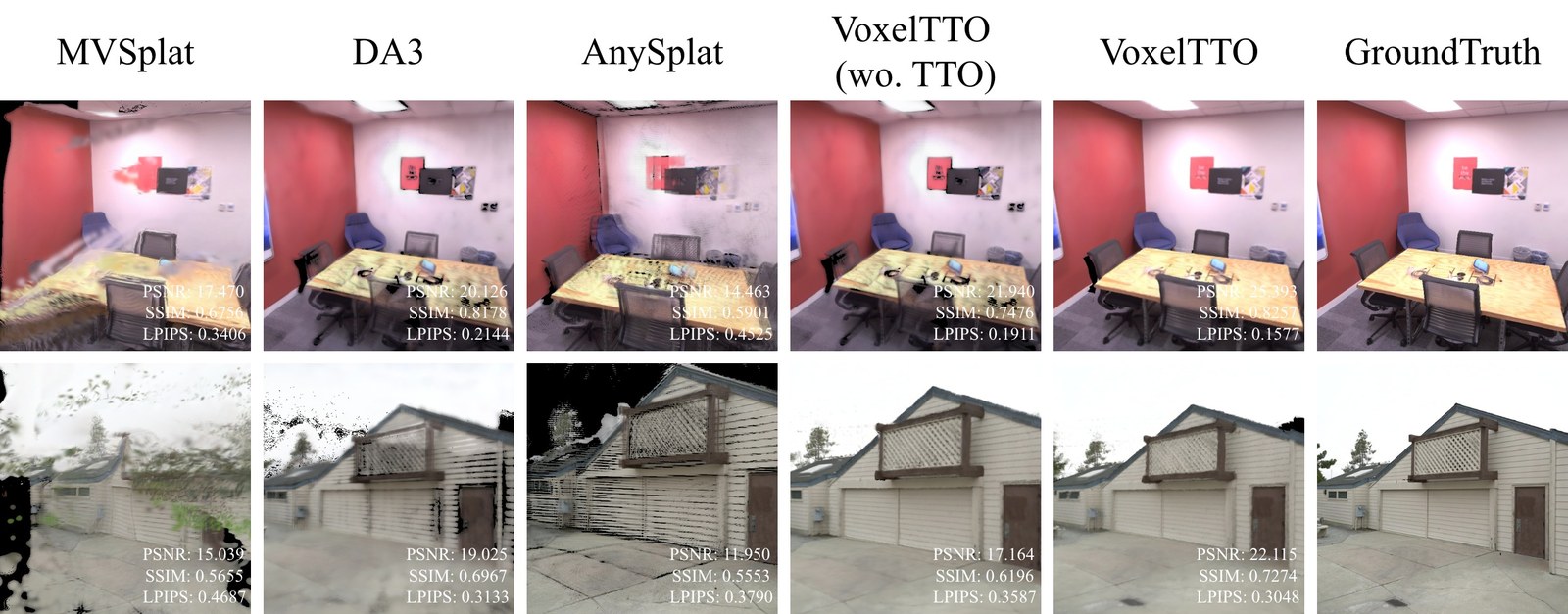
Look at YoNoSplat on Replica: 24.52 dB on input views, 11.57 on test views. Nearly thirteen decibels. A reader who saw only the input-view column would conclude it was the second-best method in the table. It is the worst. AnySplat loses 5.47 dB on Replica and 4.63 on Tanks and Temples. The paper's Figure 4 shows what that looks like in pixels, and it is not blur — it is the furniture being somewhere else:

What it changes
Two things, and they are independent — which the ablation table takes seriously enough to separate.
Voxels instead of pixels. Most feed-forward 3DGS regresses one Gaussian
primitive per pixel, which is convenient and wrong: neighbouring views see
the same surface, so the same slab of geometry gets several overlapping
Gaussians, and overlap is exactly what produces the floaters and shells you see
in AnySplat's renders above. VoxelTTO upsamples the frozen backbone's patch
tokens with DPT, fuses them into a global voxel grid, encodes that with a
sparse 3D U-Net, and decodes Gaussians from voxel features with a decoupled
geometry/appearance MLP that splits each voxel into n primitives. The
pixel-to-Gaussian correspondence is broken on purpose.
LoRA at test time, against pose. The backbone is DA3-GIANT, frozen —
1.39B parameters, of which 75.3M are trainable, and training touches only
the voxel-aligned reconstruction module. TTO adds LoRA to the Q, K and V
projections of layers 13–40 (the alternating single-view/global attention
layers; layers 1–12 are single-view only and get nothing), with a shared
down-projection A per layer and independent up-projections B.
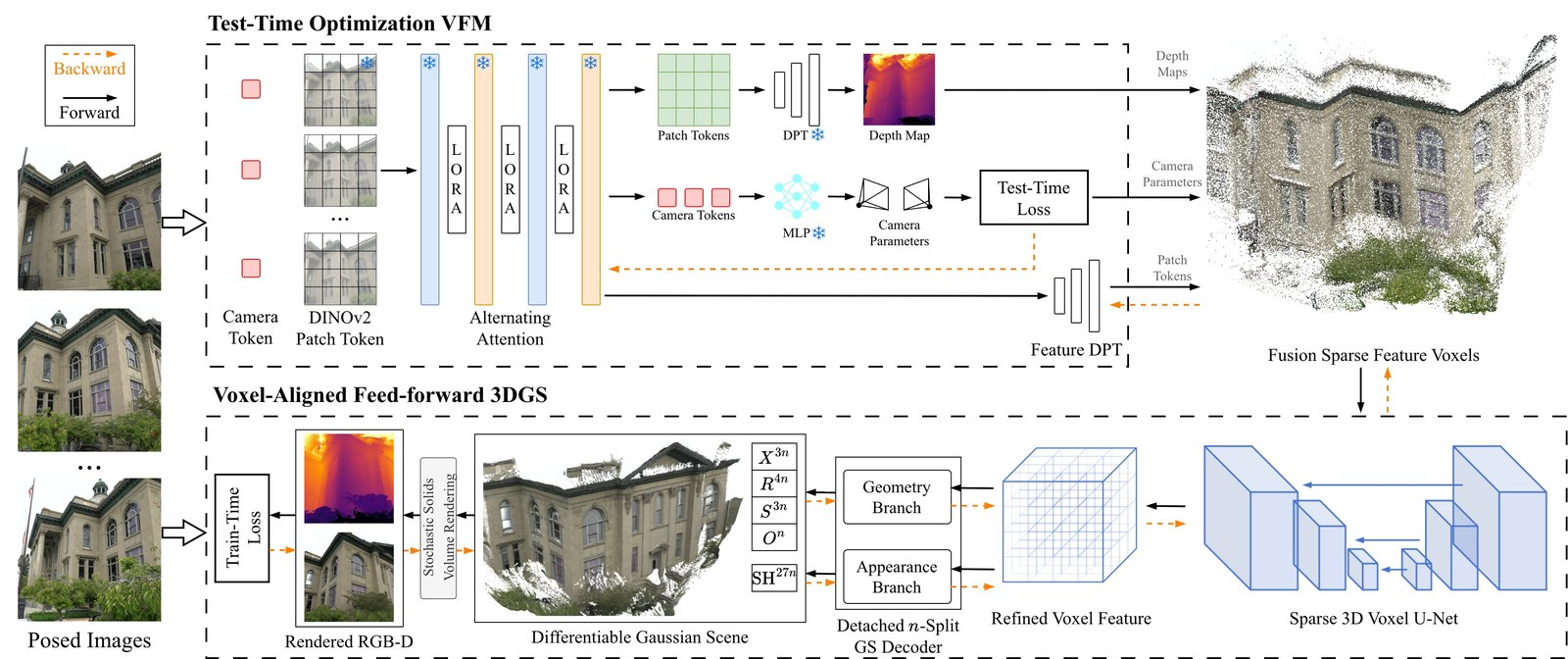
The test-time loss is the part worth pausing on, because it is not photometric. It compares the backbone's decoded camera parameters against the poses you supplied:
with the rotation term built from the relative rotation between predicted and ground-truth poses,
the first ground-truth pose pinned to identity (VGGT-style backbones use the
first image as the world frame), translations mean-normalised on both sides to
kill the scale ambiguity, and SmoothL1 on the normalised translations and on
(fx, fy, cx, cy) directly.
So this is not test-time training in the self-supervised sense. It is a twenty-step least-squares fit, run per scene, that bends the frozen backbone's attention until its camera head agrees with the poses you already have. The Gaussians move because the features move.
The mechanism works
On Tanks and Temples the twenty steps take mean rotation error from 1.636° to 0.262° — 6.2× — and beat DepthAnything3's 0.682° with the same backbone underneath. Mean translation error goes 0.047 m to 0.020 m. On Replica, where the no-TTO model was already at 0.301°, it goes to 0.220°.
That pose improvement is what closes the test-view gap. VoxelTTO without TTO loses 9.03 dB between input and test views on Tanks and Temples; with TTO it loses 1.66 dB. On Replica, 3.45 dB becomes 1.37 dB. Depth follows: test- view RMSE on Tanks and Temples goes 63.93 cm to 46.22 cm, and δ₁.₀₅ — the fraction of pixels within 5% of ground truth — goes from 52.39% to 86.75%.
The ablation is unusually clean about which half is doing what. Replacing stochastic solid volume rendering with ordinary 3DGS rasterisation at both training and inference costs 7.02 dB on test-view PSNR (28.54 → 21.52) and quadruples depth RMSE (6.95 → 27.58 cm). Training with volume rendering and rasterising at inference costs only 1.43 dB, so most of the benefit is in the supervision, not the renderer. Removing the depth loss costs 0.29 dB. Two Gaussian splits per voxel beat one; four is not better than two.
What it costs per scene
This is the number that decides whether any of the above is usable, and the paper states it in a way that does not add up on first reading.
Section 4.7, in full: "For ten 518×518 images, VoxelTTO without TTO takes 2.304 s, compared with 2.293 s for DA3… BF16 reduces backbone runtime from 1.959 s to 0.1956 s. Each TTO step requires 0.2662 s forward and 0.075 s backward, so 20 steps complete in under 7 s and total runtime is under 7.4 s."
Twenty steps at 0.3412 s is 6.824 s, and 6.824 + 2.304 is 9.13 s, which is not under 7.4. The resolution is the sentence in the middle. The 2.304 s is the figure used for the like-for-like comparison against baselines at their own official precision, so it carries the FP32 backbone. Strip that out and put the BF16 backbone back:
non-backbone work   = 2.304 − 1.959   = 0.345 s   (voxels, U-Net, decoder, render)
feed-forward, BF16  = 0.345 + 0.1956  = 0.5406 s
TTO, 20 steps       = 20 × 0.3412     = 6.824 s
                                        ───────
total                                   7.3646 s
Which is "under 7.4 s", to three significant figures. That reconciliation is mine, not the paper's, and it is the one piece of arithmetic here I would most like someone to check.
Taking it at face value: test-time optimisation is 92.7% of the per-scene cost, and 12.6× the reconstruction it is correcting. The voxel branch is genuinely free — 2.304 s against DA3's 2.293 s, an 0.5% overhead for breaking the pixel-to-Gaussian correspondence. Everything expensive is the LoRA fit.
That is a good trade or a bad one depending entirely on what you are doing. Seven seconds a scene is nothing against per-scene 3DGS optimisation, which is minutes; the entire pitch of feed-forward 3DGS is that it replaces that with one forward pass, and VoxelTTO is still two orders of magnitude inside it. Seven seconds is a lot against 0.54 s if you were planning to reconstruct anything at interactive rates, and it is a lot against DA3's 2.293 s if you were choosing between them on throughput. The ablation in Figure 7 shows LPIPS and AbsRel still improving as the step count rises past twenty, so twenty is a budget choice rather than a convergence point — which means the real cost is whatever you decide to spend, and the paper picked the knee.
Three qualifications the paper does not put next to the number, and should:
- No GPU is named for inference. Training is 40 hours on 2× RTX PRO 6000 (the abstract's "80 GPU hours"), but §4.7 gives no card. Every second above is unanchored.
- Ten images, 518×518. TTO's forward is a full backbone pass over all frames, so the per-step cost scales with the image count. Thirty images is not 7 s.
- TTO needs the poses. The loss is supervised by the camera parameters you supply. With no poses, there is no TTO and you are reading the "w/o TTO" rows — which is still the best feed-forward model in the table on Replica, and loses 9 dB on Tanks and Temples.
What the trade actually costs
One number in the paper should stop anyone about to adopt this, and to their credit the authors print it without softening.
On Tanks and Temples, TTO makes input views worse. RGB PSNR goes 23.74 → 20.89 (−2.85 dB), SSIM 0.767 → 0.656, depth RMSE 82.07 → 90.63 cm, δ₁.₀₅ 96.35% → 90.12%. Test views go 14.71 → 19.23 dB in exchange.
This is worth sitting with, because it inverts the usual reading of a test-time-optimisation result. TTO is not making the model better. It is choosing whose coordinate frame wins when the backbone and your poses disagree, and it always picks yours. If your poses are the ones that are wrong — a COLMAP run that drifted, a rig calibration that is stale — TTO will faithfully drag the scene onto them.
There is a second, smaller thing in the ablation that is easy to miss. The voxel-size sweep runs 0.0015 / 0.002 / 0.003 / 0.005 m, and 0.0015 wins on every single metric: 29.34 dB against 0.002's 28.54, LPIPS 0.142 against 0.172, depth RMSE 6.62 cm against 6.95. The shipped setting is 0.002, "balancing performance and computation, and following prior work". The computation cost of the finer grid is not reported anywhere. That is a leading 0.8 dB sitting unclaimed behind a hyperparameter inherited from AnySplat.
Reproducibility
The code is at two anonymous.4open.science URLs — this is an ICLR 2027
submission under review, with an AI-use statement declaring generative AI for
language editing only. Training sets are ScanNet, Infinigen, ARKitScenes and
DL3DV-10K; evaluation is Replica, Tanks and Temples and DTU. There is no
released checkpoint and no project page, so there is no turntable, no
drifted-pose sweep, and nothing to look at beyond the figures above — which is
a shame for a claim whose whole evidence is what a scene looks like from a pose
you did not train on.
On DTU the surface-alignment table isolates the design one more time: Chamfer accuracy 5.556 without TTO, 3.719 with camera encoding (poses injected through the backbone's own MLP, the AnySplat/DA3 approach), 2.952 with TTO. Injecting the poses helps; fitting to them helps twice as much. That is the paper's real argument, and it holds.
What would change my mind
5 claims above, and what would falsify each
Test-time optimisation is 92.7% of VoxelTTO's per-scene runtime, and the feed-forward pass it corrects is 0.54 s.
This is my reconstruction, not a published decomposition. The paper gives 2.304 s for the no-TTO pass, 1.959 s → 0.1956 s for the backbone under BF16, 0.3412 s per TTO step, and "under 7.4 s" total; the only reading that makes those four consistent is that the 2.304 s carries the FP32 backbone. Profile the released code with BF16 on and TTO off: if that pass is 2.3 s rather than 0.54 s, my split is wrong, the total should be ~9.1 s, and the paper's "under 7.4 s" needs its own explanation.
Pose error is invisible on input views and shows only on held-out views, which is why the input/test gap is the right thing to read in Table 1.
Strongly supported by the table — YoNoSplat at 24.52/11.57 on Replica, AnySplat at 23.25/17.78 — but it is a claim about a mechanism, inferred from two columns. Partition the evaluation by measured per-scene pose error and check that the gap tracks it. If methods with near-identical pose error show wildly different gaps, something other than drift (overlap artefacts, extrapolation distance, exposure) is doing the work and the diagnostic is weaker than I am treating it as.
On Tanks and Temples, TTO buys test-view alignment by giving up input-view fidelity: −2.85 dB in, +4.52 dB out.
Straight from Table 1 and Table 2, so overturning it means the tables are wrong. What is falsifiable is my explanation — that the loss minimises pose error rather than reconstruction error, so it moves geometry off the input pixels when the two disagree. Add the photometric term to the TTO objective and re-run: if input-view PSNR recovers without losing the test-view gain, the trade is a choice of loss and not a property of the problem.
The shipped voxel size of 0.002 m is not the best setting in the paper's own ablation; 0.0015 m wins on all eight reported metrics.
Table 5, read directly. The paper justifies 0.002 by "balancing performance and computation" and by following prior work, but publishes no runtime or memory figure for 0.0015. A measurement showing the finer grid costs materially more time or VRAM would make the choice defensible and this observation trivial — which is exactly why it should have been printed.
VoxelTTO's voxel branch is essentially free: 2.304 s against DepthAnything3's 2.293 s on the same ten images.
The paper's own Figure 8 comparison, at ten 518×518 images. Both numbers are reported by the same authors on unnamed hardware, and the voxel grid's cost scales with scene extent and occupied volume, not with image count. A large outdoor capture at the same image count could move the sparse U-Net's share substantially, and nothing in the paper measures that.