2026-09-18 · 23 min · robotics · ros2 · depth-estimation · 3d-perception · tensorrt · explainer
A monocular camera cannot measure distance. It measures direction. Everything else — how far the wall is, how tall the pedestrian is — is a prior that has to come from somewhere outside the image. So when a ROS 2 node publishes sensor_msgs/Image with encoding 32FC1 on a topic called depth_image, it is making a claim about units, and the interesting question is not how good the network is. It is: who supplied the metres, and under what assumption?
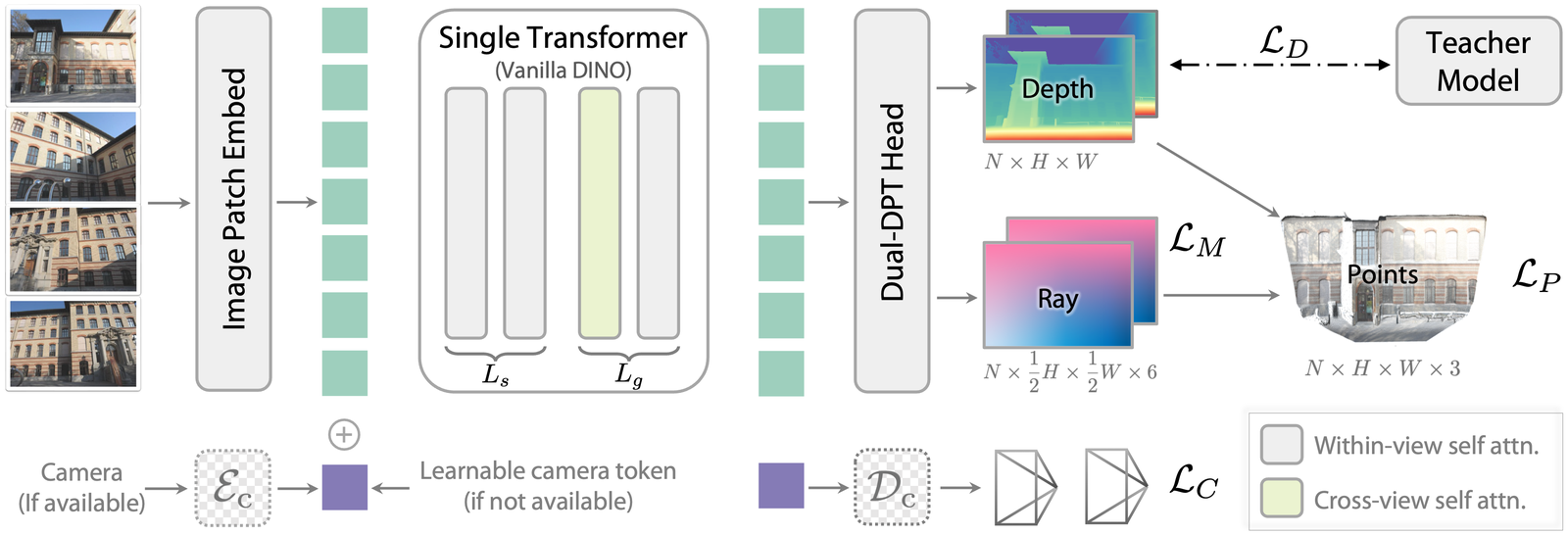
ika-rwth-aachen/ros2-depth-anything-v3-trt is a clean, small TensorRT node from RWTH Aachen's Institute for Automotive Engineering that wraps Depth Anything 3 and publishes a depth image and a point cloud. Its README says, in three places, that the output is metric. I read both repositories, pulled the published ONNX apart over HTTP, and found the answer: the metres are produced by one multiply in the wrapper's CUDA postprocess, the model file contributes nothing metric on its own, and the conversion is exactly right only for a camera whose frame is 1.8:1.
| Model | Depth Anything 3 · arXiv 2511.10647v1, 13 Nov 2025 · Lin, Chen, Liew, Chen, Li, Shi, Feng, Kang (ByteDance Seed) |
| Checkpoint | DA3METRIC-LARGE — DINOv2 ViT-L backbone, DPT head, outputs depth + sky |
| Code | ByteDance-Seed/Depth-Anything-3 @ 3d835ec · Apache-2.0 |
| ROS 2 node | ika-rwth-aachen/ros2-depth-anything-v3-trt @ 9bad9db (21 Aug 2026) · Apache-2.0 · Till Beemelmanns |
| Target | ROS 2 Jazzy, Ubuntu 24.04, CUDA 12.8/13, TensorRT 10.9 |
| ONNX | TillBeemelmanns/Depth-Anything-V3-ONNX · 731,352,693 bytes, static [1,3,280,504] input |
What the node actually publishes
Before any argument about correctness, the plain inventory. This is read off the source at 9bad9db, not the README — the two disagree in several places, which I come back to at the end.
~/input/imagesensor_msgs/msg/ImageSubscribed through image_transport; the node picks the compressed transport when the remapped topic ends in /compressed, raw otherwise.
~/input/camera_infosensor_msgs/msg/CameraInfoOnly k[0], k[2], k[4], k[5] are read — fx, cx, fy, cy. Distortion coefficients are never touched, so a fisheye or a raw un-rectified stream is silently treated as a pinhole.
decodeCPUcv_bridge::toCvShare to BGR8. This is outside the region the node times for its FPS readout.
resize + normaliseCUDAOne kernel: bicubic resize straight to the engine's input size, BGR→RGB, ImageNet mean/std, NCHW packing. The resize does not preserve aspect ratio.
TensorRTGPUDA3METRIC-LARGE: DINOv2 ViT-L backbone, DPT head, two outputs. depth comes out of an exp activation, so it is strictly positive; sky comes out of a ReLU, so it is non-negative and is not a probability.
scale to metresCUDAdepth ×= 0.5·(fx·sx + fy·sy) / 300. This multiply is the only thing that makes the output metric. Nothing upstream of it is in metres.
sky mask + fillCUDAnon-sky is sky < 0.3. The 99th percentile of the first 100 000 valid pixels in row-major order, capped at 200 m, is written into every sky pixel. Sky is filled, not invalidated.
upscaleCUDABicubic back to the camera's resolution, with no clamp — the kernel's own comment notes the overshoot is kept. Only the published depth image goes through this; the point cloud does not.
point cloudCPUBuilt from the 280×504 map with intrinsics scaled to it, X = (u−cx)·Z/fx, Y = (v−cy)·Z/fy, Z = depth. That is the optical-frame convention: +z forward, +x right, +y down.
~/output/depth_imagesensor_msgs/msg/Image · 32FC1Metres, at the camera's full resolution. header is copied wholesale from the input image, so the frame is the driver's image frame and the stamp is the capture time, not the publish time.
~/output/point_cloudsensor_msgs/msg/PointCloud2Organised, is_dense = false, xyz plus rgb when colorize_point_cloud is on. The frame_id the cloud builder set from camera_info is overwritten one line later by the image header.
~/output/depth_image_debugsensor_msgs/msg/Image · bgr8Colormapped visualisation with an FPS overlay averaged over the last 20 frames. Off by default in the node, on by default in the shipped param file.
Three things in there are worth pulling out now, because they set up everything else.
The depth image and the point cloud are not the same measurement. The cloud is built from the 280×504 network output with intrinsics scaled to that grid. The depth image is that same map, bicubic-upscaled to the camera's full resolution by a kernel whose own comment says the overshoot is kept: "There is no saturating cast here: cv::resize on CV_32F keeps the interpolated value, overshoot included." Bicubic has negative lobes, so at every depth discontinuity the published image rings — a thin band of pixels nearer than the near object and a thin band further than the far background. The cloud never goes through that filter.
They also disagree about the sky. In the cloud, sky pixels are NaN: no measurement. In the depth image, sky pixels are filled with a positive number, the 99th percentile of the non-sky depths capped at 200 m. Point one obstacle layer at the cloud and another at the image and you get two different worlds, one with a hole overhead and one with a wall at 200 m.
The header is copied, not constructed. tensorrt_depth_anything.cpp carefully picks a frame_id out of CameraInfo, falling back to "camera_link", and preserves the CameraInfo stamp. Then the node does this:
// depth_anything_v3_node.cpp:216–218
sensor_msgs::msg::PointCloud2 point_cloud = tensorrt_depth_anything_->getPointCloud();
point_cloud.header = image_msg->header;
pub_point_cloud_->publish(point_cloud);
Whole-header assignment. Both the frame and the stamp the cloud builder chose are discarded and replaced with the image's. In practice a well-behaved driver stamps both identically, so nothing breaks — but the "camera_link" fallback inside the builder can never reach a subscriber, and the cloud's geometry is the optical convention (X = (u−cx)·Z/fx, Y = (v−cy)·Z/fy, Z = depth: +z forward, +y down). If your driver publishes images in a REP-103 body frame rather than a _optical_frame, the node will happily label an optical-frame cloud with it and everything downstream will be rotated 90°.
Monocular depth has no metres in it
The reason this is delicate, in one picture. A pinhole camera maps a ray to a pixel. Scale the whole scene — every distance and every object — by the same factor and every pixel is unchanged. The image constrains the shape of the scene and says nothing at all about its size.
Every dashed box projects to the same pixels. That is the whole problem with monocular depth, and no amount of network makes it go away — the scale has to come from somewhere outside the image. Here it is the CameraInfo your driver publishes. Note where 300 px sits: that is an 80° horizontal field of view at 504 px wide, which is roughly the automotive front camera the checkpoint was calibrated around. Feed it a 60° lens and the same prediction comes out 45% further away.
So a network trained to emit "depth" from one image is emitting it in whatever unit its training made canonical. DA3's metric branch picks the cleanest possible convention: depth as it would be if the camera's focal length were 300 pixels in the model's own input grid. Give it a real focal and the metres fall out by similar triangles. That convention lives in exactly one function in the upstream repo:
# depth_anything_3/utils/alignment.py:118
def apply_metric_scaling(
    depth: torch.Tensor, intrinsics: torch.Tensor, scale_factor: float = 300.0
) -> torch.Tensor:
    focal_length = (intrinsics[:, :, 0, 0] + intrinsics[:, :, 1, 1]) / 2
    return depth * (focal_length[:, :, None, None] / scale_factor)
And the node reimplements it, in C++, against the intrinsics that arrived on ~/input/camera_info:
// tensorrt_depth_anything.cpp:357–360
const double fx = camera_info.k[0] * scale_x_;
const double fy = camera_info.k[4] * scale_y_;
const double focal_pixels = 0.5 * (fx + fy);
const double focal_scale = focal_pixels > 0.0 ? focal_pixels / 300.0 : 1.0;
Same formula, same magic 300, focal_scale then multiplied into every pixel by a CUDA kernel (postprocess_gpu.cu:88). That is the whole of the scale recovery. There is no stereo, no IMU, no known-size object, no ground-plane fit. The metres come from CameraInfo and from the assumption that the network is calibrated to 300 px.
There is one small tell that the author was not entirely sure about this line. The comment immediately above it reads // Use original intrinsics for metric conversion per spec. — but the code multiplies by scale_x_ and scale_y_, which is precisely not the original intrinsics. Scaling is the right choice (the network sees the resized grid, so the focal must be in that grid), so the code is correct and the comment is stale. Worth knowing before you "fix" it.
The model file really does stop at the head
The obvious objection: DA3's NestedDepthAnything3Net.forward already calls apply_metric_scaling, then least-squares-aligns the relative branch onto it, then fills the sky, and sets output.is_metric = 1. If the exported ONNX contained any of that, the node would be applying the focal factor a second time and every published distance would be off by a full focal ratio.
It doesn't, for two independent reasons.
The config. DA3METRIC-LARGE is not the nested model. depth_anything_3/configs/da3metric-large.yaml instantiates a plain DepthAnything3Net with a vitl backbone and a single-output DPT head — no cam_dec, no cam_enc, no Gaussian head. _process_camera_estimation is therefore a no-op and output.intrinsics never exists, so apply_metric_scaling could not run on this checkpoint even in principle; it needs intrinsics, and this network does not predict any. The nested model that does self-scale is da3nested-giant-large, which pairs a 40-block ViT-g with this ViT-L.
The graph. I didn't want to take that on faith, so I pulled the published ONNX apart without downloading it. ONNX is one protobuf, and PyTorch serialises graph.node before graph.initializer, so the first 40 MB of a 697 MiB file contains the entire node list. A hand-written varint walker over that prefix, plus a handful of Range-request probes deeper in for the weight dtypes:
The DA3METRIC-LARGE.onnx that the ROS 2 node runs ends at the network's two raw head outputs. There is no metric scaling in the graph, no sky fill, no camera head and no second backbone — so the focal-length conversion that turns the output into metres exists only in the wrapper's CUDA postprocess, and the transformer weights are already half precision before TensorRT ever sees them.
| measured | value | what it settles |
|---|---|---|
| file size, DA3METRIC-LARGE.onnx | 731,352,693 B | one self-contained protobuf; graph field declares 731,352,665 B, the 28-byte difference is the model header |
| producer | pytorch 2.6.0 | ir_version 9, graph name main_graph — a torch.onnx.export trace, matching onnx/export.py |
| nodes in the graph | 1,418 | the complete node list; the initializer section begins after it |
| distinct op types | 27 | Constant, Cast, Add, MatMul, Reshape, Mul, Transpose, Gather, Sqrt, LayerNormalization, Shape, Slice, Conv, Div, Softmax, Gelu, Relu, Concat, Resize, Unsqueeze, ConvTranspose, Squeeze, ConstantOfShape, Equal, Where, Expand, Exp |
| Softmax nodes | 24 | 24 attention blocks — one DINOv2 ViT-L. The nested metric model pairs this with a 40-block ViT-g plus a camera decoder and a Gaussian head; none of that is here |
| NonZero nodes | 0 | no boolean-mask indexing anywhere, so _process_mono_sky_estimation's sky fill is not in the graph |
| ScatterND nodes | 0 | nothing writes into a masked region — confirms the same thing from the other side |
| Sigmoid nodes | 0 | the sky output is not a probability, despite being thresholded at 0.3 |
| last node in the graph | Reshape -> sky | nothing follows the head; no focal multiply, no alignment, no pose decoder |
| depth output chain | Conv -> Exp -> Squeeze -> Reshape | the DPT head's exp activation, so depth is strictly positive and unitless |
| sky output chain | Conv -> Relu -> Squeeze -> Reshape | post-ReLU, so sky >= 0 and larger means more sky — the opposite of what the README says |
| dtype of onnx::MatMul_* / onnx::Add_* initializers | FLOAT16 | every attention and MLP weight is already fp16 in the file; precision: fp32 in the ROS param cannot recover what the export rounded away |
| dtype of model.model.* initializers | FLOAT32 | LayerNorm, cls_token, layer-scale gammas and the DPT convolutions stayed single precision — the split autocast leaves behind |
The op counts cover the whole node list, which the 40 MB prefix contains in full: the graph's name field and the first initializers both appear inside it, and PyTorch serialises nodes before either. The dtype rows are a sample, not a census — six windows were probed (20, 100, 300, 500, 700 and 730 MB). Three of them landed inside a weight blob and held no tensor header. Of the ones that did, every model.model.* initializer was FLOAT32 (160 of them in the first 40 MB, plus the DPT head at 20 and 100 MB) and every onnx::MatMul_* / onnx::Add_* initializer was FLOAT16.
1418 nodes, 27 op types, and the last node in the graph is Reshape → sky. Nothing follows the head. 24 Softmax nodes is one ViT-L, not two backbones. Zero NonZero and zero ScatterND means there is no boolean-mask write anywhere, so _process_mono_sky_estimation — which does depth[~non_sky_mask] = max_depth — never made it into the trace. That is not mysterious: onnx/export.py traces on torch.zeros(1, 3, 280, 504), and that block opens with two early returns guarded on tensor sums (if non_sky_mask.sum() <= 10: return output). Tracing resolves a Python if once, on the dummy data, and bakes the branch it took. On an all-black frame it took the early return.
So the shipped artifact is narrower than the code that produced it, and the node's CUDA reimplementation of the focal scaling, the sky mask and the percentile fill is not redundant — it is the only copy that runs. The README's line "Depth Anything V3 predicts a dense metric depth map" is, for this artifact, wrong in a way that matters: it predicts a focal-normalised depth map, and the wrapper makes it metric.
While auditing the graph I also learned two things nobody documents. The depth output comes out of an Exp, so it is strictly positive — the node's if (scaled <= 0.0f) scaled = 0.0f; clamp can only ever fire on an fp16 underflow to exactly zero. And sky comes out of a Relu, with no Sigmoid anywhere in the graph, so it is a non-negative activation and not a probability, despite being thresholded at 0.3.
The 504×280 box
Here is where the conversion stops being exact.
The engine's input is fixed at [1, 3, 280, 504]. The node resizes every incoming frame straight into that shape with a bicubic kernel that scales the axes independently (preprocess_gpu.cu:41) — a stretch, not a crop. Then it takes fx·sx and fy·sy, averages them, and divides by 300.
DA3's own input pipeline does the opposite. InputProcessor._resize_longest_side computes one scale from the longest side and applies it to both axes; _make_divisible_by_crop then centre-crops the short side down to a multiple of 14, with a docstring that spells out the intent: Example: 504x377 -> 504x364. One scale means one focal, and no averaging is needed.
For a 16:9 frame these agree almost exactly, and not by accident: 1080 × 504/1920 = 283.5, rounds to 284, floors to 280. The shipped 504×280 engine is what DA3's own preprocessing produces for 1920×1080. ika builds automotive perception; the node is calibrated for the camera they have.
Point it at anything else and the arithmetic drifts. With fx = fy the ratio between the node's focal and the aspect-preserving one collapses to a one-liner in the source aspect ratio a = W/H: (1 + a/1.8)/2, exactly 1 at a = 1.8 and falling away below it.
16:9 — the automotive front camera this node was built around
| sx = 504/1920 | 0.262500 | also the aspect-preserving scale |
| sy = 280/1080 | 0.259259 | what the vertical squeeze actually is |
| 0.5·(sx + sy) | 0.260880 | the factor the node applies to fx, fy |
| focal ratio | 0.993827 | every published metre, multiplied by this |
The shipped engine is 504×280, which is exactly what Depth Anything 3’s own preprocessing produces for a 16:9 frame — resize the long side to 504, floor the short side to a multiple of 14, 1080 × 504/1920 = 283.5, rounded to 284, floored to 280. So on 16:9 the node lands within 0.62% of the reference recipe. On 4:3 the same code silently squeezes the frame to 74% of its correct height and shortens every published distance by 13.0%. Re-exporting the ONNX at a matching height fixes the arithmetic; it does not undo the fact that the image was stretched rather than cropped, and I have no way to bound that from source alone.
A 4:3 camera — a RealSense RGB stream, most USB webcams, plenty of automotive 4:3 sensors — gets a scale factor 13.0% short, so every published distance is 13.0% short, silently, on every frame. A 5:4 industrial sensor gets 15.3%. Nothing in the node inspects the incoming aspect ratio, warns, or refuses.
And that is only the half I can compute. The other half is that the network is being handed a frame squeezed to 74% of its correct height, which is not something its training pipeline ever produced, and I have no way to bound what that does to the prediction itself from source alone. The repo's own code is blunt about how sensitive this stage is — the preprocessing kernel exists at all because of it:
// preprocess_gpu.cu:30 — comment above cubicCoeffs
// Cubic convolution weights with A = -0.75, as used by cv::INTER_CUBIC. A
// bilinear substitute is much cheaper but moves the published depth by tens of
// metres, so the filter is reproduced rather than approximated.
If swapping bicubic for bilinear moves depth by tens of metres, an anisotropic stretch is not a rounding concern. (DA3, for what it is worth, uses cv2.INTER_AREA when downscaling and INTER_CUBIC only when upscaling; the node always uses cubic, and it is always downscaling. That is a third divergence from the reference recipe, and I can't quantify it either.)
The fix is cheap and the repo already supports it: onnx/export.py takes --height and --width, any multiple of 14. Export at 504×378 for a 4:3 camera and the arithmetic error goes to exactly zero.
Sky is filled, not invalidated
The sky handling is the one place where the node's reimplementation is measurably better than doing nothing, and also the place where the documentation is most confidently wrong.
The kernel:
// postprocess_gpu.cu:86–92
float scaled = raw[i];
if (scaled <= 0.0f) scaled = 0.0f;
scaled *= focal_scale;

const bool non_sky = sky[i] < sky_threshold;
depth[i] = scaled;
mask[i] = non_sky ? 1u : 0u;
sky[i] < threshold means not sky. That matches DA3 exactly — compute_sky_mask in alignment.py:54 is literally return sky_prediction < threshold, and its docstring says "True indicates non-sky regions". The node is right. The README is backwards twice: it describes the sky output as "sky classification logits (float32, lower values = sky)" and the rule as "Pixels with sky confidence below sky_threshold are classified as sky." Both invert the actual test. The third statement about sky, in the parameter table — "lower = more sky detected" — is correct, because lowering the threshold does shrink the non-sky set. Two out of three wrong, in a way that will send anyone tuning the threshold in the wrong direction.
Then the fill: the 99th percentile of the valid depths, capped at 200 m, written into every sky pixel. Two details the docs skip. The percentile is taken over the first 100,000 valid pixels in row-major order — the kernel's own comment says so: "The sample is the first kMaxSample valid pixels in row-major order, not a subsample spread over the frame." DA3 draws a random 100,000 instead. At 280×504 = 141,120 pixels the cap only bites when more than 100,000 survive the sky mask — that is, when sky covers less than 29% of the frame — and the pixels it then drops are the bottom rows, which are the near field. A 99th percentile barely moves. It is still not the same estimator, and the kernel says so rather than hiding it.
The second detail is a bug. sky_depth_cap is declared as a ROS parameter, documented in the README, set in config/depth_anything_v3.param.yaml, and wired into onSetParam for live reconfiguration. It reaches nothing:
// depth_anything_v3_node.cpp:76 — the parameter
node_param_.sky_depth_cap = declare_parameter<double>("sky_depth_cap", 200.0);

// tensorrt_depth_anything.hpp:190 — what the kernel is actually handed
const float sky_depth_cap_{200.0f};
The node passes sky_threshold down through setSkyThreshold(), but never passes sky_depth_cap anywhere. The kernel argument is fed from a const member that no code path writes. Set sky_depth_cap: 50.0 in your param file and you will still get 200 m in the sky, with no error and no warning. It happens to be the same default, which is exactly why it hasn't been noticed.
How fast, and on what
The README's entire performance section is three lines:
Performance on Quadro RTX 6000:
- DA3METRIC-LARGE: 50 FPS
Credit where it's due: a device is named, which is more than most repos manage. But it is a 24 GB Turing workstation card, not robot compute, and three things are left implicit. The resolution is 504×280 — fixed by the engine, so at least it can't be gamed. The precision is fp16, the node's default. And the number is per-inference-call, not per-frame: the region the node times is exactly doInference, which starts after cv_bridge has decoded the frame and ends before the 32FC1 message is allocated and published.
// depth_anything_v3_node.cpp:187–191
auto start = std::chrono::high_resolution_clock::now();
bool success = tensorrt_depth_anything_->doInference(input_images, *camera_info_msg, ...);
auto end = std::chrono::high_resolution_clock::now();
const double inference_time_sec = std::chrono::duration<double>(end - start).count();
That is also the number stamped onto the debug overlay as "FPS", averaged over 20 frames. In its favour, it does include the point-cloud build, which is still on the CPU with a per-pixel cv::Mat::at loop. It excludes the image decode, which on a compressed transport is a full JPEG per frame, and it excludes the 32FC1 serialisation and publish — 1920×1080 float32 is 8.3 MB per message, on a publisher left at rclcpp's default reliable QoS with depth 1. Whatever the end-to-end rate is on your rig, it is below 50.
There is no Jetson number anywhere in the repo, and no Jetson build either: .github/workflows/docker-ros.yml passes platform: amd64, and the only base images referenced anywhere are nvcr.io/nvidia/tensorrt:25.03-py3 and 25.08-py3, both x86. If you are planning to put a ViT-L at 504×280 on an Orin, the honest position is that this repo does not tell you what to expect, and neither do I; I have no GPU here and did not run it.
The paper's own speed table doesn't transfer either. Table 8 reports 78.37 FPS for DA3-Large on an A100, at 504×336, averaged per image over a 32-image scene, in PyTorch. Different model, different resolution, different GPU, different runtime, and multi-view batching amortises the backbone in a way a single-frame ROS callback cannot. It is not comparable to 50 FPS and the repo does not claim it is.
How metric is metric
The last number worth having, because it's the one that decides whether you can put this in a costmap. The paper's Table 11 compares DA3's metric branch against the specialist metric-depth models, δ1 up and AbsRel down:
| Method | NYUv2 δ1 / AbsRel | KITTI δ1 / AbsRel | ETH3D δ1 / AbsRel | SUN-RGBD δ1 / AbsRel | DIODE δ1 / AbsRel |
|---|---|---|---|---|---|
| DepthPro | 0.932 / 0.093 | 0.843 / 0.121 | 0.386 / 0.349 | 0.950 / 0.126 | 0.734 / 0.173 |
| Metric3D v2 | 0.971 / 0.067 | 0.976 / 0.051 | 0.830 / 0.138 | 0.954 / 0.132 | 0.018 / 0.154 |
| UniDepthv1 | 0.980 / 0.061 | 0.978 / 0.051 | 0.234 / 0.464 | 0.971 / 0.113 | 0.570 / 0.266 |
| UniDepthv2 | 0.968 / 0.064 | 0.968 / 0.076 | 0.863 / 0.152 | 0.977 / 0.111 | 0.856 / 0.123 |
| DA3-metric | 0.963 / 0.070 | 0.953 / 0.086 | 0.917 / 0.104 | 0.973 / 0.105 | 0.838 / 0.128 |
DA3-metric is not the best on KITTI or NYUv2 — Metric3D v2 and UniDepth beat it on both. What it is, is the only row that never collapses: ETH3D breaks DepthPro (0.386) and UniDepthv1 (0.234) outright, and DA3 leads it at 0.917. For a robot that has to work in rooms and outdoors, "never below 0.838" is worth more than a best-in-class line on one dataset.
The number to internalise is AbsRel 0.086 on KITTI: 8.6% mean relative error. At 30 m that is ±2.6 m. At 8 m it is ±0.7 m. That is a usable free-space prior and it is not a range measurement; if something downstream is deciding whether to brake at 30 m, it is deciding on a number with a couple of metres of slack in it before you add the aspect-ratio error above.
One oddity in that table, since I'm reading it closely: Metric3D v2 on DIODE is printed as δ1 = 0.018 with AbsRel = 0.154. Those cannot both be true. AbsRel 0.154 means the average pixel is off by 15%, which cannot coexist with 98.2% of pixels falling outside a 25% band; every neighbouring entry in that column sits between 0.57 and 0.86. It looks like a transcription slip, it is in someone else's row rather than the authors' own, and it changes no conclusion — but if you were going to quote "Metric3D v2 scores 0.018 on DIODE", don't.
Things the README says that the code doesn't
Collected in one place, because several of these will cost someone an afternoon. All line numbers are 9bad9db.
| Documented | Actual | Where |
|---|---|---|
sky output: "lower values = sky" | post-ReLU; sky < threshold is non-sky | postprocess_gpu.cu:90, alignment.py:54 |
sky_depth_cap is a parameter | const float sky_depth_cap_{200.0f}, never written | tensorrt_depth_anything.hpp:190 |
point_cloud_downsample_factor default 2 | 10 | depth_anything_v3_node.cpp:79 |
write_colormap default false | true | depth_anything_v3_node.cpp:72 |
debug_colormap_min_depth 0.0 · max 50.0 | 2.0 · 100.0 | depth_anything_v3_node.cpp:73–74 |
onnx_path default DA3METRIC-LARGE.onnx | DA3METRIC-LARGE.fp16-batch1.engine | depth_anything_v3_node.cpp:63 |
| "approximate time synchronizer with 100ms tolerance" | ApproxSyncPolicy(10) — queue size only, no max interval ever set | depth_anything_v3_node.cpp:102–104 |
| Architecture diagram: "Postprocessing (CPU)" | CUDA since PR #20; only the point cloud is still CPU | postprocess_gpu.cu |
models/README.md: input [1,3,388,504], optional confidence output | [1,3,280,504], outputs depth + sky | models/README.md vs the graph |
The enable_debug default is a nice illustration of how these accumulate: the README table says false, the node declares false, and the shipped config/depth_anything_v3.param.yaml — the file the launch file loads by default — says true. Launch it as documented and you get the debug publisher, the colormap and, since write_colormap also defaults to true in code, a JPEG written to /tmp for every frame. At 50 FPS.
And one that isn't a documentation drift but is worth flagging: setting precision: "fp32" does not give you fp32. The published ONNX already stores every attention and MLP weight as FLOAT16 — that's the last two rows of the audit above — because onnx/export.py's instructions have you edit api.py to force autocast_dtype = torch.float16 before tracing. The rounding happened at export. TensorRT can only preserve it.
If I were putting this on a robot
Concretely, in order:
- Check your aspect ratio first. If it isn't within a percent or two of 1.8:1, re-export the ONNX at width 504 and height
504/afloored to a multiple of 14, then rebuild the engine —python export.py --model-dir DA3METRIC-LARGE --width 504 --height 378for a 4:3 sensor. One command, and it removes a 13% systematic error. - Treat the depth image as a prior, not a range image. 8.6% AbsRel on KITTI, plus a bicubic upscale with ringing at every edge, plus a 200 m wall where the sky is. If you want obstacles, subscribe to the point cloud — it's on the native grid and it NaNs the sky.
- Verify
camera_infois the real calibration. The entire metric claim rests onk[0]andk[4]. A placeholderKproduces confident, wrong metres. - Rectify upstream. Nothing in the node reads
Dordistortion_model; the point-cloud projection is a pure pinhole. Feed itimage_rectand the matchingcamera_info. - Don't tune
sky_depth_cap. It does nothing. Tunesky_threshold, which does — and remember that lower means more sky. - Measure your own frame rate, end to end, on your own compute. The 50 FPS is a desktop Turing card timing a subset of the callback.
None of this is a complaint about the node, which is about 1,300 lines of tidy, well-commented C++ and CUDA that does something genuinely useful, ships a Docker image, and hand-reproduces OpenCV's bicubic kernel on the GPU because it noticed the filter mattered. That last detail is the tell of someone who actually measured. The gap is the usual one: the code knows things the README hasn't caught up with, and a wrapper that recovers scale from CameraInfo is only as calibrated as the camera you point it at.
What would change my mind
5 claims above, and what would falsify each
The published ONNX contains no metric scaling, so the node's divide by 300 is the only one applied.
Run the shipped
DA3METRIC-LARGE.onnxon one image and compare its rawdepthoutput to a PyTorch run of the same checkpoint. If they match, my reading holds. If the ONNX output is already in metres, the node is double-scaling and every published distance is wrong by the full focal ratio. My evidence is the graph structure and the config, not an execution — I have no GPU here and did not run the model.A 4:3 camera gets depths 13.0% short.
That figure is arithmetic on the scale factor alone:
(1 + a/1.8)/2with a = 4/3. Measure it instead — a calibrated 4:3 camera, a target at a tape-measured distance, read the published32FC1value. If the observed error isn't near 13% short, the stretch is doing something to the network's prediction that cancels or compounds the scale error, and I already said I could not bound that from source.sky_depth_cap is a dead parameter.
ros2 param set /depth_anything_v3 sky_depth_cap 50.0, point the camera at the sky, read the maximum of the published depth image. If it drops to 50 m, the parameter is wired somewhere I missed and this is simply wrong.The 50 FPS figure excludes decode and publish.
Instrument the callback end to end —
image_msgreceipt topub_point_cloud_->publishreturn — on the same Quadro RTX 6000 at 1920×1080. If it also lands at 50 FPS, then decode, an 8.3 MB serialisation and a per-pixel CPU cloud loop are free, and I was wrong to imply they cost anything.Depth Anything 3's own preprocessing preserves aspect ratio, so the node's stretch is off-recipe.
I read
InputProcessor._resize_longest_sideand_make_divisible_by_cropat3d835ec. If the training-time pipeline — which is not in the released repo — stretched to a fixed grid instead, then the node is on-recipe, DA3's own inference path is the odd one out, and the whole aspect-ratio section is backwards.