2026-10-13 · 28 min · multimodal · vision-language-models · mixture-of-experts · on-device · quantization · speculative-decoding
Why read this
Notabletop 60%Shows from config and code that 4.7 is Qwen3.6-35B-A3B with a new vision stack, and rebuilds the phone runtime's 3 GB and 5x claims from the app's source.
- Original analysis
- Runs on a phone
- Widely used
Vision & multimodalApache-2.0Practitioner model
How this was scored
- Is it new?
- 1 of 3: An incremental tweak
- Can I trust it?
- 2 of 3: Measures key facts from files, code or configs
- Can I run it?
- 2 of 3: Open code or weights with real limits
- Will I understand it?
- 2 of 3: Mechanism from first principles with figures
- Can I act on it?
- 2 of 3: A concrete recipe, numbers or comparison
- Will it last?
- 1 of 3: Relevant for months
- Does it affect many?
- 2 of 3: A widely used model, tool or lab release
- Only here?
- 2 of 3: A teardown or measurement few others did
Score 63 of 100, ranked 231 of 513 rated articles. Each question is answered 0–3 by hand, and a 3 is rare. How articles are scored
The post that sent me here was a reply to OpenBMB's launch: "We got a Qwen3.6-35B replacement." OpenBMB's own thread, posted on 12 October, is more careful. It announces MiniCPM-V 4.7 as an open multimodal series in two sizes, a 35B-A3B mixture-of-experts and a 1B, and leads with a phone: 13+ tokens per second on an iPhone 17 Pro Max, 17+ on an iPad Pro M4 with 16 GB, "while costing only 3GB memory", thanks to a scheduling trick called LES that gives a "5× speedup ... with byte-for-byte identical outputs".
A 35B model on a phone is the part I cared about. Before reading any benchmark I
opened config.json, because "replacement" is a strong word for a model whose
acknowledgements thank Qwen3.5 and Qwen3.6 "for providing the language backbone".
- architecture
- MiniCPMV4_7ForConditionalGeneration
- task
- image-text-to-text
- library
- transformers
- license
- apache-2.0
- safetensors
- 16 shards
- largest file
- 5.04 GB
- files
- 35
- downloads
- 166
- likes
- 225
repo last modified 2026-10-13
The replacement is the original
I diffed the language half of the 35B config against
Qwen/Qwen3.6-35B-A3B/config.json. Every field matches: 40 layers, hidden size
2048, the 3:1 pattern of Gated DeltaNet linear-attention layers to full-attention
layers, 256 routed experts with 8 picked per token, one shared expert, 512-wide
expert MLPs, the same M-RoPE sections, the same rope theta of 10,000,000. The only
difference is the vocabulary, trimmed from 248,320 rows to 248,144. The
model_type inside text_config is literally qwen3_5_moe_text.
The 1B is the same story one size down. Its text config matches Qwen3.5-0.8B
field for field, except that MiniCPM unties the output head from the embedding
table, which Qwen ties. That one change adds a 254M-parameter matrix, and it
matters for the naming below.
So "Qwen3.6-35B replacement" is true in the least surprising way possible: it is Qwen3.6-35B-A3B's language model with a different vision stack bolted on and OpenBMB's own multimodal post-training. I don't mean that as a criticism. It tells you where to look for whatever is new, and it is not the transformer. It is the eyes and the runtime.
Counting the weights
I read the safetensors headers of both repos with HTTP range requests (eight bytes for the header length, then the JSON header, never the weights) and summed the shapes. All tensors are BF16.
| MiniCPM-V 4.7 35B-A3B | MiniCPM-V 4.7 1B | |
|---|---|---|
| total parameters | 35,212,875,824 | 1,554,476,272 |
| routed experts | 32,212,254,720 (91.48%) | none, dense |
| vision tower + projector | 552,986,032 | 548,266,416 |
| token embedding | 508,200,912 | 254,048,256 |
| output head (untied) | 508,200,912 | 254,048,256 |
| active per token, excluding embedding and vision | 2.95B | dense |
The 35B name is honest: 35.21B on disk. So is A3B. Per token the model touches attention (1.01B in the DeltaNet layers, 0.27B in the full-attention ones), the shared experts, the routers, 8 of 256 routed experts in each of 40 layers and the output head, which comes to 2.95B. Each routed expert is a gate, up and down projection of 2048 by 512, so 3,145,728 parameters, and each layer carries 256 of them. The config also declares one multi-token-prediction layer, but there are no MTP tensors in the checkpoint; OpenBMB ships a separate DSpark drafter instead.
The 1B is a different matter. It is 1.55B parameters. OpenBMB's own benchmark chart labels it "1.3B", which is exactly the total minus the untied output head (1,300,428,016). Call it whatever you like, but note what the table above shows: the vision tower is 548M of those parameters, more than a third of the model. A dense 0.8B language model wearing a 0.55B encoder is a very different animal from Qwen3.5-0.8B, whose own vision tower is 12 layers of width 768, and the 1B's headline comparison is against exactly that model.
The eyes: a SigLIP2 that compresses itself halfway through
The vision config is SigLIP2-shaped: 27 layers, width 1152, 14-pixel patches,
position embeddings for a 70 by 70 grid. Two fields are not SigLIP: insert_layer_id: 6
and downsample_mode: "16x". The model card credits "the intra-ViT early
compression technique from LLaVA-UHD v4" and says 4.7 supports "mixed 4x/16x
visual token compression". I wanted to know what is actually mixed, so I read the
modeling code. 4.7 inherits its vision path unchanged from MiniCPM-V 4.6 in
transformers:
# transformers/src/transformers/models/minicpmv4_6/modular_minicpmv4_6.py:418-423
insert_layer_id = self.config.insert_layer_id if use_vit_merger else -1
if use_vit_merger and insert_layer_id >= 0:
    for layer_index, encoder_layer in enumerate(self.encoder.layers):
        hidden_states = encoder_layer(hidden_states, **attn_kwargs)
        if layer_index == insert_layer_id:
            hidden_states = self.vit_merger(hidden_states, target_sizes, **kwargs)
and a few lines further down, the switch:
# modular_minicpmv4_6.py:559
use_vit_merger = downsample_mode != "4x"
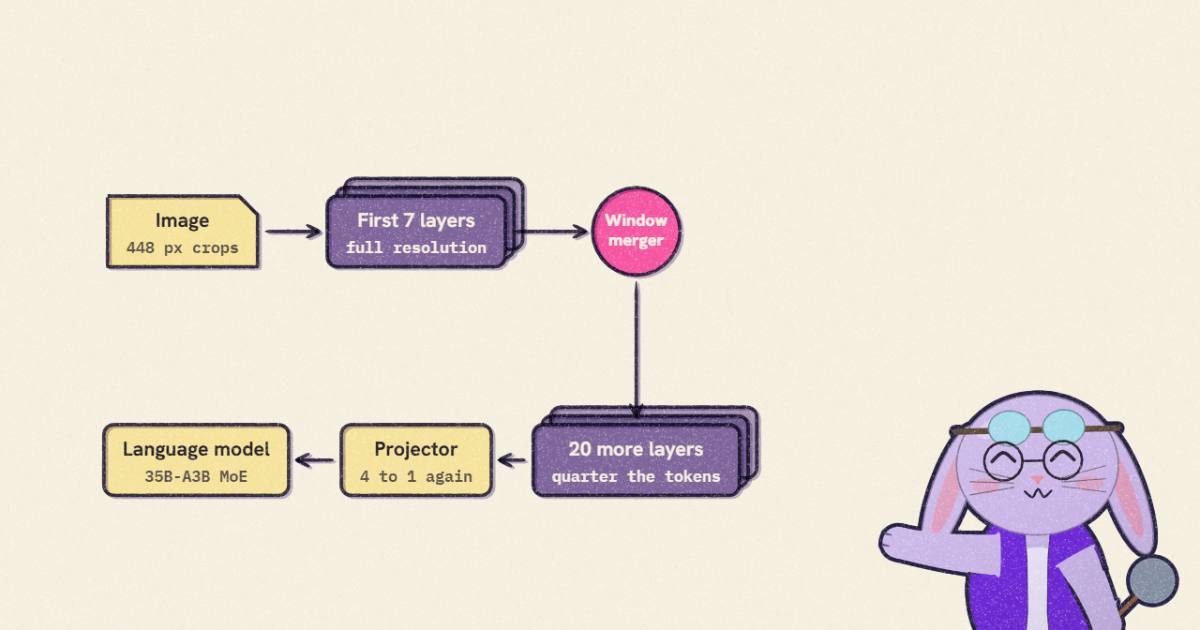
So the image goes through seven SigLIP layers (indices 0 to 6) at full
resolution. Then vit_merger runs: a self-attention restricted to each 2 by 2
window of patches, after which the four patch vectors are concatenated (4,608
wide), pushed through an MLP and added to their mean. One vector per window
leaves. The remaining 20 encoder layers run on a quarter of the tokens. At the
end a second 2 by 2 merge, the projector, folds four more into one and maps them
to the language model's width of 2048. Sixteen patches in, one token out.
The 4x mode simply skips the first merger. All 27 layers run at full resolution
and only the projector merges, so four patches become one token. You can see this
in the GGUF repo too: mmproj-model-f16-4x.gguf is 209,084,192 bytes smaller than
mmproj-model-f16.gguf, which is the 104.5M parameters of vit_merger at two
bytes each. The 4x file just does not carry it.
Two details in that merger are worth a sentence. Its first MLP layer is initialised block-diagonally, so at the start of training each of the four patches in a window passes through its own slice and nothing is mixed yet; mixing is learned. And the residual is the mean of the window, so the merger starts from a plain 2 by 2 average and learns corrections to it. Placing it after layer 6 rather than at the end is the whole efficiency argument: the last 20 of 27 layers are where most of the encoder compute is, and they now run on a quarter of the sequence.
Then there is slicing, which decides how many patches you have in the first
place. The processor targets 448 by 448 pixels per crop. A large image is cut
into a grid of up to max_slice_nums slices (9 by default, the card recommends 36
for images), picked to match the aspect ratio, plus one downscaled overview of the
whole image. Every crop is snapped to multiples of 56 pixels so that both 2 by 2
merges divide evenly.
I ported that processor into the widget below, rounding rules included, and checked it against a Python run of the same functions.
The default case is the photo from OpenBMB's own before-and-after clip, 1227 by 920. It becomes a 2 by 3 grid plus an overview, seven crops, 7,152 patches, and 447 tokens at 16x. That number is a nice cross-check: a comment in the MiniCPM-V iOS app's source says a 9-slice image costs "about 447 tokens". At 4x the same photo is 1,788 tokens.
On the encoder side, 16x does seven layers of full work and twenty at a quarter, so it costs 12/27 of the 4x mode's patch-layers, 44.4%, before counting that attention inside each crop is quadratic in its length. On the language side it sends a quarter of the tokens. For a model whose language half is a 3B-active MoE, that second saving is what decides prefill time on a phone.
What 16x costs in accuracy
OpenBMB publishes both modes side by side, which I appreciate. Averaged over the 24 non-MMHal rows of its vision-language table, 16x gives up 1.55 points. It is not uniform. The rows that lose the most are the ones that read small things: CharXiv reasoning drops 6.4 (75.60 to 69.20), TextVQA 3.27, CCOCR 2.85, OCRBench_v2 2.8. General VQA barely moves (MMBench 0.85, MMMU 0.22). Merging pixels early should hurt exactly these rows, and the split is useful: use 16x for photos and scenes, 4x for charts, forms and dense text.
Did the new eyes buy anything?
OpenBMB published this table for the 35B in instruct mode. Every number in it is theirs: the footnote says "Results are from public reports and our local evaluation using official checkpoints." I have not re-run any of it.
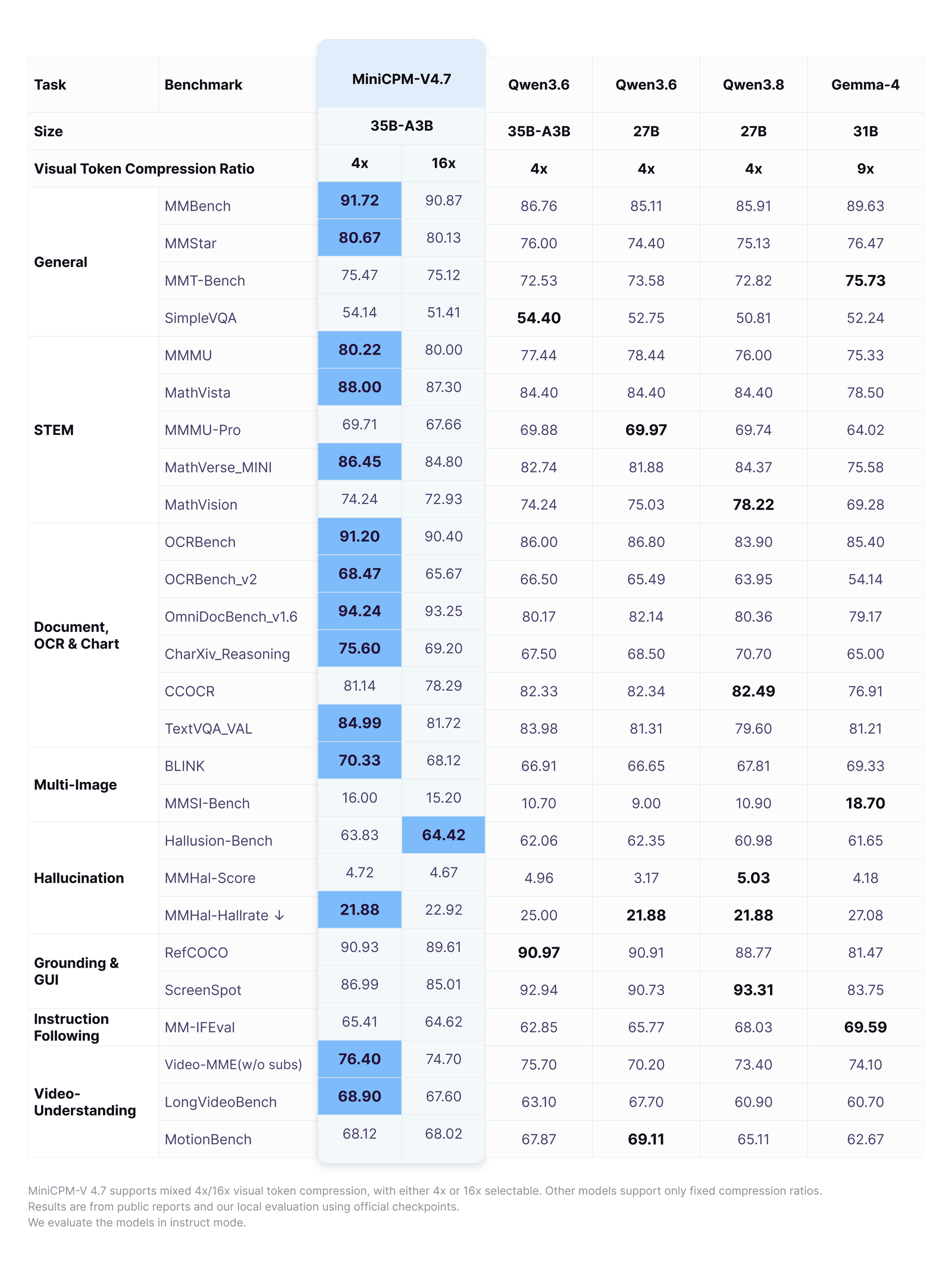
The thread says "34 benchmarks". The vision table has 26 rows and the language table below has 8, so the count is right. The column to read is Qwen3.6 35B-A3B, because it is the same language model with Qwen's own vision encoder and post-training. Any difference between the two is the vision stack and OpenBMB's data, which makes this the cleanest comparison in the release.
At 4x, MiniCPM is ahead on 19 of 26, behind on 6, tied on one (MathVision, 74.24 each). At 16x, it is ahead on 16 and behind on 10. The wins are concentrated where you would hope a vision team would win. OmniDocBench is the outlier at +14.07 (94.24 against 80.17), then CharXiv reasoning at +8.1, LongVideoBench +5.8, MMSI-Bench +5.3, OCRBench +5.2. The losses are mostly small, with one exception: ScreenSpot, GUI grounding, where MiniCPM trails by 5.95 at 4x and 7.93 at 16x. If you are building a computer-use agent, the "replacement" does not replace.
One claim in the thread does not add up
The launch post says: "Even at 16× compression, 35B-A3B scores 90.4 on OCRBench, 5.2 points ahead of Qwen3.6 35B-A3B." The chart has 90.40 at 16x and 86.00 for Qwen3.6 35B-A3B. The gap is 4.4 points. The 5.2-point gap is the 4x score, 91.20, minus 86.00. The thread put the 16x score next to the 4x margin. It is a small slip, and 16x still wins, but it is exactly the kind of number that gets copied into a hundred reposts.
The frontier chart, and what it leaves out
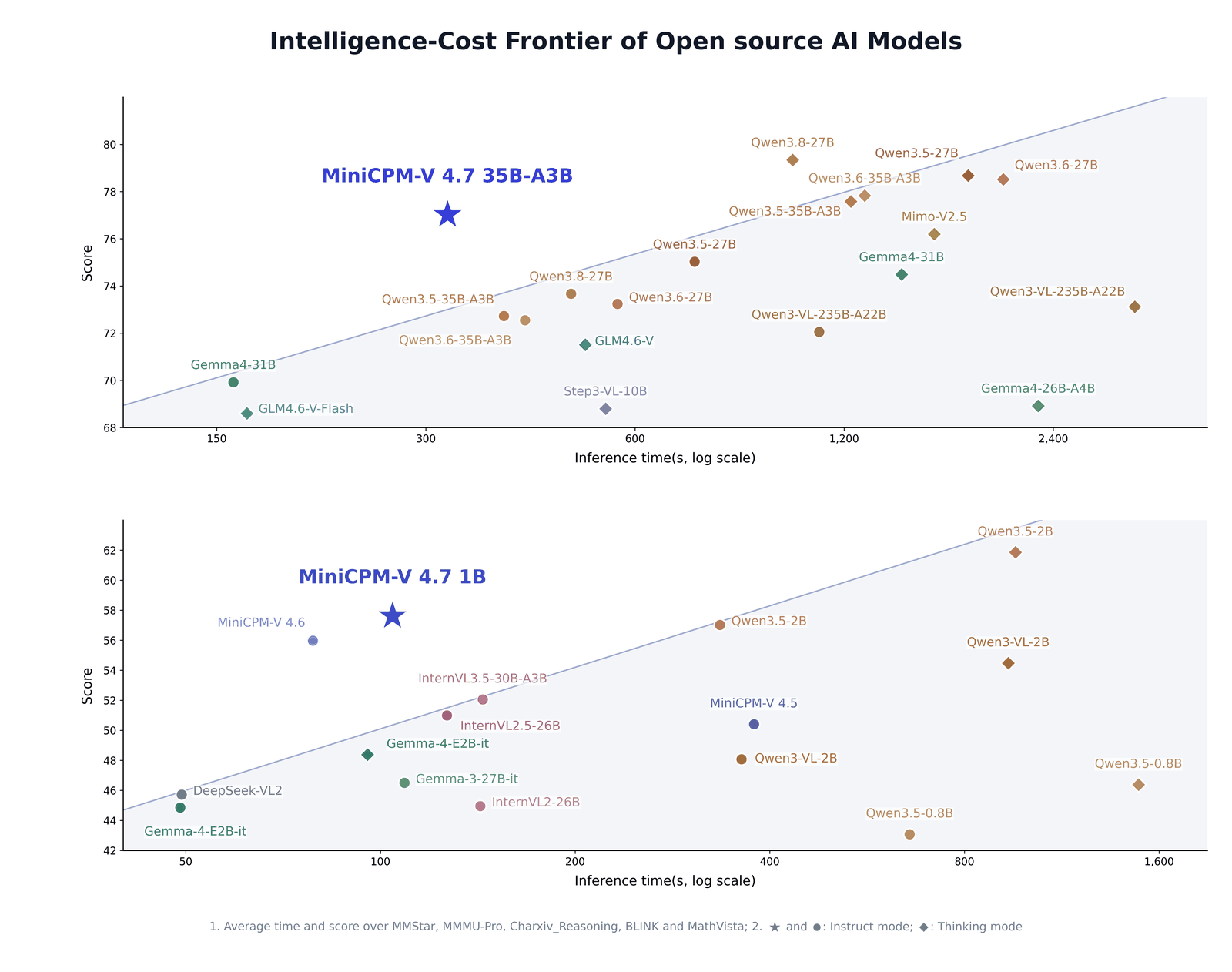
The footnote defines the score as the average of five benchmarks. I recomputed it from the table: MiniCPM at 4x averages 76.86, Qwen3.6 35B-A3B in instruct mode 72.94, which matches where the star and the circle sit. So the star is the 4x model; at 16x the same average is 74.48. Two things the chart does not tell you. First, the hardware behind "inference time" is not stated anywhere I could find, so the x-axis is a relative measure from OpenBMB's own setup. Second, look at the diamonds: Qwen3.6 35B-A3B in thinking mode scores higher than MiniCPM's star, at about four times the time. "Higher score in less time than Qwen3.6 35B-A3B" is true of instruct against instruct. Against thinking mode it is a speed trade, which may well be the trade you want, but it is a trade.
The language table is the eight benchmarks that make up the rest of the 34.
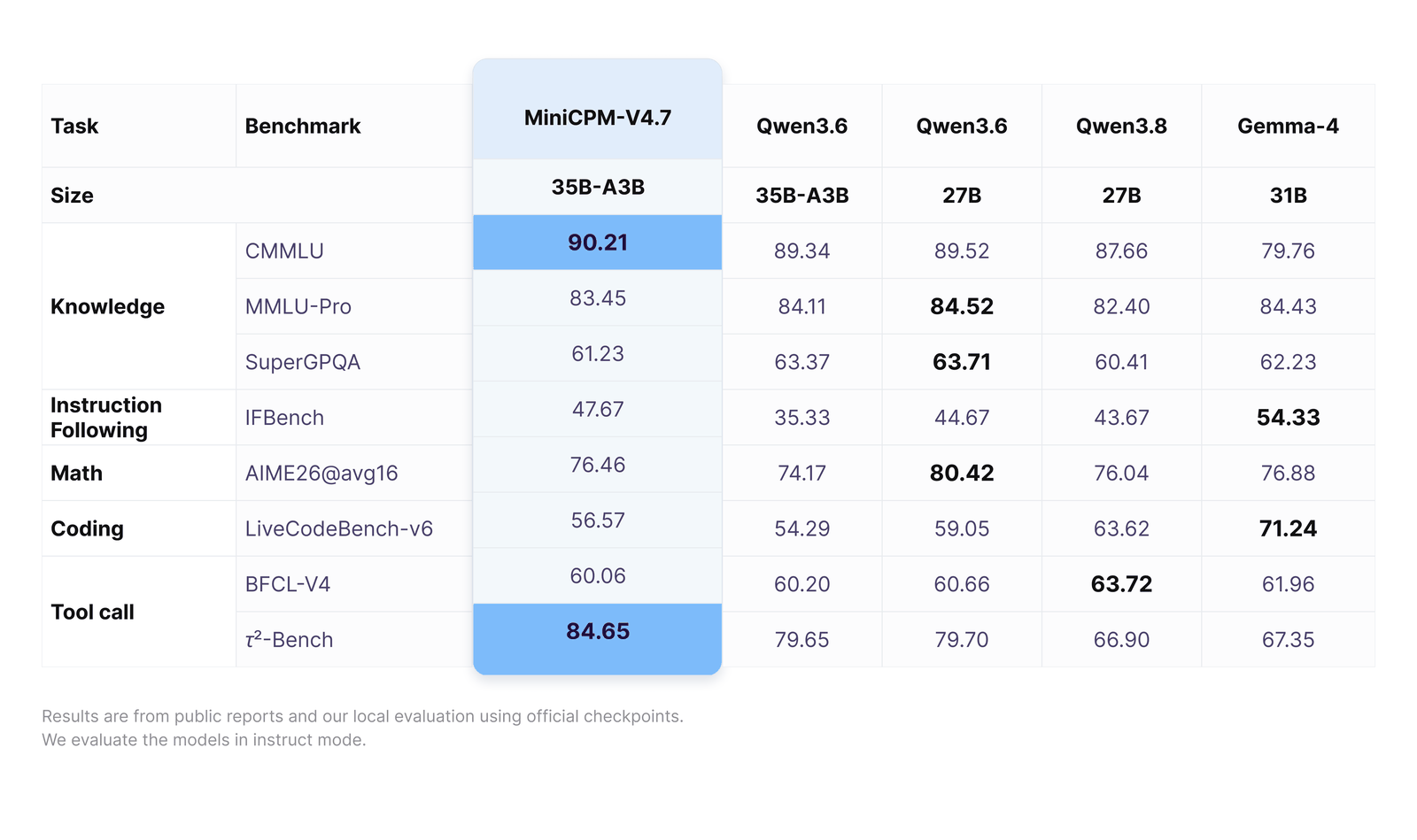
Against its own base it wins five of eight: CMMLU, IFBench (47.67 against 35.33), AIME26, LiveCodeBench and tau-squared Bench (84.65 against 79.65). It loses MMLU-Pro, SuperGPQA and BFCL-V4 by under 2.2 points each. Multimodal post-training usually costs a language model some text ability; here the text side mostly held or improved. Gemma-4 31B still beats everyone on LiveCodeBench (71.24) and IFBench (54.33).
The 1B, against the model it is built on
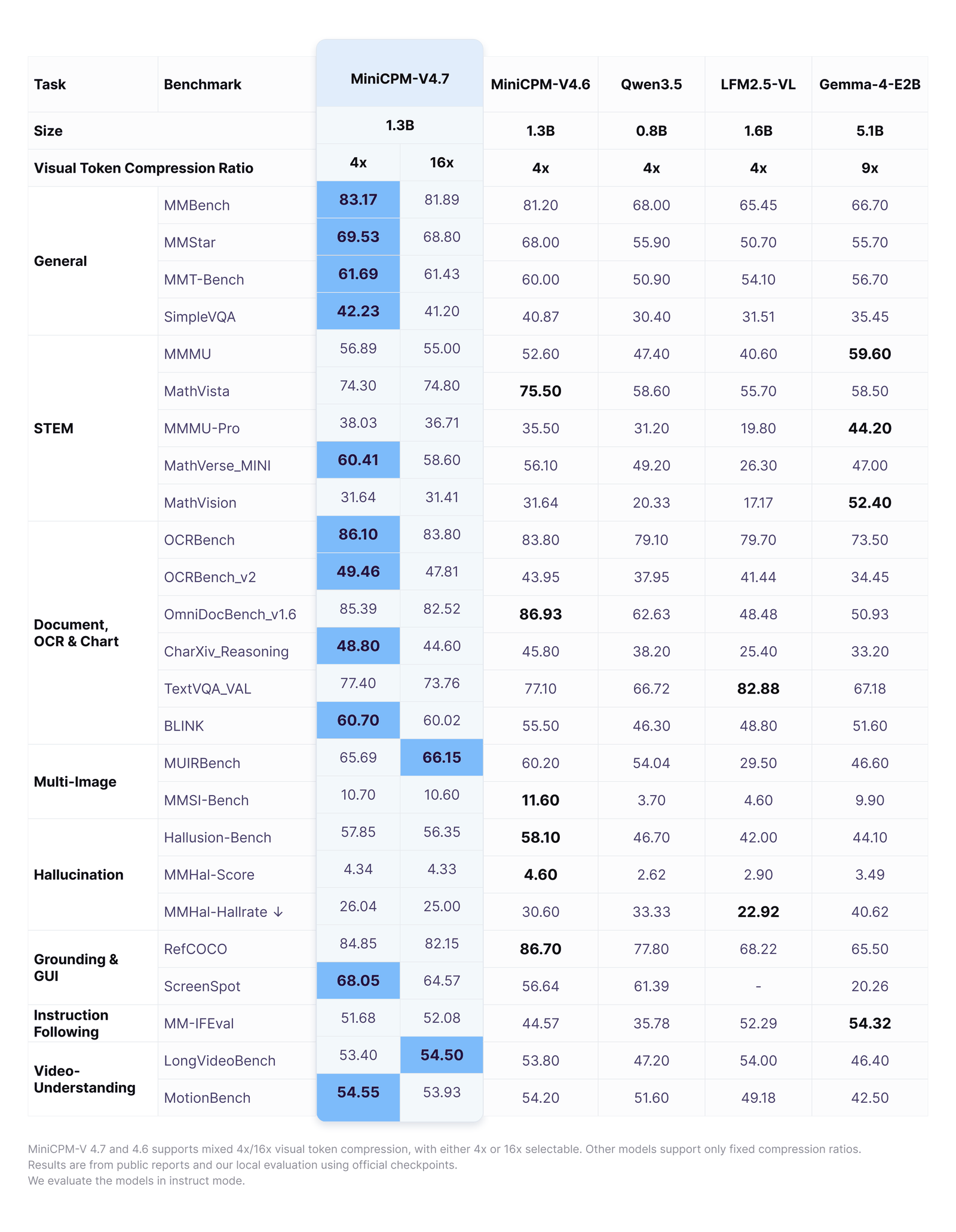
The card says the 1B "substantially outperforms Qwen3.5 0.8B", and on this table it does: ahead on all 25 rows in both modes. Given that it is Qwen3.5-0.8B's own language model plus a 548M-parameter encoder, that is the expected result, and the comparison flatters it a little: it is a 1.55B model against a 0.8B one. The more honest yardstick is MiniCPM-V 4.6 at the same size, which the card says 4.7 "continues to improve" on. At 4x it is ahead on 17 of 25 and behind on 7, including MathVista (74.30 against 75.50), OmniDocBench (85.39 against 86.93) and RefCOCO (84.85 against 86.70). An improvement on balance, not across the board.
The runtime: 13.8 GB of experts, read from flash
Now the part that is new. A 35B MoE in BF16 is 70 GB. Even at 3 bits the routed
experts alone do not fit in a phone's memory. OpenBMB's answer, which they call
Lookahead Expert Scheduling, lives in a fork of llama.cpp
(tc-mb/llama.cpp-omni) and in the iOS demo app (OpenBMB/MiniCPM-V-Apps). I
read both. The app source turned out to be the better documentation: it is full
of measured tables in its comments.
First, the bytes. The app downloads a GGUF called
MiniCPM-V-4_7-35B-A3B-mix_q3gud_im-les.gguf (1,662,732,800 bytes: everything
except the routed experts) plus 40 files experts/layer_000.bin to
layer_039.bin, each exactly 346,030,080 bytes
(MiniCPMModelConst.swift:369). Divide by 256 experts and you get 1,351,680
bytes per expert, which is 3,145,728 parameters at precisely 3.4375 bits: the
llama.cpp Q3_K format. The public GGUF repo's tensor-types.txt for that
quantization says the same thing in one line, ffn_(gate|up|down)_exps=Q3_K. All
40 layers together are 13.84 GB of experts.
Per token, 8 experts in each of 40 layers is 320 expert reads, about 432 MB if none of them is already in memory. At OpenBMB's own figure of roughly one millisecond per expert read, that is a third of a second per token spent waiting on flash. Their measured baseline, "expert weights loaded from SSD, no optimizations", is 2.97 tokens per second. The arithmetic and the measurement agree.
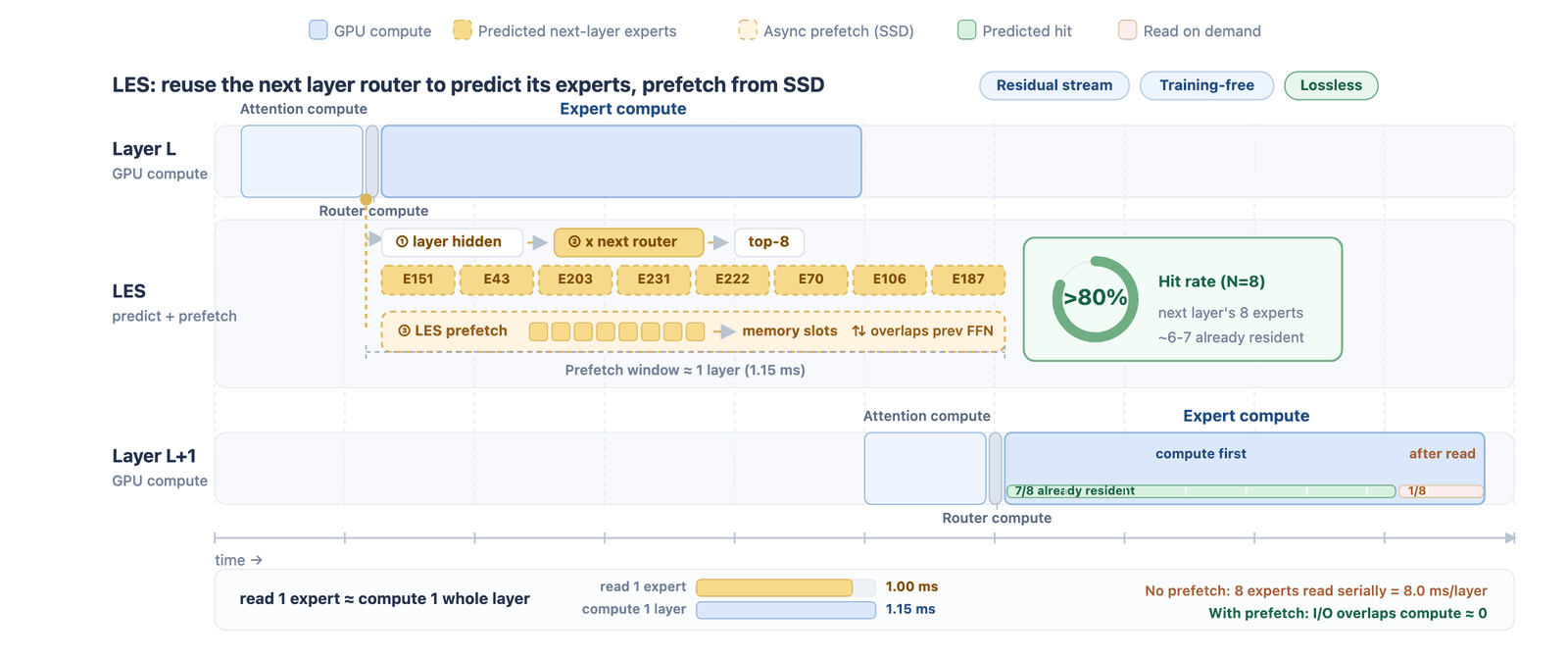
Predicting the next layer with its own router
The predictor is the part I expected to be complicated, and it is one line of graph code. While layer L runs, the fork multiplies layer L's post-attention hidden state by layer L+1's router weights and takes the top 8:
// tc-mb/llama.cpp-omni src/models/qwen35moe.cpp:455-462
if (moe_slots && moe_slots->lookahead_prefetch_enabled() && ubatch.n_tokens == 1 &&
    il + 1 < n_layer && model.layers[il + 1].ffn_gate_inp != nullptr) {
    ggml_tensor * prefetch_router_logits =
        build_lora_mm(model.layers[il + 1].ffn_gate_inp, attn_post_norm);
    lookahead_next = ggml_cont(ctx0, ggml_argsort_top_k(ctx0, prefetch_router_logits,
                                    moe_slots->lookahead_prefetch_depth()));
The bet is that the residual stream changes little between two adjacent layers,
so the next router, shown this layer's state, mostly picks what it will pick a
millisecond later. OpenBMB's diagram puts the hit rate above 80%, six or seven of
eight. I could not check that number; it is not in the repo's tables. Note the
n_tokens == 1 condition: prediction runs during decode only. Prefill, where one
layer can need over a hundred distinct experts, takes a different path.
This is where LES differs from Edge0, which solved the same problem on the same backbone a month earlier with a trained per-layer prerouter and ran it at four experts per token instead of eight. LES trains nothing and keeps all eight. The router that decides what gets computed is untouched; the prediction only decides what gets read early. A wrong guess costs a wasted read, never a wrong expert.
Most of the speed is a cache
The diagram's interesting phrase is "already resident". A one-layer prefetch
window of 1.15 ms cannot read eight experts at a millisecond each. What makes
six or seven of them resident is a per-layer cache that survives from one token
to the next. The engine gives every MoE layer its own window of expert slots
with an LRU policy (llama-moe-slot.cpp, "decode window"), and the prefetched
experts land in the same LRU. Consecutive tokens route heavily to the same
experts, so most of what a layer needs was used a token or two ago.
The app sizes that cache by device memory (MiniCPMModelConst.swift:781-783):
128 slots per layer at 16 GB, 48 at 12 GB, 24 at 8 GB, with 8 extra slots per
layer for prefetch (defaultLookaheadPrefetchDepth = 8, line 1193). A comment a
few lines above records why it is on by default, from a real multimodal session
with a 48-slot cache against no cache:
| cache on, 48 slots | cache off | |
|---|---|---|
| decode speed (tok/s) | 12.57 / 13.34 / 14.29 | 9.30 / 9.47 |
| steady-state misses | 14 / 33 / 74 | 173 / 224 |
| critical-path reads | 17 / 42 / 95 MiB | 222 / 289 MiB |
The same comment explains that a text-only benchmark (one paragraph repeated twelve times) had shown the opposite, because repeated text routes almost identically and the OS page cache alone was nearly perfect. The authors rolled back a default the same day and wrote down the lesson: tune with real prompts, not benchmark prompts. It is the most useful thing in the repository.
The table is also where I found the source of "13+ tokens/s": the cached run lands between 12.57 and 14.29. The comment does not name the device.
The widget models one layer with OpenBMB's two timings, so you can see why both pieces are needed.
OpenBMB's diagram puts the fully serial case at 8.0 ms of reads per layer. With nothing resident and no overlap, the model gives 2.73 tokens per second, close to the measured 2.97 baseline, which is the sanity check. Slide to seven resident: waiting for the eighth expert before computing gives 11.6, and computing the seven while the eighth is read gives 17.8. Below about six resident the ordering hardly matters, because one expert read costs as much as the whole layer's compute and there is nothing left to hide it behind. The ordering is worth something only once the cache has done its job. The model leaves out the CPU-side bookkeeping, which the engine's own comments measure at 3.5 ms per single-token step, so treat its numbers as ceilings.
Where the 3 GB comes from
The thread says "only 3GB memory". I could not find that number in any table, but the app's own sizing reproduces it. The cache is (slots + prefetch slots) x 40 layers x bytes per expert. At the 12 GB tier that is (48 + 8) x 40 x 1,351,680 bytes, 3,027,763,200 bytes, 3.03 GB. My reading is that "3 GB" is the expert cache, not the process. On top of it sit the 1.66 GB non-expert GGUF, which the engine memory-maps so its pages can be reclaimed, the 1.12 GB vision projector and the KV cache (small: only 10 of the 40 layers have one; the rest are DeltaNet state). On a 16 GB iPad at the default 128 slots, the same formula gives 7.4 GB of cache. The memory figure is a setting.
"5x with byte-for-byte identical outputs" is two claims
The LES document has the ladder, measured on an iPad Pro 11-inch M4 with 16 GB:
| stage | decode | step | total |
|---|---|---|---|
| experts read from SSD, no optimisation | 2.97 tok/s | 1.00x | |
| LES scheduling and load path | 9.81 tok/s | 3.30x | 3.30x |
| plus layer-wise mixed-precision quantization | 14.92 tok/s | 1.52x | 5.02x |
| plus DSpark speculative sampling | 17.39 tok/s | 1.17x | 5.86x |
The scheduling stage is lossless by construction: the real router picks the
experts, and prediction only changes when bytes arrive. It buys 3.30x. The 5x
in the thread, 5.02x in the table, includes the next row, which is a change of
quantization. A different quantization produces different weights and, at some
point, different tokens than the baseline did. Each piece is fine on its own;
the sentence that joins them claims identity for a speedup that is partly
compression. The before-and-after clip on the model card cannot settle it either
way: its two answers differ word for word, which is expected, because the
model's generation_config.json samples at temperature 1.0.
That clip is worth a second look for a different reason. Its decode counters read 2.0 and 5.5 tokens per second at the end. The headline numbers come from other runs, with the cache and the drafter switched on; the clip is the honest reminder that a phone running a 35B model is a configuration, and the default one is slower than the launch post.
Why speculative decoding only adds 17% here
The drafter is a DSpark checkpoint (MiniCPM-V-4.7-35B-A3B-DSpark): 5 layers,
389,223,169 parameters, reading hidden states from target layers 3, 11, 19, 27
and 35, drafting 15 tokens a pass. Its card reports acceptance lengths of 5.098
on MMMU, 6.126 on MathVista and 7.387 on code, which on a GPU is a big win. On the
phone the app drafts only 4 tokens a round (specDraftNMaxResolved, default 4),
and the reason is the MoE: verifying 5 tokens means 5 rows through every layer,
and each row picks its own 8 experts, so a layer can need up to 40 distinct
experts instead of 8. Every one of them has to be in the cache or read from
flash. Speculation saves forward passes, but on flash-bound MoE a forward pass of
5 rows is not much cheaper than 5 forward passes. The 1.17x is that tension
showing. The site's pieces on DSpark and
DFlash 2 cover the drafter itself.
Self-Replay Fine-Tuning, briefly
The release also points to a fine-tuning recipe, Self-Replay Fine-Tuning: before fine-tuning on a new task, sample the current model's own answers to general prompts, filter them, and mix them with the task data (OpenBMB's post gives a 4:1 blend) so the model rehearses what it already knew. The post claims it "cuts forgetting by 80%+" and shows, on a counting task, MiniCPM-V 4.5's general-score drop shrinking from 9.25 to 1.80. It is a sensible, old idea (rehearsal with self-generated data) and I did not test it. If you fine-tune either model, it is cheap enough to try.
An abliterated build, and what the adapter is made of
Added 13 October 2026.
AtomicChat, whose measured quant ladder I liked for Qwen3.8, has posted an "uncensored" MiniCPM-V 4.7 35B-A3B: refusals on filtered prompts "drop from 96.3% to 0%". It is an abliteration, the refusal-direction ablation of Arditi et al., 2024. This site has covered the mechanism and its limits before, on GLM-5.3-Flash and as a runtime hook. Mechanism and evidence only here, as there.
What the card reports. The model card is unusually complete. The 96.3% is 81 held-out English JailbreakBench prompts, BF16 to BF16; Russian red-teaming goes from 70% to 0% on 100, XSTest's safe prompts from 7.6% to 0% on 250, and with thinking on from 43% to 0% on 30. MMLU moves 84.25% to 84.50% on 2,000 questions (McNemar p = 0.52), and the ablation alone costs a mean KL divergence of 0.0090 against the original, under their own Q8_0's 0.0051 plus quantization. Two caveats the card states itself: refusal is scored from the opening of each reply, with no judge, and vision was not tested after the edit. In the public metrics dataset, 76 of the 81 English replies on the 20.1 GB build hit the 256-token generation cap, which a reply-opening classifier does not mind but a harmfulness judge would want to read to the end. The 0% has a 95% upper bound of 4.5% there.
What the adapter is (measured). I range-read the 106,269,248-byte LoRA GGUF's header. It
holds 240 tensors, an A and a B for each of 120 sites: attn_output in the 10 full-attention
blocks, ssm_out in the 30 DeltaNet blocks, the shared expert's ffn_down_shexp and the
stacked ffn_down_exps of all 256 routed experts in every one of the 40 blocks. Rank 1, F32.
No router, no embedding, nothing in the vision tower. Then I read the B vectors: every one is
the same unit 2,048-vector, in block 0 and block 39, for the shared expert, the DeltaNet output
and each routed expert. That is the shape of the published method. Projecting a direction
out of everything a matrix writes to the residual stream is , and
is an outer product, a rank-1 update whose B is itself. One direction, all
writers. The cost of the GGUF format is that each expert carries its own copy of : 2,048 x
256 x 40 floats is 84 MB of the 106 MB, one 8 KB vector repeated 10,240 times. The sizes sum
to the file to within header padding.
Vision (measured, then reasoned). The mmproj files are byte-identical to AtomicChat's
own unmodified MiniCPM-V 4.7 quants by the Hub's LFS sha256. Against OpenBMB's own
mmproj-model-f16.gguf (which is BF16 inside, despite the name), all 460 tensor names, shapes,
types and offsets match, the 128 extra bytes are metadata (name, licence, tags), and every
4 MB slice of tensor data I hashed, start, middle and end, is identical. The edit does not
touch the eyes. It does not need to for image prompts to be affected: image tokens enter the
same residual stream, and every matrix that writes to it after the input has lost its
component along . What nobody has shown is whether a request carried in an image is
refused through that same direction. The direction was estimated on text prompts only, and
the card says so.
Is it Qwen's direction? (reasoned) The language model is Qwen3.6-35B-A3B's layer for layer, as the config shows above, but AtomicChat estimated on MiniCPM's own activations, after whatever training OpenBMB did on top. The files say nothing about whether the same vector would work on Qwen3.6. Nobody has published that comparison.
The 35B on a Mac
Added 13 October 2026.
OpenBMB has also posted day-0 Mac
support through Nativ, "tested on Apple Silicon with Nativ
v0.4.x": the 35B-A3B at "4K+ prefill tokens/s, 90 tok/s decode", the 1B at 24K+ and 315.
Nativ is Prince Canuma's MIT-licensed SwiftUI app around a bundled mlx-vlm server, the MLX
library he also maintains; MiniCPM-V 4.7 support is mlx-vlm PR #2499. The post does not name
the chip, the memory or the quantization. Neither does the Nativ repository, nor do the
nativ-community and mlx-community conversions, whose only recorded checks are smoke tests
on an RTX PRO 6000 running MLX's CUDA backend.
So the configuration can only be bounded (reasoned). Decode is a memory-bandwidth problem: per token the model reads the 2.95B active weights counted above. The published 4-bit conversions keep the DeltaNet layers (1.01B) and the output head (0.51B) in BF16, so a token costs about 2.0 + 1.0 GB for those, plus about 0.54 GB for 8 routed experts in 40 layers at 4.25 bits, and roughly 0.2 GB of the rest: about 3.8 GB. At 90 tok/s that is about 340 GB/s actually delivered, beyond an M4 Pro's 273 GB/s on paper and into Max or Ultra territory. Quantize everything to 4 bits and it is about 1.6 GB a token, near 140 GB/s, which an M4 Pro could manage. Which of those OpenBMB ran is the missing fact.
The contrast with the phone runtime is the point. The mxfp4 conversion is 22.5 GB of safetensors, held entirely in unified memory, so nothing is fetched mid-token and LES has no job to do. The iPhone keeps 3 GB resident and streams 432 MB of Q3_K experts per token from flash. Different hardware too, but much of the 7x between 13 and 90 tok/s is where the experts live.
What I would use it for
If you run Qwen3.6-35B-A3B for anything with documents, charts, scans or long video, try MiniCPM-V 4.7 at 4x. The language model is the same, the vision results on paper are better where it matters (OmniDocBench by 14 points, CharXiv by 8), and the text side did not regress much. The weights are Apache-2.0. If you build GUI agents, stay with Qwen: ScreenSpot is the one place 4.7 is clearly worse. Switch to 16x for photos and video frames, where it costs about a point and a half on average and a quarter of the tokens.
The on-device story is real engineering and the code is open, but read it as a runtime with knobs: cache size per layer, prefetch depth, draft length, quantization. The launch numbers are those knobs set well on good hardware. The idea I will remember is simple: reuse the next layer's router a layer early, keep a small per-layer cache warm, and compute what you have while you fetch what you don't. None of it needs training, so nothing stops it being ported to any other MoE with the same shape.
Related on this site: MiniCPM5-2B, OpenBMB's text model from September; Edge0, the trained-predictor take on streaming this exact backbone; a 200 GB MoE on one RTX 3090, the desktop version of keeping experts out of fast memory; LFM2.5-VL-3B, another small VLM that appears in the 1B's comparison; and the mixture-of-experts explainer for why total and active parameters come apart.
- license
- Apache-2.0
- branch
- main
- tests
- none found
- source
- 1.4 MB
- commit date
- 2026-10-13
by size of tracked source at this commit, file counts in brackets; docs, data and vendored trees excluded
local clone, 2026-10-13 at 1d6b7d6 — branch, commit, commitDate, fileCount, hasTests, languages, license, licenseFile, shallow
shallow clone: counts describe the pinned tree, not the history
- architecture
- MiniCPMV4_7ForConditionalGeneration
- task
- image-text-to-text
- library
- transformers
- license
- apache-2.0
- safetensors
- 1 shard
- largest file
- 3.11 GB
- files
- 19
- downloads
- 14
- likes
- 136
repo last modified 2026-10-12
How I checked
- Weights: read every safetensors header of
openbmb/MiniCPM-V-4.7-35B-A3B(16 shards) andopenbmb/MiniCPM-V-4.7-1Bwith range requests and summed the shapes; diffed bothconfig.jsontext sections againstQwen/Qwen3.6-35B-A3BandQwen/Qwen3.5-0.8B. Expert bytes came from the app's constants and the GGUF repo's file list andtensor-types.txt. - Vision path: read
modular_minicpmv4_6.py,modular_minicpmv4_7.pyandimage_processing_minicpmv4_6.pyfromtransformersmain, ported the slicing to TypeScript and checked it against the same functions in Python. - Runtime: read
tc-mb/llama.cpp-omniat commit88bd37eb(src/llama-moe-slot.cpp,src/models/qwen35moe.cpp,docs/les/) andOpenBMB/MiniCPM-V-Appsate356c17e. I ran none of it; the iPad and iPhone numbers are OpenBMB's. - Benchmarks: transcribed OpenBMB's four chart images from the MiniCPM-o
repository (
OpenBMB/MiniCPM-Vredirects there, at1d6b7d68), recounted the 34, recomputed the frontier chart's five-benchmark averages and the OCRBench margin. All scores are OpenBMB's own evaluations; I did not run any benchmark. - Abliterated build (added 13 October): read the AtomicChat card, the Hub file list and
LFS hashes, and small files from its metrics dataset; range-read the LoRA GGUF header and
B vectors, and both
mmprojheaders plus four 4 MB data slices each. Ran nothing. - Mac numbers (added 13 October): read Nativ at
d4ab3afand the MLX conversion cards. The chip and quantization behind 90 tok/s are unstated; the bandwidth figure is arithmetic. - Not checked: the 80% prediction hit rate, the inference-time axis of the frontier chart (no hardware is given), the 13+ tok/s on a named iPhone (the measurement table I found does not name its device) and Self-Replay Fine-Tuning's numbers.