2026-08-23 · 10 min · speculative-decoding · on-device · mixture-of-experts · liquid-ai
Why read this
Solidtop 85%Why Liquid's best-accepting draft, on the 8B MoE, is slowest on a laptop: verifying a block touches the union of experts. And: pick drafts by acceptance.
- Original analysis
- Runs on a consumer GPU
- A lasting reference
Inference & servingCustom licencePractitioner model
How this was scored
- Is it new?
- 1 of 3: An incremental tweak
- Can I trust it?
- 1 of 3: Spot-checks a few numbers
- Can I run it?
- 2 of 3: Open code or weights with real limits
- Will I understand it?
- 2 of 3: Mechanism from first principles with figures
- Can I act on it?
- 2 of 3: A concrete recipe, numbers or comparison
- Will it last?
- 2 of 3: A reference for a year or more
- Does it affect many?
- 1 of 3: A specialist community
- Only here?
- 2 of 3: A teardown or measurement few others did
Score 56 of 100, ranked 402 of 577 rated articles. Each question is answered 0–3 by hand, and a 3 is rare. How articles are scored
Liquid AI released DSpark draft models for three LFM2.5 checkpoints on 20 August. The headline is the usual shape — up to 3.18× on an H100, up to 2.87× on a MacBook — and the headline is fine. It is not the interesting part.
The interesting part is that the release contains a clean, published counterexample to the metric everyone uses to compare speculative drafters. LFM2.5-8B-A1B's draft has the highest acceptance length of the three — 6.95 tokens of a possible 10, against 5.02 and 4.81 for the dense models — and the worst realized speedup on device, at 1.18×. On MT-Bench it accepts 8.52 tokens per pass and returns 1.04×, which is to say nothing at all.
Liquid publish that table, explain it in two sentences, and label it "a subject of subsequent work". Those two sentences are worth expanding, because what they describe is not a bug in llama.cpp's Metal backend. It is arithmetic that applies to every sparse model.
| Who | Liquid AI · 20 Aug 2026 · first speculative decoding release for LFMs |
| Models | draft checkpoints for LFM2.5-1.2B-Instruct, LFM2.5-2.6B, LFM2.5-8B-A1B |
| Size | ~300M parameters each · 5 layers · block size 9 |
| Integration | upstream in llama.cpp and SGLang · Safetensors and GGUF |
| Quality | greedy output identical to baseline by construction — benchmark accuracy unchanged |
| Agentic | BFCL function-call latency on a MacBook: 3.5 s → 1.5 s, a 57% cut |
| Trained | exclusively on AMD hardware, in Liquid's own framework |
- architecture
- Lfm2DSparkDraftModel
- task
- text-generation
- library
- sglang
- license
- other
- safetensors
- 1 shard
- largest file
- 591.5 MB
- files
- 5
- downloads
- 1.5K
- likes
- 32
repo last modified 2026-08-20
What DSpark is
Speculative decoding exists because decode is memory-bound: most of the latency is streaming weights from DRAM into SRAM, not arithmetic. A small draft proposes k tokens, the target verifies all of them in one pass, and the weight load is amortized across however many survive. This is true on an H100 and true on an iPhone, which is the property that makes it interesting for a company whose whole thesis is running on the device.
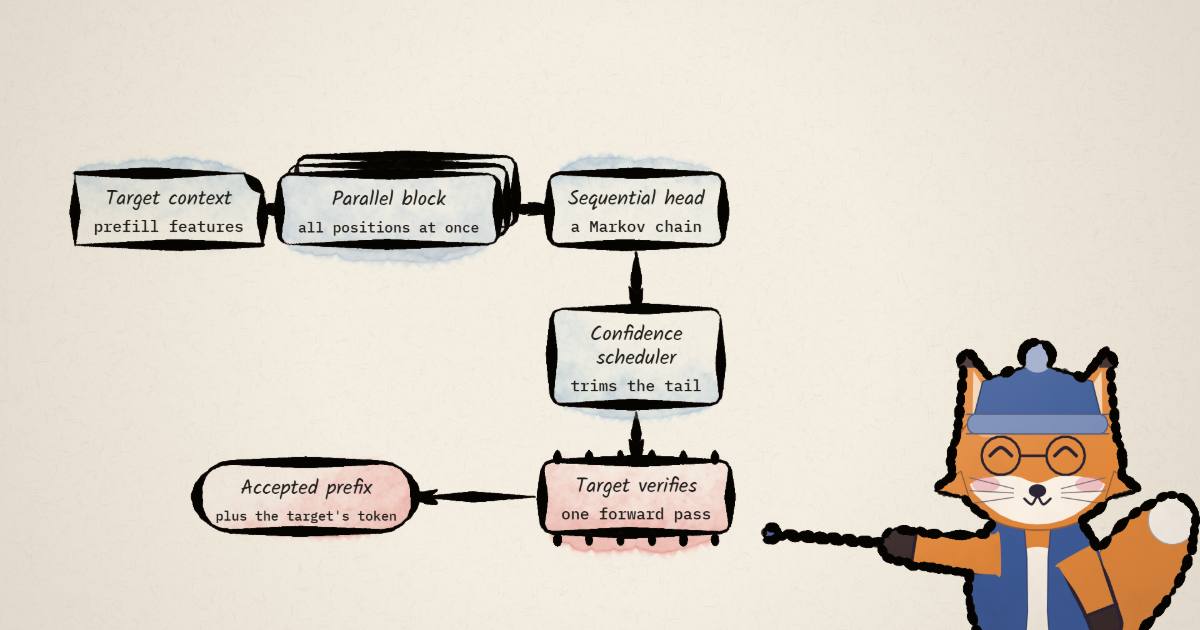
DSpark combines three pieces:
- A DFlash-style parallel backbone, conditioned on context features from the target model, that runs one forward pass over a block and produces hidden states and base logits for all
kdraft positions at once. - A lightweight sequential head, modelled as a Markov chain between neighbouring tokens, biasing each position's logits toward continuations consistent with the token sampled just before it. Parallel drafting has no dependency between positions; this adds it back, which raises acceptance at later positions.
- A confidence-scheduled verifier: a separate head predicts each draft token's acceptance probability conditioned on all previous ones being accepted, and a hardware-aware scheduler prunes low-confidence suffixes when verifying them would cost more batch capacity than they are worth.
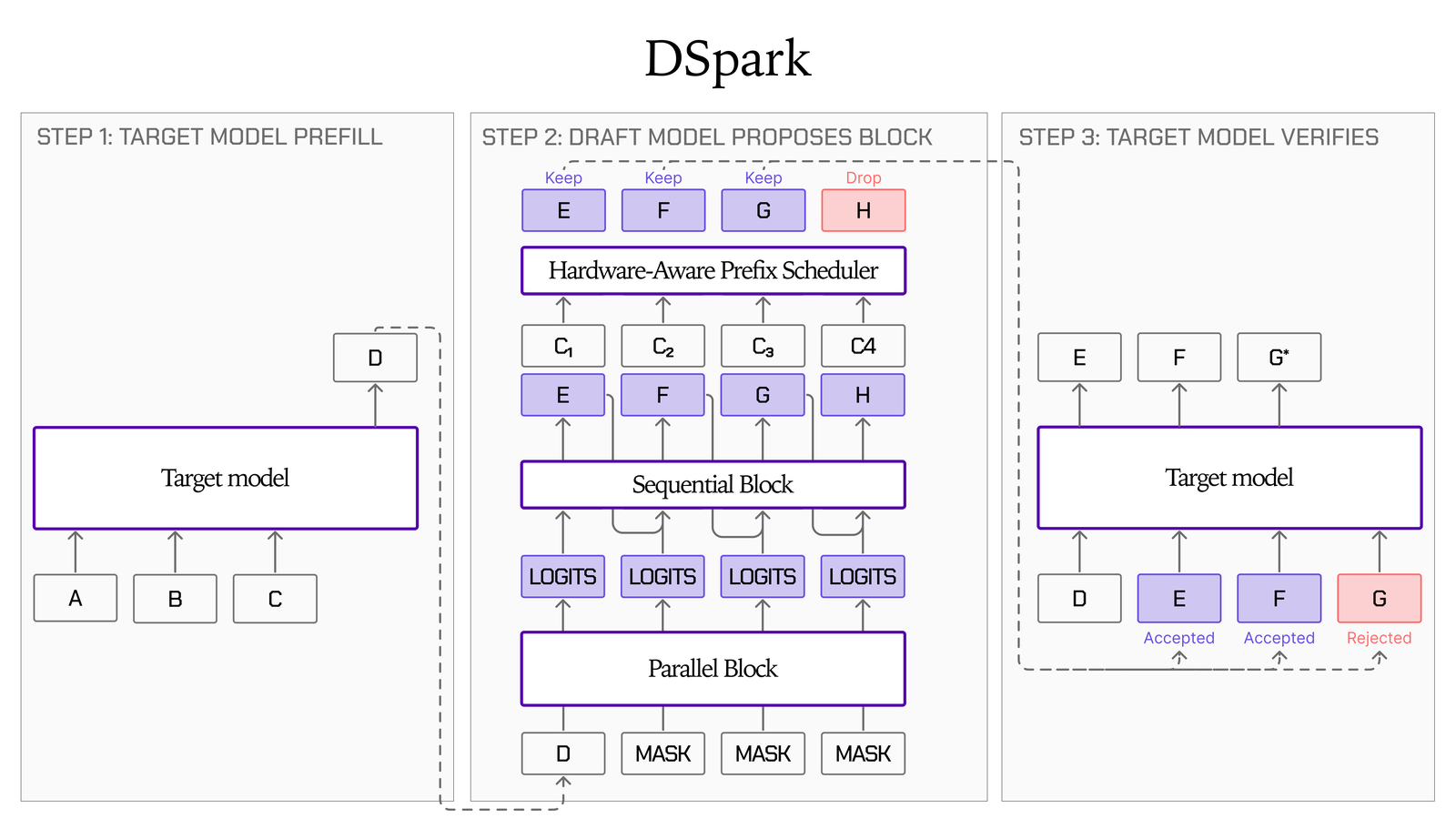
That third piece has a quiet fate worth noting. In the concurrency experiments, Liquid turn it off: "DSpark's confidence head can dynamically trim how many tokens to verify per request, but in our experiments the tokens it drops cost more than the compute it saves, so we serve a fixed verify window instead." A component of the published architecture, shipped in the checkpoints, disabled in the results — reported plainly. I would rather read that than not.
The training result nobody asks for
Before the speed tables, there is a small methodological finding that I think is the most transferable thing in the post.
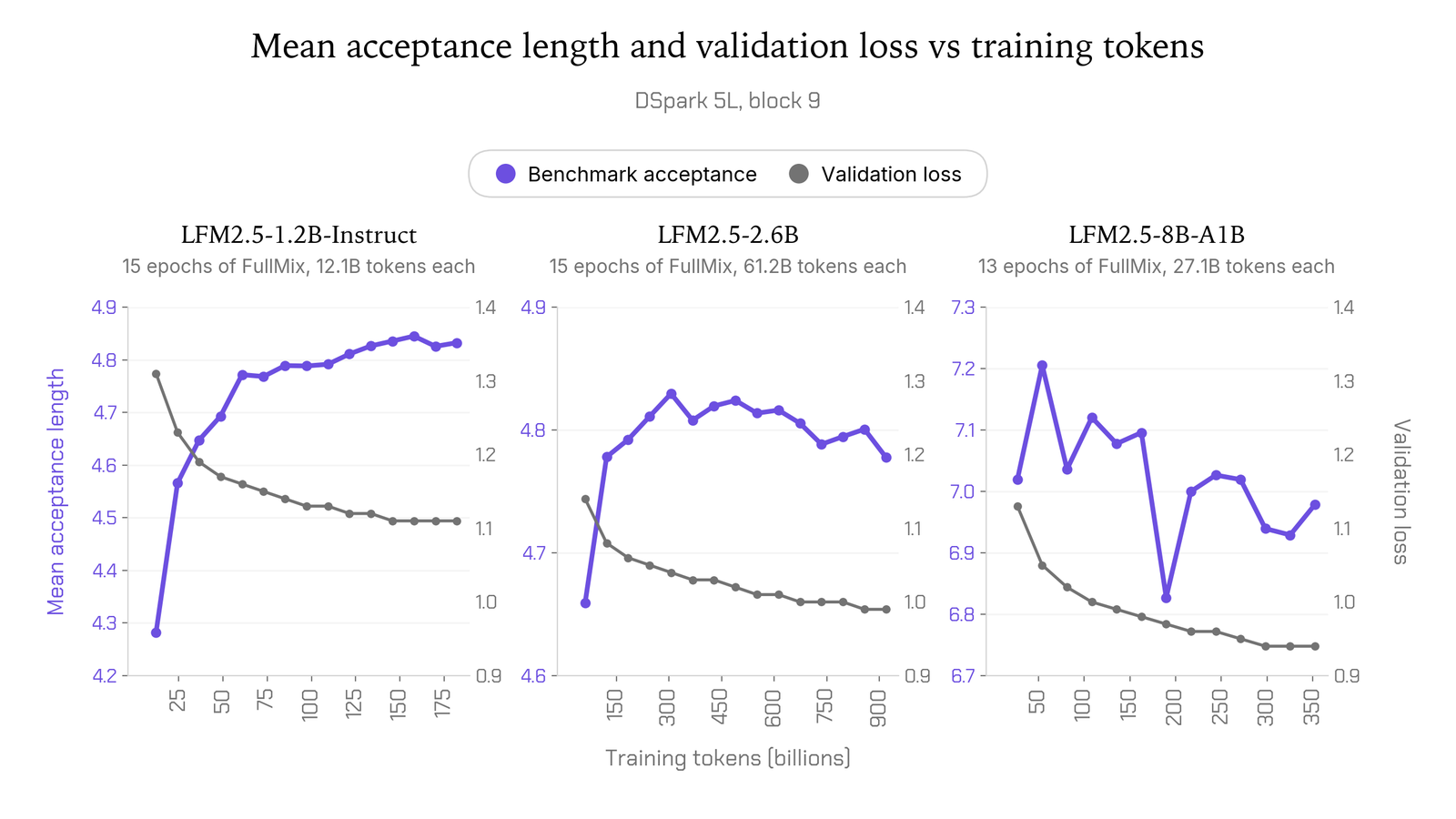
The 1.2B draft behaves the way you would hope: acceptance climbs as loss falls, and the two agree about when to stop. The 2.6B draft peaks around 300B tokens and then declines for the remaining 600B while its loss keeps improving. The 8B-A1B draft oscillates between 6.8 and 7.2 with no trend at all, its best checkpoint arriving at 50B tokens out of 350B.
So Liquid select the epoch with the highest acceptance rate rather than the lowest loss. That is obviously right and almost nobody does it, because loss is the number your training loop already has. The general form: a draft model's loss is not its objective. It is trained by distillation on next-token prediction; it is used as a proposal distribution whose value is how often the target agrees with a whole block of it. Those two are correlated until they are not, and this figure is a picture of the point where they stop being.
The tables
The dense models do what the technique promises. LFM2.5-1.2B-Instruct averages 2.54× on the MacBook, peaking at 2.87× on HumanEval — 136 to 389 tok/s, which is a different category of interactive. LFM2.5-2.6B averages 2.27× on device and 2.67× on the H100. Liquid note that on-device throughput for the 1.2B now "far exceeds the throughput offered by most proprietary cloud models".
There is real variance in there worth not glossing: for the 1.2B, speedup ranges from 1.66× on MT-Bench to 2.56× on MATH500 on the H100 — a 52% spread driven entirely by the distribution of the underlying text. Speculative decoding is a bet on predictability, and conversational text is less predictable than mathematics.
Then the 8B-A1B, where the draft is best and the outcome is worst.
Why the MoE loses
Liquid give the reason in one clause: verifying k tokens "activates more experts and thus more weight traffic than a single decode step". Here is what that means quantitatively, because the shape of it is the whole story.
A dense model reads all of its weights to decode one token. Verifying nine tokens reads the same weights, once. The extra work is free — that is the entire premise of speculative decoding, and it is why the dense LFM2.5 drafts do fine on the same laptop with the same backend.
A sparse model reads a slice. LFM2.5-8B-A1B activates about 1B of 8B parameters per token, and its advantage over a dense 8B is precisely that it does not have to touch the other seven. But nine tokens route to nine different slices, and the union is much larger than any one of them. Verifying a block is the operation that gives a sparse model's advantage back.
How much of it comes back depends on how much the routing overlaps across the block, which is exactly the temporal locality that MoE serving engines like FreeToken build their caches on. If overlap is high, the union stays small and speculation still wins. If the backend's kernels are not written to exploit that overlap during wide verification — which is what "the current MoE implementation in llama.cpp's Metal backend" amounts to — none of it is claimed and you pay the independent-routing price.
So this is half implementation and half structural, and the honest version is: on a backend built for it, sparse verification is a caching problem with a good solution. On a backend that is not, a better draft model buys you nothing. The 2.54× the same checkpoint gets on the H100 is the proof that the draft was never the problem.
The part that will actually matter
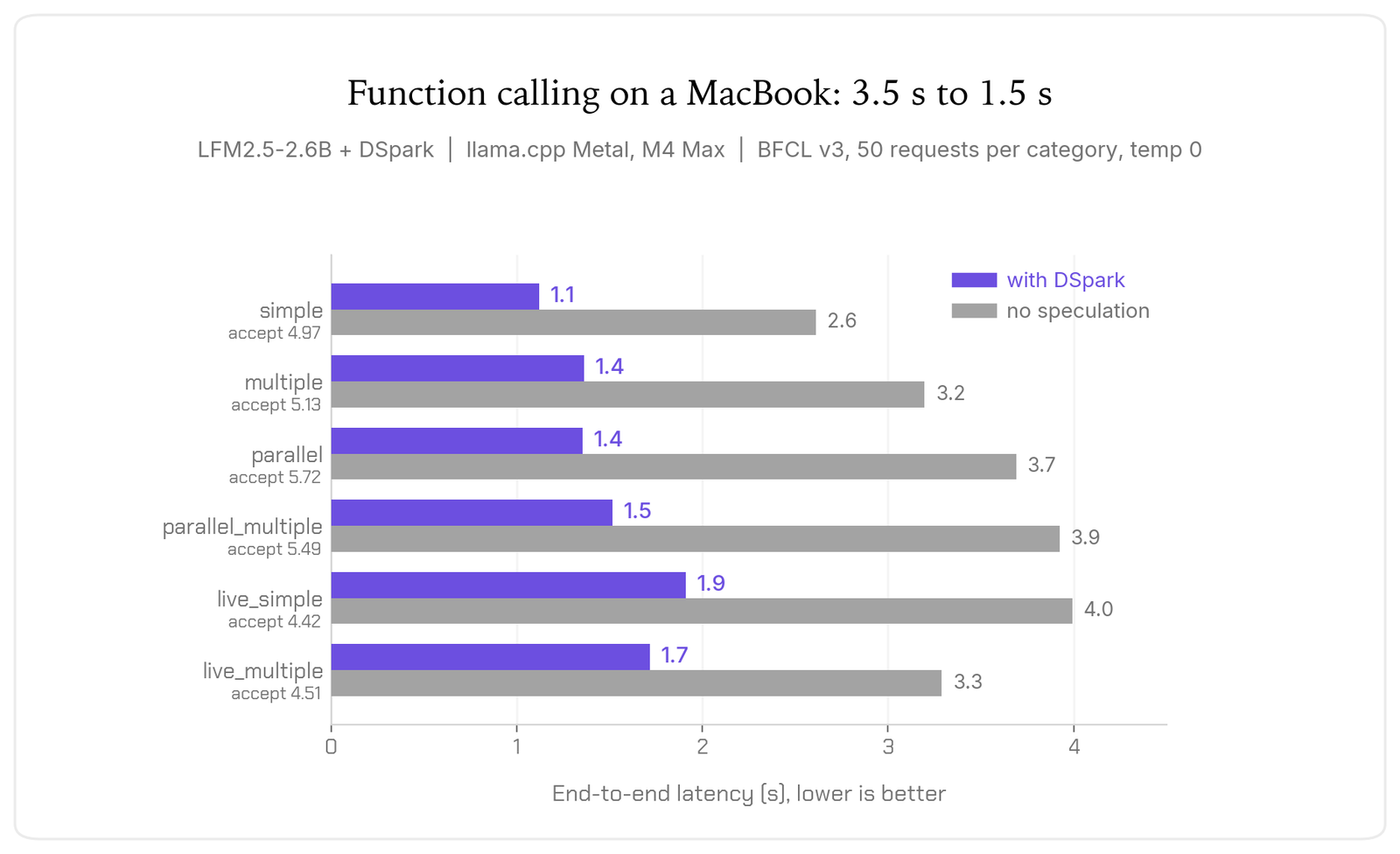
Liquid's stated goal for LFM2.5-2.6B was to make it "the first viable on-device agentic model", and the BFCL chart is the argument. In an agentic loop the model reasons before every tool call and the user waits through all of it — so decode latency is not a throughput statistic, it is the entire perceived responsiveness of the product. Cutting 3.5 seconds to 1.5 across six function-calling categories is the difference between a local agent that feels like a tool and one that feels like a demo.
And the cost of that is worth stating precisely, because "minimal memory increase" is doing some work in the announcement. A ~300M draft against a 2.6B target is +12.6% of weights; against the 1.2B it is +24.6%. That is not nothing on a phone. It is, however, a very good trade at 2.3–2.9×, and it is only that small because the embedding and LM head are tied to the target instead of duplicated.
What I would want next
The confidence head needs a machine where it pays. It is trained, shipped, and switched off. Liquid say the tokens it drops cost more than the compute it saves — on an H100 at moderate concurrency, which is exactly the regime where verification capacity is cheap. The scheduler is described as hardware-aware; the hardware where trimming a low-confidence suffix should obviously win is the 8 GB laptop, which is the configuration it was not evaluated on.
The MoE result deserves a locality measurement, not a promise. "Subsequent work" is fair, but the diagnostic is cheap: replay the routing traces and report how many unique experts a nine-token verification actually touches against one decode step. That single number decides whether this is a kernel problem worth fixing or a ceiling.
Block size 9 is fixed everywhere. Chosen by ablation on a subset, then applied to all three models across five datasets and two backends. Given that acceptance varies from 3.90 to 8.52 across those cells, the optimal block almost certainly does not — and on the MoE, block size is the direct knob on the weight-traffic curve above.
Fifteen epochs on the same corpus. The 2.6B draft trains on 61.2B tokens fifteen times over and its acceptance declines through the last two-thirds of that. Whatever is happening there — memorization, distribution drift away from the target's own outputs — it looks like a data problem being solved with an early-stopping rule.
The line worth keeping
Every speculative decoding release leads with acceptance length, and it is the right metric for the draft model in isolation. This release accidentally documents its limit: the draft that agrees with its target most is the one that made the least money, on the machine it was built for, because the pass that checks the agreement costs differently on different architectures.
Acceptance is a property of two models. Speedup is a property of two models and a machine. Publishing a table where those disagree by a factor of two, and saying so, is more useful than another 3× headline.