2026-08-06 · 9 min · llm · quantization · mixture-of-experts · on-device · open-weights · explainer
Most quantization is something you do to a model after it is trained. You take bf16 weights, find a rounding scheme that hurts least, and accept the damage. Maple-Preview, released by DeepGrove on 2026-08-04 under MIT, is the other thing: a 20B-A1.49B mixture-of-experts reasoning model where the weights were trained to be ternary, so nearly every parameter in the network is one of exactly three values — −1, 0, or +1, scaled.
The headline numbers are a 5.31 GB checkpoint and 218 tokens/sec on a Mac mini M4. Both are the kind of claim worth checking rather than repeating, and this time both check out — with one significant asterisk about what the released repository actually contains.
- architecture
- MapleForCausalLM
- task
- text-generation
- library
- transformers
- license
- mit
- safetensors
- 9 shards
- largest file
- 5.00 GB
- files
- 26
- downloads
- 5.1K
- likes
- 387
- languages
- en
repo last modified 2026-08-04
The claim, verified from the bytes
You do not need to download 40 GB to test "is it ternary." A safetensors file begins with a header giving every tensor's dtype, shape and byte offsets, so two small range requests buy you the layout, and one more pulls a single row out of the middle of a shard. Count the distinct values in that row. A normal bf16 weight row of 2048 elements has on the order of two thousand distinct values. A ternary one has three.
Three values per row, every time, perfectly symmetric about zero, with the scale s changing from one row to the next. That is ternary with a per-output-channel scale: each weight is one of −1, 0, +1 multiplied by its row’s own constant. Roughly two weights in five are exactly zero, which is what absmean ternarization does to a Gaussian. The claim is not just marketing — it is legible in the published bytes.
Every row measured came back with exactly three values, perfectly symmetric — −s, 0, +s — with
s changing from row to row. That is ternary with a per-output-channel scale, the BitNet
b1.58 shape. About 38–43% of the weights in each row are exactly zero, which is what absmean
ternarization does to a roughly Gaussian weight distribution: everything inside the rounding
threshold collapses to nothing.
What stays in full precision is as interesting as what doesn't. 96.9% of parameters are ternary; the exceptions are the two embedding tables, the norms, and — pointedly — the MoE routers. A router chooses 8 experts out of 256 based on the margin between logits. Crushing that margin to three levels would scramble which expert fires long before it degraded any individual expert's arithmetic, so the router is the one 12M-parameter tensor per layer that stays sharp.
The 5.31 GB claim reconciles, and the leftover is the vocabulary
A ternary weight carries bits of information, so that is the floor for any lossless packing. Working from the actual parameter census — 19.58B ternary, 0.64B full precision — the arithmetic lands where it should.
Two things worth taking away. First, the 5.31 GB headline reconciles: it implies 1.65 bits per ternary weight, which sits just above the 1.585-bit information-theoretic floor and comfortably below naive 2-bit — roughly what you get packing five trits into a byte (3⁵ = 243 fits in 256) plus the per-row scales. That is independent corroboration that the checkpoint really is almost entirely ternary. Second, and less obvious: once everything else is crushed to under two bits, the un-quantized embedding tables become about a quarter of the file. At 20B parameters the interesting compression problem stops being the weights and starts being the vocabulary.
5.31 GB implies 1.65 bits per ternary weight: just above the entropy floor, comfortably below naive 2-bit, and about where you land packing five trits into a byte ( fits in 256) plus the per-row scales. The claim is not merely plausible, it is consistent with the measured parameter split to within a few percent.
The second-order effect is the one I did not expect. Once you have crushed 97% of the model to under two bits, the un-quantized embedding tables are about a quarter of the entire file — 1.27 GB of 5.31 GB, for a 151,936-token vocabulary at 2048 wide, twice over (input and output are untied). At this compression ratio the interesting problem stops being the weights and starts being the vocabulary. Anyone chasing the next factor of two on-device has to go after the embeddings.
The shipped code does no quantization
This is worth stating plainly because config.json looks like it says otherwise. It contains
"quantize": true — and nothing in the released code reads it. MapleConfig.__init__ in
configuration_maple.py does not declare a quantize parameter, so the flag lands in **kwargs and
is stored and ignored. The only occurrence of the word in 1,052 lines of Python is a comment in
fa3.py.
The forward pass confirms it. MapleMLP.forward is a plain dense matmul on the dequantized bf16
tensors:
def forward(self, x):
    gate_weight, up_weight, down_weight = self.gate_proj.weight, self.up_proj.weight, self.down_proj.weight
    return torch.nn.functional.linear(
        self.act_fn(torch.clamp(torch.nn.functional.linear(x, gate_weight), max=7.0))
        * torch.clamp(torch.nn.functional.linear(x, up_weight), min=-7.0, max=7.0),
        down_weight,
    )
There is no packing, no unpacking, no ternary kernel. Run this and you get a correct model that occupies 40 GB and runs at ordinary dense-MoE speed, with none of the benefit that motivated the architecture.
The clamps are the tell that quantization-aware training happened somewhere else. clamp(gate, max=7.0) and clamp(up, min=-7.0, max=7.0) bound the activations going into the down-projection.
Activation clamping is a standard QAT ingredient — you cannot quantize weights aggressively if the
activations they multiply are free to blow up — and its presence in the inference path is a residue
of the training recipe, kept because removing it would change the model's behaviour.
The architecture around the quantization
The config describes a design clearly built for a memory-bound device rather than a datacenter.
| layers | 24 |
| hidden | 2048 · head_dim 128 · 16 heads · 4 KV heads |
| experts | 256, top-8, no shared expert, moe_intermediate_size 512 |
| attention | 3:1 sliding-window (512) to global |
| position | partial_rotary_factor 0.5, nope_on_global_attention: true |
| context | 131,072 |
| vocabulary | 151,936 (Qwen tokenizer) |
The layer_types array spells the attention pattern out exactly: s s s G repeated six times, with
global attention at layers 3, 7, 11, 15, 19 and 23. Only a quarter of the layers hold a full-length
KV cache; the rest are capped at a 512-token window. For a 131K context on a Mac mini that is not a
refinement, it is the difference between fitting and not fitting.
Two details are worth pulling out. nope_on_global_attention: true means the global layers get
no positional encoding at all — the sliding layers carry position through RoPE (at half the head
dimension, per partial_rotary_factor: 0.5) and the global layers are left to infer order from what
the local ones already encoded. The same trick appears in Kimi K3's attention
stack, and the argument for it is that removing RoPE from the layers that see the whole sequence is
what lets length extrapolation work.
And there is no shared expert — num_shared_experts: 0. Most recent MoE designs keep one or two
always-on experts to absorb generic computation. Maple routes everything, which is consistent with
the rest of the design: a shared expert is a dense tensor every token pays for, and this model is
built to minimize exactly that.
What the benchmarks say, and what the chart leaves out
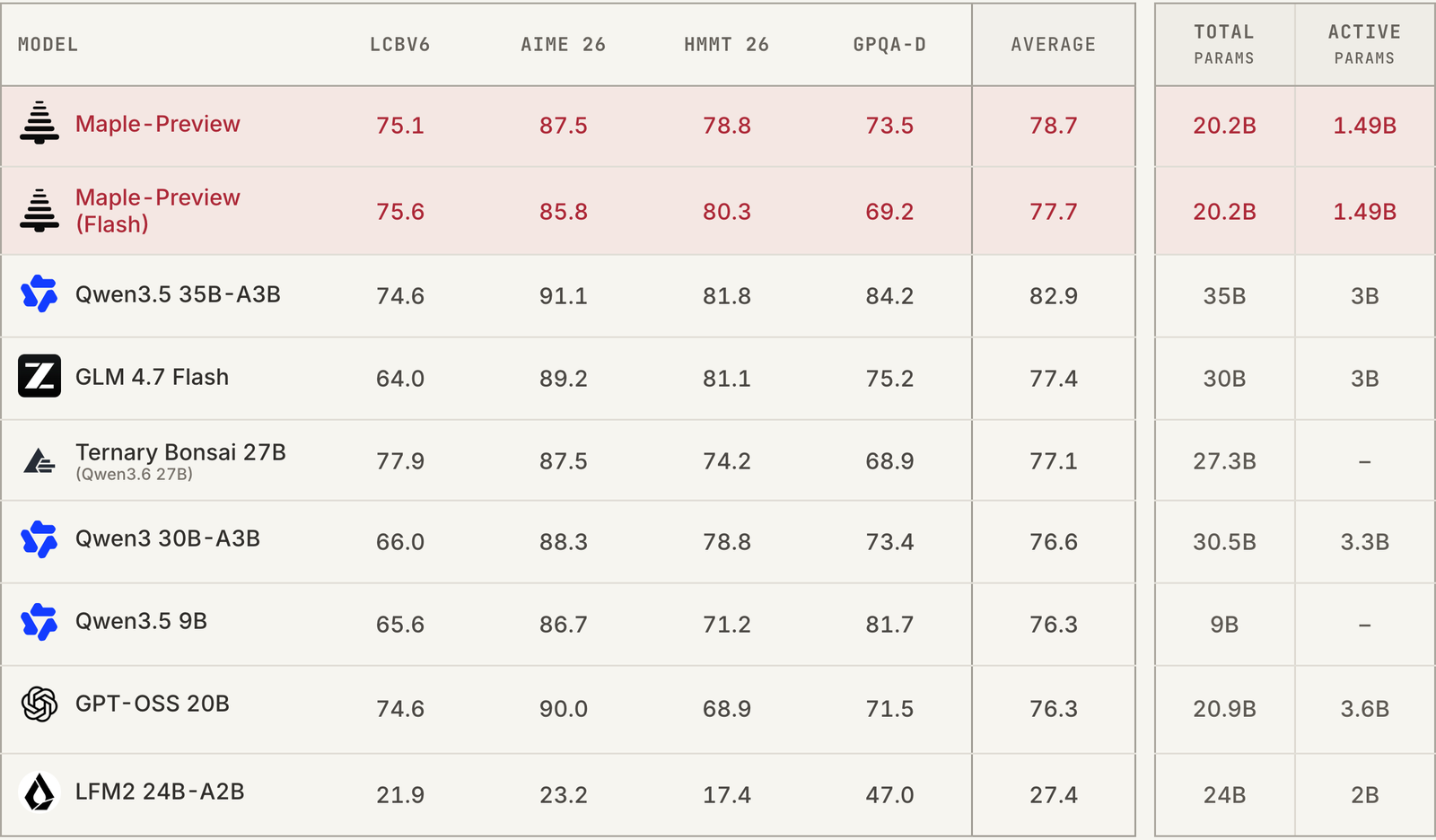
Maple-Preview averages 78.7 across LiveCodeBench v6, AIME 2026, HMMT 2026 and GPQA-Diamond, at 1.49B active parameters. That beats GPT-OSS 20B (76.3), Qwen3 30B-A3B (76.6), Qwen3.5 9B (76.3), GLM 4.7 Flash (77.4) and the other ternary entry, Ternary Bonsai 27B (77.1).
It does not beat Qwen3.5 35B-A3B at 82.9, and the gap is not evenly distributed. On LiveCodeBench Maple actually leads (75.1 vs 74.6); on AIME and HMMT it trails by a few points; on GPQA-Diamond it trails by 10.7 points (73.5 vs 84.2) and is beaten even by Qwen3.5 9B (81.7). That shape — competitive on code and competition math, weak on GPQA — is the signature of a model with strong reasoning and thinner world knowledge, which is exactly what you would predict from a 1.49B active budget where the knowledge has to survive ternarization.
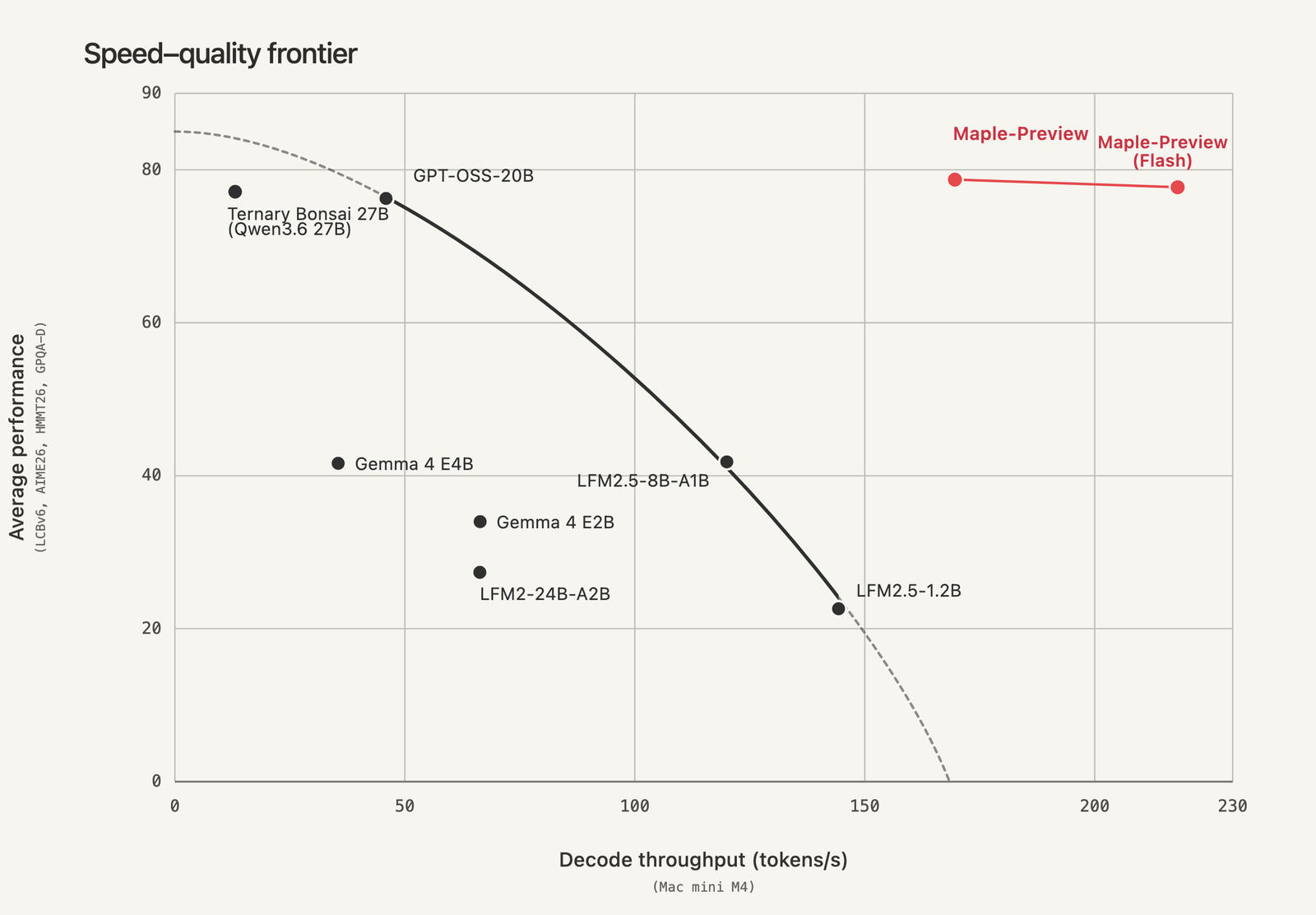
The frontier chart is the release's strongest visual and its most selective one. Maple sits alone in the top right, roughly 3.5× the throughput of the nearest model at comparable quality. But notice who is not plotted: Qwen3.5 35B-A3B and GLM 4.7 Flash, the two models that beat or match Maple on the score table, do not appear on the speed chart at all. In fairness that is close to the point — a 35B model in bf16 does not fit on a Mac mini, which is the whole argument for building this way — but "a new point on the Pareto frontier" is being claimed against a field that excludes the strongest competitor rather than measuring it. The honest version of the claim is narrower and still interesting: among models that fit and run fast on consumer hardware, nothing else is close.
Credit where the card gives it
DeepGrove's own limitations section is short and unusually candid for a launch:
This preview received minimal post-training for agentic tasks and only small-scale general reinforcement learning.
and, in the evaluation section, "this preview is focused primarily on raw reasoning and, as such, may
underperform on agentic benchmarks." That is a lab telling you which axis it did not optimize before
anyone can discover it. It also explains the naming — this is maple-preview, not maple, and the
card says extended training is coming.
The take
The interesting claim here is not the benchmark row, it is that quantization-aware training at 1.58 bits now produces a model that competes with bf16 models several times its active size. That claim survives inspection: the weights really are ternary, the compression really does land near the entropy bound, and the resulting artifact really is small enough to matter on a laptop. Ternary training has been a research thread for a couple of years, mostly at scales small enough to dismiss. A 20B model scoring 78.7 average is harder to wave away.
What is missing is the half that makes the numbers real. The packed checkpoint, the ternary kernels and the Apple Silicon runtime are all unreleased, and the reference implementation in the repository reproduces the model's outputs but none of its economics. Right now you can verify that DeepGrove trained what they said they trained. You cannot yet run it the way they ran it.
Sources: the Maple-Preview model card — README,
config.json, configuration_maple.py, modeling_maple.py, model.safetensors.index.json and the
safetensors headers — as of 2026-08-06. Both figures are DeepGrove's own, downloaded and flattened
onto white. The per-row ternary measurements and the parameter census were taken with HTTP range
requests against the published shards; no checkpoint was downloaded in full and no benchmark was
re-run. Benchmark numbers are DeepGrove's as printed on their table, with no third-party
replication. Both interactives are mine.