2026-10-06 · 18 min · mixture-of-experts · inference-optimization · quantization · offloading · on-device · systems · vllm · qwen
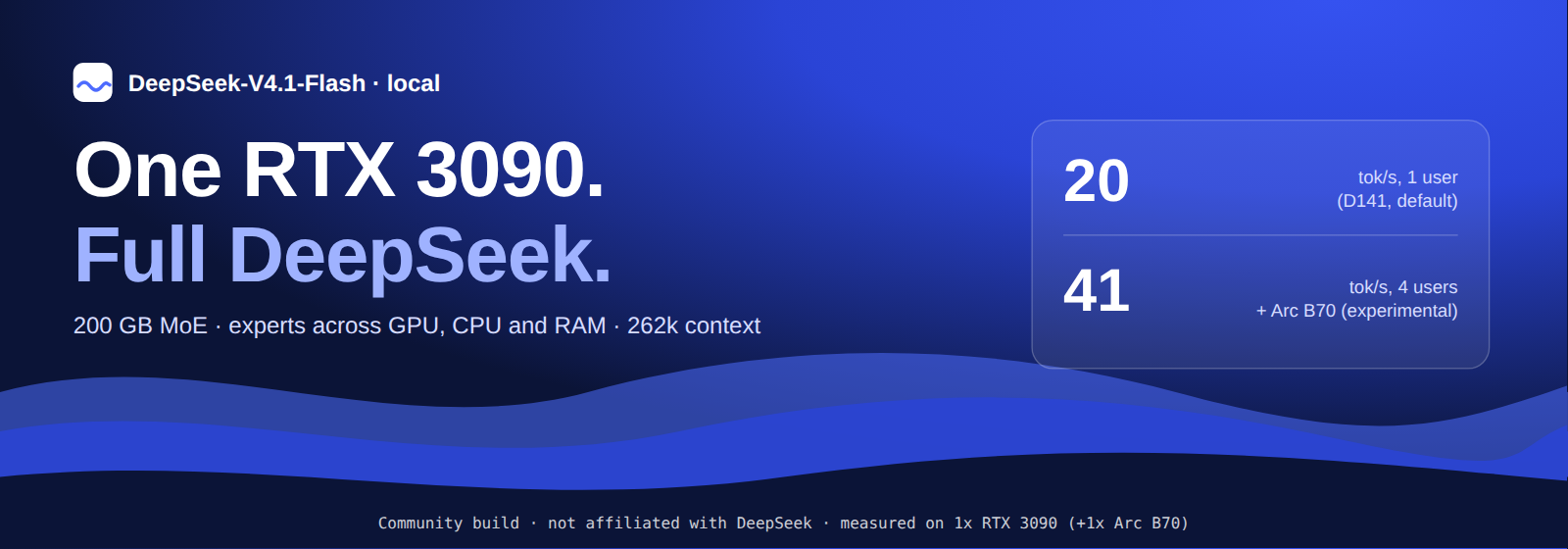
Two posts went past on the same day. @0xSero
wrote "Here's Deepseek-v4.1-Flash running on CPU + DDR4 with just a single RTX 3090",
and in the next post listed what you need: one 3090, 256 GB of DDR4 and 500 GB of
NVMe, with the repository 0xSero/dsv41-flash-offload.
A few hours later @needmorevram
posted a screen recording of "Qwen 3.8 Flash IQ3_S (GSQ RCO) on a single RTX 3090, this
time paired with DDR5-5200 MT/s memory".
DeepSeek-V4.1-Flash carries 543.6 billion routed-expert parameters. The 3090 has 24 GB. Both runs work for the same reason, and the reason has a number attached. This piece derives that number from the model configs, checks it against what the repository measured, and then finds the place where the simple story stops being true.
- license
- MIT
- branch
- main
- tests
- 1 file
- source
- 309.9 kB
- commit date
- 2026-10-05
by size of tracked source at this commit, file counts in brackets; docs, data and vendored trees excluded
local clone, 2026-10-06 at 0d99cdd — branch, commit, commitDate, fileCount, hasTests, languages, license, licenseFile, shallow, testFileCount
shallow clone: counts describe the pinned tree, not the history
What the repository actually runs
The task I set myself was to find the --override-tensor rules. There are none. This
is not llama.cpp, ik_llama or KTransformers. The README pins its stack: vLLM 0.13
from a DeepSeek-V4.1 backport image, Ampere patches from a third party, the
vllm_exl3 plugin with exllamav3 kernels built for sm_86, and a set of patches of
its own that the image applies at build time and checks against SHA-256 receipts.
The weights are Mia-AiLab's EXL3 quant
at an average 3.02 bits per weight, about 205 GB in 41 shards (reported, model
card). EXL3 is exllamav3's format: a trellis code with a codebook (mul1), not the
block-scaled integers of a GGUF Q4_K. That detail matters later.
- architecture
- DeepseekV41ForCausalLM
- task
- image-text-to-text
- library
- exllamav3
- license
- mit
- safetensors
- 41 shards
- largest file
- 8.12 GB
- files
- 51
- downloads
- 489
- likes
- 5
repo last modified 2026-09-12
The README's tier table says where everything lives (reported):
| tier | holds | size |
|---|---|---|
| VRAM, 24 GiB at 936 GB/s | attention (with wo_a expanded to FP16), embeddings, shared experts, LM head, routers, hyper-connections, Engram projections | ~7.7 GiB |
| fp8 KV cache | 1.5 GiB (297,224 tokens) | |
| CUDA graphs, prefill activations, DMA staging | ~5 GiB | |
| mirror cache of the hottest experts | what is left (8.76 GiB = 709 of 15,360 experts in run D107) | |
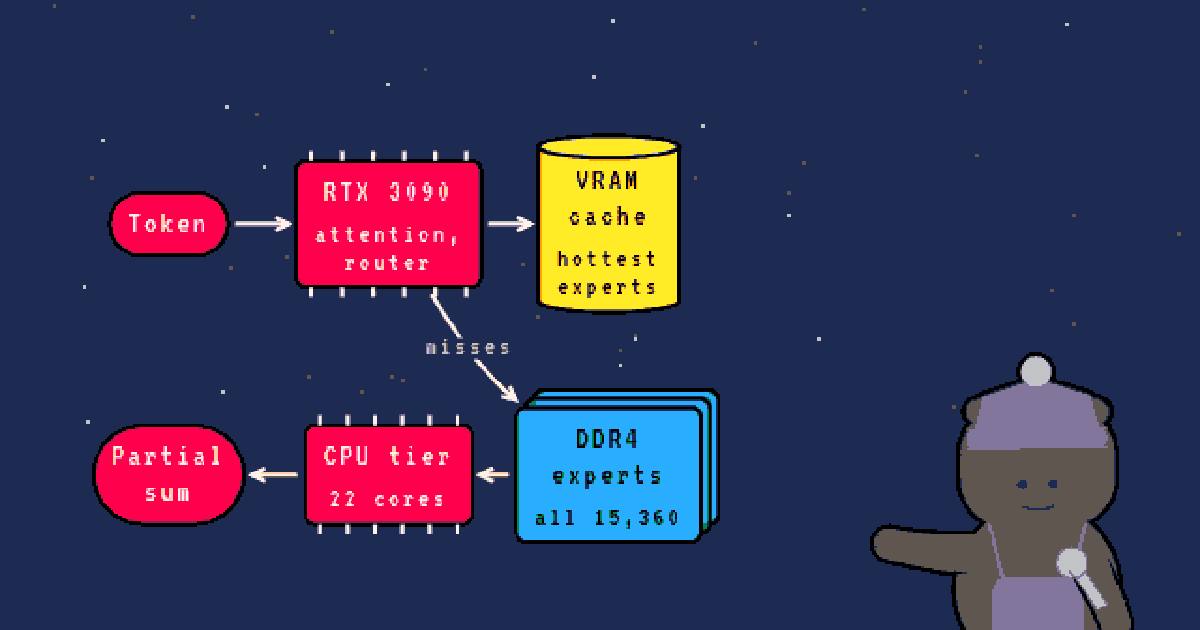
| DDR4, pinned and GPU-mapped | all 15,360 routed experts | 190.5 GiB |
| NVMe, memory-mapped | Engram n-gram tables, fp8 | 189 GiB |
Three of those numbers I can check from the configs. DeepSeek-V4.1-Flash has 40 MoE
layers, 384 routed experts per layer, hidden size 5,120 and expert width 2,304, and
picks 6 experts per token (config.json).
One expert is three matrices of 5,120 × 2,304, so 35,389,440 weights. Then
(reasoned):
- 40 × 384 = 15,360 experts, the README's count.
- 15,360 × 35,389,440 = 543.6B routed weights. At 3.0 bits that is 203.8 GB, or 189.8 GiB; the README measures 190.5 GiB pinned, and the 3.02-bit average gives 191.1 GiB. Close enough that the experts are the whole of that allocation.
- One expert at 3.0 bits is 13.27 MB (12.66 MiB). 709 of them is 8.76 GiB, exactly the cache size the README reports for D107.
The Engram tables are DeepSeek's n-gram memory, the same idea as the 51B-parameter table in Qwen3.8-Flash-Next. They are read a few rows at a time (the README says about 50 small rows per token), so they stay on the NVMe and the page cache absorbs what it can. That is where the 500 GB of disk goes: 219.3 GB of EXL3 checkpoint plus 203.1 GB of the original model's last two shards, which hold the tables.
Why this works at all: decode reads only what it routes to
Generating one token at batch size 1 means reading every weight that token touches. On one stream the GPU has almost no arithmetic to do per byte, so the read sets the pace:
A dense model reads every weight. A routed MoE reads only the experts its router picked. For DeepSeek-V4.1-Flash that is 6 of 384 per layer, 1.6% of the routed weights. Per token, from the config (reasoned):
| DeepSeek-V4.1-Flash | Qwen3.8-Flash-Next | |
|---|---|---|
| routed experts, layers × top-k | 40 × 6 | 48 × 10 |
| weights per expert | 35,389,440 | 4,915,200 |
| routed weights read per token | 8.49B | 2.36B |
| bytes per token at the run's quant | 3.19 GB at 3.0 bits | 1.03 GB at 3.5 bits (IQ3_S) |
| bytes per token at native FP4 (4.25 bits with scales) | 4.51 GB | n/a |
Qwen3.8-Flash-Next's shape comes from its own
config.json: 48 layers, 512
experts of width 640 on a hidden size of 2,560, 10 picked per token. The 3.5 bits is the
average the GSQ-RCO card gives for its IQ3_S file.
So the experts can sit anywhere that can deliver about 3 GB per token. Divide by the bus and you get the ceiling, if nothing else cost time (reasoned, peak theoretical bandwidths, DeepSeek at 3.0 bits):
| where the routed experts are read from | peak GB/s | DeepSeek ceiling | Qwen IQ3_S ceiling |
|---|---|---|---|
| DDR4-3200, 2 channels | 51.2 | 16 tok/s | 50 tok/s |
| DDR5-5200, 2 channels | 83.2 | 26 tok/s | 81 tok/s |
| DDR4-3200, 4 channels | 102.4 | 32 tok/s | 99 tok/s |
| DDR4-3200, 8 channels | 204.8 | 64 tok/s | 198 tok/s |
| PCIe 4.0 x16, GPU reading host memory | ~25 | 7.8 tok/s | 24 tok/s |
| RTX 3090 VRAM, if they fitted | 936 | 294 tok/s | 907 tok/s |
Two things fall out. First, a desktop's two DDR channels put DeepSeek at 16 to 26 tok/s before anything else is counted, which is why 0xSero's host is an AMD EPYC 7443P with eight. Second, streaming the experts over PCIe to the GPU is the worst option on the table: the link is a quarter of a desktop's RAM bandwidth. The fast path is the CPU computing the expert where it already sits.
The dense part does not go away. Attention, the shared expert, the routers and the LM head are read every token from VRAM. Taking the README's ~7.7 GiB of dense weights and removing the 1.32 GB embedding table (one row of it is read per token), the GPU reads about 6.9 GB per token, 7.4 ms at 936 GB/s (reasoned, an upper estimate). The widget below adds that to whichever side of the expert read is slower.
What sits on the GPU, and what does not
The split is the same in every engine that does this, whatever its flags are called:
- On the GPU, always: attention and its KV cache, the router, the shared expert, norms, the LM head. These are read every token, so they belong in the fastest memory. The KV cache also grows with context, and every GiB it takes is a GiB less for experts.
- In system RAM: the routed experts, all of them, as the home copy.
- Back on the GPU, opportunistically: whatever VRAM is left, filled with the experts routed to most often.
- On disk, memory-mapped: n-gram tables like Engram, which are looked up by row and never multiplied.
In llama.cpp that split is usually spelled with --override-tensor (-ot) patterns that
send the exps tensors to the CPU, or --n-cpu-moe. What llama.cpp's flags do not give
you is the third bullet: a cache that follows the routing. That is the part 0xSero's repo
adds, along with the CPU tier that serves the misses.
The cache: 4.6% of the experts, 41% of the reads
The VRAM mirror cache in ct/ct_vllm.py counts how often each (layer, expert) pair
is routed to during decode, decays the scores, and every 16 steps swaps up to 48 of the
coldest residents for the hottest non-residents. The home copy in pinned RAM stays valid,
so a stale pointer can only be slower, never wrong. In run D107 the cache had 709 slots,
4.6% of 15,360 experts, and the README reports a hit rate of 0.408 (reported).
Routing is skewed enough that 4.6% of the experts serve 41% of the reads. With 6 experts routed per layer, 0.592 × 6 = 3.55 misses per layer (reasoned), which matches the README's "only about 3.5 experts per layer miss the VRAM cache".
The misses: a per-layer auction between PCIe and the CPU
A miss can be served two ways. The GPU can read the expert straight out of pinned host
memory over PCIe ("zero-copy"), or the host CPU can compute it in place and send back
only the small output vector. ft_split_k in ct/ft_tier_cu_v.cu decides, per layer,
per step. It sorts the misses, tries every count of them to hand to the CPU, and
keeps the that minimises the slower side:
where and are the layer's hits and misses. The constants are in the code, in
milliseconds: per resident expert, per
zero-copy expert, fixed per CPU job and per CPU expert (the
docker/entrypoint.sh default; ct_vllm.py falls back to 0.16, and D132 notes it was 0.24
before). This is the same PCIe-or-CPU trade the site worked through for
FreeToken, and the source says so: the GPU side is a "vLLM port of
kernels/cpu_avx2/ft_tier_cu.cu", and the campaign is called FreeToken-EXL3.
Those constants are bandwidths in disguise. One expert is 13.27 MB at 3.0 bits, so (reasoned):
- 0.58 ms zero-copy is 23 GB/s, about what PCIe 4.0 x16 delivers.
- 0.03 ms for a resident expert is 442 GB/s, about half the 3090's peak.
- 0.20 ms on the CPU is 66 GB/s of expert weights, 32% of eight-channel DDR4-3200's 204.8 GB/s peak.
With four misses and two hits, the split sends three to the CPU and one over PCIe, and the layer costs 0.71 ms. Forty layers make 28 ms of expert time per token, and the dense read adds about 7.4 ms: a ceiling near 28 tok/s (reasoned). The README's own description is coarser, "the CPU computes them from DDR4 in about 1 ms per layer", which gives 40 ms and 25 tok/s.
Against what was measured
| run | what changed | decode, one stream | source |
|---|---|---|---|
| D030 | experts zero-copy over PCIe, no CPU tier, no cache | 4.10 tok/s | results/D030/sweep.json |
| D107 | + AVX2 CPU tier + 709-slot VRAM cache | 21.34 tok/s | results/D107/sweep.json |
| D119 | 262,144-token default, 8k to 261k prompts | 16.38-20.91 tok/s | results/D119/ |
| D141 | current default | 19.3 tok/s (24.0 at 2 streams, 26.6 at 4) | README |
All reported; I did not run the image, which needs the hardware.
D030 is the PCIe row of the table above: a ceiling of 7.8 tok/s at 25 GB/s for the experts alone, plus the dense read, against 4.10 measured. D107 is the CPU tier: about 28 tok/s from the code's own constants against 21.34 measured. Both land at 55-76% of their ceilings, which is a normal place for a hand-built pipeline with a CPU/GPU handshake in every layer and NVMe reads in the middle.
Now the point I did not expect. If the CPU tier ran at the bus's peak, the 3.55 misses per layer would cost 1.89 GB per token, 9.2 ms on eight channels (reasoned). The code budgets 0.20 ms per CPU expert, three times that rate. The DDR4 bus is not the bottleneck on this machine. The CPU is.
The reason is the format. EXL3 stores each weight as a few bits of a trellis code that
has to be decoded through a codebook before it can be multiplied. A Q4_0 block is a
scale and sixteen bytes of nibbles; an EXL3 weight is arithmetic. On 22 Zen 3 cores with
AVX2, that arithmetic runs out before the memory controller does. The
Strata article found the same thing from the
other side: its paper measures 23-26 GB/s on six cores for llama.cpp's i-quants, limited
by codebook arithmetic, against about 42 GB/s for a plain 2-bit format with a
hand-written kernel.
So the upgrade that helps 0xSero's build is more or faster cores, or more VRAM for the cache, not faster RAM. The repository's experimental branch is evidence for the second: an Intel Arc B70 added as a further expert tier takes four streams from 26.6 to 41.3 tok/s, with its quality A/B still pending (reported).
Prefill is a different machine
Decode touches 6 experts per layer per token. Prefill touches nearly all of them: the README says a 1,024-token chunk hits almost all 384 experts in all 40 layers, so the baseline moved about 203 GB over PCIe per chunk, about 8 s, and stayed near 95 tok/s. The fix is the opposite of decode's: make the chunk big (16,384 tokens in D061) and stream every expert to the GPU once per chunk with the copy engine, running busy experts as FP16 GEMMs. Prefill went to 690-790 tok/s from 8k to 261k (reported). A 261,000-token prompt still takes 341.6 s to its first token, and prefix caching turns a cached 131k-token agent turn into 0.76 s instead of 200.8 s.
During prefill the VRAM expert cache is released to make room and refilled after four decode steps. That is why the 8k row of D119 decodes at 16.38 tok/s and the longer rows near 20.5: the README says the cache is still re-warming after a short answer.
What it costs in quality
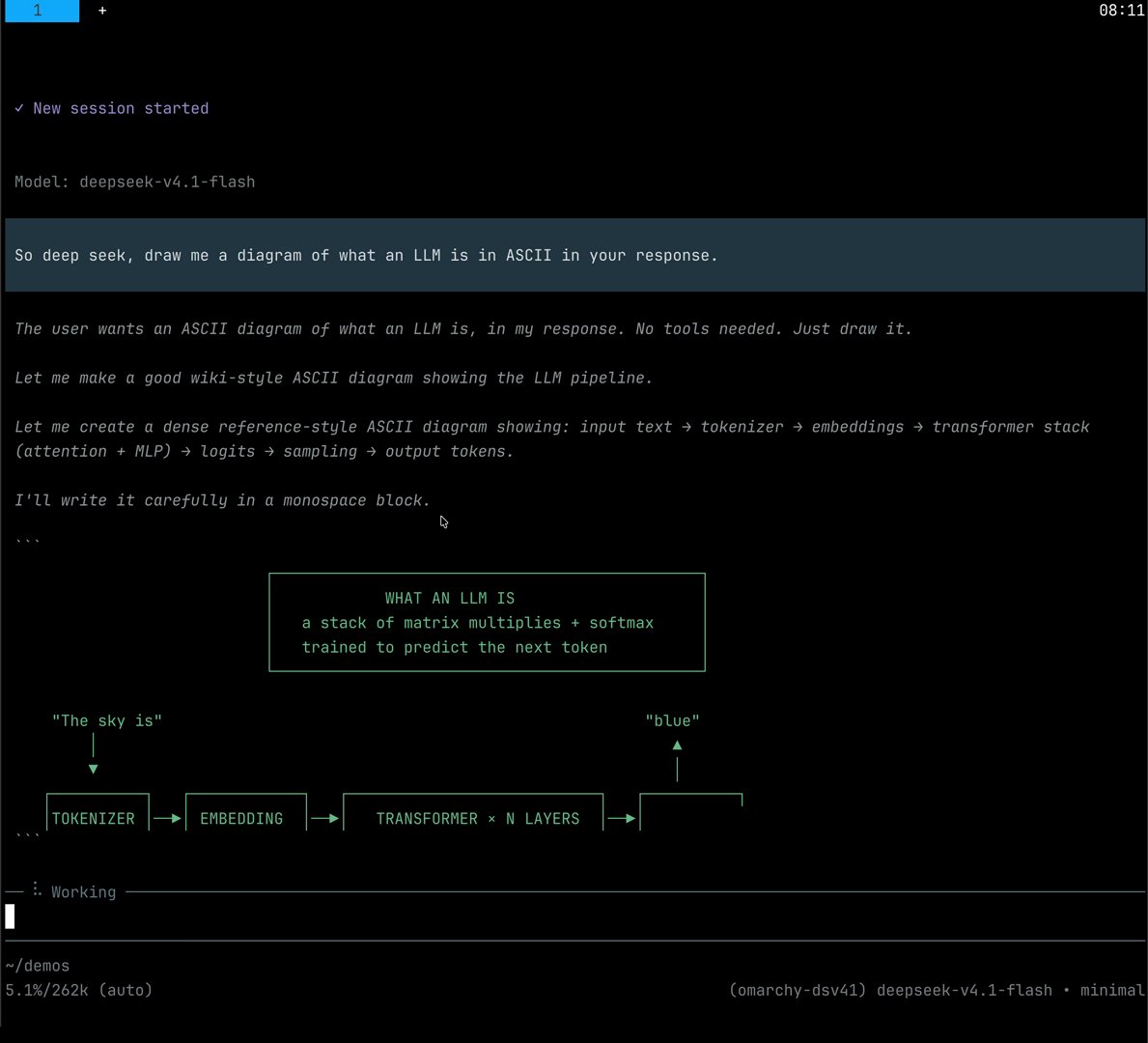
The banner says "Full DeepSeek". It is the full model at 3.02 bits per weight, and the repository is unusually direct about what that and its own kernels cost:
- The busy-expert FP16 GEMM in prefill reconstructs weights and accumulates in a different order than the fused kernel. Against a full-vocabulary teacher-forced reference (12 prompts, 416 positions), top-1 agreement is 0.9856 and mean KL 0.0068 nats, and the README marks this a fail against its own inherited guard (top-1 0.988 or better, KL 0.00103 or less). The median KL is 2.8e-6, so most positions match; a few move.
- The CPU tier was checked against the GPU kernel on its own: relative RMS 0.0037.
- The D141 quality run,
results/Q001-d141-quality, passes 50 of 50 task runs at one and four streams: needles at 8k, 64k and 200k, executed code tests, four integer maths answers, an essay of 3,131 words. One maths key was wrong, the README says, and the model was right.
None of this is a comparison with the FP8 and FP4 original on a benchmark suite. Nobody has published one for this quant that I could find, so how much 3.02 bits costs on hard tasks is open.
The Qwen run on DDR5
The second post is only a video, but it is a screen recording of a dashboard, and the dashboard prints its numbers.
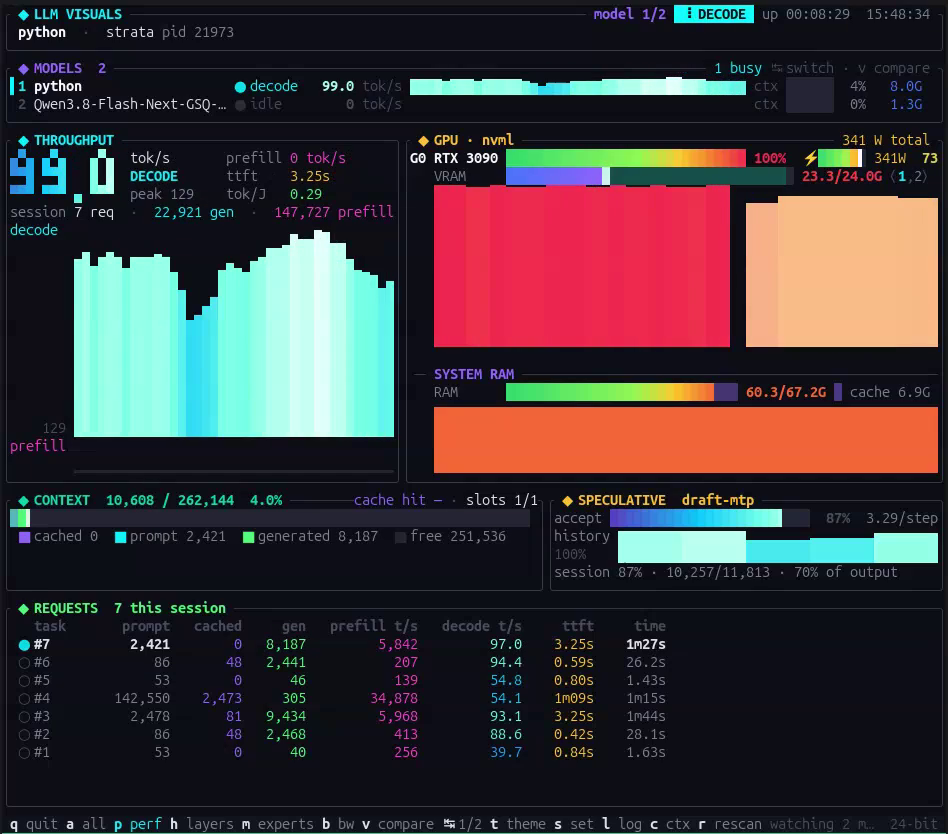
What the frame shows (reported, read off the recording): the process is strata,
the engine the site covered in TensorFold and Strata.
VRAM is at 23.3 of 24.0 GB and system RAM at 60.3 of 67.2 GB. The MTP drafter is
accepting 87% and committing 3.29 tokens per step. A 2,421-token prompt decodes at
97.0 tok/s; an earlier request with a 142,550-token prompt decoded at 54.1. In the
replies the author says the CPU is an i5-13600K, and that "I tested the 3090 on both
DDR4 and DDR5 and the difference was so tiny."
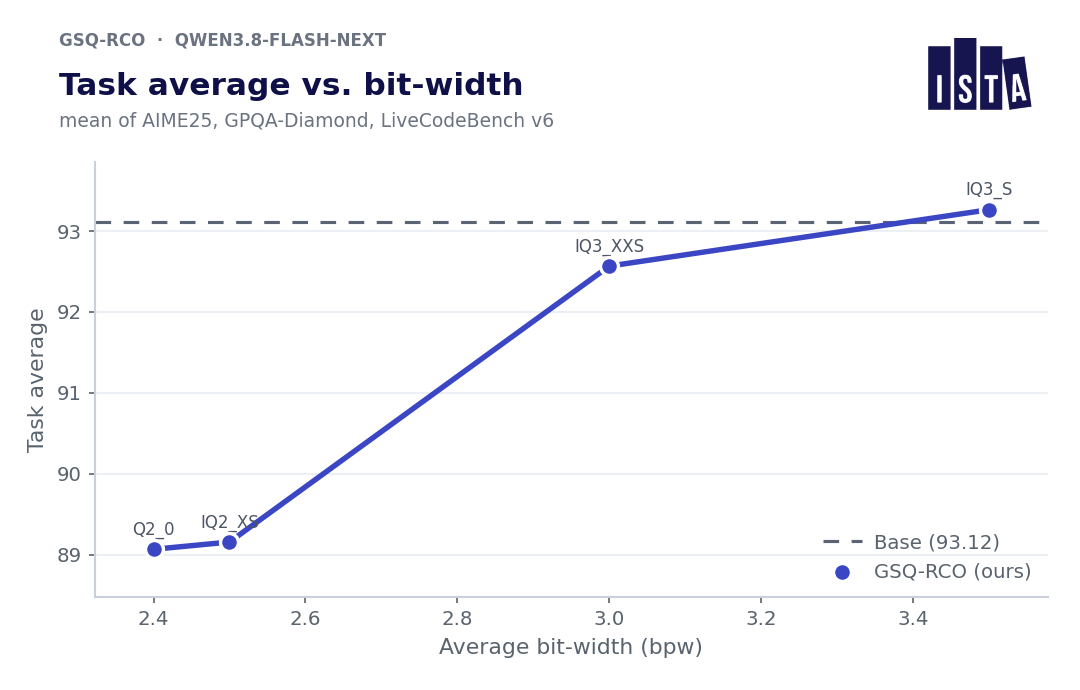
The file is ISTA-DASLab's GSQ-RCO IQ3_S: 3.50 bits on average over the transformer weights, a 54.8 GB first shard that must be resident and a 28.8 GB n-gram shard that can stay on disk (reported). GSQ learns the grid assignment per weight; RCO picks a quant type per tensor under a size budget. The card's plot puts IQ3_S at the base model's task average:
Now the arithmetic (reasoned). At 97 tok/s and 3.29 tokens per step, one step takes 33.9 ms. A step that commits 3.29 tokens reads up to 3.29 × 1.03 = 3.4 GB of experts, if no two tokens share one. Two channels of DDR5-5200 move 83.2 GB/s at peak, so even with the CPU at full bus speed, at least 26% of those reads must come from the VRAM cache to fit in the step. If the CPU runs i-quants at Strata's own measured 23-26 GB/s, the cache has to serve about 78% of them. Strata's paper measured 72% on a 12 GB card; a 24 GB card holds more experts, so 78% is plausible. The OffloadCeiling widget's Qwen preset is that solution, not a measurement of the hit rate.
And "DDR4 and DDR5 … so tiny" is what the second case predicts. If the CPU tier runs at 25 GB/s, a bus that offers 51 or 83 GB/s is not the limit, and swapping it changes little. I did not measure the DDR4 run; the author did not post its number. One reply reports 93 tok/s on two 3090s and 128 GB of DDR4 (reported, unverified).
What to take from both
- The number that decides feasibility is routed bytes per token, not total size: 3.19 GB for DeepSeek-V4.1-Flash at 3.0 bits, 1.03 GB for Qwen3.8-Flash-Next at IQ3_S. Divide by your RAM's real bandwidth before buying anything.
- Capacity decides whether it runs; it does not decide the speed. 0xSero's build needs 256 GB because 190.5 GiB of experts must be pinned. Twice the channels would not make it twice as fast.
- A codebook quant moves the bottleneck onto the CPU's arithmetic. At the repo's constants the CPU reaches 32% of eight-channel DDR4's peak; the i-quants on Strata reach 23-26 GB/s on six cores. More cores, a simpler format on the CPU side, or more VRAM for the cache move the number. Faster RAM mostly does not.
- The VRAM left after the dense weights is an expert cache, and it is worth a lot. 4.6% of DeepSeek's experts served 41% of reads. KV cache competes for the same bytes, which is why the 262k-context default has a smaller cache than the 64k runs.
Related reading on the site: FreeToken for the PCIe-versus-CPU split as a measured policy, VRAM is a policy for what a residency choice costs when it is not stated, and GLM-5.3-Flash on four mining cards for another Ampere-only vLLM fork.
What I could not check
- The tok/s numbers. All decode and prefill speeds above are the repository's own result files or a frame of a recording. I did not run either engine.
- The DDR4 speed of 0xSero's host. The README says eight channels of DDR4 on an EPYC 7443P but not the DIMM speed; the 204.8 GB/s peak assumes DDR4-3200, the fastest that CPU supports.
- The dense-read estimate. 6.9 GB per token from the README's 7.7 GiB is an upper bound; some of those weights may not be read every token.
- Quality of the 3.02-bit DeepSeek against the original on standard benchmarks. Not published.
- The KTransformers comparison a reply posted (an RTX PRO 6000 and 512 GB of DDR4 at 37 tok/s for one stream, on the original FP4 experts) is one person's run with no receipts.