2026-08-23 · 11 min · speculative-decoding · inference · block-diffusion
Why read this
Notabletop 60%Interactive walk-through of why a parallel drafter needs selection rather than depth, and why acceptance length only matters at serving concurrency.
- Interactive explanations
- Runs on a consumer GPU
- Widely used
Inference & servingResearch paper
How this was scored
- Is it new?
- 2 of 3: A real new idea, method or capability
- Can I trust it?
- 1 of 3: Spot-checks a few numbers
- Can I run it?
- 2 of 3: Open code or weights with real limits
- Will I understand it?
- 3 of 3: Mechanism carried by interactives built from real code or data
- Can I act on it?
- 2 of 3: A concrete recipe, numbers or comparison
- Will it last?
- 1 of 3: Relevant for months
- Does it affect many?
- 2 of 3: A widely used model, tool or lab release
- Only here?
- 1 of 3: Some original analysis
Score 61 of 100, ranked 316 of 577 rated articles. Each question is answered 0–3 by hand, and a 3 is rare. How articles are scored
There is one number in DFlash 2 that makes the rest of the post feel inevitable.
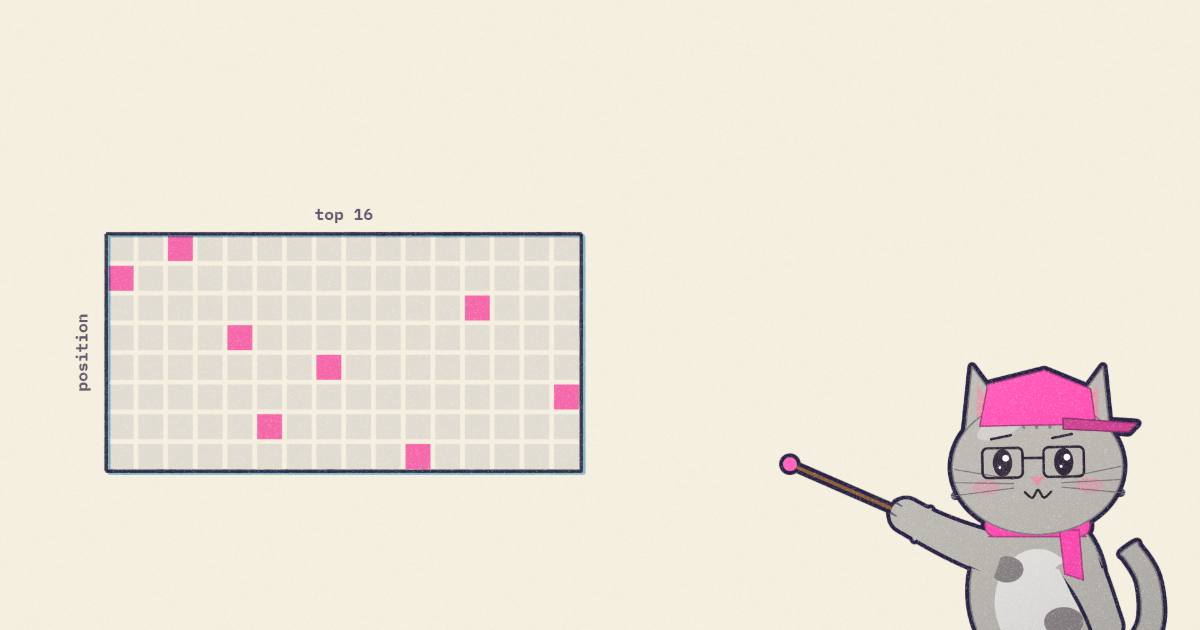
At the first position of a draft block, a five-layer DFlash drafter's top pick is correct 85.4% of the time. The correct token is somewhere in its top sixteen candidates 99.5% of the time.
The drafter is not failing to know the answer. It is failing to choose it. And the candidates it needs are already sitting in a tensor it already computed.
| Who | Inco AI · code at z-lab/dflash · 18 Aug 2026 |
| What | two additions to parallel block drafting: a pairwise path selector and a two-tap dynamic convolution |
| Cost | +1.3% draft–verify cycle latency, ~3% more drafter parameters |
| Gain | +1.05 accepted tokens per pass over DFlash (21%), +0.48 over DSpark |
| Losslessness | greedy output matches the target exactly; sampling preserves its distribution |
| Out today | drafters for Qwen3.8-27B and Meta's Muse Glimmer |
| Throughput | 2.7–3.4× autoregressive on Qwen3.8-27B, 3.1–4.6× on Muse Glimmer |
- architecture
- DFlash2DraftModel
- task
- text-generation
- library
- transformers
- license
- apache-2.0
- safetensors
- 1 shard
- largest file
- 3.85 GB
- files
- 5
- downloads
- 355.1K
- likes
- 290
repo last modified 2026-08-19
The setup, briefly
Speculative decoding exists because decode is memory-bound: the cost of a forward pass is dominated by streaming weights out of DRAM, not by the arithmetic. If a cheap drafter guesses the next k tokens, the target model can verify all of them in one pass, amortizing that weight load across however many turn out to be right.
For years the drafter itself stayed autoregressive — one token at a time, which is a strange thing to accept when the entire premise is that sequential decoding is the problem. DFlash, released in January and now in SGLang, vLLM, TensorRT-LLM and llama.cpp, made the draft one-pass too: every position of the block predicted in parallel, block-diffusion style. NVIDIA measured up to 15× throughput with it on Blackwell, Google reported 3× more tokens per second on TPUs, and CoreWeave's production Kimi K2.7 Code endpoint runs it by default. Meta ships one with Muse Glimmer, as do Poolside, Xiaomi and NVIDIA with their own models.
Predicting in parallel buys the speed. It also creates the problem this post is about.
Every pick is plausible; nothing makes them fit
When each position is predicted independently, each token is reasonable on its own terms and nothing coordinates them. The characteristic failure is a stutter: two neighbouring positions both independently deciding the most likely next word is decoding, producing "good for decoding decoding". Verification kills the block at the first mismatch, and the whole tail is discarded.
Recent methods buy coherence by bolting a sequential head onto the drafter — DSpark and Domino both rewrite each position's full-vocabulary distribution conditioned on the token before it. That works. It also reintroduces exactly the autoregressive step the parallel design was built to remove.
DFlash 2's question is whether that is necessary, and the answer comes from measuring the drafter's own candidate lists.
Turn those conditional recall rates into acceptance length — a block is accepted up to its first mistake, plus the verifier's own token — and the top-pick row gives 4.27 while the top-16 oracle gives 6.79. Two and a half tokens per pass of pure selection headroom, requiring no new predictions at all.
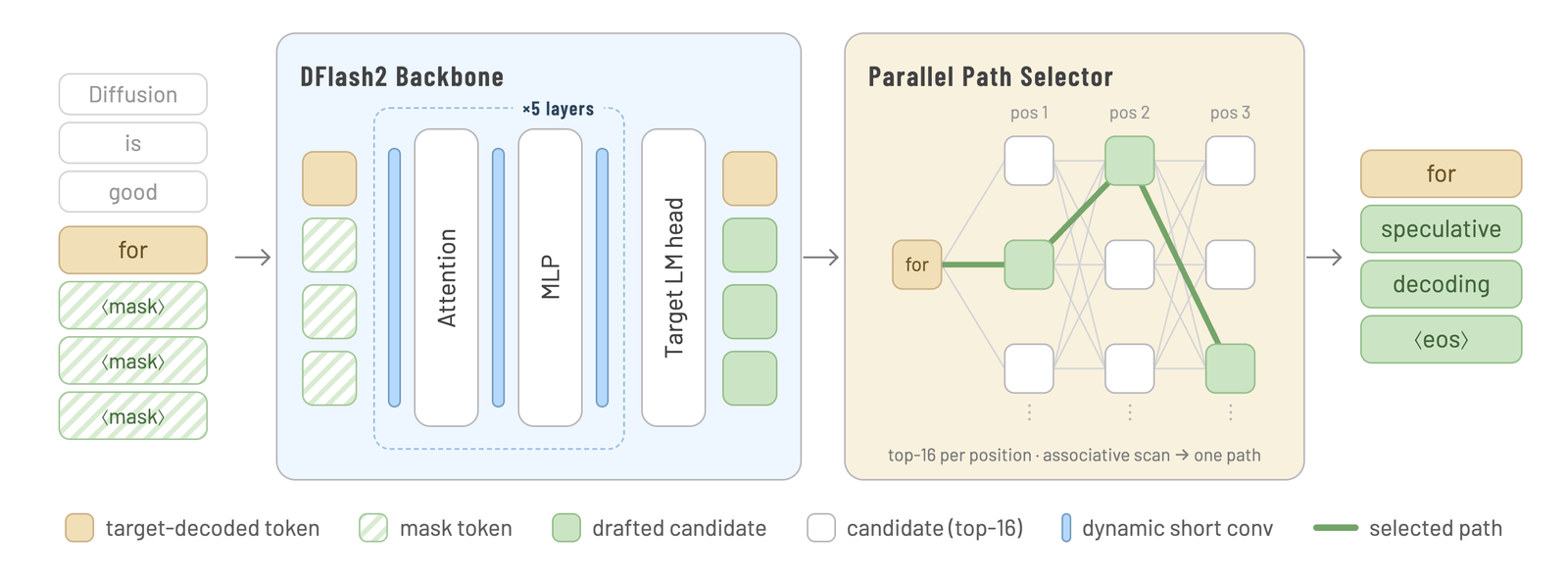
So DFlash 2 keeps the top 16 candidates at every position and scores every adjacent pair:
The first term is DFlash's own logit for b. The second asks how well b follows a: A and B give each token a compact 256-dimensional embedding, matched under a context gate H(h_t) that decides which parts of the match count — a low-rank bilinear attention over adjacent candidates. Every pair at every position is scored in one shot, with no extra backbone or LM-head pass. The only sequential work left is a walk over precomputed scores: greedy follows the best successor, sampling draws from the same scores, and rejection sampling restores the exact target distribution.
Suffix decay is a backbone problem, and a local one
The selector cannot fix everything, and the recall table says why: even the oracle decays, from 99.5% at the first position to 87.8% at the last. No amount of choosing helps when the candidates themselves have run out. That is a backbone problem.
Depth fixes it — a fifteen-layer drafter holds the end of the block far better than a five-layer one. But the curves are nearly identical at position zero, which means ten extra attention blocks are adding capacity everywhere including where none was needed, at 15.2% more cycle latency. Indiscriminate.
The targeted fix comes from looking at where the drafter's attention actually goes. It has two jobs: read the context before the block, and model dependencies inside it. And it progressively abandons the second — within-block attention mass falls from 30% in layer 1 to 8% in layer 5, and what remains concentrates in a shrinking handful of heads.
So split the jobs. A block is only 4 to 16 tokens long and the tightest dependencies are between neighbours, so the natural operator is a very short convolution: two taps, one on the current position and one reaching a single position back, with content-adaptive weights.
One sits before and after each attention and MLP sublayer of every drafter layer. Each coefficient combines a learned base kernel with a small correction from the current hidden state, shared across every 16 channels. The first position reads the last verified token's representation; every later position reads its predecessor's. Information crosses the block while all positions still compute in parallel — the convolution is block-local and stateless, so it drops in without touching attention, the LM head, or verification.
With 16.5M added parameters (3%), five layers plus convolution lands on the fifteen-layer curve. And afterwards the average within-block attention across layers 4 and 5 falls from 9.4% to 0.5% — attention hands the local job over and goes back to reading context, which is a satisfying confirmation that the diagnosis was right rather than merely a lucky architecture change.
What the two together are worth
On Qwen3.5-4B, mean acceptance length across five benchmarks: MTP 4.54, DFlash 4.92, DSpark 5.49, DFlash 2 5.97. That is +1.05 tokens over DFlash — 21% — and +0.48 over DSpark, for a combined 1.3% of cycle latency. Position by position on MATH-500, DFlash 2 holds near 86% all the way to the fifteenth draft position while every baseline finishes 6 to 9 points below it.
The two shipped drafters tell the same story against each model's official speculation path. On Qwen3.8-27B, DFlash 2 averages 4.80 against the model's built-in MTP at 4.28 and a community DSpark drafter at 3.62. On Muse Glimmer, 5.70 against the official DFlash drafter Meta ships at 4.44.
Why acceptance length is not a leaderboard statistic
Here is where I would push back on how these results usually get read — and, to be fair, where the model card is more honest than the blog post.
At batch size 1, every speculative method is a clear win and the ranking barely matters. At concurrency 32, four of MTP's five tasks and four of DSpark's are slower than not speculating at all. MT-Bench is the worst cell: 0.77× for MTP, 0.74× for DSpark. Turning the feature off would make those servers faster.
None of that is a bug. Batching already amortizes the weight loads that speculation exists to amortize, so as arithmetic intensity climbs, verifying seven tokens to keep three is just waste. Which reframes what an extra accepted token per pass is for: not a better score, but the difference between the technique still applying at your serving concurrency and not. DFlash 2 stays above water in all fifteen cells. It is the only one that does.
What I would want to know next
The oracle is still at 6.79. Pairwise scoring is, by the authors' own description, the simplest selector they could think of, and it claims about 0.34 of a 2.5-token gap. A trigram term, a wider beam, or a learned scan over three-token windows all seem obviously worth trying — and the fact that a low-rank bilinear form over adjacent pairs gets this far mostly suggests nobody has looked hard yet.
The 16 is a hyperparameter nobody varied. Top-16 per position at block size 8 means 16 × 8 pairwise blocks to score. There is no ablation on that width in the post, and it is the one knob that trades selector cost against how much of the oracle is reachable at all. Recall@16 is 99.5% at position 0; what is Recall@4, and does the cheaper selector get most of the same lift?
The convolution's win is measured on one family. The two-tap kernel closing the gap to fifteen layers is a strong result, but it is shown on Qwen3-4B, and "suffix decay is local" is an architectural claim about how much within-block dependency a drafter needs. Models with different block sizes — Muse Glimmer runs 16, twice Qwen3.8-27B's 8 — are exactly where a one-position reach should start to strain.
Lossless is doing real work in the pitch, and it should be checked. Greedy output matching the target exactly is a property of the verification rule, not of the drafter, so it holds by construction. Sampling preserving the target distribution is a stronger claim, resting on rejection sampling over the selector's scores rather than over the drafter's raw logits. The post asserts it; I would like to see the distributional test.
The line I keep coming back to
Choosing is cheaper than predicting.
That is a general principle wearing a speculative-decoding costume, and it applies well beyond drafters. A model that has already computed a distribution over candidates has done the expensive part. The mistake is treating the argmax as the answer when the distribution was the answer — and then, having thrown away the rest, paying a second full model to reconstruct what you discarded.
DFlash 2 gets an extra token per verification pass for 1.3% more latency because it stopped throwing the shortlist away. In seven months DFlash went from a paper to three and a half million downloads and an ecosystem of vendor-shipped drafters; the sequel is a two-million-parameter bilinear form and a two-tap kernel. Inference really is nowhere near its floor.
Update, 6 October 2026
A summary on X said
Qwen3.8-27B reached about 381 tok/s on one RTX 3090. An earlier post it links names the
source: syv-ai/HyperQwen,
a patch series on a pinned vLLM, measured at a 250 W power cap. The figures below are
the repo's own (reported). I read the docs; I did not run it.
The trick sits around DFlash 2, not in it. The block drafter proposes its usual 7
tokens. A lookup patch then finds the most recent earlier occurrence of what was just
generated, anywhere in the request's own history, and proposes what followed it. Those
tokens cost the drafter nothing, so the verify block is no longer capped at 7:
DFLASH_TOKENS=15 verifies 16 positions per step. It is prompt-lookup decoding fused
with the drafter. A short match is used only if the drafter agrees on its first two
tokens, and greedy outputs stay token-identical.
Measured on a 25k-token document, greedy, tokens per step / tok/s:
| task | DFLASH_TOKENS=7 | DFLASH_TOKENS=15 |
|---|---|---|
| reproduce the first 60 lines verbatim | 7.83 / 260 | 14.97 / 381 |
| free-form summary | 2.08 / 69 | 2.13 / 71 |
| C1, 8 short chat prompts | 3.33 / 131 | 3.42 / 133 |
So 381 is the copy cell: about 15 of 16 positions accepted because the answer is the prompt. On a summary of the same document the stack does 71. The long block also costs 4 request slots instead of 8 and 56k of context instead of 64k. Prefix caching is separate: a second question on the same document reaches its first token in 0.56 s instead of 22.4 s.
Of the summary's 82 → 114 → 138 progression, only the 114 (the tuned MTP path) is in the current docs; the default now quotes 127 tok/s single-stream.