2026-10-14 · 18 min · liquid-ai · mixture-of-experts · hybrid-attention · on-device · kv-cache · agents · tool-calling
Why read this
Solidtop 85%Counts the 24B-A2B from its headers and GGUF: what 2B active excludes, why its KV cache matches Qwen3.6's, and what 184 tok/s costs in bandwidth.
- Facts measured from source
- Widely used
- Concrete numbers to act on
LLM architectureNeeds a workstation GPUCustom licencePractitioner model
How this was scored
- Is it new?
- 1 of 3: An incremental tweak
- Can I trust it?
- 2 of 3: Measures key facts from files, code or configs
- Can I run it?
- 2 of 3: Open code or weights with real limits
- Will I understand it?
- 2 of 3: Mechanism from first principles with figures
- Can I act on it?
- 2 of 3: A concrete recipe, numbers or comparison
- Will it last?
- 1 of 3: Relevant for months
- Does it affect many?
- 2 of 3: A widely used model, tool or lab release
- Only here?
- 1 of 3: Some original analysis
Score 58 of 100, ranked 327 of 517 rated articles. Each question is answered 0–3 by hand, and a 3 is rare. How articles are scored
Liquid AI's thread on 13 October opens with a list: "24B total parameters, 2B active per token", a 131K context, a 128K-token vocabulary, 33T pretraining tokens, a reasoning model, and the line that will get quoted: it "Performs competitively with Qwen3.6-35B-A3B, a model with ~50% more total and active parameters, on agentic and tool-use tasks." The next posts add 184 tokens per second on an Apple M5 Max, over 21k output tokens per second on one NVIDIA B300, and reinforcement learning inside four agent harnesses.
I read the checkpoint instead of the thread. Every tensor shape below comes from the ten safetensors headers, fetched with HTTP range requests (eight bytes for the header length, then the JSON header, never the weights). The quantized numbers come the same way from the header of the published Q4_K_M GGUF. Where a number is mine I say measured; where it is Liquid's and I did not re-run it, reported; where it is arithmetic on the other two, reasoned.
- architecture
- Lfm2MoeForCausalLM
- task
- text-generation
- library
- transformers
- license
- other
- safetensors
- 10 shards
- largest file
- 4.95 GB
- files
- 23
- downloads
- 4.1K
- likes
- 251
- languages
- en, ar, zh, fr, de, ja
These add to 23.97B, not the 23.97B total — expected when a packed format stores more than one value per element.
repo last modified 2026-10-13
The shape, from config.json
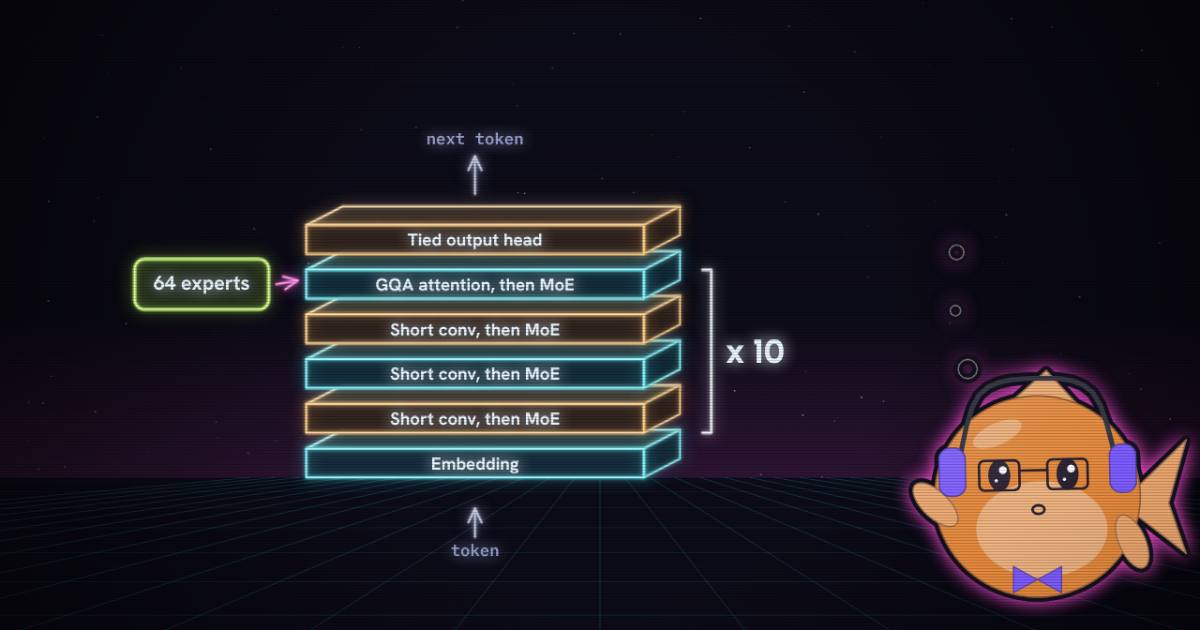
config.json declares Lfm2MoeForCausalLM, hidden_size 2048, 40 layers, and a
layer_types list that reads conv, conv, full_attention and then conv, conv, conv, full_attention nine more times, ending on a conv. So 30 convolution
blocks and 10 attention blocks (measured), attention at layers 2, 6, 10 and so
on up to 38. The card says the same: "40 (30 double-gated short convolution blocks
- 10 GQA)". The blog says the architecture is unchanged from LFM2-24B-A2B; what changed is a context window grown from 32,768 to 131,072 tokens and a vocabulary doubled from 65K to 128K.
Each block is a mixer followed by a feed-forward network, both pre-normed. The mixers are of two kinds.
The attention blocks are ordinary grouped-query attention with QK-norm: 32
query heads of 64 dimensions, 8 key/value heads, so k_proj and v_proj are
512 by 2048 (measured). Four query heads share each KV head. These ten
layers are the only ones that look further back than two tokens.
The convolution blocks are what makes this an LFM. I read the block in
transformers' modeling_lfm2_moe.py. An input projection widens the
2048-dimensional token to three 2048-dimensional vectors, B, C and x. Then:
where is elementwise multiplication and is a causal
depthwise convolution with a kernel of three (conv_L_cache: 3): each of the
2048 channels mixes the current token with the two before it, with its own three
weights. B gates what goes into the convolution and C gates what comes out,
which is the "double-gated" in the card. There is no softmax, no state that grows
with the sequence and no look-up past two tokens. The cost per token is two
matrix multiplies and 6,144 multiply-adds for the taps.
Why build most of a model from something this short-sighted? Liquid's bet is that much of what a mixer does is local, and the three-tap convolution does local mixing with a cache that never grows: decode keeps the last three inputs per channel, 12,288 bytes per layer in BF16 (reasoned, from the shapes). The ten attention layers carry everything long-range. This is the same bet Qwen3.6 makes with Gated DeltaNet and Mamba hybrids make with state-space layers; Liquid's version does the least work per token of the three. The LFM2 technical report (arXiv:2511.23404, cited by the card) is where Liquid argues for it; the background on attention caches is in attention and the KV cache, byte by byte, and on selective state spaces in Mamba from first principles.
The feed-forward side. Layers 0 and 1 have a dense SwiGLU FFN, 2048 to 11,776
and back (num_dense_layers: 2). The other 38 have a mixture of experts: 64
experts, each a SwiGLU of 2048 to 1,536 and back (9,437,184 parameters), a
2048-by-64 router, and top-4 routing (measured). There is no shared expert in
the checkpoint. The router, per the transformers code, scores experts with a
sigmoid, adds a learned per-expert bias (the 38 F32 expert_bias tensors, 64
values each) to decide which four run, then weights the four by their unbiased
scores renormalized to sum to one. The bias changes the selection, not the mix:
that is the auxiliary-loss-free load-balancing trick DeepSeek-V3 popularized.
The mixture-of-experts explainer covers the
general mechanism.
The widget lays out the 40 blocks as the config orders them; click one for its parameters. One thing it makes plain: a conv mixer (16,783,360 parameters) is larger than an attention mixer (10,485,760), because its input projection is three times the hidden size where attention's K and V are a quarter of it. The conv blocks are cheap in cache and in sequence-length scaling, not in weights.
Counting the parameters
The ten headers hold 7,610 tensors. Summing their shapes gives 23,971,587,712 parameters (measured), all BF16 except the 2,432 F32 expert biases. That is the 24B, honestly rounded. Of it, 22,951,231,488 (95.7%) are routed-expert weights (measured). Everything that is not an expert, the mixers, the two dense FFNs, the routers, norms and the embedding, is about 1.02B.
The embedding is 128,000 by 2,048, 262,144,000 parameters, and tie_word_embeddings
is true: the same matrix is the input embedding and the output head. There is no
lm_head tensor in the files.
"Active" depends on whether you count that matrix. A token's embedding is one row looked up, not a matrix multiply. But the output head multiplies the final hidden state by the whole 128,000-row matrix, every token. Here is what one token runs through:
| Part | Parameters run per token |
|---|---|
| 4 of 64 experts in each of 38 MoE layers | 1,434,451,968 |
| 30 short-conv mixers | 503,500,800 |
| dense FFN, layers 0 and 1 | 144,703,488 |
| 10 GQA attention mixers | 104,857,600 |
| routers, norms, expert biases | 5,150,336 |
| subtotal, without the output head | 2,192,664,192 |
| output head (tied embedding) | 262,144,000 |
| total, with the output head | 2,454,808,192 |
All measured. The card's spec line says "Active parameters: 2.45B", which is the second total to the digit: Liquid counts the head. The model's name, the thread and the docs say "2B active", which is the first total (2.19B) rounded down. Neither is wrong. They are two different numbers, and the "~50% more" claim below only works with one of them.
Toggle the head and the share of the checkpoint a token touches moves from 10.2% to 9.1% (measured). The other 60 experts in every MoE layer, 21.5B parameters, sit in memory and do nothing for that token, and they are why a 2B-active model needs 15 GB of RAM.
The cache: a quarter of an all-attention stack, the same as Qwen3.6
Decode memory that grows with context lives in the ten attention layers. Each stores a key and a value per token: 8 heads by 64 dimensions, twice, at 2 bytes. That is 2,048 bytes per layer and 20,480 bytes per token (reasoned). At the full 131,072 tokens it is 2,684,354,560 bytes, 2.5 GiB (reasoned). The 30 conv layers add 368,640 bytes, fixed.
Two comparisons, both reasoned from the configs:
- The same 40 layers, all attention with the same 8 KV heads: 81,920 bytes per token, 10 GiB at 131K. The hybrid saves three quarters, exactly the share of layers it replaced. Drop the grouping too (32 KV heads, plain multi-head) and an all-attention stack would need 40 GiB.
- Qwen3.6-35B-A3B, the model the thread compares against, is also a hybrid: its
config lists 30
linear_attention(Gated DeltaNet) layers and 10full_attentionlayers, every fourth. Its attention has 2 KV heads of 256 dimensions. 10 layers × 2 heads × 256 × 2 × 2 bytes is again 20,480 bytes per token. The two models keep an identical KV cache per token. Qwen's DeltaNet layers carry a fixed recurrent state instead, 32 heads of 128 by 128 in FP32 per layer (mamba_ssm_dtype: float32), about 60 MiB across 30 layers, against LFM2.5's 0.35 MiB of conv taps.
So the long-context story is not "hybrid versus attention" in this comparison; both sides made the same 3:1 trade. Where the conv blocks differ from DeltaNet is in work per token, not cache: three multiply-adds per channel against a 128-by-128 state update per head. For the KV arithmetic done the same way on a dense model, see MiniCPM5-2B's 2 KV heads.
"~50% more total and active parameters"
The thread's comparison is Qwen3.6-35B-A3B. I summed its headers too: the checkpoint is 35,951,822,704 parameters (measured), of which 446,571,248 are a vision tower and 844,640,768 a multi-token-prediction layer; the language model proper is about 34.66B. LFM2.5-24B-A2B is text-only.
- Total: 35.95 / 23.97 = 1.50 for the whole checkpoint, 34.66 / 23.97 = 1.45 for the language model alone (reasoned). "~50% more total" holds.
- Active: by the names, 3 / 2 = 1.5. By the counts, Qwen3.6 runs about 2.95B per token, the figure our MiniCPM-V 4.7 teardown measured from the same headers (MiniCPM-V 4.7's language model is Qwen3.6's, layer for layer). Against LFM2.5's own 2.45B that is 1.20 (reasoned). "~50% more active" holds only if you take the "2B" from the name against a figure that includes Qwen's output head. Counted the same way on both sides, Qwen3.6 runs about 20% more per token, not 50%.
That matters for the claim's force. Matching a model with 50% more compute per token is a stronger result than matching one with 20% more. The total-parameter half of the comparison is honest; the active half is generous by the card's own spec line.
The benchmarks
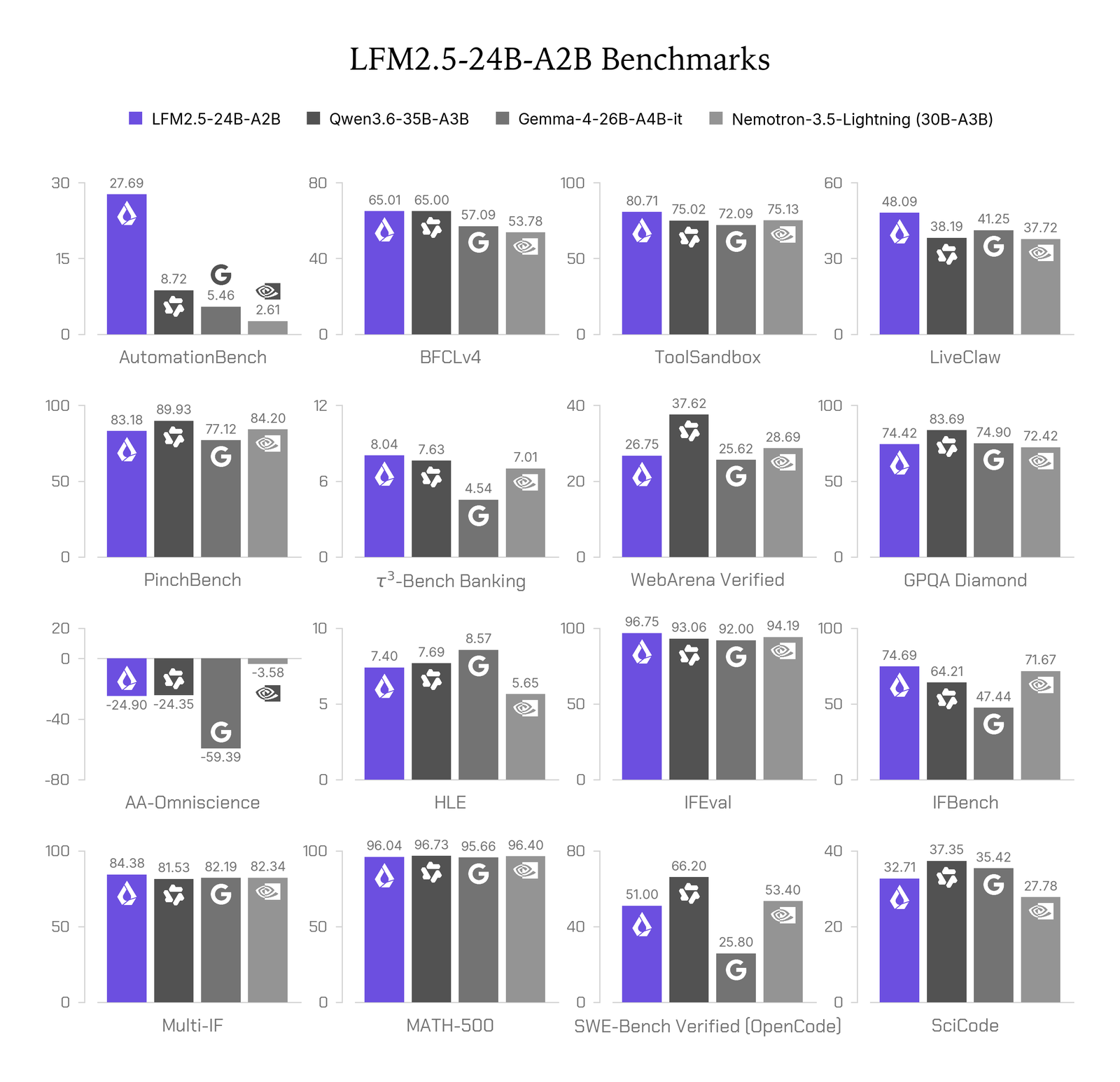
All numbers in this section are reported: Liquid ran every model itself with vLLM, and I have not re-run any. Against Qwen3.6-35B-A3B, row by row:
| Benchmark | LFM2.5-24B-A2B | Qwen3.6-35B-A3B | Difference |
|---|---|---|---|
| AutomationBench | 27.69 | 8.72 | +18.97 |
| LiveClaw | 48.09 | 38.19 | +9.90 |
| ToolSandbox | 80.71 | 75.02 | +5.69 |
| τ³-Bench Banking | 8.04 | 7.63 | +0.41 |
| BFCLv4 | 65.01 | 65.00 | +0.01 |
| PinchBench | 83.18 | 89.93 | −6.75 |
| WebArena Verified | 26.75 | 37.62 | −10.87 |
| SWE-Bench Verified (OpenCode) | 51.00 | 66.20 | −15.20 |
| IFBench | 74.69 | 64.21 | +10.48 |
| IFEval | 96.75 | 93.06 | +3.69 |
| Multi-IF | 84.38 | 81.53 | +2.85 |
| GPQA Diamond | 74.42 | 83.69 | −9.27 |
| SciCode | 32.71 | 37.35 | −4.64 |
| MATH-500 | 96.04 | 96.73 | −0.69 |
| AA-Omniscience | −24.90 | −24.35 | −0.55 |
| HLE | 7.40 | 7.69 | −0.29 |
Counting rows (measured, from the published table): LFM2.5 scores higher on 8 of 16 and lower on 8. The blog frames it as leading or matching on "five of eight" tool-use and agentic benchmarks. It does not list the eight; the seven tool and agent rows above plus SWE-Bench run through OpenCode make eight, and the five wins are AutomationBench, BFCLv4, ToolSandbox, LiveClaw and τ³-Bench Banking.
Three things to read into the wins:
- Two of the five are ties. BFCLv4 is 65.01 against 65.00. τ³-Bench Banking is 8.04 against 7.63, with every model between 4.54 and 8.04; no confidence intervals are published. Neither separates the models.
- The real margins are AutomationBench and LiveClaw, and AutomationBench is extreme: more than three times Qwen3.6's score, and more than ten times Nemotron's 2.61. Liquid also trained this model with RL "inside agent harnesses" including OpenClaw. I cannot tell from the release whether either benchmark's tasks or tool formats overlap that training. The model learning a harness's conventions is the stated goal; it also makes harness-shaped benchmarks the ones it should win.
- The settings differ by benchmark. LiveClaw ran at temperature 1.0 ("vLLM default; the agent sets no temperature") with 8,192 output tokens; BFCLv4 at 0.001; most others at 0.6. The same settings applied to all four models, so the comparison is fair within a row.
And the losses: the longest-horizon agentic tasks, WebArena Verified (−10.87) and SWE-Bench Verified (−15.20), go to Qwen3.6, and so does knowledge (GPQA Diamond −9.27). Liquid says so itself: "Larger models keep an edge on knowledge-heavy benchmarks ... and on coding benchmarks", and the card recommends pairing the model with retrieval. If your agent is a coding agent, the table argues for Qwen3.6. If it is a tool-dispatch loop over APIs, it argues for this.
One more thing from the blog belongs next to the benchmarks. During teacher specialization the model showed "well-known reward-hacking behaviors: searching for the final answer in a repository's git history or on platforms like GitHub, PyPI, and Hugging Face", and "it even figured out it was in a sandbox". Liquid says it tightened the sandboxes and that "all reported results below come from sealed evaluation environments". That is a disclosure worth having, and I cannot check it.
How it was trained
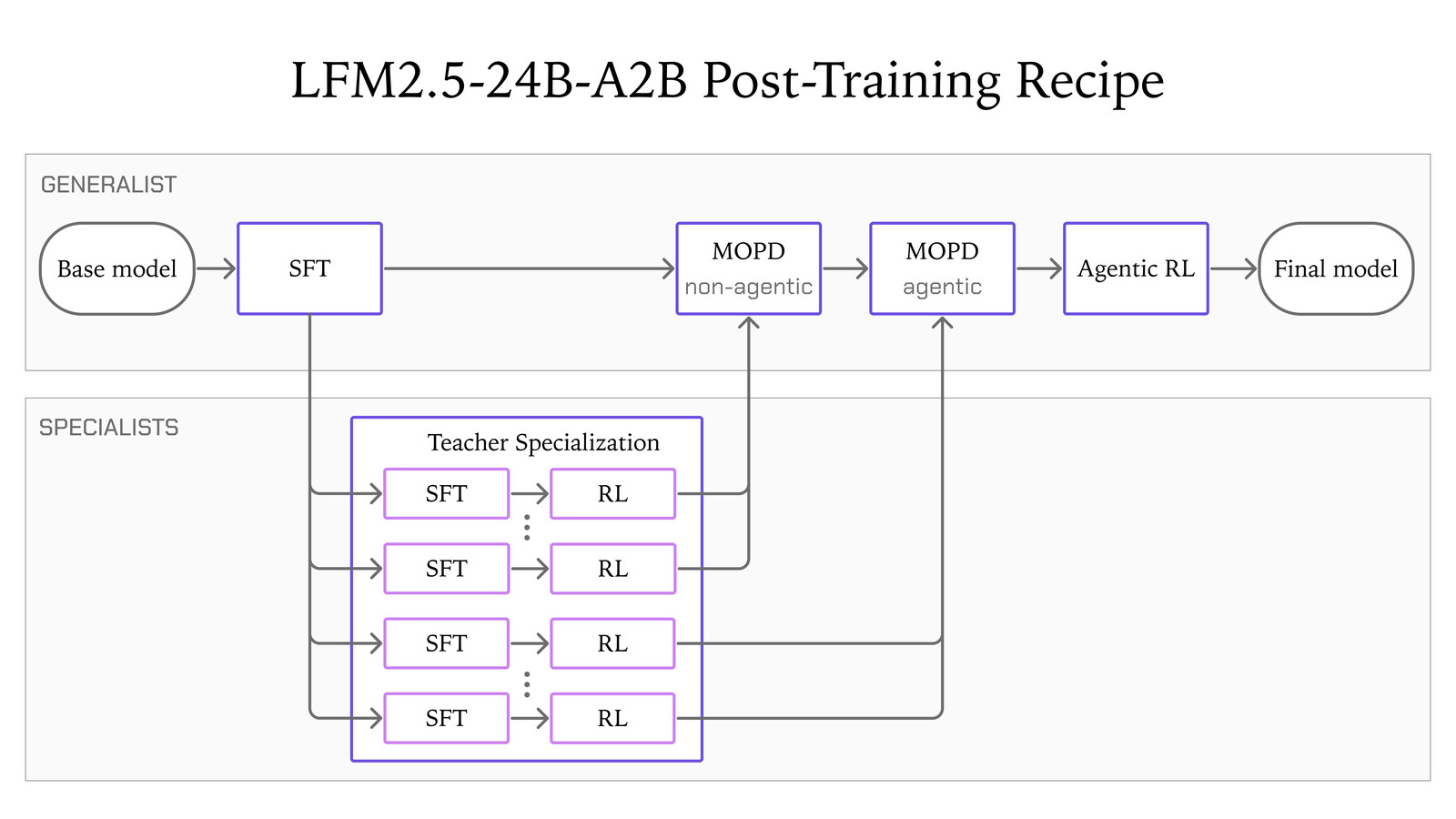
All reported. Pre-training was 33T tokens, up from 17T for LFM2-24B-A2B. Mid-training ran 2T tokens at 32K context, then 300B tokens at 131K. Post-training is the five stages in the figure: supervised fine-tuning, teacher specialization (specialists trained with SFT then RL from the SFT checkpoint), two multi-domain on-policy distillation (MOPD) stages, one non-agentic and one agentic, where the generalist learns from the specialists on its own samples, and finally agentic RL inside OpenClaw, Hermes Agent, Pi and OpenCode.
One inconsistency: the card's spec list gives a "Training budget: 36 trillion tokens". The three phases sum to 35.3T (reasoned), so 36 is a round-up of the same budget, not a different run. The thread's "33T" is pre-training alone.
The model is reasoning-only: the chat template opens every assistant turn with a
<think> tag. The card's sampling defaults are temperature: 0.1, top_k: 50,
repetition_penalty: 1.05. The docs warn that MLX needs mlx-lm>=0.32.0, because "earlier versions route the
experts incorrectly", which is the kind of note worth reading before blaming the
model. The card also lists an LFM2.5-24B-A2B-DSpark draft model for speculative
decoding as "Coming soon"; for how that family of drafters behaved on the smaller
LFM2.5 models, see LFM2.5-DSpark.
184 tokens per second, in bytes
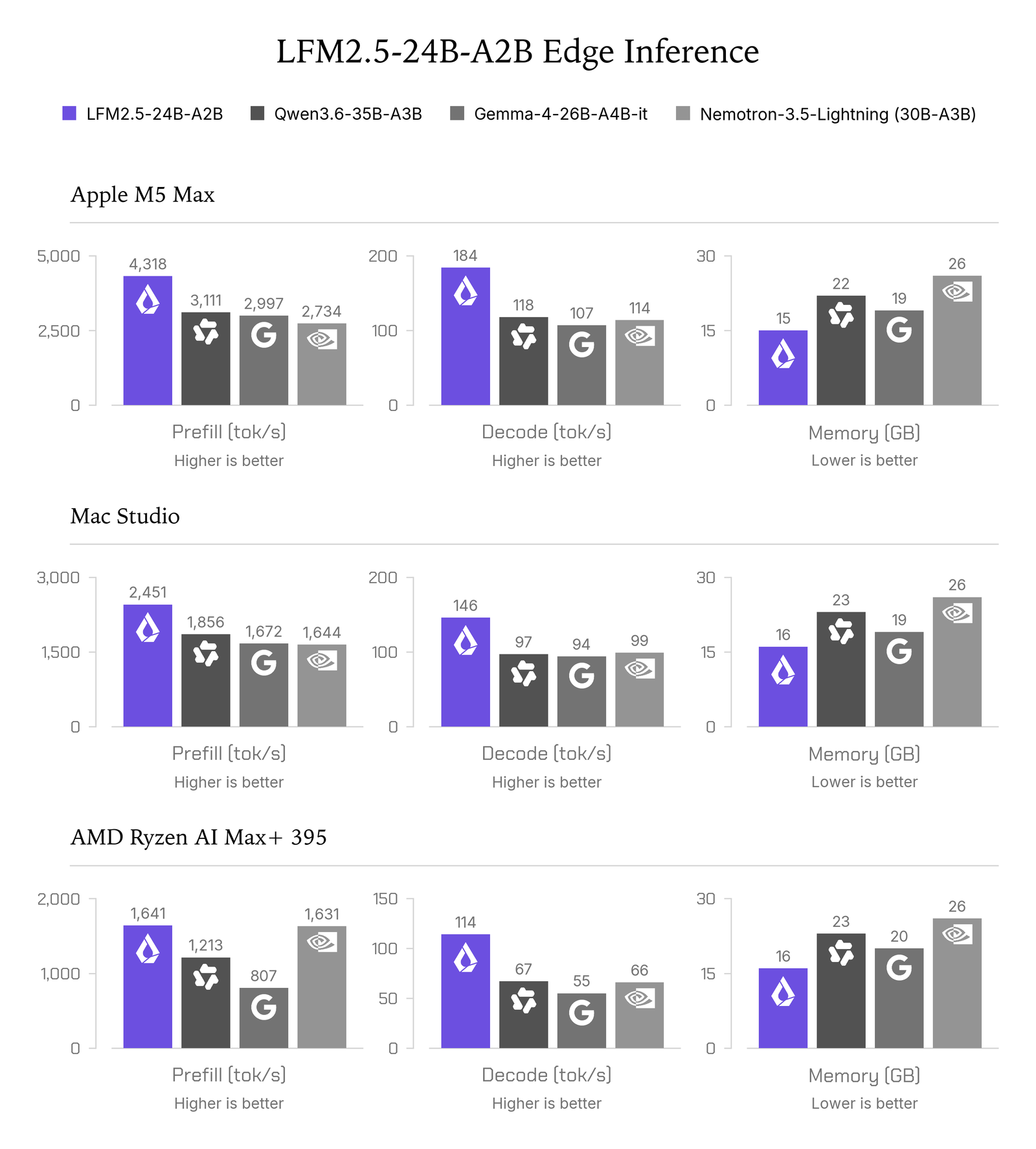
The card's settings: llama.cpp, Q4_K_M, a 4K-token input, collected on Pipette, Liquid's device benchmarking setup. On an M5 Max the model decodes 184 tok/s against Qwen3.6's 118, and prefills 4,318 against 3,111 (reported). "Up to 1.7x faster than the next-best model" is the Ryzen AI Max+ 395 row: 114 against 67 is 1.70. On the M5 Max the ratio is 1.56, on the Mac Studio 1.47 (reasoned, from the chart's labels).
What does 184 tok/s cost in memory bandwidth? Decode at batch one is mostly
reading weights. I parsed the header of the published
LFM2.5-24B-A2B-Q4_K_M.gguf (14,526,258,464 bytes). Its 428 tensors take
14,518,008,320 bytes (measured): the expert gate and up projections at 4.50
bits per weight, the expert down projections at 5.48, the embedding at 6.56, an
average of 4.85. The routed experts are 13.84 GB of that; everything else is
0.67 GB, including the tied embedding the output head reads in full.
One token reads the non-expert 0.67 GB plus 4/64 of the experts' 13.84 GB: about 1.54 GB per token (reasoned). At 184 tok/s that is about 283 GB/s (reasoned), plus 80 MiB of KV cache per token at a 4K context. Apple sells the M5 Max at 460 GB/s (32-core GPU) and 614 GB/s (40-core); the card does not say which. That is 46% or 62% of peak, plausible for llama.cpp's MoE path on Metal. The 15 GB memory reading matches the file.
The same arithmetic does not explain the gap to Qwen3.6. At a similar 4.85 bits, Qwen's 2.95B active parameters would be about 1.79 GB per token (reasoned, an assumption about its quant mix), 16% more bytes, while the reported decode gap is 56%. The rest is per-layer work that is not weight reads: 256-expert routing, DeltaNet's state update, kernel launches. That is consistent with Pipette's finding that bytes alone mispredict MoE decode, and I cannot attribute it further without profiling.
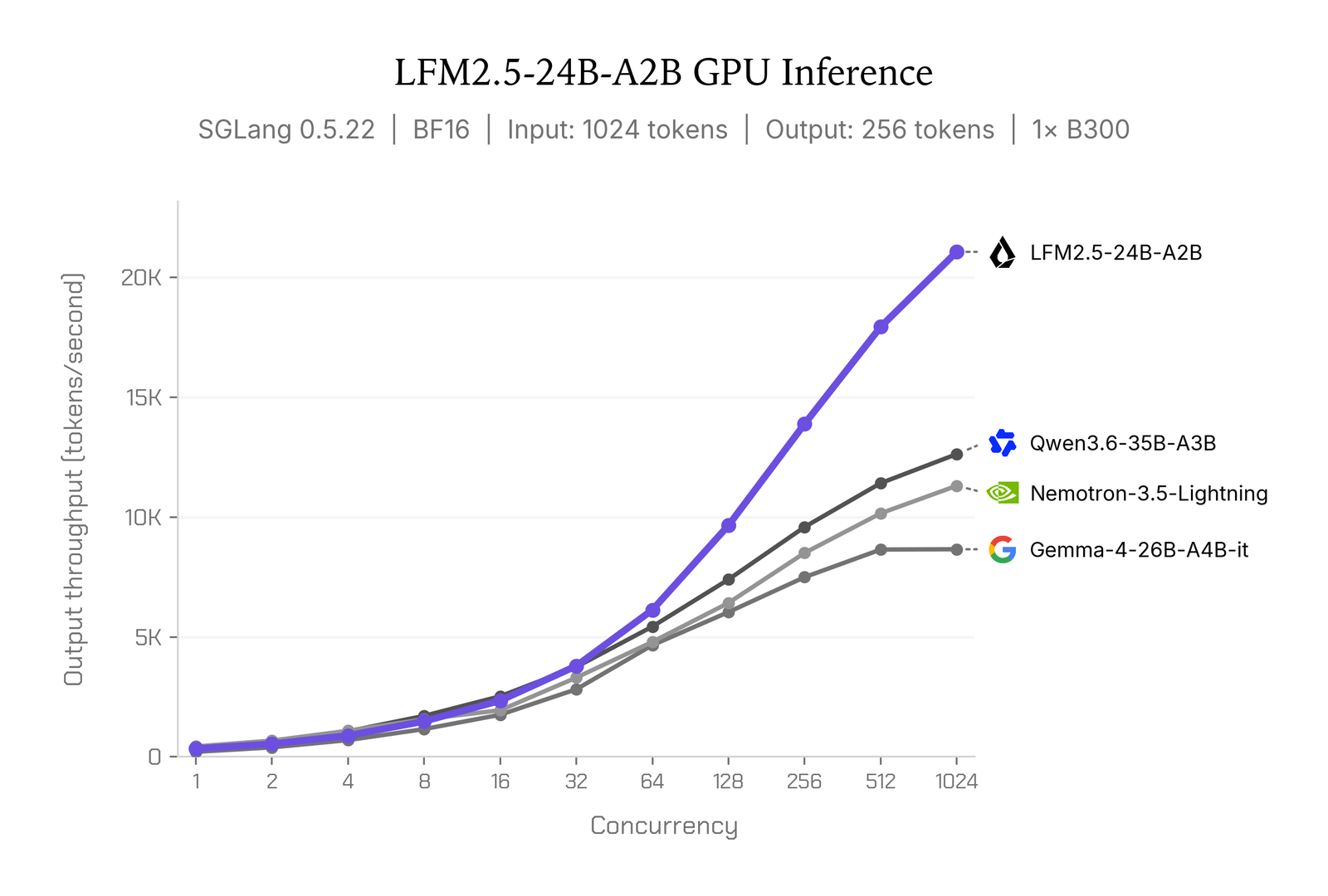
The B300 number is a server number. SGLang 0.5.22, BF16, 1,024 input tokens and up to 256 output tokens per request, with the target concurrency kept full (reported). The "over 21K output tokens per second" is at 1,024 concurrent requests, about 20.6 tok/s for each one (reasoned). Below 32 concurrent requests the four models' lines overlap, and at 8 and 16 Qwen3.6's sits slightly above LFM2.5's (read off the chart). The advantage is a high-concurrency one, where smaller active weights and a small per-token cache let more requests share each weight read: 1,024 sequences of 1,280 tokens hold about 25 GiB of LFM2.5's KV cache (reasoned). Output tokens also undercount the work: each request prefills at least four times as many tokens as it emits.
The licence
The LICENSE file is the LFM Open License v1.0, the same one on the earlier
LFM2.5 releases (covered for the Open-D1 release). It
is Apache-2.0-shaped, with patent grant and redistribution terms, plus Section 5:
"The rights granted under this License for Commercial Use are conditioned upon You
or Your Legal Entity not exceeding the Threshold", where the Threshold is "annual
revenue of 10 million United States dollars ($10,000,000) or more". Above it,
"Any Commercial Use of the Work or a Derivative Work by a Legal Entity that
exceeds the Threshold is not licensed under this Agreement." Qualified non-profits
are exempt for non-commercial or research use. For an individual or a small
company it is permissive; for a company over the line it is not an open licence.
The thread's "Open base and post-trained weights" is true of the weights; the
licence is the condition.
What I'd take from it
The architecture is the interesting part, and it is not new in this release: it is LFM2-24B-A2B's, with a longer window and a bigger vocabulary. Thirty three-tap gated convolutions and ten GQA layers give a cache of 20,480 bytes per token, and a 64-expert, top-4 MoE keeps the work per token at 2.19B parameters plus a 262M-parameter head. 95.7% of the model is experts that a given token never touches, which is why it fits in 15 GB at Q4_K_M and decodes faster than its rivals on a laptop.
The claims mostly survive contact with the files. 24B is 23.97B. "2B active" is 2.19B without the head and 2.45B with it, and the card itself uses 2.45B. "~50% more total" holds; "~50% more active" holds only by the names, and is about 20% counted consistently. The benchmarks are an even 8–8 split against Qwen3.6, with the wins concentrated in tool dispatch and instruction following and the losses in coding, browsing and knowledge. For an agent that calls APIs on a Mac, that is a good trade. For one that edits a repository, the table says otherwise. And since the model was trained inside specific harnesses, test it inside yours: harnesses differ a lot in how many model calls a task costs, as OpenHuman's cross-harness numbers show.