2026-08-23 · 21 min · mixture-of-experts · on-device · inference · agents
A 1:40 narrated explainer, drawn in code. Every number and picture in it is this article's own; the sources are below.
› transcript
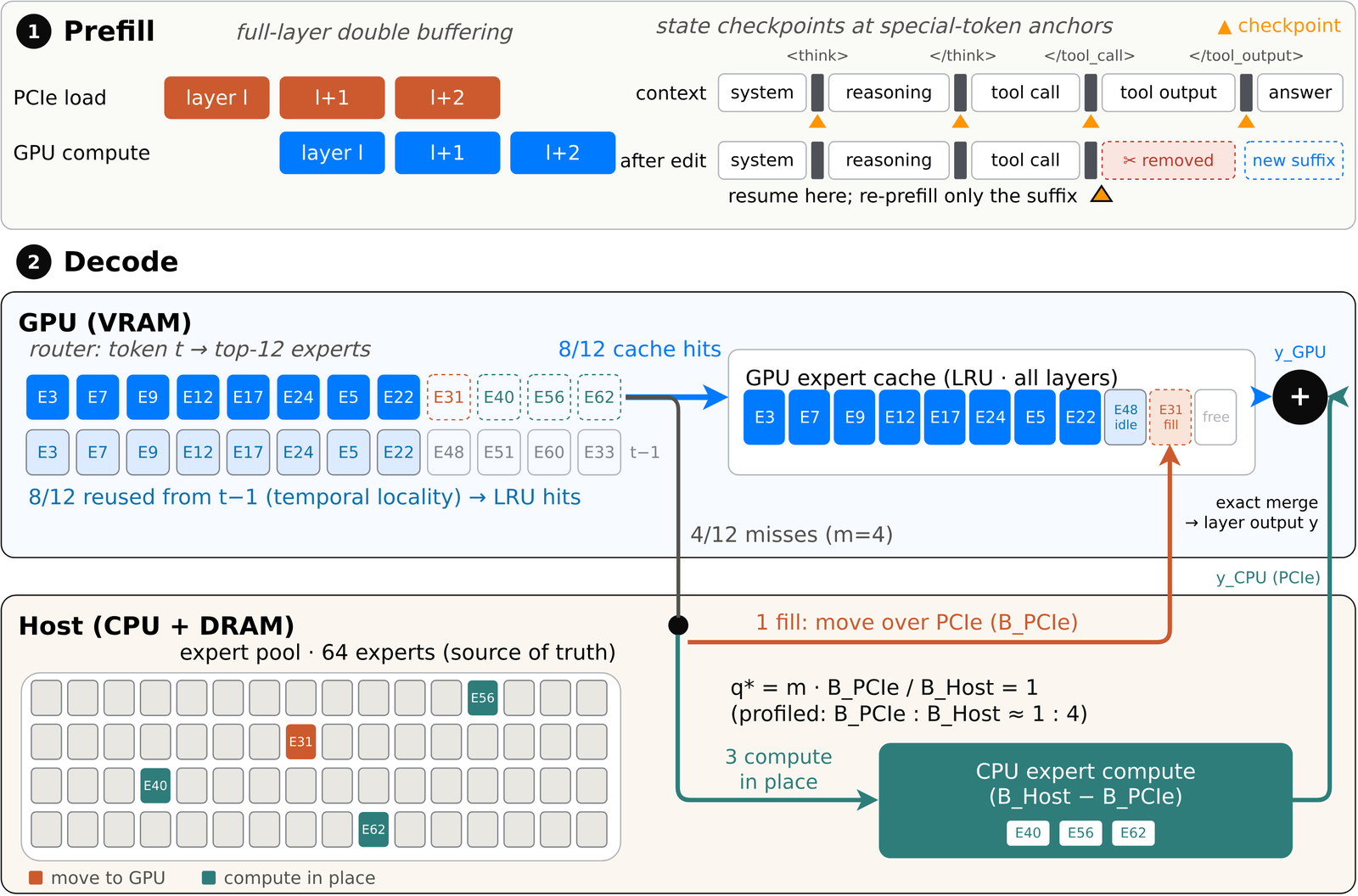
Hi, I'm Piston! FreeToken serves a seven hundred and fifty-three billion parameter model from one workstation GPU. Here's how. The idea: don't pick an offloading strategy. Measure two bandwidths, and let them split each step's cache misses between the bus and the CPU. At each layer, the router picks experts. Hits in the GPU cache run at once; the cache follows the router, least recently used out. The m misses can be fetched over the bus, or computed on the CPU, where their weights already live. FreeToken does both at once, then merges the partial sums exactly. Balance the two branches so they finish together. On top, the bus bandwidth, measured on this machine. Below, the host's expert bandwidth. Expert size cancels, so the split belongs to the machine, not the model. On ordinary consumer machines, the right share to fetch swings from twenty-five to ninety-one percent. Prefill loads the next whole layer while the GPU computes this one, before routing is even known. Recurrent state is checkpointed at special tokens, where agent harnesses edit, so only the new suffix is recomputed. And the GPU cache can resize mid-session, because the CPU pool is the source of truth. Replace decisions with measurements: the bandwidths on this machine, not a spec sheet, decide the split. To recap: follow the router, measure the bus, and split the misses by arithmetic. Every source is in the full article. I'm Piston. Bye!
Why read this
Notabletop 60%FreeToken's q* = m*B_P/B_H split between PCIe fetches and CPU compute, why it swings 25% to 91% across machines, and how to install and calibrate it.
- Runs on a consumer GPU
- Widely used
- A new technique
Inference & servingApache-2.0Practitioner tool
How this was scored
- Is it new?
- 2 of 3: A real new idea, method or capability
- Can I trust it?
- 1 of 3: Spot-checks a few numbers
- Can I run it?
- 3 of 3: Open, permissive, runs on reader hardware with instructions
- Will I understand it?
- 2 of 3: Mechanism from first principles with figures
- Can I act on it?
- 2 of 3: A concrete recipe, numbers or comparison
- Will it last?
- 1 of 3: Relevant for months
- Does it affect many?
- 2 of 3: A widely used model, tool or lab release
- Only here?
- 1 of 3: Some original analysis
Score 61 of 100, ranked 312 of 577 rated articles. Each question is answered 0–3 by hand, and a 3 is rare. How articles are scored
There is a sentence buried in FreeToken's evaluation that reframes the entire local-inference conversation, and it is not any of the headline numbers. It is this: two of the six test machines have the same RTX 5090 in them, on the same PCIe 5.0 ×16 link. One is a rented server, one is a gaming desktop. Moving between them costs FreeToken 4% of its decode rate and costs llama.cpp a fifth of its.
Same GPU. Same link. Same model, bit-identical weights. A 20% swing, produced entirely by which memory the host has.
That is the paper's actual thesis, and everything else — a 753B model on one workstation GPU, a 284B model on a gaming desktop, a 35B model on an 8 GB laptop at 39.3 tok/s — follows from taking it seriously.
| Paper | arXiv:2608.16157, 17 Aug 2026 · Yang, Fan, Pan, Xi, Wang, Sun, Keutzer, Han, Zaharia, Xu, Stoica |
| Code | FlashML-org/FreeToken, Apache 2.0 · desktop app at flashml.ai |
| What it is | an MoE serving engine that treats a personal machine as one elastic inference platform rather than a small GPU |
| Core idea | profile two bandwidths on the machine; let them decide the CPU–GPU split at every layer of every step |
| Headline | GLM-5.2 (753B-A40B) at 14.9 tok/s on a single RTX PRO 6000 · DeepSeek-V4-Flash (284B) interactively on a 32 GB desktop |
| Consistency | decode rate stays within 12% of single-turn across three real agent workloads; worst-case TTFT stays under 44 s everywhere |
The gap is not a hardware gap
The framing in the introduction is the sharpest version of an argument that has been getting muddier for two years. Open weights have almost caught proprietary models on capability. They have not caught up on accessibility, because obtaining a model and affording to run it are different problems, and only the first one got solved.
The paper's counter-observation is that the hardware already exists and is idle. More than a hundred million consumer machines have discrete GPUs — Steam alone reports over 200 million monthly actives with discrete NVIDIA parts in roughly 72% of surveyed systems. The missing piece is a serving system that can look at one heterogeneous machine and map its GPU, CPU, memory and interconnect onto the strongest configuration that machine can actually run.
That sounds like a tuning problem. It is not, and the reason it is not is the interesting part.
Three problems, and none of them is the GPU
Prefill streams the entire model, every time
MoE's selling point at the edge is that decode touches only k of E experts per token. Prefill destroys that property: thousands of tokens per layer activate nearly the whole expert set, so a prefill pass streams essentially the complete expert pool across the interconnect. An FP4 deployment of DeepSeek-V4-Flash means moving roughly 140 GB — about two seconds on an RTX 5090's PCIe 5.0 link, five on a 4090- or 3090-class desktop, ten or more on the ×8 links common in laptops. An engine that fetches experts on demand exposes that whole window as GPU idle time on every turn.
Agents re-prefill constantly, and hybrid attention makes it expensive
Frontier models increasingly interleave full attention with sliding-window or recurrent layers — gated DeltaNet in Qwen3.6-35B-A3B, Kimi Delta Attention in Kimi-K3. A recurrent layer compresses its entire prefix into one evolving state, and each saved state costs as much memory as the KV cache of hundreds of tokens, so engines keep only a few checkpoints.
Meanwhile agent harnesses edit their context on nearly every turn: they delete old tool outputs, strip thinking blocks, elide observations. Any checkpoint taken after an edited position is invalid, and because checkpoints are sparse, the engine falls back a long way and re-prefills thousands of tokens. A consumer GPU cannot hide that — an RTX 5090 delivers roughly a fifth of an H100's and a tenth of a B200's dense BF16 throughput, so each redundant re-prefill occupies the machine for tens of seconds.
Nothing on the edge is dedicated
The GPU is shared with the compositor, a browser, and possibly a game. The VRAM budget differs across launches and can shrink mid-session. The best split of that budget between KV cache and experts moves too, because agentic sessions accumulate context while the expert working set stays roughly fixed — so a split chosen on turn one is wrong by turn ten. And the engine gets started and stopped constantly, which means the roughly 20 seconds it takes to read a 140 GB pool off a 7 GB/s NVMe is a user-visible cost that recurs.
Prefill: hide the pool behind the wire
FreeToken's answer to the first problem is to stop fetching on demand entirely. It allocates two full-layer buffers out of the same slot pool the decode cache uses: while the GPU computes layer l out of one buffer, a dedicated transfer stream fills the complete expert set of layer l+1 into the other, then they swap.
The detail that makes it work is full-layer granularity. Because the whole layer is loaded, the transfer can start before that layer's routing is known — there is nothing to wait for. Weight movement runs continuously in the background instead of serially between layers. And because the buffers come from the shared pool, there is no separate prefill cache and no phase handoff: whatever survives prefill seeds the decode cache.
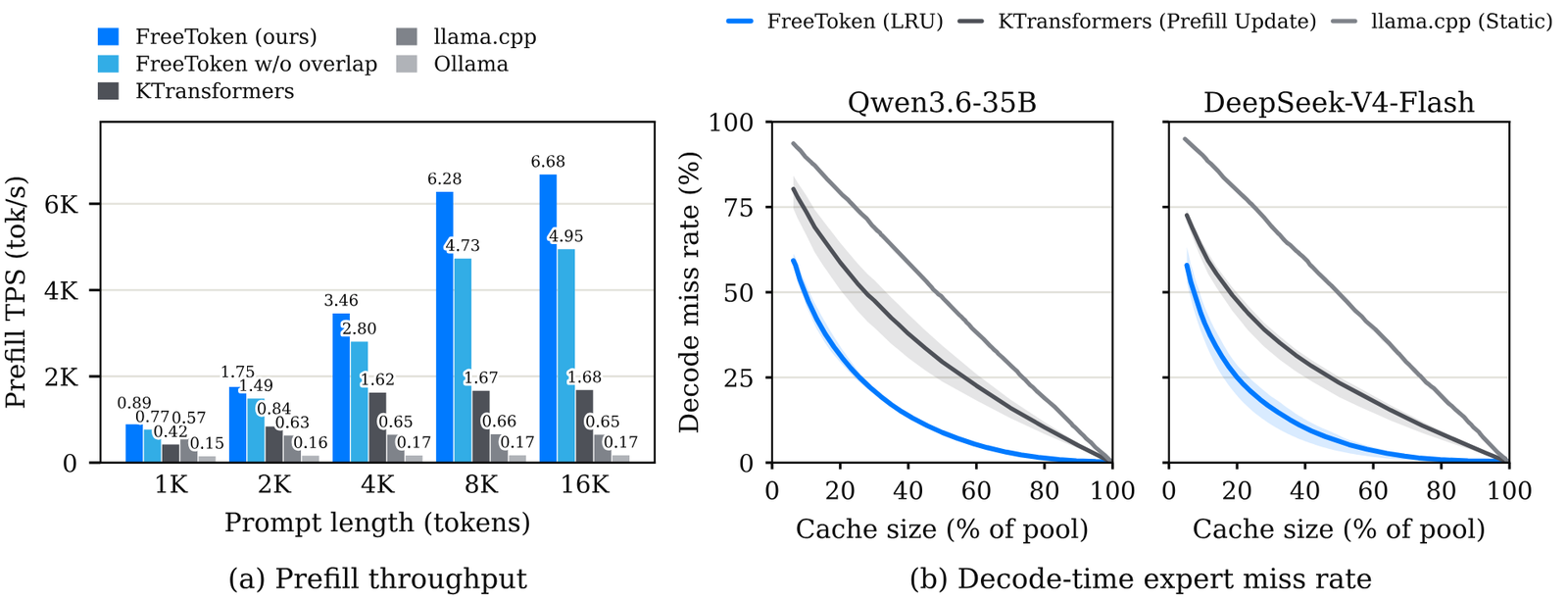
The result is that prefill becomes exactly, measurably transfer-bound, which is the best outcome available. An 8,192-token chunk completes in 1.19–1.22 s; streaming Qwen3.6's 64.4 GB expert pool once at the 52.7 GB/s the link actually delivers takes 1.222 s. Prefill throughput climbs to 6.7k tok/s at 16k tokens. Disabling the second buffer costs 19% at 4k, 25% at 8k and 26% at 16k — the penalty growing with prompt length precisely because longer prompts do more per-layer computation, so serializing exposes more of it.
Semantic anchors: checkpoint where the harness cuts
The second prefill mechanism is the one I find most quietly clever, because it is not a systems trick at all. It is noticing that agent frameworks have already told you where they are going to edit.
Full-attention KV gets a radix prefix tree, as in every modern serving engine — any prefix is reusable. Recurrent layers cannot do that, so reuse depends entirely on state checkpoints, and only a few fit. FreeToken spends that budget at semantic anchors: the special-token boundaries marking thinking segments, tool calls, tool outputs, and conversation turns.
Why those positions? Because they are exactly where the harnesses cut:
- OpenClaw strips thinking blocks from every assistant turn but the latest.
- OpenCode replaces tool outputs beyond a recent window with a fixed placeholder.
- SWE-agent elides all but the last
nobservations.
In every case the edit replaces or removes whole blocks marked by special tokens, and the harness preserves the exact prefix up to the edited block. A checkpoint anchored at that boundary survives; one taken at an arbitrary offset probably does not. When it survives, full-attention layers reuse their KV up to the edit point, recurrent layers resume from the anchor, and only the genuinely new suffix is re-prefilled.
The framing I keep coming back to is that this is a protocol observation wearing systems clothing. The chat template's special tokens were designed to delimit blocks for the model. It turns out they also delimit them for the cache, and nobody had spent the checkpoint budget accordingly.
Decode: the one equation
Now the part the paper is really about.
At each MoE layer during decode, the router picks its experts, the GPU checks residency, and the hits execute immediately. The question is what to do with the m misses. Each one can be pulled over PCIe into a cache slot and executed on the GPU, or executed in place on the CPU where its weights already live.
Neither is universally right, and this is the crux. Transfer-only leaves residual host bandwidth and CPU cores idle whenever host memory can deliver more bytes than the link can move. CPU-only leaves the link idle and forfeits every future hit a cache fill would have bought. The correct mixture depends on the machine — and, as the paper puts it, cannot be read from specification sheets.
So FreeToken measures. Two bandwidths, profiled on the target hardware at deployment: the pinned expert-transfer bandwidth and the host-side expert-processing bandwidth . Because both DMA transfers and CPU execution read from the same host-memory subsystem, a saturated PCIe transfer leaves a residual
which is precisely what the concurrent CPU branch has to work with. So the two branch times are
and balancing them gives the whole policy:
Two properties fall out of that expression that are worth more than the expression itself.
The expert size cancels. is a property of the machine, not of the model loaded onto it — which is why it can be profiled once at deployment and then left alone across a 35B model and a 753B one.
The floor is the host bandwidth, and the fills are free. Substitute back in and the balanced time is exactly . That is not a coincidence: both branches read the same DRAM, so the bytes and the bandwidth are fixed no matter how you divide them, and the split only decides whether one branch finishes early and idles. The balanced point is the only one that keeps host memory saturated end to end — and it lands at the same latency a pure-CPU path would, while leaving more experts resident for the next token. Filling costs nothing and pays later.
The degenerate case is handled by the same formula rather than by a special case: as approaches , approaches m and the system becomes pure on-demand cache fill with no separate branches. FreeToken rounds to an integer, always keeps at least one fill so the cache keeps warming, launches the CPU branch first, and merges the two partial sums exactly — no algorithmic approximation anywhere.
Residency that follows the router
The other half of decode is reducing m in the first place.
Routing has strong temporal locality: across consecutive steps, the same MoE layer keeps selecting overlapping or recently-used experts. FreeToken turns that into GPU residency with a shared global LRU whose contents follow the router — a hit refreshes recency, a fill admits, an eviction removes whatever the model demanded least recently.
The competition does not do this. llama.cpp assigns MoE tensors to devices when the model is loaded. KTransformers pins a hot subset chosen at prefill time and runs the rest on CPU. Both freeze a decision that routing invalidates within a few tokens.
Replayed on identical routing traces at equal cache capacity — 37% of Qwen3.6's expert pool, 11% of DeepSeek-V4-Flash's, which is what an RTX 5090 holds — the global LRU misses 16% and 39% of decode-time expert reads, against 41% and 59% for KTransformers' prefill-updated placement and 62% and 89% for llama.cpp's routing-blind split. The ordering holds at every capacity short of the full pool.
Keeping all of that inside a CUDA Graph is its own implementation problem, and the paper's answer is to move every routing-dependent decision onto the GPU as data inside a statically captured graph. One kernel per MoE layer deduplicates the routed experts, classifies them against the residency table, derives q, selects victims, and rewrites logical expert IDs into physical slot IDs or a CPU-assignment flag. Victim selection avoids the classic LRU trap of one full-cache scan per eviction by identifying the K least-recently-used candidates in a single pass and consuming the first q ≤ K. The CPU branch is captured into the same graph — device-to-host copies, a host-function submit node, the GPU path, a sync node, and the result copy back — so replay re-executes the whole heterogeneous step with no per-token Python scheduling.
Elastic memory, because the machine is not yours
The third problem gets two mechanisms, both resting on one property: the CPU-resident expert pool is the source of truth, so GPU memory affects only performance, never correctness. Once that is true, a lot becomes permissible.
Runtime cache reconfiguration. At any scheduler safe point, FreeToken can rebuild the GPU expert cache for a revised VRAM budget — re-establishing the captured execution path for the new configuration without restarting the engine or reloading the host pool. A game claims 6 GB; the engine shrinks and keeps serving.
Fast bootstrap. Loading reads expert weights from disk directly into their final host layout and pins the memory only afterward — pinning empty buffers first would fault in and zero gigabytes of pages merely to overwrite them. Warmup is eliminated by construction: the first request is served with a cold cache, its misses handled by the ordinary decode path, and the cache heats up through normal serving. The FTW weight format stores experts pre-merged into the runtime bank layout so launch can skip tensor discovery and repacking entirely and read aligned chunks with parallel direct I/O.
What it buys, on real agents
The evaluation runs four workloads that are agent traces rather than benchmarks: AIME with long chain-of-thought and no tools (W1); a SWE-bench issue through the OpenCode harness with real tool execution over three turns (W2); the same issue driven by Claude Code through each engine's Anthropic-compatible endpoint, spawning concurrent subagents and growing sessions to 56–65k tokens (W3); and thirteen fixed turns of an email/calendar agent through OpenClaw at stock configuration, carrying a ~24.5k-token system-context floor (W4).
On an RTX 5090, FreeToken sustains 77–83 tok/s on Qwen3.6-35B-A3B and 22–25 tok/s on DeepSeek-V4-Flash — 1.8–2.3× and 1.5–1.9× the strongest baseline in each workload.
The number I would actually put on a slide is the stability: the decode rate stays within 12% of the single-turn W1 value across all three agent workloads, while KTransformers on DSV4-Flash has already surrendered 31% of its W1 rate by W2. Single-stream benchmarks systematically overstate baseline agentic performance, and this is the cleanest demonstration of that I have seen.
Across six machines
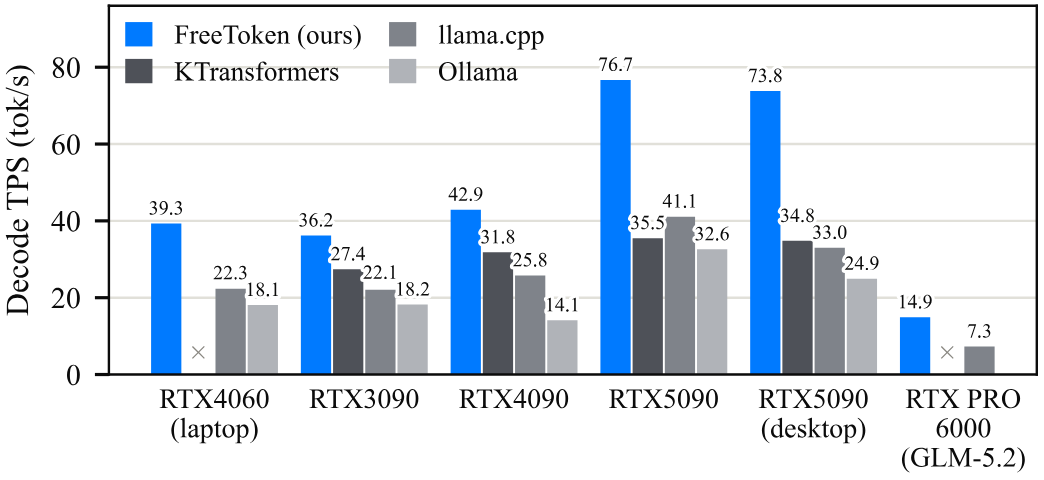
FreeToken leads the strongest baseline by 1.3× on the 3090 and 4090, 1.9× on the 5090 server, 2.1× on the 5090 desktop, and 1.8× on the RTX 4060 laptop, where an NVFP4 build sustains 39.3 tok/s on an 8 GB, PCIe ×8 machine — 92% of the RTX 4090 rate, and above the 33 tok/s median decode speed measured for Codex in production traces.
Then the frontier tier: GLM-5.2, 753B parameters with 40B active — that is the count including the multi-token-prediction layer; the 744B figure quoted elsewhere is the same model's backbone alone — a 433 GB NVFP4 checkpoint, served on a single RTX PRO 6000 at 14.9 tok/s against llama.cpp's 7.3 — with bit-identical expert weights and comparable mean TTFT, 7.5 s against 7.8 s. KTransformers has no servable path at all on that box: its GLM-5.2 methods want 753 GB to 1.5 TB of host-resident experts against 512 GiB of host memory, and its CPU kernels do not read the NVFP4 layout.
Four backends, and the one that has to be measured
The article above treats expert offload as one idea. The CLI splits it into four, and the names are worth having because they are genuinely different strategies:
ft serve --moe-backend {auto,fused,offload,cpu,hybrid}
fused keeps the experts on the GPU and is never auto-selected — it is the "you have the VRAM" path. offload puts them in host RAM behind an LRU cache of GPU expert slots and streams misses over PCIe. cpu computes misses on the host instead of fetching them. And hybrid does both at once, per step.
That last one is the interesting design, because fetching and computing consume different hardware — a miss handled on the CPU costs no PCIe bandwidth, and one fetched over the bus costs no cores. They overlap, so a step costs the longer of the two rather than the sum, and the best split is whichever makes them finish together.
Which is machine-dependent, and FreeToken does not guess. It ships ft bench bw as a once-per-machine calibration and caches the profile, with auto upgrading offload to hybrid only when a cached profile recommends it. A framework that measures your bus instead of assuming a constant is doing the unglamorous thing correctly.
The surrounding flags are a good read for what else this costs. --kv-reserve-tokens defaults to 8192, a KV floor held back before the expert cache is allowed to fill VRAM — because an expert cache that eats the KV budget wins the microbenchmark and loses the conversation. --moe-cpu-layers lets you name which MoE layers decode on CPU. --moe-hybrid-max-fetch caps PCIe fetches per layer per step. And --moe-prefill-hit-d2d copies cache-hit experts device-side during prefill so only misses cross the bus, gated on CUDA ≥ 13.
The 8 GB laptop result, and what is actually shipped
There is a striking community result circulating: Ornith-1.5-35B-A3B at IQ3_S, about 16 GB of GGUF, decoding at 46.7–50.1 tok/s server-side on an RTX 4060 Laptop with 8 GB of VRAM — around 6.9 GB VRAM in use, ~20 GB of system RAM holding the expert banks, 84–98% GPU utilisation, with a smaller IQ3_XXS build reportedly reaching 50–52 tok/s.
If it holds up it is a good illustration of everything above: 35B total, ~3B active, so the compute path fits on a small GPU while the expert pool lives in host RAM, and the hybrid machinery decides per step what to fetch and what to compute.
Two things to be precise about, because the claim is travelling faster than the code. First, docs/models.md in the repo states that FreeToken "loads HF safetensors checkpoints directly (plus native GGUF for Gemma-4)" — as of 9ef3651, Gemma-4 is the only merged native GGUF path. The broader GGUF support, covering Qwen3 MoE, Qwen3.5/3.6 MoE and dense, K-quants and I-quants, and sharded GGUFs, is a contributor pull request, not a shipped feature. Second, these are single-machine community numbers, not a benchmark run — the same caveat this article has applied throughout.
So the honest version: the architecture for this has been in FreeToken for a while and is well documented; the GGUF front door that lets a laptop use it is proposed and not yet merged. Worth watching rather than worth quoting.
What I would want to see next
A few things the paper does not settle, none of which undercut it.
The bandwidth profile is static. and are measured at deployment, but the paper's own §2.3 argues that nothing on an edge machine is dedicated — and a browser doing GPU compositing or another process hammering DRAM changes the effective host bandwidth during a session. The elastic memory manager already handles VRAM fluctuating at runtime; the bandwidths get the same argument and a one-shot measurement. Re-profiling at scheduler safe points looks like a small change with a real payoff on a machine someone is also using.
Three of the five consumer machines are emulated. The 3090/4090/5090 rows are rented dual-socket servers capped at 6 CPU threads and NUMA-pinned so their host bandwidth lands in the 56.7–77.3 GB/s range real edge machines reach. The paper is upfront about this and validates the emulation with two genuine edge boxes — and the 5090 desktop row is the one doing the most work in the argument precisely because it is real. Still, a thread cap is not a memory controller, and I would like the untiered version of all five.
Accuracy is asserted, not measured. The merge is exact and the weights are bit-identical, so there is no reason to expect drift — but the coding runs are only required to produce the reference gold patch, and agent trajectories diverge across engines, so there is no cross-engine quality comparison to read. That is a defensible scoping decision for a systems paper. It does mean "identical outputs" is an architectural claim here rather than an evaluated one.
The q★ derivation assumes a clean bandwidth model. Balancing against treats DMA and CPU kernels as drawing from one linear pool. Real memory controllers are not that polite about mixed read patterns and DMA contention, and the model has no term for GPU-side execution of the filled experts. It evidently works well enough — the cross-hardware results are the evidence — but the fact that the right integer q is often 1 or 2 means the policy is fairly forgiving of a mis-estimate, which may be doing more of the work than the derivation.
Why this one matters
The pattern to take away is not the equation. It is that FreeToken keeps replacing decisions with measurements, and each replacement makes a class of hardware serviceable that was not before.
Where to place experts becomes: follow the router, and let LRU decide. How to split miss work becomes: measure two bandwidths and let arithmetic decide. Where to checkpoint recurrent state becomes: put them where the harness already told you it cuts. How much VRAM to use becomes: whatever there is right now, rebuilt at the next safe point.
None of those individually is a research result. Together they are the difference between a 753B model being open-weight and a 753B model being runnable, on one card someone can buy. The paper's closing framing — turning open weights into deployable local software — is the right one, and the two-RTX-5090 experiment is the proof that it took a system to get there rather than a faster card.
The engine is Apache 2.0, uv pip install "freetoken[accel]", with Anthropic- and OpenAI-compatible endpoints and support for more than twenty MoE models across MXFP4, NVFP4, FP8 and BF16. It acknowledges mini-sglang as its inspiration and borrows from SGLang, vLLM, FlashInfer, flash-linear-attention, LightLLM and llama.cpp — which, given that llama.cpp is also the baseline it beats, is a nicer piece of citation etiquette than this field usually manages.