2026-07-03 · 13 min · agents · mixture-of-experts
A 1:45 narrated explainer, drawn in code. Every number and picture in it is this article's own; the sources are below.
› transcript
Hi, I'm Cypress! Poolside's Laguna report ships two coding models, but its real subject is the factory that built them. The idea: treat model building as an industrial process. Data, training, evaluation and inference form one versioned loop, and a research win ships by flipping a flag. Hive generates synthetic data. Blender streams the data mix, and Titan trains on it. Atlas serves inference and RL rollouts, reading Titan's model definitions bit for bit. What you evaluate is what you serve. One code execution platform, spanning about a million repositories, supplies synthetic tasks, runs the evals and scores the RL rewards. Every run is committed code with its own ID. So any checkpoint, or even one training token, traces back to its source. Even the data mix is automated. AutoMixer turns a matter of taste into a search. Sample mixtures from more than fifty dataset groups, staying near a hand-made prior. Train about sixty small proxy models, one per mixture. Score each one on coding, math, knowledge and more. Fit a regressor per capability, predicting scores from the mixture. Then optimize the mixture, weighting the capabilities you care about. The evidence: they built the smaller model from scratch, inception to release, in five weeks. The report's bet is that iteration speed, not an architecture trick, is the lever. The factory's job is to make the second model boring. To recap: one versioned loop, research that ships by a flag, and a data mix chosen by an optimizer. Every source is in the full article. I'm Cypress. Bye!
Why read this
Nichelast 15%Walks Poolside's 'Model Factory': versioned data and runs, the AutoMixer surrogate for data mixes, commit-derived RL tasks, and INT4/INT8 split by layer.
- Runs on a consumer GPU
- A lasting reference
- Concrete numbers to act on
Training & RLApache-2.0Practitioner paper
How this was scored
- Is it new?
- 1 of 3: An incremental tweak
- Can I trust it?
- 0 of 3: Restates claims
- Can I run it?
- 2 of 3: Open code or weights with real limits
- Will I understand it?
- 2 of 3: Mechanism from first principles with figures
- Can I act on it?
- 2 of 3: A concrete recipe, numbers or comparison
- Will it last?
- 2 of 3: A reference for a year or more
- Does it affect many?
- 1 of 3: A specialist community
- Only here?
- 1 of 3: Some original analysis
Score 47 of 100, ranked 493 of 577 rated articles. Each question is answered 0–3 by hand, and a 3 is rare. How articles are scored
Most model reports are about a model. Poolside's Laguna report is unusual: its real subject is the factory. Yes, it ships two Mixture-of-Experts models for agentic software engineering — Laguna M.1 (225.8B total, 23.4B active) and the open Laguna XS.2 (33.4B total, 3B active) — and they're solid, competitive-in-class coding models. But the argument the report actually makes is that the models are downstream of something more valuable: a Model Factory that treats foundation-model development as an industrial process rather than a craft. The evidence they offer is a number — they built XS.2 from inception to release in five weeks.
The two models, briefly
The models are conventional-but-careful MoE. Both are pre-norm Transformers with RMSNorm and token-choice routing with a shared expert. The report spells out XS.2's config — 8 of 256 routed experts per token plus one shared expert, the routed output scaled by 2.5 before it rejoins the residual (a DeepSeek-V3 / Nemotron-style modulation), a sigmoid router normalized after top-k, and a dense first layer for stability — but gives M.1's totals without its routing width, so I won't guess it. Both use GQA (not MLA), the Muon optimizer, and a served context of 256K — XS.2's attention runs 8 KV heads with softplus per-head gating.
The one architectural wrinkle worth noting is XS.2's attention: where M.1 runs global attention on every layer, XS.2 interleaves sliding-window and global at a 3:1 ratio with a 512-token window — the same hybrid-attention idea as MiMo-V2-Flash, tuned for a smaller model that has to be cheap to serve. And the data is unambiguously code-first: XS.2's pretraining mix is ~30% raw code plus a large synthetic-code share, on top of >30T tokens (from a pool of ~27T unique). But by the report's own framing, none of this is the point. The point is how it was all made.
XS.2 is really M.1 with four ablated deltas flipped on: the hybrid attention above, a Warmup-Stable-Decay LR schedule instead of cosine, the routed-expert modulation, and one dense layer instead of three. Each was a config change against the M.1 baseline, chosen on a small MoE proxy — cheap precisely because the factory made the data pipeline, trainer, and eval harness transfer for free. The peak LR came from a fitted WSD scaling law, in active params and tokens, rather than a re-tuned sweep. The stability lessons transferred too: M.1's pre-training surfaced expert collapse around 450B tokens (fixed by Moonlight-style LR scaling, so Muon runs at AdamW-scale weight decay) and a logit-drift blowup traced to a BF16 all-reduce on the LM-head input gradient (fixed by forcing that one reduction to FP32). XS.2 hit none of them — the factory's job is to make the second model boring.
What "industrial process" actually means
The Model Factory is defined as "a tightly-integrated stack of versioned data, training, evaluation, and inference." Three principles hold it together:
- Experiments as code. Every run's inputs and config are committed to one repo and get a unique ID; a Dagster DAG is the control plane for what runs and what depends on what. The payoff is end-to-end lineage — a single token in a packed training shard traces back through dedup, filtering, and synthesis to its source document, and every checkpoint, eval, and deployment traces to the exact run that produced it. Nothing is a mystery artifact.
- One code base for research and production. A promising research idea isn't re-implemented to ship — it's "promoted into production by flipping a configuration flag." The inference library (Atlas, on vLLM) consumes the trainer's (Titan) model definitions bit-accurately, so what you evaluate is what you serve is what generates your RL rollouts.
- Reserve human attention for novel decisions. A custom Kubernetes scheduler places jobs in under a minute, auto-recovers from hardware failure, and only pages a human when recovery itself fails. Cross-replica bit-identical weight-hash checks catch the silent data corruption a defective GPU would otherwise smear through a run.
The components have names, and the flywheel is literal: Titan trains, Blender streams the data mix, Hive generates synthetic data, Atlas serves inference and RL rollouts, and a containerized Code Execution platform spanning ~1M repositories provides synthetic tasks, evaluation, and RL execution rewards — one component doing all three. The RL harness they train against is the same harness they ship to customers. That's the loop the interactive above is gesturing at: data → train → eval → infer, where inference feeds the next round of data, and the whole thing is versioned tightly enough that a five-week model is possible.
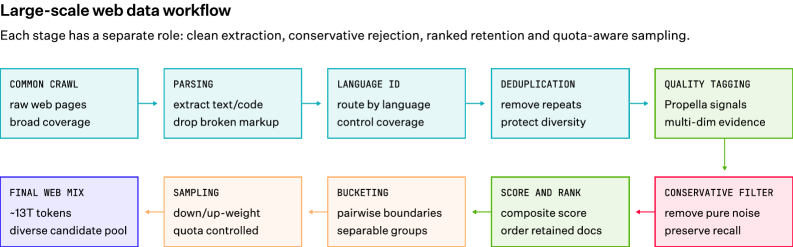
That pipeline also flipped a habit. For M.1 they ran a high-precision filter that aggressively dropped noisy documents; for XS.2 they went high-recall instead — the composite score fully rejects only ~25.8% of web samples as pure noise and recovers ~34% of documents the old static rules had thrown away, then treats quality as a ranking signal and samples from score buckets rather than hard-filtering. Under a >30T-token budget, controlling repetition and diversity beats maximizing average quality; over-filtering starves the long tail.
Choosing the data mix by optimization, not taste
The web pipeline decides which documents survive. A separate problem is how much of each source to train on — the mixture weights. Done by hand, that's a few knobs set by taste and a handful of ablations. The report's quietest radical move, AutoMixer, turns it into an optimization loop, and it's the cleanest single instance of the factory thesis: a decision that used to be craft becomes a versioned, automated search.
The setup is a surrogate-model sweep. For each data ablation they train a swarm of ~60 proxy models — each a ~0.5B-parameter MoE on ~60B tokens — from different mixtures sampled over 50+ heterogeneous dataset groups (web, curated edu, academic, raw / grounded / synthetic code, math web, conversational and knowledge sets). Every proxy is one labeled example of "mixture in, capabilities out."
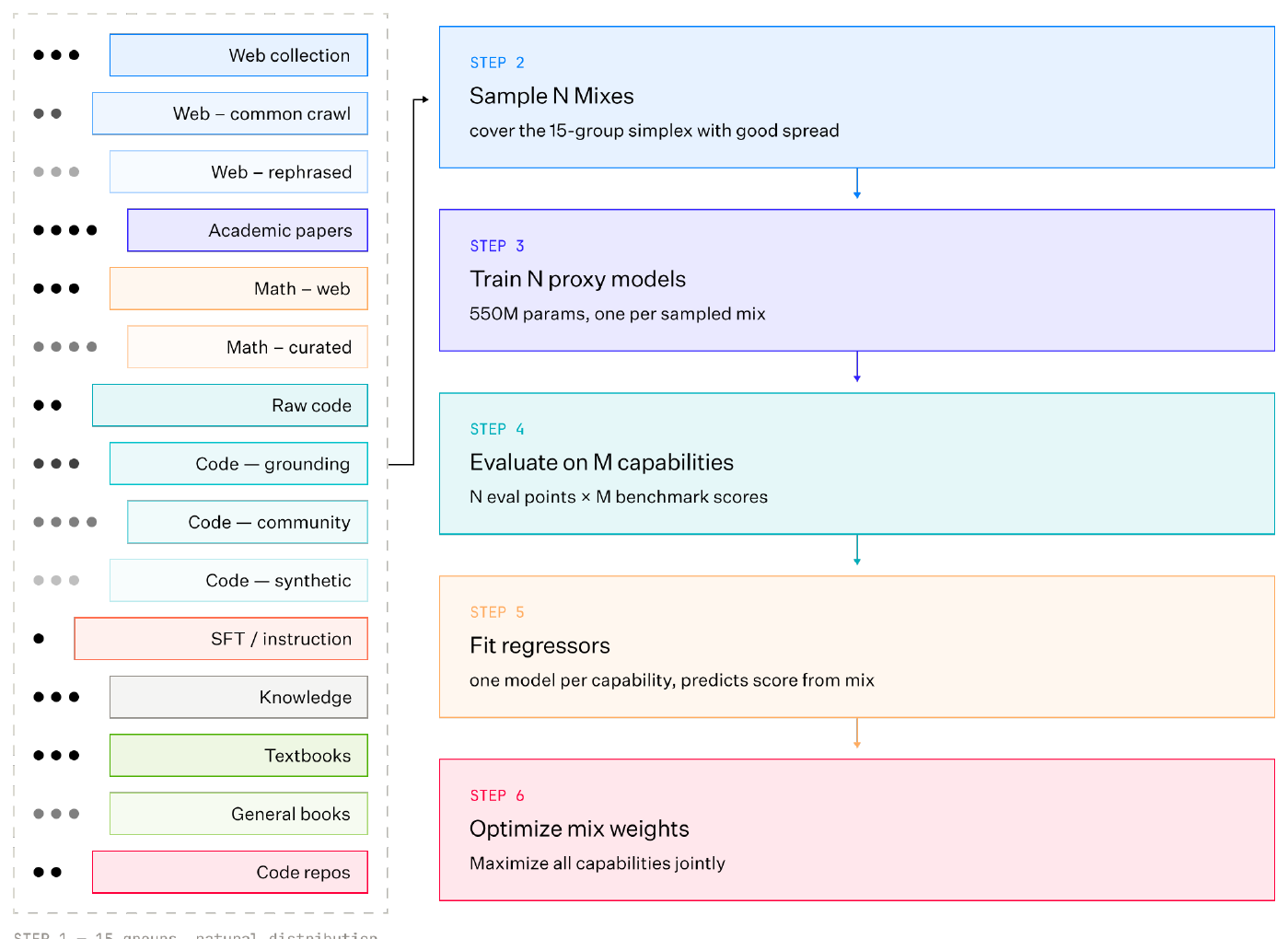
Formally they learn a surrogate where is a mixture over dataset groups and is a vector of downstream metrics across capability groups — coding, math reasoning, STEM knowledge, commonsense, general knowledge. Candidate mixtures are drawn near a hand-designed prior as subject to , so the search stays in realistic regions. For each capability they fit a regressor — linear in the simplified picture, , non-linear in practice. The mixture is then chosen by maximizing a weighted sum of the surrogates over the simplex:
with a penalty keeping the answer from collapsing onto a few dominant sources. The knobs are where intent enters: weight coding and math and the optimizer allocates data toward them.
The learned surrogate recovers relationships you'd expect — synthetic and curated code lift coding evals; conversational and knowledge corpora lift commonsense — plus finer cross-effects. On a 3B-param / 1.5T-token check, the optimized mix posts large gains on the targets (HumanEval+ +43%, CRUX-I +54%, GSM8K +41%, MultiPL-E +27%) and, encouragingly, generalizes to held-out benchmarks it wasn't optimized against (MATH +25%, LiveCodeBench +39%, BigCodeBench +16%). The cost is stated honestly and it's small: a few commonsense tasks regress (ARC-C −6.8%, the rest under 1.5%), which is exactly what you sign up for when the objective down-weights them. XS.2's final mixture — 30.6% raw code, 25.4% synthetic/code-text, 25.2% web, 9% math, the rest knowledge / instruction / academic / books (Table 4) — shifted toward web, synthetic, and math relative to M.1's while keeping the code-heavy spine. That's the thesis in one artifact: a data-mix decision made by an optimizer over a learned model, logged and re-runnable, instead of argued in a meeting.
Agentic training, from real commits
The coding ability comes from training on the actual job. Poolside turns real git commits from public repos into verifiable tasks — a problem statement, a repo checkout, and a hidden test patch, with the gold answer being the commit's own diff. A two-sided filter keeps only commits where the gold diff passes the tests and an empty patch fails them (discarding trivial or non-exercising tests), yielding 30–60k tasks from a ~236k-commit pool. Those tasks feed both SFT (as teacher-generated trajectories, sometimes wrapped in synthetic system messages for instruction-following pressure) and the RL pool (where the repo's own test suite is the verifier).
The RL stage is online: the policy itself drives the production agent harness across several thousand live containers at a time, and each rollout's reward comes from that container's verifier. The objective is CISPO — the importance-ratio-clipping surrogate from MiniMax-M1, not a Poolside invention — paired with a length-weighted leave-one-out group baseline; clipping is asymmetric, an effective on the ratio, so it only bites on heavily off-policy tokens. Reward is a deterministic chain of checks: a malformed tool call or template violation is , giving up before a minimum number of tool calls is , a timeout is , and the only positive reward is the binary task verifier () — unit tests for SWE tasks, bash assertions for terminal tasks, exact-match for tool-integrated math. A small per-token penalty lands on exactly the tokens of a failing tool step to sharpen credit assignment; everything else is carried by the terminal 1/0. It's the same "make the process the trainable target" instinct as Agents-A1's verifier-graded trajectories, wired straight into the factory — the execution environment that grades RL is the one that generates data and runs evals.
The numbers, honestly
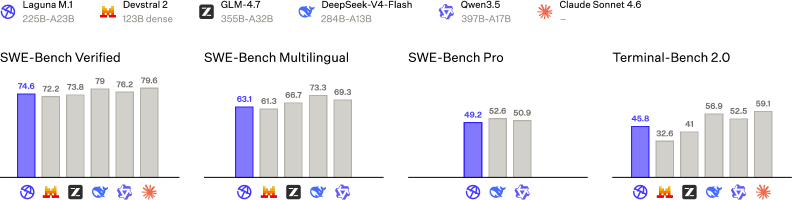
Here's where the modest framing matters. The report claims the models are "competitive with state-of-the-art open models in their respective weight classes," and that's accurate — competitive, not leading. M.1 lands mid-pack among the ~200B-class open models on SWE-bench Verified:
XS.2 is the more interesting result, because it's competitive in the ~30B class while activating only 3B parameters per token — against dense 24–31B rivals:
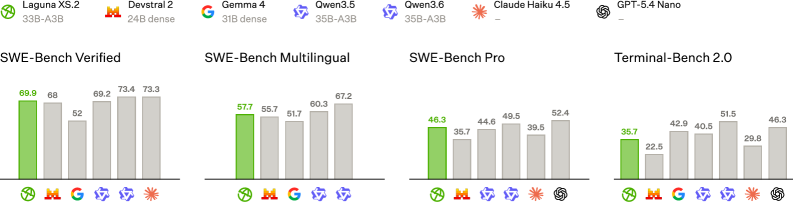
XS.2 beats Devstral Small 2 and Gemma 4 and edges Qwen3.5, though Qwen3.6 leads the class. Two honesty notes the report itself makes: the baseline numbers are Poolside-selected published scores (not re-run in their harness, so there's provider-config bias), and they patched all four benchmarks to remove git-history leaks before scoring — so these differ slightly from public leaderboards by construction. It's the rare case where the methodology disclosure is more reassuring than the raw scores.
One finding from the quantization work is worth carrying away regardless of the leaderboard: bad
quantization hurts agentic benchmarks far more than single-turn ones. A small per-token error
that's invisible on a one-shot question compounds across a hundred-step trajectory, and the report
saw exactly that — intermediate schemes that barely moved single-turn scores cratered the agentic
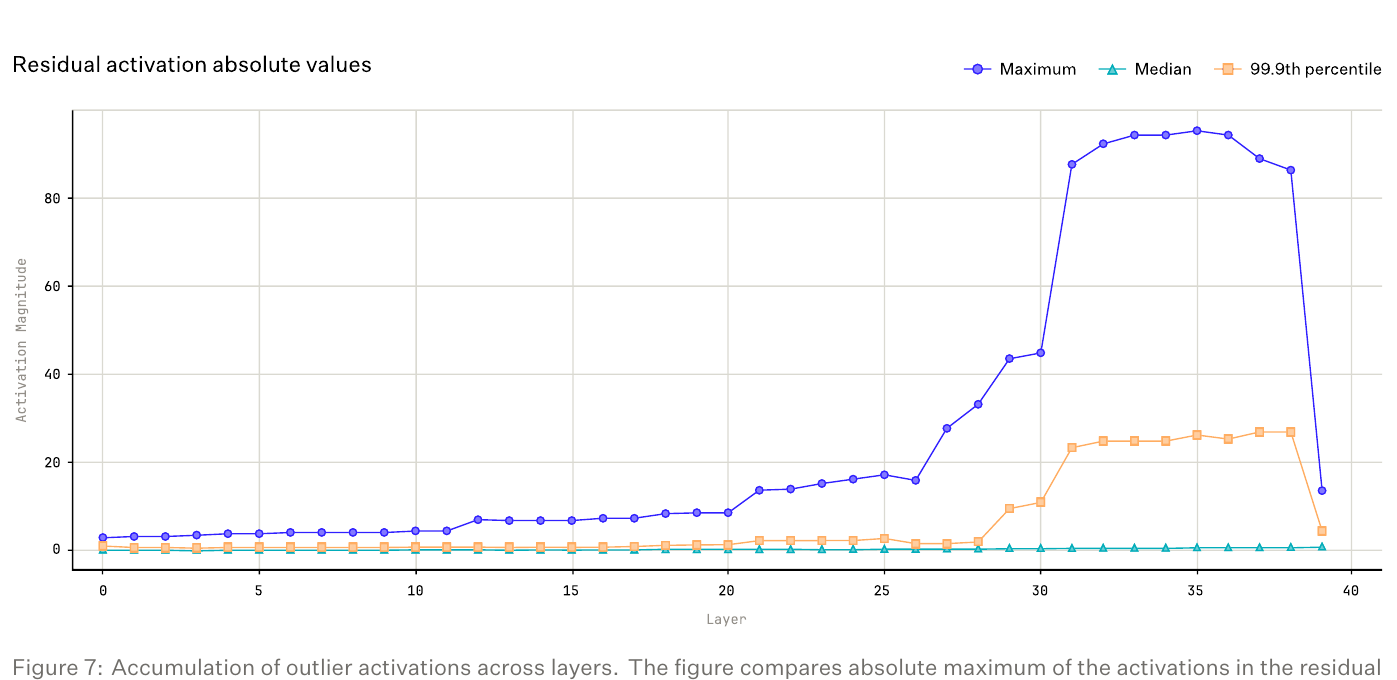
ones. The fix started by looking at where the error comes from. Naive INT4 (AWQ, W4A16) lost
quality because outlier activations pile up in the residual stream starting around layer 30 of
the 40-layer network:
So they went mixed-precision: INT4 for the first 30 layers, INT8 for the last 10 (with a
SpinQuant rotation as a pre-pass). NVFP4 needed more — direct post-training quantization lost too
much, so they recovered it with quantization-aware distillation, training the quantized student
to match a higher-precision teacher on a fixed dataset. The KV cache goes to FP8 across the full
131K context, roughly doubling how many trajectories a replica can hold. The through-line is the
same as everything else here: the diverse eval harness is what caught the agentic-only regression
that a single-turn benchmark would have waved through.
The take
I went in expecting an architecture paper and came out thinking about CI. The Laguna models are genuinely fine — a competent ~200B flagship and a genuinely efficient 3B-active open model that holds its own in a crowded class — but they're not what the report is selling. It's selling the claim that iteration speed is the frontier lever: if every run is reproducible code, every win ships by flipping a flag, and the same execution environment grades your RL, runs your evals, and generates your data, then you can turn out a from-scratch model in five weeks and keep pace with model complexity instead of drowning in it. Whether the "factory is the moat" thesis holds as everyone industrializes is the open question — but as a piece of honest infrastructure writing, with the models presented as outputs of a process rather than heroic artifacts, it's a refreshing shape for a technical report. XS.2's weights are open (Apache-2.0); the factory, of course, is not.
Built on the Laguna M.1/XS.2 Technical Report (Poolside, 2026) and the XS.2 model release (Apache-2.0). Benchmark figures are from the report's tables (baselines are Poolside-selected published scores on leak-patched benchmark images); SWE-bench Verified figures use the report/model-card values (74.6 / 69.9), higher than the earlier launch checkpoint.