2026-09-22 · 39 min · explainer · architecture · agents · llm · calibration
You have a step in your system and you want to know whether a decision model goes there. Eighteen pieces on this site have taken that question apart in somebody else's shipped code — a browser agent, a link mapper, a code reviewer, a robot arm, a UI composer, a grep, a dinosaur game — and measured what happened. This is what the measurements add up to.
The test is four questions, and they have to be asked in this order, because the third one is the only one that cannot be bought back with money and the first two are what let you reach it.
Cost is not on that list, and neither is latency. That is the first thing the evidence did to my own prior, and it did it harder than I expected: when somebody runs both arms of a comparison on one task, 193.6x faster measures 4.57x, the 245x cheaper on WindTunnel's board factors into 15.25x of interface and 16.07x of price, and the 240x cheaper on a link map is 3.7x once the tuning run is counted. None of the systems below was made possible by the price. Several of them would have been fine without the model at all.
The catalogue is a good place to check the procedure against
shipwithjev.com is a hand-sorted directory of 426 builds, with its own disclaimer in the footer — "Not affiliated with TypeSafe AI. Numbers are as reported by their authors." — which is the correct disclosure and more than most such lists carry. It also sells sponsor slots at $15–20 a week, so read it as a community catalogue rather than a survey. I am using it the way a test suite is used: not as evidence that any of it works, but as a sample of what people actually reach for.
Its own category counts are the first result:
| category | builds |
|---|---|
| Tools & apps | 168 |
| Agents & browsers | 69 |
| Research & data | 55 |
| Games & real time | 47 |
| Content & growth | 40 |
| Triage & routing | 35 |
| Trading & markets | 7 |
| Robotics & devices | 5 |
Three of those — games and real time, trading, robotics, 59 of 426 — are the categories where this corpus has a measured ceiling. The rest are categories where the answer set arrives for free: a label set, a menu, a list of documents, a list of components. (Research & data is mostly write-ups about the model rather than builds; the directory's own type breakdown is 273 GitHub repositories, 90 X posts, 46 resources, 9 skills and 8 sites.)
That distribution is a vote for the procedure before I have argued for it, and
most of the entries pass all four gates without effort. 500 emails classified
for 3.5 cents, an AI slop detector at $0.00015 and 243 ms, a YouTube
sponsor skipper, 700 leads scored in 40 seconds, 724 competitor ads broken
down against a fixed set of facets for 9 cents, 3,282 posts answered with
eight questions each for $0.1282 — every one of those is a finite label set
applied per item, enumerated by the schema the author wrote, with no item's answer
depending on another item's content, and the aggregation done in code afterwards.
So is Stagehand on a remote browser at about $0.001 a task, which sends the
accessibility tree as state and the available actions as questions, and so is
typesafe-computer-use at $0.0002 per decision. These are the cases the
procedure is built to say yes to, and it says yes to them.
The interesting entries are the handful where it does not, and where the reason is invisible from outside. I will take them at the gate each one lands on.
Gate 1 — is the answer set finite, and known before the call?
A decision model's output space is a list you sent in the request. It cannot
write a string that is not already in it. TypeSafe says so on its own
jaggedness page and
the negative-space piece measured what
that costs a real agent: across WindTunnel's 147 scored WebMCP attempts, 385 of
413 selected actions could not be executed until a second model wrote their
arguments, and 379 of those 385 requests carried at least one string property
with no enum and no const. The 28 that needed no second call were the ones the
harness could run with an empty argument object.
That is not a defect, it is the type signature, and the same repository contains
the artifact that shows what happens when you fight it. decision-spans.mjs turns
generation into a chain of choices, exactly as the vendor's page says you can and
should not: a final answer becomes eight Choice questions over the same
candidate list, deduplicated and joined with "; ". That is not a sentence. It
is a concatenation of spans that already existed in the prompt, and its own
comment marks where it runs out.
The catalogue has one entry that lands squarely here, and it is worth naming because the failure is invisible from the outside. "Jev Calc — a smart calculator notebook ... it can calculate ANYTHING" is listed under Tools & apps. The answer set of an arithmetic expression is not finite, and the vendor's own failure-mode page lists Math and Numbers — not a calculator, does not count reliably — among its eight entries. The build that works here is the one the vendor documents: the model picks which spans are the operands, and code does the arithmetic. Its dates cookbook puts it in one line — "Extraction is a judgment, so give it to the model. Arithmetic is not, so keep it in code." I have not run the notebook and cannot say which of the two it is. I can say which of the two has a number behind it.
"Finite" is weaker than it sounds if you are running it locally
On a hosted API the option count is data. open-jev-deberta's head ends in
2.weight [1, 1024] — one scalar per option, softmax afterwards, nothing in the
weights that knows how many options there are — and the cardinality caps people
quote turn out to be
five constants in five repositories with five unrelated causes,
one of which is LETTERS = "ABCDEFGHIJKLMNOP", a string literal whose length the
validator reads.
Export it and that stops being true. This corpus has found the option count welded
into the exported graph twice, on two runtimes, by two unconnected authors.
logits[batch_size, 25] is the graph metadata of the only open ONNX export
with a browser playground: batch is symbolic, sequence is symbolic, and
25 is not. And K = 32 is frozen in five of
six published Core ML bundles, with K = 4 in the sixth — the Snake bundle,
whose option capacity is four because a snake has four directions to choose
between. On the Neural Engine path all three axes freeze —
B=1, L=96, K=32 — because the layout rewrite that makes the graph an ANE
target is a rewrite into fixed buffers. Going past the
ceiling is a re-export, not a longer array.
So gate 1, stated properly: the answer set must be finite, known before the call, and — if the model runs on the user's machine — no larger than the number somebody typed into a conversion script.
Gate 2 — can code you own enumerate it?
This is the gate people skip, and it is where the work is. It is also the one the field has already converged on without saying so: five harnesses read side by side put no model in the enumerator in four cases out of five, and the fifth added one only after a truncation dropped the control a task needed.
Read the middle column. It is the same width in every row because the model's contribution really is the same size in every row: an index, or a probability. Everything else is code somebody wrote, and in every one of these repositories it is the larger half by an order of magnitude.
The clearest case is jev-linkmap, because its best idea
needs no model at all. candidates.py finds, for each target page, the two-to-six
word spans already present in the source page's copy that carry the target's
topic terms: TF-IDF cosine with the page's own headings weighted 4x, a chrome
filter that drops any page half the site already links to, and a mask over spans
that are already links so nothing gets double-linked. Standard library, no
dependencies, zero model calls. That is the component that turns "where should a
link go" into a yes/no question, and it is the component I would build first:
# candidates.py — spans of 2-6 words already in page i's copy that speak page j's topic
sent = re.sub(r"⟦[^⟧]*⟧?", " | ", sent)  # already a link: not an anchor
inbound = Counter(k for p in pages for k in p["links_out_all"])
# a page linked from most of the site is menu chrome, a contextual link to it adds nothing
self.chrome = {k for k, c in inbound.items() if c >= 0.5 * n}
The same shape, with a much larger bill, is what WindTunnel's 49/49 actually
rests on. Getting eight self-hosted applications to expose tools took 7,302
added lines across 44 tools — about 166 lines per tool — and the leaderboard's
top row is downstream of one of them. Before complete_checkout existed, all
eight WebMCP configurations scored 0/3 on the Medusa store's checkout task;
adding it took all eight to 3/3. Read that tool's own description and you can
see it was written by somebody who knew a model would be calling it: "otherwise
returns the choices so you can pass shipping_option_id" is an error path,
designed in advance, that hands the model a list to pick from when it guesses
wrong.
json-render states the price of admission
more plainly than anyone else, and puts a number on the ceiling. Its enumerator is
buildCandidates, 322 lines of hand-authored recipes for 42 configured element
instances, and each candidate costs 668.6 bytes per request, dead linear, so a
batched call tops out around 200 recipes at the Gateway's listed 32k context. Its
README carries the consequence: "Repeating the same field in multiple forms and
arbitrary new text/data are not supported." And the number in a metric reaches
the model only because a human typed it twice — once into the props the renderer
reads, once into an English sentence the model reads.
Nobody converged; they read the documentation
It is tempting to write that three independent teams arrived at this pattern in a
week. They did not, and the truth is better: the vendor published the rule
first, as a failure-mode page and four cookbooks, and these projects are
following documentation. Extraction: "extract possible options using regex or a
generative model and let jev-1.13 pick the correct extraction." Counting:
"iterate in code over the candidates and ask one question for each, then add up
the answers yourself" — which is jev-semgrep, described a week early. Re-ranking:
one question per query-candidate pair, and code does the sorting.
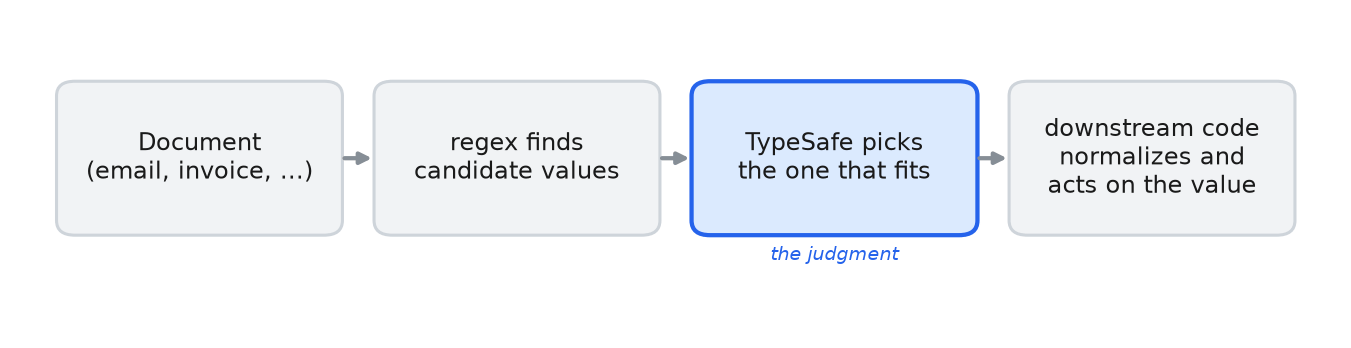
The catalogue's best entries are the ones that reproduce this without being told. "Keystroke oracle / predictive launcher — your launcher ranks by aliases, fuzzy match, and..." is jev-linkmap's architecture applied to an app launcher: the launcher already holds a finite list of items, fuzzy matching is the enumerator, and the model re-ranks what fuzzy matching found. Nothing in it can name an app you do not have.
Gate 3 — can every option be judged without reading another?
This is the gate with a number on it, and the number is the most informative measurement in the category.
On an independent fifteen-task benchmark, Jev takes thirteen tasks, scores 100% on rule and evidence judgment, 100% on ordinal scoring and 98% on ARC-Challenge — and then scores 0 of 100 on relational choice, questions that "use information in one option to select another."
Zero is not the bottom of a bad scatter. If the task were three-way and the model were guessing, the chance of scoring exactly zero is , about one draw in ; at four options it is , at five . There is no plausible option count that makes 0/100 a bad day. Zero out of a hundred is what you get from a deterministic rule that is orthogonal to the answer key — a scorer ranking each option on local plausibility, landing on the same wrong answer every single time.
The mechanism is one line of somebody else's source. A per-option scorer's encoder
takes one option; row["options"] is never passed; the options meet for the
first time in softmax(log_odds), four scalars long, after every forward pass has
finished. An option that refers to another option is referring to something that
is not in its context. Not down-weighted — absent.
And here is where my own prior needed narrowing. The obvious fix — use a model whose options share a context — does not work either:
Laya's encoder is ModernBERT and bidirectional; every option attends to every other option, in both directions, through a shared scalar head. The options could not see each other more thoroughly. It scores 8. So option isolation is sufficient to make relational choice impossible, and shared context is necessary and nowhere near sufficient. The honest form of gate 3 is that no model in this family can follow a reference between options, and switching families does not buy you one.
Which is why failing gate 3 is work, not a verdict
Three codebases hit this and all three did the same thing: build the relation in deterministic code, then hand the model one pair and ask an independent question.
Stanley wants to know whether a hunk that looks unrelated
to the task is there because another hunk needs it. It cannot ask that. So
enabledHunks does it with two regexes — the identifiers each hunk declares on
added lines, intersected with the identifiers each hunk references — and only
then opens a frame containing exactly two hunks and asks one yes-or-no. The
rationing is the instructive part: the follow-up uses .find, not .filter, so
only a hunk already flagged weak, already linked to a hunk already scoring well,
gets a follow-up, and it gets exactly one.
The xArm7 harness does the same thing where it is impossible to miss. A movement is a joint choice over X, Y, Z and the gripper — 81 combinations, and the right value on one axis depends on the others. The harness never asks for it. Each cycle is one Choice over eight intents, then four independent Choice questions, one per channel, three options each, with the constraint written into the instruction text: "This question controls ONLY X ... do not answer for another axis." The model returns four signs. The executor supplies every millimetre, and its comment is the design statement: it "never changes the selected sign."
jev-semgrep is the purest version. Each line, each
meaning, one independent probability; then disjunctive normal form evaluated in
the harness over those probabilities. Its README states the principle better than
I can: "Because each meaning yields an independent probability, logical AND and
NOT are plain boolean operations, not a trick with set differences or negative
queries." An embedding cannot do this, because the line is encoded before the
query exists. A cross-encoder judging a proposition per line can, and then && is
just &&.
The catalogue has a case that sits exactly on this line and cannot be adjudicated from outside, which makes it the most useful entry in it. Post scoring with SuperX — 61 questions per draft in about a second for $0.0004 — reports that it "picks the viral post 2 in 3 times", on a model "fitted on 9,481 real posts from 207 creators." Picking between two posts is a comparison. If each post is scored alone and code compares the scalars, it passes this gate by construction and the architecture is right. If the comparison is inside the question, it is the 0/100 case, and the aggregate accuracy will hide it — reversing an option list moved 27.8% of one suite's individual answers while its accuracy barely twitched. One reversed list and an afternoon settles which.
The same gate, one scale up: the branching problem
There is an argument going around that agents do not have a reasoning problem, they have a branching problem: every action creates more possible next states, the tree explodes over long horizons, autoregressive reasoning is an expensive way to search it, and therefore "search cheap, branch wide, reason only when necessary" should get more valuable as horizons lengthen.
I think the shape of that is right and the conclusion about who does the searching is wrong, and the measurement is already in.
A forward pass produces one distribution over the caller's options and nothing
else. A 255-option Choice carries at most bits — one
call, eight bits, no tokens, no text, no state. There is no scratchpad, no place
to write down "I am three hops in and my target is Rubber Duck" except the
state the caller reassembles on the next call. So a decision model can price one
branch. It cannot hold a frontier, and it cannot sequence what it prices.
What that predicts is exactly what the benchmark found: on a Wikipedia navigation task with a ten-hop budget, Jev reached the destination on 1 of 120 routes and stopped on 118 — the one task in the suite that requires carrying a plan across steps, from the model that takes thirteen of the suite's fifteen. The same argument appears verbatim in the systems built on it. Vercel's json-render lists "Root selection, grouping, and deciding when to stop require planning, which is a documented weakness" in its own README. The Jev Engineering guide states it as a batching rule — "The one rule: questions cannot read one another's answers. If a decision depends on a fresh search result, run the search first." Stanley states it as a limit of its own product: "hunks are judged individually; intent spread across unlinked hunks is not modeled."
The catalogue supplies the test case, and the contrast with a build that works is almost too neat. Under Agents & browsers there is a headless Chromium agent whose demo enters the Wikipedia page for "Café" and navigates hyperlinks until done — which is the WikiRouter task, the one with the 1/120 behind it. Under the same broad problem domain, jev-linkmap makes 8,460 link decisions in 5.9 seconds and works. Same subject matter, same primitive, opposite outcomes, and the difference is not difficulty: linkmap's 8,460 decisions are 8,460 independent questions about candidate pairs a TF-IDF pass already enumerated, and none of them needs to know what the previous answer was.
So the branching argument survives with its subject changed. Cheap node evaluation is genuinely valuable as horizons lengthen — but the enumerator has to enumerate successors, and the harness has to hold the frontier, apply the budget and decide when to stop. That is a planner you wrote, with a fast scorer bolted into it. It is a real and good thing to build. It is not the model doing the search, and the one published measurement of asking the model to do the search is 1 of 120.
Gate 4 — will code branch on the probability?
If the answer is no, take the argmax and stop reading. If the answer is yes, this gate is harsher than any of the three above it, and it is the one I had filed as secondary.
Start with the measurement that changed my mind. Take a five-option list, score it, then add paraphrases of the correct answer one at a time — synonyms a second engineer might reasonably add to a dropdown.
The raw entailment logit of the original option is flat: 2.29, 2.12, 2.03, 2.18, drifting only because the padded batch width moves. The model's belief in the concept rises from 0.619 to 0.821, correctly, because the paraphrases are also right. And the number your threshold reads falls from 0.619 to 0.215, through the cutoff, on evidence that never changed. A policy that acts above 0.5 and escalates below it acts at five options and abstains at six.
This is not a bug and no amount of training fixes it. Each option is encoded in its own row and scored in isolation, then the softmax is taken over the scalars, so the probability an option receives is a function of what else the caller happened to list. The calibration you are relying on is calibrated against your option list, not against the world.
Three more findings stack on top, and together they make the threshold the least portable quantity in the system:
- The field does not mean one thing. Three implementations speaking the same
SDK return three different
confidenceformulas. On a near-uniform(0.40, 0.35, 0.25), one reads 0.016 and another reads 0.575. A gate at 0.5 ships that decision unattended under one and escalates it under the other two. The vendor declines to publish the formula, so nobody is wrong — everybody guessed, differently, and the wire format cannot tell you which one you are talking to. - The cutoff does not transfer between datasets. The one published cascade sweep found its optimum at 0.67 on Banking77 and 0.37 on Web of Science, and on the second dataset routing bought nothing at all — same recipe, same models, 46% more money for the same accuracy.
- The miscalibration is in the wrong place. The only reliability diagram anyone has computed in this family shows a model that is honest where it is confident and badly overconfident in the middle: the top bin holds 140 of 252 rows at 0.979 confidence against 0.979 accuracy, while the 0.6–0.7 bin is 0.653 confident and 0.444 accurate. That is exactly backwards for confidence-gated routing, whose entire purpose is to catch the cases the model is unsure about.
Two catalogue entries land here, in opposite directions. Fraud detection with Jev and Kimi K3 — 100 emails classified in 1.42 s, the uncertain ones routed to a larger model, 96 of 100 correct for about $0.07 — is the confidence-gated cascade done right, and it is worth naming because an earlier piece here reported those numbers and could not find a citable source for them. The catalogue has one; it is the author's own post. The threshold in it is still a threshold somebody picked, and the Banking77-to-Web-of-Science result says it will not survive being pointed at different email.
The other direction is Trading & markets, seven builds, including one
described as "I gave Jev $10,000 and let it trade." I cannot verify anyone's
deployment and I am not going to try. What I can say is what the corpus found when
it read the code of the trading bot it could read: MODEL=mock is the default
even when an API key is present, the dry run is the default, and no win rate, no
P&L and no profitability number appears anywhere in the repository. Its own
README states the mechanism and stops. That is the right place to stop, and it is
a long way from a result.
What the evidence did to my own prior
I went in with a three-clause test: finite action space, enumerable by code you control, each option judged on its own merits. That survived as the primary test. Four things moved.
Cost and latency demoted further than I expected. Not just secondary — mostly not measuring the model. Local-versus-hosted comparisons measure the network on one side and a forward pass on the other, which is why the Apple silicon ports publish 1.394x about themselves and get quoted at 50x, and why the browser piece refused the same comparison in its own favour. The three-figure speed multiplier is only reachable against a baseline doing the thing the whole argument says to stop doing: at the measured 0.707 s per call, 193.6x needs the LLM side to spend 136.9 seconds on every call.
Every headline multiplier in this category, put next to the number somebody got when they ran both arms of the comparison. None of them is fabricated and none of them survives its own denominator. The largest surviving gap in the whole table is 16x, and it is a price-per-token ratio rather than a property of the architecture.
| the claim as it travels | whose | measured | what the difference is |
|---|---|---|---|
| 193.6x faster | TypeSafe homepage; relayed as "up to 200x", recirculated this week as Jev Engineering | 4.57x | per-call latency, both arms on one xArm7 task. 193.6x needs the LLM side to spend 136.9 s per call — a reasoning trace, not a classification. |
| 444.6x cheaper | same | 336.0x | per-call cost, same trial. Same order of magnitude; the gap is task mix. This is the one headline that broadly survives. |
| 245x cheaper | WindTunnel board, vs GPT-6 Astra on screenshots | 15.25x × 16.07x | Interface term times price term. Hold the interface at WebMCP and the price term is all that is left; against the best conventional WebMCP row it is 2.3x. |
| 112x cheaper | same board, vs code execution | 6.94x × 16.07x | Same 16.07x price term. The interface half is the transferable one, and it is available to any model that uses it. |
| 240x cheaper than Opus | jev-linkmap announcement | 3.7x | $17.91 all-in against $66.37, once the $15.51 rubric loop and the $2.07 editor pass are counted. Break-even on the tuning is 32,147 pages; the site has 566. |
| zero pages against 566 | same, the race chart | 18x | Per page, matched on the same 120 pages. A cost claim and a throughput claim drawn as one fact. At Jev's own concurrency Opus finishes the site in 3.3 minutes. |
| 50x faster than Jev | attributed to laya-coreml, which never says it | 1.394x | The only speed ratio either repo publishes about itself — Neural Engine against compiled MLX, same machine. The 50x divides a local forward pass into an HTTPS round trip. |
| 63x faster | LFM2.5-350M-RLCD | 1.09x – 62.91x | The ratio is (95.4 + 15.21·G) / (48.6 + 0.0392·B): it is how many tokens you made the baseline generate. The 62.91x case generated 226; the 1.09x case generated 13. |
| roughly 60 decisions per second | laya-coreml, via a third-party summary | 49.66/s | 60 is the row in the repo's own sweep that misses its deadline on 100% of ticks. A Snake decision is also three calls carrying 4, 2 and 2 options, not one. |
| at most 1 GB | same summary | 1,833 MiB | 943.6 MiB is peak MLX allocation for one short question. Ten full-context questions is 1.79 GiB. Neither is process RSS, and the weights are unquantised FP16. |
| 99.7% against Jev's 83.6% | cua-s1-forms | in-domain vs cold | A 706K-parameter specialist measured on data from the generator it trained against, versus a generalist that has never seen the distribution. The release says so itself. |
| only a mild hit in accuracy | said of jeff, a frozen-encoder server | 37.8% vs 72.1% | JevBench hard tier, using JevBench's own runner. 0 of 7 on ambiguous items, 1 of 19 on long policies. Latency and cost claims hold; the third one does not. |
| 45% to 65% recall for $15.51 | jev-linkmap's System 2 loop | 64.2%, for $0 | Moving two thresholds on data already collected captures 91% of the gain, at higher precision. The two rubric rewrites add the last 9%. |
The pattern is not that anyone lied. In every case the claimed ratio is a real division of two real numbers; what moves is which two. Three failure shapes recur: a hosted round trip divided by a local forward pass (the Atlantic, not the model), a bounded question compared against a model writing a reasoning trace (a baseline the argument itself says to stop using), and a recurring cost quoted without the one-time cost that made it work.
Calibration promoted from a consideration to a gate. See above. It is the second structural question, not a tuning detail.
"Finite" needs "at export time" bolted on, if the model runs on the user's machine. Three exports, three frozen option counts.
And the fourth is the one that changes how much any published comparison is worth. An independent team spent several days trying to reproduce, break and improve this architecture, and reports that the same checkpoint scores 76.9% in-distribution and 54.1% out of it. I have no attributed source for it — the attribution attempt is its own piece, and it failed — so treat it as Reported, but it is the third independent measurement of the same gap in this corpus, and the other two agree with it:
| who measured it | in-distribution | out-of-distribution | gap |
|---|---|---|---|
typed-decisions, DeBERTa-v3-large, baseline | 85.2% | 62.2% | 23.0 |
typed-decisions, same, with augmentation | 84.6% | 64.8% | 19.8 |
| the unattributed reproduction above (Reported) | 76.9% | 54.1% | 22.8 |
A fourth, from a different angle: kev's out-of-domain Brier score is 0.339
against the hosted model's 0.211, on 764 records from six public sources it
never trained on — the only out-of-domain comparison in the whole batch, and the
project that ran it published its own loss.
The out-of-distribution split that matters is not a held-out row, it is a held-out question: a new instruction with a new option set over the same states. Splitting states tells you almost nothing, because the model can memorise "this slot, this option list, this wording."
That number reframes every head-to-head this site has covered. cua-s1-forms' 99.7% against Jev's 83.6% is a 706K-parameter specialist measured on data from the generator it trained against, against a generalist measured cold — the release says so itself. Laya's 0.766 against 0.727 comes from the checkpoint fine-tuned on that benchmark's own training split, which its own README prints above the fold, next to base checkpoints that score near chance zero-shot. A twenty-point in-to-out gap means "X beats Jev on typed decisions" is, mostly, a claim about X's training set. It is still the correct way to demonstrate that a specialist beats a generalist on its own turf, which is worth demonstrating. It is not the sentence it gets quoted as.
The release that makes the point best is the one that broke the pattern. Bespoke's Nimble measured itself on its own 324-row contrastive holdout — its own data, its own generator, every advantage — and scored 90.12% against Jev's 93.21%. Then published it, at the top of the chart, with the raw counts. That is what an in-distribution comparison looks like when it is run honestly, and it is the only one in the batch that went the other way.
The same reproduction reports two more things that bear on where you spend effort. Six architectural ideas in one night — anchor selection, continuity smoothing, asymmetric windows, bucketed temperature, two-stage retrieval, full RLCD — all failed or failed to generalise, and moving state outside the problem sequence to save compute cost 27 points, apparently by discarding the masked-language-model priors the encoder was pretrained with. The only thing that worked was data: 1,200 to 123,475 examples took out-of-distribution accuracy from 40.69% to 54.98%.
And then the result that should be read next to any model can be Jev:
A stock decoder, read through its own option logits with nothing trained, beat
every trained small encoder in that comparison. That is the same result openjev
got from a different direction — an untrained 4B reaching 84.5% modal
agreement against Jev's published 88.3% on the vendor's own released cases —
and the same result pngwn found on Gradio pull requests, where the untouched base
model read through letter logits was as good on the judgement questions and
better above 2,000 tokens. The readout is a serving feature, not a model
feature, and it has been sitting in SGLang's /v1/score since June 2025, built
for rerankers, fifteen months before the category existed.
Which sharpens gate 2 into something practical: before you buy a decision model, find out how much of what you want is the readout. The readout is free. What is not free is the enumerator, and — per the reproduction above — the data.
Five places I would not put one, even though it would work
The procedure tells you when a decision model can go somewhere. These are the cases where it can and I would not.
1 · You are already making a generative call at that step. WindTunnel is the sharpest instance and the numbers are all in its own transcripts. Mercury runs on 0.93 calls per step under WebMCP — almost every tool call needs arguments — so the decision model is a second round trip inside a step that already contains a model. It buys 22.4% of the bill: Jev is $0.045 of the $0.202 spent across 147 attempts, and the argument writer is the other 77.6%. It costs latency: Jev's median call is 403 ms, Mercury's is 614 ms, and about 63% of the attempt's 3.21 s median agent time is model latency.
What it buys back is containment, and that is a real product: menu.find(id)
throws if the returned id was not offered, so the action space is the runtime's
and not the model's. If your actions are reversible and cheap, ask whether you
need that. If one of them charges a card, you probably do.
2 · Code already decides. The Jev Engineering guide's own sorting rule says
it: "An exact rule, such as stopping after ten actions, belongs in code, not in
either model." Stanley's eight policy blocks hold 69 hard-coded constants —
41 bare probability thresholds, two aliased to a shared one, 25 caps and a minimum
count — and those constants, not the model, decide what every answer means. And
the sharpest version is this site's own: lib/related.ts is 123 lines of tag
arithmetic, zero model calls, and it took the orphan count from 122 to 0. The
thing a decision model would have bought — a link placed on the right words —
is real and I do not have it. The thing it would not have bought is the coverage,
which was the actual problem.
3 · The corpus is fixed and the query set is open — index it instead.
jev-semgrep is a beautiful idea with the wrong unit
for a search box: one pass over this site's prose is 2.7M input tokens, eleven
cents and a hard floor of 83 seconds, charged to you rather than the person
typing, on every query, because there is no index. This site's /api/search is
BM25 over contextualised chunks, built once at startup, returning
in single-digit milliseconds for free. Replacing it would be a straight downgrade.
The version that survives is the flipped loop: O(queries × lines) becomes
O(propositions × lines) if you pick a small fixed set of propositions and score
the corpus against them at build time. Eleven cents per proposition per build,
zero per query, no model on the request path.
4 · A threshold sweep on data you already have would do. jev-linkmap's System 2 loop rewrote its rubric twice for $15.51 and reports recall going 45% to 65%. Holding the hand-written rubric fixed and moving two thresholds to the tuned values scores 64.2% recall at 84.0% precision — higher precision than the trained rubric achieves, for nothing. The threshold move captures 91% of the total gain. That is a free axis on data you already collected, and it is worth sweeping before you pay for anything else, including a model.
5 · The loop is real time and the model is hosted. This one is a timing constraint rather than a design one, and it is the only item here where the fix is mechanical. A hosted model in a real-time loop is bounded by the round trip, not by the model. The T-Rex harness measured the takeoff window at 13 to 26 frames, median 18, against a 22-frame round trip at 370 ms — so 88.5% of jump-or-duck obstacles offer at most one chance, and nothing guarantees that chance lands inside the window. The fix is not a faster model; you cannot make the window wider or the network shorter. It is concurrency: four questions per round trip turns a cadence wider than 88.5% of the windows into one narrower than all of them. The robot arm is the same arithmetic with the same answer — 0.62 Hz against the 3.125 Hz the simulation's own clock needs, with 87.9% of the wall time spent queueing on two sequential calls that could have been one request.
That is the honest reading of the catalogue's 47 games-and-real-time builds: the turn-based ones have no window problem at all — one entry reports 0.7 s per move on Slay the Spire 2, which is free time in a card game — and the frame-locked ones are bounded by a number that has been measured and has a known fix.
The tier below the tier
One more thing the evidence says, and it comes from outside this family entirely.
Uber's ADR runs the same two-tier discipline on 10,000+ agent sessions a day: a cheap triage pass on everything, an expensive investigating agent only on what it flags. Its triage layer resolves 40.7% of tasks at $0.017 and 2.3 s; the escalated path costs $0.029 and 29.7 s — 1.7x the money and 12.9x the wall clock. (That article's prose attributes the 13x to cost; it is the latency ratio. My arithmetic, correcting my own site.) Removing the triage layer raises recall from 0.667 to 0.805 and costs 29% more while introducing false positives, so the cheap tier is load-bearing for precision, not only for the bill.
Two things about it are worth taking. The triage model is an ordinary LLM, not a decision model — the tiering discipline does not require this architecture, it requires a cheap pass with an escalate-on-ambiguity bias. And the layer underneath both of them, the one that catches the most, is regex and entropy with no model at all, at 97.2% precision across 212 unique credentials. ADR's own sentence is the boundary: simple non-LLM checks work well for known static patterns "but fail for attacks requiring reasoning about tool semantics, causal context, and enterprise policies."
- license
- MIT
- branch
- main
- tests
- 1 file
- source
- 178.0 kB
- commit date
- 2026-09-19
by size of tracked source at this commit, file counts in brackets; docs, data and vendored trees excluded
local clone, 2026-09-22 at 7a4ed8b — branch, commit, commitDate, fileCount, hasTests, languages, license, licenseFile, testFileCount
Where the corpus disagrees with itself
Four things I could not reconcile, which a reader applying this procedure should know are open.
Option-order instability is either 0.13 or 0.00, and both numbers are in this corpus. A strict per-option scorer must score exactly zero here: reversing the caller's array changes nothing about any individual (state, question, option) triple. The negative-space piece called 0.13 — quoted without a citation in a third party's BENCHMARKS.md — "the single most load-bearing unverified figure in this whole category." A day later, a third party measured it at 0.00% across 36 permutations. Thirty-six items is thin, and neither piece notices the other. If 0.13 is real, strict isolation is wrong and the likeliest explanation is the documented two-stage path for high-cardinality choices.
There are four expected calibration errors for the same model, spanning an
order of magnitude: 0.0313 on a 1,200-item MMLU probe, 0.246 in the figures
circulating from a competitor's chart, 0.077 on kev's run, and a range of
0.038 to 0.261 across thirteen subsets in Bespoke's public suite. No article
reconciles them, and they probably cannot be reconciled, which is itself the
finding: "calibrated" is not one thing you can be.
There is no such thing as this model's latency. Published p50s in this corpus run 111 ms, 178 ms, 233 ms, 236–276 ms, 246.7 ms, 338.6 ms, 351 ms, 383 ms, 403 ms and 707 ms — a 6x spread for the same model, and every article reaches for whichever one its arithmetic needs. They are not inconsistent; they are different request shapes over different network paths. The load-bearing gap is that nobody has timed a large request: the 37-question, 161-option, ~7,100-token composition call that json-render's "rendered in milliseconds" claim depends on has never been measured at all.
And one internal typo worth naming so it does not propagate. The three-tiers piece counts Stanley's policy constants as 69 in its body — with the breakdown, 41 + 2 + 25 + 1 — and as 64 twice afterwards. 69 is the one consistent with its own arithmetic.
What would change my mind
6 claims above, and what would falsify each
The test is gate 3 — independence between options — and it is the only one that cannot be bought back with money.
The decisive experiment is a single architectural change, and nobody has run it: take a per-option scorer and let the options attend to each other, changing nothing else. If relational choice, order stability and cardinality all move together, the gates are not independent and this procedure is over-factored. If letting options attend fixes relational choice and introduces order sensitivity — which is what I predict from the 53% and the 8% — then gate 3 is a fork with two prices and no model pays both. If a model ships that solves relational choice at the same latency and cost, gate 3 stops being structural and this whole article is a snapshot of one generation of models.
The 0/100 on relational choice and the 'questions cannot read one another's answers' batching rule are the same constraint at two scales.
They may be two different things: one a rule about parallel questions within a request, the other a failure within a single question's option set. If a probe shows the model handling cross-option reference fine inside one question while failing only across questions in a batch, then the batching rule is about request parallelism, gate 3 is fixable by issuing sequential requests, and the "same gate, one scale up" section is an over-reading. This is one afternoon and an API key, and it changes the procedure.
The reported probability is a function of the caller's option list, so a confidence threshold is not portable.
Measured on a local per-option scorer — DeBERTa-v3-xsmall through transformers.js — not on the hosted model, which nobody outside the vendor can inspect. Duplicate an option against the hosted API and score again. If the winning probability does not fall by roughly what the duplicate takes, the hosted model is doing something after the per-option softmax that nobody has described, and that would be the most interesting undocumented thing about it. Until somebody runs it, gate 4 rests on an architectural argument plus a local reproduction.
Every published head-to-head in this category is in-distribution for the challenger and cold for the incumbent, and the gap is worth about twenty points.
The 76.9% / 54.1% pair is Reported and I have no attributed source for it; the 85.2% / 62.2% and 84.6% / 64.8% pairs come from one project's committed run reports, on one corpus, with a three-seed spread of 2.5 points on the out-of-domain number alone — so anything smaller than that is noise. Cross-evaluate any two of the open reproductions on each other's held-out sets — Nimble's contrastive holdout, cua-s1's real-form eval and Laya's typed-decisions set are all published — and report both directions. If the challengers hold up off their own generators, this claim is too strong and the head-to-heads mean more than I am saying.
The enumerator is the hard part and the cheapest component.
Counted by reading source, not by running anything: 7,302 lines of tool code for WindTunnel's eight sites, 322 lines of recipes for json-render's 42 candidates, 11,199 lines of Stanley against 23 questions, and a TF-IDF candidate generator that makes no model calls at all. The way to falsify it is to derive an enumerator instead of writing one — component candidates from prop schemas plus a data source, WebMCP tools from an existing OpenAPI surface, anchor candidates from an embedding index. If a released project generates its option sets rather than hand-authoring them, the most laborious part of this goes away and gate 2 becomes a formality.
A stock decoder read through its own option logits matches a trained small encoder out of distribution.
Reported, from an unattributed reproduction, and it agrees with two things this site measured independently — an untrained 4B at 84.5% modal agreement against a published 88.3%, and a base model read through letter logits matching its own fine-tune above 2,000 tokens. It is falsified by any careful comparison on a held-out question split where the trained encoder wins by more than seed noise. Note what it would not falsify: that the readout is free. That part is a handler in SGLang and has been since June 2025.
The one-paragraph version
Put a decision model where the answer set is finite before you call, where code you own can enumerate it without a model inventing it first, and where every option can be judged on its own merits. The third clause is the one with a measurement on it — 0 of 100, below chance, and switching to a model whose options share a context gets you 8 — and failing it is work rather than a verdict: build the relation in deterministic code, hand over one pair, ask one independent question. The same constraint one scale up is why planning lives in the harness and why a Wikipedia navigation task scores 1 of 120 while 8,460 independent link decisions take 5.9 seconds. If code is going to branch on the probability, freeze the option list and measure the cutoff on your own outcomes, because adding a synonym to a dropdown moved a winner from 0.619 to 0.215 and a tuned threshold moved 0.67 to 0.37 between two datasets. Everything else you have been told is a ratio with a denominator worth checking: 193.6x is 4.57x, 245x is 15x of interface times 16x of price, 240x is 3.7x, and the readout that makes any of it possible has been a serving flag since June 2025. The model is the smallest, cheapest and least interesting component in every system here. The enumerator is the product.