2026-09-19 · 35 min · explainer · search · llm · calibration · nextjs
uehaj/jev-semgrep is a grep whose pattern is a sentence.
npx @uehaj/semgrep -e "ネットワーク障害" app.logIt is 309 lines of Node with no dependencies, one file, MIT, by Junji Uehara. For every
non-blank line in the file it asks Jev — TypeSafe's
decision model, which returns probabilities rather than text — a yes/no question:
does line L007 match the meaning "ネットワーク障害"? It gets a probability back,
compares it to a threshold, and prints the line. The flags are grep's: -e ORs,
-a ANDs, -v AND-NOTs, plus -r, -l, -c, -n, -A/-B/-C, --color, and
--level loose|normal|strict to move the cutoff.
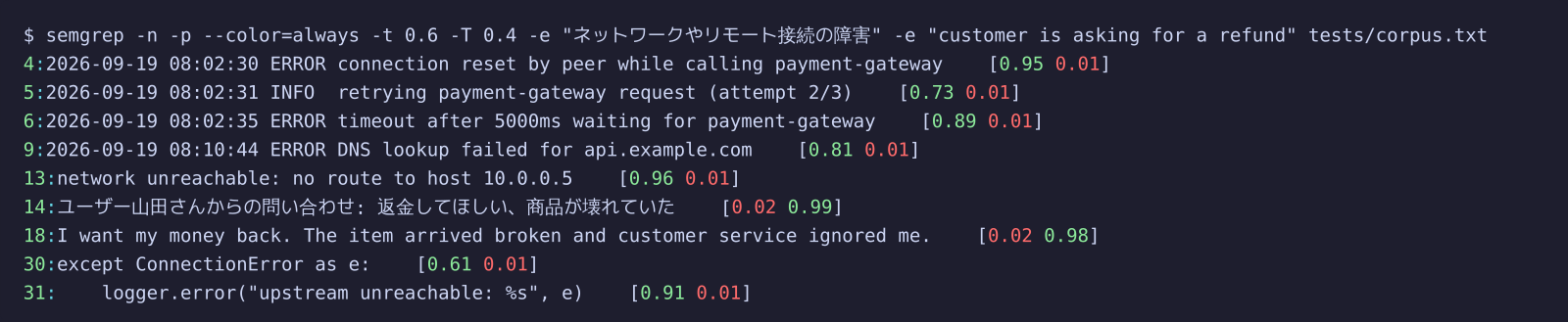
The pitch that makes this worth a full article is not the grep interface. It is the claim, stated plainly in the README, that this is a different operation from vector search — and that the difference buys you boolean logic over meanings. That claim is correct, it is more interesting than the author sells it as, and it comes with a bill and a dependency that the README does not price. All three below.
What the request actually is
The batching is the first thing worth reading, because the README's throughput numbers only
make sense once you have. From semgrep.mjs:
async function evaluate(chunk) {
  const id = i => `L${String(i).padStart(3, '0')}`;
  const state = Object.fromEntries(chunk.map((l, i) => [id(i), l.text.slice(0, 2000)]));
  const questions = {};
  chunk.forEach((_, i) => meanings.forEach((text, m) => {
    questions[`${id(i)}_${m}`] = { type: 'noul', instructions: `Does line ${id(i)} match the meaning: "${text}"?` };
  }));
  // ... one POST to https://api.typesafe.ai/v1/systemone
}
So it is not thirty separate calls, and it is not one call per line. One POST carries a
state object of thirty numbered lines and thirty × (number of meanings) noul questions,
each naming a line by its id. Jev reads the state once and answers every question against it in
one parallel pass — that shape is the entire reason the model exists, and it is what makes a
per-line decision affordable at all.
Three consequences fall straight out of that code, and the third is the important one.
Requests, not tokens, are the scarce resource. TypeSafe publishes two limits for
jev-1.13.0: 250,000 tokens per second and 1,200 requests per minute. A thirty-line chunk with
two meanings is about 3,000 input tokens, so 1,200 requests a minute is about 3.6M tokens a
minute — 60,000 tokens per second, against a cap of 250,000. You run out of requests with
three quarters of your token budget unspent. Chunking is not a latency optimisation; it is the
only mechanism that converts that unused token headroom into throughput. Thirty lines per
request turns the request cap into 36,000 lines per minute.
The "210-line file finishes in under a second" claim is one round trip, and the number is
load-bearing. The defaults are --chunk 30 and -j 8, so eight requests fire at once and
240 lines is exactly one wave. The demo file is 210 lines. Under a second is a single Jev round
trip (TypeSafe documents 70–500 ms) plus Node startup, and the wall clock steps up at 241 lines,
481, 721. It is an honest number for the file it was measured on; it is not a rate.
The probability for a line is conditioned on the other twenty-nine. All thirty lines go into
one shared state, and the question points at one of them by id. The README admits the
consequence: "Very large chunks start losing lines near the threshold, hence the default of 30."
That sentence is doing more work than it looks like. It means P(line ⊨ proposition) is not a
function of the line and the proposition alone — it is a function of the line, the proposition,
and its neighbours — and that --chunk is a quality knob disguised as a performance knob. It
also means the same line scored in two different chunks can land on two different sides of the
threshold. Hold onto that; it comes back when we try to cache this.
One real bug-shaped gap while we are in here. TypeSafe's documented budget is 64k tokens per
request, with 32k for state plus the longest single question. semgrep.mjs guards the state —
it caps a chunk at 20,000 characters — but nothing guards the question count, which grows as
--chunk × meanings. At the README's own upper bound of 420 questions that is fine; at
--chunk 500 with six meanings it is 3,000 questions against a 64k ceiling, and the state cap
passes happily on the way to a 4xx.
The argument against vector search, made properly
Here is the case as the README makes it. The six tests/contrast.txt lines below are all about
a refund. Only two are a customer asking for one.
- 1返金してほしい。商品が壊れていた — I want a refund. The item was broken.0.98
- 2返金処理が完了しましたのでご確認ください — Refund processing is complete, please confirm.0.10
- 3当社の返金ポリシーは購入後30日以内です — Our refund policy is within 30 days of purchase.0.10
- 4The manager denied the refund request yesterday0.17
- 5I demand a full refund immediately0.94
- 6Refunds are processed within 5 business days0.08
the pair the README uses for AND — lines 7 and 8 of the same file
- カスタマーサポート担当者が怒って電話を切った — the support agent hung up angrily0.05
- 顧客が怒って電話を切った — the customer hung up angrilymatched
Nine of the second line’s twelve characters are the tinted suffix, which both lines share verbatim; only the subject noun differs. That is the easiest possible case for “an embedding cannot tell these apart” and the hardest for a bag of words. The 0.05 is the README’s; the second line’s probability is not published, only the fact that it matched.
An embedding cannot make that split, and the reason is structural rather than a matter of model
quality. A bi-encoder computes enc(line) before it has seen your query — that is the
entire point of an index — so one fixed vector has to serve every question anyone will ever ask
about that line. What it can encode is what the line is about. Who did what to whom, whether
the event has happened or is being requested, and whether the sentence is negated are all
properties of the line relative to a question, and there is nowhere to put them.
Jev reads the line and the question together. That is a cross-encoder shape, and the distinction is not a hunch — it is the finding of the benchmark built for exactly this, Orion Weller, Dawn Lawrie and Benjamin Van Durme's NevIR: Negation in Neural Information Retrieval:
Read the ordering, then read the baseline. The metric is pairwise accuracy over 2,556 contrastive
document pairs that differ only by a negation: the model must rank both the query and its negated
twin correctly, so random guessing scores 25%, and the paper lists that as a row. The best
bi-encoder in the table — multi-qa-mpnet-base-dot-v1 — gets 11.1%. Not near chance.
Below it, because these models do not merely fail to notice a negation, they systematically
rank the same document higher for a query and for its opposite. The paper's own sentence:
"nearly all IR systems ignore the negation, generally scoring one document of the two higher for
both queries."
Two refinements the summary bars hide, and both cut against an over-reading. First, cross-encoding
by itself is not the fix — the cross-encoder family in Table 2 runs from 22.4% (RocketQA v2)
and 24.9% (stsb-roberta-large), both at or under random, up to 50.6%, and the clean trend
inside it is size: MonoT5 at 27.7% → 34.9% → 45.8% → 50.6% from small to 3B. The architecture
buys you the ability to condition on the query; scale is what turns the ability into accuracy.
Second, the 100% human bar is three annotators on ten sampled test instances — a sanity check
that the task is trivial for people, not a measured human baseline, and I would not quote it as
one without saying so.
That is the published version of jev-semgrep's claim, and it supports the direction of the argument while flatly refusing to support a strong form of it. Cross-encoding is the right family. It is not a solved problem in that family.
Why negation is the whole thing
The README frames the advantage as "boolean AND and NOT are plain boolean operations." It is worth being precise about why, because the OR is not actually the interesting half — you can fake OR in vector search by issuing two queries and unioning the results, and you can fake AND by intersecting. You cannot fake NOT, and the reason is a one-line fact about the geometry.
Cosine similarity ranges over [-1, 1] and it is a measure of alignment, not of truth. The
complement of a direction in embedding space is not "not that direction" — it is
everything else, which includes every unrelated topic in the corpus. 1 − cos(q, d) is not
P(¬q holds of d); it is distance, and "the customer is not asking for a refund" is at maximum
distance from "the customer is asking for a refund" in exactly the same way that "the weather is
nice" is. Subtracting a query vector does not give you its negation either, because the
embedding of a sentence and the embedding of its negation land next to each other — which is the
NevIR result above, measured.
A probability has a complement. P(x) and 1 − P(x) partition the unit interval, ¬ is
subtraction, ∧ and ∨ are operations you can actually define over the results, and the whole
thing composes. That is the real content of the project, and it deserves the flagship treatment
the author does not quite give it.
The boolean algebra is only classical at one setting
This is the part I did not expect to find, and it is the one thing in this article that is not in the repository's documentation anywhere.
The matcher is a single line of semgrep.mjs:
if (!expr.some(term => term.every(([m, not]) => (not ? p[m] < tNeg : p[m] >= tPos)))) continue;A positive literal is true when p >= tPos. A negative literal is true when p < tNeg. Two
independent cutoffs — not two sides of one. And the --level presets set them in opposite
directions:
-t is the cutoff for a meaning and -T the cutoff for its negation, and the presets move them in opposite directions. Only normal leaves them equal, so only normal gives you the classical boolean algebra the README advertises. The two-sided form is deliberate — the help text says so outright (“with -t 0.6 -T 0.3 a line at 0.3..0.6 matches neither X nor not-X”) — but the paraconsistent half of it is not mentioned anywhere.
Only normal makes the two cutoffs meet. Everywhere else a band opens between them, and the
sign of the band decides which law of classical logic you have given up:
- Under
--level loose, a line atp = 0.5satisfies both-e Xand-v X. The predicate and its negation are simultaneously true; non-contradiction fails. This is a paraconsistent logic, and it is the setting the help text recommends for "catch more, accept some noise." - Under
--level strict, that same line satisfies neither. Excluded middle fails; a line can be neither X nor not-X. This is a truth-value gap — Kleene's third value in all but name.
The help text discloses the second half ("with -t 0.6 -T 0.3 a line at 0.3..0.6 matches neither X
nor not-X") and never mentions the first. And here is the twist: the project's own threshold
sweep, committed in tests/report.md, reports its best-F1 operating point as -t 0.45 -T 0.65.
That is a 0.20-wide overlap. The empirically best configuration is one of the inconsistent
ones — which makes sense, because widening both sides raises recall on both the positive and
the negative literals, and F1 on this fixture rewards recall.
I want to be fair about what this is. It is not a bug; the two-threshold design is deliberate and it is a reasonable way to express "I am not confident either way." It is a documentation gap and a conceptual one. A tool whose headline claim is "logical AND and NOT are plain boolean operations, not a trick" ships a default preset set in which two of the three presets are not plain boolean operations, and the one tuning run in the repository lands on a fourth that is not either.
The bill
Now the part the README prices at one sentence and does not extend.
grep is O(lines) byte comparisons against a compiled DFA, running at memory bandwidth on your
own machine, for free. This is O(lines) model calls against a metered API in someone else's
data centre, and — the asymmetry that matters — you pay the whole corpus again on every
query, because there is no index. The README says this itself, to its credit: "for repeated
queries over a large, fixed corpus a vector index is cheaper and faster."
A semantic grep is O(lines) model calls, and the bill scales with the corpus on every query, not once per index. One pass over this site's own prose costs about eleven cents and cannot finish faster than 83 seconds at the published rate limit.
| corpus and query | lines sent | requests | input tokens | cost | ≥ wall clock | basis |
|---|---|---|---|---|---|---|
| tests/corpus.txt, 1 meaning | 51 | 2 | 3,225 | $0.00014 | 0.1 s | measured (README) |
| tests/corpus.txt, 3 meanings | 51 | 2 | 5,673 | $0.00024 | 0.1 s | measured (README) |
| this site's content/, 1 meaning | 49,490 | 1,650 | ~2,700,000 | $0.11 | 83 s | computed |
| this site's content/, 3 meanings | 49,490 | 1,650 | ~5,220,000 | $0.22 | 83 s | computed |
| 1,000,000 English lines, 1 meaning | 1,000,000 | 33,334 | ~54,500,000 | $2.29 | 28 min | computed |
| this site's content/, BM25 (what /api/search runs today) | 49,490 | 0 | 0 | $0.00 | in-memory | the existing route |
Output tokens are metered free, so input is the whole bill. The last row is the one to read twice: BM25 over the same corpus is the ranking function this site already runs at /api/search, with no model call, no key, and no per-query cost at all.
The two measured rows are the tool's own stderr summary quoted from the README; the rest is a token model fitted to them, and the method is in the table. The row to sit with is the third: one semantic-grep pass over this site's own prose — 275 MDX files, 49,490 non-blank lines — is about 2.7 million input tokens, eleven cents, and 1,650 requests, which at the published 1,200-per-minute cap cannot complete in less than 83 seconds. Per query. For one meaning.
Eleven cents is, in absolute terms, nothing. That is the honest headline: at $0.042 per million input tokens with output metered free, a decision per line is shockingly affordable compared to any LLM doing the same job, and the ecosystem has been rediscovering this all month. But the unit is wrong for a search box. Eleven cents and 83 seconds per query is a batch job, not an interaction, and it is charged to you rather than to the person typing.
There is also a concurrency detail worth naming. The default is -j 8, and the README quotes
0.2 s per request. Eight in flight at 0.2 s each is 2,400 requests a minute against a documented
cap of 1,200. Past a few thousand lines you are not running at concurrency 8; you are running
inside the 429 backoff loop at the bottom of evaluate(), which retries six times at
500 ms × 2ⁿ. It works — that is what the loop is for — but the effective rate is set by the
limiter, not by -j.
The threshold is a calibration bet, and nobody has published the odds
--level loose|normal|strict is a threshold on a probability. That is not a metaphor: it is
literally 0.3, 0.5, 0.7 compared against a number the model emits. Which makes this tool an
instance of the pattern TypeSafe itself markets as confidence-gated routing, and makes it depend
on exactly the quantity nobody has measured.
I went looking for that measurement in RLCD is not constrained
decisions: TypeSafe's docs corpus is 835,504 bytes and
contains zero occurrences of Brier, expected calibration, reliability diagram or
proper scoring, and ECE as a whole word appears nowhere across the docs, the launch post, the
manifesto or evals.typesafe.ai. RLCD — Reinforcement Learning for Calibrated Decisions — is
published as three sentences of output contract and no method, no loss, no data and no number.
The only reliability diagram that exists for anything in this family is the one I computed from
openjev's committed logits, and openjev is a different
model: 79.4% accuracy at 85.5% mean confidence, ECE 0.071, over 252 rows.
So when you type --level strict you are asserting that 0.7 means something stable. Three things
in this repository say it might not.
And then there is the single most informative number in the whole repository, which is in the
figure at the top of this article. Line 5 of the corpus is
2026-09-19 08:02:31 INFO retrying payment-gateway request (attempt 2/3). Against the meaning
"network or remote connection failure" it scores 0.73.
That is the one line in a 51-line corpus that two independent readers can reasonably disagree
about: it is an INFO line, it names no failure, and it implies one. The LLM judge in
tests/judge.mts marks it as not a match, twice, in two separate cases. A calibrated model
asked a genuinely ambiguous question should return something near 0.5. Jev returns 0.73 —
above strict. One data point is not an ECE, and I am not claiming it is. But it is the
observation that a calibration number would settle, and it is sitting in the project's own
promotional screenshot.
What the evaluation is, named by its denominator
The README's headline is "precision 0.94, recall 0.98." It is better than that number usually is, and worse.
Better, because the harness is real and the design has a piece of genuine care in it. judge.mts
asks Claude Sonnet which lines match each meaning separately, and then evaluates the AND/OR/NOT
expression over those per-meaning verdicts in the runner. The judge never sees the boolean
expression. That is the correct way to test a boolean algebra over predicates — it isolates the
algebra from the judging — and it is a better methodological instinct than most released
evaluations have. It also runs semgrep exactly once at -t 0 to extract raw probabilities and
then sweeps 361 threshold pairs offline, never calling the API again. Remember that; it is the
right architecture, and it turns up again in Part Two.
Worse, because of the denominators.
The project's headline 'precision 0.94, recall 0.98' rests on 90 true positives, and 62 of them — 69% — come from the two queries that match most of the corpus. The eight ordinary queries produce 28 true positives between them, and one of the ten cases scores zero on both metrics.
| case | judge | semgrep | TP | FP | P | R |
|---|---|---|---|---|---|---|
| not/only-non-log | 39 | 39 | 39 | 0 | 1.00 | 1.00 |
| ornot/code-or-not-english | 23 | 25 | 23 | 2 | 0.92 | 1.00 |
| single/ja-meaning | 6 | 8 | 6 | 2 | 0.75 | 1.00 |
| single/angry-customer | 5 | 5 | 5 | 0 | 1.00 | 1.00 |
| or/refund-or-address | 4 | 4 | 4 | 0 | 1.00 | 1.00 |
| andnot/error-not-network | 4 | 5 | 4 | 1 | 0.80 | 1.00 |
| single/abstract | 3 | 4 | 3 | 1 | 0.75 | 1.00 |
| mixed/(finance and negative) or weather | 3 | 3 | 3 | 0 | 1.00 | 1.00 |
| single/security-risk | 3 | 3 | 3 | 0 | 1.00 | 1.00 |
| and/net-and-retry | 0 | 1 | 0 | 1 | 0.00 | 0.00 |
| — total, best thresholds (-t 0.45 -T 0.65) | 90 | 97 | 90 | 7 | 0.93 | 1.00 |
| — total, shipped defaults (-t 0.5 -T 0.5) | 90 | 94 | 88 | 6 | 0.94 | 0.98 |
| — the two broad queries alone | 62 | 64 | 62 | 2 | 0.97 | 1.00 |
| — the other eight queries | 28 | 33 | 28 | 5 | 0.85 | 1.00 |
The denominators are the point. Ten queries over one 51-line file is 510 line-level decisions, of which ~414 are true negatives; a query like 'not a timestamped server log line' matches 39 of 51 lines by construction. The sweep also fits 361 threshold pairs on exactly the cases it reports, so the 'best' row is tuned on its own test set — the default row is the honest one, and it is the one the README quotes.
Ninety true positives, and sixty-two of them — 69% — come from two queries:
"not a timestamped server log line," which matches 39 of the 51 lines by construction, and
"source code or SQL, or not written in English," which matches 23. The other eight queries
produce 28 true positives between them. One case, and/net-and-retry, scores 0.00 precision and
0.00 recall, because the judge says nothing matches and semgrep returns one line — and that line
is L5, the retry at 0.73.
Two further things to state plainly. The ground truth is a language model's opinion, instructed
to "Be strict: only clear matches," which biases the reference toward fewer positives and
therefore mechanically inflates the false-positive count of anything measured against it. And the
361-pair threshold sweep is fit on exactly the ten cases it reports, with no held-out set — so
the "best -t 0.45 -T 0.65" row is tuned on its own test set. The author does the right thing
here and quotes the default thresholds in the README, which is the un-tuned number. I would
just say the word "tuned" out loud next to the other one.
The multilingual result is a demo, and a good one
tests/multi.txt is fourteen lines. Six are refund requests, in French, Russian, German,
Spanish, Chinese and Korean; six are thank-you notes in the same six languages; two are server
errors in French and Russian. A Japanese query finds all six refund requests and none of the
other eight. A Russian query does the same.
That is a real and non-obvious capability, and it is worth being impressed by: no translation step, no per-language index, no tuning, six languages found by a Japanese query, which is a seventh. It is also fourteen lines with six positives and eight negatives, and the eight negatives are thank-you notes and connection timeouts — topically about as far from a refund request as a fixture can get. "Zero misses, zero false positives" on that set is the expected outcome, not evidence about the general case. N = 14 cannot carry the sentence.
The README is, again, more honest than it needs to be about the limit next door: "TypeSafe documents English as the most accurate language, and in our tests Japanese meanings wobble a little more near the threshold. When a query is borderline, phrasing the meaning in English is the safer choice." That is a disclosure published directly against the interest of a tool whose author writes its documentation in Japanese first, and it is the most credible sentence in the file.
Part two — where this goes in Next.js 16
Satyajit's instruction for this half was three words: figure out Next.js best practice for
this. The answer has moved. This repository runs Next.js 16.3.5, and the version-matched
documentation ships inside the package at node_modules/next/dist/docs/ — every claim below is
from those files rather than from memory of Next 14.
Where the call belongs: a Route Handler, and it is not close
Three places could host a decision-model call. Only one survives contact with this workload.
Not a Server Action. The server-actions guide states the disqualifying property in its
second section: "Next.js dispatches Server Actions one at a time per client. If a user triggers
three actions in quick succession, the second waits for the first to finish." The whole
performance story of this pattern is eight concurrent chunk requests. From the browser, eight
Server Actions are eight sequential round trips. The docs even name the remedy, and it is the
answer to this question: "do not rely on Promise.all to parallelize Server Actions from the
client... use a Route Handler for non-mutation requests." A search is not a mutation. Two more
reasons stack on top: a Server Action is identified by an action ID that Next rotates at most
every 14 days, so a long-lived search tab that survives a deploy gets
Failed to find Server Action; and the request body limit is 1 MB by default
(serverActions.bodySizeLimit), which a pasted log blows through without trying.
Not a Server Component, for a user-typed query. A Server Component is the right home for a
fixed set of propositions evaluated over known content — a page that labels every article
with "states a measured benchmark number," say — because then it prerenders and caches. Point it
at searchParams and you have made the route runtime-dependent, you have put the corpus in a
URL, and you have bought a full re-render per keystroke.
A Route Handler, then: app/api/semantic-grep/route.ts, POST, streaming. Two Next 16
facts to hold while writing it. Route Handlers "are not cached by default" — GET can opt in
with export const dynamic = 'force-static', and other methods never cache. And use cache
cannot appear inside a Route Handler body; the docs are explicit: "extract it to a helper
function." Which is exactly where you want it anyway.
Caching: nothing is cached by default, and the threshold must not be in the key
Start from the version-specific baseline, because the internet's memory of this is wrong. In
Next 16 the fetch default is auto no cache, and the docs say it in one sentence:
"Caching is opt-in." Route Handlers are uncached. Nothing about a Jev call gets cached
unless you say so.
Two mechanisms are available, and they are not equivalent.
The fetch cache, which needs no configuration at all and has a property that fits this
workload perfectly:
force-cache: Next.js looks for a matching request in its server-side cache. A request matches on its URL, method, headers, and body, so requests that differ in any of these are cached separately. […] Caching is opt-in. Setcache: 'force-cache'to cache any request, includingPOST.
A Jev call is a POST whose body is { model, state, questions }. Matching on the body means
the framework cache key is (the thirty lines, the propositions, the model) — the exact key
you would have designed. One option object and you have a content-addressed decision cache:
const res = await fetch("https://api.typesafe.ai/v1/systemone", {
  method: "POST",
  headers: { authorization: `Bearer ${key}`, "content-type": "application/json" },
  body: JSON.stringify({ model: "jev-1.13.0", state, questions }),
  cache: "force-cache",
  next: { revalidate: false, tags: ["jev-1.13.0"] },
})
Three details in that options object, and a fourth that is not in it. revalidate: false is right, and it is right for an unusual reason:
P(line ⊨ proposition) under a pinned model is a pure function with no time dimension at all,
so there is nothing to revalidate on a clock. It revalidates on a model version. That is what
the tag is for — revalidateTag("jev-1.13.0") when you move. Which is also why the body says
jev-1.13.0 and not jev-latest: caching an alias caches a moving target. And the docs warn
that force-cache will happily cache a request carrying an authorization header — fine when
the key is your server's, a serious footgun the day it is a user's.
The one that is not in the object is easy to miss and it costs money. React's automatic fetch memoisation — the thing
that collapses two identical calls inside a single render pass — does not apply in Route
Handlers, because a Route Handler is not part of the component tree. Two identical chunks in
one request are two calls and two bills unless the persistent cache catches them, and on a cold
serverless instance it will not. Deduplicate chunks yourself, before dispatch.
use cache, which needs cacheComponents: true in next.config.ts. This site does not have
it enabled, so on this codebase today the fetch cache and unstable_cache are what exist. When
you do turn it on, the key is "build ID + function ID + serializable arguments", including
anything captured from an enclosing scope. Which brings us to the one design decision that is
worth more than every other knob in this pattern:
belongs in the key
- the line text, normalised
- the proposition text, verbatim
- the model id (jev-1.13.0, not jev-latest)
- the chunk the line was scored in
must not
- -t / -T / --level
- the AND / OR / NOT expression
- -A / -B / -C context, -n, --color
- the file name, the user, the request
The fourth row of the left-hand list is the uncomfortable one. Jev scores a line against a state holding all thirty lines of its chunk, and the README says large chunks “start losing lines near the threshold” — so the probability is conditioned on the neighbours, and a key of (line, proposition) alone is not quite sound. Keying on the chunk is honest and caches almost nothing; keying on the line alone caches well and quietly asserts an independence the tool’s own documentation denies.
The threshold does not belong in the cache key. Jev returns a probability; -t, -T and
--level are a comparison against it. Put the cutoff inside the cached function and every value
a reader tries is a fresh entry and a fresh O(lines) bill. Apply it to the cached return value
and switching loose → strict costs zero calls and zero cents.
The jev-semgrep CLI gets this wrong and its own test harness gets it right. Change --level on
the command line and all 49,490 lines go back over the wire; tests/judge.mts calls semgrep once
at -t 0, harvests the raw probabilities, and sweeps 361 threshold pairs with no further API
traffic. The correct architecture is already committed to the repository — it just lives in the
tests instead of in the tool.
What the hit rate actually is
The docs give a blunt warning about cache keys: "If cache keys have mostly unique values per
request (search filters, price ranges, user-specific parameters), cache utilization will be
near-zero." A line of text is a high-cardinality key, so it is fair to ask what the hit rate
would be. I measured it on this site's corpus: of 49,490 non-blank lines, 40,716 are distinct —
a 17.7% duplicate rate, but 86% of those duplicates are markup: bare ---, code-fence
markers, /> and </Callout>. Strip those and the substantive repeat rate is 2.5%.
So the docs are right for prose and wrong for the workload this tool was built for. Prose lines
are nearly unique; log lines are templated, which is the entire premise of every log-parsing
system ever written, and the same ERROR connection reset by peer while calling payment-gateway
appears ten thousand times in one file. Per-line caching is close to worthless on an essay and
close to free money on a log — and the way to find out which you have is to count distinct lines
before you design the cache, not after.
The bigger win is not within a query anyway. It is across queries: the same corpus, scored
against the same proposition, next week. That is where a durable cache earns its keep, and
it is where Next 16's defaults will quietly betray you. With the default in-memory handler,
serverless entries "typically don't persist across requests," and no cache directive
survives a deploy, because the build ID is in the key. Refilling a 2.7M-token cache after every
deploy is eleven cents and 83 seconds, every time. The docs name the fix and name this exact
situation while doing it: 'use cache: remote' is for "Rate-limited APIs: your upstream service
has rate limits or request quotas that you risk hitting." For entries that must outlive a
deploy, it is unstable_cache or the fetch cache — the two that key on something other than
the build.
Batching, server-side
Everything from Part One transfers: chunk to thirty, cap the chunk by characters, bound concurrency, and remember the rate limit is on requests. The one thing to add on the server is a queue that is shared across requests rather than per-request, because eight concurrent chunks per user is eight per user — twenty simultaneous readers is 160 in flight against a 1,200-per-minute cap, which is a 429 storm arriving as a p99 latency graph. A single module-scope semaphore sized to your actual quota is the whole fix, and it is one of the few genuinely good reasons to keep state at module scope in a Next server.
Streaming partial results, and why Suspense is the wrong tool here
Suspense streams rendered UI, and a boundary resolves once — all of its content at once, not
progressively. For a set of chunks known at render time, sibling boundaries are exactly right and
the streaming guide covers the pattern well: each <Suspense> resolves independently and paints
as it lands. For a user-typed query, it does not fit, because every keystroke is a new render
tree and you want one long-lived response that emits verdicts as they resolve.
The docs' own answer for that is a Route Handler returning a ReadableStream — they give the
recipe under "Streaming in Route Handlers" — and NDJSON is the natural body: one JSON object per
line per verdict, flushed as each chunk's promise settles, in corpus order via a small reorder
buffer so the output matches grep's.
Three things will silently eat your stream, and all three are documented in the same guide:
- Safari buffers until 1,024 bytes have arrived. A verdict line is maybe 60 bytes, so about seventeen results appear at once and then it flows. Pad the first chunk or send a header record.
- Reverse proxies and CDNs buffer.
X-Accel-Buffering: nofor nginx; check your CDN. Compression buffers too, which is its job. - Platform support is not universal. Vercel streams natively; AWS Lambda needs response streaming mode explicitly enabled, and it is not the default.
Runtime: the question has been answered for you
This is the part where a pre-release Next matters most, because the received wisdom — "put your
lightweight API calls on the edge, it's closer to the user" — is now actively wrong. From
node_modules/next/dist/docs/01-app/03-api-reference/03-file-conventions/02-route-segment-config/runtime.md:
So: Node, and there is no decision to agonise over. It would have been the right answer anyway —
this workload is a fan-out of eight HTTPS calls to one origin, where the round trip to
api.typesafe.ai dominates and being 20 ms closer to the user buys nothing.
The constraint that does bite is maxDuration. A 10,000-line corpus is 334 requests; at the
1,200-per-minute cap that is 17 seconds of pure rate-limit floor before any backoff, and default
serverless timeouts are not generous. Two things help, in this order: don't accept a whole
corpus in one request (cap lines server-side before chunking, and paginate), and stream, which
keeps the connection producing bytes instead of sitting silent until a platform kills it.
Rate limiting and cost control, which this pattern makes mandatory
The dangerous property of a semantic grep is that the ratio of user effort to your spend is
about as bad as it gets. One paste, one click, ceil(lines / 30) upstream calls. A 50,000-line
paste is 1,667 requests — 83 seconds of your entire organisation's rate limit, consumed by one
person who has not finished reading the page yet.
Four controls, cheapest first:
- Cap the input before you chunk. A line limit per request is one
slice()and it is the only control that cannot be circumvented by the caller. - Cache. A repeat query costs zero calls, which makes the cache a rate limiter that also
happens to be fast. This is the argument for
'use cache: remote'over in-memory, stated as a budget rather than as a latency number. - A per-session token budget, checked before dispatch, not after. Jev bills on input tokens
and you know the input exactly before you send it —
chars/T + questions— so this is the rare case where you can enforce a budget predictively instead of reconciling a bill. - Record spend out of band with
after(), so logging the token count never adds latency to the response.
And treat the endpoint as public. The docs say it about Server Actions — "reachable via a direct POST request, not just through your application's UI" — and it is trivially true of a Route Handler, which is just a URL. Auth goes inside the handler, above the chunker.
Would this suit /api/search? No — and there is a better shape
This site already has search. /api/search is a GET handler over
lib/search.ts: BM25 — the ranking function, explained — over
contextualised chunks, where each chunk is prefixed with its document title, description, tags
and nearest heading before indexing. The index is built once from content/, cached in a module
variable, and scored through a postings map. No model, no key, no per-query cost, no network.
Replacing that with a semantic grep would be a straight downgrade, and the cost table above says
why: eleven cents and a hard floor of 83 seconds per query, against something that currently
returns in single-digit milliseconds for free, on a public unauthenticated GET that anyone can
call in a loop. That is not a close call. It is the same trade tgrep makes
from the other direction — pay once to build an index so queries are cheap — and the reason both
answers are "index it" is that this site's corpus is fixed and its query set is open.
But there is a shape that fits, and it is the interesting one. Flip the loop. A semantic grep
costs O(queries × lines). Precomputation costs O(propositions × lines), once. So pick a small
fixed set of propositions — "this passage reports a measured benchmark number," "this passage is
about training rather than inference," "this passage states a limitation of the work" — score
the corpus against them at build time, and commit the probabilities as a column next to each
chunk. Then /api/search keeps BM25 for the query and gains free boolean filters over meanings:
?q=attention&is=measurement¬=marketing. Eleven cents per proposition per build, zero per
query, no model on the request path.
That is the same move Next 16's whole caching model is built around — do the expensive thing when the inputs are known, serve the cheap thing at request time — and it is the version of jev-semgrep's idea that survives contact with a public endpoint.
What I would tell the author
Four things, in order of how much I think they would improve the tool:
- Split the run from the threshold.
judge.mtsalready proves the design: score once, cache the probabilities, apply-t/-Tlocally. A--cacheflag keyed on(line, proposition, model)would make--levelfree and turn threshold tuning from a repeated bill into an instant one. - Document the overlap. The help text explains the gap under
strictand never mentions thatloosemakes a line and its negation both true. One sentence. - Guard the question budget, not just the state —
--chunk × meaningsagainst 64k. - Publish a reliability diagram. The pieces are already committed:
judge.mtsharvests raw probabilities at-t 0, andverdicts.jsonholds per-meaning ground truth. Binning those probabilities against those verdicts is about twenty lines and would produce the first calibration measurement anyone has published for a Jevnoul— the number on which every--levelin this tool depends, and which TypeSafe has not published for its own model.
What would change my mind
6 claims above, and what would falsify each
The boolean algebra is only classical at --level normal.
Read as code,
-e Xisp >= tPosand-v Xisp < tNeg, andloosesets those to 0.3 and 0.7 whilestrictsets them to 0.7 and 0.3. Runsemgrep --level loose -p -e "X" fileandsemgrep --level loose -p -v "X" fileon a corpus with a line between 0.3 and 0.7 and find that line absent from one of them, and I am wrong — the matcher would have to be doing something other than what line 275 says.One pass over this site's corpus is about 2.7M input tokens and eleven cents.
Two measured rows anchor a fitted token model; everything else is extrapolation, and the model assumes 4 characters per token for English. Run the tool over
content/with a key and read theinput tokensfigure it prints to stderr. If it lands outside roughly 2.0M–3.4M, my chars-per-token constant is wrong and every extrapolated row moves with it. The requests column and the 83-second floor do not move — those areceil(49490/30)and the published 1,200/minute.Negation is the capability that vector search structurally cannot have.
NevIR measures bi-encoders below a random baseline on pairs differing only by negation, which is strong evidence, and the mechanism — the document is encoded before the query exists — is not a quality problem. A bi-encoder that scores meaningfully above random on NevIR-style pairs without cross-encoding at query time would falsify the structural half of the claim. Note the reverse is already conceded: the best cross-encoder in that table gets 50.6%, so "cross-encoders solve negation" is not something I am asserting.
Line 5 scoring 0.73 is evidence of a calibration question, not a model error.
This is a single data point and I have labelled it as one. What would settle it is a reliability diagram: bin Jev's
noulprobabilities against the judged verdicts already committed inverdicts.jsonand see whether the 0.7–0.8 bin is right about 75% of the time. If it is, the model is calibrated and my discomfort with 0.73 on an ambiguous line is just my disagreement with the judge. Nobody has run this, which is the actual finding.A Route Handler, not a Server Action, is where this belongs in Next 16.3.
The load-bearing fact is the documented sequential dispatch of Server Actions per client. If a future version parallelises client-side dispatch — or if a measurement shows eight actions fired with
startTransitionoverlapping rather than serialising — the main argument collapses to the weaker ones (body size limit, action-ID rotation, and search not being a mutation), which are real but would not by themselves decide it.The evaluation's headline rests on two broad queries.
Transcribed from
tests/report.md, and the arithmetic reconciles to its own stated totals (TP 90 / FP 7). Adding cases with narrow expected sets, or reporting macro-averaged per-case P/R instead of micro-averaged totals, would change the picture — and would be the right fix. Ten cases on one 51-line file is the limit here, not the method.
The one-paragraph version
The idea is right and under-sold. Asking a model for the truth of a proposition, rather than the
distance to a topic, gives you a quantity with a complement — and a complement is the thing
embedding search cannot manufacture, which NevIR measures and which is why "mentions refunds but
is not a request" is one command here and not expressible at all in a vector index. The
implementation is clean, honest about most of its limits, and cheap enough that per-line
inference stops being absurd. What it does not have is the number the whole design rests on:
--level is a threshold on a calibration nobody has published, its own screenshot shows 0.73 on
the corpus's most ambiguous line, and two of its three presets quietly give up a law of classical
logic. On the engineering side, the pattern maps cleanly onto Next 16 — Route Handler, streamed,
Node runtime, batched thirty at a time — provided you put the threshold outside the cache key and
count your distinct lines before you believe in the cache at all.