2026-09-19 · 28 min · explainer · llm · architecture · agents
Everything published about System One models this week has been about what they can do. The architecture, the open rebuilds, the one benchmark row that says zero. This piece is the negative space, and I think it is the more useful half, because none of these limits is a bug someone will fix in the next checkpoint. They fall out of the shape.
I started with a thesis I liked: one architectural choice produces every limitation observed this week. Each option is scored without seeing the others, the output is bounded to the option set, and everything else follows. It is a tidy claim, it makes a good diagram, and it is about 60% true.
Here is where it survived and where it broke, before the details:
- It cannot write a string that is not already an option. Forced. True of every family, no exceptions.
- It cannot keep an intermediate result between calls. Forced, and the reason the multi-step weakness is structural rather than a training gap — though some of the reported weakness is ordinary.
- It cannot answer a question that spans two options. Not forced. This follows from options being isolated, which is one of two available implementations.
- The option order changes the answer. Also not forced, and it is the other implementation's price. No model pays both. These two are not the same limit; they are the two sides of one coin the shape leaves face-down.
- There is a ceiling on how many options you can send. This one dissolves entirely. It is five numbers in five repositories with five unrelated causes, and one of them is the absence of a ceiling.
And a sixth thing, which is the part I think matters most for anyone reading the vendor's own failure-mode page: half the entries on it have nothing to do with the architecture. Literal reading, arithmetic, date ordering, context rot, prompt injection. A prompted 400B model has all of them. Filing them with the structural limits is what makes the shape look worse than it is.
The one choice, stated precisely
A generative model's output space is its vocabulary, sampled repeatedly. A decision model's output space is a list you sent in the request. That is the whole difference, and two families implement it:
- Vocabulary readout. The options go into the prompt as lettered text and the model
picks a letter —
openjevslices sixteen fixed rows out of a 151,936-wide logit vector. The options share a context. - Per-option scalar scorer. Each option's text is encoded and scored on its own, and
the softmax is taken over the resulting scalars — CUA-S1,
open-jev-deberta, and, by the argument in the RLCD piece, Jev. The options never share a context.
There is a third arrangement, which I had not appreciated until I read Laya's code, and it matters later: all options in one sequence with marker tokens, a bidirectional encoder over the lot, and a scalar read from each marker position. Options share a context and each one gets its own scalar. Hold that thought.
The size of the output is worth putting a number on, because it is the source of two of the five limits. A 255-option Choice carries at most bits. One call, eight bits, and nothing else comes back — no tokens, no text, no state. A generative model asked the same question emits a hundred tokens from a six-figure vocabulary and can carry a couple of thousand bits, most of it useless, some of it the scratchpad it needs to get to the answer.
Eight bits per call is not a criticism. It is the product: a bounded, calibrated, parseable answer. But you cannot spend eight bits on both the answer and the working.
1 · It cannot write the string
This is the limit TypeSafe states most plainly, on its own jaggedness page, which is a genuinely unusual document — a vendor enumerating eight ways its flagship model fails, with a "do this instead" for each:
What makes this more than a footnote is what it does to a real agent.
WindTunnel is nekuda's benchmark of the four
ways a browser agent can operate a website, and its board v1.2 added a Jev configuration.
The leaderboard is covered separately and published at
webmcp.com/benchmark, so I will not relitigate it here. The relevant fact is structural and it is in
the repo's own docs/SPEC.md: "Jev (jev-1.13.0) selects actions; Mercury
(mercury-2.5) writes arguments or field values and the final answer."
Two models, because one model can pick search_products out of the tool list and cannot
produce the query string to put in it.
WindTunnel publishes the redacted per-attempt traces, so the split is measurable rather than rhetorical. I summed the 147 scored WebMCP attempt records:
In the only third-party benchmark that runs a decision model end to end, the decision model makes the decisions and a generative model does almost everything else. 385 of the 413 actions Jev selected could not be executed until another model had written their arguments, and 379 of those 385 required at least one string that was not in any list.
| across 147 scored attempts | Jev 1.13.0 | Mercury 2.5 |
|---|---|---|
| provider calls | 413 | 385 |
| input tokens | 1,074,068 | 712,698 |
| output tokens | 30,706 | 18,382 |
| estimated cost | $0.045111 | $0.156447 |
| share of the bill | 22.4% | 77.6% |
| calls filling at least one unconstrained string | n/a | 379 of 385 |
| options per decision (min / median / max) | 3 / 7 / 10 | n/a |
Jev reads half again as many input tokens as Mercury and costs under a third as much, which is the whole commercial argument for the shape. It is also doing less than half the job: every argument, every field value and all 143 final answers were written by the other model.
385 of 413 selected actions could not be executed until a second model wrote their
arguments, and 379 of those 385 requests carried at least one string property with
no enum and no const — a field with no list to pick from. The 28 decisions that
needed no second call were the ones the harness could execute with an empty argument
object.
The decision model is genuinely cheap: it read half again as many input tokens as Mercury for under a third of the cost. It is also doing less than half the job. Every argument, every field value, and every one of the 143 final answers was written by the other model.
The version without a second model
The same repository contains the more interesting artifact: the argument filler they
built to avoid the second model, and did not use for the measured runs.
experiments/jev/frozen/arms/decision-spans.mjs turns generation into a chain of
choices, exactly as the jaggedness page says you can and should not.
- 1
the task arrives as a string
Find the post whose title starts with "Introducing" and report its full title.
a real prompt from the published WebMCP traces; the chosen action is ask_site, whose only argument is a free-text query
- 2
the harness manufactures an answer set
regex over the prompt for emails, quoted spans, ISO dates, all-caps tokens and numbers · every string, number and boolean walked out of the last observations · then every contiguous span of the prompt up to six words long
63 candidates from this prompt's own text before a single observation is added; the pool is capped at 2,000
- 3
the string field becomes a Choice
options = the surviving candidates that validate against the field's schema, sliced to 255 — or 254, because an optional field spends one slot on “Omit this optional argument”
required fields with no representable candidate throw; optional ones are dropped and audited as argument_omitted
- 4
the final answer becomes eight Choices
slot 1 of 8 … slot 8 of 8, each over the same candidate list plus “Stop selecting answer evidence”, deduplicated, joined with “; ” and truncated at 3,900 characters
a sentence is not composed; it is concatenated out of spans that already existed somewhere
and then the comment in the source, where the ladder stops
"contiguous spans up to six words, not linguistic phrase extraction. Longer newly composed strings require the hybrid filler."
collectCandidates over this prompt alone. Every other number and quotation is read out of the file.Read the fourth step again. A final answer is eight Choice questions over the same
candidate list, deduplicated and joined with "; ". That is not a sentence. It is a
concatenation of spans that already existed somewhere in the prompt or the observations.
The whole of it is one function:
// WindTunnel · experiments/jev/frozen/arms/decision-spans.mjs @ 5ca8644 — one audit() call elided
export async function answerFromSpans(state, choose, audit = () => {}) {
  const { candidates, omitted } = collectCandidates(state.task, state.history.map(h => h.result ?? h));
  const values = candidates.filter(c => typeof c.value === "string" || typeof c.value === "number");
  const remaining = values.slice(0, 254); // Reserve one choice for stop.
  const questions = Object.fromEntries(Array.from({ length: 8 }, (_, i) => [`slot${i}`, {
    question: `Select answer evidence for slot ${i + 1} of 8, in task order. Choose a distinct relevant value for each slot, or stop when no more evidence is needed.`,
    options: [{ value: null, label: "Stop selecting answer evidence" }, ...remaining],
  }]));
  const answers = await choose(state, questions), selected = [];
  for (const id of Object.keys(questions)) {
    const value = answers[id].value;
    if (value === null) break;
    if (!selected.includes(value)) selected.push(value);
  }
  if (!selected.length) throw new Error("no answer evidence selected");
  return selected.join("; ").slice(0, 3900);
}
collectCandidates scrapes the task text and every observation for strings, numbers,
quoted phrases, dates and contiguous spans of up to six words. The model picks eight of
them in order, or says stop. join("; ") is the composition step, and it is a string
method. The file's own comment marks where this runs out: "Longer newly composed
strings require the hybrid filler."
The ladder is not a hack around the limit. It is the limit, drawn at full size.
Which is also the recipe
The useful half of this is that TypeSafe documents the same pattern as the correct architecture, not as a workaround. Its pre-parsed value extraction cookbook is three steps long:
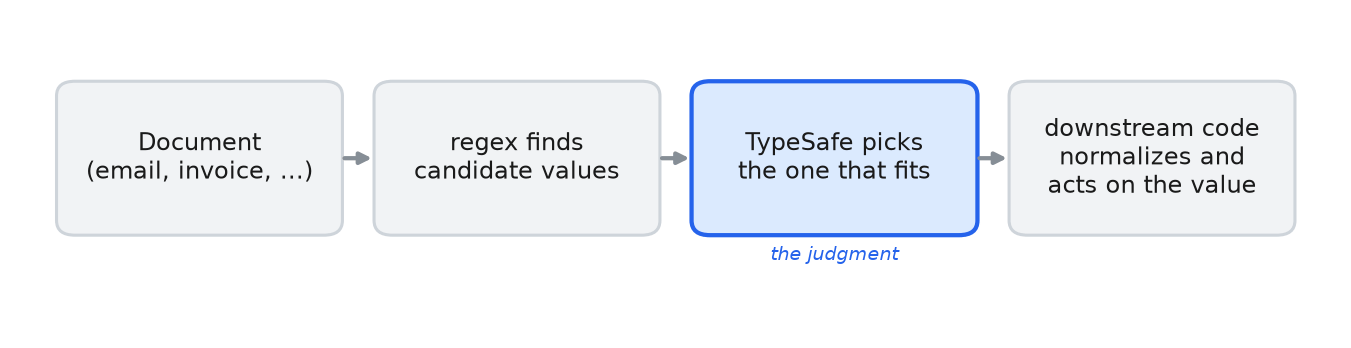
And the line that turns the limit into a feature:
Those three boxes are also three blocks of a real agent loop. Here is WindTunnel's, with everything but the boundary stripped out:
// WindTunnel · experiments/jev/frozen/arms/decision-agent.mjs @ 5ca8644 — abridged
snapshot = await bounded(() => adapter.observe(), signal);          // 1. enumerate
const menu = [...snapshot.actions, FINISH, ABSTAIN];
if (menu.length > 255) throw new Error('action menu exceeds 255 choices');
if (new Set(menu.map(a => a.id)).size !== menu.length) throw new Error('duplicate or reserved action ID');
const state = decisionState(task, menu, history, snapshot.observation, audit);

const selection = await select(state, 'Choose the next action to advance the user task. …',
  menu.map(a => ({ value: a.id, label: `${a.id}: ${a.description ?? ''}` })));   // 2. decide
const id = selection.value;
const action = menu.find(a => a.id === id);
if (!action) throw new Error('selector returned an unoffered action');

if (hybrid) args = await request('luna', () => providers.fillLuna(state, publicAction(action)));
else args = await fillFromSpans(action.inputSchema, state, choose, audit);       // 3. compose
assertArgs(action.inputSchema, args);
adapter.observe() lists the tools the page is exposing right now, so the answer set is
finite before the model is called at all. select returns an id. menu.find turns that
id back into the real object, and the throw on the next line is the invariant: an id that
was not offered ends the attempt rather than doing something approximate.
The composition step is a provider, and it is swapped in from outside the loop. The published WebMCP runner is three lines:
// WindTunnel · experiments/jev/webmcp/arm.mjs @ 5ca8644 — reflowed, Jev fetch wrapper elided
const providers = createDecisionProviders({ ...opts, fetchCall: /* Jev, 60s deadline */ });
providers.fillLuna = mercuryProvider({ ...opts, fetchCall, requestTimeoutMs: 60000 });
return providers;
That is why the file says fillLuna while the leaderboard says Mercury: the decision half
never learns which generative model is writing its strings. Replacing the composer is an
assignment. That property — not the latency, not the price — is what makes this a design
rule rather than one integration.
A model that cannot write cannot misspell your customer's account number. Whether that trade is worth it depends entirely on whether the candidates can be enumerated, which is where the difficulty went and where the rest of this article ends up.
2 · It cannot read two options at once
Paras Chopra's fifteen-task benchmark put Jev at 0 of 100 on relational choice — questions that "use information in one option to select another" — on a suite where the same model scores 100% on rule/evidence judgment and 98% on ARC-Challenge. Zero, not low. You cannot fail that reliably by accident.
The derivation is short. If each option is encoded and scored on its own, an option that refers to another option is referring to something that is not in its context. Not down-weighted — absent. That reading is Reasoned, and the 0/100 is the behavioural signature it predicts.
Here is where my one-limit thesis got its first real test, and lost. If option isolation is what causes this, then a model whose options do share a context should be able to answer relational questions. Two such models were measured in the same table:
The prompted Qwen readout, which sees every option in one context window, gets 53%. So sharing a context is not sufficient, but it is the only arrangement in which the question is answerable at all.
Laya is the awkward one, and it is awkward in a way that is worth being precise about.
Its DecisionModel in laya/common.py builds one sequence containing every option,
runs a bidirectional ModernBERT encoder over it — so every option attends to every other
option, in both directions — and then gathers the hidden state at each option's marker
position through a shared Linear(d, 1) scorer. The options could not see each other
more thoroughly, and it scores 8 of 100.
So: option isolation is sufficient to make relational choice impossible, and shared context is necessary but nowhere near sufficient. A 421M encoder that sees all the options still cannot follow the reference. The honest version of limit 2 is therefore narrower than the version I wanted: a per-option scorer cannot answer a relational question, and nothing else in this family reliably can either.
3 · The option order — the same choice, the other price
Now run the argument backwards. If a model's options share a context, each option sits at a position, and a position is something a prior can attach to.
openjev ships an option_reversal perturbation — the same evidence, the same question,
the same options in the opposite order — and commits both its fixtures and its raw
per-row predictions with the base_id each perturbed row came from. The
CUA-S1 piece joined those and found it changed its mind on 10
of 36 cases, 27.8%, while aggregate accuracy barely twitched.
That is the symptom. The mechanism is measurable from the same files, and as far as I can tell nobody has measured it, so I did.
All 36 pairs are three-option questions, which means reversal swaps slots A and C and leaves B exactly where it was. B is therefore a control. Take the change in B's logit as the global drift of the last-position logits, subtract it, and what remains is how much an option's score moved purely because its text changed slot. Average the two directions and you get one number per question: what slot A is worth, independent of what is written in it.
Slot A is worth +1.71 logits on average, +1.56 at the median, and it is positive on 32 of the 36 questions. Moving an option's text from first to last costs it 1.54 logits; moving it from last to first gains 1.88. In odds terms the first slot multiplies an option's odds by about five and a half, for no reason connected to the option.
The prior does not flip answers on its own — look at where the solid bars are. It flips the questions whose content margin happens to be the same size as the prior. The ten questions that flipped had a median winning margin of 1.81 logits; the twenty-six that held had 4.50. Five of the nine questions with a margin under 2 logits flipped; five of the twenty-seven above it did.
This is a property of the readout, not of the model being small. A and B are
different tokens carrying different learned priors, and no amount of scale makes them
interchangeable. Two honest caveats: openjev here is an unadapted Qwen3.5-4B, so this is
the prior a base model brings rather than one a trained decision model is stuck with, and
option-order shuffling during training is the known remedy — Laya says it needs more of
it, reporting 0.150 and 0.230 instability at 20 options and calling that "worth fixing".
The number I cannot verify, and it is the important one
If Jev is a per-option scalar scorer, its order instability should be exactly zero. Not small — zero, up to tie-breaking. Reversing the caller's array changes nothing about any individual (state, question, option) triple, so every scalar is bit-identical and the softmax is over the same multiset.
Laya's BENCHMARKS.md reports "Jev measured at 0.13" for option-order instability, with
no citation. Laya did not measure it — the file opens by saying it has no TypeSafe API
access and that all Jev figures are third-party. I could not find the primary source; it
is not in Chopra's gist, which reports no stability figure at all.
If that 0.13 is real, strict per-option isolation is wrong, and the likeliest explanation is the two-stage path: TypeSafe's launch post says high-cardinality Choices run "a 2 stage-system of scoring independently then making an explicit choice", and an explicit choice among survivors is exactly where an order could re-enter. If it is not real, it is a number that has been repeated into the record. Either way it is the single most load-bearing unverified figure in this whole category, and it is one afternoon and an API key away from being settled. Falsifier at the end.
4 · The ceiling that is five ceilings
This is the limit I expected to fold into the thesis and instead had to throw out.
There is no cardinality limit in the System One shape. There are five numbers in five repositories, produced by five unrelated mechanisms, and one of the five is the absence of a limit. The often-repeated explanation for the smallest of them — that 16 is how many letters survive as single tokens — is wrong, and the committed artifacts say so.
| model or repo | ceiling | what actually enforces it | how to check |
|---|---|---|---|
| openjev (vocabulary readout) | 16 | LETTERS = "ABCDEFGHIJKLMNOP" — a 16-character string constant, and a validator twenty lines later that reads its length | src/semif_phase1/core.py, lines 11 and 32 |
| Laya 421M | ~20 | a recommendation, not a check: all options live in one 512-token sequence, and markers past the limit are silently dropped | BENCHMARKS.md "Keep choice questions under ~20 options"; laya/common.py truncates markers |
| Jev 1.13 | 255 | a served product limit, with a documented two-stage fallback above the point where one pass is too slow | docs.typesafe.ai — the Choice primitive, plus the Wikiracing note in the launch post |
| system-one-mini | fixed K | the answer set is welded into the head at training time: final layers of [2, 768], [2, 768], [5, 768], [5, 768], [2, 768] | the safetensors header; the card says so too |
| CUA-S1, open-jev-deberta | none | one scalar per option. The head's output dimension is 1, so the option count is a loop bound rather than a weight | head.safetensors: 2.weight is [1, 1024] |
The last row is the interesting one. A head whose final layer is Linear[..., 1] has no cardinality at all: the softmax is taken over however many options the caller sent, and nothing in the weights moves when that number changes. Any project that hit a ceiling chose to have one.
Five numbers, five mechanisms, none of which is "the architecture". A product limit, a
recommendation, a training-time weld, a string constant — and, in the family that is
supposed to be the most constrained, no ceiling at all. open-jev-deberta's head ends in
2.weight [1, 1024]: one scalar per option, softmax afterwards, nothing in the weights
that knows how many options there are.
The openjev row deserves a correction, because the explanation I have seen repeated — and
half-believed myself — is that 16 is how many uppercase letters survive as single tokens.
It is not. LETTERS = "ABCDEFGHIJKLMNOP" is a 16-character string constant on line 11 of
src/semif_phase1/core.py, and the validator twenty lines later reads its length; that
is the entire mechanism. Here it is in full:
# openjev · src/semif_phase1/core.py @ b9cb325 — lines 11 and 30-32
LETTERS = "ABCDEFGHIJKLMNOP"

def validate_row(row: dict) -> None:
    ...
    options = row["options"]
    if not isinstance(options, list) or not 2 <= len(options) <= len(LETTERS):
raise ValueError("options must contain 2-16 entries")len(LETTERS). Not a tokenizer property, not a measured degradation point, not a
property of the readout — the length of a string literal, read once at validation time.
Add ten characters to it and the cap is 26.
The committed predictions say the same thing from the other side. Every prediction
records its answer_token_ids, and across all 814 of them the ids run 32, 33, 34 …
39 for A through H — consecutive, with no gaps, which is what a byte-level vocabulary
does with printable ASCII. On that arithmetic P is 47 and Z is 57. Eight letters is as
far as the committed rows go, so the rest is inference rather than measurement, but it
does not need to be settled: _slot_ids already refuses to run unless every letter it
is handed is one exact round-trip token. The guard is there so the constant does not have
to be conservative. Sixteen is a choice, and a round one.
So "decision models cap out at N options" is not a claim about decision models. It is a claim about one file.
5 · It cannot plan
TypeSafe documents this itself, twice. Entry 4 on the jaggedness page:
And the closing reminder on the same page lists "System Two tasks: more layers of indirections" among the things to avoid — which is the model's own category name being used as a warning label.
An independent implementer says the same thing without hedging. Vercel Labs' json-render
added a Jev composer this week — covered separately
— and its Limits section reads: "Root selection, grouping, and deciding when to stop
require planning, which is a documented weakness of Jev," linking to the jaggedness
page. That is a team shipping the integration writing down, in the README, the thing the
integration is bad at.
The measured version is thin but pointed. Chopra's WikiRouter task is Wikipedia navigation with a ten-hop budget: Jev reached the destination on 1 of 120 routes, and "stopped on 118". His prototype managed 4 and Laya 0, and he says himself that these counts do not establish a ranking. They do not. What they establish is that the best performer in every other row of that table falls over on the one task that requires carrying a plan across steps.
The derivation is the eight-bit argument from the top. A forward pass produces one
distribution over the caller's options and nothing else. There is no scratchpad, no chain
of thought, no place to write down "I am three hops in and my target is Rubber Duck"
except the state the caller reassembles on the next call. Multi-step reasoning is not
weak in the model; it is absent from the model and located in the harness, which is
where the constructive half of this article picks up.
Label: partly derived. Bounded output forbids the scratchpad — that is forced. But "struggles with indirection" also describes plenty of ordinary encoders, and I cannot separate the two from the outside with the evidence available.
The six that do not belong
TypeSafe's jaggedness page has eight entries. Two of them — Generation, Indirection — are the structural ones above. The other six are:
| entry | what it is |
|---|---|
| Literal reading | answers the question you wrote, not the one you meant |
| Math and Numbers | not a calculator; does not count reliably |
| Date and time comparison | reads dates as text, not as ordered quantities |
| Large state full of irrelevant detail | accuracy falls as unrelated context grows |
| Adversarial content | state is data, and it is not treated as hostile |
| Contradictory instructions and criteria | confused when the two disagree |
Every one of these describes a prompted LLM equally well. Context rot has its own literature. Prompt injection is the defining unsolved problem of the entire agent field. "It answers what you wrote, not what you meant" is a description of language models in general.
They are on the page because the page is honest, not because they follow from the shape, and reading them as consequences of the architecture is the mistake that makes people conclude the architecture is a dead end. It is worth separating the two, because the structural limits have workarounds that are design rules and the ordinary ones have workarounds that are just prompt engineering.
The five limits people attribute to the System One shape are not one limit. Two of them are forced by bounded output and hold for every family. Two more are the opposite prices of a decision the shape leaves open, so no model pays both. One is not a limit of the architecture at all, and a sixth group of failures that gets filed with them belongs to no architecture in particular.
| reported limit | applies to | status | evidence |
|---|---|---|---|
| cannot produce text that is not already an option | every family | Derived · forced by bounded output | TypeSafe: "not trained to generate text". Measured: 385 of 413 WebMCP decisions were handed to a generative model, and 379 of those filled at least one unconstrained string. |
| weak multi-step reasoning and planning | every family | Derived · partly. Bounded output forbids a scratchpad; some of the reported weakness is ordinary. | TypeSafe: "multiple hops of reasoning costs accuracy". json-render: planning is "a documented weakness of Jev". Reported: 1 of 120 ten-hop WikiRouter routes. |
| cannot answer a question spanning two options | per-option scorers only | Derived · from option isolation, not from bounded output | Reported: Jev 0/100 on relational choice; Laya 8/100; a prompted Qwen3.5-4B readout, whose options share a context, 53/100. |
| option order changes the answer | shared-context readouts only | Derived · from position carrying identity. Not expressible in a per-option scorer. | Measured: openjev flips 10 of 36 reversed questions, and slot A is worth +1.71 logits. Reported: Laya 0.150 and 0.230 instability at 20 options. |
| a ceiling on how many options you may send | no single family | Not one limit · five ceilings with five unrelated causes, one of which is no ceiling | Measured: 16, about 20, 255, a fixed K welded into a head, and none at all. See the next table. |
| literal reading, arithmetic, date ordering, context rot, prompt injection, contradictory criteria | no architecture in particular | Not derived · ordinary weaknesses, sitting on the same page as the others | Six of the eight entries on TypeSafe's jaggedness page. A prompted 400B model has all six; none of them follows from the option set being the output. |
The 'applies to' column is the one that matters. A claim that 'decision models are order-sensitive' is false of every per-option scorer, and a claim that 'decision models cannot answer relational questions' is not forced for any model whose options share a context — it is just what Jev, and the two open models tested alongside it, happen to do.
So: one limit, or several?
One limit, two prices, and a lot of misfiling.
The one limit is real and it is the one worth knowing: the output is an element of the caller's set. It forbids generation, it forbids a scratchpad, and those two are true of every model in this category regardless of how it is built.
The two prices are a genuine fork, and the most useful thing in this article for anyone choosing between these models. The shape does not say how options reach the scorer, and the two answers fail in opposite directions:
- Isolate the options and order becomes inexpressible — you get exact order-invariance for free — but a question spanning two options has no answer to find.
- Share the context and relational questions become at least answerable, but position acquires a prior worth 1.71 logits, and 27.8% of a reversed set changes its mind.
You can find out which family a hosted model is in with one afternoon and a reversed list. That single experiment tells you more about what it will do in production than any accuracy number on its card.
And the misfiling: the cardinality ceilings are implementation constants, and six of the eight documented failure modes are ordinary model weaknesses that happen to be written down by an unusually honest vendor.
The constructive half: the bounded model decides, something else composes
The limits are not a verdict. They are a specification, and this week three unrelated projects shipped the same answer to it.
WebMCP arm
nekuda-ai/WindTunnel
- who builds the answer set
- the page — every live WebMCP tool, re-listed each step, plus finish and abstain
- what the model decides
- which tool to call next, out of a menu of 3 to 10
- who composes the result
- Mercury 2.5 writes the arguments and the final answer
- what it costs
- 385 of 413 decisions needed the second model; it is 78% of the bill
semgrep
uehaj/jev-semgrep
- who builds the answer set
- the file — 30 lines per request, one Noul per (line, meaning) pair
- what the model decides
- does this line match this meaning · one probability, thresholded
- who composes the result
- JavaScript evaluates the AND / OR / NOT in disjunctive normal form
- what it costs
- every query re-reads the whole corpus; there is no index
json-render
vercel-labs/json-render
- who builds the answer set
- the developer — 17 component types, plus per-request value and binding candidates
- what the model decides
- membership, then parent slots and sibling order, in two batched evaluations
- who composes the result
- code assembles and validates the tree; the registry owns appearance
- what it costs
- “arbitrary new text/data are not supported”
The rows are the design rule. Somebody enumerates a finite answer set; the model chooses
within it; somebody else composes the result. In WindTunnel the page enumerates (every
live WebMCP tool, re-listed each step) and Mercury composes. In
jev-semgrep, which has its own
piece, the file enumerates — thirty lines per request, one
Noul per (line, meaning) pair. The enumeration is a nested forEach:
// jev-semgrep · semgrep.mjs @ 21120e9 — the enumerate step, inside evaluate(chunk)
const id = i => `L${String(i).padStart(3, '0')}`;
const state = Object.fromEntries(chunk.map((l, i) => [id(i), l.text.slice(0, 2000)]));
const questions = {};
chunk.forEach((_, i) => meanings.forEach((text, m) => {
  questions[`${id(i)}_${m}`] = { type: 'noul', instructions: `Does line ${id(i)} match the meaning: "${text}"?` };
}));
// … one POST to /v1/systemone, then:
return chunk.map((_, i) => meanings.map((_, m) => answers[`${id(i)}_${m}`].noul));
Thirty lines times however many meanings you passed, each an independent yes/no with its own probability. Nothing is ranked, nothing is retrieved, nothing is embedded. And the composition is one line of JavaScript:
// jev-semgrep · semgrep.mjs @ 21120e9 — the boolean algebra, entirely outside the model
if (!expr.some(term => term.every(([m, not]) =>
      (not ? p[m] < tNeg : p[m] >= tPos)))) continue;
Disjunctive normal form, evaluated in the harness over independent calibrated
probabilities. The README states the design principle better than I could: "Because each
meaning yields an independent probability, logical AND and NOT are plain boolean
operations, not a trick with set differences or negative queries." An embedding cannot do
this, because an embedding of a line is fixed before it ever sees your query; a
cross-encoder judging a proposition per line can, and then && is just &&.
In json-render the developer enumerates — seventeen component types plus per-request value and binding candidates — and code assembles the tree: "Jev does not author the serialized JSON; code assembles it from the choices." Those are the lines that do the assembling:
// json-render · packages/core/src/experimental-composition-batch.ts @ 3ad3818 — abridged
const answers = await call("select", shared, questions);   // one batched evaluation
if (answers.root!.choice === "unavailable") { yield complete("unavailable"); return; }
const root = candidates.find((c) => c.id === answers.root!.choice)!;
const selected = [root];
// … one membership answer per candidate group appends to `selected`

spec = { root: "node_0", elements: {}, state: structuredClone(options.initialState ?? {}) };
const defaultSlot = rootSlots.includes("default") ? "default" : rootSlots[0]!;
selected.forEach((candidate, i) => {
  const id = `node_${i}`;
  spec!.elements[id] = { ...structuredClone(candidate.element), children: [] };
  if (i) attach(spec!, id, { id: spec!.root, slot: defaultSlot });
});
validate(spec);
The model's entire contribution is answers: a map from question id to a chosen string.
Every character of JSON that reaches the renderer is written by the block underneath it,
out of objects the catalog already held. Note that unavailable is itself a candidate,
which is how "nothing offered fits this request" comes back as a choice instead of as a
malformed tree.
The correction: nobody converged
I wanted to write that the field arrived at this independently in a week. It did not, and the truth is better. TypeSafe published the rule first, in the shape of a failure-mode page and four cookbooks, and these projects are following documentation:
- Generation: "extract possible options using regex or a generative model and let
jev-1.13pick the correct extraction." - Counting: "iterate in code over the candidates and ask one question for each, then add up the answers yourself." That is jev-semgrep, described a week early.
- Dates: "Extraction is a judgment, so give it to the model. Arithmetic is not, so keep it in code." Every part of a date is a small closed set, so extraction becomes a Choice.
- Re-ranking: one question per query-candidate pair, and code does the sorting.
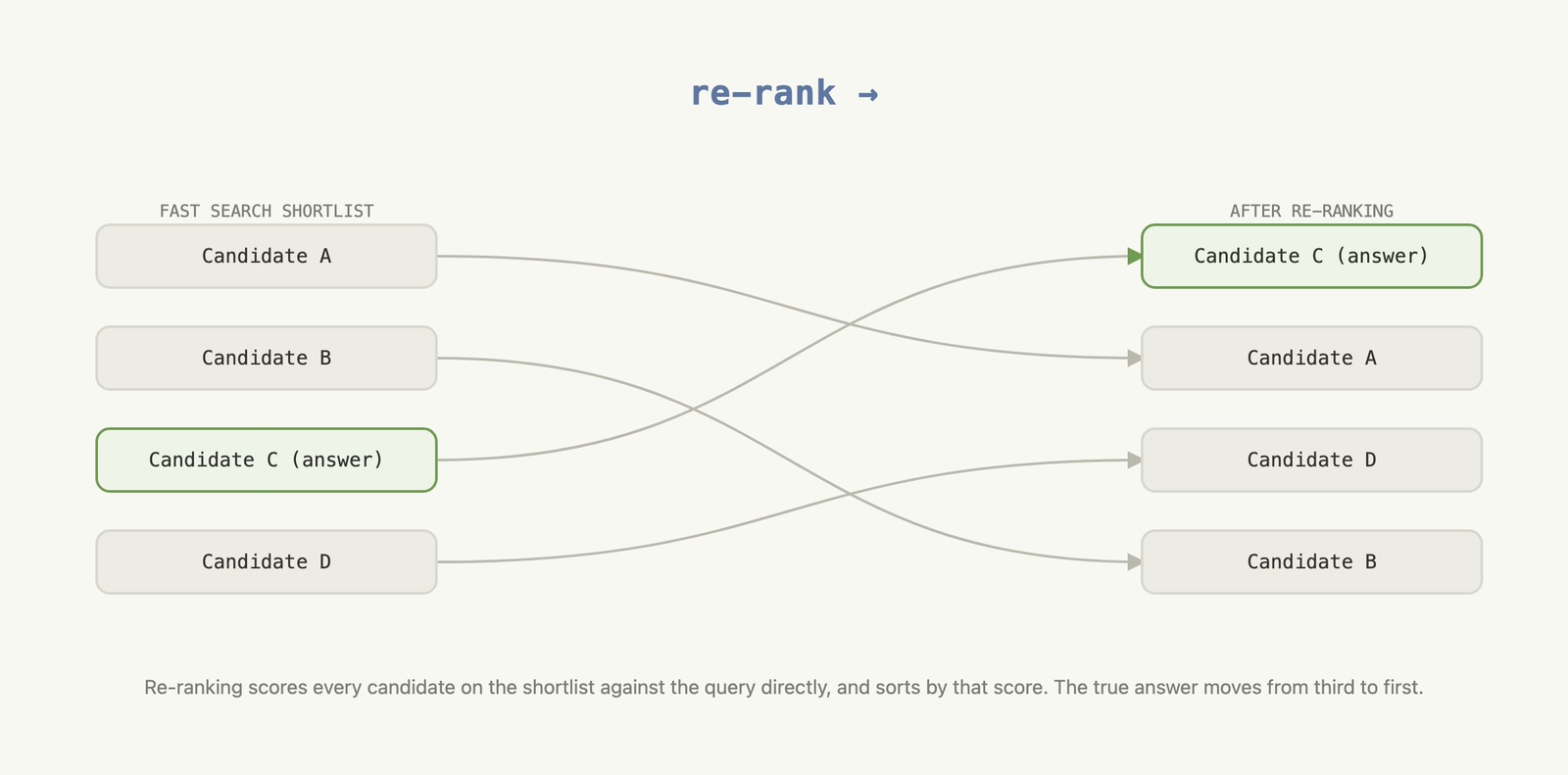
A vendor publishing a page titled "jaggedness" that is, read sideways, the architecture guide for its own product is a genuinely good piece of technical writing, and it was published against the immediate commercial interest of making the model sound capable. Credit where it is due.
Where the difficulty went
The rule has a cost, and json-render is the only one of the three that states it plainly:
That is the whole trade in one sentence. You do not remove the open-ended part of the problem by putting a bounded model in the middle of it. You move it to whoever builds the list, and you get, in exchange, a guarantee: the answer is one of the things you already decided you were willing to do. WindTunnel's harness puts it as an invariant — the action menu is rebuilt every step from what is on the page, capped, checked for duplicates, and a returned index can only ever name something the runtime already validated.
So the design rule, stated for the next person who asks why it cannot just do X:
Put the bounded model where the answer set is already finite, and where something else owns the composition. If you find yourself enumerating candidates that a generative model had to invent first, you have not removed the generative model — you have given it a proofreader. That is often exactly what you want, and it is worth being clear-eyed that it is what you bought.
What would change my mind
5 claims above, and what would falsify each
All five limits trace back to one architectural choice.
This is the article's own thesis and I think it is wrong as stated — I have argued it down to one limit with two prices. The decisive experiment is a single architectural change: take a per-option scorer and let the options attend to each other, changing nothing else. If relational choice, order stability and cardinality all move together, the one-limit reading was right and my split is overcautious. If letting options attend fixes relational choice and introduces order sensitivity — which is what I predict — they are separate constraints on a fork, and the article stands. If it fixes relational choice and order stability survives, my account of the position prior is wrong.
Jev's option-order instability is 0.13.
A per-option scalar scorer must score exactly 0 here, so this number is either the strongest evidence against the isolation reading or an unsourced figure that has been repeated into the record. It appears in Laya's BENCHMARKS.md, which states it did not measure any Jev figure. Anyone with an API key settles it in an afternoon: take 200 Choice questions, submit each twice with the option array reversed, and count argmax changes. A non-zero rate on low-cardinality Choices falsifies strict per-option isolation; a non-zero rate that appears only above the two-stage threshold localises it to the second stage.
Slot A is worth about 1.7 logits in openjev, and that is what flips the 27.8%.
Measured from committed artifacts at commit b9cb325, using the unmoved middle option as a drift control — which assumes the drift is common to all three slots. Re-run the 36 pairs with four or five options, so there are two controls and two moved options, and check the estimate holds. If the per-question advantage collapses once there is more than one interior option, my control is absorbing something else and the estimate is inflated.
Cardinality ceilings are implementation constants, not an architectural limit.
Change
LETTERSin openjev to the full alphabet and run its suites at 26 options. If accuracy degrades no faster than it does between 8 and 16, the 16 was arbitrary and this stands. If it collapses at 17, something real is being protected and the constant was load-bearing after all — in which case I would want to know what, because nothing in the readout code explains it.Six of the eight documented failure modes are ordinary, not structural.
Run the six on a per-option scorer and on a prompted LLM of comparable capability, on the same items: literal-reading traps, counting, date ordering, a padded-state suite, an injection suite, contradictory criteria. If the decision model is systematically worse on these rather than comparably bad, they are not ordinary and the shape is implicated after all. Nobody has published this comparison and it is the cheapest useful experiment in this entire article.