2026-10-11 · 23 min · video-generation · world-models · realtime · distillation · diffusion · pricing
Why read this
Solidtop 85%Recomputes W1's $0.003/s from the credit packs (one tier, one promo), splits the async API from the private-beta stream, and prices it against six rivals.
- Original analysis
- Concrete numbers to act on
- Explained from first principles
Image & video generationAPI onlyProprietaryPractitioner model
How this was scored
- Is it new?
- 1 of 3: An incremental tweak
- Can I trust it?
- 2 of 3: Measures key facts from files, code or configs
- Can I run it?
- 1 of 3: API-only, gated or restrictive licence
- Will I understand it?
- 2 of 3: Mechanism from first principles with figures
- Can I act on it?
- 2 of 3: A concrete recipe, numbers or comparison
- Will it last?
- 1 of 3: Relevant for months
- Does it affect many?
- 1 of 3: A specialist community
- Only here?
- 2 of 3: A teardown or measurement few others did
Score 54 of 100, ranked 347 of 494 rated articles. Each question is answered 0–3 by hand, and a 3 is rare. How articles are scored
Robert Scoble's post about Vivix W1 opens with a price: "$0.003 per second." Then a ratio: "For the price of one Seedance 2.5 clip you get about 77 clips of the same length." Then a speed: "An 8 second clip takes about 8 seconds to make." And then a promise, that "Real time works through the API today, and browser tools are coming."
I wanted to know which of those four sentences describe the same product. A price per second, a clip that takes as long to make as to watch, and a video you can steer while it plays are three different things, and a launch thread can blend them without anyone lying. So I read what Vivix itself has published: two technical reports, the API documentation, the model page and the pricing page. No paper and no weights exist.
The short version: the arithmetic is right and the architecture is a sensible one, but the $0.003 belongs to the slowest of three W1 model IDs on a promotional credit pack, the public API is a job queue for 5 to 15 second clips, and the interactive, streaming W1 is a separate model in private beta with no published price. The quality comparison is Vivix's own ten-scene gallery, one clip per model, and it does not use the Seedance version the price ratio does.
Two products share the name
The W1 model page links to one API guide, "World Video Generation". It is a plain asynchronous REST flow: upload reference images or audio, POST /v1/videos/jobs, poll GET /v1/videos/jobs/{job_id} "every few seconds while the job is queued or processing", then download an MP4 from video_url. A job is exactly one clip; duration is an integer from 5 to 15. Nothing in it streams, and nothing accepts input while the clip is being made.
That endpoint takes three model IDs, and the docs say all three "deliver the same video quality and differ only in generation speed and price": vivix-w1 at 1 credit per second of video, vivix-w1-fast at 3, and vivix-w1-ultrafast at 4. The fastest one costs four times the slowest.
The streaming model is a different ID, vivix-w1-stream, documented under "Streaming World". The models page tags it "Private beta" and says it "only appears on GET /v1/models for approved workspaces, and requests using it are rejected otherwise." The introduction page is just as direct: Streaming World "is in private beta and not yet publicly available." The pricing page, rendered on 11 October, says "with the Streaming World API coming soon."
So when the post says real time "works through the API today," it is true in one sense. You can call an API today that returns an 8 second clip in about 8 seconds. The interactive half, a world that keeps generating while you push it around, is not something a new account can call.
How a video model streams
The interesting engineering is in that private-beta half, so it is worth understanding what Vivix describes even though you cannot use it yet.
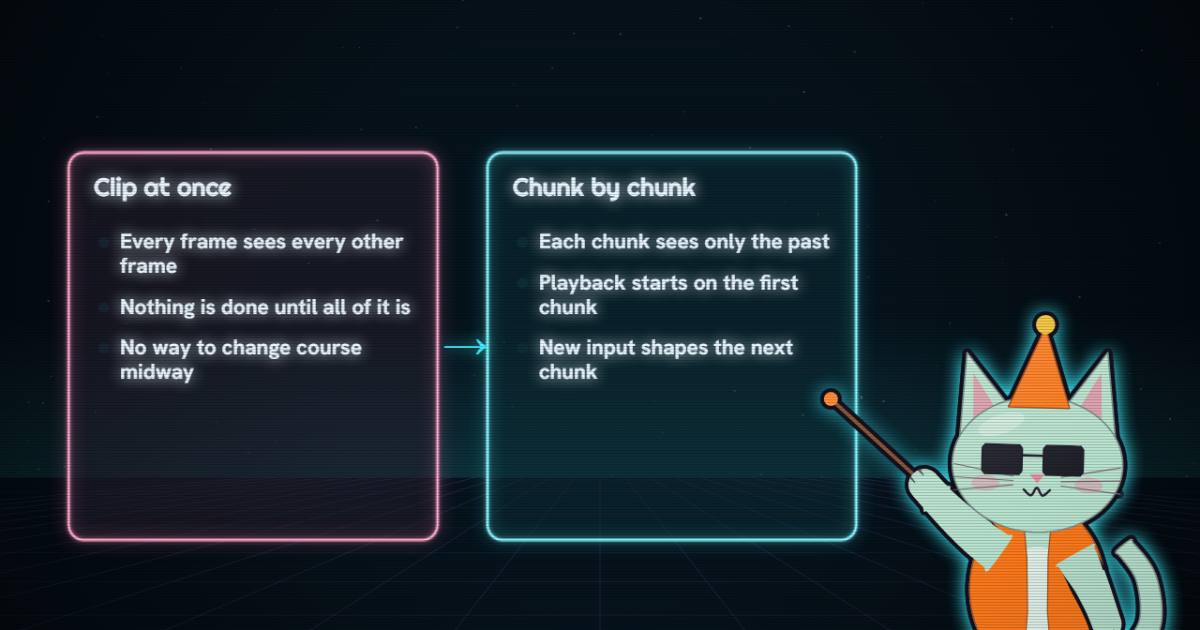
A clip-level video model, the kind Seedance, Kling and Veo are sold as, denoises the whole clip at once. Every frame attends to every other frame, past and future, for every one of its sampling steps. That is why it looks good and why it cannot stream: frame one is not finished until frame two hundred is. It is also why you cannot change your mind halfway through. There is no halfway.
A streaming model breaks the clip into short chunks and generates them in order. Each chunk attends only to chunks that already exist, through a cache of their keys and values, plus whatever conditioning arrived since the last chunk. That causal ordering is what lets the viewer start watching chunk zero while chunk one is being made, and it is what gives an interaction somewhere to land: a new instruction conditions the next chunk, not the one already on screen.
Vivix's own diagram of W1 is that loop.
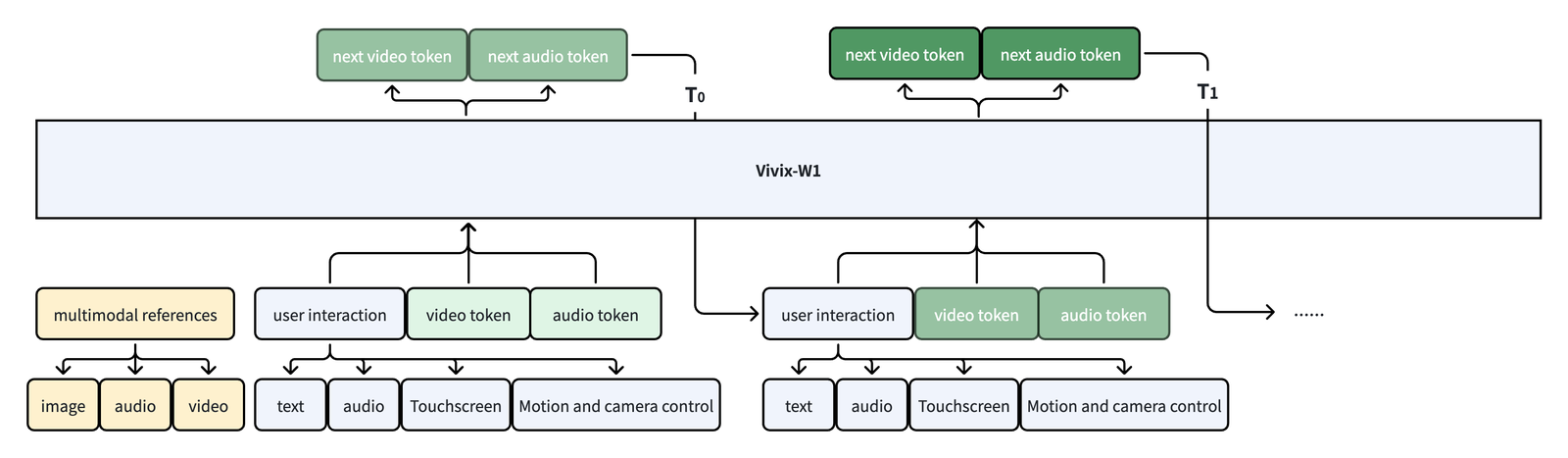
Three things in that figure matter. Audio and video come out of the same step, so the soundtrack is generated with the picture rather than added afterwards; the report calls this "native audio-visual joint generation," and it is the same bet Kandinsky 6.0 Video and MAGI-2 make. The interaction inputs are text, audio, touchscreen, and "motion and camera control," fed in at every step rather than once at the start. And the references (images, audio, video) sit outside the loop as fixed anchors, which matches the API's named references that later events can invoke by name.
The figure says "next video token", which reads like a language model. The infrastructure report is clearer about what actually happens inside a step: it talks about "the video denoising process", a "DIT" and a VAE, and its serving diagram (further down) shows "Pipelined chunk generation" with a diffusion row and a VAE row. So each "token" in Figure 1 is a chunk of latent frames that a diffusion transformer denoises in a few steps, conditioned causally on the chunks before it. That is chunked autoregressive diffusion, the design behind CausVid, Self Forcing and the ABot-World-0 world model this site took apart in August.
The two problems every streaming model has, and what Vivix says it did
Chunked autoregression has two well-known costs. The first is speed. A diffusion model that needs fifty sampling steps per chunk cannot keep up with playback, so streaming models are distilled down to a handful of steps. The second is drift. During training the model sees clean previous chunks; at inference it sees its own slightly wrong ones, and the errors compound until colours saturate and patches repeat. ABot-World-0's paper has the clearest picture of it I know: its plain causal baseline holds for 15 to 20 seconds and then visibly degrades.
Vivix calls its answer to both Vivix-Turbo. The W1 report lists four parts: "ultra-low-step distillation to reduce inference cost", joint optimisation of "shot planning and temporal continuity over long sequences", reducing "error accumulation over long streaming horizons", and keeping multimodal references consistent. It does not say how any of the four works. No loss, no schedule, no rollout length.
What it does give is one chart.
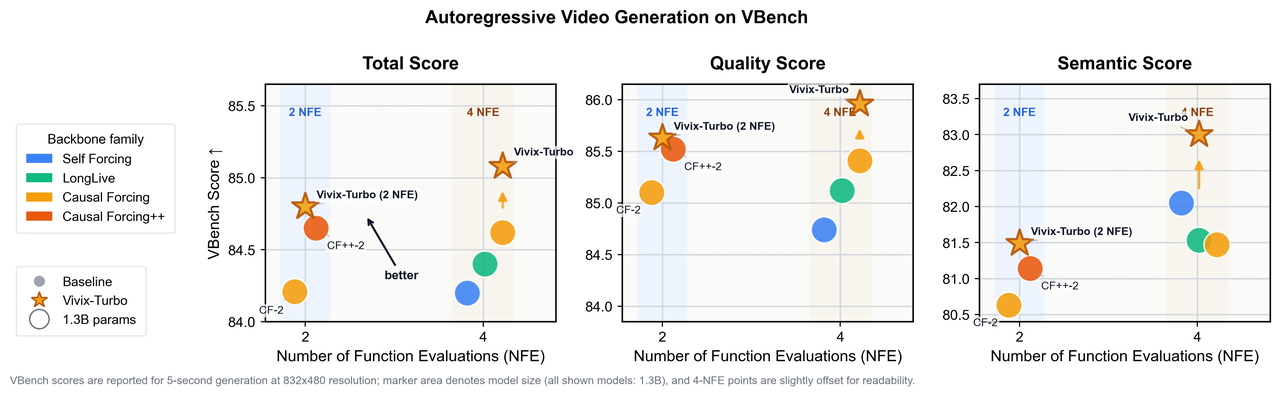
Two readings. The baselines it chose tell you what family W1 is in: Self Forcing, LongLive, Causal Forcing and Causal Forcing++ are all methods for turning a bidirectional video diffusion model into a few-step causal one. Vivix is benchmarking itself against the streaming-distillation literature, not against Seedance. That is the most informative thing in the report about the architecture.
The other reading is the size of the win. On the Total Score panel the star sits a few tenths of a point above the best baseline at each step count, on an axis that runs from 84 to 85.5. VBench is an automatic metric on 5-second clips, it does not measure the long-horizon drift Vivix-Turbo claims to fix, and the experiment is on a 1.3B model in a regime where the open baselines exist. I read it as "our distillation recipe is competitive with the published ones at small scale," which is a fair and modest claim. It says nothing about how W1 itself drifts over a minute.
W1 is described as having "approximately 30B active parameters," validated "at a medium training scale." "Active" usually means a sparse mixture-of-experts with more parameters in total, but the report does not say so and gives no total. Vivix's X post from 7 September adds that the data engine is being scaled "toward tens of millions of hours of training data" for the next version. No other architecture details are published.
The serving side, which is most of the engineering
The second report, on "Vivix Model Infra", is the more concrete of the two. Its thesis is that real-time video is a systems problem: a model fast enough on a benchmark still has to start answering before the user finishes speaking, start sending before the video is done, and take a new direction mid-inference.
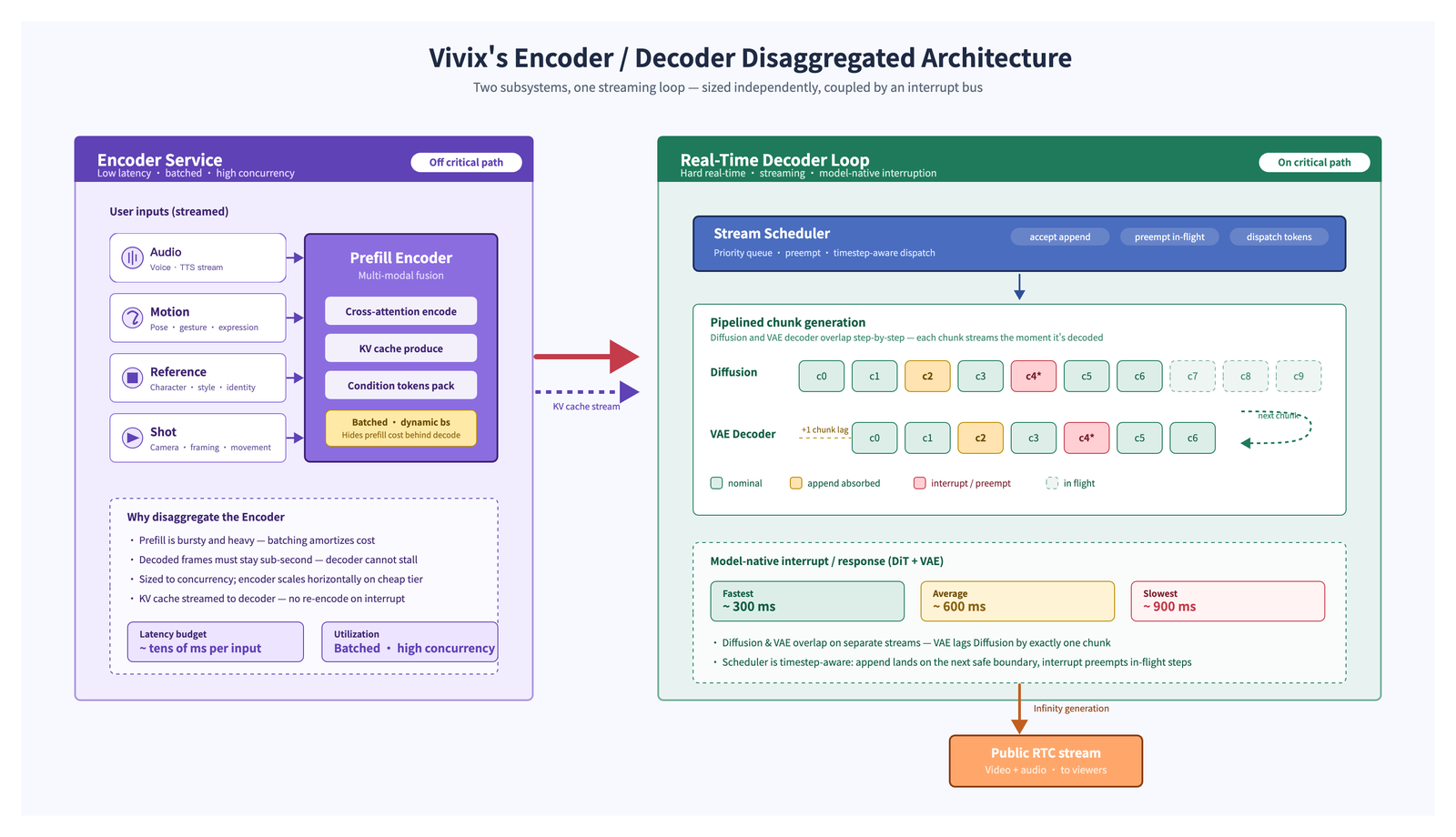
Read the decoder lane left to right and the streaming design becomes concrete. The diffusion transformer denoises chunk c3 while the VAE decodes c2 into pixels; the VAE "lags Diffusion by exactly one chunk". A new instruction ("append") is absorbed at the next safe chunk boundary; an interrupt preempts the chunk in flight. Inputs are encoded by a separate prefill service and handed over as a KV cache, so the decoder loop never stalls on encoding. The report says it is, "to our knowledge", the first to apply prefill-decode disaggregation to a real-time video pipeline. I have no way to check the priority claim; the pattern itself is standard in LLM serving and this is a sensible place to borrow it.
The streaming API's semantics follow from that lane exactly, which I found reassuring. An event.create in "steer" mode "redirects unpublished future media at a safe boundary"; it "does not retract media that is already committed, published, or buffered, and it does not promise a frame-accurate cut." There is no event.completed, because an event "can influence a continuous world long after its first visible effect." That is the honest contract for a chunked model: you can bend the next chunk, never the one being decoded.
The rest of the report is a list of familiar inference tricks applied to video: FP8, INT8 and NVFP4 GEMMs with quantization error "corrected without retraining", a sparse attention variant (VSA), CUDA Graphs collapsing "hundreds of kernel launches per step into a single submission", KV offload to host memory, FP8 attention communication across GPUs, and hybrid Ring/Ulysses sequence parallelism. None of it comes with a number except the latencies: "end-to-end TTFR below 1.7 seconds and video response latency, the time from user input to the first visible reaction, below 0.6 seconds."
Those latency figures are for "Vivix's production streaming model," and the report's own framing is that the stack serves "today's avatar product." Vivix also sells a streaming avatar model, A1, on monthly plans anyone can buy. I could not tell whether the 0.6 s was measured on W1 or on A1, and for a stream nobody outside the beta can open, the distinction matters.
The price, recomputed
Here is where the post's numbers come from. The W1 page has two bar charts: cost per second and time per clip.
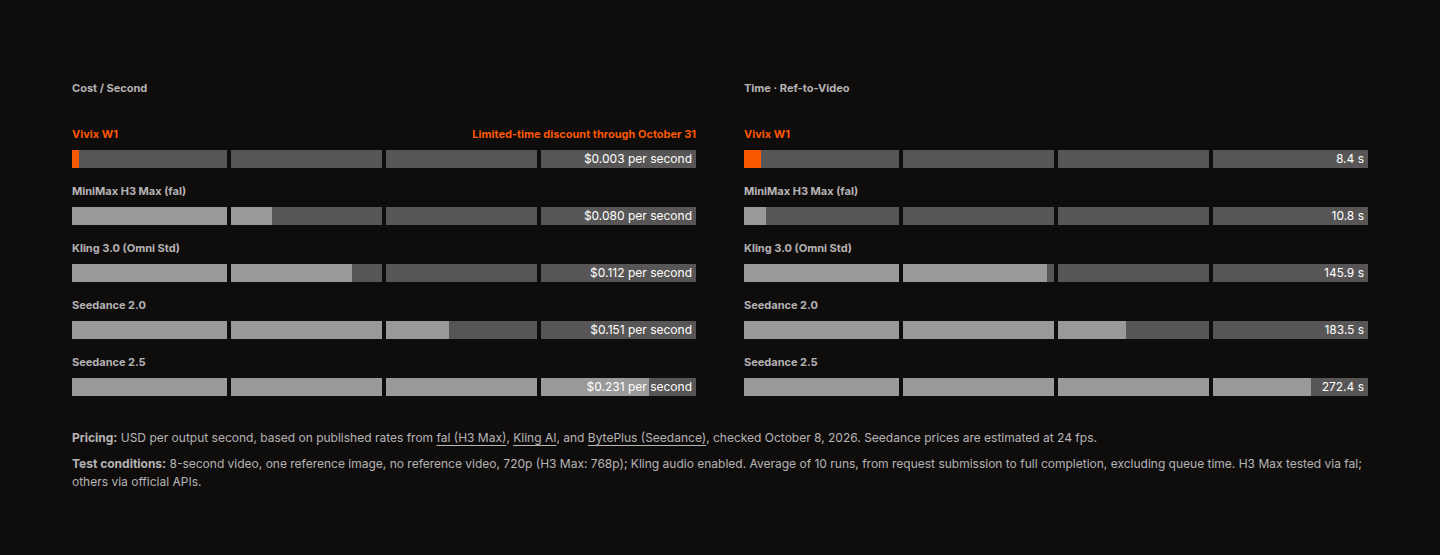
The 77 is the ratio of the two per-second prices: 0.231 ÷ 0.003 = 77. I checked the Seedance side against BytePlus. Seedance 2.5 bills by tokens, and BytePlus gives the estimate as duration × width × height × frame rate ÷ 1024. At 720p and 24 fps that is 21,600 tokens per second; at $10.70 per million tokens for "input without video," it comes to $0.231 a second, which is also the figure in BytePlus's own example table. An 8 second clip is $1.85, which is the "same $1.85 budget" in Vivix's announcement. The Seedance 2.0 ($0.151), Kling 3.0 Omni ($0.112, 720p with native audio) and fal H3 Max ($0.080 at 768p) bars all match the vendors' pages on 11 October.
Now the W1 side. Credits are sold only in packs, and the per-second price depends on the pack and the model ID:
| Pack (pricing page, 11 Oct) | Credits | Model it is sized for | $ per second |
|---|---|---|---|
| W1 Trial, $19 | 5,700 (90 days) | any of the three | 0.0033 at 1 credit/s |
| W1, $399 | 133,000 (1 year) | vivix-w1, 1 credit/s | 0.0030 |
| W1 Fast, $599 | 200,000 (1 year) | vivix-w1-fast, 3 credits/s | 0.0090 |
| W1 Ultrafast, $799 | 266,000 (1 year) | vivix-w1-ultrafast, 4 credits/s | 0.0120 |
So $0.003 is real, for the standard-speed model, bought $399 at a time. Every pack lists "Concurrency: 1". The model page says the price is a "Limited-time discount through October 31," and the docs separately waive the surcharge for reference images and audio "through October 31, 2026."
What was the price before? On 9 October a buyer replied to Vivix's launch post that the only pack was "$399 for 30k credits", which "takes 1 credit per second so its $0.0133/second not $0.003/second." Vivix answered that its "pricing page still shows the regular price" and that the offer would go live on 10 October. I did not see the old page myself, but by Vivix's own reply the regular rate was about 4.4 times the headline one. At $0.0133 a second, one Seedance 2.5 budget buys about 17 W1 clips, not 77.
The other two claims in Vivix's own post use different baselines. "Under 1/50 the cost" is against Seedance 2.0 (0.151 ÷ 0.003 is 50.3), not 2.5. "20× faster generation" also fits Seedance 2.0: 183.5 ÷ 8.4 is 21.8, while against Seedance 2.5 the ratio is 32.4 and against Kling 3.0 it is 17.4. Each comparison is accurate on its own. Together they put the cheapest W1 tier against the most expensive Seedance on price, and Seedance 2.0 on everything else.
The calculator below multiplies the published per-second prices by a session. "Share of each hour spent generating" is there because the post's argument is that interactive video "keeps generating the whole time you're inside it", so an hour of use is an hour of billed video.
36,000 seconds of generated video
vivix-w1-stream, is in private beta and has no published price.At the promotional rate an hour of continuous W1 output is $10.80. The same hour from Seedance 2.5 at 720p is $831.60, from Kling 3.0 Omni $403.20, and from Veo 3.1 Fast $360. The gap is real at every W1 tier: even vivix-w1-ultrafast at $0.012 a second is $43.25 an hour, under a quarter of the cheapest rival here, Veo 3.1 Lite at $0.05 a second.
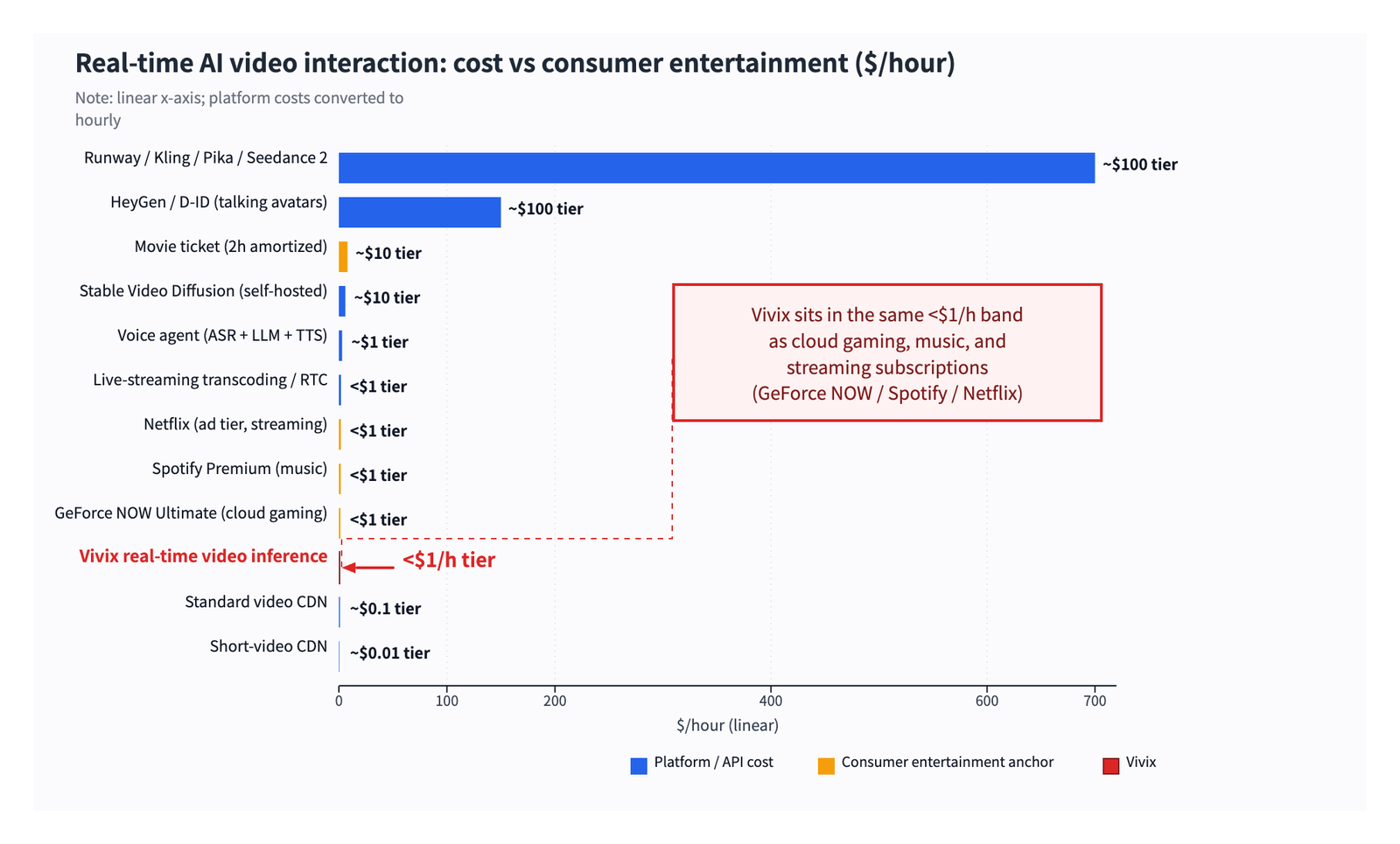
Two cautions. The rivals' prices are for clips you queue for; none of them is pretending to stream. And none of this is the price of interactive W1. The streaming docs report usage as generated_video_ms and generated_audio_ms, which suggests it will be metered per generated second too, but no rate exists. Vivix's infra report puts its own compute cost in "the same <$1/h cost tier as mainstream digital entertainment"; whatever that number is, the price a customer sees today is more than ten times it.
Real time, as a ratio
The other number in the post, "an 8 second clip takes about 8 seconds to make," is the 8.4 s bar. The useful way to read it is as a real-time factor: generation time divided by the length of what was generated. Below 1, a model makes video faster than you watch it. Above 1, a stream at that rate falls behind, and a player has to bank the difference before pressing play.
grey bar: seconds to make the clip · orange tick: the 8 s it plays for
From Vivix's own table: W1 is 8.4 ÷ 8 = 1.05, MiniMax H3 Max 1.35, Kling 3.0 18.24, Seedance 2.0 22.94, Seedance 2.5 34.05. W1 and H3 Max are in a different class from the rest, and that is the real news in the chart. Seedance 2.5 takes over half a minute of compute for every second you watch.
A factor of 1.05 is close to real time but on the wrong side of it: to play a 60 second session straight through at that rate, a player would need about 3 seconds in the bank. That is an idealisation, and the widget says so. These are whole asynchronous jobs, timed from submission to completion with queue time excluded, and include prompt enhancement (the API's pe_mode runs a multimodal call before generation) and encoding. A dedicated stream with a warm cache would behave differently. But the chart does not say which of the three model IDs it timed. If the 8.4 s came from vivix-w1-ultrafast, the price that goes with it is $0.012 a second, not $0.003. I could not find this stated anywhere, and it is the one detail I would ask Vivix for first.
"Holds up against Seedance"
The quality claim in the post is attributed correctly: "in Vivix's own side by side tests it holds up against Seedance 2.5 and Kling 3.0." Vivix's own wording is "Comparable quality." Here is what those tests are.
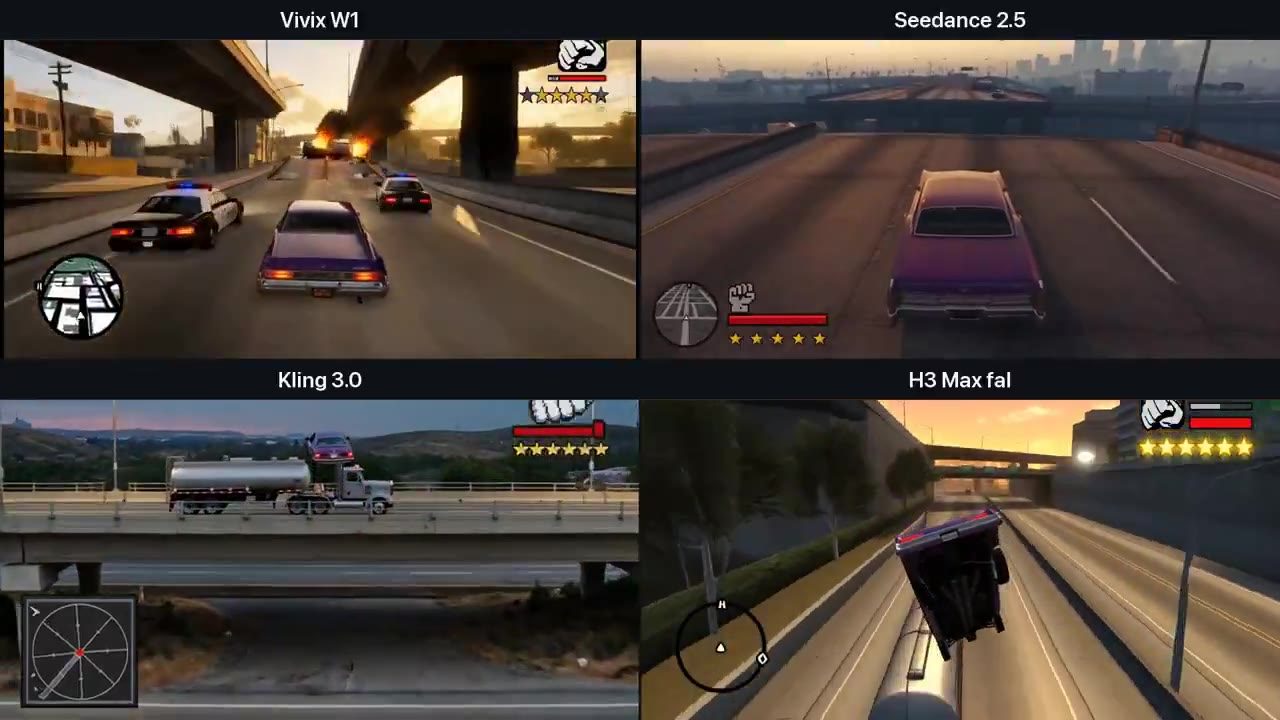
The W1 page's "How W1 Compares" section has ten scenes, from "Anime Transition" to "Drone Dive." Each shows one clip per model for five models, with the prompt underneath. One clip per model per scene. There is no score, no preference count, no rater, no statement of how many generations were made before one was picked, and no blind protocol of any kind. In the page's own script the comparison models are labelled Seedance 2.0, Kling 3.0, MiniMax H3 and fal H3 Max. Seedance 2.5 appears in the price chart and in the video Scoble posted, but not in the gallery.
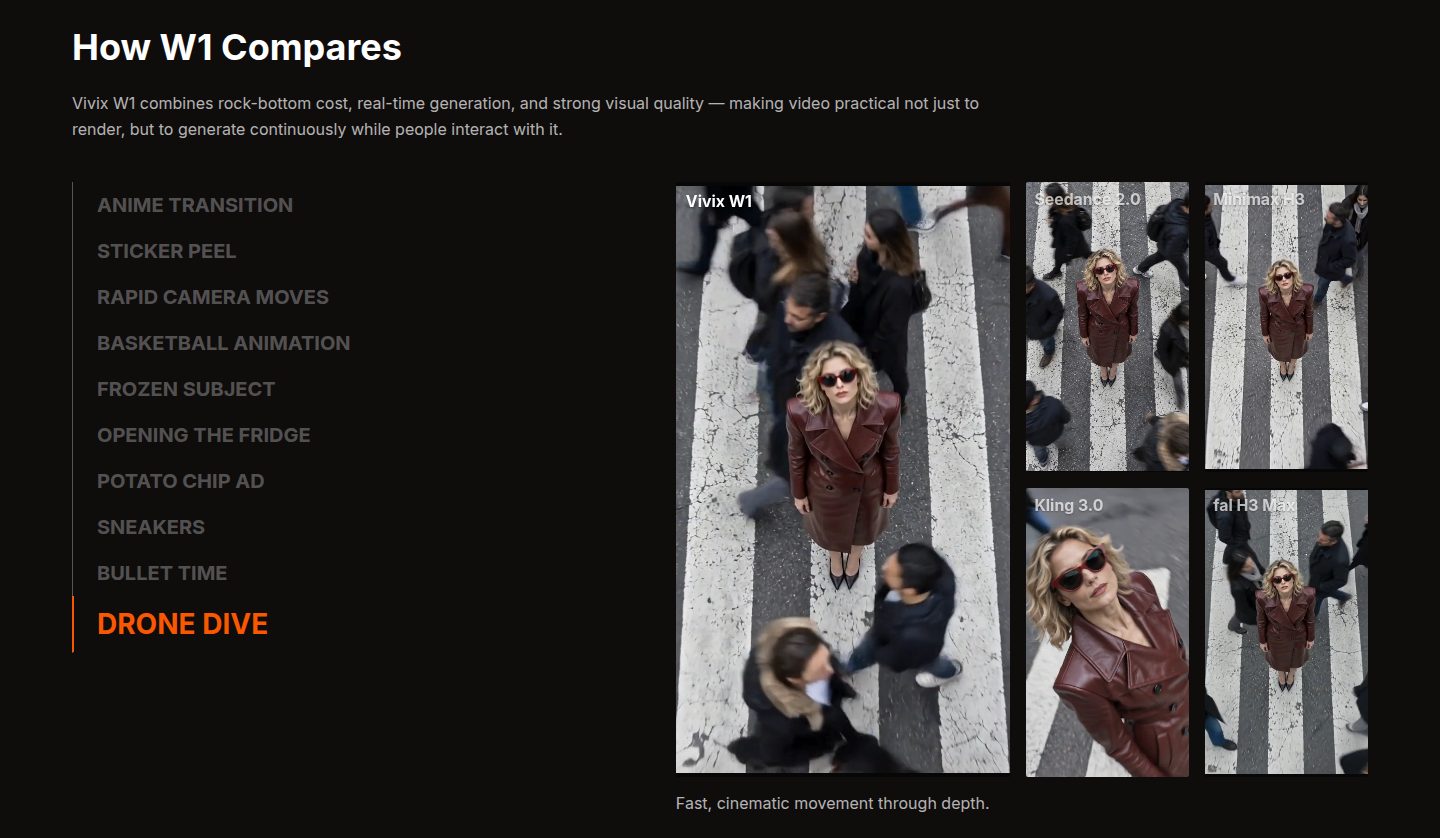
One more detail from the page source: the W1 clips load from files named scene-…-w1-20261010-web.mp4, while every competitor clip has no date. The page's script appends that revision only for W1. So W1's side of the gallery was replaced on launch day and the others were not. That could be a newer checkpoint, a re-render at better settings, or a fresh pick; the page does not say, and any of them is normal for a launch page. It is also the reason a gallery like this cannot carry a quality claim.
To Vivix's credit, the same report that makes the claim also states the limits plainly. "In certain complex scenarios, especially those requiring professional-grade visual fidelity, complex motion, or dense scene dynamics, there remains a gap compared with state-of-the-art clip-level video models." Scoble repeats that caveat, and it is the most useful sentence in the launch. Several replies under his post asked the obvious follow-up, whether anyone outside the team has run the same prompts. As of 11 October I found nobody who had published one.
Where it sits among the streaming models on this site
The real-time video work I have read this year splits into open research models you can run and closed products you can rent, and W1 is clearly the second kind.
ABot-World-0 is the closest open relative in mechanism: a 5B causal student distilled from a bidirectional teacher, with a long-rollout fix for drift, streaming a 720p world at up to 16 fps from one RTX 5090 with 1.2 seconds from keypress to first frame. Apache-2.0, weights and data released, video only. LongLive-Plug packages the few-step and long-context distillation that streaming needs as LoRAs you can transfer across a family of models. FastH3 distils MiniMax H3 to four steps and 90% sparse attention, and its "sub-realtime" claim held for one of the three clip lengths tested. SANA-Video 2.0 went the other way, making the whole clip cheap with linear attention: 13.06 s for a 720p, 5 s clip on one H100, which is fast but still clip-level. And XGEN-JING is a reminder that "world model" on a launch page can mean an offline, non-causal renderer.
Against that field W1's distinguishing features are audio generated in the same step as video, a 30B-active model rather than 1-5B, an interaction API that already has sensible semantics, and a price. What it does not offer is anything to inspect. You cannot read its weights, its distillation recipe or its evaluation, and the VBench chart is the only number in either report that is not a latency or a cost.
What I would do with it
If I needed many short clips cheaply this month, I would try vivix-w1 on the $19 trial pack before October 31 with my own prompts, time the jobs myself, and note which model ID I was timing. At the promotional price it is an order of magnitude cheaper than anything else here per second of output, and if quality is acceptable for drafts and variations that is a real saving even if it is not Seedance-grade.
I would not plan an interactive product around it yet. The streaming model is gated, unpriced and, as far as anyone outside can tell, untested in public. The architecture Vivix describes is the right one for the job and the API contract reads like it was written by people who have run a stream. That is a reason to ask for beta access, not a reason to believe the price of the clip queue is the price of the world.
How I checked
I read the X post and its replies through the fxtwitter API, and Vivix's own posts from 7 September to 10 October, including the 9 October exchange about the $399 pack. I read the W1 technical report and the Model Infra technical report on vivix.ai and took their figures from the image files they load. I read the Vivix API docs through their llms.txt index: the introduction, models, World Video Generation, and the Streaming World configuration, control, sessions and events pages. The model page and pricing page are client-rendered, so I rendered them in headless Chromium on 11 October, took the screenshots shown here, and read the page's comparison script for the model labels and file names.
Competitor prices come from BytePlus ModelArk's pricing page (Seedance 2.5 and 2.0, 720p, no input video), Kling's API pricing page (3.0 Omni, 720p, no video input, with native audio), fal's H3 Max reference-to-video page (768p) and Google's Gemini API pricing (Veo 3.1, 720p with audio), all read on 11 October. The per-second W1 prices are pack price ÷ credits × credits per second. The real-time factors are Vivix's timings divided by 8. I did not buy credits or generate any video, so every timing and every quality judgement here is Vivix's; I found no paper, no weights and no third-party evaluation. The Vivix-Turbo margins are read off the published chart, not from a table.