2026-08-03 · 7 min · world-models · video-generation · diffusion · open-weights
Most interactive-world demos are a video model you watch. ABot-World-0, from Alibaba's AMAP CV Lab, is one you steer: upload a starting image, hold WASD, and a 5B-parameter model streams a continuously-controllable 720p world back at up to 16 frames per second, from a single RTX 5090, with 1.2 seconds between an action and its first frame on screen. Code, weights (Apache-2.0), and a 500-hour action-annotated dataset are all released. It does not top the benchmark it's measured on. That's the more useful fact to lead with, not bury.

Bidirectional teacher, causal student, then fix the drift
The model is a distilled video-diffusion world model, trained in three stages on top of the Wan2.2-TI2V-5B backbone. First, a high-quality bidirectional action-conditioned teacher learns good dynamics over full temporal context -- accurate, but it has to see the whole clip at once, so it can't stream. Second, teacher forcing plus causal ODE distillation compress that into a causal, few-step student that approximates the teacher's denoising trajectory turn by turn, which is what makes low-latency interaction possible at all. Third, and this is the paper's actual technical contribution: LongForcing.
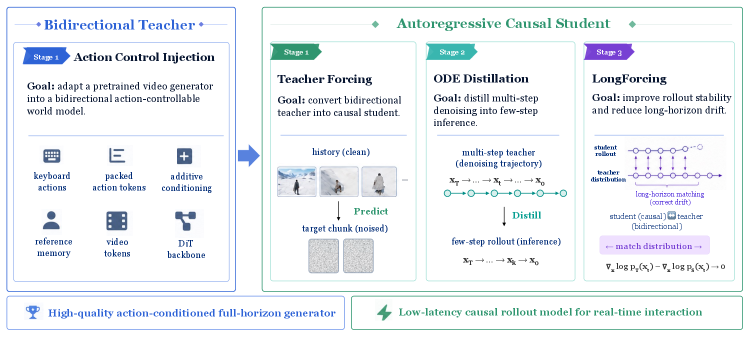
Plain causal distillation only ever supervises short, clean trajectories -- it never sees what its own errors compound into over a minute of rollout. LongForcing closes that gap directly: let the causal student generate a long self-rollout, then correct the distribution of that self-rollout against an extended-horizon teacher, rather than only imitating clean short clips. It is, in effect, training the model against its own failure mode instead of only against ground truth. Measured over a 60-second rollout against a plain causal-forcing baseline, the effect shows up as less accumulated visual damage, not a benchmark score:
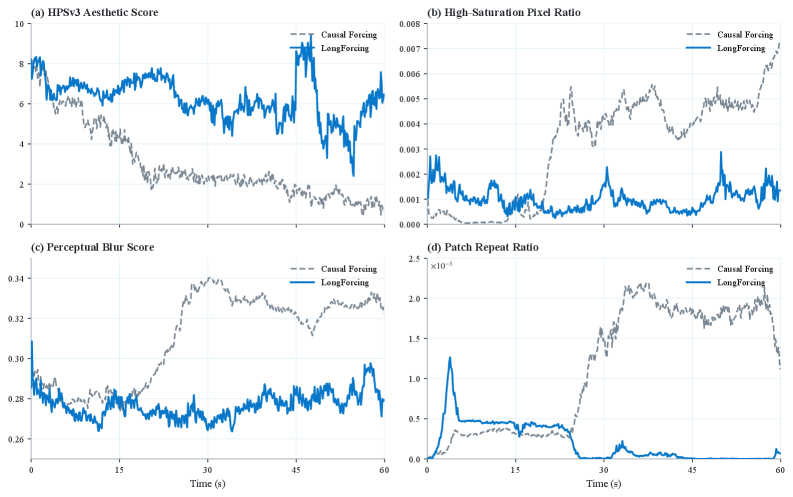
The baseline doesn't fail suddenly -- it drifts. Causal Forcing looks comparable to LongForcing for the first 15-20 seconds on all four curves, then peels away: color saturation creeps up, the image blurs, patches start repeating. That's exactly the accumulated-error problem autoregressive video generation is known for, and LongForcing's fix is to train against long rollouts directly rather than assume short-horizon quality generalizes.
Real-time is five separate wins, not one
"Few-step generation does not automatically translate into real-time interaction" is the paper's own line, and Table 2 backs it up in a way that's genuinely counterintuitive: adding a faster attention kernel by itself does nothing, because the model doesn't fit in memory to begin with.
Both Base and +SageAttention2 run out of memory before they produce a single frame -- a faster attention kernel changes nothing if the model doesn't fit. Feasibility starts only once the VAE decoder is replaced (LightVAE), and FPS keeps climbing through FP8 and Fast-RoPE while VRAM mostly falls (Fast-RoPE actually costs 3.4 GiB more than FP8 alone -- not every step is a pure win). The final low-bit variant is a choice, not a further stack: MXFP4 reaches 15.831 fps at 17.148 GiB; MXFP6 trades some of both for a smaller VAE-time increase. The paper's real-time claim is a systems result built from five separate, individually-necessary changes, not one clever kernel.
Every one of those five changes is load-bearing. Skip the VAE swap and the faster attention kernel just gets you a faster out-of-memory error. That's a more honest way to read "single desktop GPU" than treating it as one clever optimization -- it's a full-stack co-design where the first fix is the one that makes the rest of the stack possible to even measure.
WorldRoamBench: a real third-party number, and it doesn't sweep
WorldRoamBench is not Alibaba's benchmark -- that independence is worth stating plainly, because it means ABot-World-0's score wasn't set by the people reporting it. Against Genie 3, HappyOyster, LingBot-World (14B), and HY-World 1.5 (8.3B):
ABot-World-0 sits second, not first, on Strict Accuracy -- and that pattern holds across the rest of the benchmark's sub-metrics too:
ABot-World-0 (5B) trails the leader (HappyOyster) on Strict Acc. by 0.5 points -- 52.7 vs 53.2.
Across all seven sub-metrics: ABot-World-0 beats LingBot-World (14B) on 7/7 and HY-World 1.5 (8.3B) on 7/7 -- every metric, at roughly a third and three-fifths the parameter count. Against HappyOyster, the un-sized model that actually tops this benchmark, ABot-World-0 wins on 1/7 (Imaging) and trails on the rest. That is the honest shape of this result: a clear efficiency win, not a leaderboard sweep.
Two honest qualifications on top of what the chart above already shows. First, neither Genie 3 nor HappyOyster has a disclosed parameter count, so the efficiency claim is only verifiable against the two comparators whose sizes are public -- LingBot-World and HY-World 1.5 -- not against the benchmark's actual leader. Second, ABot-World-0 running on a single consumer GPU is not a property this benchmark measures at all; WorldRoamBench scores output quality and controllability, not deployment cost. The efficiency story and the benchmark score are two separate claims, and only one of them is what WorldRoamBench actually tested.
What's missing
The paper's qualitative claims -- physically plausible responses despite no explicit physics training, coherent hour- and day-scale rollouts, generalization to out-of-domain controls -- are demonstrated with cherry-picked keyframe strips, not a systematic user study. That's standard for this genre of paper, not a special flaw of this one, but it means "plausible physical responses" is an illustration, not a measured claim the way WorldRoamBench's numbers are. The data-collection system behind all of this, WorldExplorer, is also worth a sentence on its own: it's closed-loop and distribution-aware, meaning it uses the current model's own failure modes to decide where to collect more data next, rather than collecting blind -- a genuinely different approach from scraping video and hoping coverage works out, though the paper's evidence for how well that targeting works is qualitative too.
The take
ABot-World-0 is not the best model on WorldRoamBench. HappyOyster beats it on six of seven reported sub-metrics, and the benchmark's own leader has no disclosed size to compare against. What ABot-World-0 actually demonstrates is that a 5B model, with the right three-stage distillation and a genuinely load-bearing systems stack, beats two larger open rivals on every metric measured while being the only one of the group that runs interactively on one desktop GPU. That's a real, checkable claim, and it's a more interesting one than a clean sweep would have been -- a paper that only won everywhere would have less to say about where the wins actually come from.
Built on Alibaba AMAP CV Lab's ABot-World-0: Infinite Interactive World Rollout on a Single Desktop GPU (Jiang et al., 2026) and the amap-cvlab/ABot-World repository (Apache-2.0). Figures 1, 3, and 10 are reproduced from the paper for commentary, flattened onto white; the systems-ablation and WorldRoamBench explorers are original visualizations of the paper's Table 2 and Table 3 data, not measured traces. Benchmark numbers are as reported in the paper and on WorldRoamBench.