2026-09-18 · 15 min · world-models · video-generation · diffusion · benchmarks · explainer
XGEN Labs calls its new pairing JING (镜, "mirror") and DAO (道, "the way") — a generative first-person experience model coupled to what the announcement calls a computable, shared-world engine. The pitch, in their words: "DAO (道) computes the shared world's state and dynamics, while JING (镜) generates each observer's first-person experience," in a loop where "actions change the world" and those changes "shape what humans and agents experience and how they act next." The closing line of their own research page is more ambitious still: "Together, DAO and JING move beyond generating the next frame toward simulating the world behind it," with an explicit nod to OASIS — "a persistent shared world that people can inhabit, rather than a sequence of scenes generated on demand."
That is a real, well-posed problem. Almost every "world model" demo you've seen fails the same test: walk away from something and look back, and the room has quietly changed, because there was never a world there — only a sequence of frames conditioned on the last few frames. Splitting a symbolic, authoritative state from a generative renderer is a genuine answer to that failure mode. It is also, plainly, the same split every networked video game has run for decades: a server owns the world and decides what's legal; a client only ever sees, and renders, the slice the server hands it. XGEN has swapped the rasterizer for a diffusion transformer. That reframing is the useful way to read this announcement — and it immediately raises the sharp question underneath it: if DAO computes the consequences of actions, what is JING actually responsible for? Is either of them doing physics, or is one of them doing appearance and calling it a world?
- task
- image-text-to-video
- library
- diffusers
- license
- other
- safetensors
- 15 shards
- largest file
- 4.93 GB
- files
- 28
- downloads
- 2
- likes
- 18
- languages
- en, zh
repo last modified 2026-09-18
I read the GitHub repo end to end, pulled the Hugging Face repo's file listing, and checked the WBench leaderboard directly rather than trusting the announcement's numbers. Short version: the headline WBench rank is real and current. The architecture story is real too, but only half of it is something you can download.
What JING actually is
JING isn't a from-scratch world model. It's MiniMax-H3 Ref2VA — an existing open audio/video diffusion
transformer — plus FlashGen, a
four-step distillation LoRA, wrapped in a camera-control layer and a demo harness. The Hugging Face repo
ships 15 safetensors shards totaling 66,885,741,424 bytes (~66.9 GB), created September 16, 2026 —
two days before this leaderboard result. The Hub's own metadata parser didn't return a parameter count
for it (safetensors comes back empty in the API response), so as a sanity check: at bf16 (2 bytes per
parameter), 66.9 GB of weights is ~33.4B parameters — a back-of-envelope number, not one XGEN states
anywhere, but consistent with a sizeable single-observer video/audio DiT.
The transformer's own config.json is the actual architecture disclosure, and it's worth reading over the
prose:
// jing_flash_v1/config.json (Hugging Face: XGENlabs/XGEN-JING)
{
  "_class_name": "H3Transformer",
  "num_attention_heads": 56,
  "attention_head_dim": 128,
  "hidden_size": 5376,
  "num_layers": 50,
  "ffn_dim": 14336,
  "in_channels": 24,
  "audio_in_channels": 32,
  "control_config": { "enable": true, "dim_in": 6, "dim_out": 512 },
  "attention_backend": "fa4"
}
control_config.dim_in: 6 is the camera-control vector — six dimensions, FiLM-injected into every
transformer block. But the WASD parser that fills it, models/control.py, only ever populates two of
those six:
# models/control.py — control_vector()
return [
    float(("d" in keys) - ("a" in keys)),  # strafe
    0.0,
    float(("w" in keys) - ("s" in keys)),  # forward / back
    0.0, 0.0, 0.0,
]
So "keyboard-controlled movement," in the release you can actually run, is planar strafing and forward/back — there's no turning (yaw) dimension driven by keys. The other four slots exist in the architecture and sit at zero in this demo. It's a small thing, but it's the kind of small thing that separates a marketing clip from a released control surface.
Inference runs on six H100 GPUs — one for the text encoder, one for the video/audio VAEs, four for the transformer under sequence parallelism, with FlashAttention-4 as the default backend — and the license is the MiniMax H3 Community License Agreement, inherited as-is because JING is a derivative of MiniMax-H3. That license carves out four "Excluded Territories" — the EU, the UK, South Korea, and the United States — and gates commercial use over $20M/year behind separate written authorization. I covered that clause in detail in the MiniMax H3 piece; it applies to JING unchanged.
The split: an authoritative server with a diffusion renderer
XGEN's own diagram for DAO — literally a five-chip pipeline on their research page — reads: GLOBAL STATE → RULE VALIDATION → STATE UPDATE → OBSERVER FILTER → JING PROMPT. That is not a loose metaphor for a game server's tick loop; it is one, chip for chip. Global state is the authoritative world. Rule validation rejects an illegal action before it can touch anything. State update commits the legal consequence. The observer filter is the area-of-interest culling every multiplayer server runs before it sends a client its next update — and its output, a "JING prompt," is the packet handed across the wire. JING never sees the world; it sees only what DAO decided this one observer gets to perceive.
Crops the freshly updated global state down to what one observer — human or agent — can currently perceive, then packages it as a JING PROMPT (XGEN's own term for the handoff). This is exactly the area-of-interest filter an authoritative multiplayer server runs before it sends a client its next update.
XGEN says this plainly in their own capability comparison, where "World-State Management" is a dash for Veo 3.1, Genie 3, and GWM Worlds 2, and reads "Maintained and updated by world engine DAO" for XGEN-JING alone. So by their own accounting, JING doesn't manage world state — it renders. Which answers the sharp question directly: DAO is claimed to own the physics; JING owns only the appearance. Handing persistence to a symbolic engine instead of a neural one is a real, defensible engineering answer to the "walk away and look back" failure mode — a rule-checked state table doesn't drift the way an autoregressive video model's hidden state does. But it also means the generative half of this system, the part that's actually released, is not the part keeping the world consistent. If DAO isn't running, nothing in the public artifact is holding a persistent world at all — and, as the next section covers, DAO isn't running.
What's actually released
△ marks a partial: something real ships, but not the thing the announcement's headline claim rests on. Both released-code rows belong to JING; DAO does not have a column with a single ✓ in it.
I searched the entire XGEN-JING GitHub repository for the string DAO. It appears exactly once, and
it's a false positive: Dao-AILab, the GitHub org for FlashAttention (named after its author, Tri Dao —
unrelated to XGEN's 道). There is no DAO client, no DAO API call, no world-state object anywhere in the
inference pipeline. pipelines/bidirection.py reads a single static JSON file of pre-written prompt and
WASD-control chunks (read_cases), encodes the whole thing, denoises it in four steps, and decodes one
finished clip — the entire sequence of "actions" is authored up front, not supplied step-by-step by
anything reactive:
# pipelines/bidirection.py — read_cases()
allowed = {
    "name", "prompt", "control", "slices", "chunks",
    "save_name", "reference_images", "height", "width", "num_frames", "seed",
}
And attention in models/attention.py is explicitly non-causal:
# models/attention.py
out, _ = flash_attn_func(q, k, v, causal=False)
That's the "bidirectional" in JING-Flash-v1's own name: it denoises the entire pre-written clip at once, not frame-by-frame in response to a live action. The README says exactly this, and says what's missing: "This release provides four-step bidirectional inference... The causal model and technical report are coming soon." A causal, frame-reactive model is the one you'd actually need to sit downstream of a live DAO loop. It isn't released.
DAO fares worse. There's no XGEN-Labs/DAO repository, no Hugging Face model, and no arXiv listing — the
JING repo's own badges read "arXiv: Coming Soon," and there's no separate DAO badge at all. The DAO
section of XGEN's research page has no GitHub link and no Hugging Face link, unlike the JING section
directly above it, which has both. What DAO does have is an elaborate interactive demo — a hand-drawn
1893 town called "Oakhaven," rendered as a WebGL panorama viewer with sprite-based characters walking a
hand-authored graph. I read that page's source rather than just its rendered output, and its own code
comments are unambiguous:
DAO big-map simulation — Canvas 2D, no deps, no LLM. Draws the real Oakhaven 1893 town — the hand-authored oblique painting — and the eight real character sprites, then plays a hand-written script: per beat, every actor has a timeline of waypoints and facings...
COMPILE THE WORLD — four observers of one scripted event on Main Street, Oakhaven 1893. No LLM: every beat, position, perception and plan below is authored by hand.
Elsewhere the same file's comments reference what sounds like a real backend for the actual system —
"the engine's PromptBuilder actually assembles for a reactive_decision" — but that backend isn't what
loads in your browser. What loads is a deterministic stand-in for it: 114 hand-placed standing anchors, a
walk graph, eight sprite sheets, and a six-beat narrative written by a person, not computed by anything.
DAO, as anyone outside XGEN can currently observe it, is a demonstration of the idea of a computable
world engine, not a running instance of one.
The WBench claim, checked
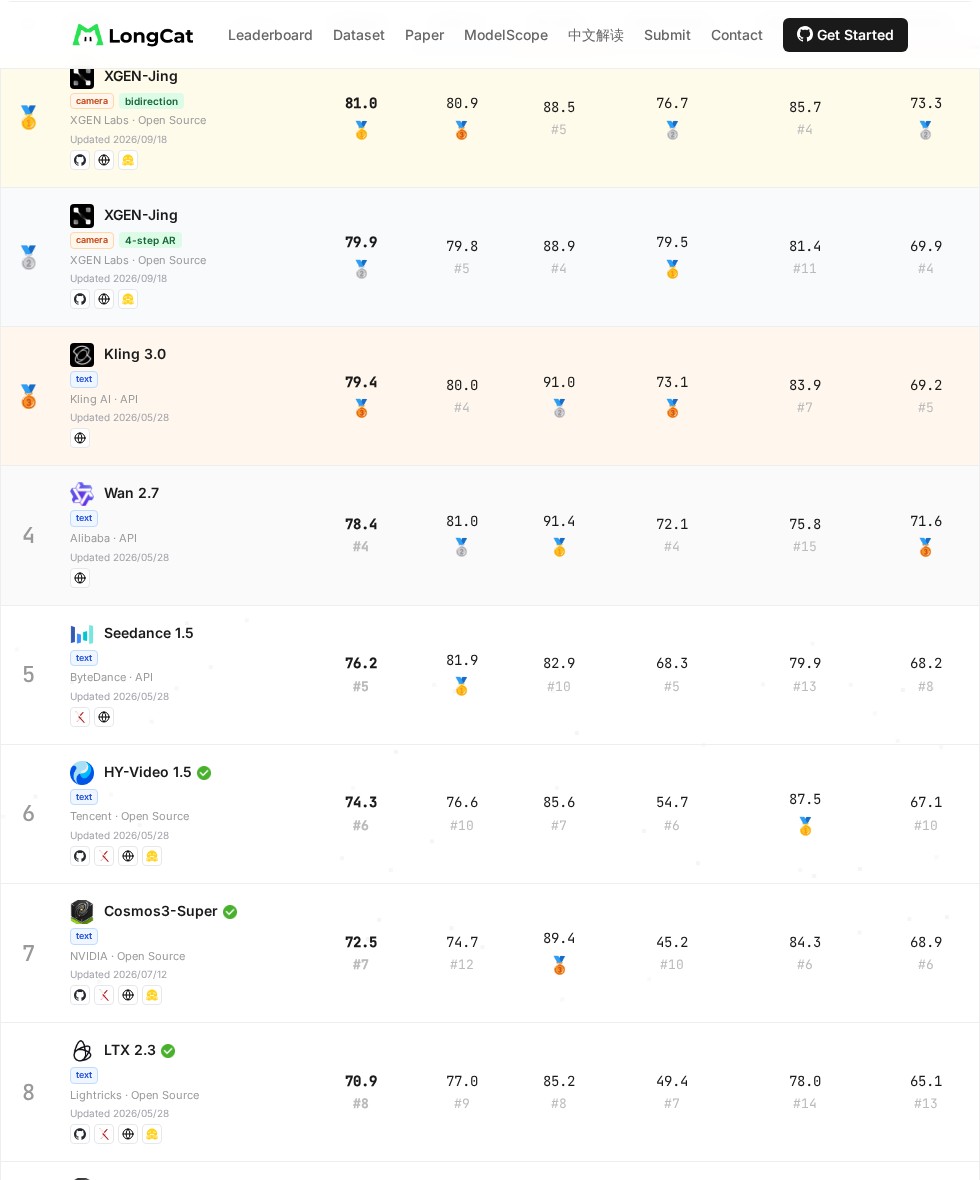
The headline claim checks out. WBench's live leaderboard, as of today, shows XGEN-Jing (bidirection) ranked #1 on the Full split — 289 cases, five scored dimensions (video quality, setting adherence, interaction, consistency, physics) from WBench's own benchmark — at an 81.0 average, just ahead of XGEN-Jing (4-step AR) at 79.9, then Kling 3.0, Wan 2.7, Seedance 1.5, HY-Video 1.5, Cosmos3-Super, and LTX 2.3.
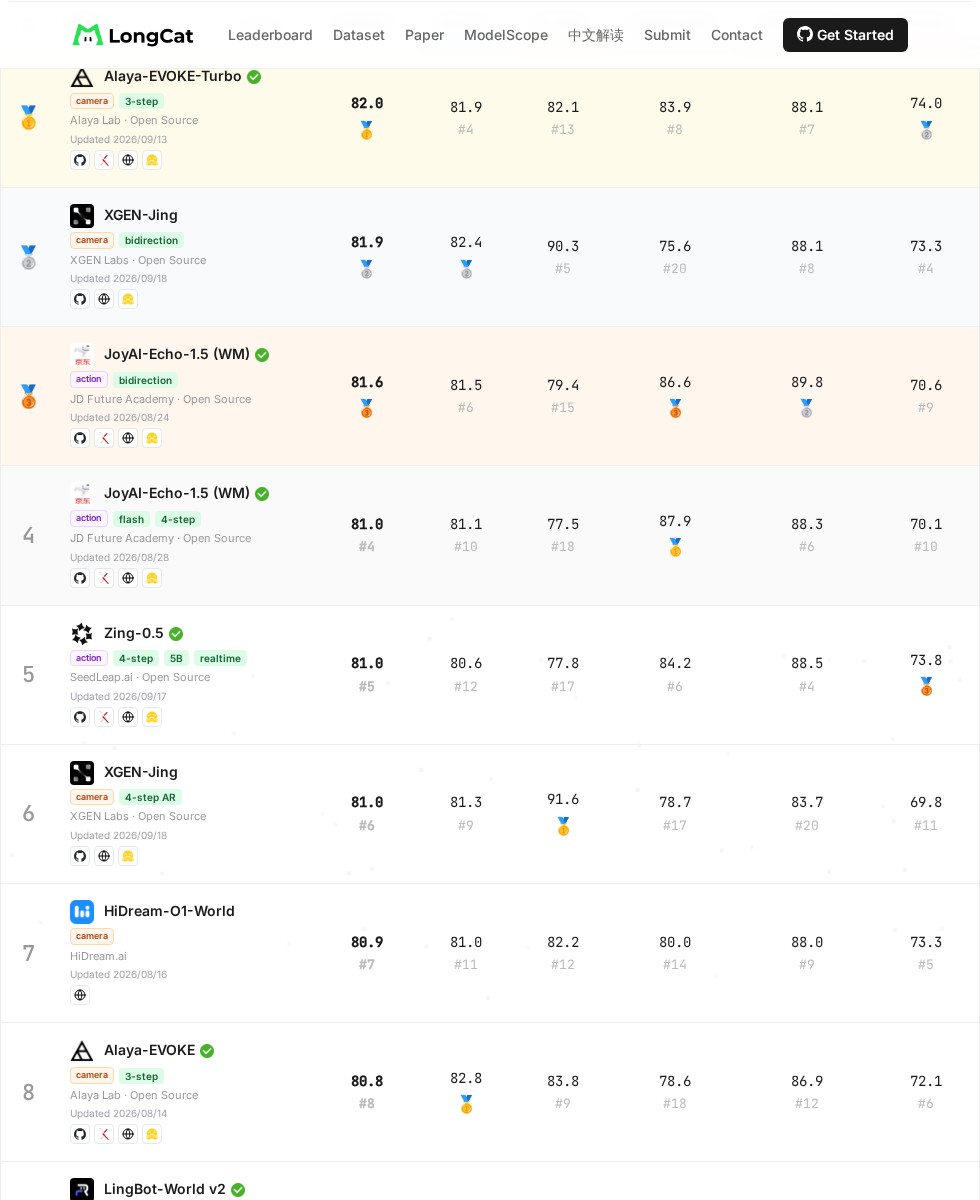
On the Navi split (158 navigation-only cases, a larger field of 39 models), the ranking XGEN claims is also accurate, and it's the more interesting one to look at directly: Alaya-EVOKE-Turbo edges ahead at 82.0, XGEN-Jing (bidirection) is #2 at 81.9, and XGEN-Jing (4-step AR) sits at #6, tied with two other models at exactly 81.0.
Three things the announcement doesn't say, that the primary source does:
- The ranking is hours old, not settled. Both XGEN-Jing rows carry an "Updated 2026/09/18" timestamp — today. So does Astronex-World a few rows down, and Zing-0.5 (updated the day before). The top of this board is being actively re-shuffled right now; a #1 that's one day old and a #1 that's held for a month are different claims, and this is the former.
- The scores are marked self-evaluation in the leaderboard's own markup. The attribute is
data-evaluation-source, and it is rare rather than routine: of 108 data rows across the board's four tables, exactly 10 carry it, and all 10 readself-evaluation. Those 10 resolve to three distinct models — XGEN-Jing's two variants and Alaya-EVOKE-Turbo — each flagged in every table it appears in. The other 98 rows carry no such attribute in any form, which reads as WBench having run those itself. The flag isn't surfaced anywhere in the rendered page — no badge, no tooltip, no footnote — so a reader scanning the visible table has no way to know it's there. I can't tell you what WBench intends by it, only that it's in the source and that it singles out exactly the two labs at the top of both splits. - Only one of the two ranked XGEN entries is something you can go run. "4-step AR" — the #2 Full-split, #6 Navi-split entry — is almost certainly the autoregressive/causal variant the GitHub README lists as "coming soon." The bidirectional model, the #1 entry, is real and downloadable. The runner-up isn't.
WBench's page markup tags some leaderboard entries with a data-evaluation-source attribute, and every instance of it on the page reads self-evaluation. There are 10 such row instances across the leaderboard's four tables, covering 3 distinct models: XGEN-Jing's two variants and Alaya-EVOKE-Turbo — which is to say, exactly the entries at the top of both splits. No other row carries the attribute in any form. Nothing in the rendered page surfaces it: no badge, no tooltip, no footnote. A reader scanning the visible table cannot tell these scores apart from the rest. What WBench intends by the flag is not stated anywhere I could find; that it is present, and where, is checkable in one view-source.
| table | rank | model | avg | data-evaluation-source |
|---|---|---|---|---|
| Navi split (summary) | 1 | Alaya-EVOKE-Turbo 3-step Alaya Lab | 82.0 | self-evaluation |
| Navi split (summary) | 2 | XGEN-Jing bidirection XGEN Labs | 81.9 | self-evaluation |
| Navi split (summary) | 6 | XGEN-Jing 4-step AR XGEN Labs | 81.0 | self-evaluation |
| Full split (summary) | 1 | XGEN-Jing bidirection XGEN Labs | 81.0 | self-evaluation |
| Full split (summary) | 2 | XGEN-Jing 4-step AR XGEN Labs | 79.9 | self-evaluation |
| Navi split (per-dimension) | 1 | Alaya-EVOKE-Turbo 3-step Alaya Lab | 65.2 | self-evaluation |
| Navi split (per-dimension) | 2 | XGEN-Jing bidirection XGEN Labs | 64.1 | self-evaluation |
| Navi split (per-dimension) | 6 | XGEN-Jing 4-step AR XGEN Labs | 63.6 | self-evaluation |
| Full split (per-dimension) | 1 | XGEN-Jing bidirection XGEN Labs | 61.8 | self-evaluation |
| Full split (per-dimension) | 2 | XGEN-Jing 4-step AR XGEN Labs | 61.4 | self-evaluation |
Denominators: 108 data rows across 4 tables (39 / 15 / 39 / 15), of which 10 carry the attribute — 98 carry no data-evaluation-source at all. The Navi tables list 39 models, the Full tables 15; the same three models are flagged in every table they appear in. The attribute takes exactly one value across the whole page: self-evaluation.
The vision versus the research preview
XGEN's own limitations section is candid, and worth quoting rather than summarizing, because it undercuts the OASIS framing more precisely than I could:
Generative World Simulation is a research preview, and practical economical real-time deployment requires lower latency, better visual fidelity, and more reliable interaction. Fast motion and rapid viewpoint changes can reduce camera and action precision, while extended sessions may introduce drift in scene details, spatial relationships, and interaction context.
"Drift in scene details" over extended sessions is precisely the failure mode the DAO/JING split is supposed to have designed away — DAO holds ground truth, JING just re-renders it, so a returning observer should see the same room. That guarantee only holds once DAO is a running system with an API, and today it's a hand-scripted demo page. One more detail, tucked into a single tagline with no elaboration anywhere else on the site: "DAO makes the world computable. XGEN-JING makes it perceptible. SHEN turns experience into action." SHEN doesn't appear again — not in the repo, not in the doc pages, not in any release-plan checklist. Whatever it is, it's earlier-stage than DAO.
Bottom line
The architecture claim is real and worth taking seriously: DAO-as-server, JING-as-renderer is a coherent, defensible design, and naming the split explicitly is more honest than most "world model" marketing, which usually hides that there's no persistent state at all. The WBench rank is also real, current, and independently verifiable — I checked, and XGEN-Jing does sit at #1 on Full and #2 on Navi today. What doesn't hold up is the implied symmetry: the announcement reads as one coupled system, but only the generative half has weights, code, and a leaderboard entry you can reproduce. The computable half — the piece actually responsible, in their own words, for making the world persist — has no repository, no weights, and a public demo that explicitly disables the one thing (an LLM-driven agent loop) that would make it resemble the thing it's describing. Judge JING as a first-person video/audio diffusion model built on MiniMax-H3, because that's what shipped. DAO, for now, is a diagram and a demo.
What would change my mind
5 claims above, and what would falsify each
The WBench rank is real — XGEN-Jing (bidirection) does sit at #1 on Full and #2 on Navi.
A leaderboard capture showing otherwise, or a WBench statement that the rows are provisional. This is the claim in the piece I most expect to stop being true, and not because it's wrong: I captured it on 2026-09-18, the same day three of the top rows were last updated. A leaderboard this actively re-shuffled dates its own findings.
Exactly 10 of 108 rows carry data-evaluation-source, and all of them read self-evaluation.
A WBench build where the attribute appears on rows I counted as bare, or takes a second value such as
benchmark-run. My count is one fetch of one static page; the dataset records the exact rows so a re-count is a minute's work. Note this is a claim about markup, not about misconduct — WBench has published no policy on what the flag means, and I'm not assuming one.DAO has no released weights or code — only the generative half shipped.
A DAO repository, checkpoint, or API with something behind it. This is the load-bearing claim of the whole piece and the easiest to overturn: XGEN Labs can falsify it in an afternoon by pushing the code, and I hope they do. Until then the asymmetry is the story.
The public demo disables the LLM-driven agent loop.
A demo configuration where the agent loop runs. I based this on the demo's own settings as exposed at the time I looked; a server-side flag I couldn't see, or a later build, would change it.
“4-step AR”, the #2 Full entry, is the variant the README lists as coming soon.
A downloadable 4-step AR checkpoint, or a statement from XGEN that the ranked entry is a different model than the unreleased one. This is the one inference in the piece I could not confirm directly — the leaderboard names a variant, the README names a variant, and I matched them on the name alone.