2026-07-27 · 7 min · llm · lora · agents · open-weights · generative-ui · explainer
Macaron-V1 is Mind Lab Research's agent model family, released 2026-07-21 under MIT. The flagship, Macaron-V1-Venti, is described as a 748B model. That number needs an asterisk immediately: 744B of it is a frozen GLM-5.2, and Mind Lab's contribution is four 1B LoRA adapters — about half a percent of the artifact.
That is the whole idea, and it is a genuinely different bet from how most post-training is done. Rather than fine-tuning one monolithic model, take a strong open base, freeze it, and attach a small number of tiny specialists. They call it Mixture of LoRA (MoL).
Mixture of LoRA
Four adapters, each 1B: l0 Chat, l1 Agent, l2 Coding, l3 GenUI. The routing detail is the neat part —
l0 is both the conversational backbone and the router. It sees each new user request and dispatches it to
whichever specialist fits.
That sliver on the right is the entire specialization. The base is frozen and it is not Mind Lab’s — it is GLM-5.2 — so everything Macaron adds rides in four 1B adapters, about half a percent of the artifact. This is the opposite trade from Mixture-of-Experts: MoE routes every token through experts baked in during pretraining, while MoL routes each request once, at the adapter level, on top of somebody else’s frozen base. Ongoing reasoning and tool calls stay inside the chosen specialist; finished work is handed between them as summaries rather than shared state.
Note what routes and when. In a Mixture-of-Experts model, a router fires on every token at every MoE layer, and the experts were built during pretraining — they are inseparable from the model. MoL routes once per request, at the adapter level, and the thing being routed between is four swappable files sitting on a base someone else trained. Ongoing reasoning and tool interaction stay inside the selected LoRA for the duration; when a specialist finishes, its work is passed to the next as a concise summary rather than shared state.
The practical consequences are real. Specialization costs 1B parameters instead of a full fine-tune. Adapters can be swapped, added, or updated independently. And when GLM-5.2 improves, you re-fit adapters rather than retrain a 744B model. The cost is equally real: you inherit the base's ceiling, its licence obligations, and its failure modes, and a request-level router cannot change its mind halfway through a turn the way per-token routing implicitly can.
What the adapters actually buy
Most of the release table compares Macaron to Claude, GPT and Gemini. That is the least informative comparison available, because it confounds the adapters with GLM-5.2's own strength. The controlled experiment is sitting right there in the same table: each variant against the frozen base it was built on. That isolates the only thing Mind Lab actually changed.
Read the coloured segment as the adapter contribution. Most of it is a real but modest 3 to 6 points, and on T3-Bench and SWE Atlas QnA it is inside noise at +0.2 and +0.6. Then there is UI4ABench: +20.7 on Venti and +25.4 on Tall. That is the clearest evidence the method does something — and also the place to be most careful, because UI4ABench is Mind Lab’s own benchmark measuring the capability they built a dedicated adapter for.
The pattern is consistent and modest: roughly +3 to +6 points across chat, agent and coding work. Two rows
are inside noise — T3-Bench at +0.2 and SWE Atlas QnA at +0.6. And then UI4ABench jumps +20.7 on Venti and
+25.4 on Tall.
That outlier is the honest crux of the release. It is simultaneously the strongest evidence that a 1B adapter can teach a frozen base a genuinely new skill, and the result most exposed to selection effects — UI4ABench is Mind Lab's own benchmark, measuring generative UI, which is exactly the capability they built a dedicated adapter for. Both things are true at once.
Read the evaluation table twice
The published benchmark figure includes its own methodology notes, and they change how several rows should be read.
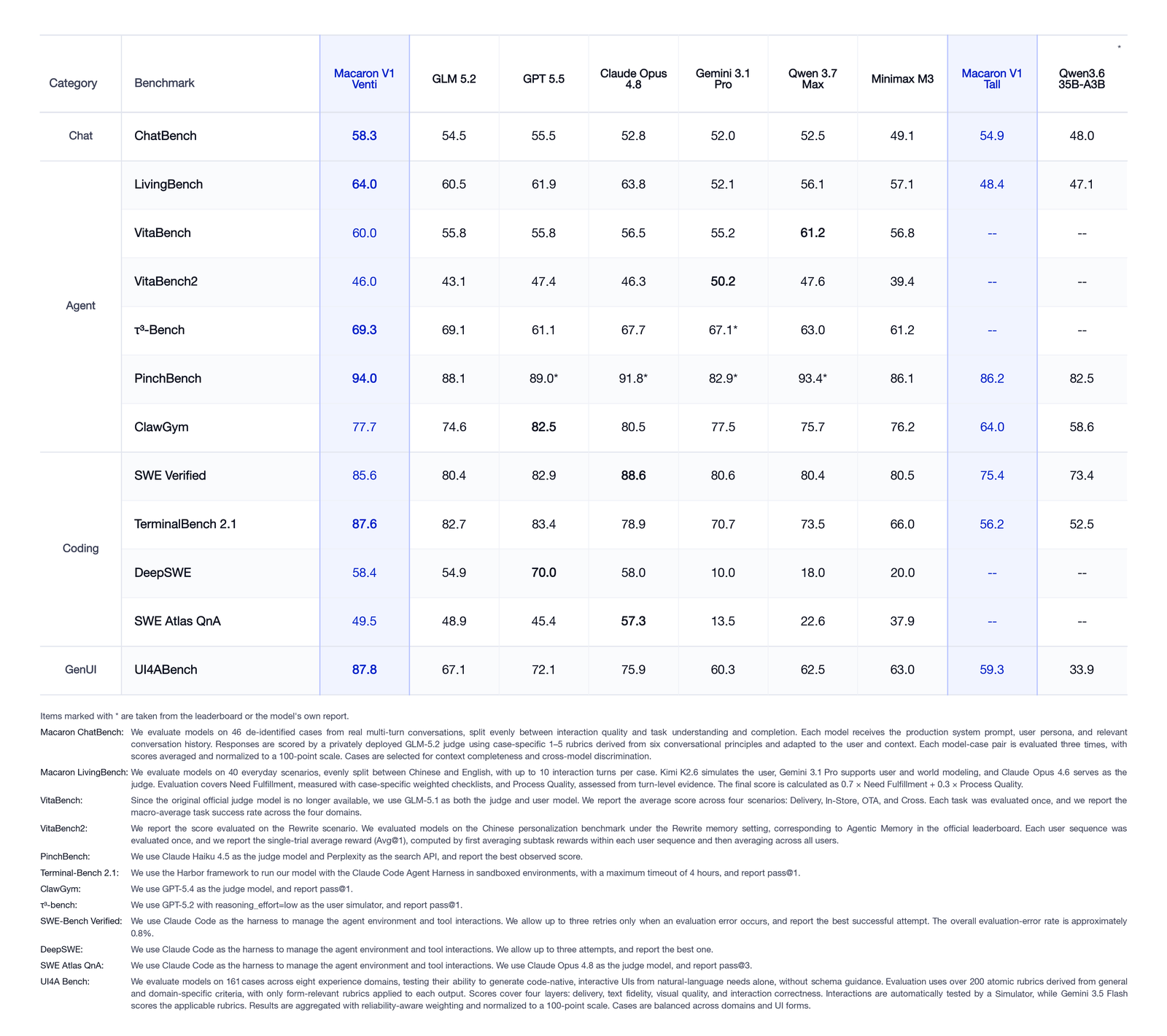
Three things stand out:
- The judges are other models, and one of them is the base. ChatBench is scored by "a privately deployed GLM-5.2 judge" — and Venti is GLM-5.2 plus adapters. A model's own base evaluating its output is a conflict worth naming. Elsewhere the judge is a competitor: Claude Opus 4.6 on LivingBench, Claude Haiku 4.5 on PinchBench, GPT-5.4 on ClawGym, GLM-5.1 on VitaBench, Gemini 3.5 Flash scoring UI4ABench rubrics.
- Several rows are best-of-N, not single-shot. PinchBench reports "the best observed score". DeepSWE allows "up to three attempts, and report the best one". SWE Atlas QnA is pass@3. SWE-Bench Verified permits up to three retries on evaluation errors and reports the best successful attempt. Those are legitimate protocols, but they are not comparable to a single-trial number from another lab's report — and some competitor cells are marked as taken from leaderboards or the models' own reports.
- Macaron does not lead everywhere. Claude Opus 4.8 wins SWE Verified (88.6 vs 85.6) and SWE Atlas QnA (57.3 vs 49.5). GPT-5.5 wins ClawGym (82.5 vs 77.7) and DeepSWE (70.0 vs 58.4). Qwen 3.7 Max wins VitaBench (61.2 vs 60.0) and Gemini 3.1 Pro wins VitaBench2 (50.2 vs 46.0). Mind Lab says as much in its own post: "Coding is where we currently sit close to, rather than ahead of, the frontier."
The rows where Gemini, Qwen and Minimax collapse to 10.0–22.6 on DeepSWE and SWE Atlas QnA are almost certainly harness incompatibility rather than capability — those evaluations run through Claude Code as the agent harness, which is not neutral ground for every model.
The infrastructure claims
Three systems are named, none with a technical report behind them yet:
- MinT — the post-training platform, claimed to support models up to a trillion parameters via adapter-only handoffs and a "million-scale adapter catalog". Adapter-only handoff is the load-bearing idea: if specialization is always a small file, you never move a 744B checkpoint between training stages.
- MindForge — an agentic RL framework built around discovery, expansion and update cycles against production harnesses.
- LongStraw — million-token RL, which works by evaluating a shared prompt once into a reusable resident state and then replaying only the response branches. For agentic RL where many rollouts share a long prefix, that is the obvious win, and it rhymes with the external KV-cache pooling in Kimi K3's RL infrastructure.
Macaron-V1 also ships a serving story: a Mixture-of-LoRA harness that keeps an OpenAI-compatible endpoint while adding the L0 router and same-request switching into the selected specialist, plus Macaron Artifacts, a local WebUI and plugin that runs inside Claude Code, Codex or Kimi Code.
The take
The interesting claim in Macaron-V1 is architectural, not competitive: that request-level routing across a few 1B adapters on a frozen base is enough to build a specialized agent model, and that you can therefore treat a frontier open-weight model as infrastructure rather than as something to fork. The base-versus-tuned comparison supports a weaker version of that claim than the headline table does — a few points nearly everywhere, and one large gain on the capability they purpose-built an adapter for.
What would settle it is the technical report, which the model card lists as "coming soon", along with the full benchmark methodology. Until then this is a self-reported release with no third-party replication, several best-of-N protocols, and its own base model sitting on the judging panel. The idea is worth watching. The numbers are worth waiting on.
Sources: the Macaron-V1 collection and the Macaron-V1-Venti model card (architecture, adapter roles, parameter counts, benchmark table), and Mind Lab's Introducing Macaron-V1 post (MinT, MindForge, LongStraw, variant sizes). All benchmark numbers are Mind Lab's own, with per-benchmark judge models and retry policies as annotated in their published table; no technical report has been released. The interactives are mine.