2026-09-22 · 28 min · explainer · agents · systems · architecture · open-source
Eighteen articles on this site are about what an agent decides. Decision models, rubrics, confidence gates, option enumeration, the arithmetic of a router that has to pick one of nine workflows and then defend the pick. That whole thread assumes something it never examines: that the process holding the decision is still alive to act on it.
google/ax is about the other end. Process isolation, state durability, recovery. It is the layer that decides whether your decision layer gets to finish. A router that answers in 178 ms is worth very little if the harness around it loses four hours of accumulated state to a pod eviction, and nothing in the decision-model literature has anything to say about that — by construction, because the decision tier's whole appeal is that it is stateless and cheap to call again. Somebody has to hold the state it is called about.
So this is a read of the runtime, not the reasoner. Google announced it in May as "Google's open-source runtime standard for agent execution, resumption, and distributed deployment," built by the team behind Google's internal agent runtime, and the announcement makes two design claims specific enough to check:
In distributed agent workflows, multiple components may attempt to update shared session state at the same time. Agent Executor's built-in single-writer architecture helps maintain consistency and reduces the risk of corruption in that state.
Long-running execution requires the ability to resume after outages or agentic interruptions such as human-in-the-loop (HITL) confirmations. Agent Executor provides this backend resilience automatically for any actor (e.g., an agent, agent harness, skill, tool, or sandbox) through its event log and snapshotting.
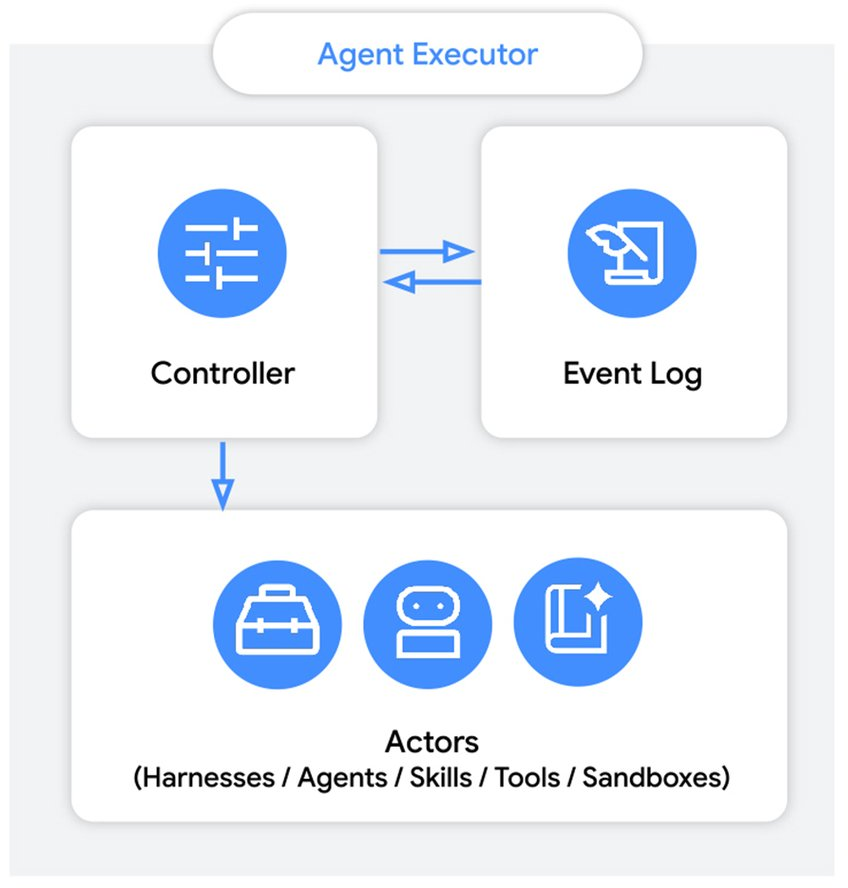
Both claims are real trades rather than features, and both are checkable by reading. I did that, and then I ran the thing to check what reading told me.
Read the date before you read the code
On 19 September 2026, three days before this piece, commit dc4f36c
landed: "Restructure AX into a general-purpose orchestration layer for agentic
tasks." One commit, 151 files, +16,191 / −19,988 lines. It deleted
internal/controller/eventlog/ entirely. It deleted internal/harness/, the
HarnessService proto, the Step and Content message families, the Python
Antigravity sidecar, and the skills registry client. It was tagged v0.3.0
the same day.
So there are two ax projects, and the claims above describe the first one.
v0.2.3 · b777313 | v0.3.0 · d8ed0fe | |
|---|---|---|
| Shape | a harness runtime you plug agents into | a kubectl-shaped orchestrator for sandboxed tasks |
| Primitives | conversations, executions, harnesses | Task, Workspace, Gateway, Model |
| Durable state | Postgres/SQLite event log | Redis hashes + Redis Streams work queue |
| Go source | 68 files, 16,311 lines, 22 test files | 32 files, 14,178 lines, 10 test files |
| Single writer | named in three package docs | the phrase does not appear |
| Event log | internal/controller/eventlog/ | deleted |
Neither version is vapourware, and the project has been worked on properly: 625
commits since 21 January 2026, thirteen contributors, 413 commits from
@google.com addresses, six tags, Apache 2.0, and a README that opens with a
breaking-changes warning it has honoured. But the advice you give a reader
depends entirely on which of those two columns they are looking at, so the rest
of this piece checks the claims against the code that made them, then checks
what survived.
Claim one: the single writer
Single-writer means exactly one component may mutate a given piece of state. What you buy is serialisability without distributed locking. What you pay is write throughput and a failover question: when the writer dies, who takes over, and what stops the old one from writing after the new one starts?
The first question is what the unit of ownership is. In ax it is the
conversation id — and the proto says so, in the comment on the message that
carries it:
// proto/ax.proto — a conversation cannot be continued before the last
// execution is completed or failed.
message StepEvent {
  string conversation_id = 1;
  string interaction_id = 2;
  string agent_id = 3;
  ...
}
The same id is also the name of the sandbox. SubstrateHarness.Start calls
CreateActor(ctx, conversationID), ResumeActor(ctx, conversationID), and on
close SuspendActor(ctx, conversationID). One conversation, one actor, one
writer. That is a clean design: the unit of isolation, the unit of durability
and the unit of exclusion are the same object, which is exactly what you want.
So where is the exclusion enforced? Here, in full:
// internal/server/server.go — the entire single-writer mechanism
type Server struct {
	proto.UnimplementedInteractionsServiceServer
	controller *controller.Controller
	grpcServer *grpc.Server
	inFlight   map[string]struct{}
	inFlightMu sync.Mutex
}

func (s *Server) markInFlight(id string) (exists bool, cleanup func()) {
	s.inFlightMu.Lock()
	defer s.inFlightMu.Unlock()
	if _, ok := s.inFlight[id]; ok {
		return true, func() {}
	}
	s.inFlight[id] = struct{}{}
	return false, func() {
		s.inFlightMu.Lock()
		delete(s.inFlight, id)
		s.inFlightMu.Unlock()
	}
}
And at the top of the RPC:
inFlight, cleanup := s.markInFlight(req.ConversationId)
if inFlight {
	return status.Errorf(codes.FailedPrecondition,
		"conversation %q is already in flight", req.ConversationId)
}
defer cleanup()
That is it. Ownership is acquired by inserting a key into a Go map and released
by a deferred delete when the RPC returns. There is no lease, no TTL, no
renewal, no fencing token, no SETNX, no row in a table, nothing in Redis, and
no Lock outside sync.Mutex anywhere in the tree — I grepped every
non-generated Go file for lease, owner, fencing and singleflight and the
only hits are in comments about closing resources.
The failure path is where this is either good or a liability, so take it in two halves.
When the writer dies mid-write, the design is fine. A crash takes the map with it, so there is no stale lock to break and no lease to wait out — the degenerate failure mode of a lease-based design, where a live writer is fenced out for thirty seconds because a GC pause looked like a death, cannot happen here. The log append itself is a single transaction, so a torn event is impossible. The cursor file the harness persists is written temp-file-plus- rename, so a torn cursor is impossible too. Nobody was sloppy.
The problem is that nothing was ever excluded in the first place. A Go map is a per-process object. It excludes a second caller arriving at the same process. It has no opinion about a second caller arriving at a second process, and the reference deployment ships three of them:
# manifests/ax-deployment.yaml
apiVersion: apps/v1
kind: ReplicaSet
metadata:
  name: ax-server
spec:
  replicas: 3
  ...
            - name: AX_EVENTLOG_DSN
              valueFrom:
                secretKeyRef:
                  name: ax-eventlog-postgres
                  key: dsn
Three replicas, one shared Postgres event log, and — I checked — no
kind: Service in front of them anywhere in that manifest tree. The only
Service in manifests/ is the one in front of Postgres, and the documented way
to reach the control plane is kubectl port-forward -n ax rs/ax-server 8494:8494, which attaches to one arbitrary pod of the set. Nothing hashes a
conversation to a replica. Nothing pins one. Restart the port-forward mid-run
and you may land somewhere else.
This matters more than a race usually does, because the layer below documents that it is relying on the invariant. From the harness interface:
// internal/harness/harness.go
// Single-writer expectation: the controller must ensure that at most one
// Execution exists per conversation id at a time. Harness implementations rely
// on this invariant -- for example, a harness that durably persists
// per-conversation state may use a last-write-wins store without
// compare-and-swap, which is correct only because there is a single writer per
// conversation.
type Harness interface {
	Start(ctx context.Context, conversationID string, config []byte) (Execution, error)
}
And the shipped harness takes them up on it:
// internal/harness/antigravityinteractions/cursorstore.go
// It assumes a single writer per conversation (the controller guarantees at
// most one Execution per conversation), so writes are last-write-wins with no
// compare-and-swap.
Read those two comments next to replicas: 3. The contract is stated
precisely, the consumer is written against it, and the deployment does not
provide it. This is not an oversight in the sense of nobody having thought about
it — somebody thought about it carefully enough to write the paragraph.
What two replicas actually do
I did not want to argue this from reading, so I built the pre-restructure tree
(go build ./..., clean) and stood up two ax-server instances in one process
tree, each with its own Controller and its own event-log handle, both pointed
at the same SQLite file. Then two clients, same conversation id, at the same
time. A fake harness emits five steps at 40 ms each so the turns overlap.
Both were admitted — no FailedPrecondition on either side, which is the
expected result and the whole point. What I did not expect is the second-order
effect:
replica A: err=<nil> frames=10
replica B: err=<nil> frames=5
durable log holds 20 events for conversation "same-conversation"
  step  1  state=STATE_PENDING    interaction_id=""  go
  step  2  state=STATE_PENDING    interaction_id=""  B-step-0
  step  3  state=STATE_PENDING    interaction_id=""  A-step-0
  ...
  step 11  state=STATE_COMPLETED  interaction_id=""
  step 12  state=STATE_PENDING    interaction_id=""  A-step-4
  step 13  state=STATE_COMPLETED  interaction_id=""
  step 14  state=STATE_PENDING    interaction_id=""  go
  step 15  state=STATE_PENDING    interaction_id=""  A-step-0
  ...
  step 20  state=STATE_COMPLETED  interaction_id=""
events with empty interaction_id: 20/20
Replica A ran the turn twice for one client request. The mechanism is in
Controller.Exec: it first reads the conversation's resumption state, and if
that state is STATE_PENDING it runs the harness once to finish the pending
work and then runs it again with the new inputs. A's state read landed after
B had already appended its input event, so A saw a pending conversation that was
in fact B's in-progress turn, "resumed" it, completed it, and then did its own.
Ten output frames for one request.
Two details in that dump are worth keeping. state=STATE_COMPLETED appears at
step 11 while the conversation is still running — a completion written by one
writer about the other's work. And interaction_id is empty on all twenty
events. The schema has exactly one field for telling turns apart, and
internal/controller/controller.go declares it on the logger struct, reads it
into every event, and never assigns it:
type logger struct {
	conversationID string
	interactionID  string   // declared, read twice, assigned never
	el             eventlog.EventLog
	harnessID      string
}
So the durable record of a conversation cannot distinguish two concurrent
executions after the fact. Not "it is hard to" — the field is there and it is
always "".
Do readers see stale state?
Mostly the question does not arise, which is itself the finding. There are no
independent readers. EventLog has exactly three methods — Append, Events,
Close — and Events does a full scan of the conversation ordered by step. The
only in-tree caller is ResumptionState, on the write path. There is no watch,
no tail, no cursor, no read replica, and no WatchTask-style streaming of the
log to anyone. The blog promises that "Agent Executor lets clients reconnect to
agents and backfills responses from the last sequence seen by the client"; the
request message is
message CreateInteractionEvent {
  string conversation_id = 1;
  repeated Step inputs = 2;
  reserved 3;
  string agent_id = 4;
  bytes agent_config = 5;
}
There is nowhere to put a last-seen sequence. Step.index is populated on the
way out, so the client can observe a sequence number, but there is no field,
RPC or code path that lets it ask for a range. Same for the announcement's
trajectory branching: no branch, fork or checkpoint API exists at any commit I
searched. Those two are roadmap described in the present tense.
Claim two: the durable event log
For an event log the question is always the same. Is the log the source of truth, with state derived by replaying it? Or is it an audit trail sitting beside mutable state that lives somewhere else? The two behave completely differently on recovery, and the interface doc-comment promises the first one:
// EventLog is the persistent, append-only record of all actions taken in an
// exec. Every entry is an atomic step: replaying the log in order brings
// the executor back to a consistent state from which execution can resume.
type EventLog interface { ... }
Here is the whole of replay:
// internal/controller/controller.go
func (l *logger) ResumptionState(ctx context.Context) (proto.State, string, error) {
	events, err := l.el.Events(ctx, l.conversationID)
	if err != nil {
		return proto.State_STATE_UNSPECIFIED, "", err
	}
	var state proto.State
	var harnessID string
	for _, ev := range events {
		if harnessID == "" && ev.AgentId != "" {
			harnessID = ev.AgentId
		}
		if ev.State != proto.State_STATE_UNSPECIFIED {
			state = ev.State
		}
	}
	return state, harnessID, nil
}
Replay reads every event of the conversation and reduces them to two scalars: the last non-unspecified state, and the first harness id it saw. Nothing is reconstructed. No conversation history, no tool results, no working set, no filesystem. The log is not the source of truth for anything the agent knows.
The truth lives in two other places, both of them mutable:
- The Substrate actor.
snapshotsConfigwithonPause: Dataand adurableDirvolume, so the actor's filesystem — and, on gVisor, its memory — is checkpointed on suspend and restored on resume. That is a real durability mechanism, and it is Agent Substrate's, notax's. - A cursor file.
cursorStorewrites one JSON file per conversation holdingprev_interaction_id, the tail of the model provider's own server-side interaction chain. Resumption of the conversation is delegated to the provider;axremembers the pointer.
So the honest description is: an append-only audit trail beside mutable state, plus a two-field state machine driving a re-run. That is a perfectly reasonable architecture. It is not event sourcing, and the difference shows up the moment you ask what recovery does.
The log's concurrency control is the single writer
Append computes the next step number inside a transaction:
// internal/controller/eventlog/sql.go
tx, err := l.db.BeginTx(ctx, nil)
...
if err := tx.QueryRowContext(ctx,
	"SELECT COALESCE(MAX(step), 0) + 1 FROM conversation_log WHERE conversation_id = $1",
	event.ConversationId).Scan(&step); err != nil { ... }
...
tx.ExecContext(ctx,
	"INSERT INTO conversation_log (conversation_id, step, payload) VALUES ($1, $2, $3)",
	event.ConversationId, step, string(payload))
Read-modify-write on MAX(step). The table has PRIMARY KEY (conversation_id, step), so a collision fails loudly rather than corrupting — good. SQLite opens
with _txlock=immediate and a 10-second busy timeout, which takes the write
lock up front and genuinely serialises writers — also good, and clearly
deliberate. Postgres gets no such treatment, and the function says so:
// OpenPostgresEventLog connects to the PostgreSQL database described by dsn and
// initializes the event log schema. Caller is responsible to ensure it is safe
// for concurrent use.
Under READ COMMITTED, two concurrent appends to one conversation both read the
same MAX(step) and one loses the primary key. The event log's correctness is
delegated, in a comment, to the single-writer property that the deployment does
not provide. And the loser is not retried:
// internal/controller/controller.go — OnMessage
logStep, err := a.logger.LogOutputs(ctx, []*proto.Step{step}, proto.State_STATE_PENDING)
if err != nil {
	slog.WarnContext(ctx, "Failed to log streamed message to event log", ...)
}
// ...execution continues
A failed append is a warning line. The agent keeps going. The durable record of what it did quietly has a hole in it, which is the one thing an audit trail is not allowed to have.
What happens to effects that already escaped
An agent that sent an email before crashing cannot un-send it on replay. Any
runtime built for long-running agents has to have an answer: exactly-once with
transactional effects, or at-least-once with idempotency keys, or an explicit
statement that effects are the caller's problem. I grepped the whole tree and
its whole history for idempot, dedup, exactly-once, at-least-once. There
are three hits and none of them is a mechanism:
substrate.go: "CreateActor is idempotent here" — about the actor lifecycle.antigravityinteractions.go: "Creating an interaction is not idempotent, so only 429 — which is rejected before any interaction is created — is retried here." Careful, correct, and about the model API, not about tools.eventlog.go: the replay promise quoted above.
That third one is the tell. The project thought hard about non-idempotency at the provider boundary and did not carry the thought across to the tool loop. In the interactions harness, the loop is: post a turn, get back a list of tool calls, execute every one of them, post the results. The side effect happens in step two; the cursor advances in step three. Crash in between and the cursor still points at the interaction that issued those calls.
So I measured it. Same pre-restructure tree, one server, one conversation, and a harness whose every step performs one irreversible action. The client disconnects after two steps — a network drop, a pod eviction, a closed laptop. Then the user comes back and sends one more message.
after interruption:   runs=1  effects=2
turn 2 streamed 12 frames;   total runs=3  total effects=14
durable log holds 18 events
One interruption and one follow-up message produced three executions of the
same turn and fourteen irreversible actions where six were asked for. The
resume branch does not skip the work that already happened, because nothing
records that it happened: HarnessStart carries agent_config and steps and
nothing else. There is no resume flag, no last-executed index, no call id list.
A harness cannot tell a resume from a first attempt except by its own persisted
cursor, and a harness that keeps no cursor — the fake one here, and any custom
harness written against the documented interface — redoes everything.
To be fair about scope: the shipped interactions harness does keep a cursor,
so its model-side chain would not restart from zero the way my fake one does.
But that is a property of one harness, not of the runtime, and the runtime is
what the README invites you to extend. "Bring your own harness implementation by
implementing HarnessService" comes with no guidance on this at all.
It is also worse than the number suggests for the harness that does keep a
cursor. Controller.Exec opens with a TODO:
// TODO(jbd): Resume an incomplete execution if there exists one.— under a README advertising "Automatic recovery from failures or
interruptions." And on the interactions harness the resume branch cannot
succeed, because Run refuses to run with nothing queued:
input := e.drainQueue()
if len(input) == 0 {
	if prevID == "" {
		return fmt.Errorf("no input messages queued for the initial turn")
	}
	return fmt.Errorf("Run called with no queued input and no work pending")
}
The controller's resume branch calls Start then Run with no Queue. Both
arms of that condition are errors, and Exec propagates them. So
ax --conversation <id> --resume fails on the flagship harness — and because
the resume branch runs before the input branch, a conversation whose last
event is STATE_PENDING cannot take new input either. A conversation ends in
STATE_PENDING exactly when it was interrupted, which is the case the feature
exists for.
Testing "not a framework" instead of repeating it
Every framework says it is not a framework. The old README said it twice:
A managed service. AX is self-hosted and not a managed service. An agentic framework. AX is agnostic of the framework used to build agents.
The honest test is not the disclaimer, it is the import list. What must your code implement, and could you run an existing harness under it unmodified?
- implement proto HarnessServiceone bidi RPC, Connect(stream HarnessRequest) returns (stream HarnessResponse)
- speak ax's message typesStep, ContentStep, ThoughtStep, ToolCallStep, FunctionResultStep — 236 lines of proto
- adopt its turn shapeexactly one start frame in, zero or more outputs frames out, exactly one terminal end
- give up mid-turn steeringthe request oneof is {start, cancel}; there is no wire frame for input after start
- hold conversation state yourselfkeyed by the conversation id ax hands you, last-write-wins, no CAS — because single writer
- put a runner at a fixed path/usr/local/bin/ax-task-runner in your image, even if it is a shell wrapper
- serve two HTTP paths on :80/healthz always 200; /readyz 503 until the workspace is prepared
- read two environment variablesAX_TASK_YAML and AX_WORKSPACES_YAML, then start spec.command yourself
- stay up as PID 1outlive the command so ax ssh keeps working; forward SIGTERM to its process group
- nothing about the agentspec.command is opaque argv; your agent imports no ax package and knows no ax type
os.MkdirAll and writes no MCP config at all.Before the restructure, it was a framework, and a fairly opinionated one.
You implemented HarnessService, a bidirectional gRPC stream, and spoke ax's
own 236-line message family — Step, ContentStep, ThoughtStep,
ToolCallStep, FunctionResultStep. You adopted its turn shape: exactly one
start frame in, zero or more outputs frames out, exactly one terminal end.
And you gave up capability at the boundary, which the code is admirably honest
about:
// Note: mid-run steering (injecting extra human input while a turn is running)
// is intentionally NOT supported here. The execution can accept steering via
// Queue, but the HarnessRequest oneof only defines {start, cancel} -- there is
// no wire frame to carry additional input after start -- so a client cannot
// deliver steering over Connect.
You cannot take a Claude Code or an OpenHands loop and run it unmodified against
that. You rewrite it as a HarnessService and lose mid-turn steering on the
way. That is what a framework is.
After the restructure, it is an orchestrator, and the claim is true. The
runner contract in docs/runner.md demands things of your image, not your
agent: an executable at /usr/local/bin/ax-task-runner, HTTP on port 80 with
/healthz and /readyz, read AX_TASK_YAML, start spec.command, stay up as
PID 1, forward SIGTERM. Your agent is opaque argv. It imports nothing from
ax and knows none of its types. An existing harness runs unmodified if you can
containerise it, and the docs say outright: "AX ships a default runner. You do
not have to use it."
That is the right answer, and it is worth saying that the restructure is the
project's own correction. ax stopped being a framework by deleting the
framework.
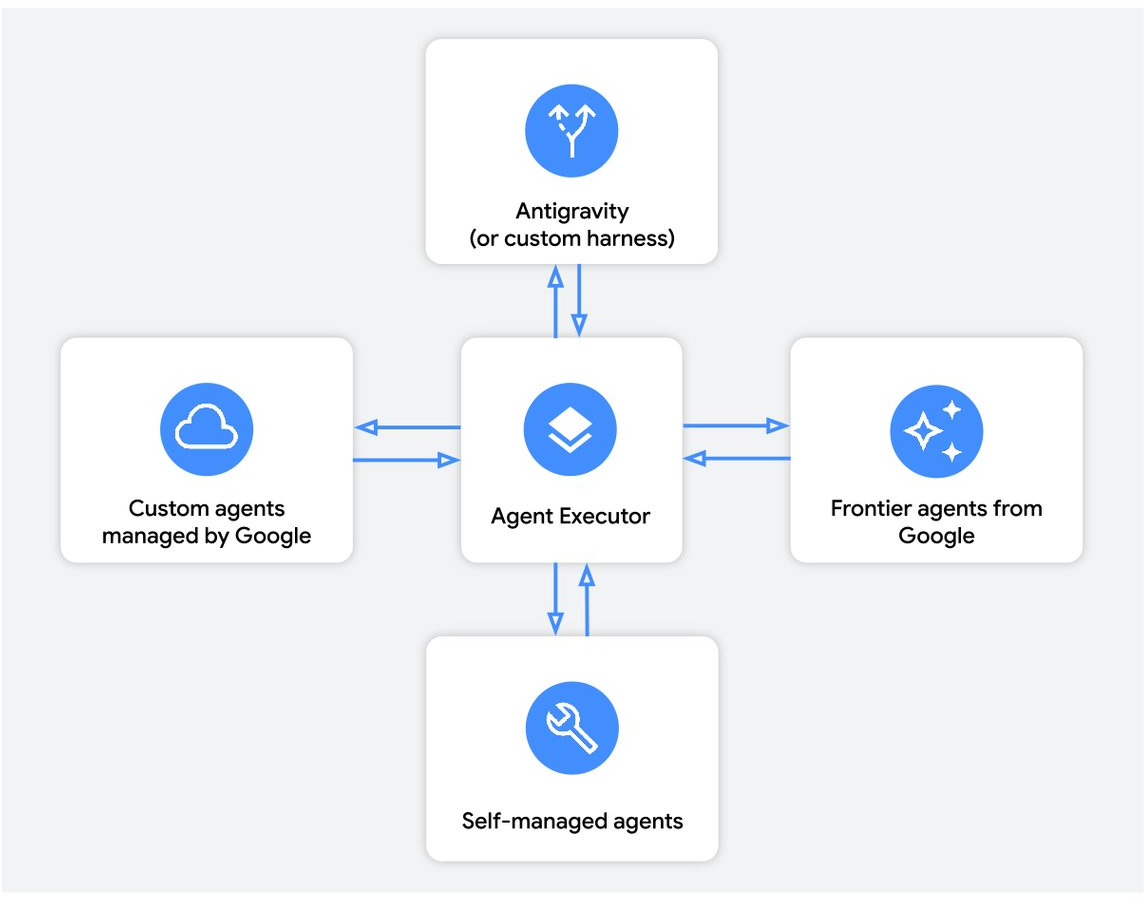
Where the protocol claim does not hold up
"Built-in support for MCP tools and skills" is the part of the pitch that would substantiate "speaks existing protocols rather than defining new ones," and it is the weakest thing in the repository.
MCP. At v0.3.0 a Workspace declares MCP servers and registries, and the
proto is properly modelled — MCPConfig, MCPRegistry, MCPServer{name, endpoint, command, args} — with a round-trip test. There is no MCP client. The
string modelcontextprotocol appears exactly once in the tree, in a test
fixture's args array. go.mod has no MCP dependency. SetupWorkspace clones
git repos, creates a skills directory and optionally runs a bootstrap agent; it
writes no MCP configuration, although docs/runner.md tells third-party runner
authors that they should. The only code that consumes the field passes
mcpConfig != nil — a boolean — into an LLM prompt asking it to plan an
environment. I searched the full history: there has never been an MCP client in
this repository.
Skills. This one genuinely regressed. v0.2.3 had a real implementation:
internal/skills/ with a Gemini Enterprise registry client that downloaded and
materialised skill packages, a local-directory source, and a
SkillsSystemInstruction builder that told the agent where its skills lived and
listed them. The restructure deleted all of it. What replaced it is:
// internal/workspace/setup.go — the entire skills implementation at v0.3.0
func setupSkills(skills *v1alpha1.SkillsConfig) string {
	if skills == nil || skills.Path == "" {
		return ""
	}
	if err := os.MkdirAll(skills.Path, dirPerm); err != nil {
		slog.Warn("creating skills dir", "path", skills.Path, "error", err)
	}
	return skills.Path
}
mkdir -p. The skills.registries field in the example manifest, with its
provider: google and query: "skills.tags:nodejs", resolves to nothing.
This is the cost of the restructure stated plainly: the new shape is the right
shape, and it arrived with the integrations stripped out. Declaring a thing in a
CRD is not supporting it, and a reader evaluating ax for MCP or skills support
today should know they are evaluating a schema.
Isolation, resumption, scale, maturity
What "isolated" means. Not much of it is ax's. Isolation is Agent
Substrate's, and ax is a client of its Control API — CreateActor,
ResumeActor, SuspendActor, CreateActorEgressPolicy. Substrate runs actors
in gVisor or microVM sandboxes
on Kubernetes workers, multiplexing many idle actors onto few pods. What ax
adds on top is the Gateway: an egress allowlist of hosts and ports, applied to
the actor before it is resumed, which is the correct order. It is applied
best-effort, though:
if err := r.client.ApplyEgressPolicy(ctx, atespace, actorName, egressAllowlist); err != nil {
	slog.Warn("could not apply egress policy (continuing)", "actor", actorName, "error", err)
	r.setCondition(task, condGatewayReady, "False", "PolicyApplyFailed", err.Error(), now)
}
The condition goes False, the reconcile continues, and the actor resumes. A network fence that fails open is worth saying out loud, because the README's one-line pitch is "AX sandboxes it, wires up its workspace, fences its network."
Resumption granularity is the whole actor at turn boundaries. Close()
suspends it; the next turn resumes it; Substrate snapshots the durable volume on
pause and restores it into a fresh container. There is no mid-tool checkpoint and
no partial-turn resume — cursorstore.go says a richer cursor is a future
possibility, "e.g. partial function-call results for mid-tool-loop recovery,"
which is a precise statement of what does not exist yet.
Scale figures. The README says ax is "built to run billions of tasks per
cluster." There is no measurement of that anywhere in the repository — no
benchmark, no load test, not one func Benchmark in 32 Go files. Substrate,
one layer down, does publish numbers (sub-500 ms resumes, 500+ suspend/resume
activations per second, ~250 actors multiplexed onto 8 pods), and it ships a
benchmarking/ directory to reproduce them. Treat the ax number as an
architectural intention.
Maturity. Eight months, 625 commits, thirteen contributors, v0.3.0, Apache
2.0. This is not a fresh open-sourcing of mature internal code — the README is
careful to say only that ax is "developed and maintained by the team actively
working on Google's internal runtime" and that "the two projects operate at
different layers today." What you are looking at is a public rewrite by people
who have built this before, which is a different and slower thing. The current
control plane is honest about being early: one ax-controller replica, one
Redis Deployment with no PVC and no appendonly configured, so the entire
control-plane state lives in one pod's memory. UpdateTaskStatus is a get
followed by a set with no resourceVersion and no CAS. Workers consume a Redis
Streams group where "every event is handled by exactly one of them" — a
competing-consumer queue, which does not partition by key, so scaling the
controller past one replica reintroduces concurrent reconciles of the same task
against a last-write-wins store. And a failed reconcile is acknowledged anyway,
deliberately, "so a bad task cannot wedge the queue" — a defensible trade that
also means no retry.
So what would I actually do with it
Three different answers depending on who is asking.
If you want the sandbox, you probably want Agent
Substrate directly. It is the
part with the isolation, the snapshot/restore, the density numbers and the
reproducible benchmarks. ax is a declarative front end over it plus an egress
allowlist, and if all you need is "run this agent in a gVisor sandbox and
suspend it when idle," the front end is optional.
If you want the orchestrator, v0.3.0 is the right shape and the
Workspace idea is the best thing in the repository — pre-wiring repos, tools
and skills once and binding them from many tasks is the piece every team
rebuilds badly. Use it knowing that the tool-wiring half is declarations today,
that the control plane stores state in an unpersisted Redis, and that the API is
v1alpha1 under a banner promising breaking changes.
If you came for the durability claims, read them as design intent rather than as behaviour you can lean on. The unit of ownership is right, the failure handling around individual writes is careful, and nobody was sloppy — but single-writer is enforced inside one process and deployed as three, the event log is an audit trail that replay reduces to two fields, and effects are at-least-once with no dedup key in the system. Those are not exotic distributed systems problems; they are the ordinary ones, and they are the reason the decision layer is the easy half. Making a decision cheap is a modelling problem. Making sure the decision is only acted on once is a systems problem, and this runtime has not solved it yet.
What would change my mind
5 claims above, and what would falsify each
The single-writer exclusion is per process, so the reference three-replica deployment does not enforce it.
The whole section falls if the exclusion is enforced somewhere I did not look — a Substrate-side admission check that rejects a second Connect stream to an already-busy actor, or a routing layer outside the manifest that hashes conversation ids to replicas. I only read
google/axand the Substrate client it uses; I did not read Substrate's control plane. IfCreateActor/ResumeActorrefuse concurrent activations of one actor, then the Go map is a fast path in front of a real guarantee and my framing is wrong. Run twoax-serverpods against one Substrate cluster and open two turns on one conversation: if the second is refused belowax, I have over-read the gap.The event log is an audit trail beside mutable state, not a source of truth that replay reconstructs from.
Falsified by any code path that rebuilds agent-visible state from
Events(). I found one caller,ResumptionState, reducing the log to a state enum and a harness id. If a harness in a private branch — or Google's internal runtime, which the README says operates at a different layer — feeds the log back into a model context on resume, then the open-sourceaxis a partial extract and the claim belongs to the system I cannot see rather than the one I read.Side effects are at-least-once with no dedup, and one interruption plus one follow-up ran the same turn three times.
My probe used a fake harness with no internal cursor, which maximises re-execution; the shipped interactions harness persists
prev_interaction_idand would not redo the model-side chain the same way. Instrument the Antigravity harness against a real endpoint, interrupt it mid-tool-loop, and count actual tool invocations across the resume. If its cursor plus the provider's interaction chain together make tool execution effectively once-only, then the gap is a documentation gap for custom harnesses rather than a runtime-wide property, and "at-least-once" overstates it.'Not a framework' is true of v0.3.0 and was not true of v0.2.3.
Straightforwardly testable, and I would like to be wrong about the second half. Take an existing harness — Claude Code, OpenHands, an ADK agent — and run it against
b777313without rewriting its loop as aHarnessService. If an adapter that is genuinely thin does it, "framework" is too strong a word for what v0.2.3 demanded, and the arc I am describing is a smaller change than I have made it.MCP and skills support at v0.3.0 is declarative only — a schema with no client.
One MCP client commit falsifies this, and it may exist by the time you read it; the restructure is three days old and the roadmap explicitly lists integrations. Check
go.modfor an MCP dependency andinternal/workspace/setup.gofor code that writes a server config into the sandbox. If the runner materialisesspec.mcp.serversinto something an agent can call, this paragraph is stale and should be read as a note about one week in September.
Read at d8ed0fe (v0.3.0, 19 Sep 2026) and its parent b777313 (v0.2.3, 19
Aug 2026). Code excerpts are verbatim from google/ax,
Apache 2.0. The two figures are from Google Cloud's Agent Executor
announcement
(20 May 2026), reproduced for commentary; the repository itself ships no
architecture image, only a logo. The three diagrams are my own drawings of
mechanisms I read, not screenshots. Both probes ran against the pre-restructure
tree built from source with a fake harness; they measure the controller's
control flow, not a live model endpoint.