2026-08-03 · 4 min · licensing · open-source · multimodal · video-generation · explainer
MiniMax announced H3 on July 31, 2026 and put weights on Hugging Face two days later — an omni-modal system that takes text, image, video, or audio in and produces video with native stereo audio out, up to 2K resolution, 15 seconds, 24 FPS. The architecture underneath is a real, disclosed piece of engineering: an encoder built on the full pretrained weights of Qwen3-VL-32B, sampled from its 50th layer, feeding a 33B-parameter dense Omni-Transformer with no modality-specific attention or feed-forward blocks — only the input/output layers and a set of AdaLN branches (about 13B of the 33B) are modality-specific.
I'm not writing about the capability, though. I'm writing about what shipped alongside it, because the license and the evidence base are the actual story here.
- task
- image-text-to-video
- library
- minimax-h3
- license
- other
- safetensors
- 104 shards
- largest file
- 10.42 GB
- files
- 280
- downloads
- 3.8M
- likes
- 5.6K
repo last modified 2026-08-13
The license
MiniMax H3's weights carry the MiniMax H3 Community License Agreement, and its territorial scope is precise enough to quote directly. The license grants use across the "Applicable Territory," defined as worldwide excluding the "Excluded Territories" — and the Excluded Territories are named explicitly: the European Union, the United Kingdom, the Republic of Korea, and the United States of America.
The license grants use “worldwide” except in four named Excluded Territories — the point is that the exclusion is drawn at the EU/UK/US/ROK level, not by geography generally: Switzerland, right next to three excluded blocs, is not excluded. Everywhere not excluded still carries a separate condition — written authorization once a commercial deployment clears $20M/yr in revenue.
That is a different thing from a normal open-weight release. Apache-2.0 and MIT — the licenses this site's other open-weight coverage almost always carries — don't have a geography clause at all. This one draws the line at specific jurisdictions, and the four it picks are, not coincidentally, four of the jurisdictions with the most developed AI-regulatory frameworks in the world. There's a second condition stacked on top for everywhere else: commercial deployments need "separate, prior written authorization" once they clear $20 million/year in revenue, plus a requirement to "prominently display 'MiniMax H3'" on the interface of anything built with it.
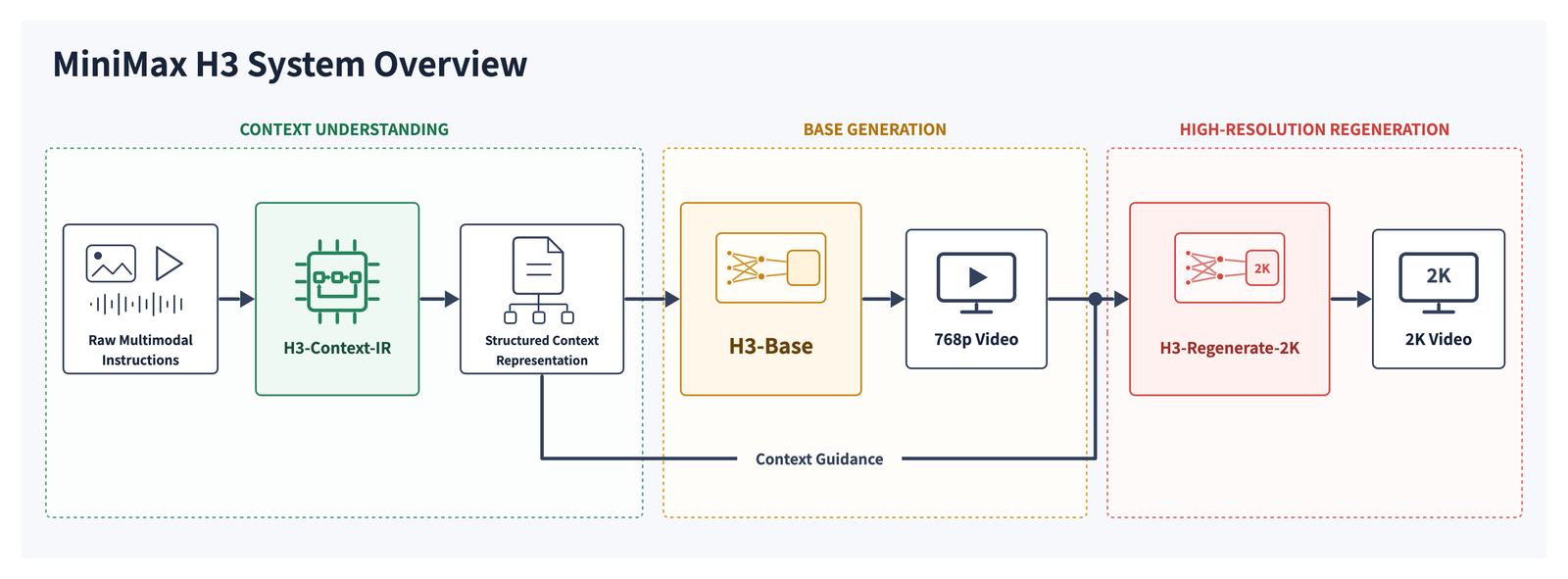
That figure matters for the licensing question too: even inside the "open" release, two of the three modules the diagram shows aren't open at all. H3-Context-IR — which the README calls "critical to the quality of the final output" — and H3-Regenerate-2K, the 2K upsampling stage, are both hosted services you call MiniMax's API for. What's actually downloadable is the middle box, in two task-specific checkpoints (text/first-last-frame→video and reference→video), both CFG-distilled BF16. Native sparse attention, used in the final training stage, is withheld from this release as well.
The benchmark that isn't there
I looked for a number to weigh the license against and didn't find one. There is no VBench score, no Elo comparison, no named baseline model anywhere in the blog post or the Hugging Face card. The one performance claim in the entire release is pricing, and even that has no dollar figure attached: "At 2K, H3's per-second price is less than a third of mainstream models, and at 768p, it's less than half the price of mainstream models' 720p." Less than a third of what? Which mainstream models? The post doesn't say.
The take
Put the two things next to each other: a model you may be legally barred from using depending on which of four major jurisdictions you're in, released with no numbers that would let you decide whether it's worth working around that restriction if you could. Neither fact is hidden — the license text is public and precise, and the absence of benchmarks is just an absence, not a false claim. But "open-source," used as freely as MiniMax uses it in the blog copy, is doing less work here than it usually does. A license with a four-jurisdiction carve-out and a revenue-gated authorization clause is a commercial license with a wide default grant, not a permissive one. Whether that's a reasonable posture for a company shipping an expensive-to-train omni-modal model is a separate question from whether it should be called "open" without the qualifier.
Sources: the MiniMax H3 blog post and Hugging Face model card (MiniMax, July–August 2026), including the license file's Excluded Territories clause. The figure is MiniMax's own system-overview diagram; the territory checker is my own illustration of the license's geographic scope, not a legal opinion.