2026-07-01 · 8 min · transformers · scaling-laws
Why read this
Nichelast 15%The cosine MLP-width taper at fixed params, the early/middle/late control that isolates direction, and modest but consistent gains on four architectures.
- A lasting reference
- A new technique
- Concrete numbers to act on
LLM architectureNeeds datacenter GPUsResearch paper
How this was scored
- Is it new?
- 2 of 3: A real new idea, method or capability
- Can I trust it?
- 0 of 3: Restates claims
- Can I run it?
- 1 of 3: API-only, gated or restrictive licence
- Will I understand it?
- 2 of 3: Mechanism from first principles with figures
- Can I act on it?
- 2 of 3: A concrete recipe, numbers or comparison
- Will it last?
- 2 of 3: A reference for a year or more
- Does it affect many?
- 1 of 3: A specialist community
- Only here?
- 0 of 3: Same as the press release
Score 43 of 100, ranked 520 of 577 rated articles. Each question is answered 0–3 by hand, and a 3 is rare. How articles are scored
Here's an assumption baked into every transformer, recurrent, and memory-based language model since 2017: the layers are identical. Same residual dimension, same attention shape, same MLP width, stacked N deep. It's a default inherited from the original transformer and almost never questioned — parameters are spread uniformly across depth.
Tapered Language Models (TLMs), from Bayat, Behrouz, and Courville, ask what happens if you don't. Their answer is a one-line change with a free-lunch flavor: under a fixed parameter budget, give the early layers more MLP width and the late layers less, on a smooth cosine schedule. Same parameters, same FLOPs — better model.
The default no one questions
Why would non-uniform be better? Because a growing pile of evidence says layers don't contribute equally. The paper points at three findings:
- Early-exit methods show the residual stream often converges to its final prediction well before the last layer.
- Layer-skipping shows later layers can be bypassed at inference with minimal damage.
- Interpretability work finds lower layers capture shallow syntactic patterns while upper layers encode semantics — different jobs, not equal ones.
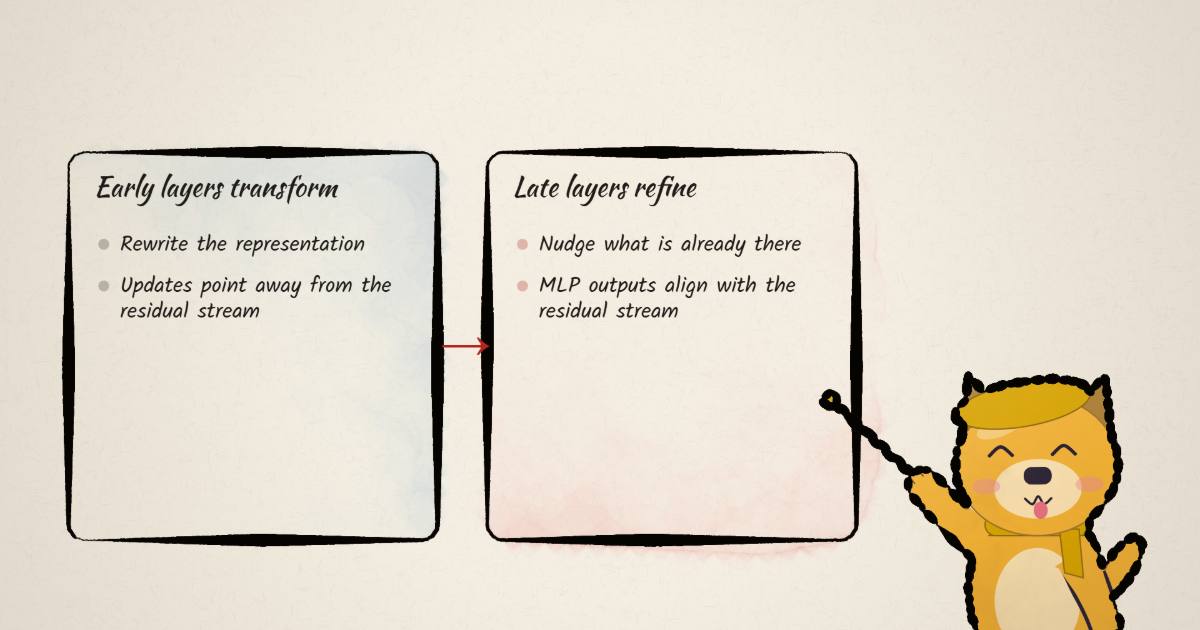
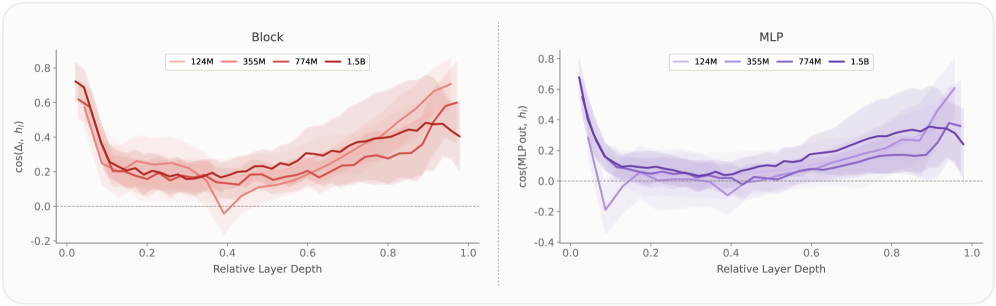
The unifying picture: later layers refine the residual stream rather than transform it. An early layer rewrites the representation; a late layer nudges it. If you measure how much each layer actually changes things, the work is front-loaded:
And if late layers are only refining, giving them the same width as the layers doing real transformation is wasted capacity — capacity you could have spent where it matters.
The taper, precisely
TLMs taper exactly one thing: the MLP intermediate width . Attention — residual dimension, head count, key/value dims — is left identical to the baseline. That's a deliberate choice: MLPs dominate the parameter count in every modern LM family, and width is a single clean axis to vary. The schedule is a cosine over depth:
Layer 0 is widest (), the last layer narrowest (), monotonically decreasing in between. The endpoints are multipliers of the baseline width, and the best config is at the front, at the back — a 3:1 taper. The crucial property: the per-layer widths average to the baseline, so
Early layers get wider than baseline, late layers narrower, and the integral is preserved. Total parameters don't change. Total FLOPs don't change. Tapering only shifts where the compute is spent, not how much. That's what makes it a redistribution rather than a bigger model — and why the comparison to the uniform baseline is honest.
Direction is everything
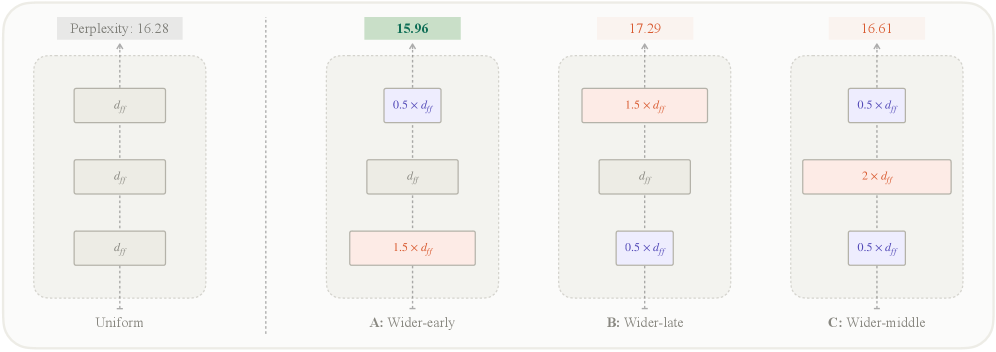
The foundational experiment splits the stack into three blocks and moves the extra capacity around — early, middle, or late — at fixed budget. The result is unambiguous:
Front-loading helps. Centering the capacity is worse than uniform. And back-loading — wider late layers — is the worst option of all, +1.01 perplexity over just doing nothing. This is the control that makes the whole paper: the gain isn't from "more capacity somewhere," it's specifically from putting it where the representational work happens.
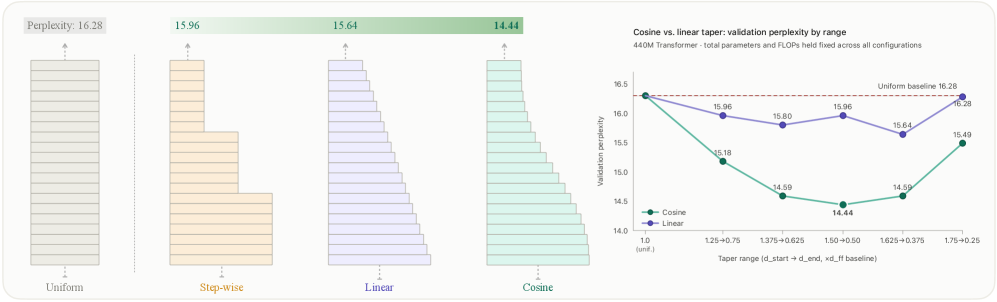
The shape matters too. Sweeping cosine against linear and sigmoid schedules, cosine wins in every setting; sigmoid is often worse than the uniform baseline. And taper strength is U-shaped — too gentle leaves gains on the table, too aggressive (a 7:1 ratio) starves the late layers and regresses. The 1.5→0.5 cosine is the bottom of that U.
How consistently it holds
The tuned config — cosine 1.5→0.5, found once on a 440M Transformer — is then transferred unchanged to three scales (440M/30B tokens, 760M/50B, 1.3B/100B) and four architectures: plain Transformer, Gated Attention, and Behrouz's own HOPE and Titans memory models. It keeps improving almost everywhere. At 760M, the perplexity reduction from the exact same parameter budget:
And it carries through to downstream accuracy — the average over eight commonsense benchmarks (LAMBADA, PIQA, HellaSwag, WinoGrande, ARC-easy/challenge, SIQA, BoolQ) rises for every architecture at 760M:
The full picture, uniform → tapered, is small-but-consistent rather than dramatic:
| scale | architecture | WikiText ppl | LAMBADA ppl | commonsense avg |
|---|---|---|---|---|
| 760M | Transformer | 21.86 → 21.42 | 22.29 → 21.25 | 52.25 → 52.84 |
| 760M | Gated Attention | 20.74 → 19.98 | 21.85 → 21.44 | 52.61 → 52.88 |
| 760M | Titans | 21.58 → 20.77 | 23.09 → 22.92 | 52.30 → 53.29 |
| 1.3B | Transformer | 17.39 → 17.17 | 17.62 → 16.93 | 56.05 → 56.38 |
| 1.3B | Titans | 16.05 → 15.76 | 14.19 → 14.04 | 56.73 → 57.08 |
The honest read: at scale the gains are typically 0.1–1.0 perplexity and a few tenths of a point of accuracy — improving in ~15 of 16 measured cells (the lone regression is 1.3B HOPE's WikiText, off by 0.03). It's not a step change. It's a free, universal nudge in the right direction from a config that was never even tuned at these scales.
Why it works
The mechanism check makes the story tight. Measure the cosine similarity between each MLP's output and the residual stream it writes into, and it rises with depth — later MLPs produce updates increasingly aligned with the residual (Pearson r ≈ 0.49–0.71 vs. layer index). An update aligned with the residual is a refinement; an orthogonal one is a transformation. So late MLPs, writing residual-aligned updates, aren't using their extra width — the hidden dimension is spent nudging in a direction the stream already points. Tapering removes width exactly where that alignment is highest and moves it to the early layers, which write the orthogonal, representation-defining updates that actually need the capacity. The MLP is where the parameters live; this is just allocating them by how hard each layer is working.
The take
I like this paper for the same reason I liked HydraHead: the architectural change is derived from a measurement, not reverse-justified. "Later layers refine, not transform" is an old observation; TLMs turn it into a concrete lever — cosine-taper the MLP width — and then run the control (reverse it, and it hurts) that proves the direction is what's doing the work.
The caveats are real and the authors state them. The gains at scale are modest, the single 1.5→0.5 cosine schedule was tuned only on a 440M Transformer and transferred without re-tuning (so there's likely more on the table), and there's no code release. But the appeal is that it costs nothing — same parameters, same FLOPs, one function applied to the MLP widths. For a default that's gone unquestioned for eight years, "uniform depth was leaving free perplexity on the floor" is a satisfying result, and an easy one to try.
Built on Tapered Language Models (Reza Bayat, Ali Behrouz, Aaron Courville, 2026). Perplexity, accuracy, and ablation figures are quoted from the paper's tables; the residual-alignment correlation is from its Figure 4.