2026-07-01 · 8 min · attention · long-context · interpretability
Why read this
Nichelast 15%Why HydraHead hybridizes per head, not per layer, how causal patching picks the retrieval heads, and which long-context results come only from a figure.
- A lasting reference
- A new technique
- Explained from first principles
LLM architectureNothing to runResearch paper
How this was scored
- Is it new?
- 2 of 3: A real new idea, method or capability
- Can I trust it?
- 1 of 3: Spot-checks a few numbers
- Can I run it?
- 0 of 3: Closed, nothing to run
- Will I understand it?
- 2 of 3: Mechanism from first principles with figures
- Can I act on it?
- 1 of 3: General advice
- Will it last?
- 2 of 3: A reference for a year or more
- Does it affect many?
- 1 of 3: A specialist community
- Only here?
- 1 of 3: Some original analysis
Score 44 of 100, ranked 510 of 577 rated articles. Each question is answered 0–3 by hand, and a 3 is rare. How articles are scored
The attention that made transformers work is also what makes them expensive: every token attends to every other, so cost grows with the square of the context length. That quadratic term is fine at 4K tokens and ruinous at 512K — exactly the regime long-context models are pushing into. Linear attention (LA) fixes the scaling by keeping a fixed-size recurrent state instead of a full attention matrix, so cost grows linearly. But that fixed state is lossy: it can't do exact, long-range token retrieval — the "find the one sentence 400K tokens ago" trick that full attention nails.
So the field mixes them — hybrid attention. Almost everyone does it per layer: interleave whole full-attention (FA) layers with whole linear-attention layers at some fixed ratio (3:1, 7:1), sometimes searched with NAS (as in GLM-5). HydraHead, from Alibaba, argues that the layer is the wrong unit — and backs it with an interpretability result.
The finding: layers are smooth, heads are not
HydraHead's authors probe a pretrained dense model (Qwen3-1.7B) and look at two things:
- Across layers, the outputs vary smoothly — the layer-to-layer output-similarity matrix is one gradual block, with no crisp boundary that says "put full attention here, linear attention there." Layer-wise hybridization is cutting where there's no clean seam.
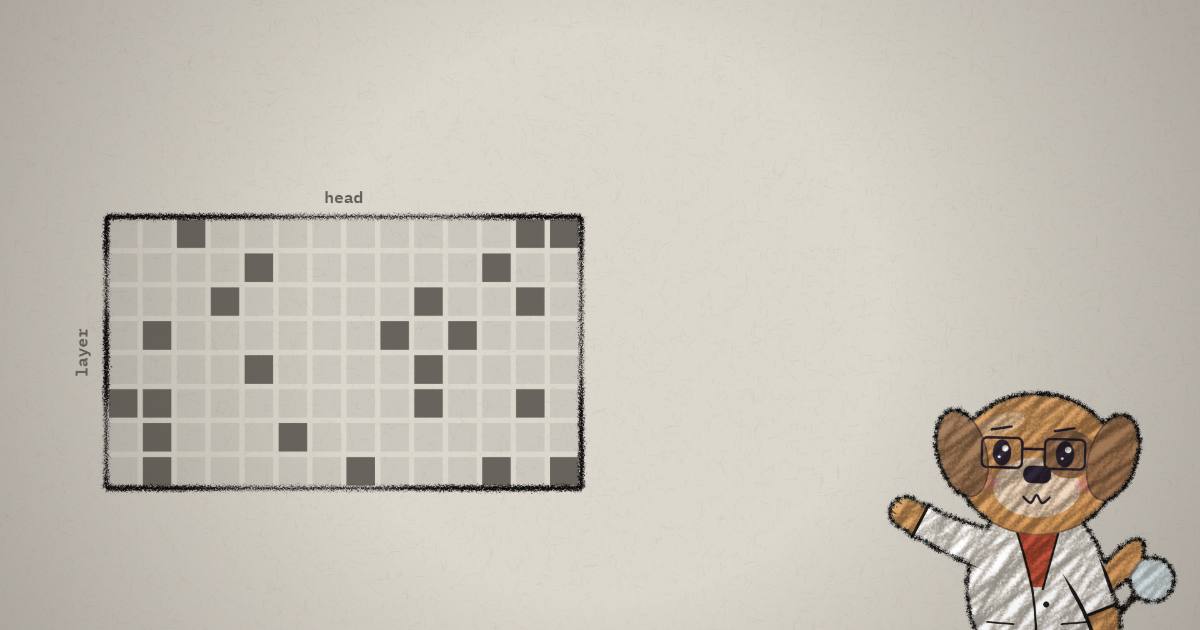
- Within a layer, the heads are sharply heterogeneous. Reading the same input, they do different jobs — and only a few do the long-range retrieval that genuinely needs FA. The per-layer Gini coefficient of head importance averages 0.62: importance is concentrated in a handful of heads. Across all 448 query heads, only about 6.5% are essential for retrieval; ~91% can be swapped to linear attention with negligible loss. And the critical ones are scattered — almost every layer mixes a couple of retrieval heads with a dozen replaceable ones.
You can see the heterogeneity directly — heads in one layer specialize, and only some need to reach far back:
That's the whole argument in one observation. If retrieval capability lives in a sparse, scattered set of heads, then the head — not the layer — is the natural granularity for deciding where to spend full attention.
Picking the retrieval-critical heads
HydraHead keeps FA for about 25% of heads by default and runs the rest as Gated DeltaNet (GDN, the linear-attention variant it builds on). The question is which 25%.
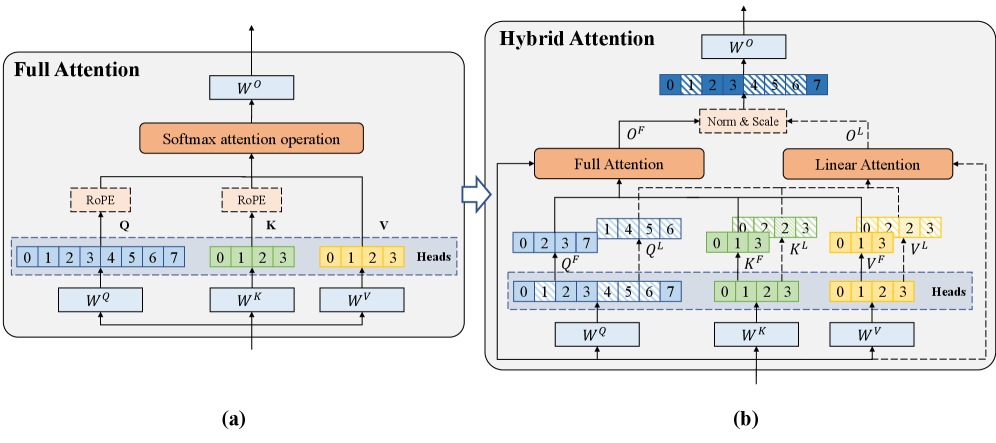
The selection is a causal interpretability procedure, not a guess:
- Build counterfactual pairs from RULER needle-in-a-haystack probes — swap the needle's value for a same-length distractor while holding the rest of the context fixed, so activations stay in-distribution.
- Run activation patching (for heads that receive the retrieved information) and path patching (for heads that send it), scoring each head by how much restoring it recovers the correct-answer logit.
- Fuse the per-capability scores, rank all heads, and keep the top-K as FA.
It's cheap — the ranking stabilizes from roughly six calibration samples — and it's faithful: knock out just the top ~1% of heads by this score and needle-retrieval accuracy collapses, while ablating random heads barely moves it. Crucially, the ablation confirms the selection beats fixed or random head assignment — the interpretability signal is doing real work.
Reconciling two kinds of output
You can't just concatenate FA and GDN heads and project them — their outputs live on different scales. Softmax attention is query-magnitude-modulated: it produces sharp, low-entropy distributions peaked on a few tokens. Linear attention cancels that magnitude out, giving smoother, higher-entropy, more uniform outputs. Splice the two naively and the model degrades badly.
HydraHead's scale-normalized fusion handles it with two moves: an independent per-head RMSNorm on every head's output, then a learnable per-head scalar that re-weights each head before the shared output projection. It's a small module, but it's load-bearing — remove the normalization and RULER's extended-context score drops from 87.5 to 71.4. A learnable scale also beats a learnable gate by ~20 points, so the model keeps every head's contribution and just rescales it, rather than gating heads off.
Building it cheaply
You don't train HydraHead from scratch — you convert a pretrained FA model in a three-stage transfer pipeline that reuses as much as possible:
- Parameter migration + alignment — the FA heads keep their pretrained weights; the new GDN heads reuse the base model's Q/K/V projections (repeated channel-wise to bridge the GQA→multi-head shape gap), so nothing starts from random. A per-layer MSE loss aligns the hybrid's hidden states to the original.
- Logit distillation — unfreeze the whole model and match its output distribution to the original FA teacher with a KL objective.
- Long-context fine-tuning — ordinary next-token prediction at 16K context.
The controlled conversion runs on ~2.3B tokens; the scaled-up model in the paper uses ~15B. Either way it's a rounding error next to pretraining — the capability is inherited, not learned fresh.
The payoff: long context that doesn't collapse
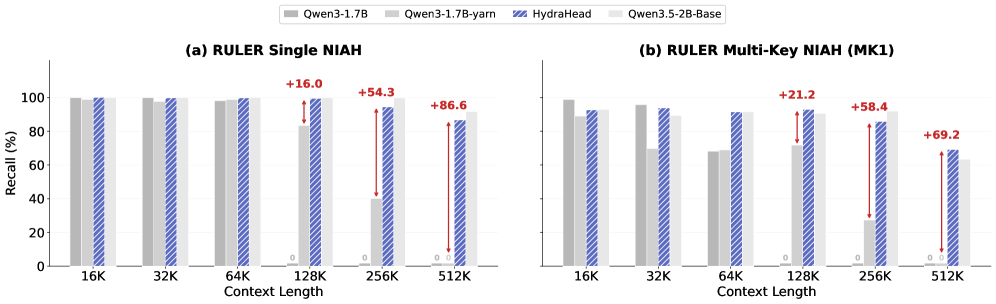
The headline result is retention. On RULER single-needle retrieval, most hybrid models — and the base model itself — fall to near zero by 256K. HydraHead holds:
The harder multi-key retrieval shows the same shape — everything else craters, HydraHead degrades gracefully:
Across the full context sweep the retention gap only widens: HydraHead tracks the baselines up to 64K, then holds as they collapse — reaching +86.6 points on single-needle and +69.2 on multi-key at 512K, closing on Qwen3.5-2B-Base (which ships native 256K support):
And it buys that without wrecking short-context ability — the usual tax on linear-attention conversions. On general reasoning it lands within ~3.4 points of the full-attention base model, and on MMLU it essentially matches it:
The efficiency claim is the one to internalize: at a 7:1 GDN-to-FA head ratio — only one head in eight keeping full attention — HydraHead matches a 3:1 layer-wise hybrid's long-context average, while doing better on hard reasoning. Same quality, far less full attention, which means a smaller KV cache (HydraHead's is ~0.35× a full-attention model's). If you've read the inference write-up, that cache number is the whole game at long context — it's what decides how many requests fit on the GPU.
The take
What I like here is that the architecture change follows from an interpretability result instead of being reverse-justified by one. The claim "retrieval lives in a sparse, scattered set of heads" is measured with causal patching, the ablations show fixed/random selection is worse, and the fix — hybridize per head, keep FA where the retrieval heads are — falls straight out of the measurement. It's a clean example of interpretability paying rent.
Two honest caveats. The flashiest numbers — "69% improvement at 512K" and "approaching Qwen3.5" — come only from a figure, with no supporting table; the tabulated results stop at 256K, so treat the 512K story as directional. And this is all at the 1.7B scale on retrieval-style benchmarks; whether head-level hybridization holds its edge at 30B+ and on messier long-context reasoning is the open question. But the core idea — that the head is the right unit for spending your quadratic-attention budget — is the kind of insight that tends to generalize.
Built on HydraHead: From Head-Level Functional Heterogeneity to Specialized Attention Hybridization (Tan, Chen, Shen, Liu, Shen, Wu, Ye; Alibaba Group, 2026). Benchmark figures are quoted from the paper's tables; the 512K and Qwen3.5 comparisons are from its Figure 1.