2026-09-20 · 18 min · image-generation · diffusion · qwen · open-weights · inference-optimization · benchmarks · explainer
Two months ago Qwen shipped Qwen-Image-3.0 as an API and published no architecture, no parameter count and no benchmark table — a capabilities announcement, which is what the piece on it here had to work with. On 20 September 2026 they shipped Qwen-Image-2.1: a lower version number, released after 3.0, with the weights attached.
So this time there are files to read, and I read them rather than the blog. Every number
below comes from
Qwen/Qwen-Image-2.1 and its ModelScope
mirror — config.json per component, the safetensors indexes, the tensor headers pulled
over HTTP range reads, and the LICENSE file. They do not all say what the announcement
says, and the gaps are worth knowing before you plan around this model.
- task
- text-to-image
- library
- diffusers
- license
- other
- safetensors
- 7 shards
- largest file
- 9.97 GB
- files
- 27
- downloads
- 183
- likes
- 484
Measured from the safetensors headers: the denoiser is 7,115,124,736 parameters in 297 tensors, all BF16, with no bias tensors anywhere — the claim holds exactly. The pipeline around it does not: 8,767,123,696 in the Qwen3-VL text encoder, 337,740,404 in the FP32 autoencoder, and a further 9,409,813,744 if you use the prompt rewriter the README recommends. The LICENSE is the Qwen Research License Agreement, non-commercial, dated 20 September 2026 — not Apache-2.0, which every previous open Qwen image model carried.
repo last modified 2026-09-20
The denoiser stops being an MMDiT
Qwen-Image 1.0 and its December refresh were both QwenImageTransformer2DModel: 60 joint
blocks, 24 heads of 128 (3,072 wide), a separate text stream with its own modulation and
its own MLP, and a text encoder whose states arrived at joint_attention_dim: 3584. That
is an MMDiT, in the MM-DiT-from-SD3 sense, and it weighed 20,430,401,088 parameters.
2.1 is QwenImage21Transformer2DModel, and the tensor names give it away before the config
does. There is no txt_mlp, no add_q_proj, no to_add_out — no second stream at all.
Text is projected once by txt_in into the same 4,096-wide space, condition-image latents
are substituted into the sequence at the slots the vision-language encoder reserved for
them, the target image's tokens are appended, and one stack of 32 blocks runs over the lot.
| Qwen-Image 1.0 / 2512 | Qwen-Image-2.1 | |
|---|---|---|
| denoiser class | QwenImageTransformer2DModel | QwenImage21Transformer2DModel |
| blocks | 60, dual-stream | 32, single-stream |
| width | 24 x 128 = 3,072 | 32 x 128 = 4,096 |
mlp_ratio | 4 (implicit) | 3 |
| modulation | per block | one shared projection |
patch_size | 2 | 1 |
| denoiser params | 20,430,401,088 | 7,115,124,736 |
| text encoder | Qwen2.5-VL-7B | Qwen3-VL-8B |
| VAE | z_dim 16, 8x spatial, RGB | z_dim 64, 16x spatial, RGBA |
| licence | Apache-2.0 | Qwen Research (non-commercial) |
Two of those rows do most of the shrinking, and neither touches depth or width.
mlp_ratio: 3 is unusual — nearly every transformer since 2017 uses 4 — and the modulation
is a single top-level Linear(4096 → 16384) that every block slices its scales and gates
out of, rather than 32 copies of it. The diffusers port says so in as many words: "blocks
hold no modulation parameters of their own." There are no bias tensors, and the final
AdaLN emits scale only, no shift.
- img_mlp x32 — 4,831,838,208 params. SwiGLU, 4,096 <-> 12,288, three matrices per block
- attn x32 — 2,147,483,648 params. q/k/v/o, one shared stream over text + images
- modulation — 67,108,864 params. one Linear(4,096 -> 16,384) for every block: scale and gate, twice, no shift
- txt_in — 33,558,528 params. RMSNorm + GELU MLP lifting Qwen3-VL's 4,096-wide states into the stream
- norm_out + time_embed — 34,603,008 params. scale-only final AdaLN, sinusoidal timestep projection
- img_in + proj_out + norms — 532,480 params. 64-channel latents in and out, per-block q/k norms
the same 32 x 4,096 stack, built the ordinary way
- as shipped
- 7.12B
- + modulation per block, not shared
- +2.08B
- + mlp_ratio 4, not 3
- +1.61B
- would weigh
- 10.81B
Two config lines — mlp_ratio: 3 and a single shared modulation projection — take 3.69B off the denoiser, which is 34.2% of what the conventional arrangement would have cost. Depth and width are unchanged.
what the “7B” sits inside
25,629,802,580 parameters end to end on the path the README recommends. The denoiser everybody quotes is 27.8% of it. Drop the optional prompt rewriter and the pipeline you still have to download is 16.22B.
The 7B claim is exact. The framing around it is the part to watch: the README's "just 7B
parameters in its visual generation component" is true of the component and not of the
thing you download, which is 33.1 GB of BF16 and FP32 weights before you add the rewriter.
Some of that is dead: the Qwen3-VL text encoder ships its 622,329,856-parameter lm_head,
tie_word_embeddings is false, and the pipeline never generates a token. vLLM-Omni's
recipe notes the same thing from the other direction — it excludes "its vision tower and
unused lm_head" when quantising.
Block-causal attention, and why the cache is exact
The interesting engineering is in how the sequence is masked. The release calls it "mixed-granularity attention"; the implementation is one line:
# diffusers/models/transformers/transformer_qwenimage21.py
allowed = ((q_idx >= kv_idx) | same_image_block) & key_valid[batch_idx, kv_idx]
The joint sequence is causal, the way a language model is causal — except that every image block, each reference image and the target, is internally bidirectional. Text tokens get token-level granularity; image tokens get chunk-level. The release's own figure is the mask itself, which is the right way to draw it:
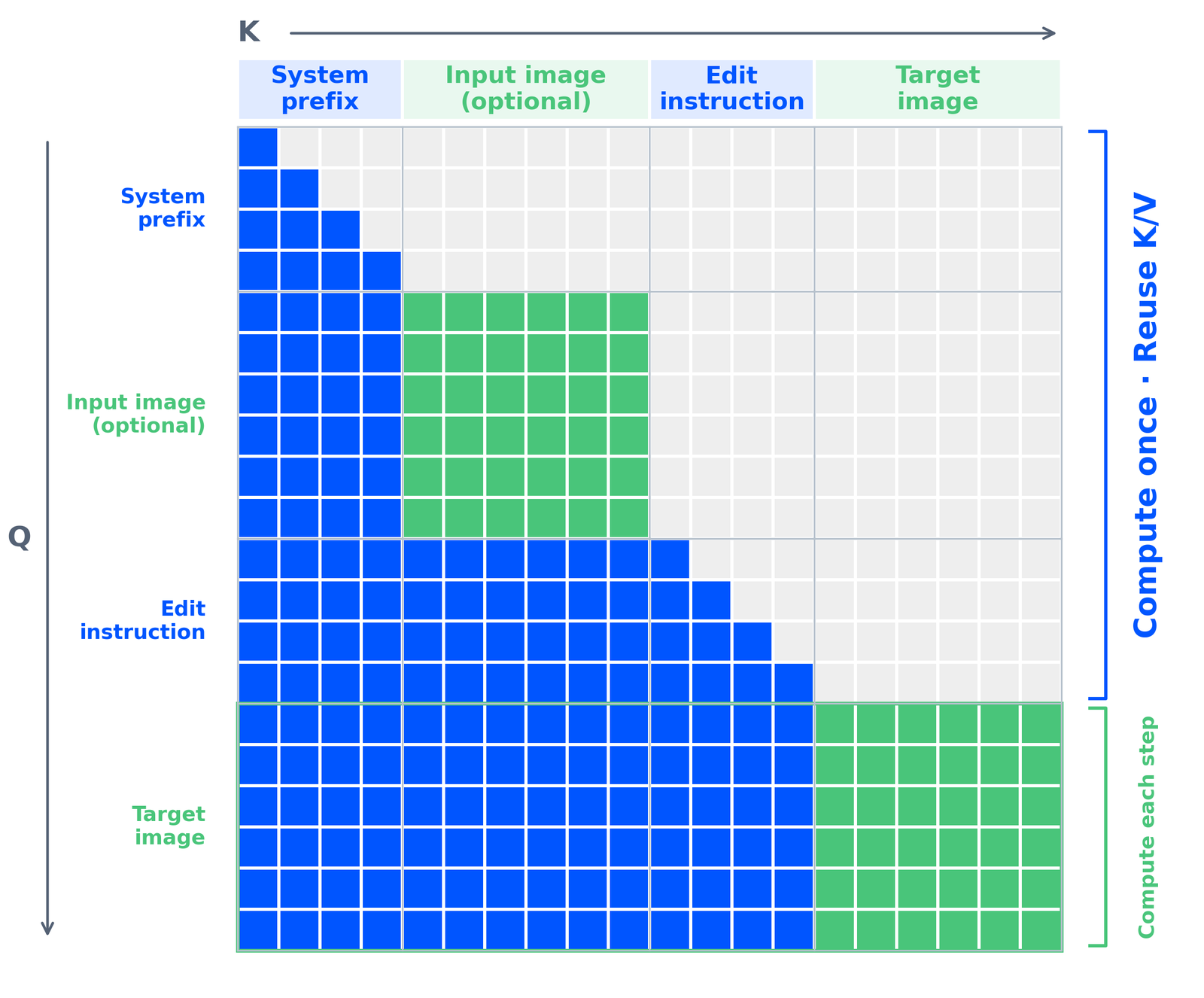
Causality alone would not buy anything during sampling, because a diffusion step changes
every token's activations. What makes the prefix reusable is a second switch,
causal_condition: true, and it is the detail worth carrying away from this release. Text
and condition-image tokens are modulated from t = 0 instead of from the sampled timestep
— the code builds a modulation tensor with batch_size + 1 rows and routes the prefix to
the extra one. Their activations therefore do not depend on the step, so their K and V do
not either, and caching them is exact rather than approximate. The library refuses to let
you get this wrong:
kv_cache requires `causal_condition=True`. The cache is only valid because text and
condition-image tokens modulate from t=0, which makes their activations independent of
the denoising step.
Whether that is worth anything depends entirely on how much prefix there is, and the
arithmetic is simple enough to do exactly. patch_size is 1 and the VAE compresses 16x, so
an image is exactly (H/16) × (W/16) tokens: a 1024px reference costs 4,096 of them, a
2048px target costs 16,384.
the joint sequence — 20,736 tokens
- prompt 1.2%
- 4 references 79.0%
- target image 19.8%
Steps 2 through 40 recompute 19.8% of the sequence. The other 80.2% is K and V that cannot change, because text and condition-image tokens modulate from t = 0 rather than from the sampled timestep.
At four references and a 1024px target that puts 19.8% of the sequence in the recomputed part, against the "about a fifth" the vLLM-Omni recipe reports for the same configuration — which is the cross-check I wanted, because it means the model matches the serving stack's behaviour rather than my reading of the code. Drag the references to zero and the saving collapses to nothing, which is also what the recipe says: "plain short-prompt text-to-image has almost nothing to cache." This is an editing optimisation that a text-to-image benchmark cannot see.
The alpha channel is real; the published evidence is 684 pixels wide
The feature that actually distinguishes this checkpoint is in vae/config.json, one line
from the top: in_channels: 4, out_channels: 4. The autoencoder takes and returns RGBA.
z_dim is 64, scale_factor_spatial is 16, decoder_base_dim is 144 against a
base_dim of 96 — so the decoder carries 259,044,052 of the VAE's 337,740,404 parameters
and the encoder only 78,675,680, a 3.3:1 split. It is stored in FP32, alone among the three
components, which is why 337M parameters occupy 1.35 GB.
This folds in the December 2025 Qwen-Image-Layered model as a capability of the base
checkpoint rather than a separate download, and the prompt format is a blunt instrument:
you ask for it in English, in the prompt, with a sentence the model card spells out —
This is an RGBA image with transparency. … The image has alpha channel and the background is transparent.

I measured that file's alpha channel rather than taking the claim. All 256 levels are present, so it is not a one-bit matte — but the histogram is sharply bimodal: 53.1% of pixels fully transparent, 23.5% fully opaque, 22.6% within 31 levels of one of those two extremes, and 0.8% of the image anywhere between alpha 32 and 223. That is a clean cutout with an anti-aliased fringe, not translucency. It is also a 684 x 685 web asset, well under the 2048px the card gives as the default generation size, and downsampling manufactures fringe alpha on its own — so even the fringe is not safely attributable to the model. The release publishes no native-resolution RGBA sample, which means the one claim you most want to check from the artifacts is the one you cannot.
The licence is the news
Every open Qwen image model before this one is Apache-2.0. I checked all of them on the Hub:
| Repo | Released | Licence |
|---|---|---|
Qwen/Qwen-Image | Aug 2025 | Apache-2.0 |
Qwen/Qwen-Image-Edit | Aug 2025 | Apache-2.0 |
Qwen/Qwen-Image-Edit-2509 | Sep 2025 | Apache-2.0 |
Qwen/Qwen-Image-Edit-2511 | Dec 2025 | Apache-2.0 |
Qwen/Qwen-Image-Layered | Dec 2025 | Apache-2.0 |
Qwen/Qwen-Image-2512 | Dec 2025 | Apache-2.0 |
Qwen/Qwen-Image-Bench | May 2026 | Apache-2.0 |
Qwen/Qwen-Image-2.1 | Sep 2026 | Qwen Research License |
The LICENSE file is dated 20 September 2026 and says what it says:
You are granted a non-exclusive, worldwide, non-transferable and royalty-free limited license … to use, reproduce, distribute, copy, create derivative works of, and make modifications to the Materials FOR NON-COMMERCIAL PURPOSES ONLY.
with "Non-Commercial" defined in clause 1(i) as "for research or evaluation purposes
only", and commercial use routed to an email address. Both prompt-rewriting checkpoints
carry the same terms. So does the VAE — there is no separate licence for it, which matters
because autoencoders get lifted out of releases and reused more often than denoisers do,
and this is the first 16x RGBA one worth lifting.
This is not a use-restriction licence in the RAIL sense; there is no acceptable-use annex and no list of forbidden applications. It is a plain commercial restriction, with Chinese governing law and exclusive jurisdiction in the Hangzhou courts. "Open-source" is the word the blog, the README and the model card all use. The OSI definition has said no field-of-endeavour restrictions since 1998, and this is one.
The downstream is already inconsistent about it, within hours of release. Of the two FlagOS
repackages that Qwen's own README links,
FlagRelease/Qwen-Image-2.1-BF16-zhenwu-FlagOS
is labelled apache-2.0 on ModelScope, which is not a licence that repo is in a position
to grant. Among the community GGUF conversions that appeared the same day, two carry
qwen-research and one carries no licence field at all. None of that is Qwen's doing, and
all of it is the predictable consequence of shipping a research licence into a family
people have spent a year treating as Apache.
What the one published eval measures
There is no technical report. arXiv has no Qwen-Image-2.1 paper; the most recent Qwen image
paper is the benchmark's, from May. The GitHub repo is a README, a LICENSE, and a
prompt_rewrite/ directory — no inference code of its own, no training code, no evaluation
harness. The entire quantitative record of this release is one chart.
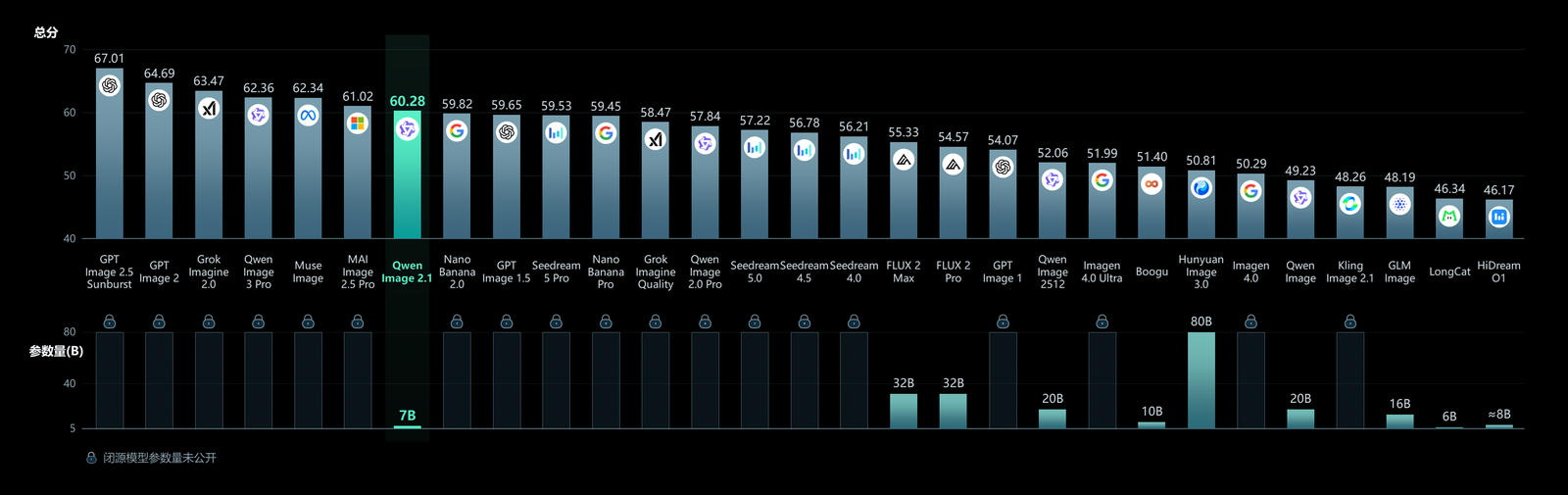
Name the denominators, because the chart does not.
Qwen-Image-Bench is 1,000
expert-written bilingual prompts, scored across a three-level rubric — 5 pillars, 23
sub-capabilities, 56 verifiable facets. Each facet is judged Fail, Pass or Excel, mapped
to 0, 60 and 100, N/A excluded, and averaged up the tree. The judge is Q-Judger, a
Qwen3.6-27B fine-tune trained on 130,000+ annotated pairs from 80 art-academy annotators,
run at temperature 0, seed 42, thinking on.
So: Qwen's model, on Qwen's prompts, scored by Qwen's judge, against competitors Qwen ran itself. That is not disqualifying — the benchmark, the judge and the dataset are all published under Apache-2.0, which is more than most vendors do, and you can rerun it. It is also not third-party, and the chart does not say so.
Three things the chart leaves out that its own sources state:
- The leaderboard it reuses is the Chinese-prompt run. Eighteen of the 29 bars match the benchmark's published leaderboard to the hundredth, and that leaderboard carries a footnote: "results are computed based on Q-Judger's evaluation of images generated from Chinese prompts. We will release the results for image generation from English prompts soon." The chart inherits the denominator and does not mention it.
- The human-agreement figure is a model-level rank correlation. Spearman is impressive and it is computed over models, not over images. It says the judge orders a field the way experts do. It does not say the judge is right about any particular picture, and it says nothing at all about whether a 0.46-point gap between two adjacent bars is a real difference.
- It is a text-to-image benchmark. Transparency, ten-reference composition, circle- and mask-guided local editing, identity preservation — everything this release actually added — is measured by none of it. The chart scores the one capability 2.1 did not change.
The rubric is worth putting the totals back onto, because 60 is not an arbitrary number on that scale. It is the score of a model that passes every facet and excels at none.
A row marked * cannot reach its total at the chosen fail rate, so it is drawn at the lowest fail rate that works — 23.0% for HiDream O1, 18.0% for Qwen-Image 1.0. Qwen-Image-2.1 is the lowest bar on the chart with no such floor: 60.28 is the first total that a model could reach without the judge ever writing Fail.
That gives the chart a reading it does not advertise. Qwen-Image-2.1 at 60.28 is the
lowest bar on it that could, in principle, have zero Fails — everything below is carrying a
floor on how often the judge said the image failed outright, up to 23.1% for the last bar.
Against its own line the improvement is real and large: 49.23 for Qwen-Image 1.0, 52.06 for
2512, 60.28 here, at roughly a third of 1.0's denoiser size. Against the field it is
seventh of 29, below Qwen's own Qwen Image 3 Pro at 62.36, and the six models above it are
all closed.
What it costs to run, from someone other than the vendor
The release makes an efficiency argument — "compact", "lightweight", "low computational cost" — and publishes no latency, no throughput and no memory figure to support it. The only measured numbers I found are third-party, in the vLLM-Omni recipe, taken on one NVIDIA GB300 at 1024 x 1024 and 40 steps:
| Config | Peak memory | Time per image |
|---|---|---|
| BF16 | 34.0 GB | 3,282-4,492 ms |
DiT FP8, img_mlp kept BF16 | 32.0-32.7 GB | 3,356-4,706 ms |
| Text-encoder FP8 | 27.5-28.1 GB | 3,427-4,770 ms |
Two things follow. 34 GB peak means a "7B" model does not fit a 24 GB card without offloading — the pipeline is 33.1 GB of weights before activations, of which the denoiser is 14.2 GB. And FP8 on Blackwell buys memory, not speed: none of the quantised rows is faster, which is what you expect when the bottleneck is bandwidth rather than tensor cores. Qwen ships no quantised export of its own; every FP8, W8A8 and GGUF build is a partner's or the community's.
What is missing
Shortest useful list, all verified by absence:
- No technical report. No arXiv preprint, no PDF, no architecture section beyond eight bullet points in a README.
- No training data disclosure. Nothing about corpus, scale, filtering, or the licensing of what it learned from. The flagship multi-reference demo is a generated group photograph assembled from six publicity portraits of identifiable real people, and the release has nothing to say about that either.
- No eval for anything new. The benchmark covers text-to-image; the transparency, editing and reference-composition claims are supported by curated examples only. No GEdit, no ImgEdit, no alpha-matting metric, no identity-similarity number.
- No first-party quantisation. BF16 shards only, plus an FP32 VAE.
- No inference code in the repo. The GitHub repository ships the prompt rewriter and nothing else; the model runs through third-party libraries from day one, which is a reasonable choice and worth knowing before you file an issue.
- No limitations, bias or intended-use section in the model card. Not one line.
- No separate licence for the VAE.
The take
Qwen-Image-2.1 is a good piece of engineering and a worse release than the six that
preceded it. The architecture work is genuine and legible from the files: a single-stream
DiT at a third of the previous denoiser's size, a shared modulation projection and
mlp_ratio: 3 that together account for 3.69B of the parameters it does not have, a 16x
RGBA autoencoder that makes transparency a property of the latent space instead of a second
model, and a block-causal mask whose prefix cache is exact because someone thought to
modulate the condition from t = 0. That last one is the idea I would steal.
What surrounds it is thinner than the version number suggests. One aggregate score on the vendor's own benchmark, on the vendor's own judge, on the Chinese-prompt run, measuring the capability that did not change. No report, no data, no numbers for the new features, no first-party quantisation. And a licence that moves a year-old Apache-2.0 family to non-commercial research terms while the announcement keeps saying "open-source" — which is the one change here that decides whether you can use it at all, and the only one the blog post does not mention.
What would change my mind
5 claims above, and what would falsify each
The denoiser is exactly 7,115,124,736 parameters and contains no second text stream.
Sum the shapes in
transformer/diffusion_pytorch_model.safetensors.index.jsonand the two shard headers. Atxt_mlp,add_q_projorto_add_outtensor anywhere in those 297 names, or a total that does not reconcile with the index'stotal_sizeof 14,230,249,472 bytes at two bytes per BF16 parameter, falsifies it.The published quantitative comparison is the vendor's benchmark, judged by the vendor's model, on Chinese prompts.
A third-party evaluation of this checkpoint on a harness Qwen did not write, or an English-prompt Qwen-Image-Bench leaderboard that reproduces the chart's ordering, would change how much weight the 60.28 carries. The footnote I am relying on is on the dataset card at
huggingface.co/datasets/Qwen/Qwen-Image-Bench; if it is edited or the English run lands, this section is stale.The prefix KV cache is worth little for plain text-to-image and a lot for multi-reference editing.
The widget computes token shares and MACs from the config; it times nothing. A measured step-time breakdown showing the cached path saving substantially less than the token share predicts — because the win is bandwidth-bound, or because cache reads cost more than the recompute they avoid — would falsify the framing, not the arithmetic.
Qwen-Image-2.1 is the first Qwen image model under a non-commercial licence.
A Qwen image checkpoint on the Hub or ModelScope, dated before 20 September 2026, whose
LICENSEis not Apache-2.0. I checked the eight repos in the table and nothing else.The published RGBA sample is a clean cutout with an anti-aliased fringe, not real translucency.
An alpha histogram from a native-resolution generation — not the 684px web asset — with meaningful mass between alpha 32 and 223. My measurement is on a downscaled published file, and resampling alone can account for the fringe I found; a glass or smoke prompt at 2048px would settle it in either direction.
Sources, all read directly: the Hugging Face repo
(model_index.json, transformer/config.json, text_encoder/config.json,
vae/config.json, scheduler/scheduler_config.json, both safetensors indexes, the tensor
headers by range read, and LICENSE); the
ModelScope mirror, whose card is
byte-identical to the Hub's; the GitHub repo;
the release blog; the diffusers implementation of
QwenImage21Transformer2DModel and AutoencoderKLQwenImage21; the
Qwen-Image-Bench dataset and
Q-Judger model cards, and their paper
(arXiv:2605.28091); and the third-party
vLLM-Omni recipe for the only measured
latency and memory figures in this piece. Figures are the release's own, served locally and
flattened; the checkerboard behind the RGBA sample is mine.