2026-07-04 · 8 min · diffusion · image-generation · inference · flow-matching
Why read this
Nichelast 15%Explains MrFlow's low-res steps, pixel-space SR and one refine step, and separates the 4-9x training-free speedups from the 25x that needs distillation.
- A new technique
- Explained from first principles
Image & video generationRuns on a consumer GPUPractitioner paper
How this was scored
- Is it new?
- 2 of 3: A real new idea, method or capability
- Can I trust it?
- 1 of 3: Spot-checks a few numbers
- Can I run it?
- 1 of 3: API-only, gated or restrictive licence
- Will I understand it?
- 2 of 3: Mechanism from first principles with figures
- Can I act on it?
- 1 of 3: General advice
- Will it last?
- 1 of 3: Relevant for months
- Does it affect many?
- 1 of 3: A specialist community
- Only here?
- 1 of 3: Some original analysis
Score 45 of 100, ranked 502 of 577 rated articles. Each question is answered 0–3 by hand, and a 3 is rare. How articles are scored
A modern text-to-image model — a flow-matching or diffusion network like FLUX or Qwen-Image — makes a picture by running a stack of denoising steps. The expensive fact about that stack is where the compute lands: every step runs at the output resolution. A 20-step sample at 1024² pays the full-resolution price twenty times over, and most of those steps are spent on detail the early ones can't even see yet. That's the cost MrFlow goes after — and it does so without any fine-tuning, purely by rearranging when the model works at full size.
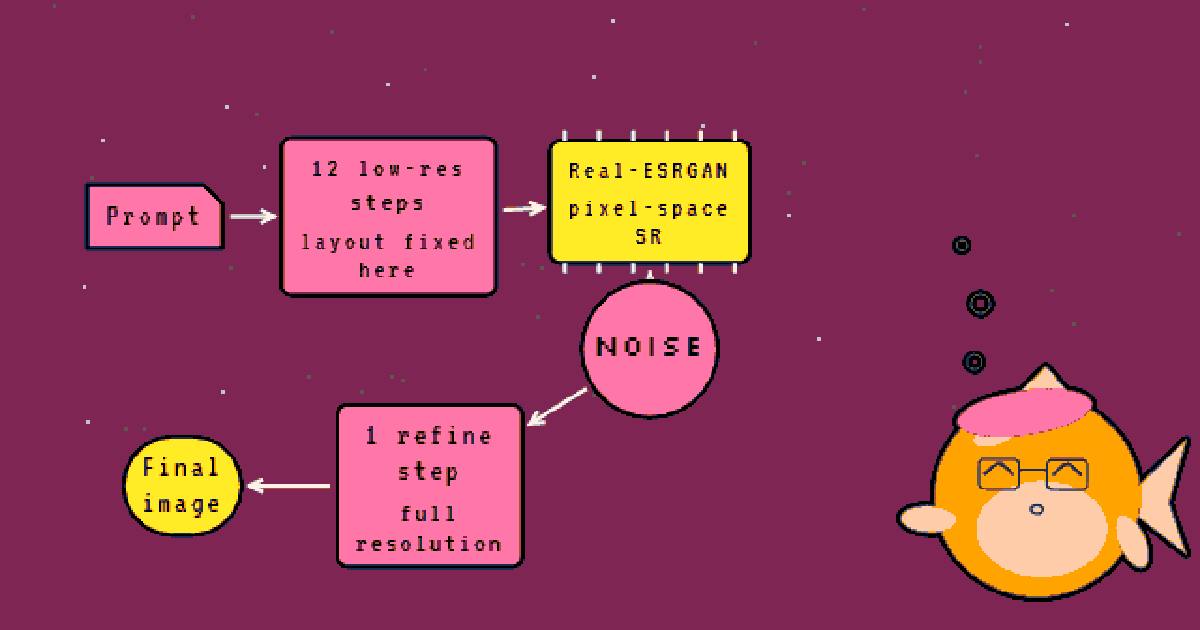
The idea is a budget reshuffle. Structure is decided early and is cheap to compute at small sizes; sharp high-frequency detail is what full resolution actually buys you. So MrFlow spends the pricey diffusion steps at low resolution, does the climb to full resolution in pixel space with an off-the-shelf super-resolution network, and then spends just one diffusion step at high resolution to clean up. Walk the four stages:
The pipeline, precisely
MrFlow is four stages, and only the outer two touch the full-resolution latent:
- Low-resolution generate. Run the flow/diffusion model for ~12 of its 20 steps at a low resolution (e.g. 512²). Steps are cheap at this size, and this is where composition and layout are fixed. Decode to a low-resolution image.
- Pixel-space super-resolution. Upsample that image to full resolution with a pixel-space SR network — Real-ESRGAN — in a single forward pass. This is the resolution jump, and crucially it is not more latent diffusion steps.
- Low-strength noise re-injection. Encode the upscaled image back to latent and add a small amount
of noise,
σ_t ∈ [0.1, 0.15], computed closed-form from the flow schedule. No extra network, no training — just enough noise to give the model something to denoise. - One HR refine step. A single high-resolution diffusion step blends the upscaled detail back into the model's own distribution and cleans up the SR network's artifacts.
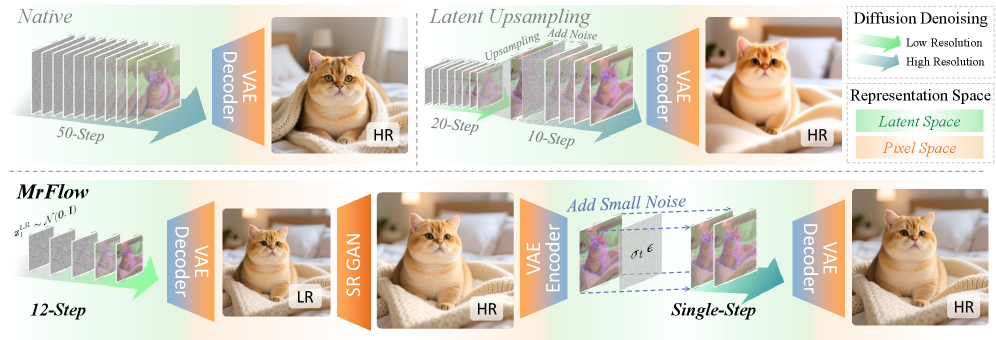
The contrast with the usual "latent upsampling" trick (middle row of the figure) is the whole point. Those schemes also start small, but they climb by running more latent diffusion steps at the higher resolution — you pay full-resolution diffusion twice. MrFlow does the climb with a cheap pixel-space network and buys back fidelity with a single diffusion step.
Where the budget actually goes
The reason this is faster isn't subtle: high-resolution diffusion steps are the expensive line item,
and MrFlow runs almost none of them. If you count an HR step as roughly 4× an LR step (2× the linear
resolution is 4× the pixels), a native 20-step HR sample and a MrFlow (12, 1) config are worlds apart
in compute. Drag the config and watch the budget — and the honest quality tradeoff — move:
That schematic is where the config dependence lives, and it's the first honest caveat. The speedup is the reliable part — fewer, cheaper steps is unambiguously less compute. Quality is the part that swings: strip the refine steps and Real-ESRGAN's artifacts survive to the final image; starve the low-resolution stage and the composition never locks in.
Why pixel-space SR instead of more diffusion
The subtle design question is: once you have a low-resolution image, how do you get to full resolution? The latent-upsampling answer is "more diffusion." MrFlow's answer is "a super-resolution network, then one diffusion step to fix it." The paper compares SR backbones — bilinear interpolation, SwinIR, OSEDiff, Real-ESRGAN — with and without the final HR refine step:
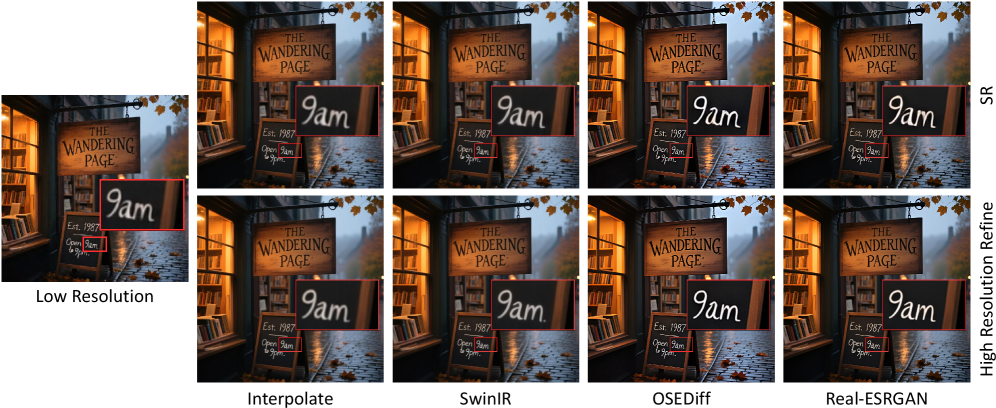
Two things read off that grid. First, the SR network alone is not enough — plain interpolation stays soft, and even a strong SR net can hallucinate wrong detail (look at the "9am" text). Second, the single refine step is doing real work: the bottom row is visibly cleaner than the top. Real-ESRGAN can introduce its own artifacts, and the HR refine step is there precisely to fix them — the two stages are a pair, not alternatives.
The speed–quality frontier
The payoff is best seen as a Pareto plot: quality against speedup, versus the obvious baseline of just running the model with fewer native steps. Toggle the model and walk the refine-step configs:
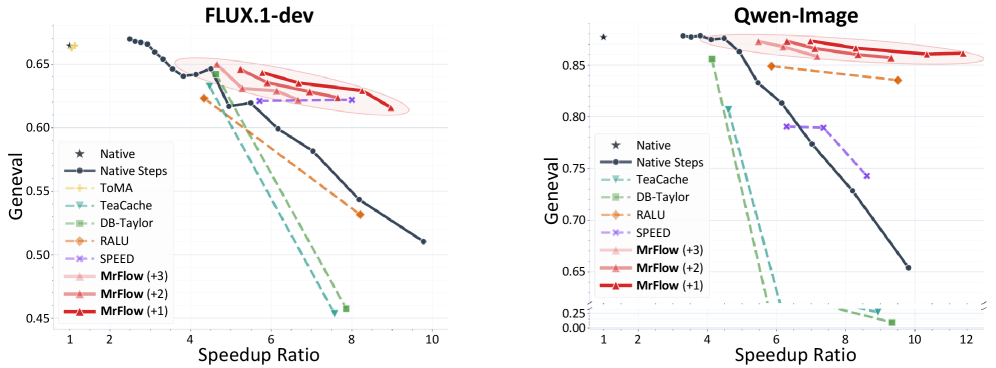
The shape is the honest summary. On the good configs, MrFlow's frontier dominates both "fewer native
steps" and prior accelerators like TeaCache and RALU — you get several× speedup while staying close to
the native star. But the frontier still slopes downward: more speed costs some quality, and the +1
config (fastest) sits measurably below +3. Qwen-Image holds its quality far better than FLUX across
the same speedups, which is exactly the point about model dependence — some base models tolerate the
reshuffle much better than others.
The honest headline
The clean numbers to keep are the training-free ones: roughly 4–9× faster on the frontier configs at near-native quality, no fine-tuning required. The bigger figures you may see quoted come with strings:
A few smaller honesty notes. "Within 1%" is a best case measured on forgiving configs and models; the
same pipeline pushed to (12, 1) on FLUX loses ~18% on OneIG. The compute-unit accounting in the
diagrams above is a schematic (an HR step is roughly 4× an LR step) — the paper's speedups are
measured wall-clock, and they depend on the SR network's own cost, which the unit count glosses over.
And Real-ESRGAN, being a GAN, can invent detail that isn't in the low-resolution image; the refine step
mitigates but doesn't fully erase this.
The take
MrFlow's contribution is a reframing more than a new network: the resolution climb doesn't have to be paid for in diffusion steps. Set against the usual acceleration playbooks — caching redundant computation (TeaCache-style), or simply taking fewer steps — it makes a sharper bet: structure is cheap and settles early; resolution is expensive and can be borrowed from a pixel-space SR net; artifacts are cleanable in one diffusion step. Because every piece is training-free and closed-form, it drops onto an existing checkpoint with no retraining, which is the practical reason to care. The catch is the one every honest acceleration paper carries — the best-case headline is best-case. On a forgiving model at a conservative config it really is near-free; push the config or pick a brittle model and you pay for the speed in quality. As a way to make an existing image model several times cheaper to sample without touching its weights, though, it's a clean idea, cleanly executed.
For the diffusion background this builds on, see Set Diffusion and, for how denoising models differ from autoregressive ones, the diffusion language model walkthrough.
Built on MrFlow (arXiv 2607.01642), a training-free staged-sampling accelerator for flow and diffusion image models. Benchmark and speedup figures (GenEval, OneIG; FLUX.1-dev and Qwen-Image) are quoted from the paper; the interactive diagrams are illustrations of the mechanism, and the per-stage compute units are a schematic, not measured FLOPs. Speedups are config- and model-dependent; the top-end figures require distillation on top of the training-free pipeline.