2026-07-22 · 4 min · image-generation · diffusion · performance
Why read this
Nichelast 15%A short tour of Mage-Flow's cheap tokenizer, bucket-free MMDiT and 4-step Turbo, with the paper's memory and latency numbers.
- Runs on a consumer GPU
Image & video generationMITPractitioner model
How this was scored
- Is it new?
- 1 of 3: An incremental tweak
- Can I trust it?
- 0 of 3: Restates claims
- Can I run it?
- 2 of 3: Open code or weights with real limits
- Will I understand it?
- 1 of 3: Partial mechanism
- Can I act on it?
- 1 of 3: General advice
- Will it last?
- 1 of 3: Relevant for months
- Does it affect many?
- 1 of 3: A specialist community
- Only here?
- 0 of 3: Same as the press release
Score 29 of 100, ranked 564 of 577 rated articles. Each question is answered 0–3 by hand, and a 3 is rare. How articles are scored
The open image-generation frontier has been scaling backbones hard: Z-Image at 6B, Qwen-Image at 20B, FLUX.2 at 32B, Hunyuan-Image-3.0 at 80B. Mage-Flow, from Microsoft's Mage team, bets the other direction — a compact 4B stack for text-to-image generation and instruction-based editing that stays competitive with those much larger systems by co-designing its three layers instead of just growing one. It's MIT-licensed and released as an open research baseline.

The organizing idea is "codec-aligned efficiency" — spend representation capacity where the signal is — and it shows up as three co-designed components: a cheap tokenizer, a native-resolution backbone, and a fused-kernel training system.
The tokenizer that pays for everything
The VAE is the quiet tax on high-resolution diffusion: every image is encoded to latents and decoded back, and at 2K that cost dominates. Mage-VAE is a lightweight pixel-diffusion tokenizer distilled from the FLUX.2-VAE latent space, using one-step encode/decode with anchor-latent KL regularization. It matches FLUX.2-VAE's reconstruction fidelity while doing far less work:
Make the tokenizer an order of magnitude cheaper without losing quality, and every downstream stage — training and inference — inherits the saving. That's the lever the rest of the stack is built on.
A backbone that doesn't crop
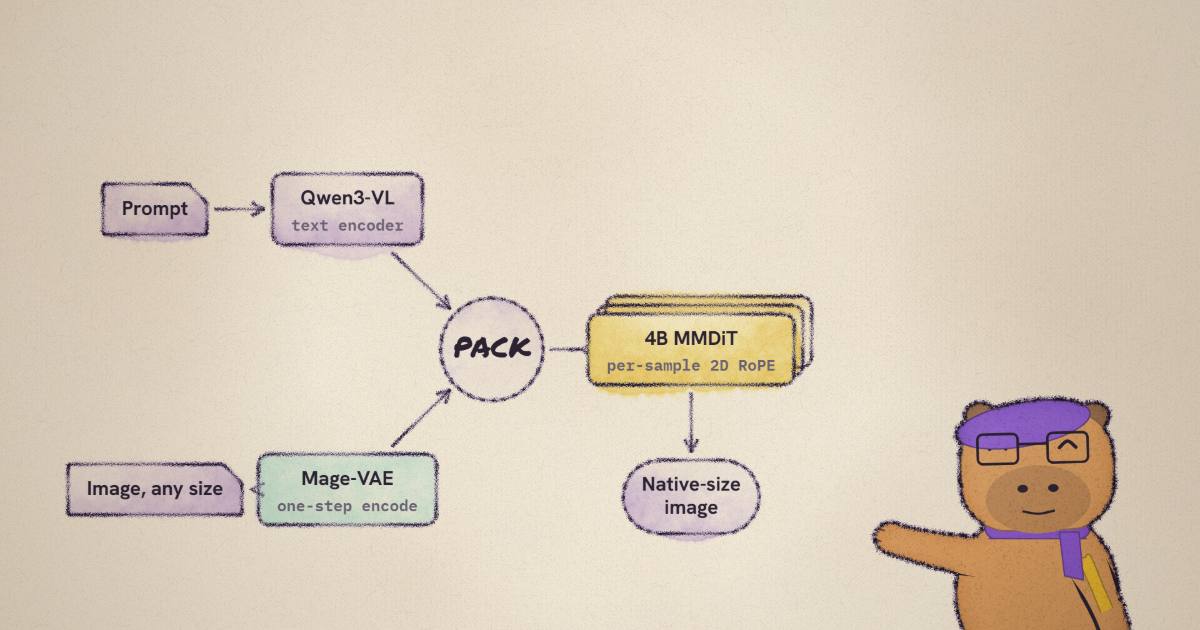
The generator itself is a Native-Resolution Multimodal Diffusion Transformer. Text prompts are encoded by Qwen3-VL; images are turned into compact latents by Mage-VAE; and — the key move — images of any resolution and aspect ratio are flattened into variable-length token sequences and packed together with the text tokens in one batch. Per-sample 2D rotary embeddings and variable-length FlashAttention let the 4B MMDiT process those packed sequences while preserving each image's native spatial layout, so there are no fixed resolution buckets and no center-crops.
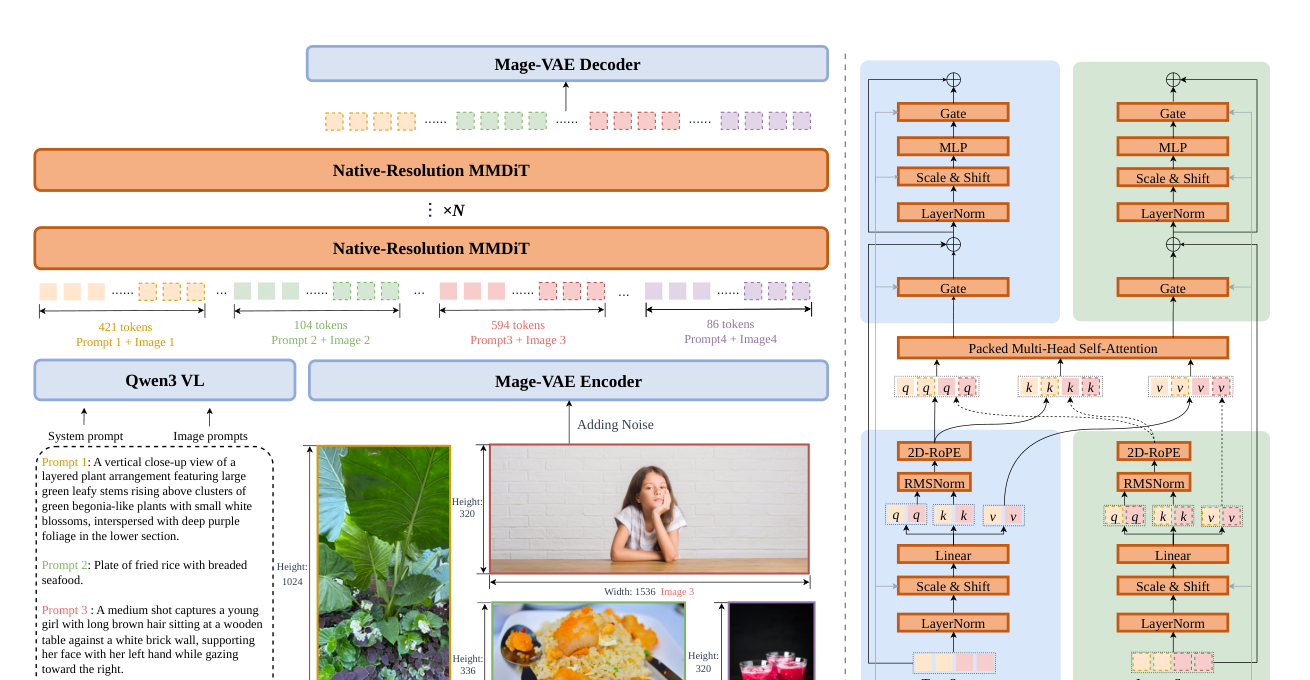
That's what makes one checkpoint span the whole range — 512² up to 2048², any ratio, out to an extreme 4:1 panorama:
One backbone, three rungs
On top of that foundation Mage-Flow ships a family. A Base model trained with rectified flow matching is aligned into the RL model with Diffusion-NFT (better prompt following, text rendering, aesthetics, editing fidelity), then distilled into a 4-step Turbo with Decoupled-DMD and adversarial perceptual guidance. The same pattern produces the editing line. Watch the step count — and the latency — fall:
The Turbo rung is the point: it turns a 30-step diffusion model into a 4-step one, so at 1024² on a single A100, generation drops from 4.37s to 0.59s and editing to 1.02s — interactive speed from a model you can actually fit.
The frontier that matters
Mage-Flow's case isn't that it tops any single benchmark — it's that it sits on a favorable quality–speed–memory frontier. On GenEval (generation) and GEdit-Bench-EN (editing) it's competitive with or ahead of much larger systems, while its peak GPU memory stays the lowest of the field:
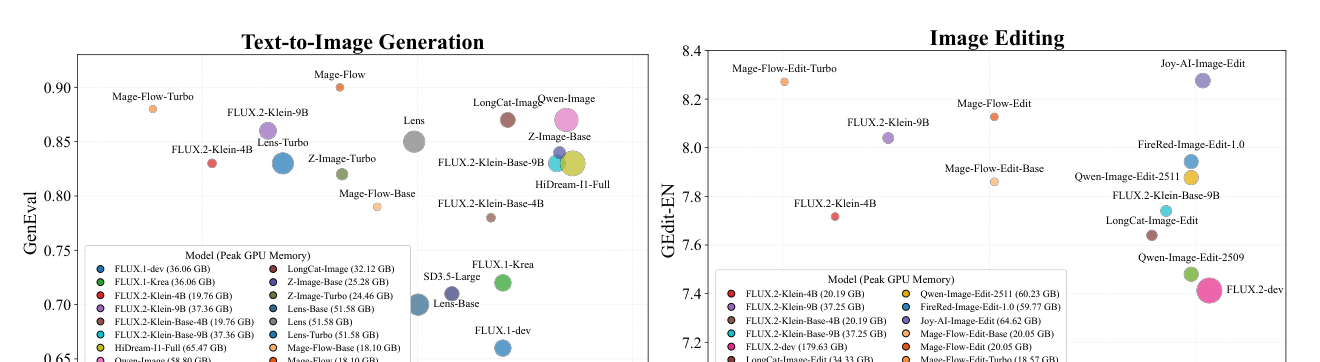
The concrete number is memory: across generation and editing, Mage-Flow's peak GPU memory stays around 18–20 GB — versus 58.8 GB for Qwen-Image, 65.5 GB for HiDream-I1, and a two-GPU 179.6 GB for FLUX.2-dev. ~18 GB is a single desktop-class card, which is the whole pitch: a strong generation-and-editing model that runs locally.
The take
Mage-Flow is a clean argument that image-model efficiency is a co-design problem, not a scale problem. The headline speed (0.59s at 1024²) comes from the tokenizer being cheap, the backbone avoiding resolution buckets, the kernels being fused, and the sampler being distilled — each layer pulling its weight so a 4B model can stand next to 20–80B ones. It pairs naturally with the far larger Qwen-Image-3.0: same task, opposite bet on where the capability should live. Worth the usual caveat — the weights are MIT but released for research use, and the benchmark framing is the authors' own — but the frontier it draws is a genuinely useful one.
Source: Mage-Flow: An Efficient Native-Resolution Foundation Model for Image Generation and Editing (Zhang et al., Microsoft, 2026), the Mage repo, and the model collection. Figures are the paper's; the interactives are mine.