2026-10-06 · 27 min · mixture-of-experts · pretraining · training · scaling-laws
Why read this
Notabletop 60%Walks Marin 535B's mid-run changelog through its issues and code: the MuonH axes bug left in, the shut attention gate, and what the MFU gain really came from.
- Original analysis
- A lasting reference
- Concrete numbers to act on
Training & RLNeeds datacenter GPUsApache-2.0Research model
How this was scored
- Is it new?
- 1 of 3: An incremental tweak
- Can I trust it?
- 2 of 3: Measures key facts from files, code or configs
- Can I run it?
- 1 of 3: API-only, gated or restrictive licence
- Will I understand it?
- 2 of 3: Mechanism from first principles with figures
- Can I act on it?
- 2 of 3: A concrete recipe, numbers or comparison
- Will it last?
- 2 of 3: A reference for a year or more
- Does it affect many?
- 1 of 3: A specialist community
- Only here?
- 2 of 3: A teardown or measurement few others did
Score 59 of 100, ranked 244 of 445 rated articles. Each question is answered 0–3 by hand, and a 3 is rare. How articles are scored
Most model releases show you the end. A loss curve that bends politely, a table of benchmarks, a paragraph about "infrastructure challenges" that tells you nothing. What happens between step 0 and the press release, the bug reports and the half-measures and the nights someone stares at a norm plot, stays inside the lab.
Percy Liang's thread from this morning is the opposite. Marin's 535B-A23B mixture-of-experts run "has crossed the halfway mark", and instead of a teaser he posted the changelog: an optimizer bug scare, an attention norm that went off trend, a mid-run weight decay, kernel work that took MFU from 21% to 27%, a data-mixture swap, and a loss forecast the run is being held to. Every item links to a GitHub issue or a W&B chart.
I went in expecting a summary. What I found was the lab notebook itself. The issues hold ablation
tables, per-head gate statistics, layer-skip experiments, and long exchanges with people outside
the team. Some of the analysis is posted by the team's coding agents; Marin's AGENTS.md
requires agent comments to start with a robot emoji, and a lot of them do. This article walks
through what they changed mid-run and why, checked against the code at commit
8baa0a4.
My view up front: the individual fixes are ordinary. The decisions around them, and especially the
ones where they decided not to change anything, are the part worth studying.
- license
- Apache-2.0
- branch
- main
- tests
- 1065 files
- source
- 43.8 MB
- commit date
- 2026-10-06
by size of tracked source at this commit, file counts in brackets; docs, data and vendored trees excluded
local clone, 2026-10-06 at 0de0367 — branch, commit, commitDate, fileCount, hasTests, languages, license, licenseFile, shallow, testFileCount
shallow clone: counts describe the pinned tree, not the history
What is actually being trained
The model lives in experiments/grug/moe_hero_ep/, and the hero's spec is one dataclass,
HERO_MODEL in heuristic.py. It is a 48-layer transformer at width 6,144 where every layer's MLP
is a mixture of experts: 384 routed experts of width 3,072, eight chosen per token, plus two shared
experts that every token goes through. The routed experts run in a 3,072-wide latent space: each
token is projected down to half width, normalised, sent to its experts, and projected back up after
the weighted combine. The launcher's table counts 535B total and 23B active parameters (the hero
issue gives 535.3B and 22.76B).
Attention has 48 heads of dimension 128, sliding-window (2,048) on three layers out of four and full-causal on every fourth and on the last. Two details from the attention path matter later. Each head's output is multiplied by a learned gate, and nearly every matrix in the model is trained with an optimizer that pins its norm.
The run is 390,251 steps of 11,264 sequences of 4,096 tokens: 46,137,344 tokens a step and 18.0T in total, on 11 GB200 NVL72 racks with 64 GPUs per rack doing the work: 704 GPUs, with the experts split 64 ways inside each rack and the racks running as data-parallel replicas. The team budgeted roughly a hundred days for it.
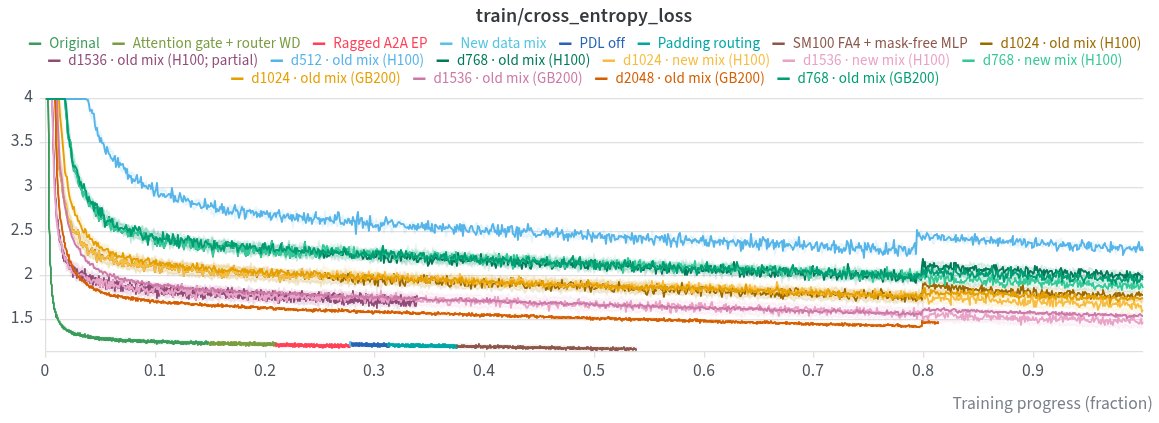
If MoE routing or expert parallelism is new to you, my Mixture of Experts, from scratch builds the router and the dispatch, and Olmo-core 3 covers the parallelism axes a run like this has to pick from. The whole mid-run changelog fits on the run's own step axis; the sections below take the entries one at a time.
- Change:
- Decoupled weight decay 0.02 on attn_gate and the router weight, annealed linearly to 0 by the last step.
- Why:
- Both norms left the ladder's trend about 1% into the run (#8818). Loss was on track; this was insurance.
- Effect:
- The gate norm's growth slowed. Small-scale ablations put the loss effect inside noise.
A sphere for every matrix
Marin trains with MuonH. If you know Muon, the first half is familiar: take the momentum of a matrix's gradient, run five quintic Newton-Schulz iterations so that no singular direction dominates, and use the result as the update direction. The H is for hyperball. Instead of adding the update and letting the weight's norm wander, MuonH moves the weight along the update and then rescales it back onto the sphere it started on. The norm of every MuonH matrix is fixed at initialisation for the whole run.
The step itself is seven lines of experiments/grug/moe_hero_ep/optimizer.py:
# optimizer.py:76-82, the path for 3-D and 4-D stacked parameters
axes = tuple(range(1, param.ndim))
param_norm = jnp.sqrt(jnp.sum(jnp.square(param), axis=axes, keepdims=True))
update_norm = jnp.sqrt(jnp.sum(jnp.square(update), axis=axes, keepdims=True))
new_param = param - learning_rate * update * param_norm / jnp.maximum(update_norm, 1e-10)
new_param = _pin_sharding(new_param, param)  # correct the sharded norm reduction (issue #8073)
new_param_norm = jnp.sqrt(jnp.sum(jnp.square(new_param), axis=axes, keepdims=True))
return new_param / jnp.maximum(new_param_norm, 1e-10) * param_norm - param
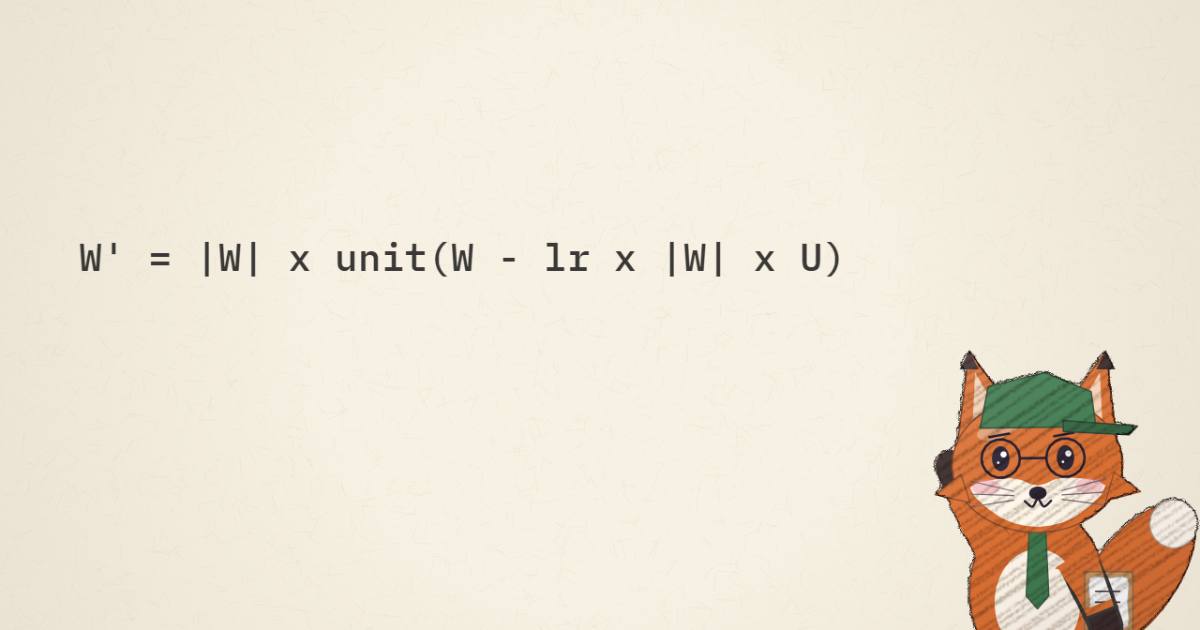
The step size is learning_rate times the weight's own norm, so the learning rate is a fraction of
the weight, and the last line forces the new weight back to the old norm. With norms pinned, the
optimizer cannot grow its way out of trouble, which is the point: weight decay becomes unnecessary
for these matrices, and the hero issue says so directly ("no decoupled weight decay"). The health
check posted on August 20 shows it working. Every MuonH parameter's norm reads the same at
its minimum, maximum and average: 268 for w_q, 2,624 for each expert bank.
Look at axes, though. The layers are stacked for jax.lax.scan, so the routed experts are one 4-D
array, [layers, experts, d_in, d_out], or [48, 384, 3072, 3072]. Axis 0 is the layer, so
range(1, 4) reduces over experts and matrix dimensions. The norm being preserved is the norm of
all 384 experts of a layer together. Newton-Schulz, meanwhile, runs on each expert separately
(_newtonschulz_4d_distributed flattens layers times experts and orthogonalises each 3,072 by
3,072 matrix).
Issue #8621, opened on August 24 in the
run's first week by GitHub user jamt9000, spotted exactly this. Its argument: the code was written
for 3-D [experts, d_in, d_out] shapes, where axes (1, 2) really are one matrix, and when experts
moved into a 4-D stack the same line silently started treating a whole layer as one ball. Each
expert can now grow or shrink as long as the layer total holds. Percy's thread calls this Linus's
law at work: multiple people read the code once the run was public, and one of them found a line
that a closed lab's reviewers had every chance to miss.
The widget makes the difference concrete. It is a toy with six experts, but the mechanism is the real one.
The response is the part I would copy. Larry Dial, who runs the hero, replied the same day that it was unintentional, but that the learning-rate tuning and the whole scaling ladder had been run with exactly this behaviour, and earlier tests across four scales had shown no harm. Changing the optimizer would make the hero a different recipe from the one its forecast was fitted on. So they measured instead. A rerun of the smallest ladder rung with a per-expert norm finished at 3.018 Paloma macro loss against 3.015 for the per-layer version, about 0.1%, inside noise. Then they looked at the hero's own checkpoint.
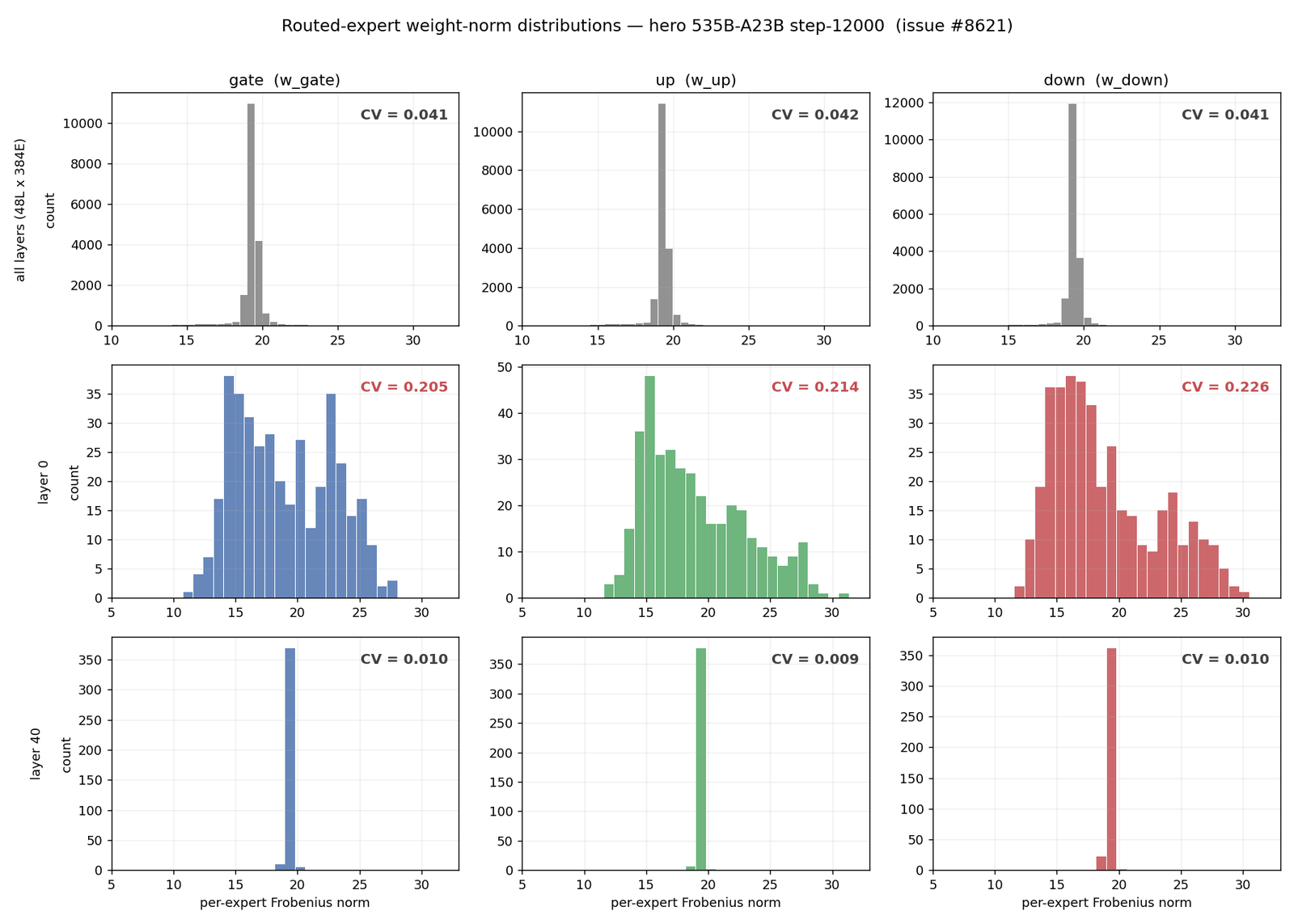
At step 12,000 the experts in layer 40 had a coefficient of variation of 0.010 in their norms,
essentially per-expert behaviour. Layer 0 had spread to 0.205 on the gate projection. The deep
layers act as if each expert had its own ball; only the first few layers use the freedom. Larry's
read is that the dynamic is mostly self-stabilising: Newton-Schulz gives every expert an update of
the same scale, so an expert with a smaller norm sees a larger relative step and tends to grow back.
The risk would be a feedback loop driving some expert to zero, so they agreed to check checkpoints
every 6,000 steps. On August 31 the issue says "Dynamic looks stable", and the line on
optimizer.py:76 is still range(1, param.ndim) today.
I think that is the correct call, and the reasoning is the transferable bit. A bug in the optimizer is only a bug relative to the recipe your forecasts were made with. Fixing it mid-run swaps an untested recipe for a tested one. The issue also raised a question I had not thought about: Muon treats any matrix-shaped tensor as a matrix, so whether you pack 384 experts or 48 attention heads into one array changes the optimizer's dynamics without changing the forward pass at all.
The one knob nobody pinned
If every MuonH matrix has a fixed norm, where does scale go when the model wants more of it? The
optimizer has three groups (GrugMoeMuonHConfig.create_mask): MuonH for the matrices, AdamH for the
output head, and plain Adam for a small free set. That free set is the token embeddings, the norm
gains, the short-convolution kernels, the router weight and bias, and attn_gate. Plain Adam, no
hyperball and, at launch, no weight decay.
attn_gate is the headwise attention gate. It is a [6144, 48] matrix per layer, initialised to
zero, and used like this (model.py:663-665):
# Headwise gating: sigmoid(x @ attn_gate) produces one scalar per head.
gate = 2 * jax.nn.sigmoid(jnp.einsum("bsd,dn->bsn", x, self.attn_gate))[..., None]
attn_out = gate * attn_out
At zero the gate is exactly 1 for every head, so it starts as a no-op. The model can learn to turn a head down (toward 0) or up (toward 2) depending on the token. A gate like this exists to let a head abstain cleanly, rather than dumping attention onto some sink token when it has nothing useful to add.
On August 31, Larry opened issue #8818. The
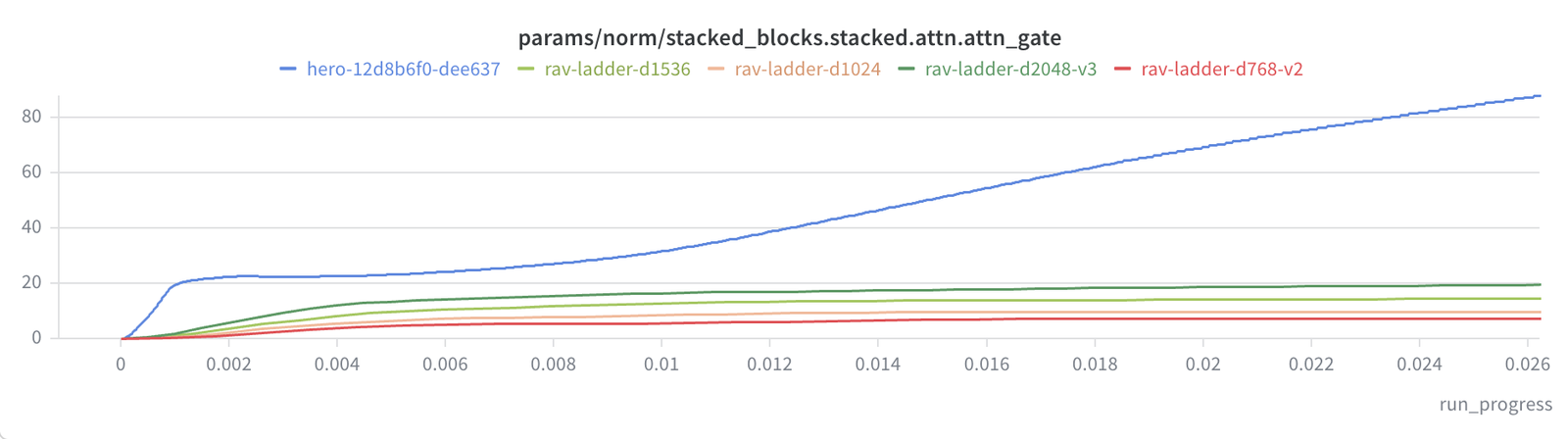
norm of attn_gate on the hero had left the ladder's trend about 1% into the run. The ladder rungs
settled between roughly 5 and 20; the hero was past 80 by 2.6% of training, and still climbing.
What follows in that issue is the best mid-run debugging I have read in public. They pulled the step-42,000 gate tensor and computed per-head norms: whole-tensor L2 of 229.94, per-head norms from 0.87 to 12.2, concentrated in layers 1 to 5. Then they asked what the gate actually does at layer 0, where the gate's input is a fixed function of the token embedding, so every vocabulary entry has one 48-head gate vector.
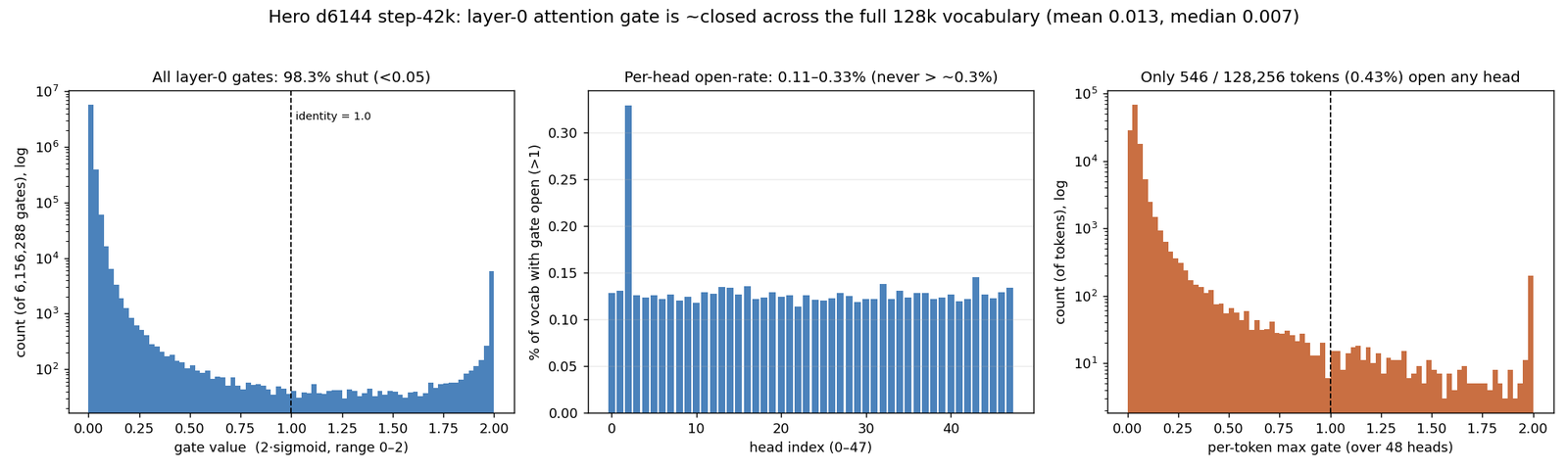
The gate was shut. 98.3% of the 6.16M token-head gates sat below 0.05; the mean was 0.013. Only 546 of 128,256 tokens (0.43%) opened any head at all, and those were almost all reserved special tokens and junk: undecodable byte fragments, spam strings, rare foreign subwords. Ordinary English sat at a gate of roughly zero. The large norm meant saturation: the model had pushed the sigmoid into its flat tail to switch layer-0 attention off, rather than using it to modulate.
That looks alarming, and the first comment says so. The second round of experiments is why I trust the team. They skipped whole layers on the step-42,000 checkpoint: dropping the first 10 layers took dropless macro loss from 2.093 to 6.584, worse than dropping the last 10 (5.455). Zeroing only the attention in layers 0 to 9 cost +0.705; in layers 38 to 47, +0.343. So the early attention was alive and contributing, at a tiny scale (residual contributions grow roughly a hundredfold with depth in their plots), and downstream layers had been trained around those small contributions. Larry's summary in the issue: "output scale does not correspond to impact."
His working theory was that attn_gate had been co-opted as a per-layer output-scale knob, a job
the RMSNorm on the attention input was supposed to do, "perhaps partially because matrices are under
hyperball". I find that persuasive. In a model where nearly every matrix's norm is nailed down, the
handful of free parameters are where scale has to go. The router weight, the other per-block matrix
that plain Adam trains, had the same off-ladder growth.
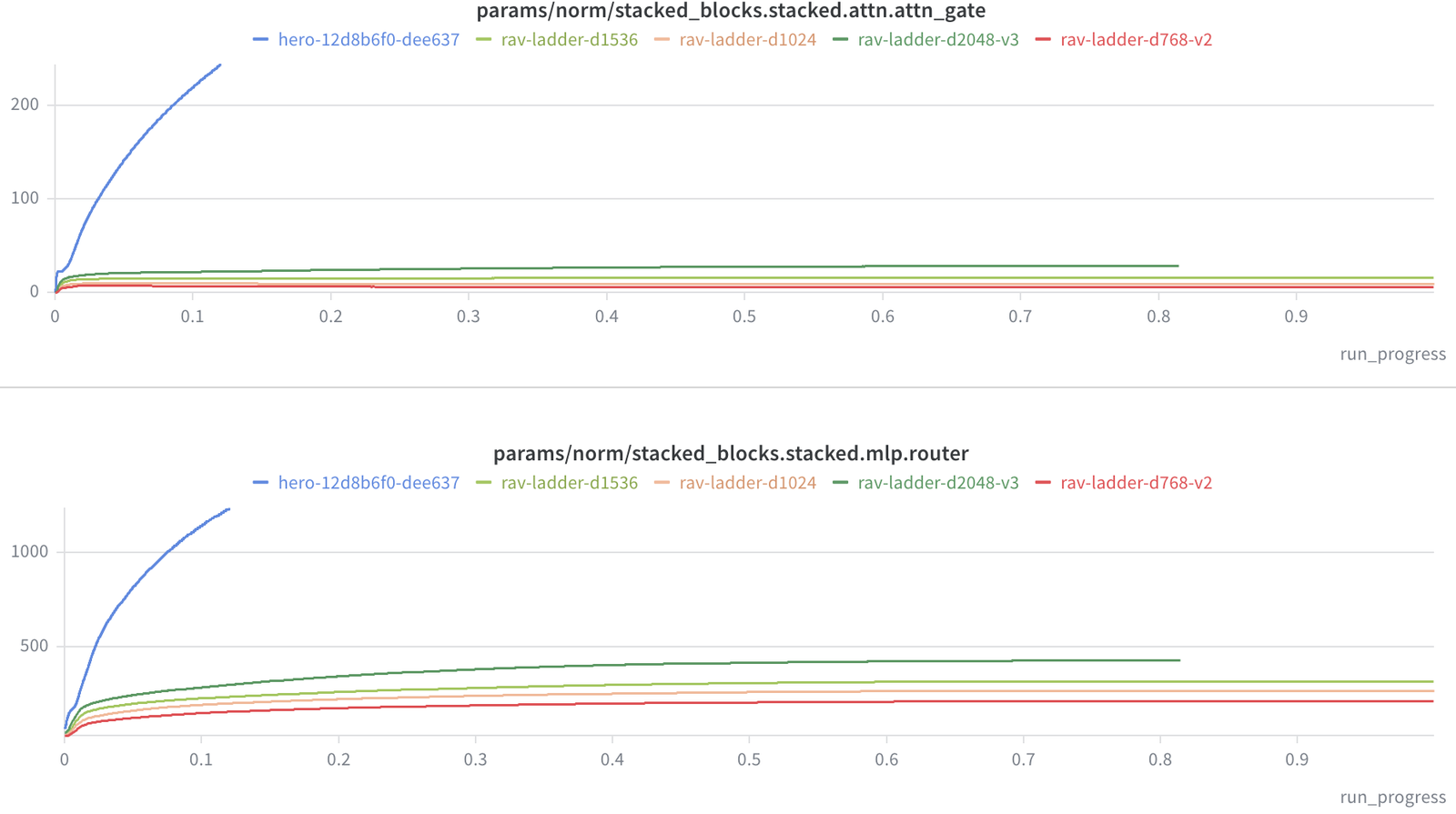
None of it showed in the loss. The forecast at step 44,000 had the hero ahead of its prediction. So the question became whether to intervene at all, and how hard. The issue lists five candidate fixes, from a hard floor on the gate to a learnable bias, and calls all of them "probably not effective as-is". Weight decay on the two free matrices was the low-risk one. They ran it on two ladder rungs first:
| run (d1024, finished) | decayed | Paloma macro | Δ vs baseline |
|---|---|---|---|
| baseline | nothing | 2.7799 | |
| gate only | attn_gate | 2.7797 | −0.0002 |
| gate + router | attn_gate, router | 2.7777 | −0.0022 |
Everything inside about 0.002, which is noise. Weight decay was not going to make the model better. The argument for it was keeping the two parameters learnable later in training, when the learning rate is small and a saturated sigmoid passes almost no gradient.
How gentle the decay had to be came from a different experiment, the one behind the widget below. On the step-48,000 checkpoint they scaled every gate logit by a constant before the sigmoid. Shrinking the logits relaxes every gate toward 1, which is what weight decay does to the gate over time, only all at once.
A 20% cut cost 0.010. A 40% cut took loss from 2.0875 to 2.7852, and at 60% the model collapsed. The gate was load-bearing, so the decay had to be gentle enough for the rest of the network to adapt as it shrank. Larry's estimate was that 0.03 would still halve the norms over about 9,000 steps; they shipped something more conservative.
The change went in at step 58,014: decoupled decay of 0.02 on attn_gate and the router weight
only, annealed linearly to zero at the last step. The implementation (optimizer.py:108-130) is
worth reading for how it was made safe to drop into a live run:
# optimizer.py:123-127, inside _scale_by_adam_gate_router_decay
step = state.count
updates, next_state = adam.update(updates, state, params)
wd = weight_decay * jnp.clip(1.0 - step / total_steps, 0.0, None)
mask = _gate_router_decay_mask(params)
updates = jax.tree.map(lambda u, p, keep: u + wd * p if keep else u, updates, params, mask)
The coefficient reads Adam's own step counter, so resuming a checkpoint written without decay picks up the right value with no new optimizer state. At step 58,014 that is 0.02 times (1 − 58,014 / 390,251), about 0.017. Setting the flag to zero leaves the update byte-for-byte unchanged, per PR #8833, which is what you want from a change you might need to roll back.
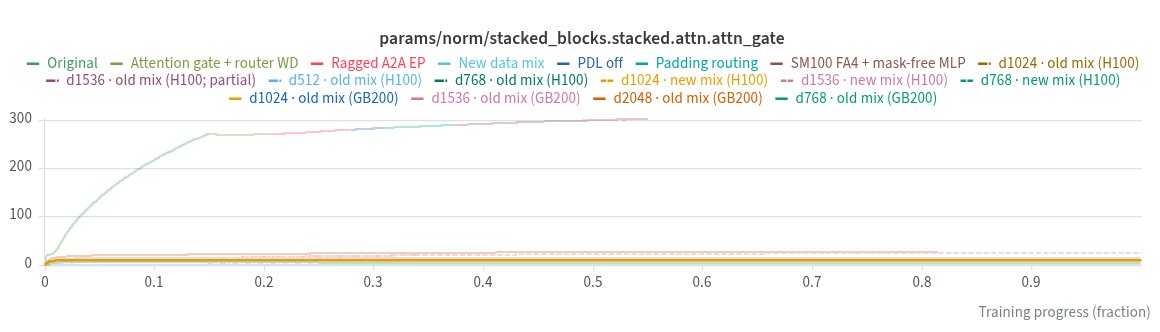
Read the chart honestly: the decay did not bring the gate back to the ladder's range. Reading it off the chart, the norm was near 270 when the decay switched on and around 300 at the halfway mark. It "dampened the growth", in Percy's words, which is all it was meant to do.
One more thread in that issue is worth knowing about. A researcher from another group training ultra-sparse MoEs linked their write-up on lower-layer experts that stop learning early, and pointed at the hero's own per-layer gradients: the routed experts in layer 0 had gradients 200 to 430 times smaller than layers 5 to 19. Larry agreed those two layers' routed experts probably are not contributing, and declined to intervene: two layers of routed experts are about 4% of the routed parameters, and by their own scaling data doubling routed parameters is worth about 20% more tokens, so the loss is marginal. It goes on the list for after the run.
21% to 27% MFU without stopping the run
The second big theme is throughput, and it is a story about expert parallelism. Each rack holds the 384 experts six to a GPU across 64 GPUs, so every MoE layer is two all-to-all exchanges: tokens go out to whichever GPUs own their eight experts, and results come back.
The run launched on a hand-rolled transport the team calls fixed pooled-wave. Every buffer has a compile-time size: each GPU packs its outgoing rows into one fixed pool, and each receiver has room for 1.15 times its expected share of rows, filled in three waves. Static shapes make XLA happy and avoid a separate metadata exchange. The price is that anything past capacity is dropped: the token skips that expert. At launch, roughly 3% of expert assignments were dropped.
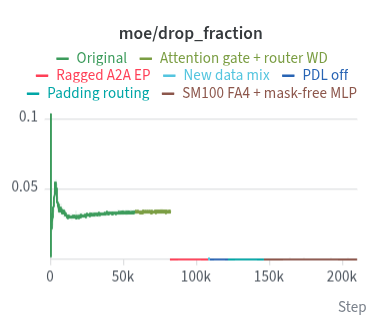
At step 81,716 they switched to a reworked ragged all-to-all (PR #8549): one variable-size transfer per (peer, local expert) pair, rows arriving already grouped by expert, the local experts run in two chunks, QuACK's SM100 grouped GEMMs for the expert MLP, and XLA's device-initiated NCCL kernel for the exchange. In the PR's one-rack A/B, restored from a real hero checkpoint, ragged dropped 0.018% of assignments against 2.67% for pooled-wave and used 12 GiB less device memory at peak (137.9 vs 149.9 GiB).
The thread's "21 to 23 MFU" leaves something out. In that same A/B the two transports were tied on MFU: 22.87 against 22.71, inside run-to-run spread. The README credits about 0.4 MFU to keeping fp32 weights on the device, which ragged's lower memory made possible. I could not decompose the rest of the production jump from public data. The honest summary is that ragged bought near-dropless routing and headroom; the MFU came along with the memory.
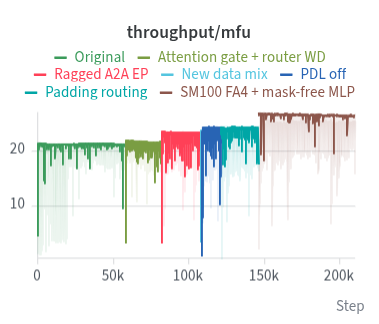
The next entry is the one I enjoyed most. At step 108,778 the team disabled PDL to work around
"intermittent hangs". PDL is programmatic dependent launch, a CUDA feature that lets the next kernel
start its setup while the previous one finishes, with an explicit wait before it reads the previous
kernel's output. The comment above _QUACK_USE_PDL = False in
lib/levanter/src/levanter/grug/_moe/quack_moe_cute.py:32-38 explains the hang:
# Programmatic dependent launch is off for every QuACK GEMM here. QuACK 0.6.4 only executes
# `griddepcontrol.wait` in its TMA-load and CLC-scheduler warps; the MMA and epilogue warps decode
# their work tiles from `cu_seqlens` in global memory before any wait, so under PDL they can read
# the group boundaries before the preceding kernel's writes are visible. The ragged EP hero hangs
# in #8870 are CTAs whose MMA and epilogue warps retired on such a stale decode while the load
# warp kept working. Measured cost of PDL off on the six-GEMM expert MLP is within noise.
_QUACK_USE_PDL = False
In a grouped GEMM over experts, cu_seqlens says where each expert's rows begin and end. Some warps
waited for the previous kernel; others read those offsets without waiting, saw stale group
boundaries, and retired while the load warp was still working, so the block never finished. My
reading is that this race only bites when group sizes change every step, which pooled-wave's fixed
per-expert buffers never did and the ragged transport does on every layer. Note also step 121,638, "fix checkpoint crashing": unglamorous,
and a 100-day run on 704 GPUs is in large part a checkpointing problem.
At step 146,139 came the jump to 27: native SM100 FlashAttention-4 kernels, and a "mask-free"
ragged expert MLP. The receive buffer has a static size with padding at the end; the kernel
interface in ep_ragged_all_to_all.py distinguishes physical group sizes from active ones, noting
that "segment-driven kernels can omit inactive rows", so the expert MLP no longer computes over
padding it then masks away. I am reading that off the code; I did not profile the run. For the
attention side, FlashAttention-3 covers what the previous generation
of kernels did on Hopper.
MFU from 21% to 27% is 29% more tokens per second. A back-of-envelope with my own segment averages (21 until step 81,716, about 23.5 until 146,139, 27 after that, assuming it holds) says the run finishes in about 84% of the wall-clock it would have taken at 21% throughout. On a budget of roughly a hundred days, that is a couple of weeks back, earned without a restart.
Changing the data at a quarter of the way
At step 108,000 the hero switched data mixtures. The pool is clustered into 40 topics times five
quality buckets, and the mixture is a schedule of weights over those 200 cells
(harrier_mix_2026_08_18.json). The repo's mixture log has the shares:
| topic | phase 1 (to 27.7%) | phase 2 (to 80%) | phase 3 (cooldown) |
|---|---|---|---|
| Performance logs and low-level code | 9.0% | 10.6% | 11.4% |
| Command-line agent transcripts | 1.3% | 6.0% | 6.6% |
| General software and web code | 7.9% | 4.5% | 3.1% |
| Natural-science research | 8.8% | 6.9% | 11.3% |
| History, literature, heritage | 6.9% | 3.7% | 3.7% |
| Mathematics problems and proofs | 4.3% | 1.8% | 1.4% |
| Law, courts, regulation | 1.1% | 3.6% | 2.9% |
Agent transcripts went up almost fivefold. Generic web code, history and math went down. Phase 3 is planned for step 312,192 and pushes natural science and the top quality bucket (Q4, from 22.9% to 28.0% of the mix).
The evidence for the swap came from a ladder of its own (issue #9126). They retrained H100 rungs with the switch and compared final held-out bits per byte against the original ladder. The d1536 rung, the largest finished, came in 0.72% lower on Paloma bits per byte, which they translate to a 1.20x compute-equivalent speedup: the old mixture needs 20% more compute to match it. Fifteen of sixteen Paloma subsets improved; Wikipedia got slightly worse.
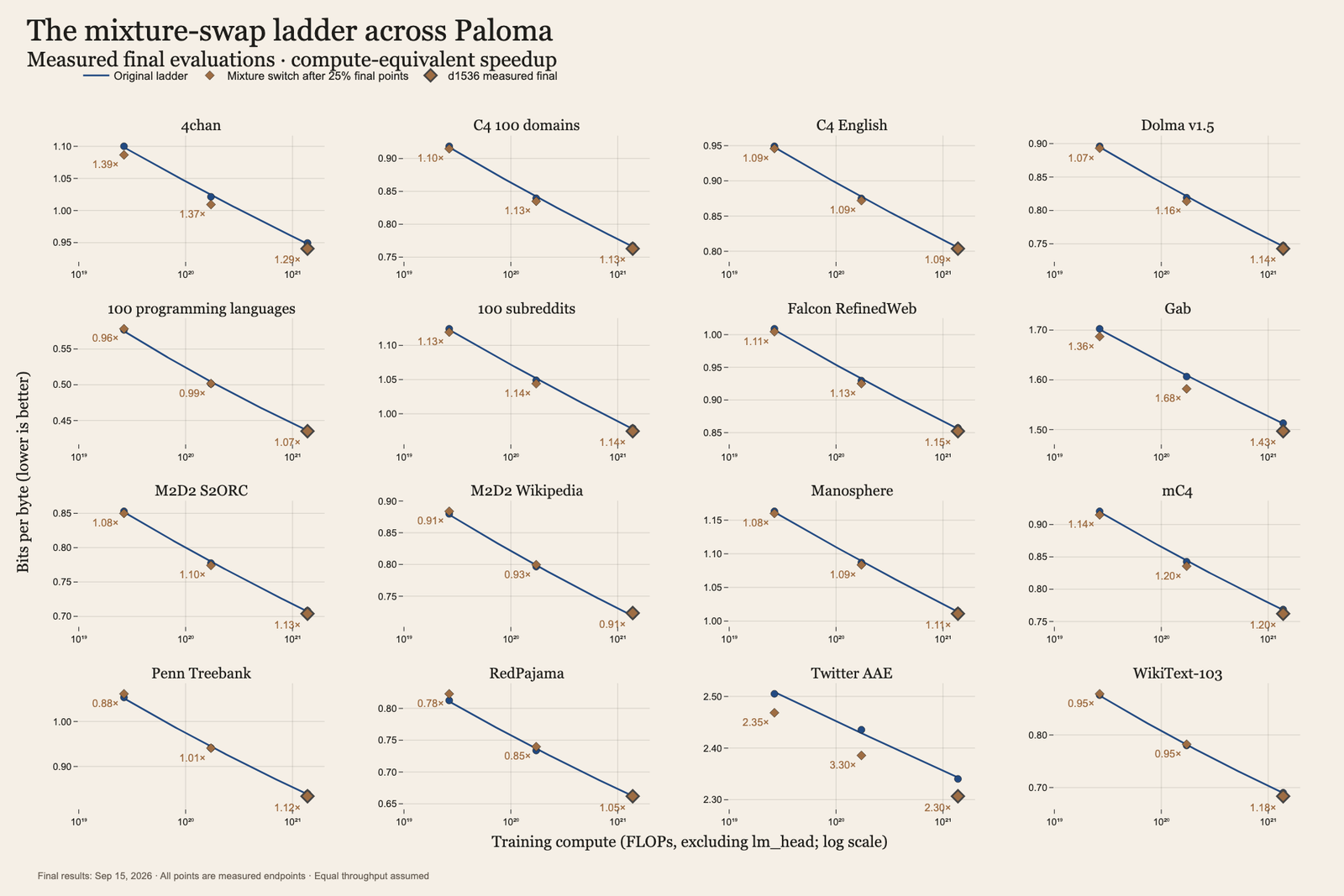
The W&B report notes the side effect: "Slightly higher train loss from harder to predict dataset." So nobody should be watching the training loss of a run like this. Change the data and the training loss changes meaning. The yardstick has to be a fixed held-out set, which is what the forecast below uses.
The forecast is the referee
Everything above was judged against one thing: a scaling ladder trained before the hero launched.
launch_scaling_ladder.py trains the identical recipe at widths 768, 1,024, 1,536 and 2,048, with
the same 384 experts, top-8, transport, optimizer and data schedule, and the same 791 tokens per
active parameter. The team fits L = 1.5 + A·C^−α on dropless Paloma macro loss separately at every
5% of training, so the hero has a predicted value at each point of its run, not only the end. The
fit predicts 2.039 at 100%.
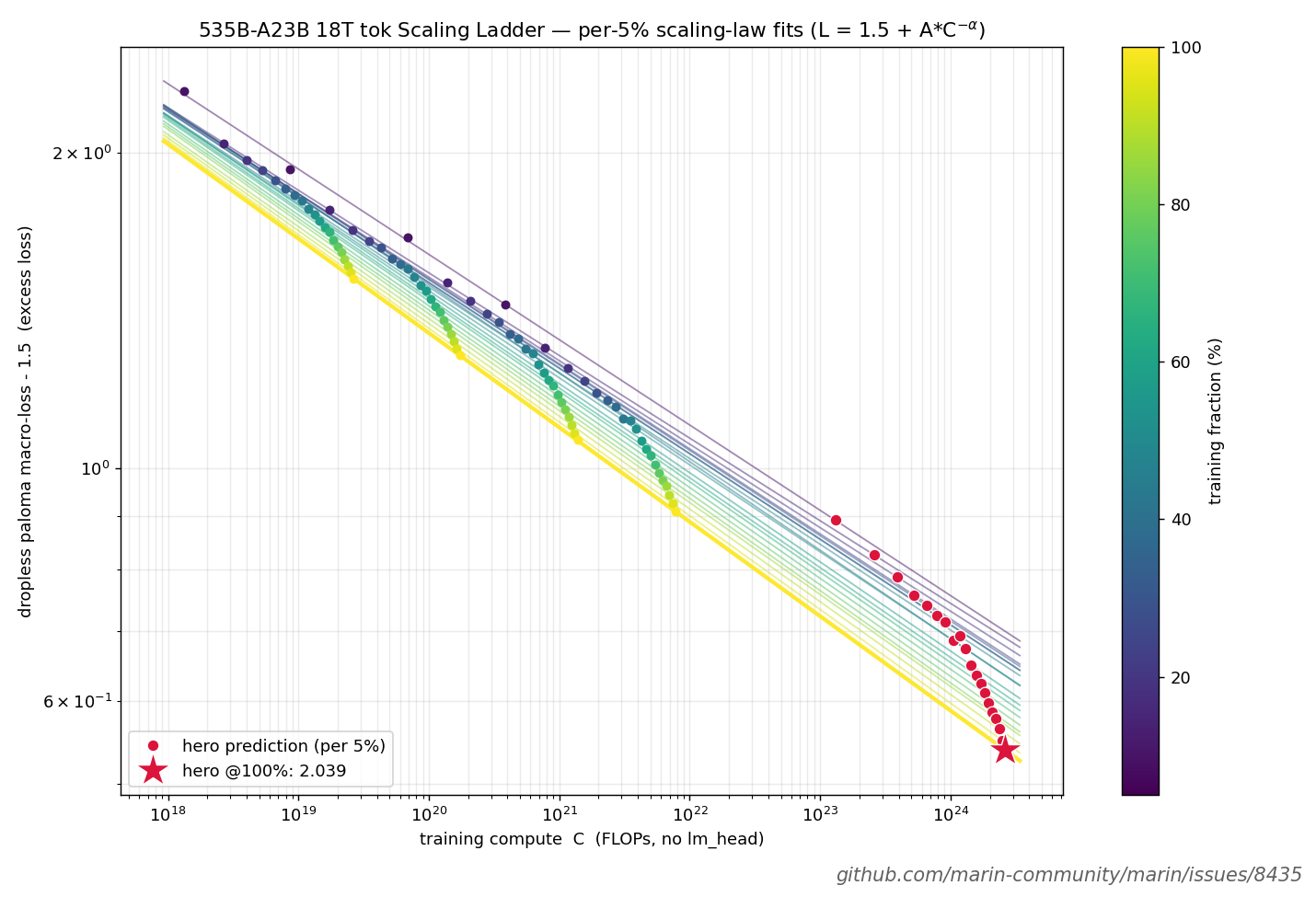
This is a long extrapolation, and the hero issue is candid about it. The largest rung is 9.2e21 FLOPs and the hero is 2.7e24, about 290 times more compute. The d2048 rung crashed at 81% and was not resumed, to give the hero more time. The fit assumes 4K context and an unchanged mixture for the whole run, neither of which will be true. Their defence is a precedent: the earlier 67B-A2B run's pre-registered and retroactive fits each landed within about 0.6% of its target. And their check of the method on the ladder itself: extrapolating each finished rung from its 60-80% window predicted its own final loss within about 0.003 to 0.004.
The issue says the ladder costs about 1% of total compute. The four GB200 rungs in the launcher's docstring add up to about 1.1e22 FLOPs, about 0.4% of the hero, so the 1% presumably includes the H100 rungs and reruns. Either way it is cheap insurance. It is what let Larry say, about the gate, that loss was "on track" and mean something checkable.
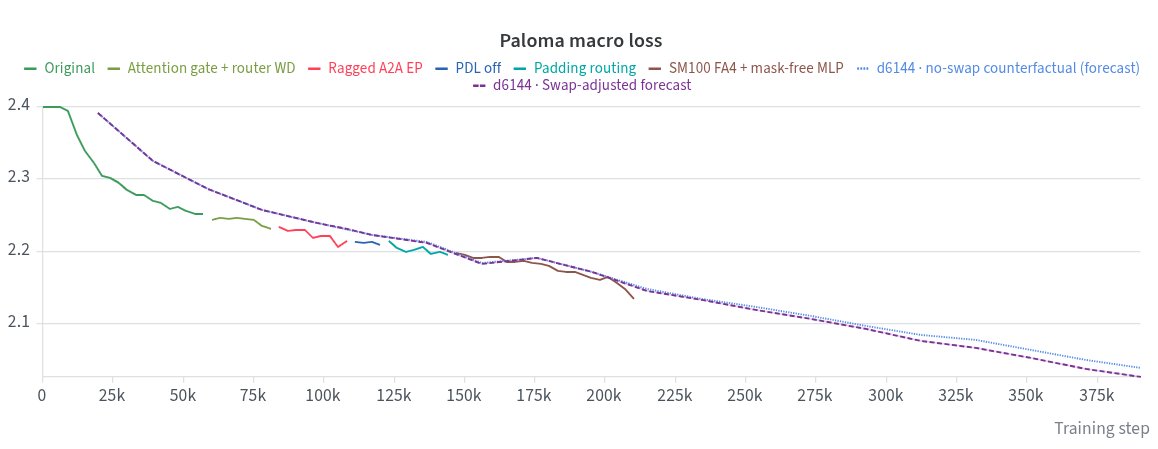
The hero has tracked it. At step 44,000 the issue recorded 2.271 against a predicted 2.326 at 10%, partly because the hero takes more steps than the ladder rungs at the same fraction. By the halfway mark the actual curve sits on the swap-adjusted forecast. Percy's word for it is "generally on trend", with a crossed-fingers emoji, which is the correct level of confidence for a run with another 195,000 steps and a context extension ahead of it.
What I'd take from it
Look at the list of things the team chose not to change. The MuonH axes bug: measured, left in. The early-layer routed experts with near-dead gradients: noted, deferred to after the run. A proposal to compute the router in more accurate arithmetic, which changed the top-8 order for about 9% of tokens on a restored checkpoint and cost 1.5-2% throughput: the recommendation in the hero issue was to keep the current arithmetic for this run and ablate it in a fresh one. Every intervention that did happen was either invisible to the model (kernels, transport, checkpoints), backed by ladder data (the mixture), or minimal and reversible (a decay that reads its own step counter and anneals to zero).
That discipline only works because the forecast exists. Without a pre-registered prediction, every weird norm plot is an argument about vibes. With one, the question becomes "is loss still on the line", and most of the time the answer is to log it and keep training.
What comes next is harder. Context extension from 4K to 8K tokens is planned, and a one-rack measurement from the step-180,000 checkpoint found 8K costs 1.6% of tokens per second and raises the dropped-assignment fraction 4.5 times, from 1.9e-4 to 8.3e-4. Small numbers, but drops are what the whole pooled-wave era was about, and 16K was worse (16 times the drops). The ladder never trained at longer context, so for that stretch the forecast loses its authority.
Percy's last post in the thread says the project is about opening "the dynamic process of discovery
- the process knowledge of how to make hypotheses, what to monitor, how to react to experimental results". After reading the issues, I believe that is what is on offer here. The weights, when they come, will be one more open MoE. Issue #8818 is a better document on how to watch a large run than anything I have read from a closed lab.
How I checked
I read Percy Liang's thread and its replies through the fxtwitter mirror and downloaded its images.
I shallow-cloned marin-community/marin at 8baa0a4 and read experiments/grug/moe_hero_ep/
(optimizer.py, grugmuon_hero.py, model.py, heuristic.py, hero_recipe.py,
launch_scaling_ladder.py, README.md, trigger_hero.sh), the ragged all-to-all and QuACK kernel
wrappers under lib/levanter/src/levanter/grug/, and docs/reports/hero-mixture-log.md. I read
issues #8435, #8621, #8818 and #9126 and PRs #8549 and #8833 with their comments through the GitHub
API, and rendered the W&B report in headless Chromium to get its phase list (the charts themselves
come from the thread). The figures are the thread's images, attachments from the issues, and the
ladder plots committed at d23e6e9.
Numbers about the run (MFU, drops, losses, norms, ablation tables) are the team's; I did not run anything. Arithmetic that is mine: tokens per step and total, the 704-GPU count, step percentages, the decay coefficient at step 58,014, 2.7e24 over 9.2e21, the ladder's share of compute from the docstring's table, and the wall-clock estimate, which assumes 27% MFU holds and uses my own segment averages. Two things I could not check: what the "Padding routing" segment in the W&B legend changed (the report's phase list does not name it; the model does count padding tokens skipped by routing), and how much of the 21-to-23 MFU step came from the transport rather than the memory it freed. The gate norms at 15% and 55% of the run are read off a chart.