2026-07-24 · 7 min · image-generation · tts · microsoft · multimodal
Why read this
Nichelast 15%Reads Microsoft's two MAI preview models as a supply-chain move; prices and vendor-reported cost cuts, no architecture to check.
Image & video generationAPI onlyProprietaryIntro model
How this was scored
- Is it new?
- 0 of 3: Repackaging or news of a known thing
- Can I trust it?
- 0 of 3: Restates claims
- Can I run it?
- 1 of 3: API-only, gated or restrictive licence
- Will I understand it?
- 0 of 3: Describes, no mechanism
- Can I act on it?
- 1 of 3: General advice
- Will it last?
- 0 of 3: News that expires in weeks
- Does it affect many?
- 1 of 3: A specialist community
- Only here?
- 1 of 3: Some original analysis
Score 17 of 100, ranked 575 of 577 rated articles. Each question is answered 0–3 by hand, and a 3 is rare. How articles are scored
For most of the last three years, "Microsoft's AI" mostly meant OpenAI's models wearing a Copilot badge. This announcement is the other Microsoft — MAI, Mustafa Suleyman's Microsoft AI group — shipping two of its own frontier models into public preview: MAI-Image-2.5-Pro, a text-to-image model tuned for quality, and MAI-Voice-2-Flash, a speech model tuned for speed. Neither is a wrapper. Both are trained in-house, and both are already swapped into products you use.
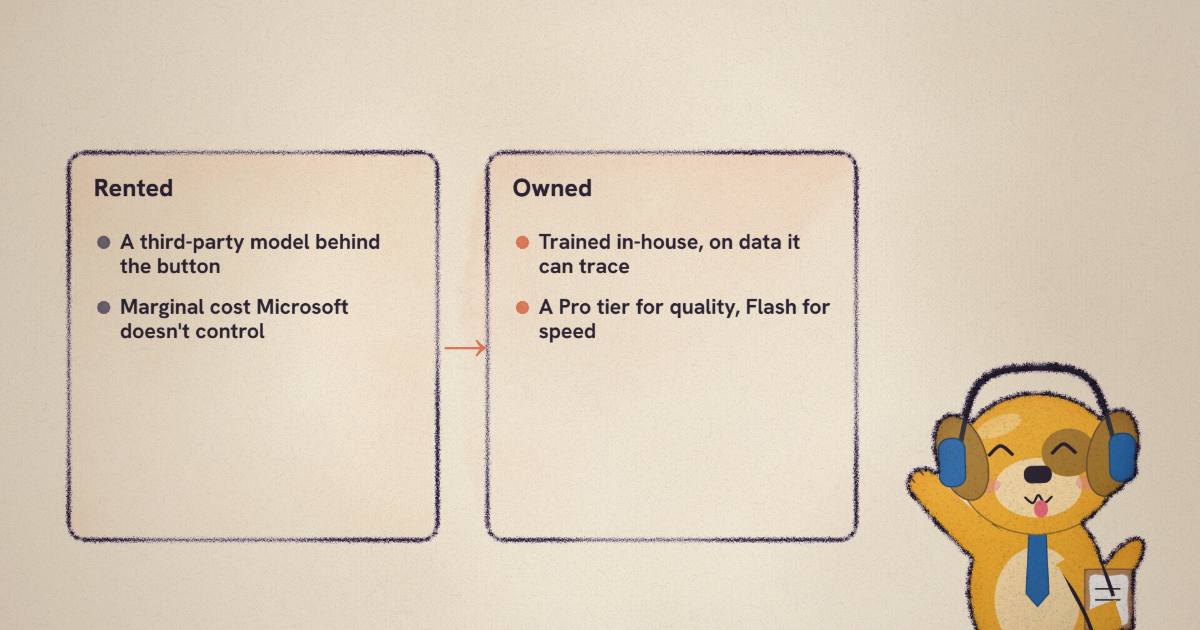
The headline isn't a leaderboard score — it's a supply-chain move. Microsoft has spent years renting its image and voice capability from third parties; MAI is now making that capability itself, on its own data, and serving it into Microsoft's product surface at a large discount. That's the frame worth reading these two releases through.
Two tracks, one strategy
The pair is deliberately split by objective. Pro is the quality lane — hero imagery, detailed edits, precise in-image text, priced like a premium model. Flash is the throughput lane — fast, cheap speech for high-volume voice, where responsiveness beats everything. What ties them together is where they land: each has been dropped into Microsoft products in place of an outside model, and each ships with a self-reported serving win.
Read the fan the way Microsoft wants you to: these aren't demos looking for a home. Bing Image Creator is now 100% in-house on MAI-Image-2.5; PowerPoint's image-to-image runs on it at a claimed 84% lower GPU cost than GPT-Image-2; OneDrive made it the default editor. On the voice side, MAI-Voice-2-Flash powers Dynamics 365 Contact Center at a claimed 89% GPU-cost reduction and feeds Azure Voice Live. The numbers are Microsoft's own, but the direction is unambiguous — every one of these was previously a place a third-party model would have run.
MAI-Image-2.5-Pro: quality, and its own data
MAI-Image-2.5 is the model line; Pro is its high-fidelity tier, the one you reach for when the output is the deliverable rather than a thumbnail. When the base MAI-Image-2.5 model debuted on LMArena it landed at No. 3 for text-to-image and No. 2 for image editing — a notch behind OpenAI's image models but, per third-party arena coverage, roughly level with Google's Nano Banana 2. For a first fully in-house image model, that's a real result.
The sample reel leans hard on the two things generators historically fumble: product photography and legible in-image text. Brand lockups, packaging copy, poster typography — the kind of output where a single wrong glyph gives the game away.

That emphasis shows up in the self-reported Arena breakdown. Against the prior MAI-Image-2, Microsoft reports a +75 overall Elo gain, and the two categories that moved most were exactly the hard ones:
These are deltas versus the previous generation, not absolute scores against rivals, and they're Microsoft's own Arena tallies — read them as "where the team pushed," not as a competitive ranking. The one claim that is genuinely strategic rather than aesthetic sits in the fine print: MAI says the model is trained on "clean, traceable, enterprise-grade data, without distillation from third-party models." For an enterprise buyer nervous about provenance and copyright, "we didn't distill someone else's model and we can trace our data" is a feature, not a footnote — and it's a pointed contrast to the murkier lineage of much of the field.
Pricing tells you which lane Pro is in: $5 / 1M text-input tokens, $8 / 1M image-input tokens, and $106 / 1M image-output tokens — priced as a premium generation model, not a commodity one.
MAI-Voice-2-Flash: the throughput lane
The voice release is smaller in ambition and clearer in purpose. MAI-Voice-2-Flash is a distilled, speed-first sibling of MAI-Voice-2: Microsoft reports it is 2× faster and 32% cheaper while keeping "the natural prosody and high acoustic quality" of the parent. It's priced at $15 / 1M characters — the kind of number that only matters at contact-center volume, which is exactly the target.
The MAI-Voice line has been a speed story from the start: its first model was pitched on generating a full minute of audio in under a second on a single GPU. Flash extends that lineage in the direction that matters for the deployment above — a call-center agent that has to respond now, thousands of conversations in parallel, where a half-second of latency is the difference between natural and robotic. Pairing "good enough prosody" with "cheap and instant" is the entire product thesis, and it's why the Dynamics 365 and Azure Voice Live integrations lead the voice half of the announcement rather than a quality benchmark.
Why in-house, and why now
Strip away the model cards and the strategic logic is a spreadsheet. Every image or utterance Microsoft generates from a third-party API is marginal cost it doesn't control and margin it doesn't keep. Owning the model turns that into an internal transfer — and the reported serving wins (−84% GPU cost in PowerPoint, −89% in Dynamics 365, 2.5× efficiency with a 25% P95-latency cut and a 26% higher save rate in OneDrive) are the payoff, measured across products that run at Microsoft scale. At that volume, a double-digit-percent cost cut on a capability embedded in Office and Azure is a very large number.
It's also insurance. MAI already builds its own text models and voice models; adding a competitive image model means Microsoft can staff Copilot, Bing, Office and Azure from its own frontier lab if it ever needs to — reducing dependence on any single outside provider. Two public-preview models are a small headline; "Microsoft no longer has to rent its image and voice stack" is the actual one.
The take
MAI-Image-2.5-Pro and MAI-Voice-2-Flash are not the most capable image and voice models in the world, and Microsoft doesn't claim they are. What they are is sufficient — a top-three image model and a fast, cheap voice model, both good enough to swap into the real products where Microsoft used to pay someone else. That's the whole move: not winning a leaderboard, but owning the supply chain and pocketing the GPU-cost delta at Office-and-Azure scale, on data Microsoft says it can trace. It pairs naturally with the research-lab counterpart from the same company, Mage-Flow — a 4B efficiency bet — and with Qwen-Image-3.0, another vendor deciding its image model should be useful infrastructure rather than an art toy. The frontier that's being contested here isn't quality. It's who owns the model behind the button.
Source: Introducing MAI-Image-2.5-Pro and MAI-Voice-2-Flash (Microsoft AI, 2026-07). LMArena placements and the "level with Nano Banana 2" comparison are from the earlier MAI-Image-2.5 launch and third-party arena coverage. All benchmark, cost, and efficiency numbers are Microsoft's own; the sample image is the announcement's, shown for commentary. The interactive is mine.