2026-09-22 · 16 min · explainer · llm · architecture · multimodal · benchmarks
Seven days after Jev launched, the open reproductions had covered the architecture (a System One model in 706,048 parameters), the serving trick (any model can be Jev), the on-device port (Laya on Apple silicon) and the failure mode (Jev scores zero). None of them could look at a picture.
akhilaaa3/Jev-Omni can. It takes
text, an image, up to thirty seconds of audio, or sixteen frames of video, and
returns a probability per option with nothing generated. The announcement calls
it the first multimodal System One model and says the others miss at least a
modality. That part holds up: the two nearest projects I could find are
shapsider/OmniJev, whose README says
audio is "wired in the client but rejected by the current backend", and
OmniJev/PlayJev, a 0.8B model that reads
GUI pixels and nothing else. Neither takes four modalities. This one does.
Everything else in the announcement is worth checking against the repository,
and I did, because the repository publishes enough to check: a merged fp32
backbone in thirteen shards, the head as a separate head.pt, the training
recipe in decision_config.json, a verification.json full of numbers nobody
asked for, and two charts whose SVG text I can read the values out of.
- task
- text-classification
- library
- transformers
- license
- apache-2.0
- safetensors
- 13 shards
- largest file
- 4.03 GB
- files
- 33
- downloads
- 0
- likes
- 10
Gemma 4 12B IT with a merged rank-512 LoRA and a trained 256-way head. The card's own results table puts it below Jev on the benchmark it was measured on, which is the most useful sentence on it.
repo last modified 2026-09-22
Where the decision head sits
The one thing a multimodal decision model has to explain is how four modalities
reach one head. No diagram ships with the release, so here is the one I drew
after reading jev_omni.py, load_model.py and both repositories' tensor
lists.
jev_omni.py, load_model.py and the safetensors headers of both repositories. The four inlets are not four encoders: vision_embedder is one Linear over a flattened 48×48 pixel square, embed_audio is one Linear over 640 raw samples, and video is the image path run sixteen times. All three belong to stock google/gemma-4-12B-it, which the loader downloads separately; this release fine-tuned the decoder and trained the head.The surprise is that there is nothing to draw. Gemma 4 Unified has no vision
tower and no audio encoder. model.vision_embedder is a LayerNorm, one
Linear(6912, 3840) and a position table — 6,912 is 48 × 48 × 3, a flattened
pixel square. model.embed_audio is a single Linear(640, 3840) over raw
samples. Summed from the base checkpoint's safetensors header, the entire
non-text front end is 52,379,904 parameters, against 11,907,350,320 in
the decoder. That is 0.44%.
Jev-Omni ships 11,907,350,320 parameters of fine-tuned text decoder and 983,296 parameters of decision head. Everything that makes it multimodal — the pixel patch embedder, the vision projection, the audio projection — is 52,379,904 parameters of stock Gemma 4 that the release never touched: 0.44% of the model, downloaded from google/gemma-4-12B-it at load time.
| component | parameters | dtype | origin |
|---|---|---|---|
| text decoder, 48 layers (666 tensors, 13 shards) | 11,907,350,320 | F32 | fine-tuned and merged in this repo |
| — of which the token embedding, 248,320 × 3,840 | 1,006,632,960 | F32 | fine-tuned and merged in this repo |
| decision head, Linear(3840 → 256) | 983,296 | F32 | trained in this repo (head.pt) |
| vision patch embedder, 48×48 pixels → one token | 35,176,704 | BF16 | stock google/gemma-4-12B-it |
| vision → decoder projection, 3,840 × 3,840 | 14,745,600 | BF16 | stock google/gemma-4-12B-it |
| audio → decoder projection, 640 × 3,840 | 2,457,600 | BF16 | stock google/gemma-4-12B-it |
| everything the classifier runs, total | 11,960,713,520 | — | — |
The fine-tuned decoder has exactly the same parameter count as the stock Gemma 4 language model, which is what a merged LoRA should look like: values changed, shapes did not. The backbone is stored in fp32 — 47.6 GB — because the repository's own verification.json records that merging the adapter in lower precision moved a probability by 0.201, against 3.39e-05 in fp32.
Two things follow, and they are the shape of the whole release.
First, Jev-Omni did not train the multimodal part. The repository ships a
text decoder and a head. load_jev_omni downloads stock
google/gemma-4-12B-it, finds its language model by walking four candidate
attribute paths, and swaps in the fine-tuned decoder:
# jev_omni.py — the graft
path, old = _find_backbone(model)
parent, _, name = path.rpartition(".")
setattr(model.get_submodule(parent) if parent else model, name, decoder)
del old
The patch embedder, the vision projection and the audio projection are the ones Google shipped. Which is not a criticism — it is the correct way to build this, and it is why it took 750 optimiser steps rather than a pretraining run. It does mean the claim to be first at four modalities is a claim about the base model being first, not about the decision training being multimodal.
Second, the readout has nowhere to go but the last position. A per-option
scorer needs each option encoded on its own; a marker readout like
Laya's needs a
[MASK] per option. Jev-Omni does neither. The prompt numbers the options, the
model runs once, and a hook grabs last_hidden_state[:, -1].
The option count is in the weights
load_model.py (Head256, output_classes: 256 in decision_config.json) and the four storage entries inside head.pt, which at fp32 are exactly mu[1,3840], sd[1,3840], linear.weight[256,3840] and linear.bias[256]. Masking before the softmax is correct arithmetic — the unused classes contribute nothing — and it is also the thing that makes the option count a property of the weights rather than of the request.decision_config.json says "output_classes": 256. load_model.py says what
that means:
# load_model.py — the entire decision head
class Head256(torch.nn.Module):
    def __init__(self, hidden):
        super().__init__()
        self.register_buffer('mu', torch.zeros(1, hidden))
        self.register_buffer('sd', torch.ones(1, hidden))
        self.linear = torch.nn.Linear(hidden, 256, dtype=torch.float32)

    def forward(self, features, counts):
        z = self.linear((features.float() - self.mu) / self.sd)
        return z.masked_fill(torch.arange(256, device=z.device)[None] >= counts[:, None], -1e30)
I checked the shape rather than trusting the constructor. head.pt is a torch
zip archive; its four storage entries are 15,360, 15,360, 3,932,160 and 1,024
bytes, which at fp32 is exactly mu[1,3840], sd[1,3840],
linear.weight[256,3840] and linear.bias[256]. 983,296 parameters, output
dimension 256.
Put that next to the sentence the CUA-S1 piece used to separate a decision head from a classifier:
This head is Linear[256, 3840]. K is welded in. The masking is arithmetically
clean — unused classes contribute nothing to the softmax — and it is also the
thing that makes the option count a property of the checkpoint. predict raises
above 256 options, and the card is straight that quality above twenty is "not
established."
This is the third independent sighting of a frozen option count in three
weeks, and the first one that is not an export artefact. The browser
piece found
logits[batch_size, 25] in an ONNX graph. The Apple silicon
piece found K frozen at
32 in five Core ML bundles and at 4 in the one that plays Snake. Both times the
PyTorch model underneath still took whatever width it was handed, and the
constraint arrived with the conversion. Here there is no conversion. The
constraint is what was trained.
Which means the option order has to matter
The prompt is built like this:
# jev_omni.py — _prompt()
choices = "\n".join(f"{i + 1}. {value}" for i, value in enumerate(options))
return (f"{state}\n\n---\n\nQUESTION: {question}\n\nOPTIONS:\n{choices}\n\n"
        f"Reply with only the number of the correct option (1-{len(options)}).\n"
        "Output a single number and nothing else.")
Class i is list position i. Move an option from second to third and it is
scored against a different row of a trained weight matrix — the same structure
as openjev reading the vocabulary rows for A, B and C, which reversing
the option list flipped on 27.8% of
cases.
The rows here were trained for the job instead of inherited from pretraining, so
the flip rate could be much lower. It cannot be zero by construction, and that is
the difference that matters: in a per-option scorer, order-sensitivity is not
expressible; here it is a training outcome.
I could not run the test. The reference loader requires a CUDA GPU and about 50 GB of fp32 weights, and there is no GPU in the machine I write these on — the same hole the Apple silicon piece had to publish. So this is Reasoned, with a falsifier at the bottom that costs one H100-hour.
What <100ms covers
The claim that travelled is "<100ms on 1 H100." The card publishes four numbers and they are all in the table above: 83 ms for about 2k tokens of text, 26 ms for an image, 31 ms for thirteen seconds of audio, and 504 ms for a sixteen-frame video. On an H200, not an H100.
So three of the four are under 100 ms and the fourth — the modality the release
is named for having — is five times over it. A video decision model quoting a
text-only latency would be the finding here; this is the softer version, which is
that the aggregate claim kept the three cheap modalities and dropped the
expensive one. The card itself does not do this: it prints all four in a row,
in the same sentence, and adds that these are "medians over 20 optimized-backend
requests; preprocessing and network time are extra." That last clause is worth
reading twice. Decoding the video with OpenCV and resampling the audio through
ffmpeg — which predict does inline, per request — are not in any of these
numbers.
"On par with Jev on Typed-benchmarks"
The card's own chart disagrees, and I can read the numbers out of it because the release ships the SVG next to the PNG.
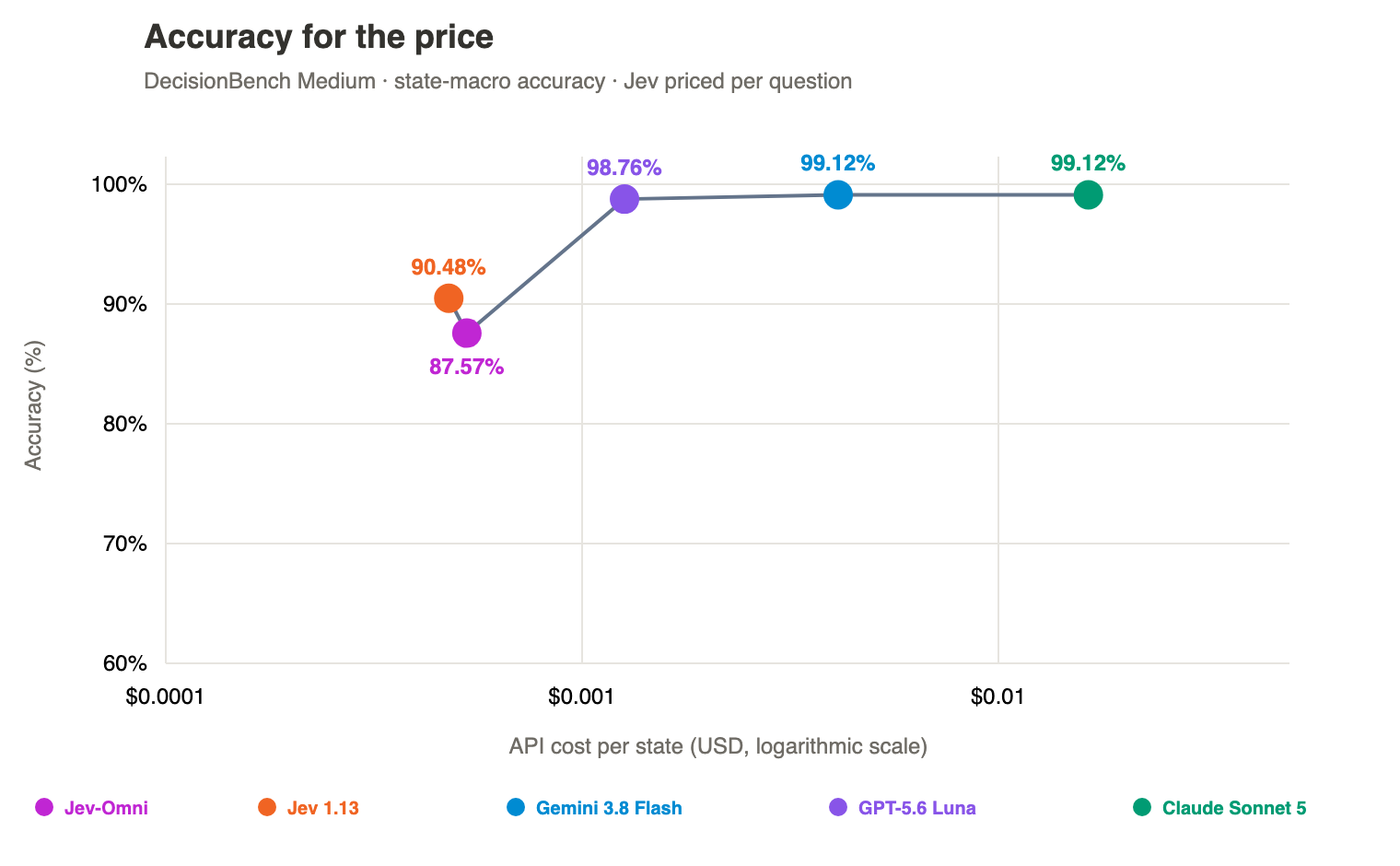
87.57% against Jev's 90.48% on DecisionBench Medium, state-macro. That is not on par; it is 2.9 points behind, and the author published it as the headline figure, which is the most creditable thing in the release. The second most creditable thing is that the three chat models are on the same chart at 98.76, 99.12 and 99.12 — an eleven-point gap that the launch framing of this whole category tends to leave out.
The chart is not really about accuracy. It is a cost chart, and on cost the argument is real. Jev-Omni has no bill, so its mark uses OpenRouter's Gemma 3 12B input rate against its own recorded input tokens, and it is charted at essentially the same point as Jev, whose measured cost per state is $0.00048 against Gemini's $0.00412 and Sonnet's $0.01645 — roughly ninefold and thirty-fourfold, before the correction below. The dataset card is unusually careful about exactly this — it documents a withdrawn earlier version of the chart where Jev was priced per state while Jev-Omni was priced per question, and states the correction plainly, including that per-question pricing multiplies input tokens by 2.82× on this subset. Publishing the retraction of your own favourable chart is rarer than it should be.
Three things the comparison does not settle.
The benchmark is the author's, and so is the answer key. DecisionBench is 80
scenarios and 293 questions per subset, "generated with Claude Opus 5", with
answers described in its own dataset card as the "writer-intended answer."
Claude Sonnet 5 scores 99.12% on it. A benchmark whose key was written by a
frontier model and on which frontier models score 99 is measuring agreement with
a generator as much as it is measuring decisions. That is not a reason to
discard it — every synthetic benchmark in this category has the same problem, and
this one at least ships its rows — but it is the denominator.
Only the easy subset is in the model card. The dataset publishes medium
and hard. hard is where the interesting number is: Jev falls to 65.26%
and its calibration error triples to 0.1204. Jev-Omni's card reports Medium
only, and the dataset's results.json has no Jev-Omni row at all, so there is no
published Jev-Omni number on the harder half of its own benchmark.
The JevBench row has no opponent. The card reports "JevBench · matched 195 groups / 231 decisions — 86.15%" with no Jev column beside it. The published JevBench figures this site has collected are 72.1% on the hard tier and 98.6% on the standard tier, so without knowing which tier the 195 matched groups came from, 86.15% is unplaceable between them.
On the two multimodal benchmarks the card is explicit that it loses: MMAU 63.10% against Inkling's 77.20%, MVBench 53.10% against Qwen3.5-397B-A17B's 77.60%. Against models 81× and 33× its size respectively, on benchmarks nobody trained for here. The card prints the parameter counts in the same table.
The calibration number, and what it is made of
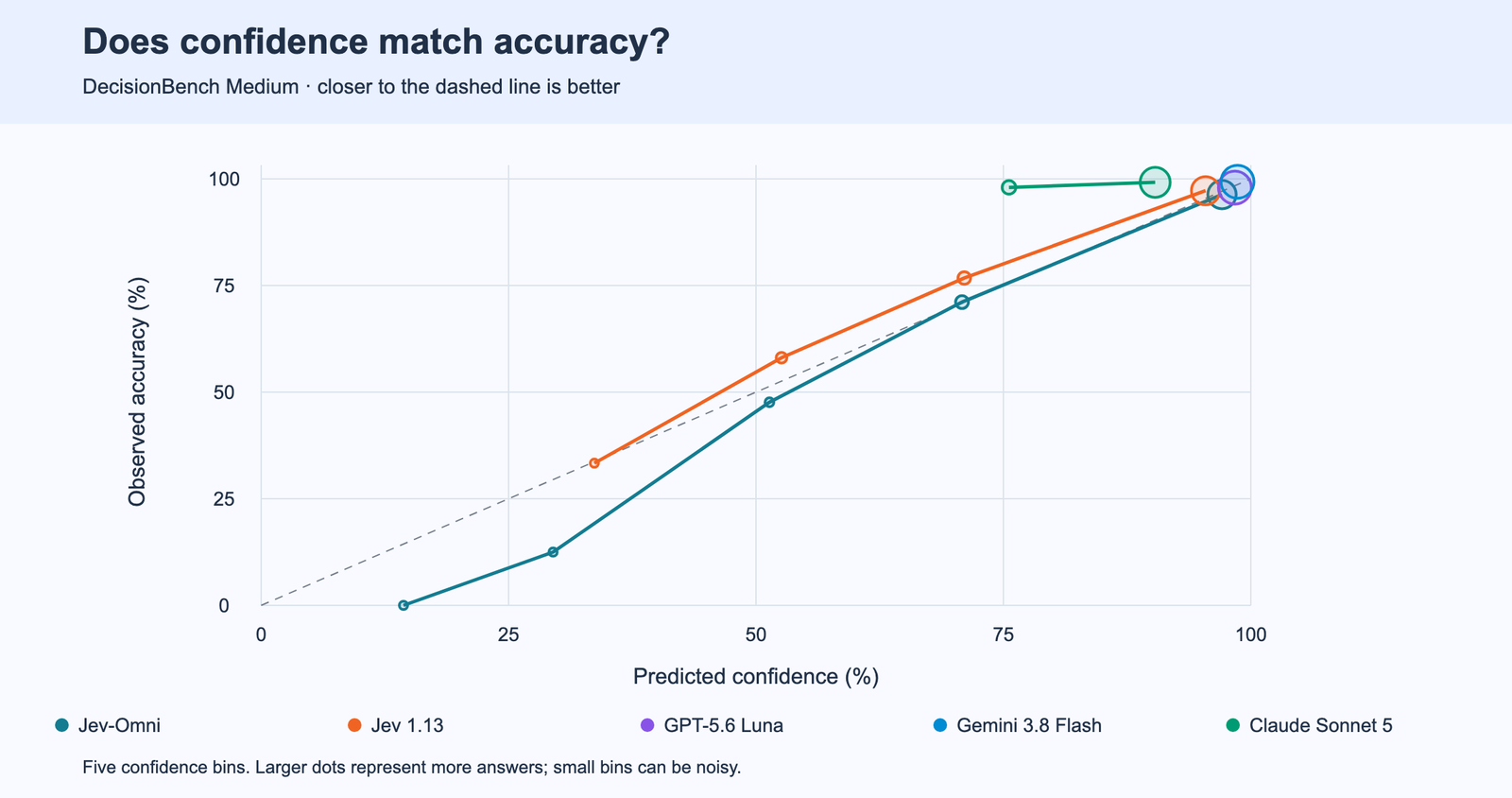
The card reports ECE 0.0400 on ten bins, which is a good number
and better than Jev's 0.1204 on hard — though Jev's own Medium ECE is 0.0324,
so on the subset both were measured on, Jev is still ahead. The curve is the
more useful artefact, and it repeats a caveat this site has made twice before:
most of the mass is in the top bin, where the model is right and says so, and a
low aggregate ECE is what near-saturated accuracy implies. The bins between
0.15 and 0.55 — the band where a confidence threshold earns its keep — sit
below the diagonal on a handful of answers each.
Two receipts the release did not have to publish
verification.json is four lines long and worth the whole file listing:
{"verification_examples": 12,
 "merged_vs_adapter_max_probability_difference": 0.20123280584812164,
 "fp32_merged_vs_adapter_max_probability_difference": 3.3915042877197266e-05,
 "merged_vs_adapter_argmax_match": true}
Merging a rank-512 adapter into the backbone at serving precision moved a probability by 0.20. In fp32 it moved by 3.4e-05. So the repository ships fp32 weights — 11,907,350,320 parameters × 4 bytes = 47.6 GB, which is the "about 50 GB" the card quotes — and runs bf16 autocast at inference instead. That is a real finding about merging, published by the person it inconveniences, and it is the reason this download is twice the size it looks like it should be.
The second receipt is the recipe, and it is where the announcement and the
artifact part company. decision_config.json records the final stage exactly:
{"size": 24000, "rank": 512, "alpha": 512, "lr": 1e-05, "epochs": 1,
 "effective_batch": 32, "steps": 750, "world_size": 4,
 "trainable_parameters": 2099183872,
 "initialization": "FP32 merged trained v1 + trained head + fresh LoRA"}
750 × 32 = 24,000, so the arithmetic is self-consistent: one epoch over 24,000
examples on four processes. The announcement says 30,000 examples on 8×H200.
The gap is presumably the earlier trained v1 rank128 stage the config names as
its starting point — but that stage ships no recipe, so the 30,000 total cannot
be checked from the repository, and the world size that is recorded is four.
The trainable count is the other number worth sitting with. 2,099,183,872 trainable parameters — rank 512 with α=512 across the projections of a 48-layer, 3,840-wide model is 17.6% of the backbone. That is not a light-touch adapter; it is most of a fine-tune, which is consistent with a release that then merges it and ships the whole thing.
What I would actually take from this
- The multimodal claim is true and smaller than it sounds. Four modalities reach the head because Gemma 4 Unified projects all four into one token stream with 52M parameters of stock front end. The decision training was text-decoder training. Anyone who picks a natively-multimodal base gets the same property for the same price.
- The frozen option count is now a pattern, not a coincidence. Three independent releases, three runtimes, three different reasons — and this one put it in the trained weights, where re-exporting cannot fix it.
- Read the four latency numbers, not the one. 26 ms for an image and 504 ms for sixteen of them is the same model doing the same arithmetic on sixteen times the visual tokens, for nineteen times the latency. Quote the one that matches your input.
- The honest comparison is the cost axis. On accuracy the card's own chart has Jev-Omni third of five and Jev second. On cost per state it is first by a factor of thirty, and that is the claim the release can actually defend.
What would change my mind
5 claims above, and what would falsify each
Jev-Omni's answers change when the option list is reordered, because class index is list position.
The cheapest possible test, and it needs one H100-hour: take fifty DecisionBench Medium Choice questions, run each with its options in the published order and again reversed, and count argmax flips and the mean maximum change in probability. A per-option scorer is at 0.0 on both by construction;
rlcd-style letter readouts flip on 27.8% of reversals. If Jev-Omni comes back at exactly 0.000 on both measures, my reading ofHead256is wrong and something order-invariant is happening that I did not find injev_omni.py.The multimodal front end is untouched stock Gemma 4.
sha256.jsoncovers this repository's files, not the base model's. Downloadgoogle/gemma-4-12B-it, hashmodel.vision_embedder.*,model.embed_vision.*andmodel.embed_audio.*, and compare against whatload_jev_omnihas in memory after the graft. They should be bit-identical, because the loader never replaces them. If they differ, the release trained more than the decoder and the parameter census above understates it.The decision head is Linear(3840, 256) — 983,296 parameters with K welded in.
python -c "import torch; print({k: v.shape for k, v in torch.load('head.pt').items()})". Anything with a trailing 1, or a shape that depends on the request, means it is a per-option scorer and I have described the wrong architecture. I read the four storage sizes inside the zip archive instead of loading it, because there is no torch in this machine; a real load is the stronger check.504 ms for video is prefill cost, not preprocessing.
The card says preprocessing is excluded, so the 504 ms should be reproducible by feeding sixteen pre-decoded frames straight to
predictand timing only the forward pass. If the number falls sharply when OpenCV is taken out of the loop, the published figure includes decode after all and the honest video latency is higher than 504 ms, not lower.DecisionBench's answer key is a frontier model's judgment, which is why frontier models score 99 on it.
Have two people independently label fifty
mediumrows and fiftyhardrows and report inter-annotator agreement against the shipped key. If humans agree with the key at 99% on medium, the key is simply correct and the chat models are simply right; if they agree at, say, 90%, then the ceiling on that chart is the generator, and every model's distance from it is partly a distance from Claude Opus 5.
Nothing here was executed. The reference loader needs a CUDA GPU and about 50 GB of fp32 weights, and there is none in the machine this was written on, so every latency and accuracy figure above is Reported — read out of the model card, the dataset card's results.json, and the text nodes of the two committed SVGs. What is Measured is the arithmetic: parameter counts summed from range-requested safetensors headers across all thirteen backbone shards and the base model's single shard, and the head's shape read from the storage sizes inside head.pt's zip archive. Repository at revision 55b53f2, dataset at 19334fe, both 2026-09-22. Companion pieces: A System One model in 706,048 parameters for the two-family split this model sits outside of, and Laya on Apple silicon for the previous two sightings of a frozen option count.