2026-09-22 · 15 min · structured-generation · constrained-decoding · agents · inference · llm · explainer
XGrammar-2
is the constrained-decoding layer under SGLang, vLLM, TensorRT-LLM and MLC-LLM, and
its headline feature is Structural Tag — a small JSON DSL that describes an
output shape, compiles to a grammar, and masks the model's vocabulary at every
decode step so the emitted tokens cannot leave that shape. Twenty-two format
types, nineteen built-in model formats, and one response_format field that
serving engines expose over the OpenAI API.
It is also the other half of an argument this site has been having with itself.
RLCD is not constrained decoding separated two things people conflate: a decoder-side constraint on what a model may emit, and a training-side property of how well its probabilities track reality. What a decision model cannot do then showed what the first choice costs — a model whose output is always an element of the caller's option set cannot write a string, and needs a generative model beside it to do so.
XGrammar is the third position. Do not replace the generator. Constrain it.
So: what does each one actually promise?
The two guarantees, stated precisely
A grammar guarantees membership in a language. The masking is exact: a token
whose emission would take the prefix outside the language is assigned zero
probability, so there is no decode path to an invalid string. If your language is
"a JSON object matching this schema", you will get a JSON object matching that
schema, with probability one, forever. What you will not get is any promise
about which member of that language you got — a schema with one free string
property admits uncountably many documents and the grammar is indifferent between
all of them.
A menu guarantees membership in a set. The output is an element of the option list the caller supplied on this request. It cannot be a value the caller did not offer, cannot be a hallucinated tool name, cannot be an enum member from last year's schema. What it will not give you is a value nobody enumerated, and the docs of the model that sells this hardest say so plainly: "not trained to generate text. While you can force it to by chaining choices, this will not work well and will be very slow."
Neither implies the other, and both directions of that matter.
A grammar does not imply a menu: to guarantee "the value is one of these five", you must write the five into the grammar. Then you have a menu — which is a real construct here, not a rhetorical one, and I will come back to it.
A menu does not imply a grammar: nothing about "choose one of these options" guarantees the chosen option is syntactically anything. It is well-formed only if every option you supplied was well-formed, which is a property of your code, not of the model.
The evidence for this is XGrammar's own benchmark
The cleanest demonstration that these come apart is in the post's first figure, and it is the figure that should be quoted from it.
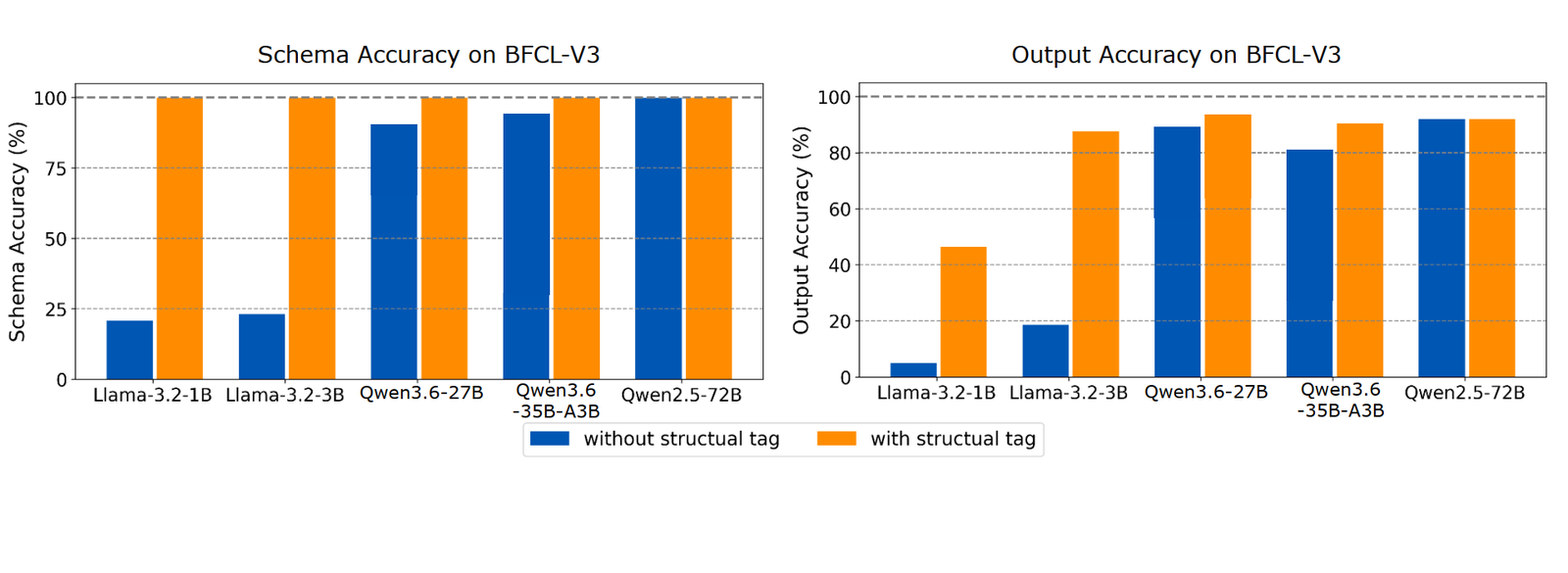
Every output is in exactly one of three states — correct, parses but is wrong, or does not parse — and the two panels pin all three. Decomposed:
The grammar deletes the third state completely. It splits the deleted mass between the other two, and the split is not in its control. For Llama-3.2-1B roughly half the recovered points became correct answers and half became tool calls that parse cleanly and call the wrong thing. For Qwen2.5-72B, which already conformed, the tag changed the score by a tenth of a point downward.
This is the right result and the post is honest about it: "XGrammar is best used to enforce format constraints, not to change the semantics of an LLM's response. It helps downstream programs avoid fatal failures from malformed outputs." Fatal failures, not wrong answers. A malformed tool call throws; a well-formed wrong one runs.
Where the two mechanisms are literally the same construct
The interesting part of the comparison is that it has a fixed point, and it is in XGrammar's type list rather than in anyone's argument.
{ "type": "or", "elements": [
  { "type": "const_string", "value": "refund" },
  { "type": "const_string", "value": "replace" },
  { "type": "const_string", "value": "escalate" }
]}
That is a menu, written as a grammar. OrFormat over ConstStringFormat, both
first-class types in python/xgrammar/structural_tag.py. The equivalent through
JSON Schema is an enum, and XGrammar's C++ converter has a name for exactly this
case:
// cpp/json_schema_converter.cc
bool TryGetFiniteValues(const picojson::object& schema, std::vector<picojson::value>* values) {
  if (schema.count("const")) { values->push_back(schema.at("const")); return true; }
  if (schema.count("enum"))  { /* ... */ return true; }
  return false;
}
// and, above the one-of classifier:
struct OneOfArmProof { enum class Kind { kTypeSet, kFiniteValues }; /* ... */ };
kFiniteValues is the grammar compiler noticing that a fragment of your schema is
a menu. When it fires, the grammar's guarantee and the decision model's guarantee
are the same guarantee, and the token-mask arithmetic is the same
arithmetic — restrict the vocabulary to
the legal continuations, renormalise, sample.
Which is the useful way to think about a real schema: it is a mixture. Some fields are finite and both mechanisms bound them. Some are not, and neither does.
search_products tool call · what a grammar bounds, and what a menu can supply"query": "" or a paragraph of nonsense — both are quoted runs of characters, so both parse. A decision model will not emit either, because neither was on a list. That is why the constructive answer is not one mechanism but a split: enumerate the fields you can, let the grammar bound the shape of the rest, and know which ones are residue, because those are the only ones where a wrong answer looks exactly like a right one.The residue is where the two mechanisms fail in different ways and both fail.
A grammar will emit "query": "" without complaint, because an empty quoted run
is a string. A decision model will not emit it, because it was not on a list —
which is not better, it is just a different failure. The 379-of-385 figure from
the WindTunnel traces is the empirical
shape of that residue in a real agent: nearly every action a bounded model selected
had at least one field it could not fill.
What Structural Tag actually adds over JSON-schema decoding
Constrained decoding against a JSON schema is old. The specific thing XGrammar-2 adds is that the schema and the wire syntax are separated.
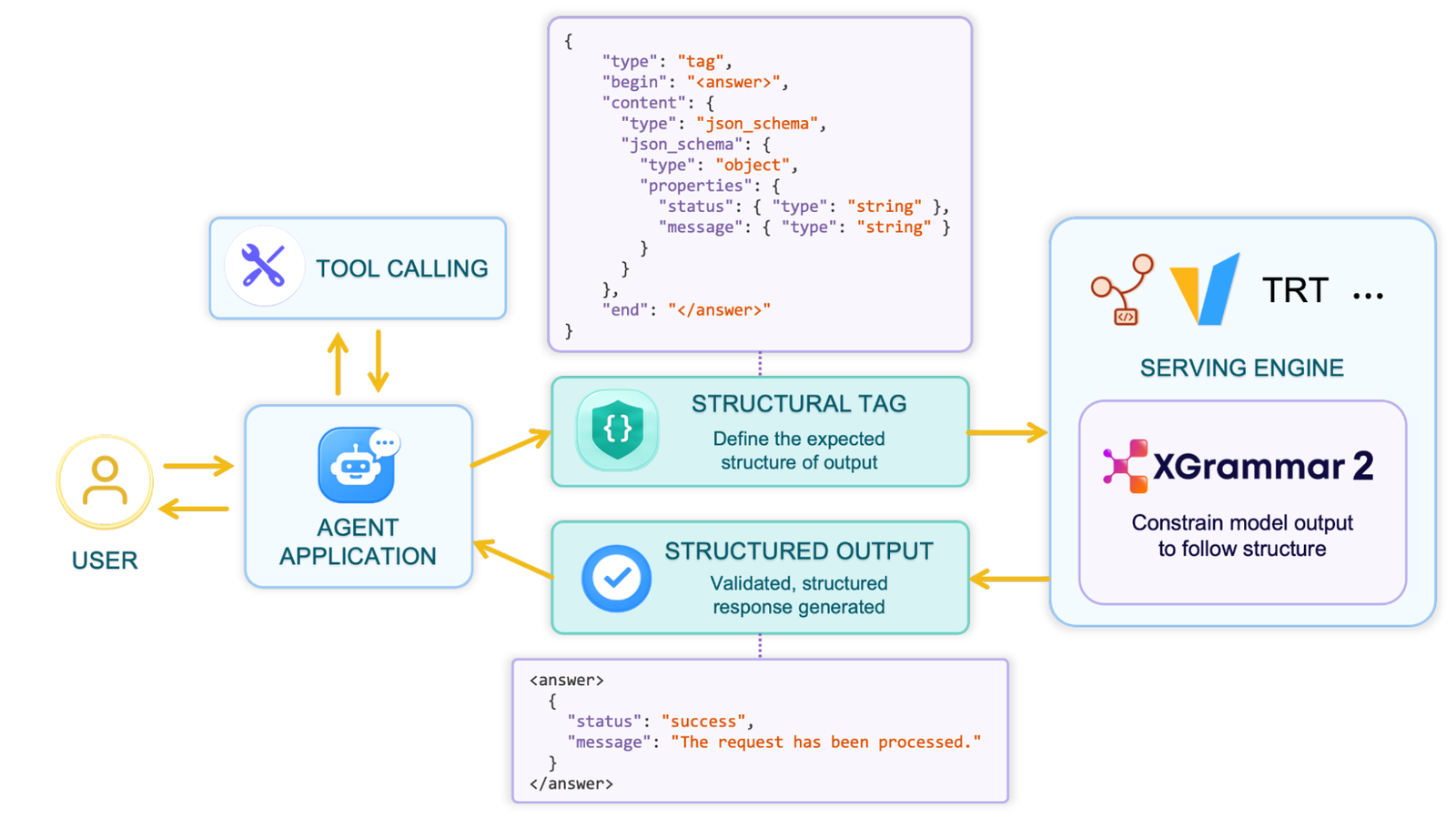
DeepSeek V4 does not emit tool calls as JSON. It emits this:
<|DSML|tool_calls>
<|DSML|invoke name="get_weather">
<|DSML|parameter name="city" string="true">Beijing</|DSML|parameter>
</|DSML|invoke>
</|DSML|tool_calls>
Your tool's schema is still {"city": {"type": "string"}}. The surface syntax is
XML-flavoured with model-specific control tokens. Under a JSON-only constrained
decoder those are two incompatible facts; under Structural Tag they are a
json_schema node with a style:
style | what the arguments look like on the wire |
|---|---|
json | standard JSON |
qwen_xml | <parameter=key>value</parameter> |
minimax_xml | <parameter name="key">value</parameter> |
deepseek_xml | <{dsml}parameter name="key" string="true|false">value</{dsml}parameter> |
deepseek_v4_1_xml | as above, with a space after the control token |
glm_xml | <arg_key>key</arg_key><arg_value>value</arg_value> |
cohere_xml | <cofl:value name="key" type="raw|json|dict|list">value</cofl:value> |
kimi_k3_xml | <|open|>argument key="key" type="type"<|sep|>value<|close|>argument<|sep|> |
minimax_m3_xml | recursive namespace XML |
Nine wire formats, one schema language. That is a lot of accidental complexity to absorb, and absorbing it in one library rather than in nine serving-engine tool parsers is the actual contribution. The post's framing agrees: "Supporting all of these requires significant effort from serving engines and downstream applications, and may still fail to match the official specification."
The second thing it adds is composition. TriggeredTags lets the model write free
text until it emits a trigger string, at which point the output must follow a
structured tag — which is how you express "reason freely, then call a tool
strictly" without constraining the reasoning. That is a shape a JSON schema cannot
describe at all, and it is the shape every reasoning model now has.
The costs, which are real but small
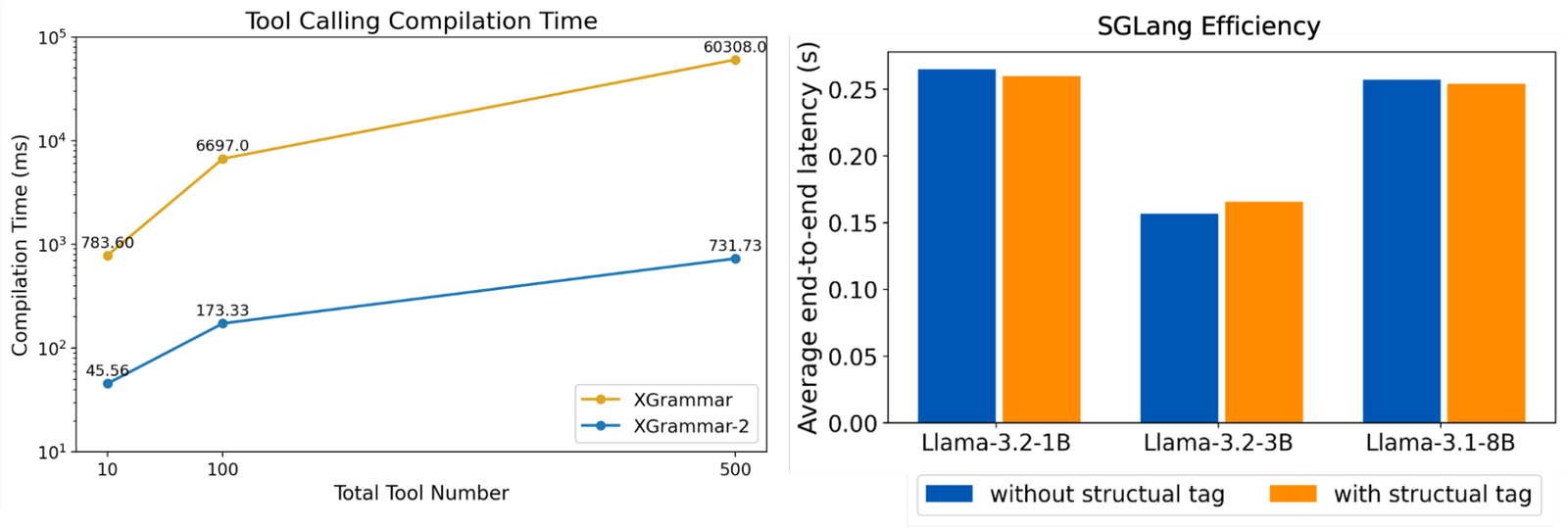
- Compilation. Fifty tools of JSON schema used to be a 6.7-second stall. The
cross-grammar cache (an automaton-based hierarchical hash that finds shared
sub-structures — "nearly 50% of structures end up reused" at 50 tools) and
repetition-state compression (
{"maxItems": 1000000}from to , 534 ms to 5.37 ms) take 500 tools from 60.3 seconds to 0.73. That is the 80×. - Per token. Near zero, and signed both ways in the published bars. The mask comes from a precomputed token-mask cache, so the common case is a lookup.
- Against speculative decoding. This is the one that would bite, and it is the
one the post spends most engineering on. A draft tree has to be masked
node-by-node on the CPU while the GPU verifies it; done serially that is a stall
per round.
traverse_draft_treewalks the whole tree once and emits masks for every node, so the CPU work overlaps the GPU verify. Given how much of modern serving is now speculative, a constrained decoder that serialises against the draft verify is not deployable, and this is the fix.
What this does not settle
The comparison has a limit worth stating, because the two mechanisms are not substitutes for each other on any axis except "stop the invalid output".
Constrained decoding does not calibrate. Masking renormalises the softmax over the legal subset, which is exact arithmetic and says nothing about whether the resulting probability means anything. The subset softmax is exact and it is not calibrated, and that is precisely the distinction RLCD's name collision obscures: a decoder-side constraint and a training-side calibration property are orthogonal, and you can have either, both, or neither.
A decision model does not parse. It returns an index and a probability. If you want JSON out of it you write the JSON yourself, from the option you selected, which is trivially correct and is the reason that architecture never has a parse bug.
Nothing here judges the semantics. Both mechanisms narrow the space and neither ranks what is left. The 46.5% output accuracy on a constrained Llama-3.2-1B is a statement about the model, and no grammar is going to move it.
The honest composition, then, is the one the WindTunnel repository arrived at by necessity and the one XGrammar's type list supports directly: enumerate every field you can, constrain the shape of the rest, and keep a list of which fields are residue — because those are the ones where a confidently wrong answer is indistinguishable, to your program, from a right one.
What I would take away
- "100% schema accuracy" and "the model got it right" are different claims and the same figure carries both. Ask which one a structured-output vendor is quoting.
- A grammar's guarantee is unconditional and narrow. Zero probability on invalid continuations is not a 99%; it is a proof. That is worth a great deal, and it is worth exactly nothing about correctness.
- Look for the
enum. Every place a schema enumerates its values is a place the two mechanisms coincide and both guarantees apply. Every freestringis a place neither does. That audit takes ten minutes and tells you where your agent will fail quietly. - Check the speculative-decoding path before adopting a constrained decoder. If masking does not overlap the draft verify, constrained decoding costs you the speculation, which on current serving stacks is a larger number than anything the grammar saves.
Related reading: why RLCD is not constrained decoding; what a decision model cannot do, whose WindTunnel split is the residue measured in the wild; parallel constrained decoding from first principles, which builds the mask in forty lines; and SGLang's jump-forward decoding, which is the same compiled-FSM machinery used for a different purpose and is currently dead code.
What would change my mind
6 claims above, and what would falsify each
Constraining Llama-3.2-1B took schema accuracy from ~21% to 100% and output accuracy from ~5% to ~46.5%, so roughly half the recovered mass became parseable-and-wrong.
Read off the two bar charts in the post's Figure 1, to the nearest half point, which is the weakest link in this article. The decomposition assumes output accuracy counts a subset of schema-conforming calls — that a call scored correct must also conform. If BFCL-V3's output-accuracy metric can credit a call that fails schema validation (via a lenient parser, say), the three states are not disjoint and the arithmetic is wrong. The post's evaluation scripts are linked from it; running them would settle both the readings and the metric definition.
A grammar and a menu coincide exactly where the grammar enumerates a finite set, and XGrammar implements that case explicitly.
python/xgrammar/structural_tag.pydefinesOrFormatandConstStringFormatas first-class types;cpp/json_schema_converter.cchasTryGetFiniteValues, which returns true forconstand for a non-emptyenum, and anOneOfArmProofwhose kinds arekTypeSetandkFiniteValues. Read at commit40ef651. If those are an optimisation pass rather than the semantics — that is, if a schemaenumcompiles to something that admits values outside the list on some path — the equivalence is weaker than I have claimed, though a grammar could still be written by hand to enforce it.Structural Tag's real contribution over JSON-schema constrained decoding is separating the schema from the wire syntax.
JSONSchemaFormat.styletakes nine values instructural_tag.py, andbuiltin_structural_tag.pyregisters nineteen model formats. That is evidence of the feature existing, not of it being the most valuable one. A reasonable person could rank the cross-grammar cache higher — 60.3 seconds to 0.73 at 500 tools is a deployability threshold, not a percentage — and I would not argue hard.A grammar guarantees the output parses but cannot make it correct, and the post agrees.
The post's own sentence: "XGrammar is best used to enforce format constraints, not to change the semantics of an LLM's response." If someone demonstrates a grammar construction that reliably raises semantic accuracy beyond eliminating format failures — by pruning branches that lead to known-bad continuations, say, which is a thing a grammar could in principle encode — then the guarantee is broader than I have drawn it. The BFCL numbers are the evidence against; they are five models on two subsets.
Per-token overhead is near zero, and signed both ways.
The post's SGLang latency bars show Llama-3.2-3B slower with the tag (about 0.157 to 0.166 s) and the 1B and 8B marginally faster. The qualifier is the post's own: "in a single-batch setting with warm-up and comparable output lengths." Batch serving with cold grammars and long tool lists is a different regime and nobody has published it. If the mask lookup contends at batch 256 the way the compile step used to contend at 500 tools, "near-zero overhead" is a single-stream claim only.
The residue — fields neither mechanism bounds — is most of a real agent's tool arguments.
This site's WindTunnel read: 385 of 413 selected actions needed a second model, and 379 of those carried at least one
stringproperty with noenumand noconst. One benchmark, one harness, one family of websites. A codebase whose tools are written enum-first would have far less residue, and the interesting unpublished number is what that distribution looks like across real MCP servers.
Read from the XGrammar-2 post of 4 May 2026 and
mlc-ai/xgrammar at commit 40ef651 — 22 format types in python/xgrammar/structural_tag.py, 19 registered
model formats in builtin_structural_tag.py, the finite-value classifier in
cpp/json_schema_converter.cc. Chart values are read off the published figures. No
model was run.