2026-09-18 · 34 min · inference · structured-generation · calibration · llm · explainer
Ask a model to fill in a JSON schema the ordinary way and it types the whole thing out, character by
character: {, "risk_level", :, "HIGH", ,, "requires_escalation", :, "true", } — one
forward pass per token, 150 to 500 of them for a real schema, latency growing with every field you add.
Nothing stops the model from typing an unmatched brace, a missing comma, or a value that isn't in your
enum. This got a name — Parallel Constrained Decoding (PCD) — after Niels Rogge (Hugging Face)
published a visual walkthrough of it built from a Qwen2.5 release calling itself RLCD, and TypeSafe's
closed product Jev made the same pitch commercially. The mechanism underneath is small enough to
fit on one page, needs no training to exist at all, and — verified against two independent, real
implementations below — has at least one place where getting the bookkeeping wrong silently returns
the wrong answer while still printing "100% valid JSON." This article is that mechanism: how it works,
what it costs, how you'd calibrate or train one, and runnable code for all three. The product claims
around Jev itself are a separate question, covered in Jev and the System-One
model — this piece stays with the mechanism.
- task
- text-generation
- library
- mlx
- license
- apache-2.0
- largest file
- 16.2 kB
- files
- 26
- downloads
- 0
- likes
- 299
- languages
- en
26 files, 0 downloads, usedStorage: 0 — the Hub's own base_model tag calls it a finetune of Qwen2.5-1.5B-Instruct, but it ships no safetensors or GGUF shards to back that up.
repo last modified 2026-09-16
The seven steps, once
Work through one field with a concrete example: a support-ticket triage schema asking for
"risk_level", one of HIGH, MEDIUM, LOW, or NONE. Every stage below is real — the token IDs are
Qwen2.5-1.5B-Instruct's actual tokenizer output, checked directly against tokenizer.json, not
approximated. The one thing to watch for as you click through: step 5 has a surprise in it.
1 — Prefill once. Run the system prompt (a compact catalog of every field the schema asks for), the user's context document, and the start of the assistant turn through the decoder a single time. Every layer writes its keys and values into a KV cache — Qwen2.5-1.5B has 28 layers, so that's 28 cache entries, one per layer, each holding every token's key/value vectors. Nothing about a specific field has happened yet; this pass only has to happen once no matter how many fields the schema has.
Repeat steps 2–7 for every other field in the schema — all of them branching off the same cached prefill from step 1 — and the whole schema is filled in after one prefill plus one cheap pass per field, no bracket, quote, or comma ever generated by the model. Since the JSON is assembled programmatically from the winning choices rather than typed out and parsed, it's syntactically valid by construction. That's the whole trick, and it needs nothing more exotic than logits you were already computing. Whether it's correct is a different claim from whether it's valid syntax — the gap between those two is most of what the rest of this article is about.
TypeSafe's own documentation publishes this shape at a size that makes the point better than a
four-option enum does. Its line-by-line search cookbook tags all 218 clauses of GitHub's Terms of
Service with an ID, then sends one request whose Choice question carries all 218 IDs as options,
alongside a second question asking separately whether the document answers the query at all — one
shared state, every candidate scored off it:
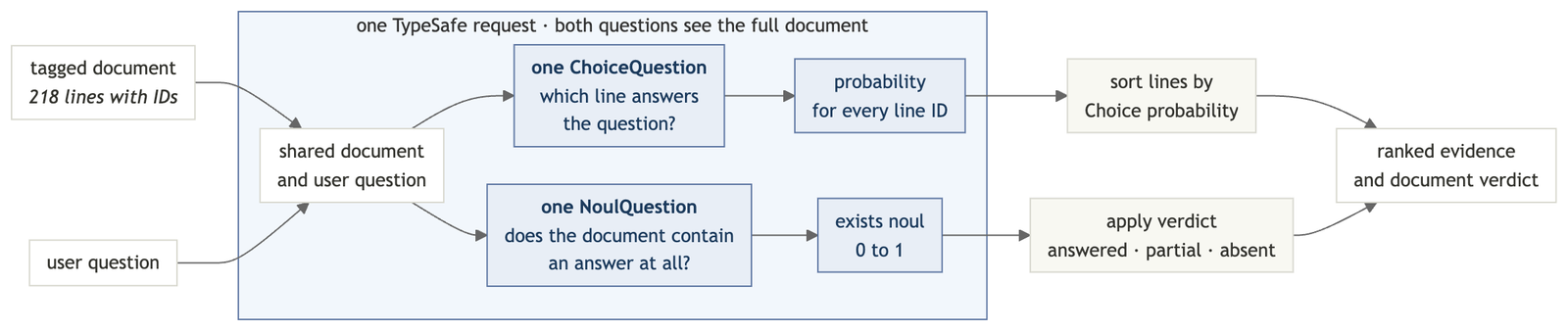
Two details in that recipe are worth carrying into the rest of this article. The first is a documented
ceiling: "A Choice question accepts up to 255 options," past which the cookbook tells you to search
in two passes — one question picks a window of lines, a second ranks the lines inside it. That 255 is
the same number the RLCD repo's high_cardinality_255.json preset picks for its own headline
benchmark, which is unlikely to be a coincidence. The second is the ID scheme: line_id(i) returns
f"L{i:03d}", so the options are L000, L001, … L217 — zero-padded, fixed width, and every single
one of them starting with the same character. Hold onto that shape; it is exactly what breaks the
first-token scoring one of the two open implementations below actually ships.
A minimal, runnable implementation
Here's the mechanism above as one function — prefill, cache broadcast, candidate-row gather, subset
softmax — trimmed to the essentials. It's ~40 lines, uses only transformers, and will run on CPU
(slowly) or GPU against the real Qwen2.5-1.5B-Instruct checkpoint:
import torch
from transformers import AutoModelForCausalLM, AutoTokenizer

MODEL_ID = "Qwen/Qwen2.5-1.5B-Instruct"
tok = AutoTokenizer.from_pretrained(MODEL_ID)
model = AutoModelForCausalLM.from_pretrained(MODEL_ID, torch_dtype=torch.bfloat16).eval()


@torch.no_grad()
def pcd(context: str, fields: dict[str, list[str]]) -> dict[str, tuple[str, float]]:
    # 1. Prefill the shared context + schema ONCE, keep the KV cache.
    prefix = (f"<|im_start|>system\nExtract the requested fields.<|im_end|>\n"
              f"<|im_start|>user\n{context}<|im_end|>\n<|im_start|>assistant\n{{\n")
    prefix_ids = tok(prefix, return_tensors="pt").input_ids
    cache = model(prefix_ids, use_cache=True).past_key_values  # legacy tuple-of-(key, value)

    # 2. One short suffix per field, e.g.  '  "risk_level": "'
    suffixes = [f'  "{name}": "' for name in fields]
    suf_ids = [tok(s, add_special_tokens=False).input_ids for s in suffixes]
    width, pad = max(len(s) for s in suf_ids), (tok.pad_token_id or tok.eos_token_id)
    batch = torch.tensor([s + [pad] * (width - len(s)) for s in suf_ids])
    M = batch.shape[0]

    # 3. Broadcast the ONE cache to M rows, then run ONE batched forward pass for every field.
    bcache = tuple((k.repeat(M, 1, 1, 1), v.repeat(M, 1, 1, 1)) for k, v in cache)
    attn = torch.cat([torch.ones(M, prefix_ids.shape[1], dtype=torch.long),
                       (batch != pad).long()], dim=1)
    logits = model(batch, past_key_values=bcache, attention_mask=attn).logits

    # 4-7. Per field: last real position -> candidate rows -> subset softmax -> argmax.
    out = {}
    for i, (name, choices) in enumerate(fields.items()):
        pos = len(suf_ids[i]) - 1
        row = logits[i, pos, :]
        cand_ids = [tok(c, add_special_tokens=False).input_ids[0] for c in choices]
        probs = torch.softmax(row[cand_ids], dim=-1)
        winner = int(probs.argmax())
        out[name] = (choices[winner], float(probs[winner]))
    return out
One prefill call, one batched call, done — no matter whether the schema has one field or thirty. Real
production code (both repos below) uses the newer Cache object's own broadcast method rather than a
raw tuple of tensors — DynamicCache.batch_repeat_interleave(M) — but the shape of the idea, and the
.repeat(M, 1, 1, 1) fallback for the plain-tuple format, is exactly what's happening either way.
Multi-token candidates: the part the diagram skips
The visual explanation this article is built from shows four clean, single-token boxes lighting up.
It doesn't show what happens when a candidate isn't one token — and as step 5 above just demonstrated
with real tokenizer output, that's not a rare edge case; it's MEDIUM in the article's own example.
So: what does real, shipped code actually do about it?
harshatheg/Qwen-2.5-1B-RLCD — the inference engine behind the Qwen2.5 RLCD release (26 files, 0
downloads, usedStorage: 0; it runs stock mlx-community/Qwen2.5-1.5B-Instruct-4bit at inference
time, per core/engine_mlx.py's own MODEL_ID) — handles it with a real trick, not a hack: hoist the
choices' common prefix into the suffix text itself, so the model only has to disambiguate the first
token of each remainder. One metadata note worth flagging on its own, in the spirit of checking a
repo's numbers against what it actually ships: the Hub's own base_model tag declares this a
finetune of Qwen2.5-1.5B-Instruct, but zero safetensors or GGUF shards back that claim up — there
is no retrained checkpoint anywhere in the repo, only inference code over the stock instruct model.
"Finetune" here is a discoverability tag, not a description of what's inside.
# core/schema.py:156-168 (harshatheg/Qwen-2.5-1B-RLCD)
prefix = os.path.commonprefix(fdef.choices)
suffix = f'  "{fname}": "{prefix}'
cands = []
for c in fdef.choices:
    rem = c[len(prefix):]
    c_toks = tokenizer.encode(rem, add_special_tokens=False)
    cands.append(c_toks[0] if c_toks else tokenizer.encode('"', add_special_tokens=False)[0])
...
has_collisions.append(len(set(cands)) < len(cands))
For ["HIGH", "MEDIUM", "LOW", "NONE"] the common prefix is empty, so this degrades to plain
first-token scoring — which is exactly why MEDIUM is silently reduced to its M token. But for
choices that actually share a prefix it's a genuinely good idea: ["TIER_1", "TIER_2", "TIER_3"]
hoists "TIER_" into the suffix text ( "action_tier": "TIER_), and the candidates become the first
token of each remainder — 1, 2, 3 — which are trivially distinct. When a remainder is empty
(one choice is itself a prefix of another, e.g. ["CANCEL", "CANCELLED"] → common prefix "CANCEL",
remainder "" for CANCEL), the code falls back to the closing-quote token, which is exactly correct
since that value genuinely ends there. It's a real, verified, well-designed answer to the "what if the
common prefix is longer than one token" case — it just doesn't do anything for the disjoint-prefix
case, which is MEDIUM.
This is still a first-token-only approximation of a multi-token value's probability, and the
schema's own file has a second, more careful path sitting right next to it —
compile_candidate_tokens / extract_calibrated_probabilities, which expand surface variants
(true/True/TRUE/yes) and take a max over them — but grepping both engine files confirms neither
name is ever called. StructuredSchema is constructed without a tokenizer at every real call site
(app.py, core/benchmark.py), so the more careful function never runs; the only path actually wired
into inference is the first-token one above. It's dead code, not a hidden fallback.
There's a better answer to "how do you score a multi-token candidate," and it doesn't need to give up on staying parallel: since you already know each candidate's exact token sequence, you can teacher-force all of them in one more batched pass — no sampling, no autoregressive loop — and sum (or length-normalize) their real log-probabilities:
def score_multitoken_candidates(model, tok, cache, prefix_len, suffix_ids, candidates: list[list[int]]):
    """Score each candidate's FULL token sequence via teacher forcing — still one
    batched forward pass, still no sampling. candidates: one token-id list per choice."""
    width, pad = max(len(c) for c in candidates), (tok.pad_token_id or tok.eos_token_id)
    rows = [suffix_ids + c + [pad] * (width - len(c)) for c in candidates]
    batch = torch.tensor(rows)
    K = batch.shape[0]
    bcache = tuple((k.repeat(K, 1, 1, 1), v.repeat(K, 1, 1, 1)) for k, v in cache)
    attn = torch.ones(K, prefix_len + batch.shape[1], dtype=torch.long)

    logits = model(batch, past_key_values=bcache, attention_mask=attn).logits
    log_probs = torch.log_softmax(logits, dim=-1)

    start = len(suffix_ids) - 1  # position that predicts candidate token 0
    scores = []
    for k, cand in enumerate(candidates):
        lp_sum = sum(log_probs[k, start + i, cand[i]].item() for i in range(len(cand)))
        scores.append(lp_sum / len(cand))  # length-normalized — see below
    return scores  # softmax these, same as any other logit set
The length normalization (/ len(cand)) matters: summing raw log-probs without it systematically
penalizes longer candidates purely for having more tokens to be right about — the same reason beam
search divides by length. Without it, MEDIUM (2 tokens, each contributing a log-prob ≤ 0) would start
at a structural disadvantage against HIGH (1 token) even if the model is equally sure about both.
openjev (TheoLeeCJ/openjev) sidesteps the whole problem a third way: instead of scoring a candidate's natural label at all, it remaps every option to a synthetic single uppercase letter and verifies the round-trip before trusting it:
# src/openjev_phase1/direct.py:13-22 (TheoLeeCJ/openjev)
def _slot_ids(tokenizer, count: int) -> list[int]:
    result = []
    for letter in LETTERS[:count]:
        encoded = tokenizer.encode(letter, add_special_tokens=False)
        if len(encoded) != 1 or tokenizer.decode(encoded) != letter:
            raise ValueError(f"Answer slot {letter!r} is not one exact round-trip token")
        result.append(encoded[0])
    if len(result) != len(set(result)):
        raise ValueError("Answer-slot tokens collide")
    return result
This is the cleanest fix for both the multi-token and the collision problem at once — every option is provably one token, defensively checked, every time. The tradeoff is that the model is now being asked to answer "A", "B", "C"... rather than write the label it actually means, which spends a little of the prefill on teaching it the legend and is one small step further from "the model just says the thing" than reading its natural-label logits directly.
The subset softmax is exact — that's not the same as calibrated
Step 6 renormalizes over only the candidate logits. Is that a different distribution than "the model's real next-token distribution, restricted to those tokens"? Write it out: if is token 's logit and is the candidate set,
— the normalizer (the sum over the entire 151,936-row vocabulary) cancels exactly. The subset
softmax is the model's own conditional probability, given that the answer is restricted to , with
no approximation anywhere in that step. That sounds like it should be reassuring, and it explains why
these numbers look so clean — but being an exact conditional distribution under the model and being
calibrated (matching how often the answer is actually correct) are unrelated properties. Discarding
151,932 rows doesn't make the surviving 4 any more truthful; it just stops competing tokens from
diluting them. In fact it can look more confident than it should: in the full 151,936-way softmax,
probability mass for "the answer is HIGH" is split across every surface form the tokenizer has for
it — HIGH, HIGH, High, high — each siphoning off a little. Collapsing to the one canonical
candidate token discards that competition and mechanically inflates the reported number, independent
of whether the model actually understood the ticket. A model can report 96% and be wrong. openjev's own
committed measurements catch this directly — one real bin of predictions came in at 83% mean
confidence and 0% accuracy, three-for-three wrong, on data collected before evaluation (see the
calibration section below). Every result row openjev writes carries the same disclaimer for exactly
this reason: "probability_status": "conditional option score; uncalibrated as decision confidence".
The real limitation: fields can't see each other
Every field in a schema branches off the same cached prefill from step 1 — computed once, before any
field's value existed. That means no field's suffix pass can ever condition on another field's answer,
because at the moment every suffix pass runs, no other field has been decided yet. Contrast that with
plain autoregressive generation: once the model has typed "risk_level": "HIGH", that literal text is
now sitting in the context, and whatever token comes next — including the start of the next field's
value — is generated conditioned on having just committed to HIGH. Slow, but genuinely coupled.
Take the fintech-fraud preset both repos ship variants of: a field risk_tier and a field
recommended_action. If the evidence is damning, you'd want recommended_action to be something
drastic exactly because risk_tier came out CRITICAL. Under PCD, both fields are scored from the
identical, unconditioned snapshot of the context — recommended_action's distribution reflects the
model's prior guess given only the raw evidence, never given the fact that risk_tier is actually
going to ship as CRITICAL. Nothing in the mechanism checks that the two answers are mutually
consistent, and nothing resolves it if they aren't — a schema can come back internally contradictory
and still be reported as "100% valid JSON," because validity here is a syntax guarantee, not a
semantic one. The support-triage preset both repos' presets include is the sharpest version of this: 28
fields, several of them (severity_tier, assigned_agent_tier, suggested_action) exactly the kind
of chain a human triager would resolve in order, all scored independently and simultaneously here.
Neither implementation checks for this.
There isn't a free fix — resolving it means giving something up. Feed each newly-decided field's value back into the context and re-prefill before scoring the fields that depend on it, and you've recovered sequential coupling for that group at the cost of exactly the extra prefill passes PCD exists to avoid. The reasonable middle ground is to actually use that independence: score genuinely independent fields in the one parallel batch this mechanism is built for, and only chain the handful of fields you know are coupled, sequentially, a small group at a time — spending sequential passes only where the coupling is real instead of on the field count.
Where the two real implementations disagree
Everything above about collisions — has_collisions[i] = len(set(cands)) < len(cands), computed once
per field in compile_parallel_metadata — sets up the sharpest, fully verified finding in this
article. What each engine does with that flag is not the same:
# core/engine_mlx.py:364-419 (harshatheg/Qwen-2.5-1B-RLCD) — the MLX / Apple Silicon path
if not has_collisions[i]:
    scores = [float(field_logits[tid]) for tid in cand_tokens]
    ...  # ordinary subset softmax, as above
else:
    # Fast direct cache slice disambiguation: up to 4 sequential greedy decode
    # steps on a per-field cache slice, multiplying per-token probabilities.
    for _ in range(4):
        nxt = int(mx.argmax(cur_logits))
        ...
        probs_prod *= p_tok
        if '"' in nxt_str or '\n' in nxt_str or ',' in nxt_str:
            break
        gen_toks.append(nxt)
        out_step = model(mx.array([[nxt]]), cache=f_cache)  # one more real forward pass
        ...
    ...
    matched = next((c for c in fdef.choices if gen_val.startswith(c) or c.startswith(gen_val)), None)
    ...
    w_prob = round(max(min(probs_prod, 0.9999), 0.75), 4)  # clamped into [0.75, 0.9999]
# core/engine_torch.py:87-89, 141-148 (harshatheg/Qwen-2.5-1B-RLCD) — the PyTorch / CUDA / ZeroGPU path
prefixes = meta["prefixes"]
has_collisions = meta["has_collisions"]
...
# has_collisions and prefixes are never read again anywhere in this file.
for i, (fname, fdef) in enumerate(field_items):
...
scores = [float(field_logits[tid].item()) for tid in cand_tokens] # unconditional gather
scores_t = torch.tensor(scores, dtype=torch.float32) / max(temperature, 1e-4)
probs = F.softmax(scores_t, dim=-1).tolist()prefixes and has_collisions are unpacked in engine_torch.py and then never referenced again — a
plain grep across the file confirms it. On a collision, the MLX path drops into a bounded,
autoregressive continuation to actually disambiguate; the CUDA/ZeroGPU path — the one the public
Hugging Face Space and any cloud deployment actually run — does the ordinary gather regardless, on
token IDs that are no longer unique. When two candidates share a first token after prefix stripping,
cand_tokens contains a duplicate ID, field_logits[tid] returns the identical value for both, and
torch.argmax breaks the resulting tie toward the lower index — deterministically, every time,
independent of which choice the model actually favors. This isn't a hypothetical: it's true of the
repo's own shipped enterprise presets.
| Preset | Field | Choices that collide | Shared first token |
|---|---|---|---|
fintech_fraud.json | counterparty_jurisdiction_risk | TIER_1_LOW, TIER_2_MODERATE, TIER_3_HIGH | "T" |
code_security.json | secondary_cwe | CWE_798_HARDCODED_CREDENTIALS, CWE_1104_OUTDATED_COMPONENTS, CWE_200_INFO_EXPOSURE | "C" |
support_triage.json | assigned_agent_tier | TIER_1, TIER_2 | "T" |
support_triage.json | target_resolution_hours | 1_HOUR, 12_HOURS | "1" |
high_cardinality_255.json | customs_category | all 255 choices | "0" / "1" / "2" |
That last row is the one that matters most, because high_cardinality_255.json is the exact preset
the README benchmarks as its headline "high-cardinality" number (89 ms, 5.6×, "100% guaranteed"
validity) — and every one of its 255 tariff codes collides after prefix-stripping, collapsing into
just 3 distinguishable buckets by hundreds-digit. Checked against the real tokenizer directly: 5 of the
40 enum fields across all four of the repo's own shipped presets (12.5%) contain at least one
first-token collision — this isn't a contrived toy case, it's routine for real enum-heavy schemas.
It also isn't a quirk of one repo's preset authoring. The 218 L000-style line IDs in TypeSafe's own
published cookbook, above, are the identical shape: hoist the common prefix L and what's left is
000 through 217, the same digit structure that collapses 255 tariff codes into three buckets in the
row above. That cuts two ways. It says nothing about how Jev is implemented — TypeSafe publishes
nothing at all about its decoding — but it does say that a first-token gather over raw option labels
cannot be what's running behind their own documented recipe, because it would hand back the same logit
for every line in the document. Some remapping step has to exist; openjev's synthetic single-letter
answer slots are one obvious way to build one.
To be fair to the design: for this specific preset, MLX's bounded fallback happens to work, because
the distinguishing digits ("0","0","1" for CAT_001) sit within its 4-step budget and the
resulting partial string still matches uniquely via the startswith check. But that success comes at
a real cost the reported numbers hide: sequential_forward_passes is hardcoded to 1 in both engines'
return dictionaries regardless of what actually ran, and the wall-clock total does include every one
of the extra autoregressive steps the collision fallback performs — meaning a real, if bounded, chunk
of that 89 ms is the exact sequential decoding this design exists to avoid, on the one preset chosen to
headline the technique. The CUDA path, with no fallback at all, would silently return whichever tariff
code within a hundred-block happens to sort first — CAT_000_Live_Animals — no matter what the
shipment actually was, on a schema literally auditing dual-use export compliance.
Two takeaways, stated plainly and fairly: the design the README benchmarks — MLX, Apple Silicon — is
the one that (mostly) handles this correctly; the CUDA/ZeroGPU path most people would actually deploy
behind an API does not. And "confidence" means two different things depending on which branch fired: a
genuine subset-softmax probability on the non-collision path, versus a clamped [0.75, 0.9999] product
of greedy per-token probabilities on the MLX collision path — two different quantities, on different
scales, both surfaced under the same confidence field. For an article about calibrated decisions,
that inconsistency is worth naming directly: a confidence number whose meaning depends on which code
path happened to fire isn't calibrated in any useful sense, whatever the number reads.
Is the headline benchmark itself fair, at least? core/benchmark.py's compare_single runs both the
naive and the parallel path against the same loaded model, same quantization, same hardware, same
context document — that part holds up; the two paths necessarily use differently-shaped prompts (a
full JSON-schema-with-descriptions prompt for naive generation vs. a compact field catalog for PCD),
but that's inherent to comparing the two strategies, not an unfair thumb on the scale. What it isn't is
rigorous: one run per preset, no repeated trials, no confidence interval, and (as above) a pass-count
field that doesn't reflect what actually executed. Compare that to how openjev treats the same kind of
claim next.
openjev's numbers: the honest kind
openjev asks a related but different question — "can something
like Jev run on a 3090 at home?" — and is explicit that it reproduces the interface pattern (typed
options, no decode loop, shared-state reuse), not Jev's undisclosed model or training. It scores a
frozen Qwen/Qwen3.5-4B three ways: direct logits (one forward pass, native answer-slot letters),
serial (cache the shared state once, score branches one at a time), and shared (cache once,
broadcast, score every branch in one batched call — the same idea as steps 1–6 above, just for
decisions instead of JSON fields), plus a Qwen3-Reranker-4B yes/no baseline for comparison. Reusing
one state across many decisions is a real, measured win:
— an 8.6× throughput gain from reuse alone, at the cost of a small, disclosed amount of drift: 5 and 6 of 777 argmaxes (respectively) flipped relative to fresh scoring, attributed to BF16 numerics rather than a logic bug. Quality tells the more interesting story. Direct logits from a completely untrained 4B model beat a dedicated reranker on every general-decision benchmark tried, and land within a few points of TypeSafe's own published Jev numbers on the 102-row subset that could be aligned from public records:
That 3.8-point gap is genuinely close for zero training — and openjev refuses to oversell it: the
sample is small and self-selected, no live Jev endpoint was run, and total-variation distance from the
public reference distributions tells a wider story (direct logits 0.177, published Jev 0.127, reranker
0.444). The perturbation results are the part worth taking most seriously, because they're where a
system that looks solid on a frozen benchmark can quietly fall apart: reverse the displayed option
order while keeping the same semantic IDs, and direct logits' balanced accuracy on 36 owned cases
actually rose from 0.723 to 0.813 — but 10 of the 36 argmaxes flipped to get there, meaning the model
is genuinely sensitive to which position an option is listed in, not indifferent to it the way you'd
want a calibrated decision system to be. And on a 36-row missing-evidence set specifically constructed
so the correct answer is always "insufficient evidence," direct logits made one confident (>0.8)
non-insufficient call anyway — a real, disclosed failure mode, not a hidden one.
Two results are labeled failures outright rather than smoothed into a speed number, which is the
detail worth taking away from this repo more than any of its throughput claims. Asked for a compact
ordered array (["yes","no",...], no keys, one line), naive generation on the same frozen model beat
direct logits' 1.023 s with 5.332 s — a real 5.21× win for the parallel readout — but its own 21-value
answer only agreed with direct logits' argmax on 18 of 21 criteria (0.857), so the speed number and the
semantic-equivalence question are kept separate rather than conflated. Pushed one step further, to a
strictly minified array with no internal spaces, the model never terminated: all three runs hit the
128-token cap still emitting "no" past the 21 required entries —
[..."no","no","no","no","no","no","no","no","no","no","no","no","no","no","no","no","no","no","no— and openjev records this as a failure, not a discounted or padded success, and drops it from the headline comparison entirely. That's the honest half of a speed claim: showing the exact run where the naive baseline you're claiming a speedup over didn't actually finish. It's also the same calibration warning from the subset-softmax section made concrete with real numbers: one of openjev's own committed reliability bins — 3 predictions, mean confidence 0.831 — landed at 0% accuracy. High confidence, entirely wrong, on data collected before anyone looked at the results.
Do you need to train anything?
Mostly, no — and this is the single most useful fact in this whole piece. As the Qwen2.5 RLCD release's author put it plainly: "every LLM has the ability to efficiently batch inference every key of a JSON at the same time and generate probabilities from a set of possible categories. No new training required, but it's easy to optimize if you need!" The seven-step mechanism above is arithmetic on logits any decoder-only model already produces at every position — there's no new capability being trained into anything, which is exactly why a completely untrained Qwen3.5-4B in openjev's benchmarks gets within a few points of a claimed, trained product on real held-out comparisons.
What training — or a much cheaper fit — would buy you is calibration: making the confidence numbers from step 7 actually track how often the answer is right. A reliability diagram buckets predictions by confidence and plots each bucket's real accuracy against it; a perfectly calibrated model sits on the diagonal. Expected Calibration Error (ECE) collapses that plot into one number — the weighted-average gap between confidence and accuracy across bins. openjev's own 0.831-confidence, 0.0-accuracy bin is a reliability diagram with one damning point on it already.
Temperature scaling is the cheapest real fix: keep the model frozen, keep every logit exactly as computed, and fit one scalar that divides every logit before the softmax, chosen to minimize negative log-likelihood on a held-out labeled split. It can't change which answer wins (dividing every logit by the same positive number doesn't change their ranking), only how sharp the winning probability looks — which is precisely the miscalibration this mechanism inherits for free, as shown in the subset-softmax section above.
import numpy as np
from scipy.optimize import minimize_scalar

def fit_temperature(logits: np.ndarray, labels: np.ndarray) -> float:
    """logits: (N, K) candidate logits per example. labels: (N,) index of the gold choice.
    Fits one scalar T minimizing held-out NLL — the cheapest calibration fix there is."""
    def nll(t):
        z = logits / max(t, 1e-3)
        z = z - z.max(axis=1, keepdims=True)
        p = np.exp(z) / np.exp(z).sum(axis=1, keepdims=True)
        return -np.log(p[np.arange(len(labels)), labels] + 1e-12).mean()
    return float(minimize_scalar(nll, bounds=(0.05, 10), method="bounded").x)


def ece(probs: np.ndarray, labels: np.ndarray, n_bins: int = 10) -> float:
    """Expected Calibration Error: weighted-average |accuracy - confidence| per confidence bin."""
    confidence, predicted = probs.max(axis=1), probs.argmax(axis=1)
    correct = (predicted == labels).astype(float)
    total = 0.0
    for lo, hi in zip(np.linspace(0, 1, n_bins + 1)[:-1], np.linspace(0, 1, n_bins + 1)[1:]):
        in_bin = (confidence > lo) & (confidence <= hi)
        if in_bin.sum() == 0:
            continue
        total += in_bin.mean() * abs(correct[in_bin].mean() - confidence[in_bin].mean())
    return total
A concrete recipe you could actually run this week: take a labeled classification set for your own
schema, run PCD over a stock instruct model to collect per-field candidate logits and the gold label
for each row, hold out a split, call fit_temperature on it, and report ece(...) before and after —
that alone turns "conditional option score, uncalibrated" into a number you've actually checked. If you
want more than recalibration — if the ranking itself is wrong, not just its sharpness — the next step
is LoRA-finetuning on exactly the field-suffix positions, which is just ordinary classification through
the LM head, restricted to the candidate columns:
from peft import LoraConfig, get_peft_model
import torch.nn.functional as F

lora_model = get_peft_model(model, LoraConfig(r=8, target_modules=["q_proj", "v_proj"]))

def training_step(batch):
    # batch rows are the same prefix+suffix prompts PCD scores at inference time.
    logits = lora_model(batch["input_ids"], attention_mask=batch["attention_mask"]).logits
    decision_logits = logits[torch.arange(len(batch["gold_idx"])), batch["decision_pos"], :]
    cand_logits = torch.stack([decision_logits[i, ids] for i, ids in enumerate(batch["cand_ids"])])
    loss = F.cross_entropy(cand_logits, batch["gold_idx"])  # classification through the LM head
    loss.backward()
    return loss.item()
On RLCD specifically, stay precise about what's public and what isn't. TypeSafe's documentation
goes a little further than its launch post: an AI-primer page places RLCD as a third post-training
branch beside RLHF and RLVR, and gives it an output contract — the model "does not generate text," it
"returns decisions and probabilities," and "higher probability should correspond to a greater chance
that the answer is correct," with the usual frequentist gloss that outcomes assigned a probability of
0.2 should occur about 20% of the time.
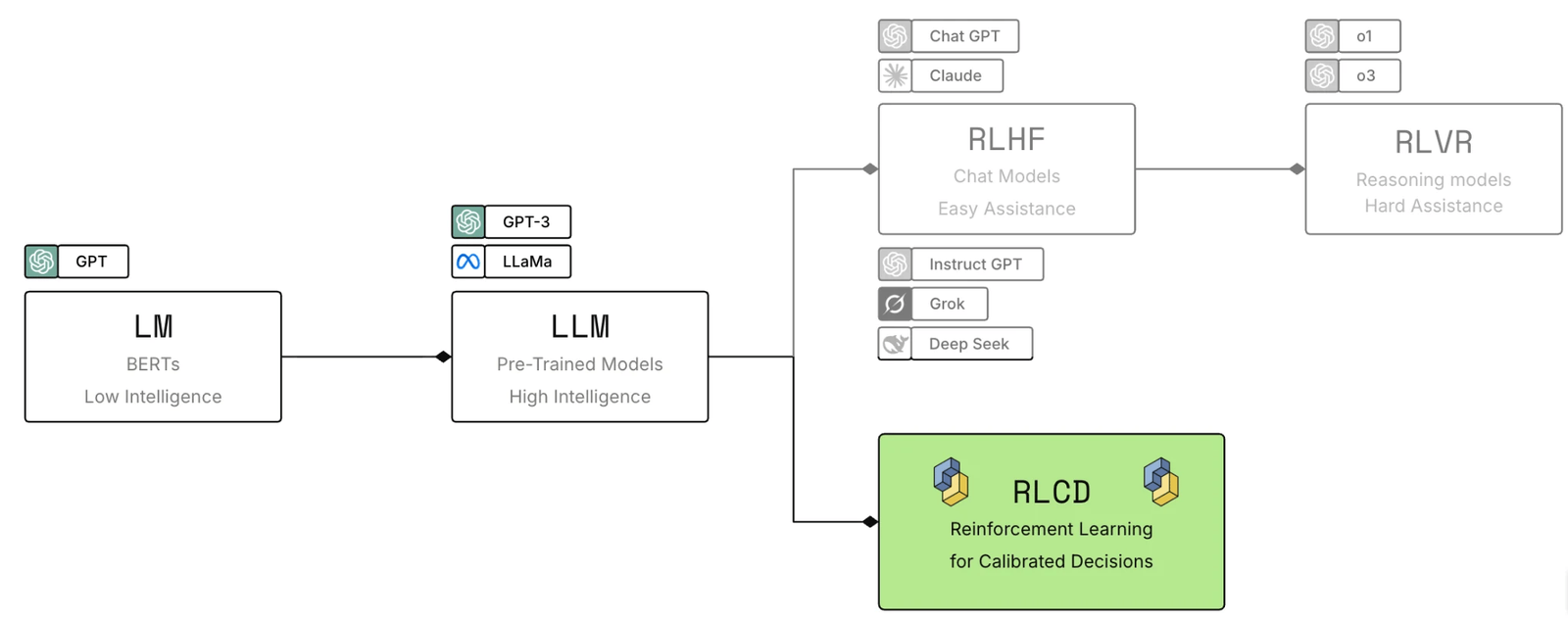
That is the whole published specification, and it is a claim about what the output should satisfy, not about how anything gets trained: no loss function, no reward signal, no training data, no paper, no reproduction. What the same page does publish is the motivation — the argument that preference optimization collapses a base model's distribution onto a single reward-favored mode, which is a real and well-documented failure mode of RLHF and a coherent reason to want a different objective for decisions:
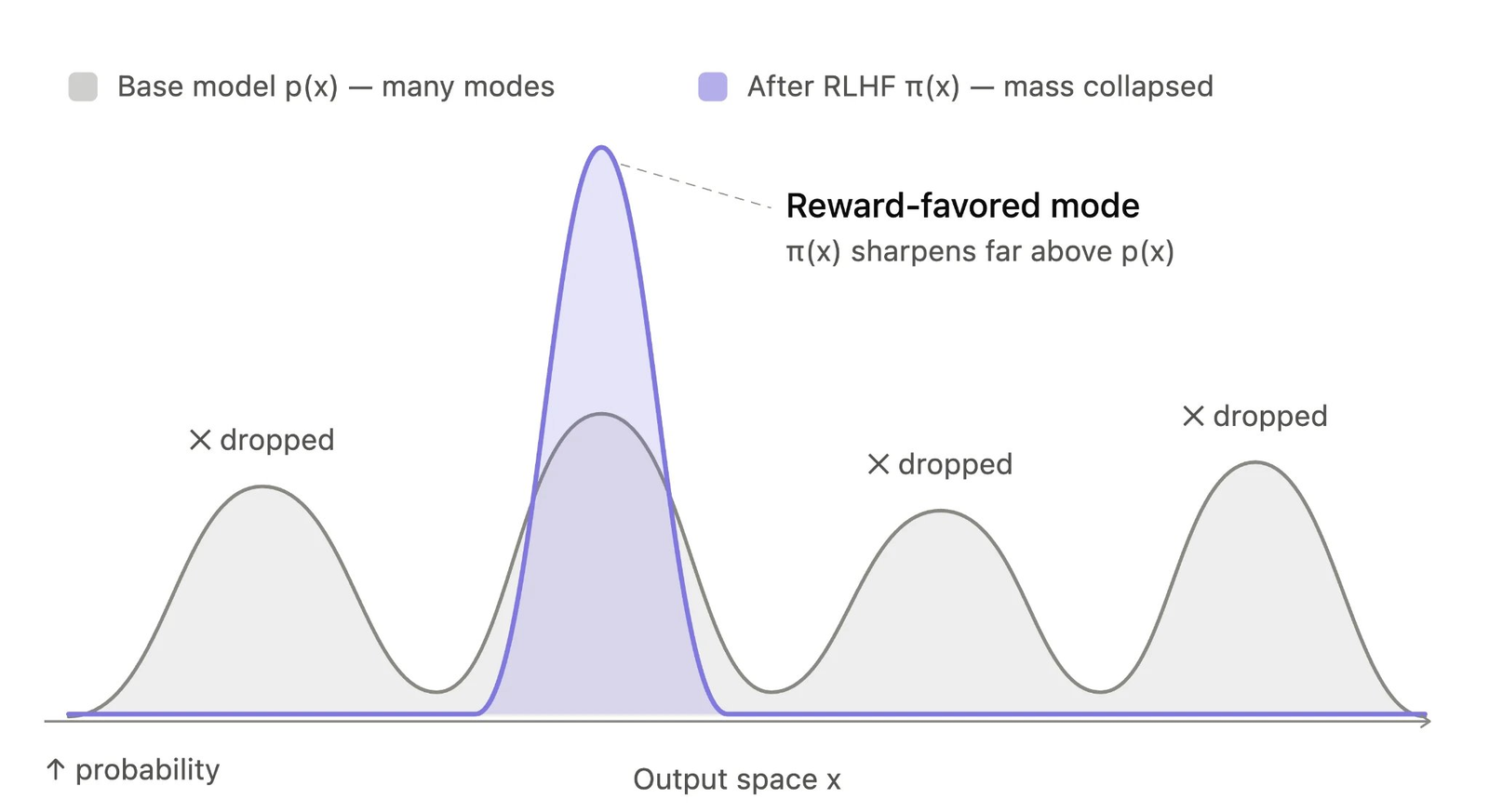
It's a good argument, and it is also, as evidence, roughly the level available for RLCD as a whole. openjev says this plainly in its own results rather than guessing at a method: "RLCD training, [not reproduced] because neither the training data nor a sufficient algorithmic specification is public." Any specific loss function attributed to RLCD beyond that sentence is a guess, including the very reasonable-sounding cross-entropy-through-the-LM-head sketch above — which is offered here as a way to move the needle with LoRA, not a claim about what TypeSafe actually did.
A cost model: when "parallel" stops winning
Put the collision-fallback cost from the divergence section into the same units as everything else — forward passes and modeled latency, as a function of how many fields a schema has, how long its values run, and what fraction of its fields collide:
default 28 / 2 / 13% ≈ the repo’s own 28-field support-triage preset, at the collision rate measured across its four shipped presets. Push collision to 100% and it matches the 255-choice tariff preset — one field, wall-to-wall ties.
With no collisions, PCD’s critical path is flat at 2 passes (one prefill, one batched suffix) no matter how many fields you add — that’s the whole trick. Every colliding field taxes that flat line with up to 4 more sequential steps, which is exactly the autoregressive cost the design exists to avoid. Drag collision rate to 100% to see it erode almost all the way back toward the autoregressive line.
The flat part of that chart is the entire pitch: with zero collisions, PCD's critical path is 2
forward passes — one prefill, one batched suffix call — regardless of field count, while naive
decoding's pass count grows linearly with every field and every token of value length. The part the
chart also shows is the honest caveat from this article's central finding: every colliding field taxes
that flat line with up to 4 more sequential steps, which is precisely the autoregressive cost this
design exists to eliminate. Push the collision slider to 100% and the model reduces almost all the way
back to the line it was built to beat — which is not a hypothetical, it's high_cardinality_255.json's
own headline field, verified above.
The take
The mechanism is genuinely simple: every model already computes logits over its whole vocabulary at every position; restricting those logits to a field's legal values and renormalizing is free arithmetic on numbers you have already, which is exactly why it needs no new training to exist. The real engineering — and the real risk — lives in the bookkeeping around that one idea: how you score a candidate that isn't one token, how you detect and handle two candidates that collide after prefix stripping, and how honestly you report the resulting number as a "confidence." The two real implementations examined here agree completely on the seven-step mechanism and disagree sharply on that bookkeeping — one ships a well-designed collision fallback on the path it benchmarks and a silent tie-break on the path most people would actually deploy; the other never claims calibration in the first place and publishes its own failures alongside its wins. Neither gap is a reason to distrust the idea. Both are reasons to check, on your own schema, which fields collide before you trust what argmax hands back — and to treat "100% valid JSON" as the syntax guarantee it is, not the correctness guarantee it can sound like.
Sources: the visual explanation this article works from is Niels Rogge's (Hugging Face), built from
the Qwen2.5 RLCD release (harshatheg) and its
public README and
MODEL_CARD. Code excerpts
and preset data are quoted directly from that repository's core/ package and presets/*.json, and
from TheoLeeCJ/openjev's src/openjev_phase1/ package and its
committed results/raw/*.json (SHA256-checksummed). All token IDs and collision findings were verified
directly against Qwen2.5's real tokenizer.json and config.json, not assumed. The three figures are
TypeSafe's own, from its public documentation — the line-by-line search
cookbook (recipe diagram, 218-option Choice, the
255-option cap) and the AI primer
(training-paths and mode-dropping diagrams); TypeSafe's launch
post publishes benchmark charts and a
workflow diagram but no decoding or architecture figure, and neither open repository above ships an
image at all. Product claims about
Jev itself are covered separately in Jev and the System-One model.
Interactives, the cost model, and the teacher-forcing/temperature-scaling code are original to this
article.