2026-07-02 · 7 min · inference · quantization · kv-cache
Why read this
Solidtop 85%Why a random rotation lets one data-free quantizer fit every KV vector, how a 1-bit QJL residual removes inner-product bias, and where the idea now ships.
- Runs on a consumer GPU
- Widely used
- A lasting reference
Quantization & compressionPractitioner paper
How this was scored
- Is it new?
- 2 of 3: A real new idea, method or capability
- Can I trust it?
- 0 of 3: Restates claims
- Can I run it?
- 2 of 3: Open code or weights with real limits
- Will I understand it?
- 2 of 3: Mechanism from first principles with figures
- Can I act on it?
- 2 of 3: A concrete recipe, numbers or comparison
- Will it last?
- 2 of 3: A reference for a year or more
- Does it affect many?
- 2 of 3: A widely used model, tool or lab release
- Only here?
- 1 of 3: Some original analysis
Score 54 of 100, ranked 433 of 577 rated articles. Each question is answered 0–3 by hand, and a 3 is rare. How articles are scored
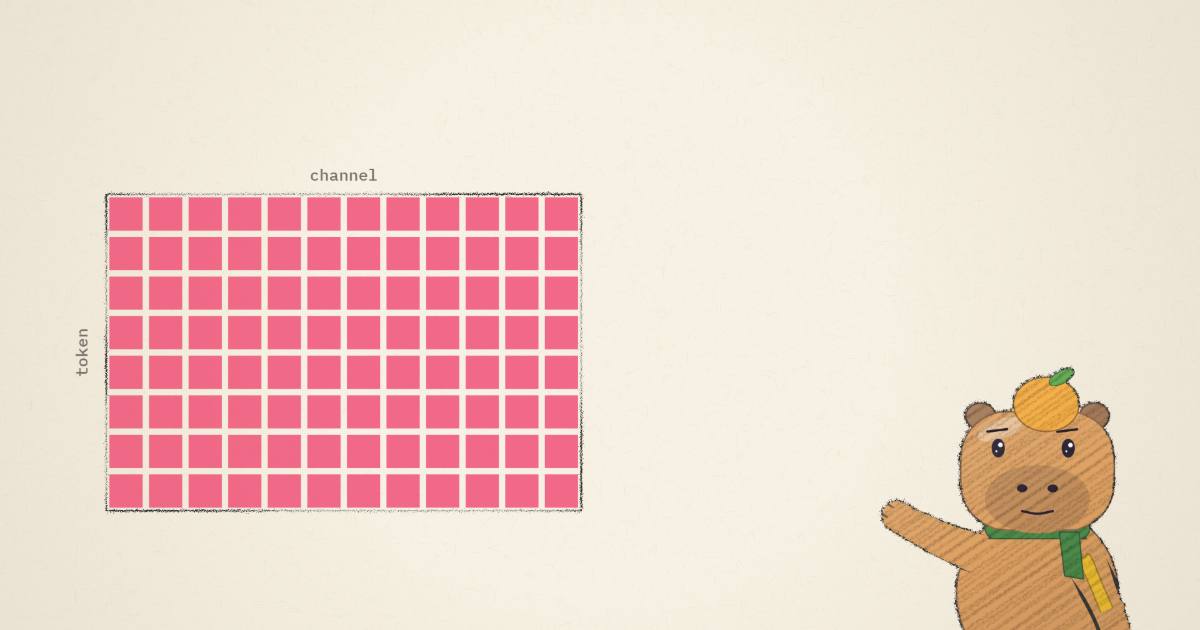
The KV cache runs the economics of LLM serving: it grows linearly with context length, per layer, and it's what decides how many requests fit on a GPU. The obvious lever is to quantize it — store the cached keys and values in 2–4 bits instead of 16. The catch is that key and value vectors have outlier coordinates: a few dimensions carry most of the magnitude, so a fixed set of quantization levels either clips the outliers or wastes precision on the empty middle. The standard fix — calibrate a per-channel quantizer on sample data — doesn't work online, where new tokens stream in and you have no calibration set.
TurboQuant (Zandieh, Daliri, Hadian, Mirrokni — Google Research, arXiv 2504.19874) solves this with one idea: rotate the vector before you quantize it.
Why rotation is the whole trick
Multiply a vector by a random orthogonal matrix and you don't change its length or its inner products with other (equally rotated) vectors — but you do spread its energy evenly across all coordinates. After the rotation, the coordinates of a unit vector provably follow a known Beta distribution, on , which for large tightens to a Gaussian . Every coordinate of every rotated vector looks the same, and there are no outliers left to clip.
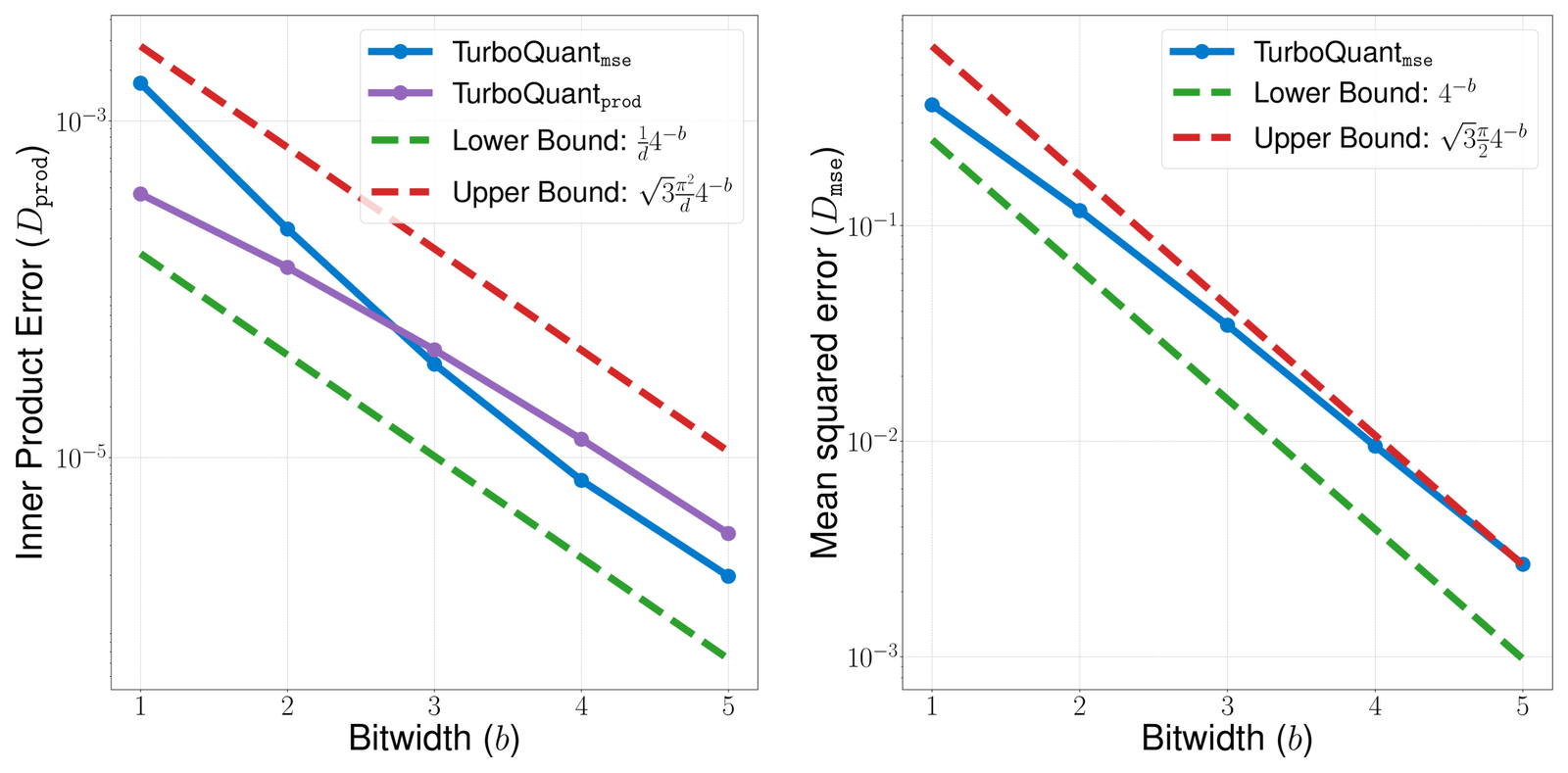
That's what makes the quantizer data-free. Because you know the post-rotation distribution analytically, you can solve for the optimal scalar quantizer (Lloyd–Max: the levels that minimize expected squared error against that Beta density) once, ahead of time, and it's optimal for every vector you'll ever see — no calibration pass, which is exactly what an online KV cache needs. The paper proves this is near-optimal: TurboQuant's distortion is within a small constant factor (about 2.7×) of the information-theoretic lower bound for any vector quantizer, at every bit-width and dimension.
The bias nobody mentions
There's a subtlety the paper is unusually careful about. An MSE-optimal quantizer minimizes reconstruction error — but attention doesn't reconstruct vectors, it takes inner products (query · key) and softmaxes them. And an MSE-optimal quantizer is biased as an inner-product estimator: on average its scores are systematically off, which quietly warps the attention weights. TurboQuant fixes this with a two-stage scheme — quantize with the MSE quantizer, then store the sign of the residual under a random projection (a 1-bit Quantized Johnson– Lindenstrauss transform, from the same authors' earlier QJL work). That 1-bit correction is exactly what cancels the bias, giving an unbiased inner-product estimate:
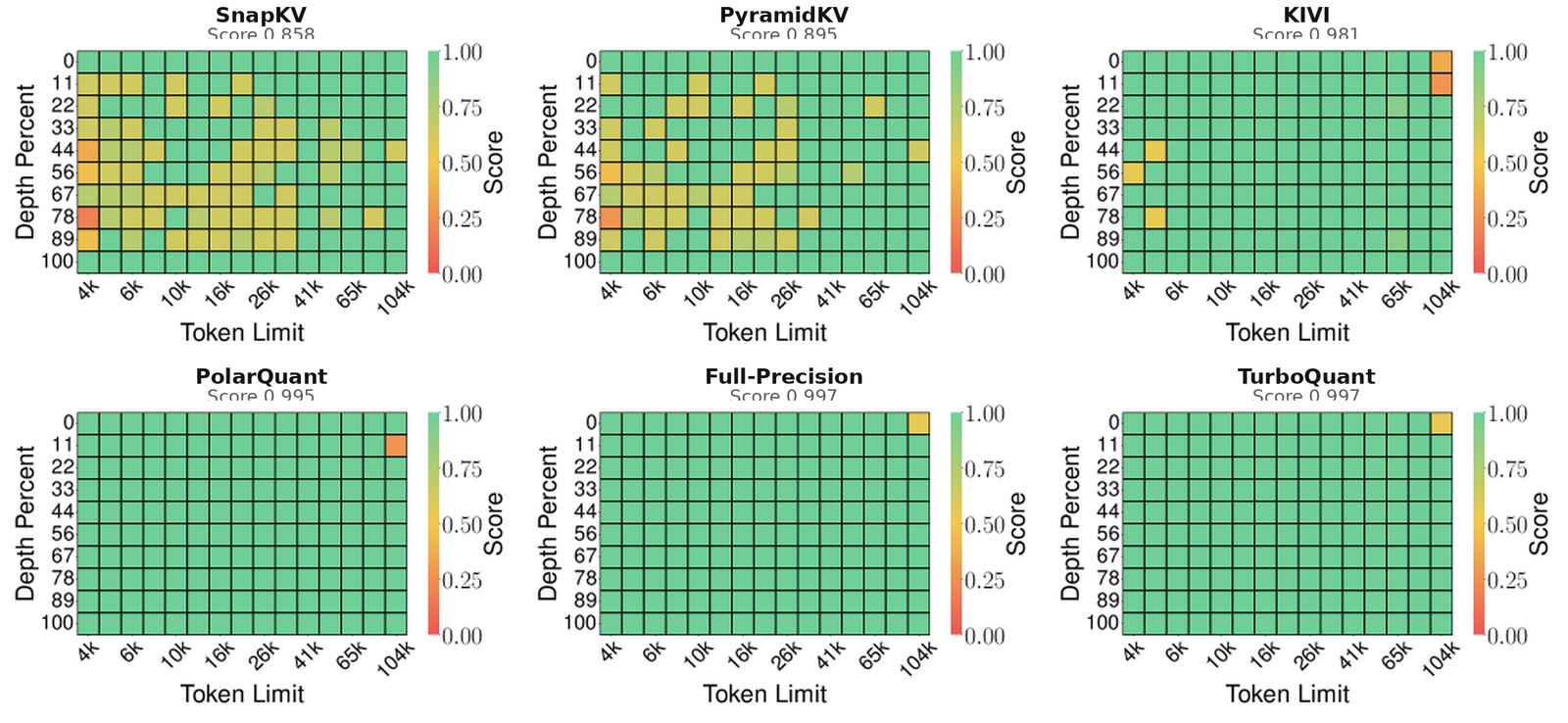
Unbiasedness is the part that lets quality hold at aggressive bit-widths: the paper reports absolute quality neutrality at 3.5 bits per channel, and only marginal degradation at 2.5.
What it costs, what it buys
An implementation (0xsero/turboquant) wires this into
vLLM and makes the tradeoff concrete. It allocates bits asymmetrically — keys get 3 bits
with the unbiased inner-product quantizer (attention scores are precision-sensitive), values get
2 or 4 bits with simpler group quantization (value aggregation is more forgiving). The
reconstruction quality splits cleanly along that line:
Keys reconstruct essentially perfectly; 4-bit values are near-lossless; 2-bit values are where the quality actually gives (0.94), which is why the implementation recommends 4-bit values for anything sensitive. Net, it compresses the full-attention KV cache about 4.4×, and that turns straight into context length:
On the reported runs, that's 30 GB of KV cache freed on a 4-GPU RTX 5090 box and a 2.0× jump in max context (457K → 914K tokens) for a dense model; a MoE model with linear-attention layers gets less (1.45×), because those layers keep a recurrent state that doesn't compress. Throughput barely moves (+5.7% prefill, +3.1% decode) — this is a memory win, not a speed one, and the honest read is that the value comes from fitting longer contexts and bigger batches, not faster tokens. The current build also still allocates a full cache during prefill and only frees it afterward, and its hybrid decode path dequantizes history to fp32 each step — real limitations the repo names outright.
The same algorithm, three places
What makes TurboQuant worth an article isn't just the KV-cache result — it's that "rotate, then quantize with a data-free optimal quantizer" is a general vector-quantization primitive, and it's showing up in very different systems:
- KV cache (
0xsero/turboquant, above): compress the attention cache in vLLM for longer contexts. - Model weights (
turbo-tan/llama.cpp-tq3): aTQ3quantization type that applies the same rotate-then-quantize idea to weights in llama.cpp (see below). - Vector search (
turbovec): the same rotation + Lloyd–Max + bit-packing, in Rust with SIMD kernels, as a FAISS-competitive similarity index — a 10M-vector corpus in 4 GB instead of 31. (Its own write-up is here.)
One paper, one primitive — a quantizer whose optimality comes from reshaping the data into a known distribution first rather than learning a codebook from samples — and it drops into inference caches, weight files, and ANN indexes alike.
TQ3 in llama.cpp: the same idea, on weights
The llama.cpp-tq3 fork adds TQ3_1S / TQ3_4S — 3-bit weight quantization types that run the
TurboQuant pipeline (a Walsh–Hadamard rotation, then Lloyd–Max scalar quantization per block) on
model weights. Worth clearing up a name collision: llama.cpp already ships TQ1_0 and TQ2_0,
but those are ternary formats unrelated to this paper — the "TQ" match is coincidental. TQ3 is
genuinely TurboQuant-based, and at ~3.5 bits per weight it hits Q4-class quality about 10%
smaller (on Qwen3.5-27B, TQ3_4S measures a hair better perplexity than Q3_K_S at ~12.9 GiB),
which is what lets a 27B model run on a 16 GB GPU.
The speedup is the interesting engineering twist. Because TQ3 blocks are 3-bit-after-rotation, they
map cleanly onto FP4 tensor cores on Blackwell-class GPUs — the fork fuses the rotation into an
FP4 activation quantizer and runs the matmul in FP4. Turning that path on roughly doubles
prompt-processing throughput: on an RTX 3090, Gemma-12B goes 737 → 1,819 tok/s (+147%) and
SuperGemma-26B 983 → 2,005 (+104%); on a DGX Spark (GB10), a 27B MTP model goes 360 → 920
tok/s (+155%). That's a rotate-then-quantize weight format turning a hardware FP4 unit into free
speed — the same primitive, paying off a third way. (The exact llama-quantize invocation isn't
documented in the repo yet; the types ship as pre-quantized models on Hugging Face.)
The take
The elegant part of TurboQuant is that the hard problem (outliers, calibration) is dissolved rather than fought. Instead of detecting and special-casing outlier channels, you rotate them away; instead of calibrating on data, you compute the optimal quantizer against the distribution the rotation guarantees. The QJL residual is the tasteful finish — a one-bit patch that turns a good reconstruction quantizer into an unbiased inner-product quantizer, which is the thing attention actually needs.
It's not magic: the KV-cache implementation is a memory win, not a throughput one, 2-bit values visibly degrade, and MoE/linear-attention models compress less. But the underlying result — near-optimal, data-free vector quantization with a formal distortion bound — is the kind of solid primitive that ends up everywhere, which is exactly what's happening.
Built on TurboQuant: Online Vector Quantization with Near-optimal Distortion Rate
(Amir Zandieh, Majid Daliri, Majid Hadian, Vahab Mirrokni; 2025), building on the authors' earlier
QJL work. Implementation details and benchmarks are from 0xsero/turboquant
(GPLv3) and turbo-tan/llama.cpp-tq3.