2026-08-06 · 11 min · agents · memory · context-management · open-source · retrieval · explainer
TencentDB Agent Memory is Tencent Cloud's open-source memory layer for coding agents — MIT, TypeScript, about 148,000 lines across three services, with adapters for OpenClaw, Hermes, Claude Code and CodeBuddy. The pitch is the one every agent-memory product makes: stop re-explaining your project to every new session.
The pitch is not the interesting part. The interesting part is a decision buried in a source comment, which reframes the whole design and is worth stealing whether or not you ever run this software.
The pyramid everyone builds
Start with what the README shows you. Conversations are captured raw and refined by an async pipeline into four levels:
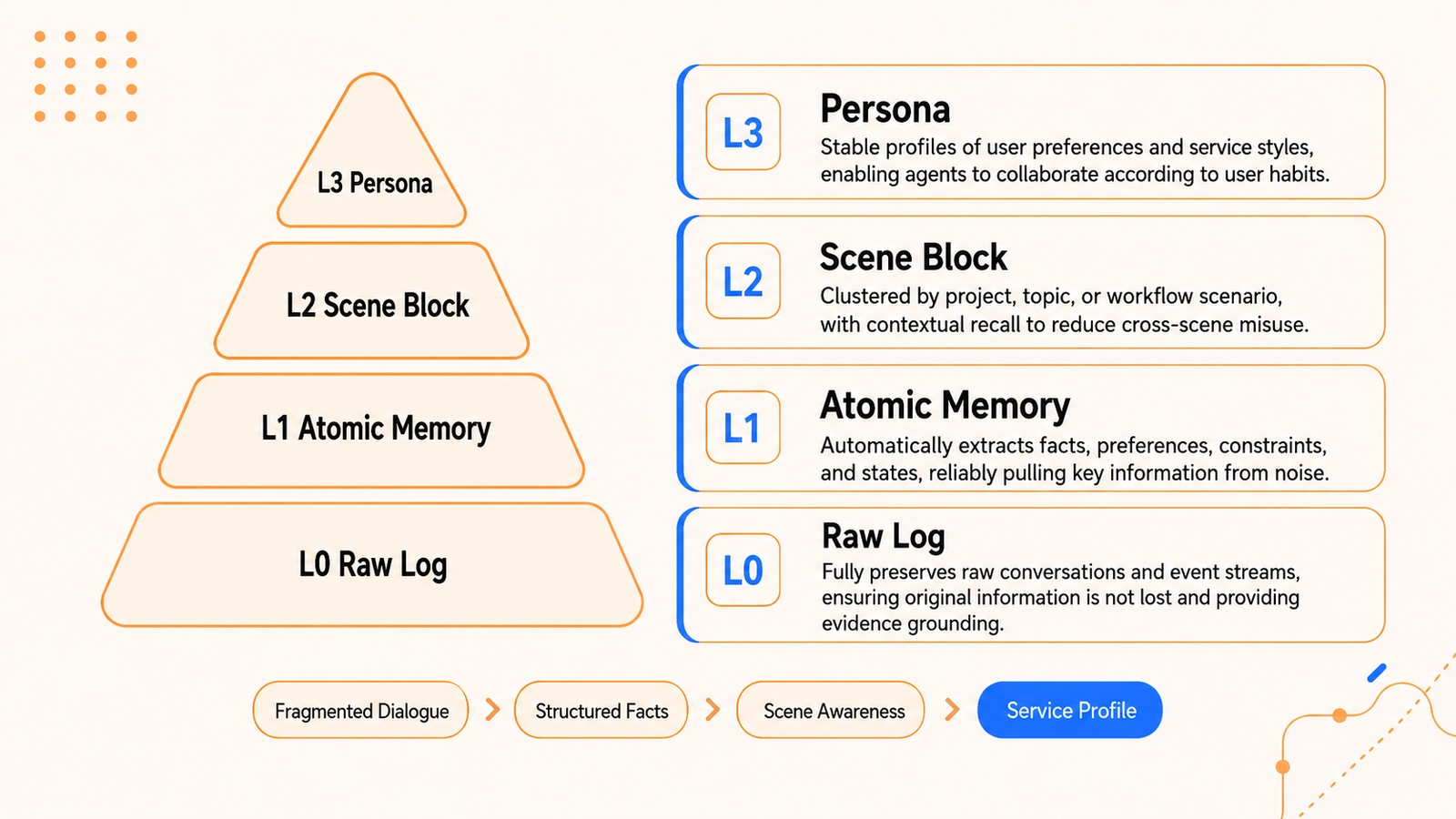
So far this is the standard picture, and on its own it does not tell you much — "summarize old things into shorter things" describes most memory systems ever built. The obvious reading is that the pyramid is about abstraction: L1 is more general than L0, L3 more general than L2.
Read the code and a different axis appears.
Sorted by volatility, not abstraction
MemoryProxy/src/injection/injectors/tdai-profile-memory-injector.ts opens with a comment
explaining how each tier reaches the model, and the three answers are all different:
- L3 persona — injected in full. "稳定且通常较短" — stable and usually short.
- L2 scenarios — only the scene-navigation index goes in: a list of paths plus a one-line summary each. The stated reason is that L2 full text "经常上千 chars × N 个" — often thousands of characters times N blocks. The agent reads the full scene through a tool once it has decided the scene matters.
- L0 and L1 — not injected at all on this path. The comment is blunt: "不再自动召回" — no longer auto-recalled. They are exposed as read-only search tools.
The proxy README gives the reason in one clause, and it is the whole thesis of the system:
injects Skills, Knowledge and Memory L2/L3 into the system prompt on demand; L0/L1 are exposed as read-only tools for the model to query proactively, avoiding upstream KV-cache invalidation.
Read top to bottom, the tiers are sorted by how often they change, and the delivery mechanism tracks that exactly. This is not a summarization hierarchy that happens to have four levels — it is a cache-stability hierarchy. Anything injected into the system prompt that differs from last turn invalidates the provider’s prompt cache and makes you re-pay for the whole prefix, so only the tiers that rarely change are allowed to live there. Everything volatile is demoted to a tool call, where it costs tokens once, in the turn that needed it.
That is a token-economics argument, not a knowledge-management one. Anything you put in the system prompt that differs from last turn breaks the provider's prompt cache and makes you re-pay for the entire prefix — so the question "which tier goes where" is really "which tier is stable enough to sit in a cached prefix." Sorted that way, the pyramid falls out for a completely different reason than the abstraction story suggests. L3 is at the top not because it is the most abstract but because it is the most stable. L0 is at the bottom because it grows every single turn.
The discipline shows up again in the deployment guide, which is where you can tell someone has run this in production:
For multi-node deployments you must use
storage.backend=cosand explicitly setinjection.externalGatewayUrl, otherwise each instance caches independently and causes upstream KV-cache misses.
Treating a prompt-cache miss as a documented operational failure mode — in an installation doc — is not something most agent-memory projects think to do. It rhymes with what the harness effect argued from the other direction: the orchestration layer, not the model, sets the bill.
The retrieval underneath is real
It would be easy to ship "hybrid search" as a marketing phrase. This is not that. auto-recall.ts
runs FTS5 BM25 for the keyword side and cosine similarity over a vector store for the dense side,
then merges the two rank lists with reciprocal rank fusion, with the constant spelled out and
attributed:
// RRF merge: k=60 is a standard constant from the RRF paper
const RRF_K = 60;
Scoring a record at rank r as and summing across lists is the standard formulation, and k = 60 is the value from Cormack et al. If the backing store can do dense-plus-sparse-plus-RRF server-side it short-circuits to one API call; on the SQLite path it runs both sides in parallel and fuses client-side. There is a graceful degradation if FTS5 is unavailable — the keyword list comes back empty and RRF operates on the dense side alone.
This is the same fusion idea this site's own search uses, and it is the right default: BM25 finds the document that says the exact identifier you typed, embeddings find the one that means what you meant, and RRF combines them without needing calibrated scores from either.
What actually bounds an injection
The README says results are "further capped by item count, character budget, and timeout limits to
prevent memory from overwhelming the context window." Checking the shipped defaults in
MemoryCore/src/config.ts, that is two-thirds true.
The README promises caps on “item count, character budget, and timeout.” Two of the three are live at the defaults; the character budget is implemented but ships disabled, and the code short-circuits when both length limits are zero. In practice five results still bounds things — but five results of unbounded length is a different guarantee than the sentence implies, and a long L1 memory is exactly the case the budget exists for. Worth setting before you trust it.
maxResults defaults to 5, scoreThreshold to 0.3, timeoutMs to 5000 — all binding. But
maxCharsPerMemory and maxTotalRecallChars both default to 0, and the budgeting function
short-circuits when they are:
if (!maxCharsPerMemory && !maxTotalRecallChars) {
  return lines;
}
So the character budget exists, is properly implemented with truncation markers and drop counts, and ships turned off. Five results still bounds things, but five results of unbounded length is a different guarantee than the sentence implies — and a single sprawling L1 memory is exactly the case a character budget exists to catch. It is a one-line config fix, not a design flaw, but you have to know to make it.
A smaller drift in the same file: l1IdleTimeoutSeconds is documented in its own doc comment as
"default: 30" and initialized to 600. Twenty times the documented value.
The guide it injects into your agent
One more thing the code shows that no doc mentions. Alongside the memories, MemoryCore injects a usage guide telling the model how to retrieve more — and it is hardcoded in Chinese, in a repository whose README, install guide and contributing guide are all bilingual:
### ⚠️ 调用次数限制
每轮对话中,tdai_memory_search 和 tdai_conversation_search 合计最多调用 3 次。
"Per conversation turn, tdai_memory_search and tdai_conversation_search may be called at most
3 times combined." The guide goes on to instruct the model that if three searches turn up nothing,
the information is not in memory and it should answer from what it has rather than keep searching.
Two observations. The 3-call ceiling is a good idea — an agent that can search its own memory without limit will, and each miss costs a round trip. Naming the budget in the prompt and telling the model what to do when it is exhausted is more thoughtful than most retrieval integrations manage. And the language is a real deployment consideration: a fixed Chinese-language instruction block enters the context of every agent this wraps, including English ones. Models handle it, but it consumes tokens in a tokenizer that is not optimized for it and it sets the instruction language for that portion of the prompt.
Permissions, checked against the code
The visibility model is the part I expected to be thinnest and it is the most carefully built. The
README promises private means private "not even team admins," and permission-checker.ts backs it
with a dated comment explaining the choice:
case "private":
  // 私密语义(2026-07 变更):严格私密,只有 owner_user_id 能访问。
  // 团队 admin 也不放行 —— 因为第 2 步 owner 判定已优先返回 ALLOW,
  // 走到这里说明当前 user 不是 owner,即使是 admin 也一律拒绝。
  return { allowed: false, reason: "visibility_restricted" };
A July 2026 semantics change, the reasoning preserved in the source, and the consequences enumerated
underneath it — including that admin list-accessible calls must not return other people's private
assets. That is a team that had the "should admins see everything?" argument and wrote down how it
ended.
One gap worth naming, because the README's framing does not survive it. restricted is described as
"precise access via User / Role / Agent ACLs," and for ordinary members that is exactly what the code
does — an explicit ACL match is the only way in. But the check is gated on membership.role !== "admin", so team admins skip the ACL entirely and fall through to role defaults. Defensible —
someone has to administer the thing — but "strict ACL whitelist" is true for members and not for
admins, and the docs do not say so.
The architecture, briefly
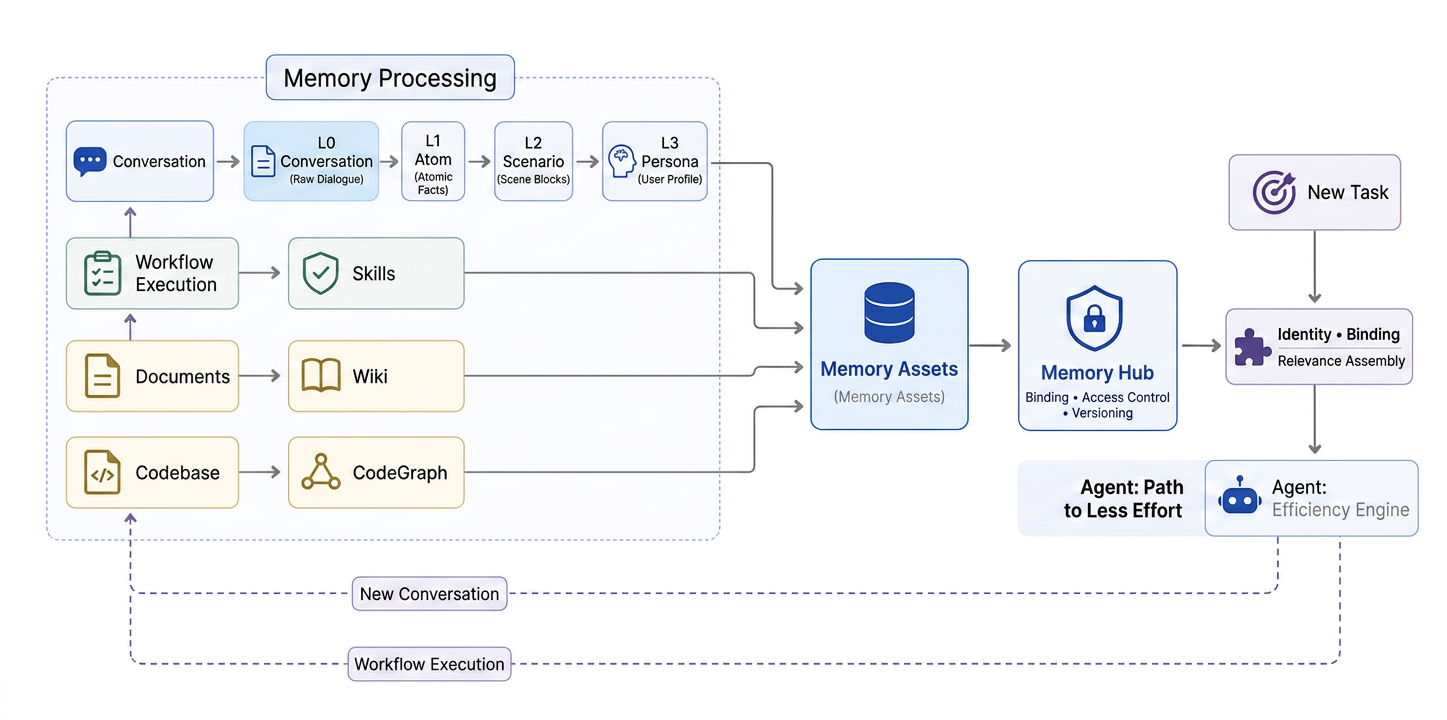
Three services. MemoryCore owns storage and the L0→L3 pipeline. MemoryKnowledge builds the
Wiki and CodeGraph assets. MemoryProxy is the clever piece: a transparent LLM proxy that forwards
OpenAI /v1/chat/completions and Anthropic /v1/messages verbatim, doing session setup, injection
and write-back on the way past. Point your coding agent's base URL at it and you get team memory
"without changing a single line of code."
That is a genuine integration strategy rather than a shortcut. It also means the proxy sits in the path of every request and every response, holding your model credentials, which is a trust decision worth making deliberately rather than by following a quickstart.
The unification is the real product claim: Chat Memory, Skills, Wiki and CodeGraph are all registered as Memory Assets with owner, version, status, visibility and agent bindings, retrieved through one permission-scoped surface. The README's comparison table puts it well — RAG answers "what can be found?", and this also answers "who can use it, which version is valid, and which agent should receive it." Whether that ontology is worth its complexity depends entirely on whether you have a team; for one person with one agent it is overhead.
The number
There is exactly one benchmark in the repository, and it is in the README:
| Benchmark | Without | With | Relative |
|---|---|---|---|
| PersonaMem | 48% | 76% | +59% |
That is the entire evaluation. No harness, no model named, no agent configuration, no seed count, no link to a run. I searched the repository for any other mention of PersonaMem and found two — the same table in the Chinese README. So there is no reproduction script here, and the claim is first-party and unreplicated.
To be fair on two counts: a memory layer improving a memory benchmark is not a surprising result, and the repository's own Notes section is refreshingly frank about what is unfinished — CodeGraph "currently prioritizes public HTTPS repositories," the Hub supports manual binding while "fully automated memory routing is still under iteration," and Team Memory is labelled Beta. A project that tells you which parts are not done yet has earned some patience about the parts it has not measured.
The provenance is also handled properly. The acknowledgements credit CodeGraph for code the CodeGraph module "uses," Nous Research's Hermes Agent for part of the Skill management code, and Karpathy's LLM-wiki gist for the Wiki design — specific about what was borrowed rather than a generic thank-you list.
The take
Most agent-memory projects are a retrieval index with an ontology bolted on, and the ontology is where the marketing lives. This one has a real idea underneath it, and the idea is not the pyramid. It is that memory has to be sorted by how often it changes, because the cost of memory is not storage, it is the prompt prefix you invalidate by updating it. Once you see the four tiers as a cache-stability ordering rather than an abstraction ordering, the delivery mechanism for each one stops being arbitrary: stable things get injected, semi-stable things get injected as an index, volatile things become tools with a call budget.
That principle is portable to any agent you are building, with or without this software. What comes with the software is a competent hybrid retriever, a genuinely careful permission model, a transparent proxy that is a real integration story and a real trust decision, one unreplicated benchmark number, two integration paths that disagree about injection policy, and a character budget you should turn on before you rely on it.
Sources: the TencentDB-Agent-Memory repository
at its 2026-08-06 state — README.md, INSTALL.md, MemoryProxy/README.md, and the TypeScript in
MemoryCore/src/config.ts, MemoryCore/src/core/hooks/auto-recall.ts,
MemoryCore/src/metadata/service/permission-checker.ts and
MemoryProxy/src/injection/injectors/. Both figures are the project's own, flattened onto white;
the pyramid is its English-language variant. Chinese source comments are quoted verbatim with my
translations. The PersonaMem figure is the project's own and is not independently replicated. Both
interactives are mine.