2026-08-14 · 6 min · retrieval · agents · search · pricing
Why read this
Nichelast 15%Reads Mixedbread's launch numbers for what they show: on Harvey's benchmark the score holds at 55 while tokens fall 3.5x, so most were spent looking.
Agents & harnessesAPI onlyProprietaryPractitioner tool
How this was scored
- Is it new?
- 1 of 3: An incremental tweak
- Can I trust it?
- 1 of 3: Spot-checks a few numbers
- Can I run it?
- 1 of 3: API-only, gated or restrictive licence
- Will I understand it?
- 1 of 3: Partial mechanism
- Can I act on it?
- 1 of 3: General advice
- Will it last?
- 1 of 3: Relevant for months
- Does it affect many?
- 1 of 3: A specialist community
- Only here?
- 1 of 3: Some original analysis
Score 36 of 100, ranked 419 of 445 rated articles. Each question is answered 0–3 by hand, and a 3 is rare. How articles are scored
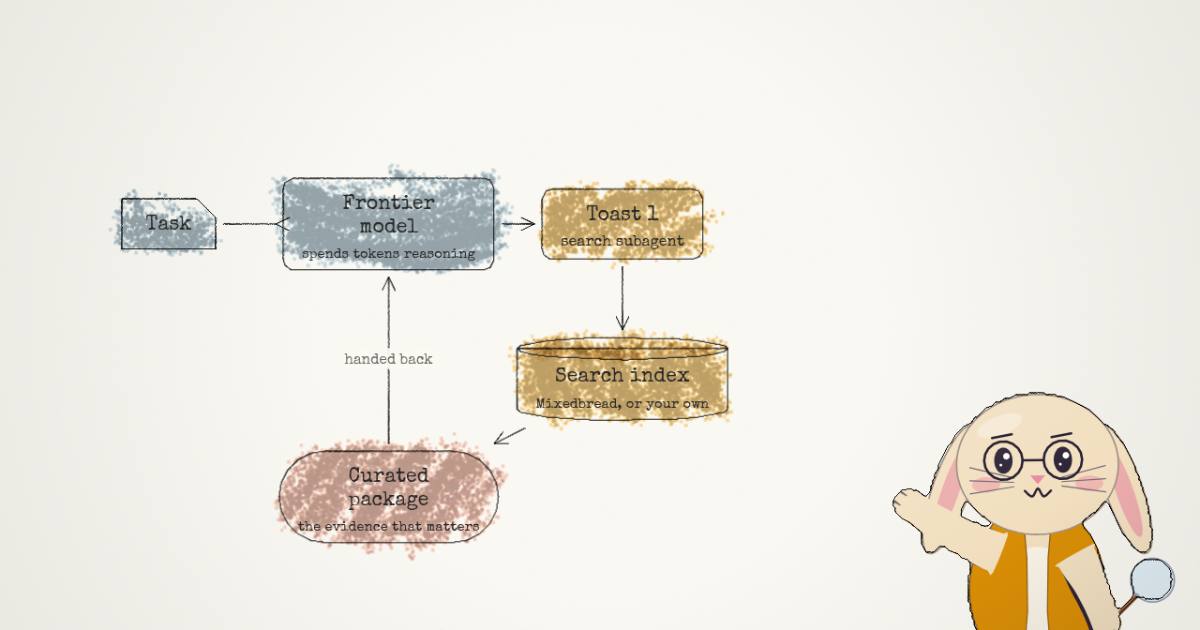
Toast 1 is Mixedbread's first specialised search agent, released 2026-08-13. The pitch is division of labour: instead of a frontier model burning its context window navigating a corpus, Toast 1 takes the whole search loop — decomposes the query into subqueries, gathers evidence, inspects sources, curates what matters — and hands back a package. The frontier model spends its tokens reasoning instead.
It runs standalone or as a subagent, and it is backend-agnostic: co-designed with Mixedbread Search but able to run over an existing index.
The result worth reading twice
The identical score across all three rows is the result, not a footnote. If quality had gone up you would be looking at a better agent; because it did not move at all, what is being demonstrated is that 57.6M of the vanilla agent’s 80.6M tokens were not contributing to the answer. They were the cost of looking. Two caveats belong here: this is a randomly selected 33-task subset rather than the full benchmark, and a score that lands on exactly 55 three times is a coarse enough measurement that small quality changes would not show up in it.
Harvey's LAB firm-knowledge benchmark, on a 33-task subset, with one model and one evaluation and only the retrieval stack changing between runs:
| configuration | tokens | turns/task | score |
|---|---|---|---|
| vanilla agent | 80.6M | 21.7 | 55 |
| + Mixedbread Search | 47.0M | 14.6 | 55 |
| + Toast 1 subagent | 23.0M | 11.2 | 55 |
The score is the finding. It does not move. If quality had gone up you would be looking at a better agent; because it is identical across all three rows, what the experiment demonstrates is that 57.6M of the vanilla agent's 80.6M tokens were not contributing to the answer. They were the cost of looking.
I recomputed the deltas and they reproduce: 47.0/80.6 is −41.7% against a stated −42%, 23.0/47.0 is −51.1% against −51%, and 80.6/23.0 is 3.50× against a stated 3.5×.
Two caveats belong right next to that, and Mixedbread states the first itself in a footnote: this is a randomly selected 33-task subset, chosen "to make repeated comparative runs tractable." And a score that lands on exactly 55 three times is coarse enough that a small quality change would not necessarily show up in it. The token reduction is a much more precisely measured quantity than the quality preservation it is paired with.
The headline benchmark, and whose numbers they are
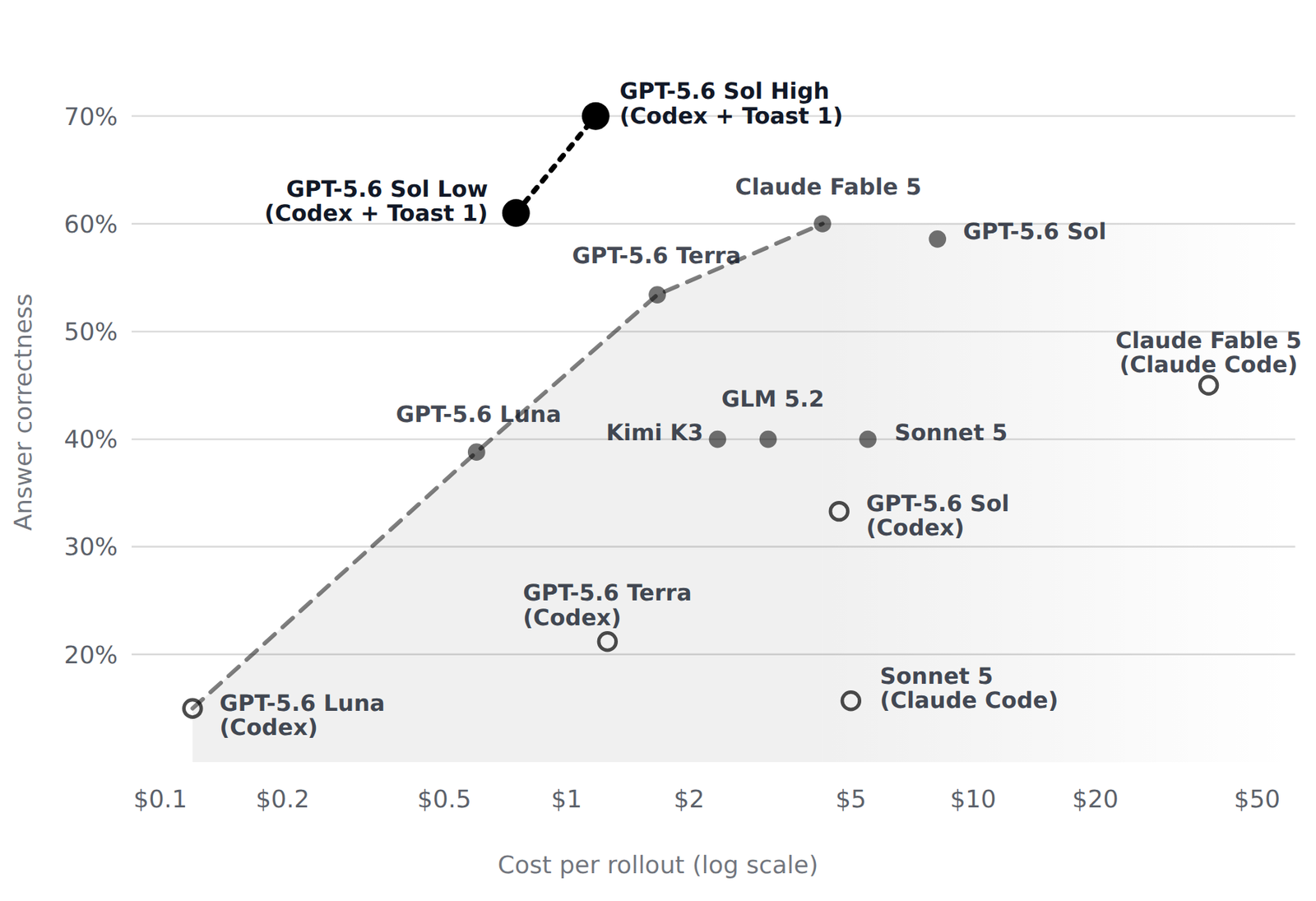
On OfficeQA Pro V2 — 90 questions on enterprise financial situations, released by Databricks — GPT-5.6 Sol running in Codex with Toast 1 as a subagent reaches 70% correctness at about $1.15 per task. The previous best in Databricks' evaluation, Claude Fable 5 on Databricks Genie, was 60% at roughly $4.
The comparison that carries the most information is the one against itself: GPT-5.6 Sol in Codex without Toast 1 reaches 33%. Same model, same harness, and correctness doubles when the search loop is delegated.
The chart's own footnote is the thing to hold onto: "Genie and harness numbers as reported by Databricks; Codex + Toast 1 runs are ours." Half the points come from the benchmark's authors and half from the vendor being evaluated. That is a normal and disclosed arrangement, and it is still a different evidential status than a single evaluator running everything.
As a standalone retriever
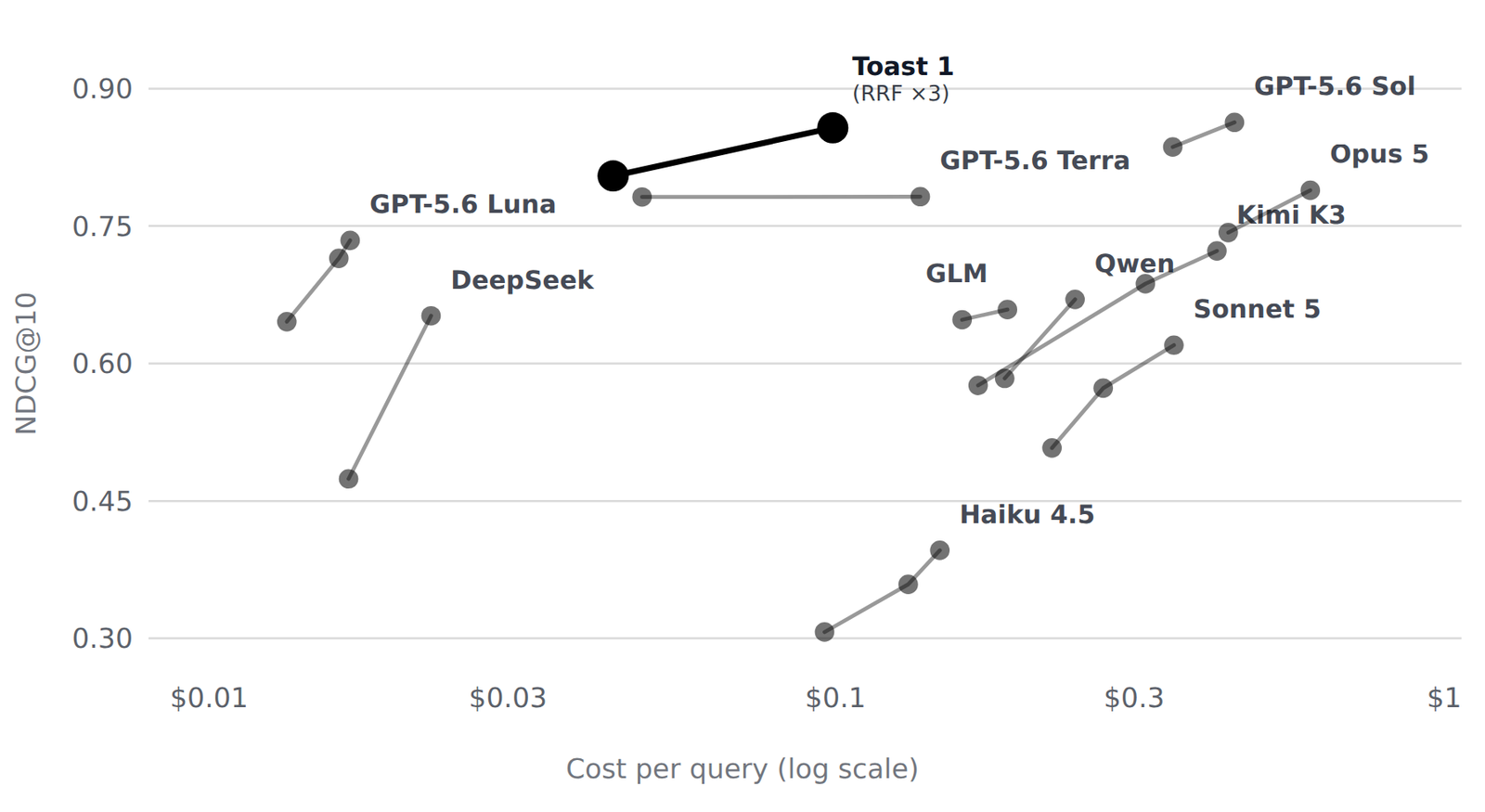
Evaluated as a retriever rather than a subagent — BrowseComp Plus, OfficeQA Pro and LongSeal, scored by NDCG@10 — Toast 1's fusion configuration lands in the same band as GPT-5.6 Sol and above Kimi K3, GLM, Opus 5 and Sonnet 5, while sitting an order of magnitude to the left on cost.
The chart shows something the prose does not dwell on: every other system is drawn as a sweep, a short line tracing what more reasoning effort buys. Toast 1's line is short and nearly flat. Whatever it is doing, spending more on it does not move quality much — which is the expected shape for a specialised model that is already doing the one thing it was trained for.
The economics
Two of these three bands are published numbers and one is arithmetic. Mixedbread gives cost and latency directly for both Toast 1 configurations, and for the frontier comparison gives latency (20 seconds to four minutes) but only a multiple for cost — “7–11× cheaper.” The band above inverts that multiple, so it is their claim rendered, not an independent measurement. The latency gap is the part that needs no arithmetic: a search subagent that answers in eight seconds and one that answers in four minutes are different products regardless of price.
A standard run is $0.016–$0.023 per query at an eight-second median; the fusion configuration is $0.05–$0.07 at eleven seconds. Token pricing is $0.30/M input, $0.04/M cached input with free cache writes, and $0.80/M output.
Against the frontier retrieval agents in the same evaluation, Mixedbread claims 7–11× cheaper. That multiple is the only cost figure given for the comparison group, so the band in the diagram above is their claim inverted rather than a published measurement — worth flagging, because the latency comparison beside it needs no such inference: 20 seconds to four minutes, quoted directly.
An eight-second search subagent and a four-minute one are different products before price enters the discussion. If a frontier model is going to call search several times per task, the difference compounds into whether the task is interactive at all.
What is not disclosed
No architecture. No parameter count. No training details, data, or method. No information about what Toast 1 is beyond what it does and what it costs. This is a product launch, not a model release, and every number in it is a system-level measurement.
That matters for one specific reason: the headline results are all system results. "GPT-5.6 Sol + Toast 1 in Codex reaches 70%" is a claim about a pipeline with at least three moving parts, and the contribution of each is not separable from the published data. The Harvey ladder is the closest thing to a controlled experiment on offer, and it is the one I would weight most — one model, one task set, one evaluator, one variable.
Mixedbread's own footnote places this alongside SID-1 and Chroma's Context-1 as a growing category of specialised search agents. That framing is right, and it is the more interesting story than any single benchmark: the bet is that retrieval is a distinct enough skill to be worth a dedicated model, and that the frontier model's context window is too expensive to spend on navigation.
The Harvey numbers are the strongest evidence for that bet I have seen stated plainly. Three quarters of a vanilla agent's tokens went to finding things, and removing that cost changed nothing about the answers.