2026-08-14 · 12 min · agents · harness · typescript
Why read this
Hightop 30%Reads dsh at a pinned commit for the one idea worth copying: every request is checked byte-for-byte against a replay of the session log, plus the rules.
- Analysis found nowhere else
- Interactive explanations
- Runs on a laptop CPU
Agents & harnessesMITPractitioner tool
How this was scored
- Is it new?
- 2 of 3: A real new idea, method or capability
- Can I trust it?
- 2 of 3: Measures key facts from files, code or configs
- Can I run it?
- 2 of 3: Open code or weights with real limits
- Will I understand it?
- 3 of 3: Mechanism carried by interactives built from real code or data
- Can I act on it?
- 2 of 3: A concrete recipe, numbers or comparison
- Will it last?
- 1 of 3: Relevant for months
- Does it affect many?
- 1 of 3: A specialist community
- Only here?
- 3 of 3: The only place this analysis exists
Score 71 of 100, ranked 89 of 445 rated articles. Each question is answered 0–3 by hand, and a 3 is rare. How articles are scored
deepseek-harness (dsh) is an MIT-licensed agent harness from DeepSeek that you run with npx @deepseek-ai/dsh web. The npm package was first published on 2026-08-10; six versions shipped in the four days after that, the latest being 0.1.0-rc.6. It is labelled a developer preview, and the README is blunt about what that means: THERE WILL BE COMPATIBILITY-BREAKING CHANGES.
The obvious thing to write about an agent harness is its agent loop. That turns out to be the least interesting part of this one. The loop is about what you would guess — claim input, assemble a prompt, call a model, run the tools it asked for, repeat while anything is owed. What is unusual is everything built around the loop to make it hold still, and the reason that machinery exists is legible in the commit history: the repository went from its first commit to that npm release in 61 days, taking 12,293 commits across 65 active days on the way. At least 209 of its 984 merged pull requests came off codex/* branches, which is a floor rather than a count.
That combination — a codebase moving faster than humans can review, and a product whose whole job is to be trustworthy about what it told a model — produced a design decision worth stealing.
Everything is a plugin, and it means it
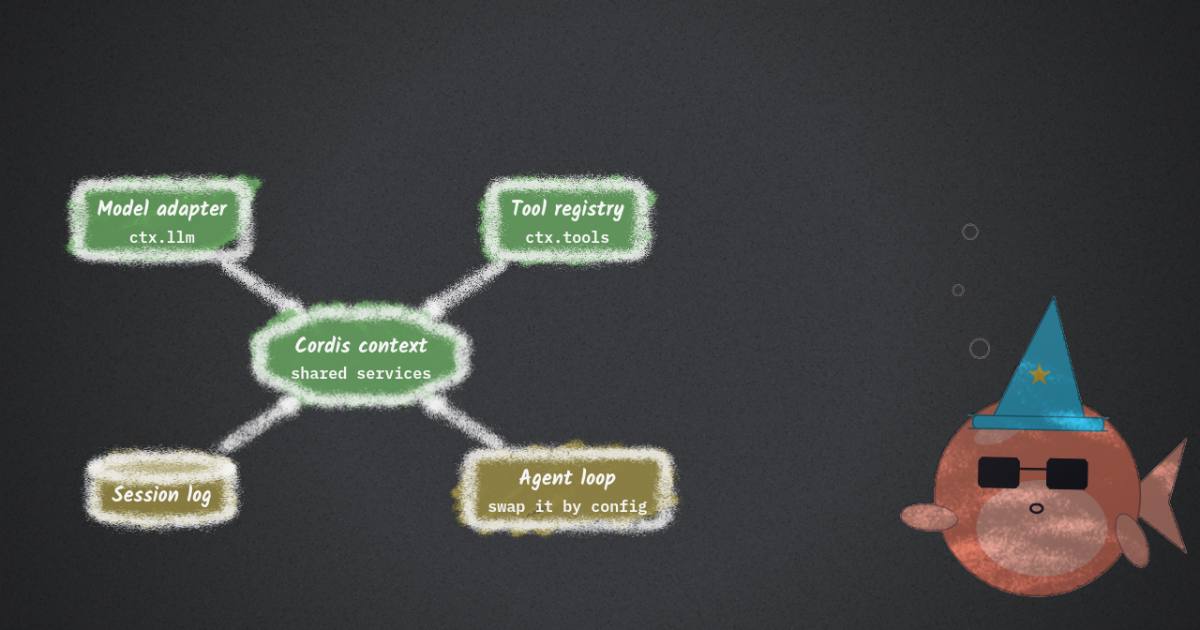
dsh is built on Cordis, a plugin framework DeepSeek vendored into the repo at v4.0.1 and rescoped under its own namespace. Cordis is five ideas: a plugin contributes services to a shared context; a service claims a stable key like ctx.tools or ctx.llm; plugins declare what they need with inject rather than being boot-ordered by hand; communication is typed events; and every registration is a reversible effect that unwinds when its plugin unloads.
The architecture doc states the consequence directly, and unlike most claims of this shape it survives contact with the source:
There is no privileged core to patch: you extend dsh by mounting a plugin beside the others.
The model adapter is a plugin. The tool registry is a plugin. The session log is a plugin. The agent loop is a plugin — core/agent owns the Agent interface and the live registry, while core/agent-loop is described as "the default driver implementing that interface." Swapping it is a config row, not a fork.
There are 219 workspace packages under packages/*/*. Twenty-one of them are model-facing tools (tool-bash, tool-fs, tool-lsp, tool-subagent, tool-terminal, and so on). The rest are seams, providers, UI surfaces, and policy.
A running dsh is composed at boot from ordered layers: bundles stack in listed order, then the profile's own patch file, then the home-level one, then any --patch overlay. I parsed the three committed bundle patches to see what that actually produces.
A patch targets a row by id and replaces its whole config, so a value that differs between modes cannot live in base — it belongs to each mode bundle, which restates the row completely. That rule is written into base’s own header comment, and it is why headless is so small: it is not base minus the web bits, it is base plus three. The layering ends with files you own, so any row the vendor shipped is a row you can replace without forking anything.
The detail I found convincing is base's own header comment, which explains why a row whose value differs between modes is not allowed to live in base: a patch replaces a row's whole config rather than merging into it, so a mode-varying row belongs to each mode bundle, which restates it completely. That is a rule written down because someone expected agents to add rows to this file.
One turn
A step is one model request plus the tools it calls. A turn is zero or more steps: it opens before its first input is claimed and closes once nothing is owed. Here is the repo's own flow block, verbatim:
turn/start
  claim next-step input plus one queued message
  assemble prompt sections + tool schemas
  -> agent/pre-step                   reject | enter(messages)
     reject, or a first enter rewritten empty -> close the turn with no step
     step/start
     append entered messages as user/message
     derive model history from the log
     agent/request -> llm/stream -> assistant/chunk* -> assistant/message
     tool/call* -> tools/pre-execute -> tools/execute -> tools/post-execute -> tool/result*
     step/end
     tools owe another request, or next-step input arrived -> claim -> next step
  -> agent/turn-stopping
turn/end
Two kinds of thing are interleaved there. Some events are durable facts appended to the session log; the rest are live extension points, and most of those are around-middleware — a listener receives next(), and either wraps the call and delegates or owns the decision and returns without delegating.
The shape worth noticing is which events are which colour. Everything the model produced or consumed is durable — it is in the log, and the log is what the next request is rebuilt from. Everything that lets you intervene is live, and most of it is around-middleware: a listener wraps the call and delegates with next(), or owns the decision and returns without it. There is no place in this diagram where you patch the loop, because the loop is a plugin like the rest and the extension points are the API.
The repo draws the same lifecycle as a sequence diagram, which adds what a linear list cannot: who talks to whom, and the branches. Both alt blocks are worth reading — a rejected pre-step leaves the turn open having spent no step, and a terminal request failure routes to an agent/request-error waterfall that returns a retry action or preserves the original error.
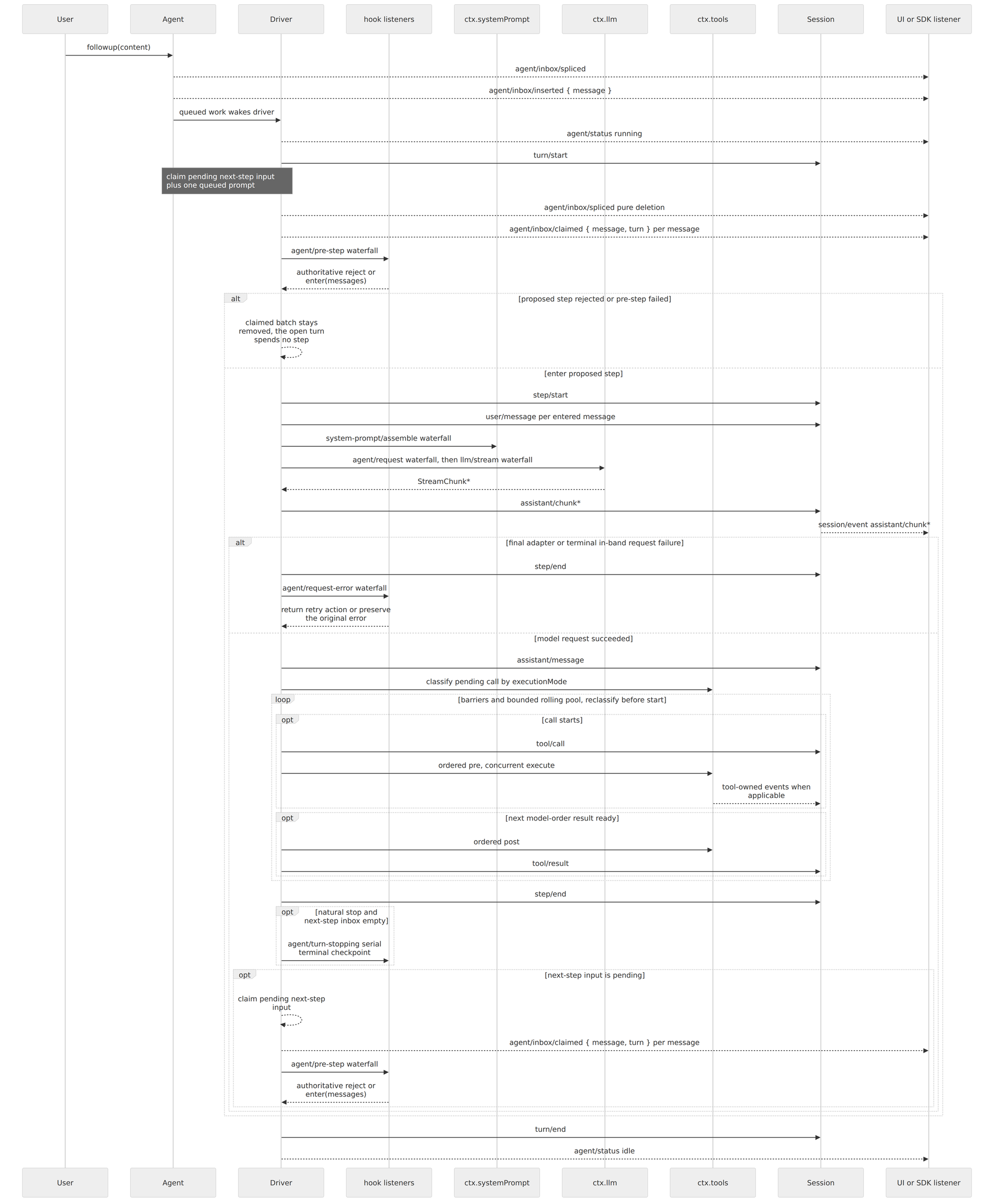
Note the line derive model history from the log. It is doing more work than it looks like.
The check that makes the log the source
Most harnesses treat the transcript as a rendering of the conversation: the conversation lives in memory, and the log is written alongside it for display and debugging. dsh inverts this. The log is the source, model history is projected from it by deriveMessages(), and a runtime invariant refuses to let those two drift apart.
The whole of packages/core/agent-loop/src/invariant.ts is 63 lines. This is its core:
ctx.on('llm/stream', (options: GenerateOptions, next) => {
  if (!isAgentLoopRequest(options)) return next()
  if (!Object.isFrozen(options)) fail('a loop-built request must be frozen')
  // ...
  const expected = session.deriveMessages()
  if (JSON.stringify(options.messages) !== JSON.stringify(expected)) {
    fail(`llm request for session "${String(session.id)}" diverges from the
          dispatch-time durable derivation (log-reconstruction desync)`)
  }
  // ... and the folded request header must match model, system, temperature,
  //     maxTokens, stop and tools
  return next()
}, { global: true, prepend: true })
Every request the loop builds is compared, byte for byte through JSON.stringify, against a fresh replay of the session log made at dispatch time. If a plugin slips an extra message into the outgoing request without writing a session event for it, the request does not go out. It throws.
The prepend: true matters: it means a replay or mock listener that short-circuits the waterfall still cannot get in front of the check.
Most harnesses treat the transcript as a rendering of the conversation. This one inverts that: the log is the source, the request is derived from it, and a runtime check refuses to send anything that does not match a fresh derivation, byte for byte through JSON.stringify. The practical consequence is that “why did it do that?” always has an answer, because a context the log cannot rebuild is a crash rather than a mystery. The listener registers with prepend: true so that a replay or mock listener which short-circuits the waterfall still cannot get in front of it.
The failure this prevents is the quiet one. Injecting an unlogged message doesn't crash anything and usually makes the model behave better — it is exactly the sort of change that ships. What it destroys is reproducibility: from then on, the log no longer explains the answer, and "why did it do that?" has no reachable answer. The repo states the rule as model-visible ⟺ logged, and this is the line of code that makes it true rather than aspirational.
The same header check covers sampling settings, which I think is the sharper half. Temperature and tool schemas are part of what makes a run reproducible, so retuning one between the logged header and the actual call is treated as divergence rather than a tweak.
The same idea, applied to tools
Tool execution gets the same treatment, and the repo's own pipeline diagram is the clearest statement of it. Two details in there are the log-is-source rule again, wearing different clothes.
tool/call is logged before execution — not after, not on completion. If the process dies mid-tool, the log still records that the call was attempted. And at the far end, tool/result is labelled single model-facing outcome: however the call actually went — denied by a guard, refused at the approval prompt, thrown inside the tool body, thrown by a wrapper, timed out — every path converges through registry normalization and finalizeContent into exactly one recorded result.
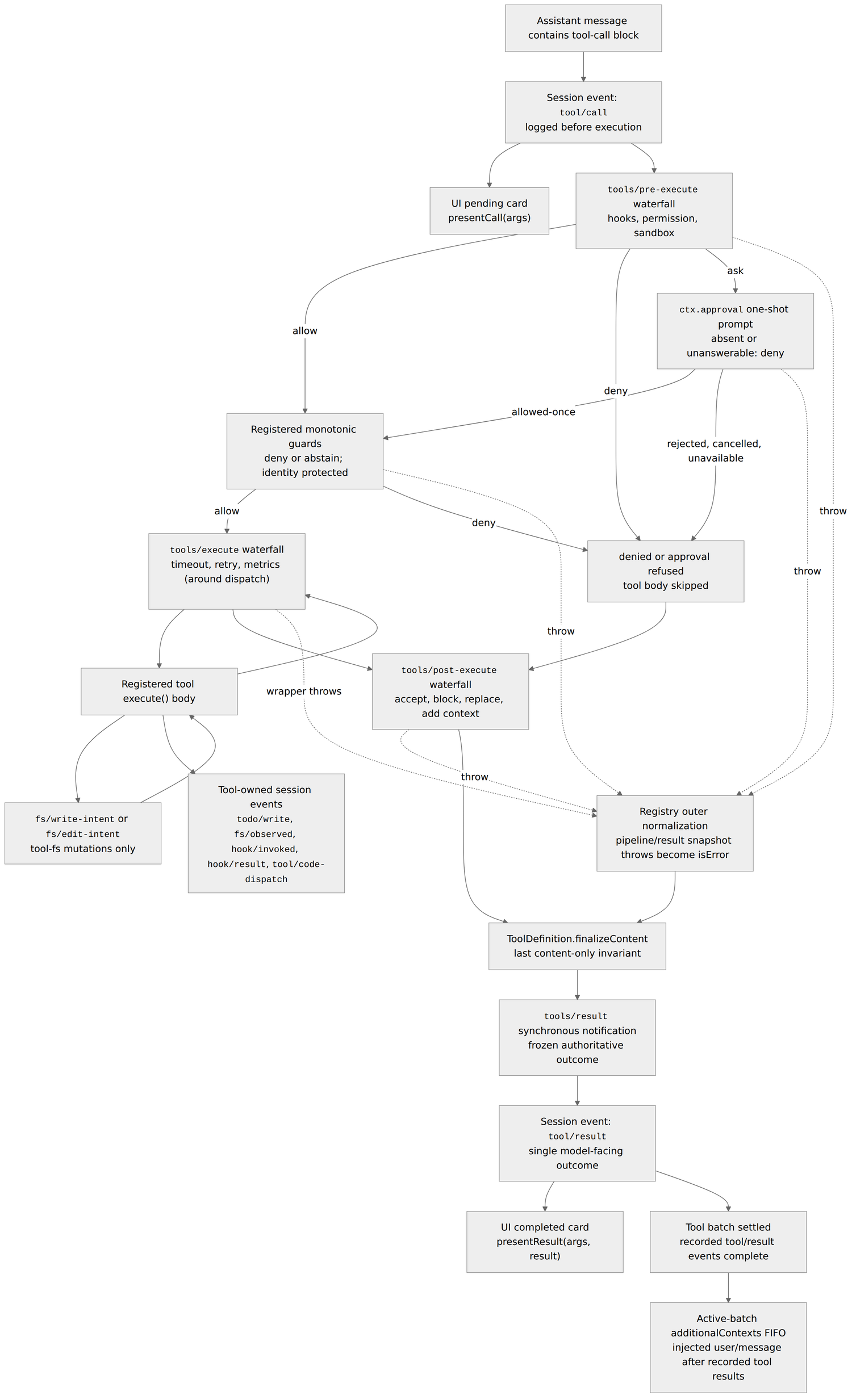
Note the dotted throw edges all landing on the same normalization box. A tool that raises does not produce a missing result; it produces an isError result that the model sees and the log records. That is what lets the invariant in the previous section hold for a turn where something went wrong, which is the only kind of turn where reproducibility actually matters.
219 invariant companions, and what they actually contain
Here is where I nearly published something wrong.
Every one of the 219 package directories contains exactly one src/invariant.ts. I checked the correspondence as a set difference in both directions: zero packages without one, zero orphans. My first instinct was to write that as "219 packages all enforce runtime invariants."
They don't. Only 35 of the 219 ever call fail(...). The other 184 are 20-line files whose install function is empty:
/** No runtime invariant: this stateless seam owns types while implementations
    enforce immutable-store checks. */
const install: InvariantInstaller = () => {}
That looked like ceremony until I read scripts/package-invariants.ts, which is what enforces the convention. A package missing its companion is a violation. An empty install function that does not carry a comment beginning No runtime invariant: is a violation. A non-empty install function that never uses its bound failure reporter is a violation.
So the number that matters is not 219 checks. It is 219 decisions — every package has been made to answer "what runtime invariant do you own?", and 184 of them answer "none, because…" in a sentence a reviewer can disagree with. Absence is recorded rather than assumed. That is a much better idea than 219 checks would have been, and it is the kind of thing that only pays off at this repo's scale.
an empty install must carry a “No runtime invariant:” comment or the build fails
a non-empty install must actually use its bound failure reporter
These four are the same fact from different angles. A codebase taking twelve thousand commits in nine weeks, a good deal of it machine-written, cannot be held together by review attention alone — so the review got moved into the build. Every package must state whether it has a runtime invariant and why not if it does not; every design decision leaves a note, including the rejected ones; and 27 separate verify-* scripts check things most repositories leave to habit, from dead documentation links to whether the eleven generated catalogs still match the code they describe.
The repo is built by the workflow it ships
The discipline makes sense once you look at how the code got written.
.agents/notes/ holds 686 design notes — 507 implemented, 143 archived, 25 proposed, and 11 rejected, kept deliberately as the record of what was decided against. (The raw file count is 1,386; every note has a .zh.md twin, and counting both would double it.) Alongside them, .agents/skills/ holds eleven repo-specific skills with names like dsh-prose-standard, dsh-doc-standards, dsh-find-simplifications, and dsh-archive-agent-notes.
Of 984 merged pull requests, 209 came off codex/* branches — a lower bound on machine-authored work rather than a total, since it only counts one agent's branch naming. Another 210 came from worktree/*, which I am not going to attribute either way.
There is more test code than source code: roughly 205,500 lines of TypeScript under src/, against about 222,200 lines of .spec.ts and .e2e.ts. And CI runs 27 standalone verify-* scripts plus eleven catalog generators re-run with --check, covering things most repositories leave to habit — dead documentation links, markdown wrapping, mermaid syntax, JSDoc on exports, whether the English and Chinese docs are still paired, whether the generated config and tool catalogs still match the code they describe.
Read together, these are one decision made repeatedly: once enough of the code is machine-written, every rule a human reviewer would have applied has to become a script, or it stops being applied.
Interop, and one honest gap
dsh can drive other harnesses. subagent-claude-code invokes the official Claude Agent SDK in the delegating session's workspace and returns only the final answer through the shared subagent contract; subagent-codex and subagent-acp do the same for their respective agents. In the other direction, hooks-claude-code and hooks-codex run a user's existing hook configuration on the harness's own interception points.
The Claude Code bridge is refreshingly self-effacing about why it exists:
A native cordis plugin could do everything this bridge does — more powerfully, with typed returns and no serialization boundary. The bridge exists only as a compatibility path for the mapped CC command-hook subset.
The model story is thinner than the plugin story. Only one first-party adapter ships (llm-deepseek); everything else routes through llm-pi-ai, a generic multi-provider adapter built on the third-party @earendil-works/pi-ai. That is a reasonable trade — a new OpenAI-compatible gateway becomes configuration rather than a code change — but it does mean the polish gradient between DeepSeek's own models and everyone else's runs through a dependency they don't control.
What I'd actually take from this
Ignore the plugin count. 219 packages is a consequence of the architecture, not evidence for it, and a smaller project copying that number would just be slower.
The transferable ideas are two, and both are cheap:
Make the log the source, then check it. If the context you send is derived from your durable record rather than accumulated beside it, then a divergence is a crash instead of a slow mystery. The check is a few lines and it runs on every request. Nearly every agent system I've read builds the request and writes the log as two separate acts of bookkeeping, and quietly hopes they agree.
Make "no check here" a thing you have to say out loud. The 184 empty invariant files are worth more than they look, because a missing check and a considered decision not to check are indistinguishable in most codebases, and a script can tell them apart here.
The caveats are real: this is a developer preview with breaking changes promised in capital letters, nine weeks old, and moving fast enough that any specific file I quoted may have been rewritten by the time you read it. Every number here is measured at commit 47f9438 (2026-08-13) — I cloned the repository rather than reading the README, because the README does not mention the invariant at all, and that is the only part I would still be thinking about a week from now.