2026-07-10 · 8 min · mixture-of-experts
Why read this
Solidtop 85%A clear walk through top-1 routing, the capacity buffer and dropped tokens, the balancing loss and fp32 router, with the 7x and 1.6T read precisely.
- Genuinely new idea
- Evergreen reference
- Widely used
LLM architectureNeeds datacenter GPUsPractitioner paper
How this was scored
- Is it new?
- 3 of 3: Changes how the field does something
- Can I trust it?
- 0 of 3: Restates claims
- Can I run it?
- 1 of 3: API-only, gated or restrictive licence
- Will I understand it?
- 2 of 3: Mechanism from first principles with figures
- Can I act on it?
- 1 of 3: General advice
- Will it last?
- 3 of 3: Evergreen fundamentals
- Does it affect many?
- 2 of 3: A widely used model, tool or lab release
- Only here?
- 0 of 3: Same as the press release
Score 49 of 100, ranked 471 of 577 rated articles. Each question is answered 0–3 by hand, and a 3 is rare. How articles are scored
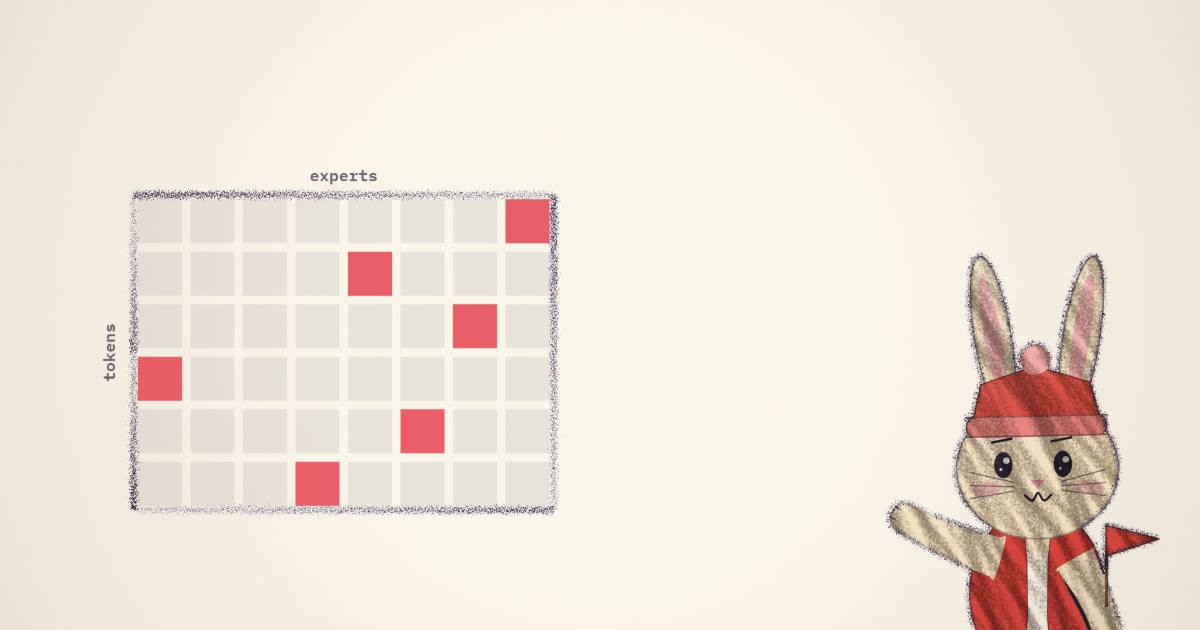
Every modern giant open-weights model — LongCat 2.0 at 1.6T parameters, and the rest of the sparse-MoE zoo — runs on one idea: don't run all the parameters on every token. Keep a big pile of experts, and for each token light up only a few. The mechanism, built from a router and a sparse forward pass, is walked through in Mixture of Experts, from scratch. Switch Transformers (Fedus, Zoph & Shazeer, 2021) is the paper that made that idea simple enough to scale — and it did so with one deliberately blunt move: route each token to exactly one expert.
That sounds like a footnote. It was the whole contribution. The prior MoE recipe (Shazeer et al., 2017) argued you needed to route each token to at least the top-2 experts — the reasoning being that comparing two experts gives the router a gradient signal to learn which is better. Switch throws that out and keeps only the top-1, the single argmax expert. Flip the toggle below and watch the routing collapse from two connectors per token to one:
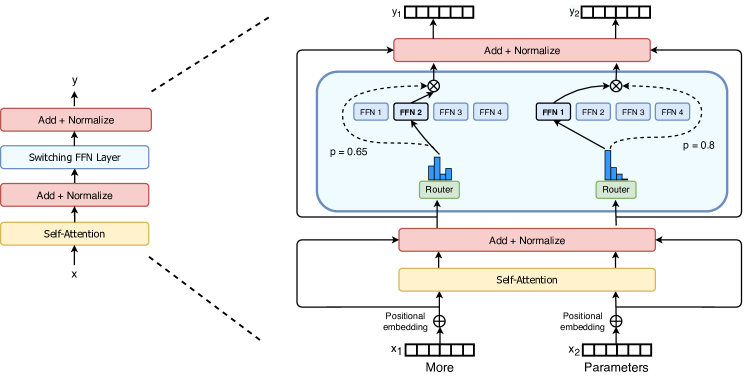
Why is top-1 worth a paper? Because the top-2 you save is not free compute you were wasting — it is a second copy of every token that has to be dispatched to another device. Experts are sharded across accelerators; routing a token to an expert means sending its activation over the network. Halving the experts-per-token roughly halves both the router's arithmetic and the all-to-all communication volume — the actual bottleneck at scale. Switch's claim is that with the right guardrails, one expert per token loses little quality while making the whole thing dramatically cheaper to run.
The capacity buffer, and the tokens it drops
The catch with routing is that it is dynamic — you don't know until runtime how many tokens will pick each expert, but hardware needs fixed tensor shapes. Switch solves this by giving every expert a fixed buffer:
If routing were perfectly uniform, a capacity factor of 1.0 would give each expert
exactly its fair share of slots. It never is uniform. When more tokens route to an
expert than it has slots, the overflow tokens are dropped — they skip the layer
entirely and pass through the residual connection unchanged. Drag the load imbalance and
the capacity factor and watch tokens overflow into red:
This is the core tradeoff, made concrete. A higher capacity factor (the paper tests
1.0, 1.25, and 2.0) means fewer dropped tokens — but every empty slot is compute
and memory spent on nothing. A lower factor is cheaper but throws away more tokens. The
whole point of good load balancing is to flatten the routing so a small buffer
suffices.
The two tricks that make top-1 stable
Blunt top-1 routing would collapse — the router would learn to send everything to a handful of experts, starving the rest. Two mechanisms hold it together:
- Differentiable load-balancing loss. An auxiliary loss added at every Switch layer, scaled by , is minimized when tokens are spread uniformly across experts. It's the product of the fraction of tokens dispatched to each expert and the router's average probability mass on that expert, summed over experts — a smooth penalty that pushes the router toward balanced assignment without hard constraints.
- Selective precision. Large sparse models train in
bfloat16for speed, but the router'sexp/softmax over expert logits is numerically fragile — small perturbations flip the argmax and destabilize training. Switch casts only the router's internal computation tofloat32, keeping everything else inbfloat16. The fp32 stays local to the router (it isn't communicated across devices), so it buys stability at no bandwidth cost.
Add expert dropout at fine-tuning time — a higher dropout rate of 0.4 inside the
expert layers versus 0.1 elsewhere — to keep the huge sparse model from overfitting
small downstream datasets, and top-1 routing trains cleanly.
What it bought: 7× at matched FLOPs
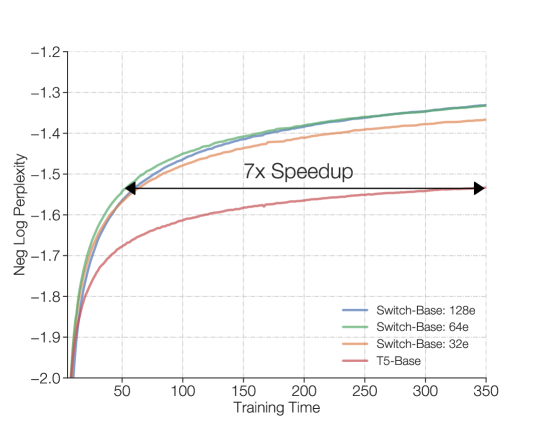
Held to the same FLOPs per token as a dense T5, Switch reaches the same pretraining quality far sooner. The 64-expert Switch-Base hits T5-Base's quality in about one-seventh the training steps; scaled up, Switch-XXL reaches T5-XXL's quality about 4× faster.
The other headline is raw scale. By stacking experts, the paper builds Switch-C with 2,048 experts and roughly 1.6 trillion total parameters — while Switch-XXL takes a different bet, only 64 experts but a much larger per-expert FFN, at ~395B parameters. Both were among the largest models trained at the time.
Distilling back to dense
A 1.6T-parameter sparse model is impractical to serve for many use cases — the parameters have to live in memory across many devices even if each token only touches a few. So the paper distills the sparse teacher back into a small dense student, and finds you can compress the model by up to 99% while still keeping about 30% of the quality improvement the sparse model earned over its dense baseline. Not all of it — but a meaningful slice of the gains survives into a model you can run on modest hardware.
Why it still matters
Almost every technique in a modern MoE — LongCat 2.0's 1.6T / ~48B-active split, the routing and load-balancing machinery in newer systems — is a descendant of the choices made here. Switch didn't invent Mixture-of-Experts; it made it simple and stable enough to scale, by proving that the aggressive top-1 route works if you surround it with a fixed capacity buffer, a balancing loss, and a precision-safe router. The interesting later work mostly pushes back on the simplifications — smarter routing than pure argmax, softer handling than hard token drops — but they all start from the Switch layer. It's the foundation the zoo is built on.
Built on Switch Transformers: Scaling to Trillion Parameter Models with Simple and Efficient Sparsity (Fedus, Zoph & Shazeer, 2021). Figures are the paper's own (Figures 2 and 5), used for academic commentary; the interactive diagrams are our illustrations of the mechanism. Numbers — the α=0.01 loss coefficient, capacity factors, the 7× and 4× speedups, 2,048 experts / 1.6T parameters, 99% compression retaining ~30% of gains, and 0.4 expert dropout — are quoted from the paper.