2026-08-06 · 11 min · llm · mixture-of-experts · architecture · linear-attention · explainer
Intern-S2 was Shanghai AI Lab's case for specialization: a 397B model that learns straight off the raw page of a scientific paper. Intern-S2-Mobius is a different experiment entirely, and much smaller — 35B parameters, continual-pretrained from Qwen3.5-35B, and the point isn't science. It's architecture. The model card's claim is that you can pull a transformer apart into two pieces — a store of learned knowledge and the computation that queries it — and get a real efficiency win from doing so: reasoning traces up to 5.0× shorter, average throughput up to 4.6× higher, at matched or better scores than the plain Transformer it's compared against.
That comparison is the thing to hold onto while reading this. Mobius isn't benchmarked against GPT-5.5, Gemini, or even other 35B-class open models — every number on its card is Mobius versus its own base model, Qwen3.5-35B, continual-pretrained the same way. It's an ablation, not a leaderboard entry. That makes it a cleaner test of what the architecture buys, and a much weaker basis for "should I use this instead of X."
What it is
- 35B parameters, bf16, five safetensors shards on Hugging Face totalling about 73 GB — not gated, apache-2.0, actually downloadable.
image-text-to-text: a vision tower (27 layers, 1152-wide, patch 16 — the same depth and width as the SigLIP-So400M family of encoders used across a lot of current VLMs) feeds a text backbone with a 256K-token context window.- Continual-pretrained from Qwen3.5-35B, then SFT and RL, on a new architecture the card calls Mobius-v0, "realized by Xtuner and LMDeploy."
- Deploys single-GPU on LMDeploy, vLLM, or Transformers, with an
mtpspeculative-decoding mode (qwen3_5_mtp) recommended in the quickstart.
The README links InternLM's ArchSpace — a public architecture-experimentation program that turns community proposals into trained, evaluated, published results — as a related project. It doesn't say Mobius came out of that pipeline, so I'm not claiming it did; it's worth knowing the program exists, because it's the same lab publicly running exactly this kind of experiment at scale.
What "Mobius" names
Not a routing scheme, not a training recipe — an architecture. The card's own framing:
Instead of binding knowledge storage and reasoning computation layer by layer as in conventional Transformer models, Mobius organizes knowledge into a globally shared Memory and lets multiple Reasoners iteratively query and refine hidden states against this shared repository.
Two capabilities follow from that split, per the card: Backward Residual Connection (a deep layer can reach knowledge a shallow layer used, not just what forward propagation handed it), and Dynamic Latent Reasoning (deliberation gets internalized into hidden states instead of written out as visible chain-of-thought tokens). Both are described in prose. The released code lets you check what's literally true of the shipped model versus what's evocative marketing language for the same idea — and it turns out you can, because InternLM shipped the modeling file along with the weights.
Forty layers, four memory banks
Here's what modeling_interns2_mobius.py actually does. config.json sets num_blocks: 4. The
model builds exactly four InternS2MobiusMetaMoeBlock objects — each one a router plus 2560
routed experts — and holds them in one list, meta_mlp. Every one of the 40 decoder layers keeps
its own attention and layernorms, but for its routed-expert lookup it computes
block_idx = layer_idx % num_blocks and reads from meta_mlp[block_idx]. Layers 0, 4, 8 … 36 all
route into the same physical weight tensors — not four separately-trained-but-similar banks, one
set of parameters, referenced by ten different layers.
This is block_idx = layer_idx % num_blocks straight out of modeling_interns2_mobius.py. All 40 decoder layers keep their own attention and layernorms, but the routed-expert bank — the “Memory” the model card describes — comes from just four physical InternS2MobiusMetaMoeBlock objects, each reused by ten layers spread across the full depth. Hover a cell: bank 0 is queried by layers 0, 4, 8, 12, 16, 20, 24, 28, 32, and 36 — a linear-attention (Gated DeltaNet) layer.
A standard MoE transformer ties knowledge to depth: layer k owns bank k, and whatever it learned lives only there. Mobius reuses the same four banks across the whole stack instead, so a layer near the input and a layer near the output can draw on the identical knowledge subspace. That's the concrete mechanism behind "Backward Residual Connection" — not a literal skip connection running backward through the network, but a shared address space that any depth can query. It's also a real parameter-efficiency trade: with four banks instead of forty, the routed-expert weight mass is
roughly 90% of the model's total, and roughly consistent with the ~36.5B implied by the 73 GB of
bf16 weights on disk. Per token, only one bank is queried per layer and only 8 of its 2560 experts
fire — call it ~28M active FFN parameters per layer (8 routed experts plus the always-on per-layer
shared expert), times 40 layers. That's a back-of-envelope estimate from config.json, not a
number the card states; unlike Intern-S2-Preview-397B's plain top-8-of-512
math, Mobius's shared-bank routing makes a clean "active parameters" headline harder to state, and
InternLM doesn't attempt one.
One more thing falls out of matching two arrays in the same config: layer_types cycles
linear-attention, linear-attention, linear-attention, full-attention every four layers
(full_attention_interval: 4), the same period as the memory-bank assignment. Bank 3 is always
the one full-attention layer in its group of four; banks 0–2 are always linear attention — a Gated
DeltaNet variant, the same family covered in KDA's half-life for Kimi
K3's linear attention. That alignment isn't asserted anywhere in the README. It's just what the two
config arrays do when you line them up.
Whether "iteratively query and refine" is literally true of inference is a fair question to ask of
any of this. The released InternS2MobiusTextModel.forward() is a single straight-through pass
over 40 layers — no runtime loop, no repeated pass over the same weights within one layer. What
does repeat, ten times, is the pattern: attend, then query one of four shared memory banks, at
increasing depth. If that reads like an unrolled recurrence rather than free-form iteration, that's
a fair description — it's a coarser, more surgical form of weight sharing than a fully looped
transformer, which ties whole layers (attention included)
across depth, or LOTUS, which loops the same weights over a
fixed latent region multiple passes per token. Mobius ties only the expert banks, once each, spread
across depth rather than iterated in place.
The benchmarks
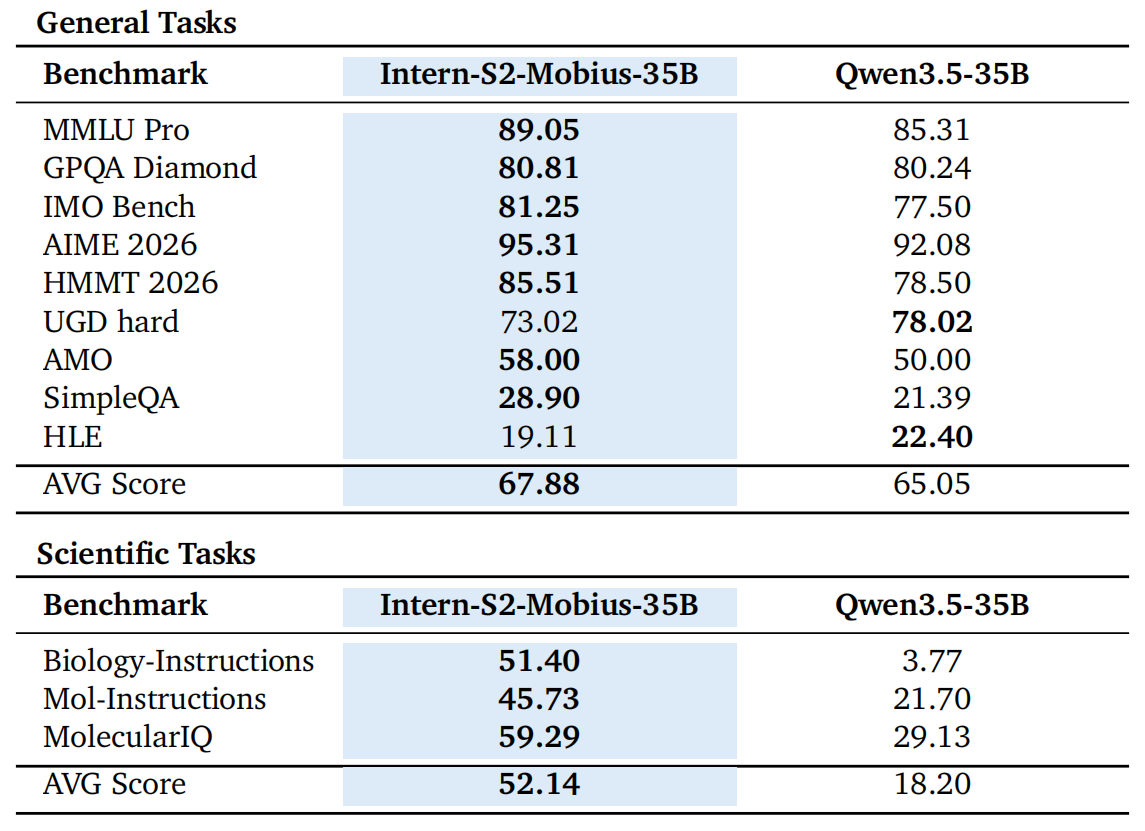
Everything on the card is Mobius vs. Qwen3.5-35B — its own continual-pretraining source, not a frontier model. On general reasoning:
The average hides a mixed picture. Mobius leads on MMLU Pro (89.05 vs 85.31), IMO Bench (81.25 vs 77.50), HMMT 2026 (85.51 vs 78.50), AIME 2026, GPQA Diamond, AMO, and SimpleQA. It loses on two: UGD hard (73.02 vs Qwen's 78.02) and HLE (19.11 vs 22.40) — worth stating plainly, since the card's own bullet points don't mention either.
Scientific tasks show the wider gap, and it's the same shape as the S2-Preview-397B story at a different scale:
Biology-Instructions carries that average almost alone: 51.40 vs 3.77, a 13.6× gap. Mol-Instructions (45.73 vs 21.70) and MolecularIQ (59.29 vs 29.13) are more modest but still roughly double. I'd read this less as "Mobius learned multi-omics" and more as evidence that whatever mix of continual pretraining and RL Shanghai AI Lab runs across the Intern-S2 family leans hard on scientific data — consistent with, though far less extreme than, Intern-S2-Preview-397B's own scientific dominance.
Shorter traces, faster serving
The headline claim is "nearly 4x speedup reported in the technical report" — a report the model card references but never links or cites; there's no arXiv listing for Mobius as of this writing. What the card does show directly is Fig. 1: request throughput at batch sizes 16 through 256, averaged across six reasoning benchmarks, with Mobius 2.9× faster at batch 16 and 4.6× faster at batch 256.
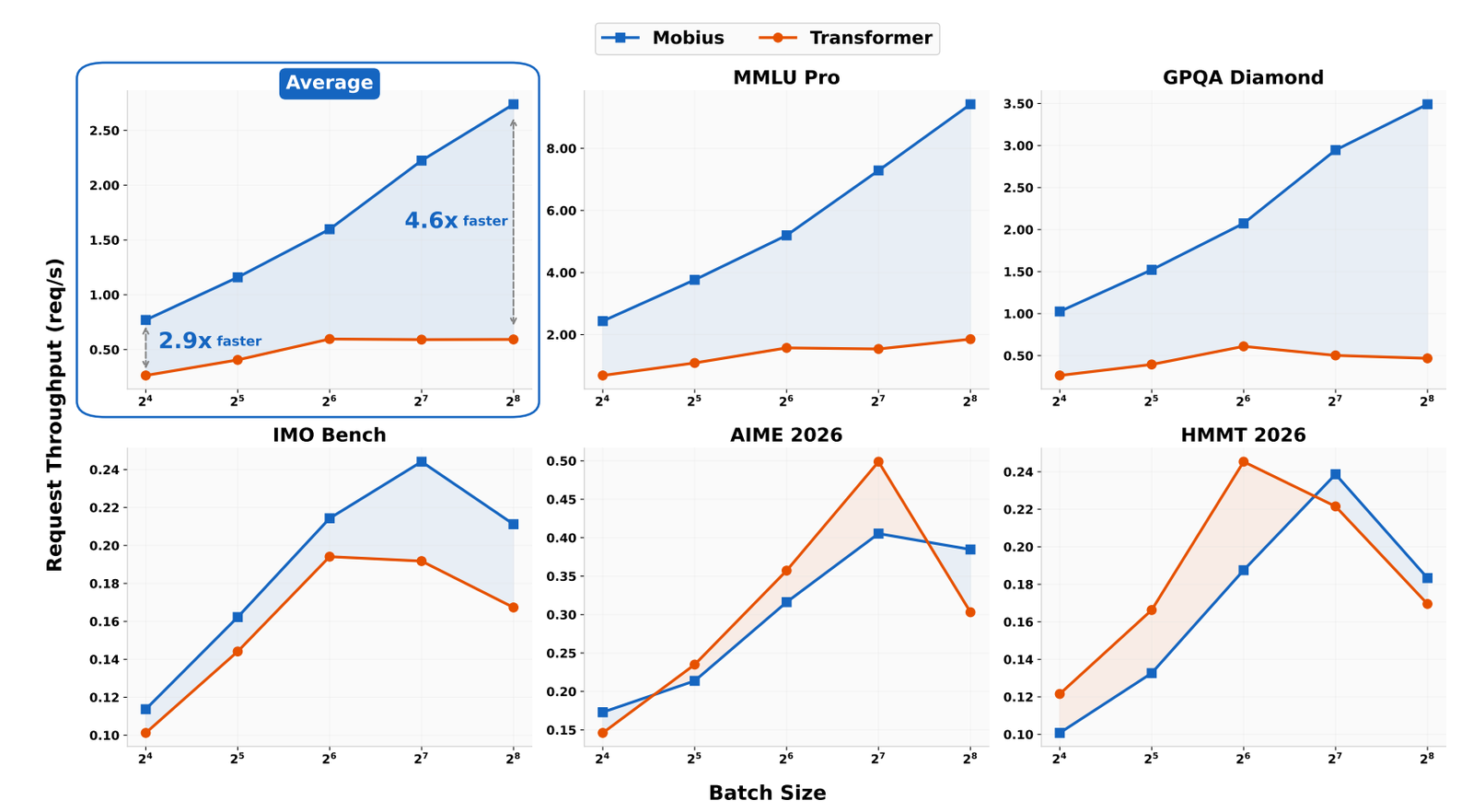
Zoom into the five subplots behind that average and the story isn't uniform. MMLU Pro and GPQA Diamond show a wide, cleanly growing gap in Mobius's favor — that's most of what drags the average up. The three math-competition benchmarks look nothing like it. On AIME 2026 and HMMT 2026 the lines cross, and the Transformer baseline is the faster of the two at three of the five batch sizes plotted — including 2⁷, where AIME's gap is widest in the baseline's favour. IMO Bench does stay in Mobius's favour at every point, but by a margin closer to 1.1× than to anything in the headline. The 2.9–4.6× number describes the boxed average panel. It doesn't describe every benchmark that average is built from, and the chart says so plainly if you look past the box.
Most of the throughput gain traces back to shorter output, not cheaper per-token compute — Fig. 2 gives average trace length directly, and the "Nx shorter" figures on it are exact, not chart-estimated:
On GPQA Diamond, Mobius reaches a comparable or better score (see the benchmark table below) while emitting a trace 5× shorter than the same-size Transformer it's compared against. GPQA Diamond and MMLU Pro compress the most (5.0× and 4.6×); the three math-competition benchmarks — IMO Bench, AIME 2026, HMMT 2026 — compress far less (1.2–1.5×), which is also where Fig. 1's throughput lines stop being one-sided.
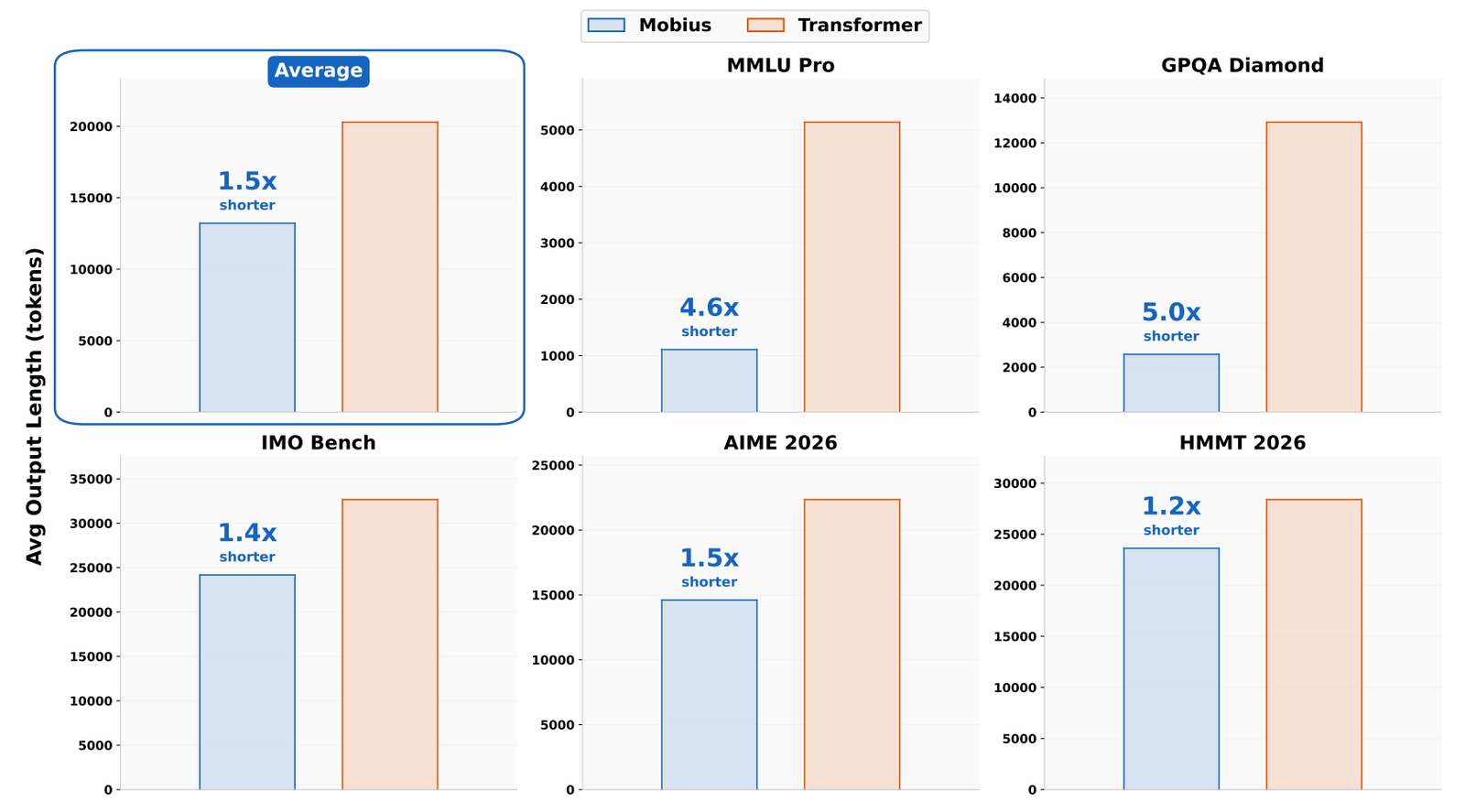
The same pattern repeats: GPQA Diamond and MMLU Pro compress the most and are also where the throughput gap is widest and cleanest; the math-competition benchmarks compress the least and are where the throughput lines cross. Shorter traces plus fewer live tokens in the KV cache is a coherent story for why throughput goes up — it just doesn't go up evenly.
Licence, and whether you can run it
Apache-2.0, same family as Intern-S2-Preview-397B. The weights are real:
five bf16 safetensors shards on Hugging Face (internlm/Intern-S2-Mobius), about 73 GB total, not
gated, mirrored on ModelScope. That's a workstation-class footprint next to the 397B model's
frontier-hardware requirement — LMDeploy's quickstart serves it on a single GPU (--tp 1), MTP
speculative decoding recommended for the throughput numbers above.
What I make of it
- The mechanism is real and it's in the code, not just the prose.
block_idx = layer_idx % num_blocksis a two-line change with a genuinely different parameter-sharing shape than a standard MoE — four memory banks instead of forty, each queried by ten layers spread across depth. That's checkable, and it checks out. - "Dynamic Latent Reasoning" oversells what the inference code shows. There's no runtime loop — it's a single forward pass with a repeating depth-wise pattern, which is a more modest and more precise thing than "iterative refinement" suggests.
- The efficiency win is real but uneven, and it tracks trace compression. Where output collapses — GPQA Diamond 5.0× shorter, MMLU Pro 4.6× — throughput climbs cleanly. Where it barely moves — HMMT 1.2×, IMO Bench 1.4×, AIME 1.5× — the throughput advantage narrows to nothing or inverts. That is a coherent mechanism rather than a mystery: the speedup is mostly fewer tokens, not cheaper tokens. It also means the gain should be expected to shrink on any task where the model still needs to think at length.
- This is an ablation, not a leaderboard entry. Every comparison on the card is Mobius against its own untouched base model. That's the right comparison for isolating what the architecture buys. It's the wrong comparison for deciding whether to run Mobius instead of anything else.
Sources: the Intern-S2-Mobius model card
(README, config.json, configuration_interns2_mobius.py, modeling_interns2_mobius.py) and the
Intern-S2-Preview-397B model card, both
InternLM / Shanghai AI Lab. Benchmark numbers and figures are quoted as reported on the Mobius
model card; no independent technical report or arXiv paper could be located.