2026-09-08 · 33 min · rust · search · retrieval
Why read this
Essentialtop 10%Reads tgrep's trigram planner to show exactly where it falls back to a full scan, and computes the break-even nobody published: 3 to 200 queries, or never.
- Analysis found nowhere else
- Runs on a laptop CPU
- Interactive explanations
Developer tools & infraMITPractitioner tool
How this was scored
- Is it new?
- 1 of 3: An incremental tweak
- Can I trust it?
- 2 of 3: Measures key facts from files, code or configs
- Can I run it?
- 3 of 3: Open, permissive, runs on reader hardware with instructions
- Will I understand it?
- 3 of 3: Mechanism carried by interactives built from real code or data
- Can I act on it?
- 3 of 3: A decision guide a practitioner can follow today
- Will it last?
- 2 of 3: A reference for a year or more
- Does it affect many?
- 2 of 3: A widely used model, tool or lab release
- Only here?
- 3 of 3: The only place this analysis exists
Score 81 of 100, ranked 18 of 577 rated articles. Each question is answered 0–3 by hand, and a 3 is rare. How articles are scored
tgrep is a trigram-indexed grep with a client/server
architecture, and Microsoft says it now powers grep search inside
GitHub Copilot CLI. Its pitch is the one every code-search
tool eventually makes: grep/ripgrep re-scan every file on every query — O(total bytes) per
search — and in a 100k+ file monorepo that's slow enough to matter. tgrep pre-builds an index once
so a query only touches the small set of files that could possibly match.
The README's headline is up to 52x faster than ripgrep, and the benchmark table right under it
is captioned, in tgrep's own words, "avg latency per query, index pre-built." That qualifier is
the whole story compressed into three words, and it's honest — but it also means the number is not
a like-for-like comparison with ripgrep, which does zero setup and scans cold every time. tgrep
amortizes an index build and keeps a server resident between queries. Whether that's a good trade
depends entirely on how many queries you're about to run against a tree that isn't changing out from
under you — which is exactly the regime a coding agent or an editor lives in, and exactly the
regime a one-shot CI grep does not. This piece reads the actual Rust — tgrep-core, tgrep-cli,
the fuzz targets, BENCHMARKS.md — to find the real mechanism, the real limits, and the number
neither document publishes: how many queries it takes for the index to pay for itself.
Index once, search forever
tgrep index .            # build the trigram index
tgrep serve .            # start server (watches for file changes)
tgrep "fn main" .        # instant — auto-connects to running server
Three commands, three separate concerns. index is a one-shot batch build. serve keeps that
index resident in memory, watches the filesystem for changes, and listens on a local TCP port.
Every subsequent tgrep <pattern> is a short-lived client process that finds the running server
(via a serve.json discovery file) and asks it a question over the wire — the query itself pays
almost nothing beyond process startup and a round trip, because the expensive part already
happened. The project's own architecture diagram makes the two-layer index explicit:
tgrep <pattern> ---TCP---> tgrep serve (multi-client)
    (client)                   |
                          HybridIndex
                          /         \
                   IndexReader    LiveIndex
                   (mmap disk)   (in-memory overlay)
                        ^              ^
                        |              |
                  Periodic Flush  File Watcher (notify)
                  (50K files /    Background Indexer
                   5 min)         (rayon parallel)
IndexReader is the durable, mmap'd on-disk index built by tgrep index. LiveIndex is a
mutable in-memory overlay for anything that has changed — or is still being indexed — since the
server started. HybridIndex merges both and lets the overlay win on conflict. Everything below
is either "how the on-disk half works" or "how the two halves stay in sync while files churn under
a running server" — the two questions that decide whether a persistent index is actually the right
design for a given workload.
The idea: bytes you can rule out without reading them
The mechanism is the one Russ Cox described in Regular Expression Matching with a Trigram
Index — tgrep's own source and docs never cite it by
name, but the code is a textbook implementation. A trigram is every overlapping 3-byte window
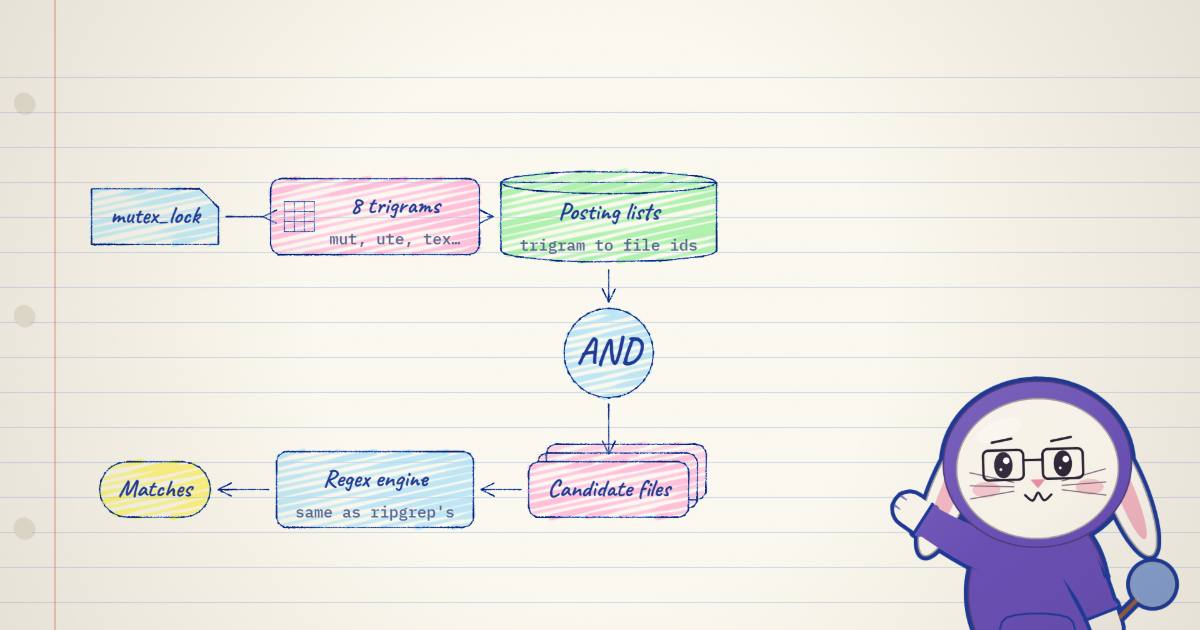
in a string. "mutex_lock" has eight of them: mut, ute, tex, ex_, x_l, _lo, loc,
ock. The insight is that if a file matches the literal string mutex_lock, it necessarily
contains every one of those eight trigrams somewhere — so an inverted index from trigram →
files-that-contain-it turns "which files contain mutex_lock" into an eight-way set intersection,
answerable without opening a single file whose posting lists don't all agree.
tgrep-core/src/trigram.rs packs each 3-byte window into a u32 — three bytes is 24 bits, so the
packing is exact and collision-free by construction:
pub type TrigramHash = u32;

/// Pack three bytes into a single u32 trigram hash.
#[inline]
pub fn hash(a: u8, b: u8, c: u8) -> TrigramHash {
    (a as u32) << 16 | (b as u32) << 8 | c as u32
}

/// Extract all unique trigrams from a byte slice.
pub fn extract(data: &[u8]) -> Vec<TrigramHash> {
    if data.len() < 3 {
        return Vec::new();
    }
    let mut seen = HashSet::new();
    let mut result = Vec::new();
    for window in data.windows(3) {
        let h = hash(window[0], window[1], window[2]);
        if seen.insert(h) {
            result.push(h);
        }
    }
    result
}
Because the key is its own hash, tgrep swaps out HashMap's default SipHash — which exists to
resist adversarial collisions that can't happen here — for one multiply-xorshift mix, and the
crate's own comment on why is worth quoting directly:
/// A trigram key *is* its own hash: packing three bytes into 24 bits is
/// injective, so there is nothing for a cryptographic hash to protect against.
/// The default SipHash is not free, though, and extraction hashes once per
/// input byte — twice for a file containing any uppercase — which put it
/// directly on the critical path of every index build.
That's a small, disciplined optimization, and it's representative of the codebase: BENCHMARKS.md's trigram-extraction microbenchmarks show it and a fused case-folding pass cutting extraction time on mixed-case 256 KiB inputs from 8.44ms to 2.28ms — a real, measured 3.7x, not a guess.
Each trigram also carries two 8-bit masks per (trigram, file) pair, computed once during extraction and stored alongside the posting entry — cheap pre-filters that reject some false positives before a candidate file is even opened:
/// Per-trigram masks for a single file.
pub struct TrigramMasks {
    /// Positional mask: bit i is set if the trigram occurs at offset where offset % 8 == i.
    pub loc_mask: u8,
    /// 8-bit Bloom filter of bytes that immediately follow this trigram in the file.
    pub next_mask: u8,
}
loc_mask lets the query engine cheaply check whether two trigrams from the same literal could
plausibly be adjacent in the file (rotate one mask by a bit, AND with the next), and next_mask
is an 8-bucket Bloom filter of what byte actually follows each trigram occurrence — so a query for
mutex_lock can reject a file that has the trigram tex followed only by, say, t (as in
text_lock) without ever reading the file's bytes. Both are approximations that can only produce
false positives, never false negatives — consistent with the two-stage design the rest of this
piece keeps coming back to: narrow cheaply, verify exactly.
From bytes to files: the on-disk format
The index is three flat files, documented directly in tgrep-core/src/ondisk.rs:
/// ## `lookup.bin` — sorted trigram → postings pointer
/// Fixed-size 16-byte entries sorted by trigram hash for binary search.
/// ┌────────────────┬────────────────┬────────────────┐
/// │ trigram_hash   │ offset         │ length         │
/// │ u32 (4B LE)   │ u64 (8B LE)    │ u32 (4B LE)    │
/// └────────────────┴────────────────┴────────────────┘
///
/// ## `index.bin` — concatenated posting lists
/// Each entry is 6 bytes: `file_id(u32) + loc_mask(u8) + next_mask(u8)`.
///
/// ## `files.bin` — file ID → path mapping
/// Variable-length records: `file_id(u32 LE) + path_len(u16 LE) + path_bytes`.
pub(crate) const LOOKUP_ENTRY_SIZE: usize = 16;
pub(crate) const POSTING_ENTRY_SIZE: usize = 6;

pub struct PostingEntry {
    pub file_id: u32,
    pub loc_mask: u8,
    pub next_mask: u8,
}
lookup.bin is sorted by trigram hash, so a lookup is a binary search over fixed-size records —
reader.rs's binary_search is the textbook loop, mid = lo + (hi - lo) / 2, over an mmap'd
slice with no deserialization step. index.bin is nothing but posting lists back to back, sorted
by file ID within each trigram — which matters at query time, because it means an AND across
several trigrams' posting lists is a linear merge-intersection, not a sort-then-intersect:
fn intersect_sorted(a: &[u32], b: &[u32]) -> Vec<u32> {
    let mut result = Vec::new();
    let (mut i, mut j) = (0, 0);
    while i < a.len() && j < b.len() {
        match a[i].cmp(&b[j]) {
            std::cmp::Ordering::Equal => { result.push(a[i]); i += 1; j += 1; }
            std::cmp::Ordering::Less => i += 1,
            std::cmp::Ordering::Greater => j += 1,
        }
    }
    result
}
IndexReader mmaps all three files, so opening an index is a syscall, not a parse, and every
lookup is zero-copy against kernel-managed pages. HybridIndex::open explicitly checks for a
"degenerate" reader — mmap sections present but a zero entry count — because on Windows a stale
metadata write once produced exactly that shape and silently returned zero candidates for every
query.
Building the index without blowing up memory
The naive way to build this — collect every (trigram, file_id) pair for the whole repo, sort
once, write once — has peak memory that grows linearly with repo size, and on a repo the size of
Chromium that's genuinely a problem. tgrep's default strategy is an external merge sort instead:
pub enum IndexStrategy {
    /// Hold every posting in heap, sort once, write once. Peak memory grows
    /// linearly with repository size and is unbounded.
    InMemory,
    /// Bound peak memory with an external merge sort. Postings accumulate in
    /// a fixed-size arena that spills sorted, compact segments to disk when
    /// full; the segments are then k-way merged straight into the index.
    /// Peak heap is independent of repository size.
    #[default]
    External,
}
Measured on the Linux kernel tree (94,634 files, 990 MB index), the difference isn't marginal:
| Strategy | Spill segments | Peak working set | Build time |
|---|---|---|---|
memory (in-heap sort) | – | 2.20 – 3.76 GiB | 23 – 32 s |
external --index-buffer 256 | 8 | 430.6 MiB | ~24 s |
external (64 MiB arena, default) | 31 | 151 – 160 MiB | ~23 s |
external --index-buffer 16 | 122 | 109.6 MiB | ~23 s |
external --index-buffer 1 | 1,946 | 98.9 MiB | ~29 s |
(BENCHMARKS.md, "Index build strategies")
That's a ~17x reduction in peak memory for no time cost at the default arena size — in several
runs the external strategy was measurably faster than the in-heap one, because sorting one giant
posting vector (with the doubling reallocations that come from growing a Vec) costs more than
encoding and merging spill segments. The same bounded builder now backs a cold tgrep serve
bootstrap too, which used to walk the repo into an unbounded in-memory overlay and flush once at
the end:
| Bootstrap path | Peak working set | Wall time |
|---|---|---|
| in-heap overlay (before) | 1,569.7 MiB | 73.6 s |
| external builder (after) | 148.6 MiB | 28.7 s |
(BENCHMARKS.md, "Server bootstrap" — Linux kernel tree, 94,181 files) — a 10.6x memory cut and a 2.6x speedup, and the old path had a second problem worth naming: because it wrote nothing until one end-of-build flush, killing the server at 99% left an empty index behind. The bounded builder leaves a usable partial index if interrupted.
From regex to trigram query
A regex isn't a trigram, so the first job at query time is decomposing the pattern into the
literal fragments it requires — an occurrence trigram query can only assert "this file contains
these bytes somewhere," never anything about ordering across fragments or repetition count. That
decomposition lives in tgrep-core/src/query.rs, built on regex-syntax's parsed HIR (the same
crate ripgrep itself uses to plan its own literal-prefilter optimizations):
/// A node in the query plan tree.
pub enum QueryPlan {
    /// All trigrams must match (intersection of posting lists).
    And(Vec<TrigramQuery>),
    /// Any branch can match (union of results).
    Or(Vec<QueryPlan>),
    /// No trigrams could be extracted — must scan all files.
    MatchAll,
}
Three cases, and MatchAll is the honest one: it means the planner found nothing indexable, and
every candidate file has to be opened and run through the real regex engine — the same thing
ripgrep always does, for every query. A plain literal decomposes into an And of every trigram it
contains:
fn literals_to_query_plan(bytes: &[u8]) -> QueryPlan {
    if bytes.len() < 3 {
        return QueryPlan::MatchAll;
    }
    let queries: Vec<TrigramQuery> = (0..bytes.len() - 2)
        .map(|i| {
            let hash = trigram::hash(bytes[i], bytes[i + 1], bytes[i + 2]);
            let expected_next = if i + 3 < bytes.len() { Some(bytes[i + 3]) } else { None };
            TrigramQuery { hash, expected_next }
        })
        .collect()
}
For anything more than a bare literal, decompose_hir walks the parsed regex tree. Its Concat
arm is forgiving — it accumulates literal text and only flushes it into a checked run when it
hits something non-literal, so one unindexable fragment doesn't cost the fragments around it:
HirKind::Concat(subs) => {
    let mut all_queries = Vec::new();
    let mut current_literal = String::new();
    for sub in subs {
        if let HirKind::Literal(Literal(bytes)) = sub.kind() {
            current_literal.push_str(&String::from_utf8_lossy(bytes));
        } else {
            if !current_literal.is_empty() {
                // flush current_literal into all_queries, then clear it
            }
            let sub_plan = decompose_hir(sub, case_insensitive);
            if let QueryPlan::And(queries) = sub_plan {
                all_queries.extend(queries);
            }
            // MatchAll or Or children don't contribute AND trigrams
        }
    }
    // flush any trailing literal, then:
    if all_queries.is_empty() { QueryPlan::MatchAll } else { QueryPlan::And(all_queries) }
}
Its Alternation arm is the opposite — not forgiving at all:
HirKind::Alternation(alts) => {
    let plans: Vec<QueryPlan> = alts.iter().map(|a| decompose_hir(a, case_insensitive)).collect();
    // If any branch is MatchAll, the whole alternation is MatchAll
    if plans.iter().any(|p| p.is_match_all()) {
        QueryPlan::MatchAll
    } else {
        QueryPlan::Or(plans)
    }
}
One indexable-free branch in an A|B|C poisons the whole OR, even if the other branches are clean
literals — because a file could match only through that one ungoverned branch, so no candidate
set built from the other branches is safe to trust. The same poisoning rule applies one level up,
across -e/multi-pattern searches (build_multi_pattern_plan unions every supplied pattern's
plan the same way, for the same reason).
Try it: type a pattern, watch it decompose
The interactive below reimplements these exact rules — verified line-for-line against the real
regex-syntax 0.8.11 crate, not guessed — so you can see which trigrams a pattern actually yields,
and which of a tiny six-file demo repo survive the resulting filter. It also runs a real regex
against each demo file afterward, the same "narrow, then verify" pipeline tgrep itself runs, so a
genuine false positive (the trigram filter honestly can't rule it out) shows up as one.
Where a trigram index always gives up
Every trigram engine degrades to a full scan somewhere, and the honest version of "why tgrep is
fast" has to include exactly where. Five separate mechanisms in the source produce a MatchAll,
and each one is worth naming precisely rather than hand-waved as "short patterns and wildcards":
-
Under 3 literal bytes.
literals_to_query_planbails the instant a contiguous literal run is shorter than 3 bytes — there's no 3-byte window to hash. This is the sharpest edge case in the whole system:a{2,3}looks like it should narrow on three occurrences ofa, butregex-syntax's HIR represents the repeated unit as the single-byte literal"a", not"aaa", so even a{2,3}repetition of a one-byte literal still only ever contributes one byte to trigram planning. Verified directly againstregex-syntax::parse("a{2,3}"). -
A character class with nothing else around it.
[abc],\d,\w,\p{L}— any bareHirKind::Classnode — maps straight toMatchAll. But becauseConcatonly flushes and discards the class itself rather than poisoning its neighbors,[Ee]rrorstill keepsrror's two trigrams (rro,ror); only the fully bare form loses everything. -
Inline
(?i), specifically — not-i. This is the sharpest, least obvious edge in the whole design, and it's worth stating precisely because it's easy to get backwards. tgrep's own-i/-Sflags lowercase the pattern string in Rust before it ever reachesregex-syntax, so the parser still sees a plainLiteraland the query stays fully indexed. But writing(?i)hellodirectly into the pattern hitsregex-syntax's own case-folding at parse time, which does not preserveLiteralat all — verified directly:regex_syntax::parse("(?i)hello") => Concat([Class('Hh'), Class('Ee'), Class('Ll'), Class('Ll'), Class('Oo')])Every letter becomes its own one-off character class, never a
Literal, sodecompose_hir's Class arm swallows the whole thing —(?i)hellois a full scan, even though-i helloon the exact same corpus is fully indexed. It's not all-or-nothing, either: only the alphabetic bytes get case-folded away.regex_syntax::parse("(?i)v1_2")returnsConcat([Class('Vv'), Literal("1_2")])— the digits and underscore survive as a real literal, so(?i)v1_2still yields one trigram (1_2) even though(?i)helloyields none. -
An optional element wrapping the whole pattern.
Repetitionwithmin == 0—x?,x*, or a{0,n}— isMatchAllfor that node. Buried inside aConcat(error?) this only costs the optional tail; as the entire pattern ((?:TODO)?,.*) there's nothing left to flush and the whole query reverts to a full scan. -
One bad branch in an alternation, or in a multi-pattern search. Covered above —
Orpoisoning is not forgiving, unlikeConcat.
Two more only apply under -P/--pcre2, the backtracking engine (fancy-regex, not real PCRE2 —
more on that below). The default regex crate doesn't support lookaround or backreferences at
all, so a pattern using either fails outright as a parse error before query planning runs, exit
code 2 — the same thing ripgrep does with default. -P recovers something from lookaround: a
relaxer, relax_for_indexing, deletes lookaround text from the pattern outright and re-parses
what's left, on the argument that deletion can only widen the matched language, never narrow it:
/// Every rewrite only ever *widens* the matched language, so
/// `L(pattern) ⊆ L(relaxed)`:
///
/// * deleting a zero-width lookaround removes a constraint on the match;
/// * turning `(?>…)` into `(?:…)` only restores backtracking paths.
///
/// That direction is the one the index needs. A trigram the relaxed pattern
/// requires is therefore required by the original too, so no file that really
/// matches can be filtered out. Narrowing would be a correctness bug.
pub fn relax_for_indexing(pattern: &str) -> Option<String> {
So (?<!//)ExchangePrincipal relaxes to plain ExchangePrincipal and stays fully indexed under
-P. But the function returns None — full scan — the instant it sees a backreference (\1,
\k<name>), \K, \G, or a conditional (?(1)...), anywhere in the pattern, even next to a
perfectly good mandatory literal — because widening those away risks silently dropping a real
match, and tgrep's own comment is explicit that correctness wins that trade every time.
And several CLI flags bypass the index outright, regardless of what the pattern says, because
they need information the trigram filter structurally can't provide — an inverted index of "files
that contain X" has no way to answer "files that do not match" or "files that were never in the
index to begin with." From tgrep-cli/src/search.rs:
let plan = if opts.effective_passthru() || opts.encoding.may_differ_from_index() {
    QueryPlan::MatchAll
} else if matcher.is_standard() || opts.fixed_string {
    query::build_multi_pattern_plan(&opts.all_patterns()?, opts.fixed_string, ci)?
} else {
    query::build_relaxed_multi_pattern_plan(&opts.all_patterns()?, ci)
};
// ...
let candidate_ids = if is_match_all || opts.files_without_match || opts.invert_match || opts.include_zero {
    reader.all_file_ids()   // even a perfectly narrowed plan is discarded here
} else {
    query::execute_plan_with_masks(&plan, &|tri| reader.lookup_trigram_with_masks(tri))
};| Flag | Why it bypasses |
|---|---|
-v / --invert-match | Trigrams assert presence, never absence |
--files-without-match | Same — needs files that lack a match |
--include-zero | Needs to see files the plan would have excluded |
-E / --encoding (non-default) | Re-decodes bytes the index never saw |
-a / --text, --binary | The index only covers text files |
-. / --hidden, every --no-ignore* | Widens the file set past what was indexed |
| A single file named on the command line | Reading one file is cheaper than a lookup |
That's the honest boundary of the design: a trigram AND/OR filter over "definitely contains bytes X" is a narrow, one-directional tool, and every one of these cases is a query that isn't shaped like that. None of it is a bug — the failure mode in every single case is "scan and verify everything," which is exactly ripgrep's normal, correct behavior. A trigram index cannot silently produce a false negative in this design; it can only fail to help.
Client/server: staying warm without going stale
The part of the pitch that's easy to undersell is that tgrep serve isn't just "the index, but in
RAM" — it's a whole small system for keeping that index correct while a real, actively-edited
repository changes underneath it. HybridIndex is the seam:
/// **Concurrency**: the on-disk `IndexReader` is held inside an internal
/// `RwLock<Arc<IndexReader>>`, which lets the publish path swap the reader
/// **without** the caller having to hold an exclusive (`&mut`) reference to
/// the `HybridIndex`. This means `tgrep serve` can safely keep search
/// queries running with only an outer read lock during a flush — the brief
/// inner write lock around the `Arc` swap takes microseconds and the old
/// reader's mmap is released only after the last in-flight query drops its
/// `Arc<IndexReader>`.
pub struct HybridIndex {
    reader: RwLock<Arc<IndexReader>>,
    pub live: LiveIndex,
    pub root: PathBuf,
}
LiveIndex is the in-memory half — every trigram it holds gets its file IDs tagged with a high bit
(OVERLAY_BIT: u32 = 1 << 31) so overlay entries and on-disk entries never collide in the same ID
space, and the merge is simply "overlay wins":
pub struct LiveIndex {
    inverted: HashMap<u32, HashSet<u32>>,           // trigram -> overlay file IDs
    masks: HashMap<(u32, u32), trigram::TrigramMasks>,
    file_paths: HashMap<u32, String>,
    path_to_id: HashMap<String, u32>,
    deleted_paths: HashSet<String>,
    next_id: AtomicU32,
    dirty_count: u32,
}
Filesystem changes reach LiveIndex through the notify crate — the same watcher library
ripgrep-adjacent tooling generally reaches for — and the hand-off between the OS notification
thread and the actual indexing work is deliberately decoupled, with the reasoning spelled out in
the source:
// Hand events to a worker thread instead of indexing inside the callback.
// The callback runs on the platform's notification thread, which on Windows
// owns a fixed-size `ReadDirectoryChangesW` buffer; doing file I/O and
// trigram extraction there stalls it, and everything arriving meanwhile is
// dropped by the OS with no error we can see. The queue is bounded so a
// burst (a branch switch, a build) can't grow it without limit.
let (tx, rx) = std::sync::mpsc::sync_channel::<Event>(queue_cap);
A monorepo where files change constantly — the adversarial case for any index — is exactly what this is built to survive, but the design is explicit that OS-level file-change notifications are lossy by nature: a full queue, a network filesystem that silently declines to report a change, a branch switch that replaces half the tree. tgrep doesn't pretend otherwise:
Once the index is built, everything that changes it arrives as an OS notification, and a notification can go missing... nothing else in the server revisits a file it believes it already knows. A missed change would otherwise last until that file happened to change again, which for a deleted file is never.
So a watching server also reconciles on a timer: about once an hour it walks the tree and compares it against the index... It waits for a two-minute gap in queries first, and gives up waiting after four hours so a continuously busy server still reconciles.
That reconciliation pass — an hourly tree-walk-and-diff, deliberately timed around query traffic
rather than fighting it — is the belt to the file watcher's suspenders, and it's the detail that
makes "the server watches for changes" a credible claim on a busy monorepo rather than an
aspiration. Memory during churn is bounded the same way index builds are: the overlay flushes to
disk every 50K files or 5 minutes, whichever comes first, swapping in a fresh IndexReader
under that brief write lock above. --max-memory (default: 50% of RAM, clamped 512 MB–16 GB)
caps the overlay before that scheduled flush if churn outpaces it.
The wire protocol
The server binds an ephemeral TCP port on localhost and speaks newline-delimited JSON-RPC 2.0, one thread per connection:
/// Server discovery info, written to `serve.json`.
pub struct ServerInfo {
pub pid: u32,
pub port: u16,
}
fn handle_connection(stream: TcpStream, state: &Arc<ServerState>) -> Result<()> {
let mut reader = BufReader::new(stream.try_clone()?);
let mut writer = stream;
let mut line = String::new();
while reader.read_line(&mut line)? > 0 {
let response = process_request(&line, state);
writeln!(writer, "{response}")?;
writer.flush()?;
line.clear();
}
Ok(())
}
fn process_request(request: &str, state: &Arc<ServerState>) -> String {
let req: serde_json::Value = serde_json::from_str(request)
.unwrap_or_else(|e| return json_rpc_error(None, -32700, &format!("Parse error: {e}")));
match req.get("method").and_then(|m| m.as_str()).unwrap_or("") {
"search" => handle_search(id, ¶ms, state),
"files" => handle_files(id, state),
"status" => handle_status(id, state),
"reload" => handle_reload(id, state),
other => json_rpc_error(id, -32601, &format!("Method not found: {other}")),
}
}And the client side of a search is exactly the mirror — connect to the discovered port, write one line of JSON, read one line back:
let mut stream = TcpStream::connect(format!("127.0.0.1:{}", info.port))?;
writeln!(stream, "{}", serde_json::json!({
    "jsonrpc": "2.0", "method": "files", "id": 1,
}))?;
BENCHMARKS.md is explicit that its own numbers include this round trip, not just the search:
"Every query is run through a fresh tgrep client process, so each measurement includes process
startup and the TCP round trip, exactly as a shell user or editor integration would pay them."
That's the right thing to measure — it's the actual cost an agent calling tgrep as a subprocess
would pay on every single call.
Correctness over speed: what the fuzz suite actually checks
A trigram prefilter that produces a false negative is worse than useless — it would make tgrep
silently miss real matches, which is a much worse failure than being slow. The fuzz/ crate's
four targets are aimed almost entirely at the boundary where that could happen: the on-disk format
and the code that has to trust bytes it didn't write.
// fuzz_reader.rs — the sharpest of the four
//
// `fuzz_ondisk` only round-trips `PostingEntry` encode/decode, so nothing
// reaches `IndexReader` itself — yet that is where untrusted values do
// damage. The `offset` (u64) and `length` (u32) fields of a `lookup.bin`
// entry are the loop bound and the slice base for decoding `index.bin`, so a
// corrupt pair there is what turns a bad file into a panic, an out-of-range
// slice, or a multi-gigabyte reservation.
fuzz_target!(|data: &[u8]| {
    // ...carves `data` into synthetic lookup.bin/index.bin/files.bin files...
    let Ok(reader) = IndexReader::open(&dir) else { return };
    for i in 0..reader.num_trigrams().min(MAX_ENTRIES_DECODED) {
        let (trigram, entries) = reader.trigram_posting_at(i);
        assert!(entries.len() <= max_decodable, "decoded postings not bounded by file size");
    }
});
The other three: fuzz_trigram checks that extract never panics and that
extract_with_masks produces the identical trigram set as plain extract on arbitrary bytes;
fuzz_query throws arbitrary UTF-8 at build_query_plan and build_literal_plan at both
case sensitivities, asserting only that it never panics (a bad regex is Err, not a crash);
fuzz_ondisk round-trips PostingEntry and pins that every extracted trigram hash re-decodes to
the same three bytes.
Worth being precise about what this buys, and what it doesn't. This is not fuzzing regex
correctness — that job belongs entirely to whichever regex engine is doing the actual matching
(regex by default, fancy-regex under -P), both mature crates with their own, much larger,
independent test and fuzz histories that predate tgrep by years. What tgrep's own fuzz suite is
defending is narrower and, for this specific piece of software, more important: that a
maliciously or accidentally corrupt on-disk index — the one thing tgrep adds to a codebase that
plain ripgrep doesn't have at all — can't crash the reader or corrupt a search, and that the
trigram layer's own transformations (extraction, hashing, masking) are lossless. Confidence in
tgrep's matching is inherited from upstream regex/fancy-regex; confidence in tgrep's index
is what this suite is actually testing.
Whose regex engine is this, anyway
tgrep-core's dependencies answer the "is this built on ripgrep's own ecosystem" question
directly:
[dependencies]
regex = "1"
regex-syntax = "0.8"
ignore = "0.4"
globset = "0.4.18"
memmap2 = "0.9"
rayon = "1"regex, regex-syntax, ignore, and globset are all crates from the same ecosystem that powers
ripgrep — regex/regex-syntax are Andrew Gallant's (BurntSushi's) core matching engine and its
parser/HIR, ignore is the same .gitignore-aware directory walker ripgrep itself uses (tgrep's
own walker.rs says so directly in its doc comment: ".gitignore-aware file walker using the
ignore crate (same as ripgrep)"), and globset backs -g/--glob. So for the default
matching path, the regex engine that actually decides whether a candidate file's bytes match is
the same engine ripgrep runs — tgrep's contribution isn't a faster matcher, it's a narrower set
of files handed to that matcher. tgrep-cli adds fancy-regex for -P/--pcre2, which is worth
flagging precisely because the flag name invites a wrong assumption: -P/--pcre2 is ripgrep's
own naming convention for "the backtracking engine that supports lookaround and backreferences,"
but neither ripgrep nor tgrep links real libpcre2 — both use a pure-Rust backtracking engine
instead (fancy-regex here; ripgrep uses the same crate for its own -P). "PCRE2" names the
feature set, not the library.
The headline number, qualified
Here is the table the README leads with, reproduced in full — six repos, three platforms each, eighteen cells:
| Repo | Files | Queries | Windows | macOS | Linux |
|---|---|---|---|---|---|
| chromium/chromium | 504,351 | 30 | 17.6x | 15.8x | 3.81x |
| mozilla/gecko-dev | 387,841 | 122 | 38.6x | 51.9x | 7.36x |
| torvalds/linux | 95,831 | 102 | 34.8x | 21.0x | 9.38x |
| rust-lang/rust | 62,326 | 102 | 7.69x | 2.69x | 1.61x |
| kubernetes/kubernetes | 31,300 | 97 | 7.08x | 2.81x | 0.93x |
| golang/go | 15,833 | 103 | 7.53x | 3.12x | 1.29x |
(BENCHMARKS.md, "At a glance" — 24 Aug 2026 sweep, commit 82b88a1, GitHub-hosted runners)
Geometric mean across the six repos: 14.6x on Windows, 8.61x on macOS, 2.82x on Linux. The single highest cell is Gecko on macOS at 51.9x — the source of "up to 52x." The single lowest is Kubernetes on Linux at 0.93x — a loss, the one cell in the whole sweep where ripgrep wins (101.8ms vs. 94.4ms per query, on a warm page cache with generic high-match-volume queries where tgrep pays more to deliver results over the wire than the index saved by narrowing candidates). You relayed this as "7x–50x faster," and that phrase is defensible only as a splice of two different platforms' numbers — "never below 7.08x" is specifically the Windows floor, and "up to 52x" is specifically a macOS cell — stitched together while dropping the one Linux cell that's actually a loss and the Linux geometric mean (2.82x) that's the honest floor of the whole sweep. The repo's own "up to 52x" is the more careful of the two claims: it's a real number from a real cell, explicitly framed as a ceiling rather than a typical case.
Does BENCHMARKS.md disclose index build time and size, or only steady-state query latency? Both — but not in the same table, which is exactly how "avg latency per query, index pre-built" ends up doing the headline-compressing work it does. The at-a-glance table above is pure steady-state query latency. Build time and index size are real, disclosed numbers — they just live in each repo's own prose section further down the document, never joined to the latency table:
| Repo | Files | Index build (Linux / Windows / macOS) | Index size |
|---|---|---|---|
| chromium/chromium | 504,351 | ~52s / ~73s / ~248s | ~2,584 MB |
| mozilla/gecko-dev | 387,841 | ~35s / ~58s / ~165s | ~1,952 MB |
| torvalds/linux | 95,831 | ~21s / ~26s / ~37s | ~1,000 MB |
| rust-lang/rust | 62,326 | ~4s / ~6s / ~8s | ~199 MB |
| kubernetes/kubernetes | 31,300 | ~4s / ~7s / ~5s | ~215 MB |
| golang/go | 15,833 | ~2s / ~3s / ~3s | ~113 MB |
(reassembled from the per-repo "Index build time" / "Index size" lines BENCHMARKS.md states for each repo — the source never puts this next to the latency table above)
The indexer's peak memory during that build is disclosed too, in the same scattered way, this time in its own separate table further down:
| Repo | Windows | macOS | Linux |
|---|---|---|---|
| chromium/chromium | 402.9 MiB | 462.6 MiB | 332.2 MiB |
| mozilla/gecko-dev | 347.8 MiB | 416.3 MiB | 256.9 MiB |
| torvalds/linux | 135.4 MiB | 216.7 MiB | 129.6 MiB |
| rust-lang/rust | 114.7 MiB | 150.8 MiB | 109.4 MiB |
| kubernetes/kubernetes | 109.1 MiB | 145.3 MiB | 110.7 MiB |
| golang/go | 108.0 MiB | 137.2 MiB | 108.7 MiB |
(BENCHMARKS.md, "Index-build peak memory in the latest sweep") — bounded well under 470 MiB even for Chromium's 504K files and 2.6 GB index, consistent with the external-merge-sort design above.
One more honest caveat BENCHMARKS.md states about itself, worth repeating rather than smoothing over: these are shared GitHub-hosted runners, not controlled hardware, and the document says outright that a single ripgrep column can move meaningfully between runs — five identical runs of the kernel query suite measured macOS ripgrep at 385s, 388s, 495s, 500s, and 550s, a 1.4x spread from runner variance alone. Compare tgrep and ripgrep within a row of a given run, not across different sweeps' absolute milliseconds.
(One thing worth naming plainly: BENCHMARKS.md compares tgrep only against ripgrep. There's no
ugrep column anywhere in the source — not in the benchmark suite, the README, or the repo's
history — so any three-way comparison would have to be run independently; it isn't something this
repository publishes.)
What per-query latency doesn't tell you: the break-even
Every number above describes steady state — the index already exists, and every following query is nearly free. What it doesn't answer is the question that actually decides whether building the index was worth it for a given session: how many queries does it take before the one-time index build has paid for itself against ripgrep's zero-setup cold scan? BENCHMARKS.md gives both halves of that arithmetic — the build time table above and the per-query latency table above it — and never combines them. Doing the division across all eighteen cells:
| Repo | Platform | Index build | ripgrep/query | tgrep/query | Break-even |
|---|---|---|---|---|---|
| chromium/chromium | Linux | 52.0s | 2,404.2ms | 631.4ms | ~29 queries |
| chromium/chromium | Windows | 73.0s | 24,575.8ms | 1,396.1ms | ~3.1 queries |
| chromium/chromium | macOS | 248.0s | 41,806.2ms | 2,643.1ms | ~6.3 queries |
| mozilla/gecko-dev | Linux | 35.0s | 1,194.9ms | 162.4ms | ~34 queries |
| mozilla/gecko-dev | Windows | 58.0s | 17,841.2ms | 462.6ms | ~3.3 queries |
| mozilla/gecko-dev | macOS | 165.0s | 33,401.8ms | 643.0ms | ~5.0 queries |
| torvalds/linux | Linux | 21.0s | 426.9ms | 45.5ms | ~55 queries |
| torvalds/linux | Windows | 26.0s | 3,280.0ms | 94.2ms | ~8.2 queries |
| torvalds/linux | macOS | 37.0s | 5,390.3ms | 256.1ms | ~7.2 queries |
| rust-lang/rust | Linux | 4.0s | 144.2ms | 89.4ms | ~73 queries |
| rust-lang/rust | Windows | 6.0s | 1,489.4ms | 193.7ms | ~4.6 queries |
| rust-lang/rust | macOS | 8.0s | 654.6ms | 243.6ms | ~19.5 queries |
| kubernetes/kubernetes | Linux | 4.0s | 94.4ms | 101.8ms | never |
| kubernetes/kubernetes | Windows | 7.0s | 1,342.3ms | 189.5ms | ~6.1 queries |
| kubernetes/kubernetes | macOS | 5.0s | 285.9ms | 101.9ms | ~27 queries |
| golang/go | Linux | 2.0s | 44.1ms | 34.1ms | ~200 queries |
| golang/go | Windows | 3.0s | 591.7ms | 78.6ms | ~5.8 queries |
| golang/go | macOS | 3.0s | 204.6ms | 65.6ms | ~21.6 queries |
(computed as index_build_ms / (ripgrep_ms_per_query - tgrep_ms_per_query) from the two tables
above — this arithmetic appears nowhere in BENCHMARKS.md or the README)
Two things stand out. First, the range is enormous — from about 3 queries (Chromium on Windows) to about 200 (Go on Linux) — and it tracks the same two variables the rest of BENCHMARKS.md names as deciding the margin: repo size (bigger repos have more for the index to skip, so ripgrep's cold-scan cost is higher and the payback is faster) and platform (Windows's high per-file I/O overhead makes ripgrep's cold scan disproportionately expensive, so the index earns its keep almost immediately; Linux's warm page cache makes brute force cheap, so payback is slow even where tgrep eventually wins on every query). Second, Kubernetes on Linux — the one cell BENCHMARKS.md already flags as ripgrep's sole win — never breaks even at all: tgrep's own per-query cost there (101.8ms) is already higher than ripgrep's cold scan (94.4ms), so the index is behind from the first query and the gap only widens.
The regime this is actually built for
None of this is an argument against tgrep — it's an argument for naming the regime the design targets, which the README's headline number quietly assumes rather than states. A persistent, watched index is the right architecture when the same tree gets queried many times between changes and the caller can afford to keep a server resident — which is precisely the shape of an editor's "find all references," or a coding agent making dozens of grep calls per task against a repository that isn't being rewritten between them. That's exactly the GitHub Copilot CLI integration the README names as tgrep's reason for existing, and inside that regime the 3–200 query break-even table above resolves in tgrep's favor almost immediately, because a single agent task or editor session routinely issues far more than a few dozen searches.
It is close to the wrong architecture for a one-shot CI grep, a single ad-hoc terminal search, or any workload where the tree is rewritten between almost every query — a build watcher constantly touching thousands of files is close to the adversarial case the whole file-watcher-plus-hourly- reconciliation design exists to survive, not the case it makes free. ripgrep's zero-setup cold scan is the right tool exactly where tgrep's amortization can't apply: when there's no second query coming.
Everything in this piece is read directly from microsoft/tgrep
at the commit its BENCHMARKS.md sweep cites (82b88a1) — tgrep-core/src/{trigram,query,ondisk, builder,reader,hybrid,live}.rs, tgrep-cli/src/{search,serve}.rs, fuzz/fuzz_targets/*.rs,
Cargo.toml, README.md, and BENCHMARKS.md. The regex-syntax HIR outputs quoted for (?i)
were independently verified against regex-syntax 0.8.11 rather than inferred, and the underlying
mechanism traces to Russ Cox's Regular Expression Matching with a Trigram
Index, which the tgrep repository itself does not
cite. This is an interactives-only piece — there's no paper and, unlike an article built around a
research release, no diagrams or figures in the source repository to responsibly reproduce, so the
mechanism above is explained entirely through the real Rust and the two components on this page,
following the precedent already set by BM25 on this site.
For the retrieval side of this — how BM25's inverted index compares to a trigram one, and how TurboVec makes the same "amortize a one-time cost, then stay fast" trade for vector search instead of text — and for why an agent harness cares about tool latency like this in the first place, see Agent harnesses: engineering the loop around the model.