2026-07-15 · 12 min · reinforcement-learning · reasoning · mixture-of-experts
A 1:38 narrated explainer, drawn in code. Every number and picture in it is this article's own; the sources are below.
› transcript
Hi, I'm Snowdrop! Ring-Zero trains a one-trillion-parameter base model to reason with nothing but a checkable reward. No human-written reasoning at all. The idea: reward only a right answer and a clean format, at trillion scale, and keep it stable with four stages and one ratio fix. Stage one's loss isn't divided by length, so longer correct traces earn more credit. The model learns to think at length, and to pad. Self-distillation keeps the shortest correct traces, trims the bloat, and resets the gap between the training and inference engines. Stage two divides the loss by length, so rambling earns nothing. Stage three trains three tiers, so one checkpoint reasons short or long on demand. One engine writes the rollouts, another trains on them, and they disagree by tiny amounts. Below the line: what the inference engine gave the token when it wrote it. Above it: what the training engine assigns now. So the ratio measures the update actually made. In the ablations, a naive ratio collapsed near step eight hundred. This one kept training. Scale moves the ceiling. After stage one, the trillion-parameter model scores eighty-nine point one on AIME. The smaller flash model, seventy-one point two. Zero RL sharpens the reasoning already latent in pretraining. A bigger base, not a cleverer reward, moves the ceiling. To recap: a checkable reward, four stages that grow then trim the reasoning, and a ratio that keeps the engines honest. Every source is in the full article. I'm Snowdrop. Bye!
Why read this
Nichelast 15%The four-stage zero-RL pipeline on a 1T MoE, the engine-ratio fix with its equations, and the scope caveats: ablations at 104B and nothing released.
- A lasting reference
- A new technique
- Explained from first principles
Training & RLNothing to runResearch paper
How this was scored
- Is it new?
- 2 of 3: A real new idea, method or capability
- Can I trust it?
- 0 of 3: Restates claims
- Can I run it?
- 0 of 3: Closed, nothing to run
- Will I understand it?
- 2 of 3: Mechanism from first principles with figures
- Can I act on it?
- 1 of 3: General advice
- Will it last?
- 2 of 3: A reference for a year or more
- Does it affect many?
- 1 of 3: A specialist community
- Only here?
- 1 of 3: Some original analysis
Score 40 of 100, ranked 529 of 577 rated articles. Each question is answered 0–3 by hand, and a 3 is rare. How articles are scored
Zero RL is the stripped-down recipe behind the reasoning-model boom: take a pretrained base model, give it math problems whose answers can be checked, reward it for getting them right, and let reinforcement learning grow the chain-of-thought on its own — no supervised fine-tuning, no human-written reasoning traces, no reward model. DeepSeek-R1 made it famous. But almost every published zero-RL study runs on models small enough to fit a modest cluster, which leaves the interesting question open: what happens when you do this to a genuinely large model?
Ring-Zero is that experiment. The authors run zero RL directly on Ling-2.5-1T-Base — a 1-trillion-parameter Mixture-of-Experts model with 63B active parameters per token — and report what changes at scale. The paper frames its results as a vindication of the bitter lesson: with enough scale, hand-crafted heuristics for "good reasoning" become unnecessary because the model develops them itself. The contribution is less a single trick than a stable, four-stage training pipeline that survives trillion-scale RL, plus a careful account of the training dynamics and the behaviors that emerge.
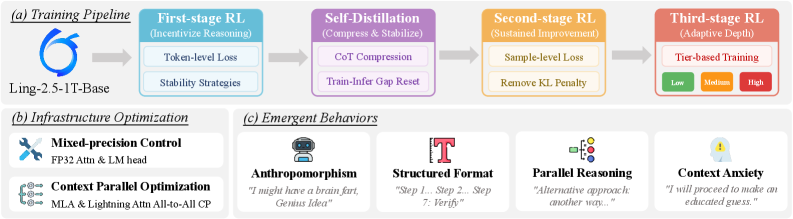
The pipeline is the method
There is no single loss here. Ring-Zero's real content is a sequence of four stages, each one repairing a failure mode the previous stage creates. Click through them:
The logic of the sequence is worth stating plainly. First-stage RL uses a token-level loss — the per-response loss is deliberately not divided by length — so a longer correct trace earns more total credit and the model learns to think at length. That works, but it also teaches the model to pad (more on that below). Self-distillation then samples from the stage-1 expert, keeps the shortest correct trace, self-filters redundant steps, and fine-tunes the base model on the result — compressing the bloat and, crucially, resetting the gap between the training and inference engines. Second-stage RL switches to a sample-level (length-normalized) loss so gradients no longer reward length, and drops the KL penalty now that the model is a strong starting point. Third-stage RL adds three difficulty tiers with their own prompts so one checkpoint can reason short or long on demand.
The setup
The base is Ling-2.5-1T-Base, a hybrid MoE combining MLA (multi-head latent attention) and Lightning Attention layers, trained from scratch with no SFT. The smaller Ling-2.5-flash-Base (104B total, 7.4B active) is used as the scaling foil and — importantly — as the workhorse for most ablations. Training runs on 320 × H200 GPUs with Megatron for updates and SGLang for rollouts. Each step draws G = 16 rollouts per question at temperature 1.0; the reward is dead simple and rule-checkable:
where checks for well-formed <think>...</think> and <answer>...</answer> tags and is rule-based matching early on, LLM-as-judge (Qwen3-Next-80B) later. That is the entire supervision signal — no human labels, no learned reward model. This is what "zero" means. It builds directly on ideas we have covered before: the MoE backbone (see Mixture of Experts, from scratch and Switch Transformers) and RL from verifiable rewards on reasoning (see Leanstral).
The objective, precisely
Stage-1's policy objective is a clipped-importance RL loss with a group-normalized (GRPO-style) advantage:
The is a stop-gradient: the importance weight scales each token's contribution but gradient flows only through . The weight is a clipped importance ratio:
with and no lower bound. Read the numerator and denominator carefully, because this is the paper's quiet but load-bearing fix. The denominator is the probability the inference engine (SGLang) assigned when it generated the rollout. The numerator is the probability the training engine (Megatron) assigns now. The two engines disagree by tiny floating-point amounts, and a naive ratio that mixes engines lets that disagreement compound until the ratio explodes and training collapses. The training-inference ratio correction is simply: put the training engine in the numerator, so the ratio measures the update you actually make.
This is the same disease diagnosed — from the routing angle — in Rollout Routing Replay: when the engine that generates a rollout and the engine that computes the gradient disagree, the importance ratio blows up and MoE RL diverges. Ring-Zero attacks the numerical side of it (and adds a small KL leash, , with the reference model refreshed every 400 steps, plus mixed-precision control — BF16 everywhere except FP32 in the attention softmax and the LM head, the two places rounding error is worst).
From token-level to sample-level: killing length inertia
The token-level loss has a side effect the paper names length inertia. Because the loss is not normalized by length, the model discovers a lazy shortcut: emitting more tokens is mathematically safer, so responses inflate even on easy problems it already solves on the first try. The fix is the Stage-2 loss, identical to Stage-1 except for one factor:
That makes the gradient magnitude independent of response length, so there is no longer a gradient reason to ramble. Paired with the self-distillation step that actively trims traces, it holds length flat while accuracy keeps climbing.
One model, three depths
Stage-3 trains three difficulty tiers jointly — Low (4k budget), Medium (16k), High (64k) — each with its own system prompt , so a single checkpoint routes its reasoning depth by prompt:
Pick a tier and watch the budget, the tokens actually spent, and the accuracy move together:
Does it work? The numbers
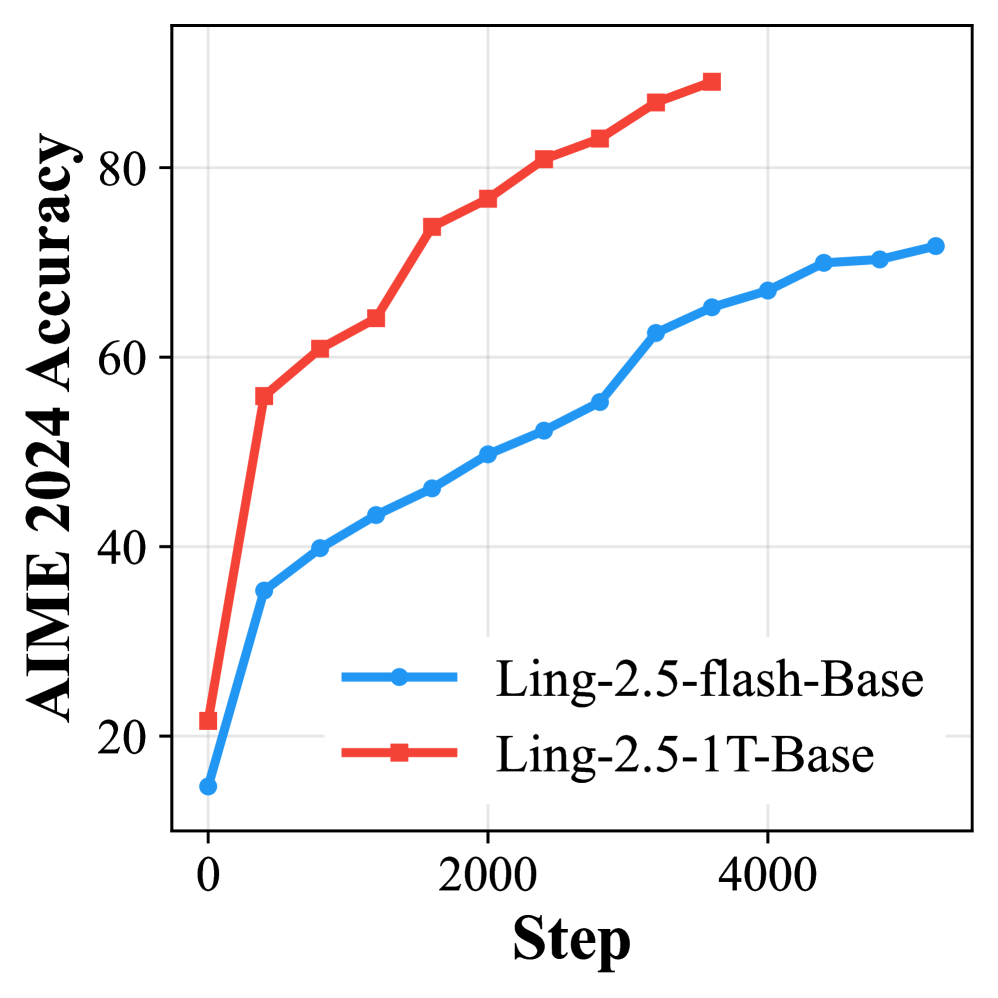
The headline is scaling. On the first stage of RL alone, the 1T model clears the 104B model by wide margins on every math benchmark. First-stage 1T scores (with the 104B flash model in prose for contrast): AIME 2024 89.1% (flash 71.2), AIME 2025 83.3% (63.5), AIME 2026 84.2% (65.3), HMMT Feb 2026 66.2% (50.3), IMOAnswerBench 59.3%.
The full pipeline (second-stage RL, with a 2× YaRN context extension) pushes those to 94.1% / 92.3% / 93.2% on AIME 2024/25/26. The scaling advantage is visible not just in the endpoint but in the slope — the 1T model learns faster per step:
Honesty check on where this lands. Ring-Zero's best AIME 2026 number (93.2%) is genuinely strong — but it still trails the frontier models the authors themselves list. This is a zero-RL-at-scale study, not a SOTA claim:
Where Ring-Zero does claim an edge is CoT quality, measured three ways. Its traces win LLM-as-judge comprehensibility comparisons against GLM-5.1, Kimi-k2.6, MiniMax-M2.7 and Qwen3.5-397B. They reproduce better under distillation: fine-tuning student models on only 100K Ring-Zero traces beats distilling 800K DeepSeek-R1 traces —
— and they are efficient: on problems both solve, Ring-Zero averages 6,368 tokens, less than half its baselines' length.
Two phases: discovery, then sharpening
The second finding is about how RL improves the model over time. Track two quantities: pass@1024 (can the model solve a problem in any of 1024 attempts — a measure of coverage) and pass@1 (does it nail it on the first try — reliability). They move on different schedules.
Coverage saturates early — pass@1024 flattens around step 800 — meaning RL has already surfaced essentially every reasoning pattern it will ever use (the discovery phase). But pass@1 keeps rising long after (the sharpening phase): the model is not finding new tricks, it is becoming reliable at the ones it has. The paper reads this as evidence for a sharper claim in its discussion — that zero RL optimizes within a boundary set by pretraining rather than expanding it. Which is exactly the honest ceiling in its limitations: RL cannot invent a proof technique the base model never saw.
Behaviors nobody programmed
The third finding is the paper's "bitter lesson" payoff: with scale, the model spontaneously develops cognitive behaviors that smaller-model work usually has to elicit with hand-crafted prompts or rewards. The paper documents five:
- Anthropomorphism — traces narrate themselves ("I might have a brain fart here", "let me not wing it", "genius idea"), artifacts of the pretraining corpus surfacing as reasoning scaffolding.
- Structured formatting — spontaneous "Step 1: / Step 2: / Verify:" scaffolds appear with no formatting instruction, hinting at a higher-level action space above raw tokens.
- Parallel reasoning — the model branches into competing strategies within a single rollout, compares outcomes, and commits only when evidence converges (tree-of-thought, self-taught).
- Self-verification — it re-checks assumptions, substitutes answers back into the problem's constraints, learned because that is what secures the correctness reward.
- Context anxiety — approaching its token limit, the model strategically aborts deep reasoning to guarantee a well-formatted answer, revealing an implicit awareness that format compliance is also rewarded.
The claim is not that these are magic; it is that at 1T scale they arrive for free, making the elaborate reasoning-elicitation machinery of small-model RL redundant.
What the ablations actually establish
Several design choices are backed by ablations — with one caveat that matters (see below): they are run on the 104B flash model, not the 1T model.
- RL algorithm. Comparing GRPO / DAPO / CISPO / GSPO reveals a speed-stability tradeoff: amplifying low-probability tokens (CISPO, DAPO) learns fastest but its entropy collapses; GRPO is most stable but slowest. Ring-Zero's clipped-importance-plus-corrections scheme is the attempt to get both.
- KL penalty. Remove it in stage 1 and the log-prob gap diverges, entropy collapses, and reward crashes within ~2,000 steps. With it stays healthy.
- Ratio correction. The naive ratio collapses near step 800; a clip-only patch delays collapse to ~2,700 steps; the training-engine-numerator correction trains indefinitely. This is the single most important stability result.
- Format reward. A single opening
<think>tag lets length explode with no reward gain; requiring properly closed tags with an EOS token is what makes stopping — and therefore credit — well-defined. - Hyperparameters. Robust to learning rate over ; is fastest per step but fastest in wall-clock; token-level loss grows length, sample-level keeps it flat — motivating the stage-1 to stage-2 switch.
The take
Ring-Zero's value is not a new loss function — it is a demonstration and an engineering recipe. The demonstration: run the simplest possible RL signal (right/wrong plus format) on a trillion-parameter base, and you get sharp gains, a clean two-phase learning dynamic, and reasoning behaviors that smaller models have to be coaxed into. The recipe: a four-stage pipeline where token-level RL grows reasoning, self-distillation compresses it and resets the engine gap, sample-level RL sustains it without length bloat, and tiered RL makes depth controllable — all held together by a training-inference ratio correction that is easy to overlook and, per the ablation, the difference between training and diverging.
The honest frame is the one the paper itself offers in its limitations: zero RL sharpens the reasoning already latent in pretraining; it does not transcend it. That is why coverage saturates while reliability climbs, and why a bigger base — not a cleverer reward — is what moves the ceiling. As a controlled study of what pure reward does at scale, it is unusually candid; as a frontier-accuracy claim, it is not one, and it does not pretend to be.
Built on Ring-Zero: Scaling Zero RL to a Trillion Parameters for Emergent Reasoning (Tang, Cao, Liu et al., 2026; CC BY 4.0), the team behind the Ling / Ring models. All benchmark, efficiency, and ablation figures are quoted from the paper; the interactive diagrams are illustrations of the mechanism, not reruns of the experiments. Ablations are on the 104B flash model unless noted; the 1T model and infrastructure are not publicly released.