2026-07-13 · 10 min · reinforcement-learning · distillation · mixture-of-experts
Why read this
Nichelast 15%Walks through MOPD routed distillation and HMPO's median-length budget, and marks where the 100B-class framing trails Kimi-K2.5.
- Explained from first principles
Training & RLNothing to runResearch model
How this was scored
- Is it new?
- 1 of 3: An incremental tweak
- Can I trust it?
- 1 of 3: Spot-checks a few numbers
- Can I run it?
- 0 of 3: Closed, nothing to run
- Will I understand it?
- 2 of 3: Mechanism from first principles with figures
- Can I act on it?
- 1 of 3: General advice
- Will it last?
- 1 of 3: Relevant for months
- Does it affect many?
- 1 of 3: A specialist community
- Only here?
- 1 of 3: Some original analysis
Score 37 of 100, ranked 546 of 577 rated articles. Each question is answered 0–3 by hand, and a 3 is rare. How articles are scored
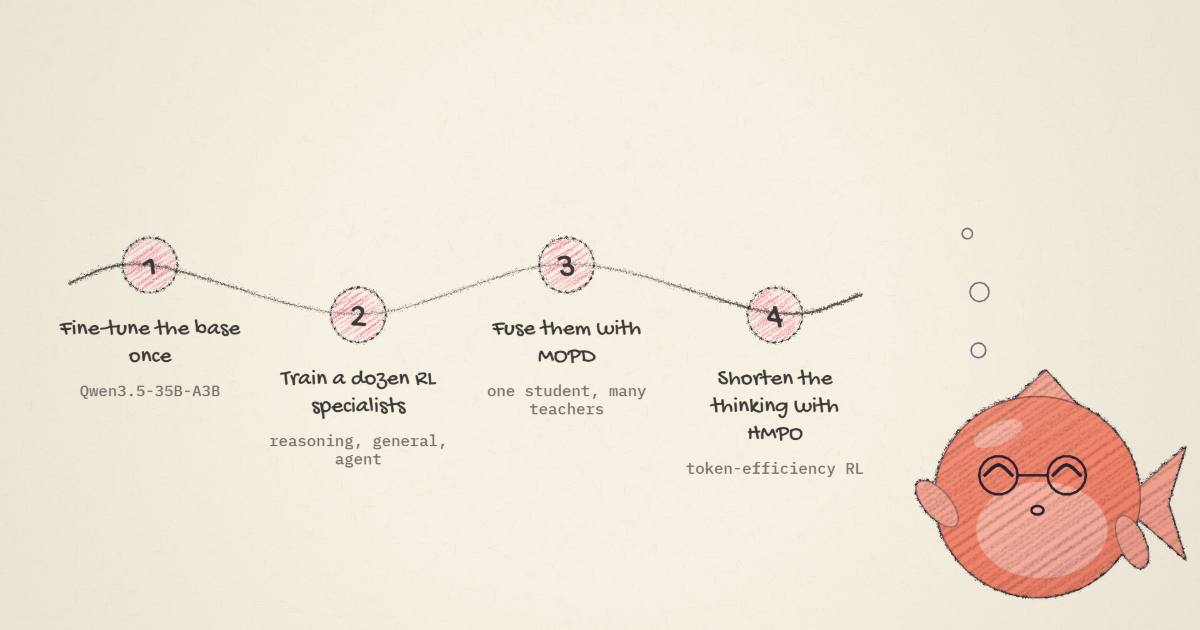
The dominant recipe for a better model is still scale the pre-training — more parameters, more tokens, more compute. Mach-Mind-4-Flash, from Li Auto's Foundation Model team, is a bet on the other axis. It starts from an existing compact base — Qwen3.5-35B-A3B, a Mixture-of-Experts model with 35B total parameters but only 3B active per token — and pushes it toward the score band of 100B-class models using post-training only: reinforcement learning, expert fusion, and inference-time efficiency. No extra pre-training compute.
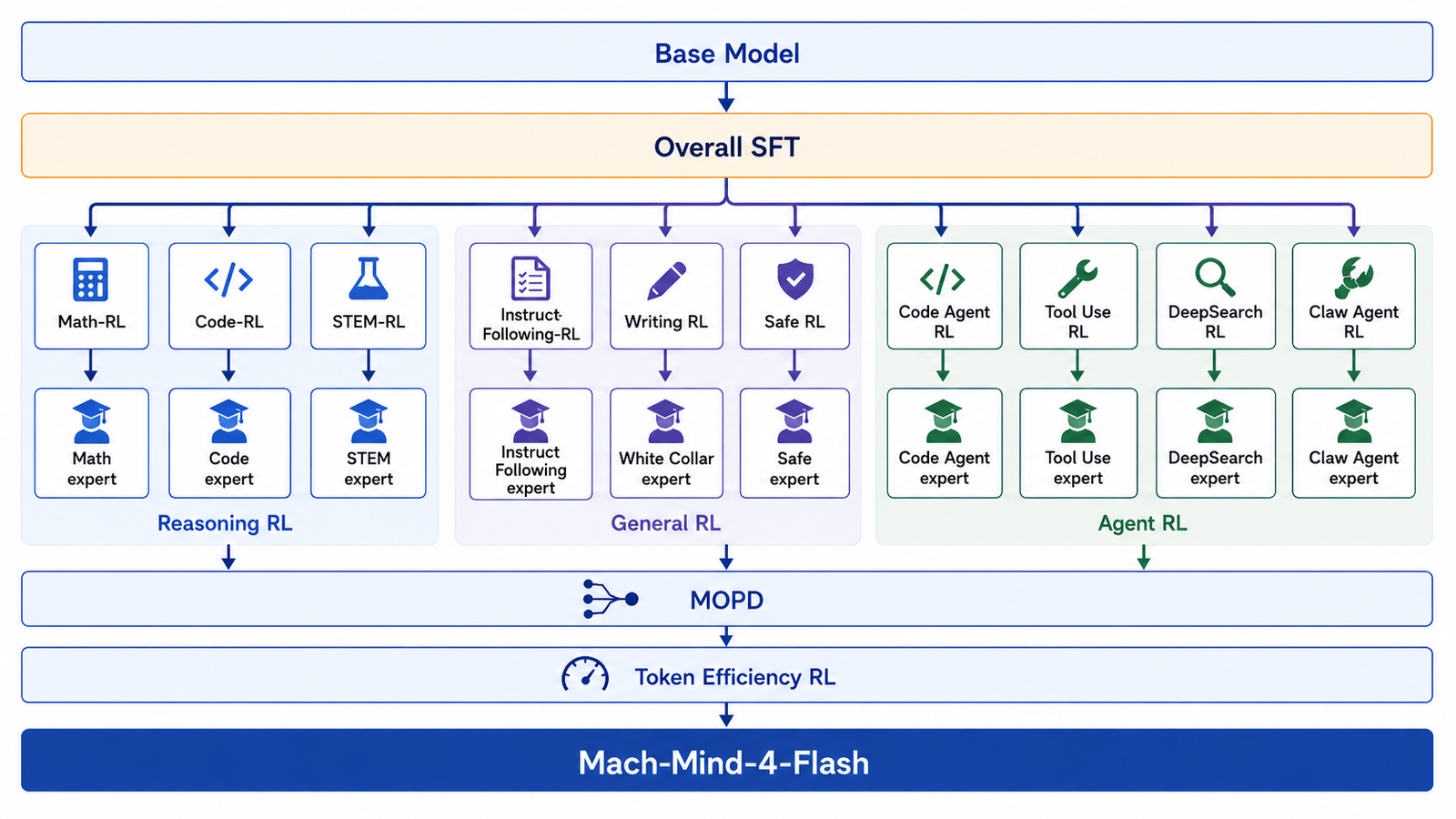
The one idea to leave with is the shape of that post-training: specialize, then integrate. Rather than run one big mixed-reward RL job — which tends to rob Peter to pay Paul across capabilities — the team trains more than ten domain specialists in parallel (across Reasoning, General, and Agent tracks), then fuses them into a single deployable generalist. The fusion is the paper's headline contribution, Multi-Teacher On-Policy Distillation (MOPD), and a second stage, HMPO, trims the model's reasoning length without paying for it in accuracy.
The fusion problem, and MOPD
If you train separate RL experts — a math expert, a code-agent expert, a safety expert — each is excellent in its lane. The naive way to get one model with all of those skills is to mix every domain's reward into a single RL objective. In practice that fails in a specific way the paper names see-saw degradation: the gradients from different rewards collide, so a gain on one capability is "routinely offset by regressions on others." You climb one hill by sliding down another.
MOPD sidesteps the collision. Every training sample carries a routing key that deterministically selects the one frozen domain teacher that should supervise it. The student generates a rollout under its own policy, and each token is pulled toward its routed teacher with a token-level reverse-KL:
Two things matter here. It is on-policy — the distillation runs on the student's own generations, not a fixed teacher corpus — which is what makes it behave like RL rather than plain SFT. And it is routed, so each domain's gradient stays clean: no averaging of conflicting rewards. (Under the hood the reverse-KL is optimized with a single-sample estimator and a clipped policy-gradient surrogate; domains are mixed in a strict 1:1 ratio.) Flip between the two regimes below and drag the training progress — watch how mixed reward lets the weakest capability stall while MOPD lets all three climb together:
MOPD sits inside a unified RL/OPD objective, , so the same framework can run pure RL (), pure distillation (), or a joint blend — and new teachers register as config nodes with "zero intrusion into the framework's core logic." A pilot on the tool-agent domain shows the mechanism converging: the teacher-student top- token-overlap rate climbs from 0.73 to 0.84 over training.
Fusion is not perfectly lossless, and the paper is candid about it. Across the three tracks it reports three distinct outcomes: capability anchoring for Reasoning (the frozen expert prevents the student from regressing during fusion), full retention for General, and mixed results for Agent — where the fused model sometimes lands below its own expert teacher (SWE-bench Verified 71.1 after fusion vs. 73.8 for the standalone expert). Long-horizon agent behavior is the hardest thing to distill without smoothing away.
HMPO: pay for correct-and-short
The second stage attacks overthinking — reasoning chains far longer than the task needs, which inflate latency and serving cost for no accuracy gain. Hybrid Median-length Policy Optimization (HMPO) is a single-stage token-efficiency method with a neat trick for the length budget: don't set a threshold, measure one. For each query the policy samples a group of rollouts, and the budget is the median length of the correct ones:
where is the set of correct rollouts. The token reward is a cosine decay that starts at 1 and fades toward as a correct trace grows, then cliffs to zero the instant it runs over budget — and any incorrect trace earns zero at any length:
The multiplicative composition enforces a strict correctness-first, length-second hierarchy: wrong or over-budget traces get exactly zero reward, so efficiency gradients never flow to bad answers. And because is the group median, it self-tightens as the policy gets more concise — an implicit curriculum with, in the authors' words, zero tuning. Drag the candidate length, the training progress, and :
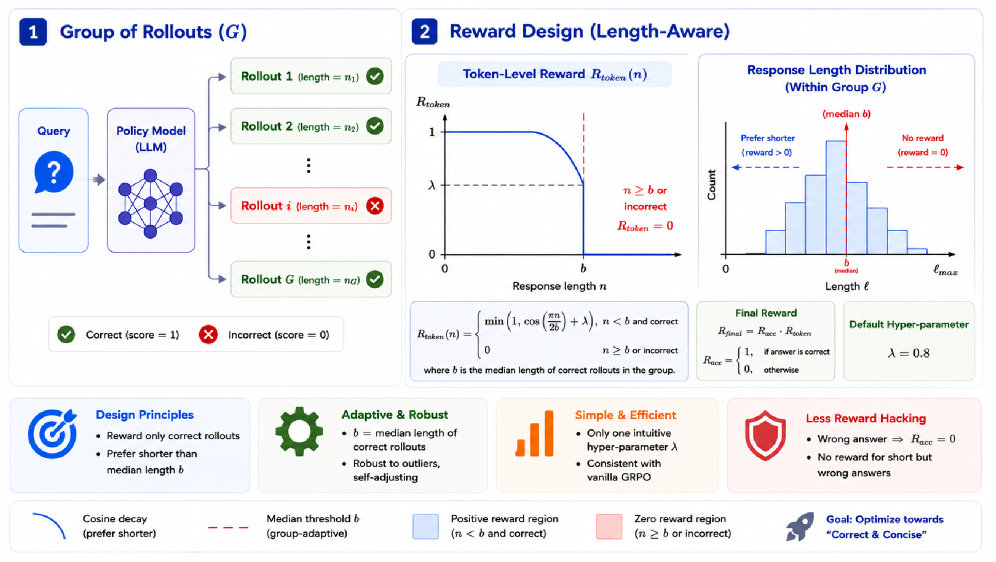
Trained on a compact set of ~6.5K math problems (group size , ), HMPO cuts generation length by 19-46% with at most a 0.7-percentage-point accuracy drop — and although the training is math-only, the learned length control generalizes to unseen domains: code generation, science QA, and instruction following. As a single-pass method it also costs 1.5-2.5× fewer GPU-hours than the multi-stage length-control baselines it replaces.
The infrastructure that makes it cheap
None of this is free unless the training loop is fast, and the third contribution is the plumbing: a unified RL/OPD framework with operator-level acceleration reported at a 17% end-to-end training speedup. The wins are Hopper-specific kernel work — a deep integration of SonicMoE into Megatron that implements an efficient Indexed Grouped GEMM for the MoE MLPs (using TMA copy, warp specialization, and multi-stage producer-consumer pipelines), a gate-up fusion, and a segmented fusion with the shared expert that overlaps communication and computation by splitting the shared expert into AllGather / compute / ReduceScatter stages staggered against the routed experts. It also leans on multi-token prediction and multi-dimensional hybrid parallelism. This is the same category of problem as stabilizing MoE RL and cutting RL's cost: the algorithm is only as good as the systems that let you run it at scale.
The numbers
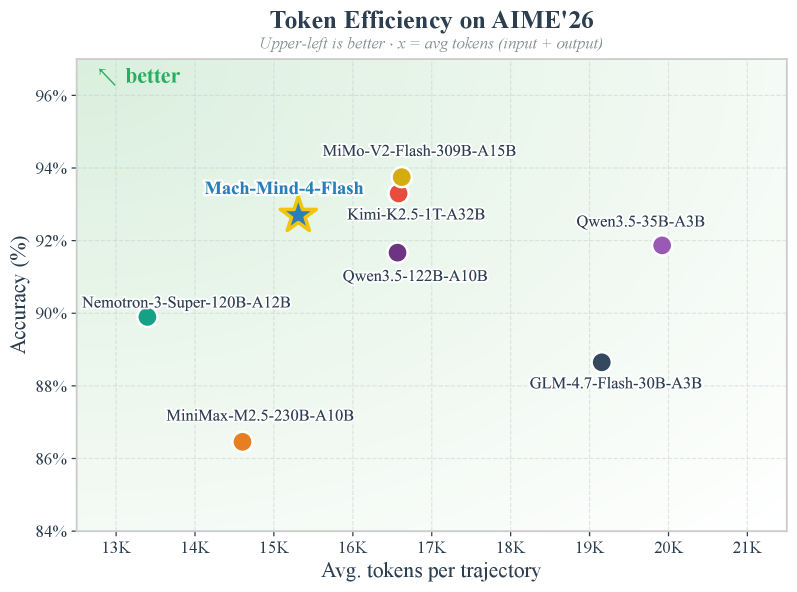
The result is a 3B-active model that trades blows with much larger ones. On raw reasoning it is strong but not the frontier — at AIME'26 it lands ahead of the 122B-active Qwen3.5 but behind the 309B MiMo-V2-Flash and the 1T-parameter Kimi-K2.5:
Where it genuinely leads the pack — beating both the 122B-active Qwen3.5 and the 1-trillion-parameter Kimi-K2.5 — is on instruction-following, safety, tool use, and Chinese web search. These are the axes the specialize-then-integrate recipe was built to lift:
For context on those: IFBench 82.8 vs. 76.1 (Qwen 122B) and 67.4 (Kimi 1T); Behavioral-SafetyBench 80.7 vs. 29.9 and 67.8; BFCL-v4 75.8 vs. 72.2 and 74.5. Elsewhere it is competitive rather than dominant — GPQA-Diamond 83.1, LiveCodeBench-V6 80.9, SWE-bench Verified 70.6, -bench 80.0 — solidly in the mix for a model activating a fraction of its rivals' parameters. And the efficiency story is where the whole thing pays off: on AIME'26, HMPO puts Mach-Mind-4-Flash at the upper-left of the accuracy-vs-tokens frontier, matching frontier accuracy at far fewer tokens per trajectory than models of much larger active scale.
The take
Mach-Mind-4-Flash's contribution isn't a new architecture — it reuses an off-the-shelf 35B-A3B MoE — it's a post-training recipe that composes cleanly. MOPD turns "train many experts, ship one model" from a lossy averaging problem into a routed distillation where each capability keeps its own gradient, and the see-saw that plagues mixed-reward RL mostly disappears. HMPO is the tidy companion: make the length budget a measured group-median instead of a tuned hyperparameter, gate it behind correctness, and reasoning gets shorter for almost free. Set against the field's default answer — spend more pre-training compute — this is the argument that a lot of headroom is still sitting in the post-training stack, reachable by a compact model that only lights up 3B parameters at a time. Whether a 35B model can truly close the last gap to a trillion-parameter frontier on the hardest long-horizon tasks is the open question the paper's own limitations point at — but as a demonstration that specialize-then-integrate scales to a dozen domains without falling apart, it's a clean result.
Built on the Mach-Mind-4-Flash Technical Report (Foundation Model Team, Li Auto Inc., 2026; CC BY-NC-ND 4.0). All benchmark and efficiency figures are quoted from the report; the MOPD and HMPO interactives are illustrations of the mechanism, and the capability curves in the fusion diagram are illustrative, not measured. Related on this site: Mixture of Experts, from scratch, Rollout Routing Replay, and MiMo-V2-Flash, which also leans on multi-teacher distillation.