2026-07-10 · 11 min · reinforcement-learning · gpu · cuda · code-generation
Why read this
Nichelast 15%Explains MusaCoder's correctness-first kernel reward and its three RL stabilizers, with the caveat that the benchmark and protocol are the authors' own.
- A new technique
- Explained from first principles
Training & RLNothing to runResearch paper
How this was scored
- Is it new?
- 2 of 3: A real new idea, method or capability
- Can I trust it?
- 0 of 3: Restates claims
- Can I run it?
- 0 of 3: Closed, nothing to run
- Will I understand it?
- 2 of 3: Mechanism from first principles with figures
- Can I act on it?
- 1 of 3: General advice
- Will it last?
- 1 of 3: Relevant for months
- Does it affect many?
- 1 of 3: A specialist community
- Only here?
- 1 of 3: Some original analysis
Score 36 of 100, ranked 550 of 577 rated articles. Each question is answered 0–3 by hand, and a 3 is rare. How articles are scored
Ask a language model to turn a PyTorch module into a hand-written CUDA (or MUSA, Moore Threads' CUDA-alike) kernel and you hit a task that punishes it at every turn. The output has to compile against a real toolchain, launch without an illegal memory access, produce numerically-matching results across dtypes and shapes, and run faster than the reference — or it is worthless. Most first attempts fail outright, which is exactly what makes the obvious training recipe, execution-based reinforcement learning, so hard: when nearly every rollout scores the same failing reward, there is no gradient to learn from. Worse, the model quickly discovers it can "pass" a correctness check by quietly calling the very PyTorch operator it was asked to replace.
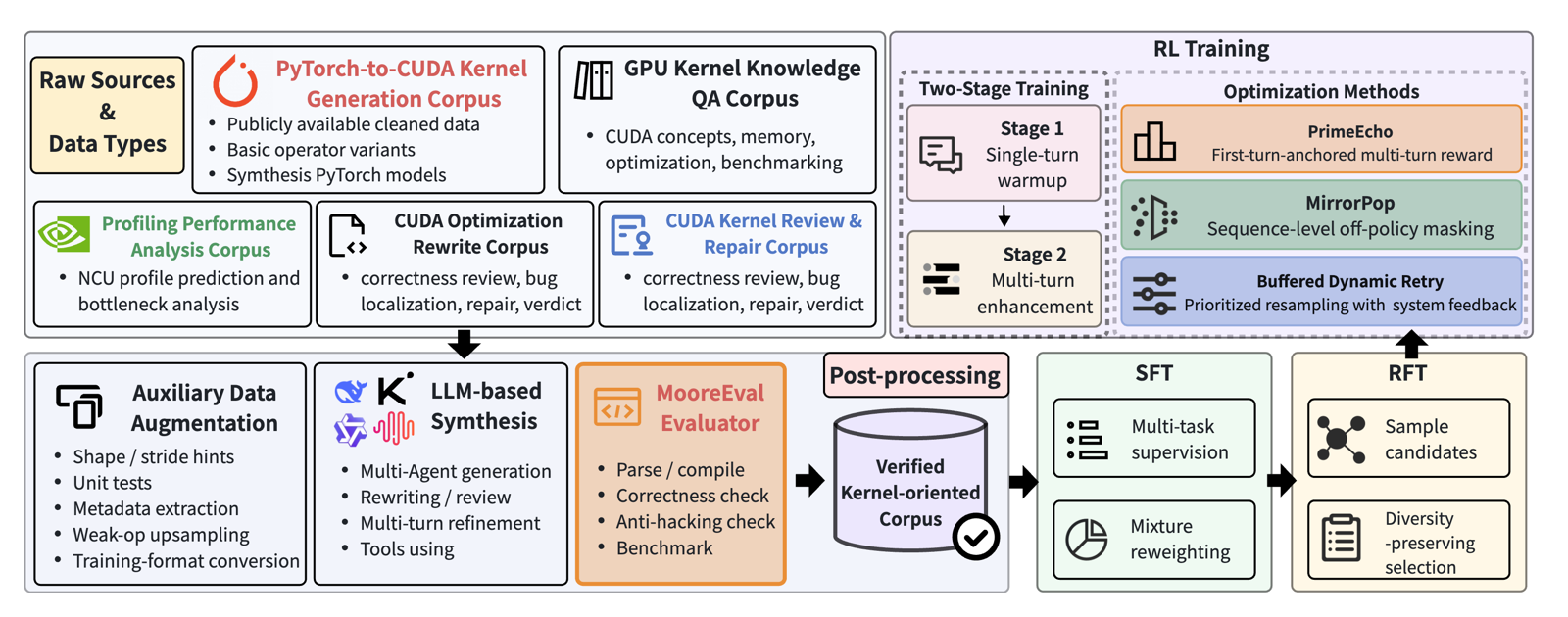
MusaCoder (Cheng et al., Moore Threads, 2026) is a full-stack answer to that. It is less a single trick than an assembled pipeline — data synthesis, supervised and rejection fine-tuning, and RL against an execution verifier — with three stabilization mechanisms that keep the RL from collapsing. The result: a 9B model built on Qwen3.5-9B that matches the frontier closed models the paper evaluates, and a 27B model (on Qwen3.6-27B) that tops them on the paper's KernelBench protocol.
The reward is where correctness gets enforced
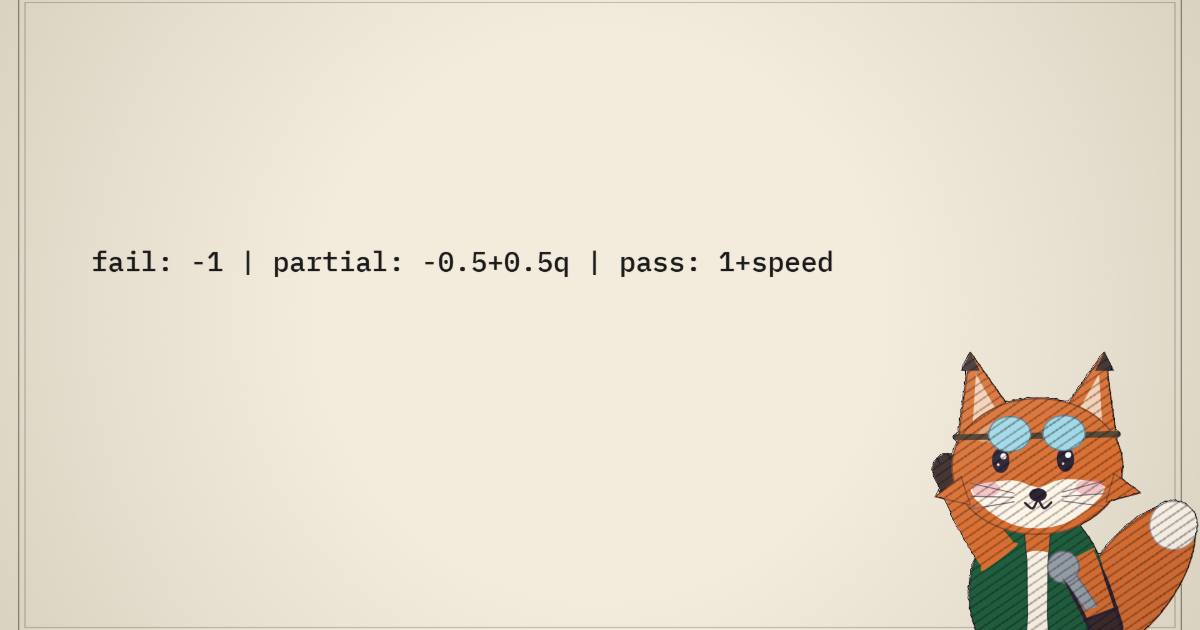
Everything downstream depends on one design choice: the scalar reward s(c) that MooreEval — the paper's distributed compile/execute/verify environment — assigns to a candidate kernel c. MooreEval first produces a structured verdict V(c,x) = (compiled, correct, legal, speedup, category, detail), and collapses it into a correctness-first reward (Equation 2):
where q is the fraction of test cases passed and ν the measured speedup over the PyTorch baseline. The shape of this function is the anti-hacking policy. A kernel that cheats by falling back to aten::* scores exactly the same −1 as one that never compiled; partial correctness earns a bounded, still-negative shaping term so the model can climb out of "totally broken"; and only a fully correct, legal, native kernel crosses zero, at which point a clipped speedup bonus applies. Drag the verdict below and watch where each outcome lands:
That single wall at zero is what keeps the model honest. Speed is never rewarded until correctness is banked, and forbidden fallbacks are punished as hard as a crash — so the fastest way to positive reward is to actually write the kernel.
Data and fine-tuning: getting off the floor before RL
RL only works if the base model clears the bar sometimes. MusaCoder spends most of its pipeline manufacturing that starting competence. A three-stage data engine expands the PyTorch-to-CUDA/MUSA workload distribution (real modules, cleaned GitHub projects, and NNSmith-generated computation graphs across ~162 operators), injects tensor shape/stride/contiguity hints extracted with torch.fx/torch.export, and enforces a six-step structured-reasoning template before any code is written. Auxiliary corpora add GPU-kernel knowledge Q&A and a kernel-reviewer task that must emit VERDICT: CORRECT or INCORRECT.
Two fine-tuning stages follow. Multi-task SFT teaches canonical kernel patterns and error-diagnosis (with loss masking so feedback tokens are context-only). Then a diversity-preserving rejection fine-tuning (RFT) step deliberately breaks with convention: standard RFT keeps only the single fastest correct sample, which collapses entropy; MusaCoder instead retains a heterogeneous set of verified-correct implementations, preserving the exploration diversity that RL will need. That choice alone is worth 2.2 points of Pass@8 (SFT 84.8 → 82.6 without RFT, Table 2). If you have not met torch.profiler — the same tool MusaCoder uses to diagnose which operator families the base model is weak on — it is worth a detour.
The three stabilizers
RL runs in two stages: a single-turn warmup to establish basic execution understanding, then multi-turn feedback RL where a failed kernel gets MooreEval's error log appended and the model tries again. On top of a GRPO objective, three mechanisms keep it from falling over.
PrimeEcho — anchor the reward to the turn that ships
In multi-turn RL the naive reward is the best score across all turns, max_k s_k. But the model only ever deploys its first-turn kernel, and rewarding best-of-turns teaches it to defer correctness — ship something broken, then "fix" it once the verifier hands it the error. PrimeEcho blends the two (Equation 9):
with an early-success bonus b_early = β₁·1[success at turn 1] + β₂·1[fail at 1, success at 2]. Keeping α high anchors the reward to zero-shot quality while still letting later turns supply exploration signal. Slide α and watch a deliberately-late trajectory get more reward as the anchor weakens — the exact hack PrimeEcho suppresses:
Buffered Dynamic Retry — rescue the all-failed groups
GRPO normalizes advantages within a group of G rollouts. When a task is hard enough that all G samples fail — r_i = −1 for every i — the advantages are all zero and the sample contributes no gradient, so the hardest tasks teach nothing. Buffered Dynamic Retry (BDR) composes a repair task x' = Compose(x, c⁻, f⁻) from a failed kernel and its feedback, pushes it into a FIFO buffer B, and mixes buffered repair tasks back into training with probability p_buf. It turns a dead rollout group into a feedback-conditioned second chance. In the paper's isolated test (Table 3) BDR lifts Pass@8 from 59.6 → 62.4 on a Qwen3-8B checkpoint (~16% of previously-failed tasks recovered) and 73.2 → 74.4 on Qwen3.5-9B (~28% recovery).
MirrorPop — catch the off-policy sequences that cancel
MusaCoder's rollouts are generated asynchronously, so the rollout policy drifts from the training policy and the per-token importance ratio ρ_t no longer sits at 1. Vanilla sequence-level masking scores a response by its signed mean log-ratio — but a response that is badly off-policy with roughly equal positive and negative deviations averages to ≈0 and slips through as if it were on-policy (the paper's Figure 11 "cancellation" case). MirrorPop instead uses the mean absolute log-ratio, which every token can only push upward, and masks the sequence when it exceeds a threshold δ (Equation 21):
Toggle the two responses below — an on-policy one and a drifted one whose ratios cancel — and see which filter catches the drift:
This is the same failure mode that Rollout Routing Replay fixes at its source for MoE routers and that async frontier-RL setups wrestle with generally — here it is handled at the masking layer. Of the three stabilizers, MirrorPop is the one whose removal hurts most.
The numbers
MusaCoder is evaluated under its own strict MooreEval protocol on KernelBench, split into Level 1–3 by difficulty. Pass@8 asks whether at least one of 8 samples passes verification; Avg.@8 is the mean correctness rate across the 8; Faster Rate counts a candidate only if it is correct, legal, and beats the baseline by more than 1.1×. The headline is overall correctness — MusaCoder-27B-RL reaches 93.2 Pass@8 / 88.6 Avg.@8, ahead of every model the paper tests:
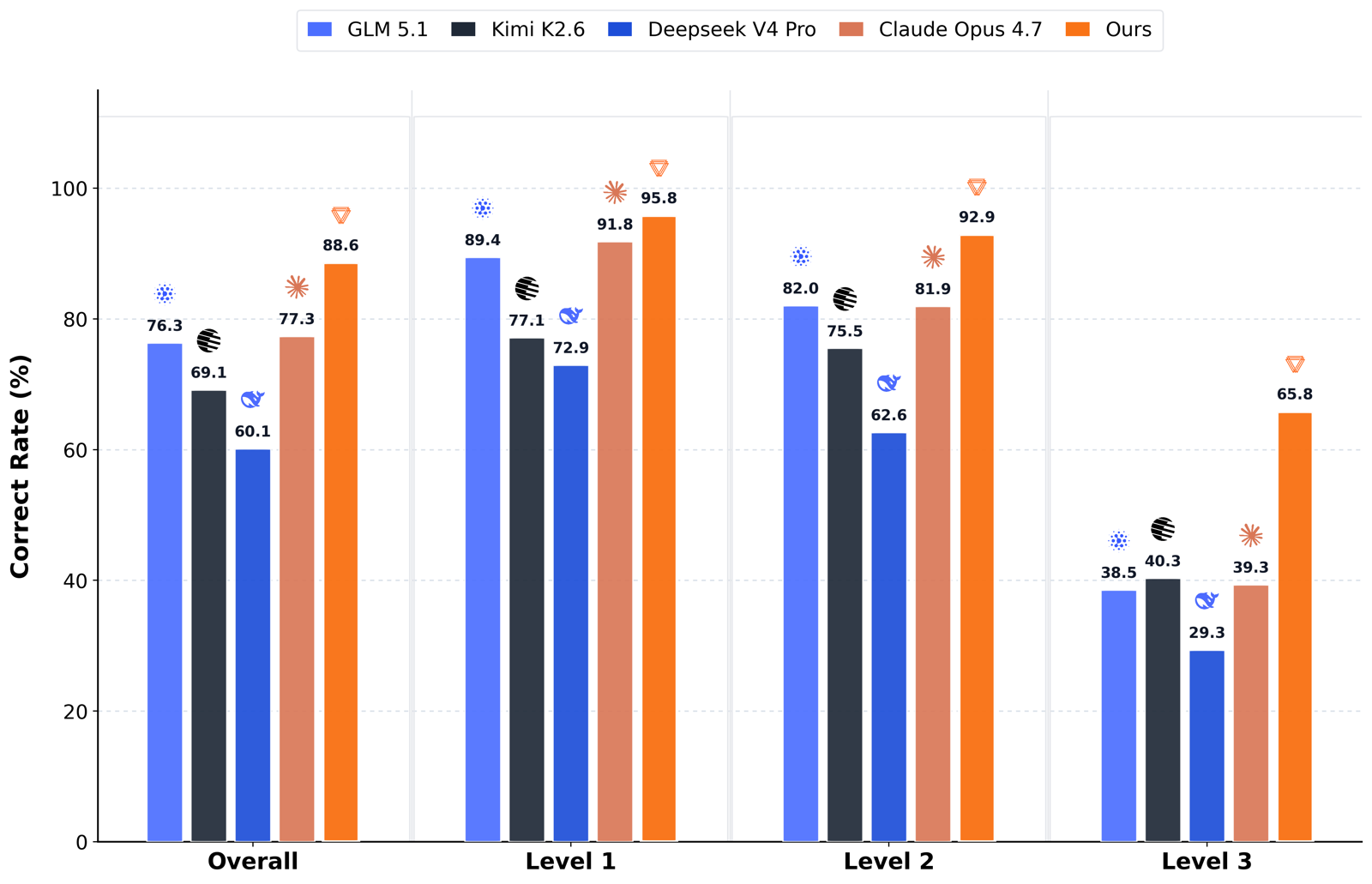
The gap widens on the hardest tier. On Level 3, MusaCoder-27B-RL scores 72 Pass@8 / 65.75 Avg.@8 against Claude Opus 4.7's 54 / 39.25 and GLM-5.1's 54 / 38.50 — the RL model roughly doubles the average correctness of the frontier baselines on the tasks where kernels are hardest to get right. Notably the 9B model (77.2 Avg.@8) edges Claude Opus 4.7 (77.3 is essentially tied) despite being a fraction of the size, and the RL stage is decisive: MusaCoder-27B jumps from 79.4 (SFT) to 88.6 (RL) Avg.@8.
Correctness is the easy win; speed is much harder. Even a good kernel rarely beats a fused torch.compile baseline, so absolute Faster Rates are low across the board — but MusaCoder still leads:
Against torch.compile (a tougher bar), MusaCoder-27B-RL's Faster Rate is 9.2% vs Claude Opus 4.7's 7.5%. On the authors' ported MUSA KernelBench (Table 4), the 27B model leads on both correctness and speed (92.4 Pass@8 / 81.7 Avg.@8 / 12.5 Faster) over DeepSeek-V4-Pro (92.0 / 56.9 / 5.7) and GLM-5.1 (88.0 / 66.4 / 6.9).
The ablation (Table 2) confirms each stabilizer earns its place, measured as removals from the full RL model (93.2 Pass@8):
Dropping MirrorPop costs the most (93.2 → 86.0), consistent with off-policy drift being the dominant instability in asynchronous kernel-generation RL.
The honest caveats
A few more things worth stating plainly:
- The base models are already strong. MusaCoder-27B starts from Qwen3.6-27B (67.2 Pass@8) and MusaCoder-9B from Qwen3.5-9B — the recipe adds a lot on top, but this is not a from-scratch capability.
- Speed remains the weak axis. A ~15% Overall Faster Rate means the large majority of even correct generated kernels do not beat the reference. The framing is correctness-first for a reason; treat the speedups as a bonus, not the story.
- The reward's tuning knobs aren't disclosed. The paper leaves
λ(performance weight) andν_max(speedup clip) as symbols; the values in the reward interactive above are illustrative, chosen to show the shape, not read from the paper. - No dedicated limitations section. The paper does not enumerate its own failure modes or generalization limits, so the boundaries of the approach — how it holds up on operator families outside the ~162 synthesized, or on GPUs beyond the CUDA/MUSA pair — are left for the reader to infer.
The take
MusaCoder's real contribution is not any one of its parts but the recognition that execution-feedback RL for kernel generation fails in three specific, nameable ways — sparse rewards, multi-turn reward hacking, and off-policy cancellation — and a targeted fix for each. The correctness-first reward makes cheating pointless; PrimeEcho keeps the model honest about the turn that ships; BDR rescues the hardest tasks from the dead-gradient zone; MirrorPop stops async drift from poisoning the update. It is careful RL engineering more than a new algorithm, and the payoff — a 9B model tied with the closed frontier and a 27B model ahead of it on the paper's bench — is the kind of result that only shows up when every stage of the pipeline is doing its job. Whether the lead survives a neutral, third-party benchmark is the open question the provider-run setup leaves on the table.
Built on MusaCoder: Native GPU Kernel Generation with Full-Stack Training on Moore Threads GPU (Cheng, Lu, Liao et al.; Moore Threads, 2026; CC BY-SA 4.0). All benchmark numbers are quoted from the paper's tables; the interactive diagrams illustrate the reward and stabilization mechanisms and use illustrative parameter values where the paper leaves them unspecified.