2026-09-18 · 19 min · gpu · compilers · parsing · cuda · futhark · performance · explainer
Pareas is a compiler that runs on the GPU. Not a compiler for GPUs — a compiler whose lexer, parser, semantic analysis and RISC-V code generation all execute as Futhark kernels, with the CPU doing little more than reading the file and writing the ELF. It came out of two 2021 Leiden master's theses, Robin Voetter's Parallel Lexing, Parsing and Semantic Analysis on the GPU and Marcel Huijben's Parallel Code Generation on the GPU, and a 2022 paper at ACM Computing Frontiers, Compilation on the GPU? A Feasibility Study (DOI 10.1145/3528416.3530249 — it is not on arXiv; I looked, including the authors' own publication list, and there is no preprint).
I cloned the repository, rebuilt its lexer generator, and measured the parts of the design that decide whether any of it scales. The front end is the interesting half: the code-generation backend is a different thesis, and lexing is where the "can this even be data-parallel?" question is sharpest.
| What it is | a GPU compiler front end (lex → parse → semantic analysis) in Futhark, plus a JSON parser built the same way |
| The lexer | a parallel DFA: every byte becomes a transition function, composed by a prefix scan |
| Hardware in the paper | one RTX 3090 (24 GB, 936 GB/s) for GPU runs; a separate 2× EPYC 7601 box for CPU and simdjson runs. Two GPUs installed, one used. No cluster anywhere |
| The headline | on the two largest JSON files, the GPU parser beats simdjson |
| The baseline it's against | simdjson, one thread, on the other machine · PAPAGENO, a parallel CPU lexer/parser · its own Futhark multicore back end at 1–64 threads |
| Is the transfer counted? | No. Appendix C's JSON table reports Upload as a separate column and leaves it out of Total |
| Are there tests? | None in the repository — no token-stream comparison against any reference |
| Last commit | March 2024 (a Futhark-HEAD compatibility fix), 383 stars. The research is finished, not abandoned mid-flight |
A lexer is a prefix scan
Start from why this is hard. A DFA is the definition of sequential: state , and you cannot know without . Every classic lexer — flex, re2c, ragel, the hand-rolled switch in your favourite parser — is a loop over bytes with a state variable, and that loop is a dependency chain.
The escape is the Hillis & Steele reformulation the thesis builds on. Instead of carrying a state, carry a function. Partially apply the transition function to the symbol: . Then the state after the whole input is
and function composition is associative, so the running state after every prefix is an inclusive prefix scan. Parallel time drops from to .
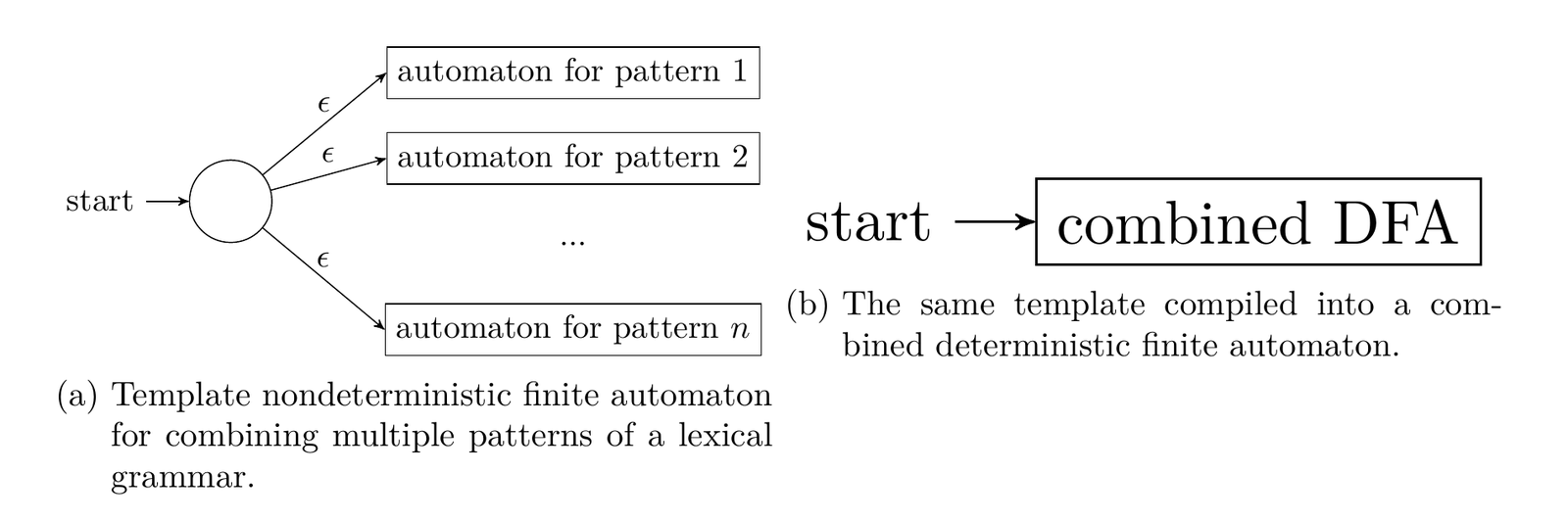
The obvious problem is that a transition function is a table of entries, so a naive scan stores intermediate state — the thesis works this out and rejects it. Pareas's answer is to precompute, ahead of time, every composition of transition functions that is actually reachable, assign each one an integer identifier, and reduce composition to a two-dimensional table lookup. Call the number of distinct reachable functions . The scan then carries a single u16 per position and the merge operator is one load from a table.
src/compiler/lexer/lexer.fut, computed live in the page rather than read off the real tables. Drag the round slider to watch Hillis–Steele fill in the prefixes with stride 1, 2, 4. Switch the grammar and watch k move: one string rule takes this toy from 5 to 20, and takes the real pareas.lex from 1,927 to 7,952. Under “int + ws” the quote has no rule at all, so the automaton drops into R and the reject state absorbs the rest of the input.That is the whole kernel. src/compiler/lexer/lexer.fut, which is what actually runs on the GPU:
let lex [n] [m] 'token (input: [n]u8) (table: lex_table [m] token): [](token, i32, i32) =
    let merge (a: state) (b: state) =
        let a = a & !produces_token_mask
        let b = b & !produces_token_mask
        in table.merge_table[state.to_i64 a, state.to_i64 b]
    let states =
        input
        |> map (\x -> table.initial_state[u8.to_i64 x])
        |> scan merge table.identity_state
Three lines of real work: one map from bytes to function identifiers, one scan whose operator is a table lookup, then a filter and two gathers to turn states into (token, start, length) triples. No if, no divergence, no shared-memory choreography. Compared to the shared-memory ballet in a hand-tuned CUDA kernel, this is almost embarrassingly clean — which is exactly why it is worth asking what it costs.
The merge table is the entire cost model
The thesis reports its two tables in passing — "about 8 MB of precomputed data" for the language, "about 35 MB" for JSON — and then moves on. That number is the design, so I wanted it measured rather than quoted.
You do not need a GPU for this. pareas-lpg, the lexer and parser generator, is plain C++20 that depends only on {fmt}, and it has a --verbose-lexer flag that prints the table sizes. I built it against a header-only fmt 7.1.3 and ran it on the two shipped grammars:
$ pareas-lpg --lexer src/json/json.lex --check --verbose-lexer
Initial states table: 256 element
Merge table: 4176² elements = 17438976 elements
Final states table: 4176 elements

$ pareas-lpg --lexer src/compiler/lexer/pareas.lex --check --verbose-lexer
Merge table: 1927² elements = 3713329 elements
lexer.fut declares merge_table: [n][n]state with module state = u16, so those are 34,877,952 and 7,426,658 bytes. The thesis's "4 176 unique unary transition functions ... about 34.9 MB" and "1 927 ... about 7.5 MB" are exactly right. First check: the thesis's own arithmetic holds.
The interesting question is what moves . Section 6.1.1 of the thesis predicts the failure mode itself — "when more of these structures are introduced, for example in a programming language which also supports strings, the amount of entries in the merge table blow up drastically, and makes the entire system infeasible" — but never quantifies it. So I edited the grammars, one rule at a time, and re-ran the generator.
the shipped JSON grammar with the string rule deleted
the shipped language grammar with // comments deleted
the shipped JSON grammar with the number rule deleted
shipped: 48 rules, // comments, no string literals
shipped: 12 rules, RFC 8259 strings and numbers
[0-9a-f] → [0-9a-fA-F] inside the \uXXXX escape
one added rule: "..." with backslash escapes
one added rule: /* ... */ — generator dies with std::bad_alloc
u16. Nothing here needs a GPU — k falls out of the grammar, and pareas-lpg --verbose-lexer prints it. The last bar is a floor: the stock generator aborts on that grammar, and a patched build that counts states without allocating the square table was still past 38,000 and climbing when I stopped it.Deleting the string rule from json.lex takes from 4,176 to 642 and the table from 34.9 MB to 0.82 MB. One rule is 97.6% of the JSON lexer's precomputed data. Deleting // comments from pareas.lex takes it from 7.4 MB to 1.3 MB. Going the other way, adding a single C-style string literal to pareas.lex — one line, string_literal = /"([^"\\\x00-\x1F]|\\["\\nrt])*"/ — takes from 1,927 to 7,952 and the table from 7.4 MB to 126.5 MB, and takes the generator from 4 seconds to 139.
Adding a block comment instead does not finish at all. The stock generator aborts after about six seconds:
$ pareas-lpg --lexer pareas-blockcomment.lex --check --verbose-lexer
terminate called after throwing an instance of 'std::bad_alloc'
  what():  std::bad_alloc
MergeTable::resize in src/lpg/lexer/parallel_lexer.cpp allocates capacity² × sizeof(Transition) and doubles the capacity, so the step past 16,384 asks the allocator for 17 GB. I rebuilt it with resize() patched to count states instead of allocating; the count went past 38,000 and was still climbing inside the merge closure when I stopped it. One /* … */ rule, on a 48-rule grammar, and the table goes from 7.4 MB to somewhere north of 2.8 GB.
The mechanism is easy to see once you look at the transition functions. Outside a string, they are constant: a digit puts you in the "in a number" state regardless of where you were. Constants compose to constants, so the closure barely grows. A string introduces a mode — a digit means "number" outside it and "string body" inside it — so stops being constant, compositions stop collapsing, and grows toward its combinatorial bound. Flip the grammar toggle in the widget above and watch the toy do it: 5 functions become 20, a 4.0× growth, against the 4.1× I measured on the real grammar. Same mechanism; the toy's whole merge table is 800 bytes and the real one is 126.5 MB.
Pareas's parallel lexer turns every input byte into an identifier for a DFA transition function, and composes them with a k×k merge table. k is the number of distinct transition functions reachable by composition, and it is decided entirely by the lexical grammar. I rebuilt pareas-lpg and measured k for the two shipped grammars and six variants.
| lexical grammar | change from shipped | k (states) | u16 table | generator |
|---|---|---|---|---|
| src/json/json.lex | shipped, unmodified | 4,176 | 34.9 MB | 15 s |
| json.lex − string | deleted the string rule | 642 | 0.82 MB | 0.3 s |
| json.lex − number | deleted the number rule | 1,482 | 4.4 MB | 1.5 s |
| json.lex, \u00E9 fix | [0-9a-f] → [0-9a-fA-F] in \uXXXX | 4,249 | 36.1 MB | 17 s |
| src/compiler/lexer/pareas.lex | shipped, unmodified | 1,927 | 7.4 MB | 4 s |
| pareas.lex − comment | deleted the // comment rule | 798 | 1.3 MB | 0.9 s |
| pareas.lex + string literal | added one C-style "..." rule | 7,952 | 126.5 MB | 139 s |
| pareas.lex + block comment | added one /* ... */ rule | > 38,000 | > 2.8 GB | did not finish |
The last row is the thesis's own predicted failure, measured. The stock generator dies on it with std::bad_alloc after about six seconds — MergeTable::resize allocates capacity² × sizeof(Transition) and the doubling step past 16,384 asks for 17 GB. I rebuilt it with resize() patched to count states instead of allocating; the count passed 38,000 and was still in the merge closure when I stopped it, so the k and byte figures on that row are lower bounds, not the answer.
This matters beyond tidiness, because the table lives in global memory and is read with a data-dependent access pattern. The thesis says so itself, and names the fix it could not reach: if the table were tens of kilobytes it would fit in shared memory and "lexical analysis speed could be improved drastically". At 34.9 MB it does not fit in the RTX 3090's 6 MB L2 either. The merge operator — the innermost operation of the whole kernel — is a random gather into a 35 MB array in VRAM.
What the throughput number is actually against
Here is the claim, from the thesis's own conclusions: "When the input is sufficiently large, however, the GPU-powered JSON parser is able to outperform simdjson."
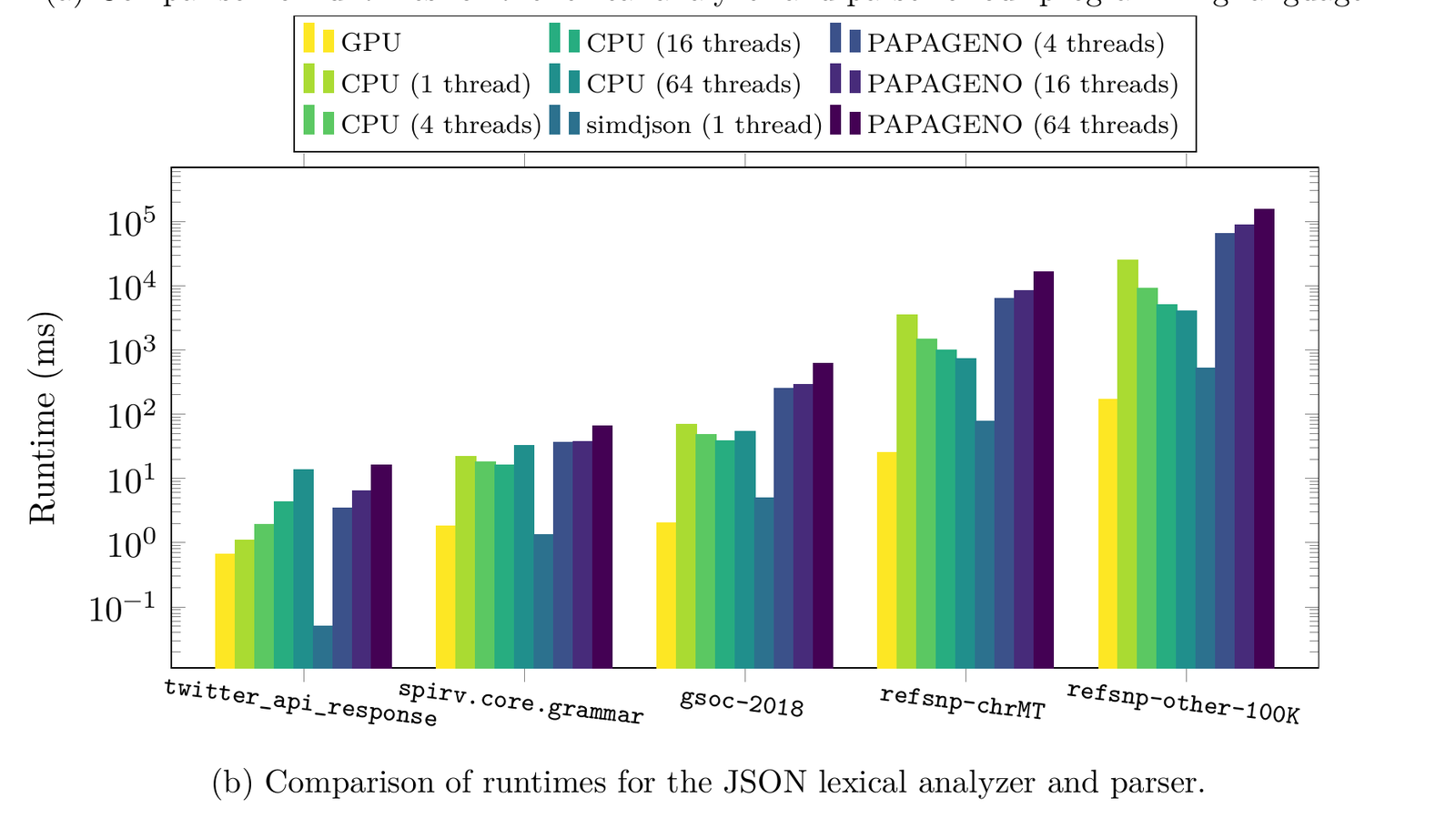
The figure is a log-scale bar chart, so I went to Appendix C for the milliseconds. Table C.6 breaks the GPU JSON run into five columns — Upload, Lexical Analysis, Parsing, Building parse tree, Restructuring — plus a Total. For the largest file, refsnp-other-100K at 442 MB:
                  Upload    Lexical A.   Parsing    Building   Restruct.   Total
refsnp-other-100K 107.43      58.41        56.86      12.20      42.11     169.59
Add the four processing stages: 58.41 + 56.86 + 12.20 + 42.11 = 169.58. The printed Total is 169.59. The Total excludes the 107.43 ms upload. This is not a rounding artefact — it holds on every row of that table, and the cpu (1 thread) row for twitter_api_response makes it unambiguous: its four stages sum to 1.10 ms, its Total is 1.10 ms, and its Upload is a separate 9.80 ms. Table C.5, the compiler table three pages earlier in the same appendix, does the opposite: there Total equals Upload plus every stage (pareas-4: 40.74 + 345.34 = 386.08 against a printed 386.10). Two tables, same appendix, two different definitions of Total, and the one the simdjson comparison uses is the one that drops the transfer.
That transfer is not incidental. It carries the document and the 34.9 MB merge table, and it is the flattest number in the whole appendix: across a 29,000× range of input sizes the upload rate sits between 3.8 and 4.4 GB/s. That is what a bus looks like, not what a kernel looks like — and the GPU host is a pair of Xeon Silver 4214R, which is PCIe 3.0, capping at 15.75 GB/s theoretical and considerably less for pageable memory.
With the upload counted, the GPU still wins on the two largest files, so the thesis's claim survives — but the margin on refsnp-other-100K falls from 3.03× to 1.86×, and gsoc-2018 flips from a 2.48× GPU win to a 2.34× simdjson win. Turn on the second switch and it gets worse: Futhark hands kernel source to the driver at context creation, and section 5.3.3 measures that at 2.0 seconds for the JSON parser. Against a 442 MB file that simdjson finishes in 515 ms, a one-shot pareas-json invocation pays 2,277 ms. The GPU parser is a server, not a CLI tool, and nothing in the paper claims otherwise — it is just not a distinction the bar chart can draw.
Three more things the denominators are worth saying out loud:
- simdjson here runs at 0.86 GB/s, which is well under what simdjson is usually quoted at. That is not a knock on simdjson: it is one thread on a 2017 EPYC 7601 (Zen 1, AVX2, no AVX-512), being compared to a 2020 RTX 3090 sitting in a different machine. Do not read 0.86 GB/s as simdjson's ceiling, and do not read the GPU's 1.60 GB/s as beating simdjson in general. The thesis is candid about exactly this — "comparing the massively parallel GPU architecture with a single-core CPU based implementation, which can be easily replicated over multiple cores to parse different documents in parallel, is not very fair" — and says plainly that "the lack of a proper baseline makes it hard to draw a final conclusion." Four of those 64 EPYC cores parsing four documents at once would out-throughput the GPU on every file in the set.
- The lexer stage in isolation is the fast part: 58.41 ms for 442 MB is 7.57 GB/s, flat at 7.2–7.6 GB/s across the two largest files. Measured against the input alone that is 0.8% of the 3090's 936 GB/s — but the input is not what the kernel moves. Section 5.3.4 works out that lexing holds about 20 bytes of intermediate state per input character (a
u16state, plus a start and endi32, doubled during the filter), and Table 5.2b measures 9.74 GB allocated for this one 442 MB file. Move that 8.8 GB even once in 58.41 ms and you are at roughly 150 GB/s, about 16% of peak. The state expansion, not the byte count, is what the kernel actually pays for — and at 22 bytes per byte of input, a 24 GB card tops out somewhere near a 1 GB document. - The corpus is five files, two of them reconstituted dbSNP JSONlines dumps wrapped in an array to make them a single document. Two of the five are the ones the headline rests on.
Does it produce the same tokens?
The repository has no test suite. git ls-files turns up a test_parser.cpp for the LLP generator and the vendored Futhark library's own tests, and nothing that compares a token stream or a parse tree against a reference. The paper measures runtime; correctness is asserted, not checked. For a lexer that reaches every byte through a precomputed composition table, that is the part I most wanted to poke at — string escapes and comment terminators are exactly where a data-parallel scan gets interesting.
There is a LexerInterpreter in src/lpg/lexer/interpreter.cpp that walks the same merge table sequentially, but nothing calls it; it is dead code. So I wrote a harness around it. It builds the real ParallelLexer from src/json/json.lex the way src/lpg/main.cpp does, then steps the merge operator one pair at a time — which is the same function lexer.fut hands to scan, so the token stream it prints is the token stream the kernel produces:
// lexcheck.cpp — transcription of LexerInterpreter::lex_linear, with one change:
// the byte is widened through `unsigned char`. The repo's version writes
// `for (auto c : input)` and indexes `initial_states[c]` with a *signed* char,
// which is out of bounds for every byte >= 0x80. lexer.fut does the same lookup
// as `table.initial_state[u8.to_i64 x]`, i.e. unsigned.
for (unsigned char c : input) {
    auto st = lx.initial_states[c];
    states.push_back(st.result_state);
    if (st.produces_lexeme) emit(lx.final_states[PL::START]);
}
for (size_t i = 1; i < input.size(); ++i) {
    auto prev = states[i - 1];
    auto st = lx.merge_table(states[i - 1], states[i]);
    states[i] = st.result_state;
    if (st.produces_lexeme) emit(lx.final_states[prev]);
}
That signed-char indexing is a real bug, though a harmless one — the interpreter it lives in is never called, and the generator itself is uint8_t throughout, so the tables the GPU gets are correct. It cost me one confusing run before I spotted it.
Fourteen inputs, against CPython's json module as the reference decoder:
Pareas ships no test that compares its token stream against a reference. I built one. Fourteen inputs through the generated JSON lexer (the repo's own tables, driven one pair at a time through the same merge operator the GPU scan uses), against Python 3's json module as the reference decoder. Five of the fourteen disagree, which is three distinct defects.
| input | pareas json.lex | python json | verdict |
|---|---|---|---|
| {"a":1} | lbrace string colon number rbrace | accept | agree |
| [1.5e+10,-0,0.25] | lbracket number comma number comma number rbracket | accept | agree |
| ["a\tb\u0041\/\\"] | lbracket string rbracket | accept | agree |
| "\u00e9" (lowercase hex) | string | accept | agree |
| "\u00E9" (uppercase hex) | (input error) | accept | DISAGREE |
| "\u00Ff" (mixed hex) | (input error) | accept | DISAGREE |
| "é" (C3 A9, valid UTF-8) | string | accept | agree |
| "ÿþ" (FF FE, invalid UTF-8) | string | reject | DISAGREE |
| "" (lone continuation byte) | string | reject | DISAGREE |
| "ab" (raw DEL, 0x7F) | (input error) | accept | DISAGREE |
| "a\tb" (raw TAB, 0x09) | (input error) | reject | agree |
| "abc (unterminated) | (input error) | reject | agree |
| 01 | number number | reject | deferred to parser |
| +1 | (input error) | reject | agree |
Five rows are marked DISAGREE and one is deferred. Two of the five are the same bug counted twice (uppercase hex in a \uXXXX escape), so it is four distinct defects: uppercase hex escapes rejected, raw 0x7F rejected, and invalid UTF-8 accepted without complaint. RFC 8259 §7 defines the escape as %x75 4HEXDIG, and ABNF terminals are case-insensitive; §7 also permits unescaped %x20-21 / %x23-5B / %x5D-10FFFF, which includes 0x7F. The `01` row is not a lexer defect — the token stream `number number` is not a valid JSON document, so the parser rejects it downstream.
Three distinct defects in that table, plus a fourth in the language grammar, and nothing in the repository catches any of them:
- Uppercase hex in a
\uXXXXescape is rejected. The grammar writes the escape asu[0-9a-f][0-9a-f][0-9a-f][0-9a-f]. RFC 8259 §7 defines it as%x75 4HEXDIG, and ABNF terminals are case-insensitive, so"\u00E9"is valid JSON. Pareas lexes it to(input error). This one is cheap to fix: changing the class to[0-9a-fA-F]takes from 4,176 to 4,249 — 1.2 MB more table, 3.5%. - A raw
DEL(0x7F) inside a string is rejected. RFC 8259 forbids only%x00-1Funescaped; 0x7F is explicitly allowed by the%x5D-10FFFFrange. - Invalid UTF-8 is accepted silently.
"\xFF\xFE"and a lone continuation byte both lex to a cleanstringtoken. The grammar's negated class lets every byte from 0x80 to 0xFF through unchecked. simdjson, the comparison baseline, validates UTF-8 as part of its parse — so the two programs in that bar chart are not doing the same amount of work. - A
//comment at end of file without a trailing newline fails.pareas.lexwritescomment = /\/\/[^\n]*\n/, and the newline is mandatory.fn f(): int { return 1; }\n// trailing commentlexes fine right up to the comment and then ends in(input error).
None of these are fatal to the research — the thesis is a feasibility study, not a conformance claim, and it never says otherwise. They are just what "correctness is asserted, not verified" looks like when you go and check.
What I could not check
- Whether the GPU numbers reproduce. Futhark 20.6, CUDA 11.2 and an RTX 3090 are all five years old now; nobody has re-run this on a Hopper or Blackwell card, where the memory hierarchy and the PCIe generation both changed.
- Whether the parse trees are right. I checked the lexer's token stream. The LLP(1,1) parser, the grammar transformations that work around it, and the semantic analysis passes are all unverified by me and by the repository.
- The "no cluster" question. There isn't one. Two benchmark machines, one for CPU work and one for GPU work, two 3090s installed and one used. Nothing in either thesis or the paper distributes a lexer across nodes, and given that a 442 MB document already needs 9.74 GB of VRAM for the lexing stage alone, sharding by file rather than within a file is the obvious design anyway.
What would change my mind
4 claims above, and what would falsify each
The merge table, not the scan, is what limits this design.
A grammar with block comments and string literals that generates a table small enough to fit in an RTX 3090's 6 MB L2 — or a sparse encoding of the table that keeps the merge operator O(1). The thesis proposes both; neither is implemented. Either would move the ceiling.
The GPU-beats-simdjson result shrinks from 3.03× to 1.86× once the PCIe upload is counted.
A statement from the authors that the JSON Total in Table C.6 does include Upload and the columns are labelled misleadingly. The arithmetic says otherwise on all five rows, but arithmetic on a published table is an inference about intent, not a measurement.
Pareas's JSON lexer disagrees with a reference decoder on five of fourteen inputs.
A demonstration that my harness diverges from the Futhark
scan— most plausibly ifproduces_token_maskhandling inlexer.futchanges which token a state reports. Runningpareas-jsonon those fourteen inputs on real hardware would settle it in a minute, and I cannot.Adding one block-comment rule to pareas.lex makes the table unbuildable.
A completed run of the patched generator landing at some modest k — my number is a lower bound taken while the closure was still growing, not a final count. I stopped it; somebody with more RAM and more patience should not.
The take
The reformulation is the good part and it is genuinely good. Turning "simulate a DFA" into "scan an associative operator" is the kind of move that makes a sequential problem disappear, and lexer.fut is a map, a scan, a filter and two gathers, with no divergence, no barriers and no shared-memory choreography — the opposite of the register-and-barrier hand-scheduling that FlashAttention-3 style kernels live on. Read it once and the idea is yours.
What the measurements say is that the cost moved rather than vanished. It went into , the number of distinct transition functions, and is quadratic in the table and superlinear in the grammar's complexity. JSON — twelve token rules, one of them a string — already needs 34.9 MB. One block comment is enough to make the generator run out of memory building the thing. That is not a tuning problem; it is the representation. Every real language the approach would want next (C, Rust, anything with nested comments, raw strings or a preprocessor) sits on the wrong side of that curve, and the thesis's own future-work section names the two fixes it would need — shrink the table into shared memory, or store it sparsely — without implementing either.
And the throughput headline is real but narrower than the chart suggests: a 1.86× win over one simdjson thread on a 442 MB document, once the transfer is counted, on a card with 5.5× the memory bandwidth of the CPU it is being compared against, after a 2.0-second startup, with no UTF-8 validation and no tests. All of which the thesis is more honest about than most papers would be — it writes "the lack of a proper baseline makes it hard to draw a final conclusion" in its own conclusions. The right reading of Pareas is the one its title claims: a feasibility study that answers yes, and here is precisely which part will stop you. Five years on, the part that stops you is still the table.
Sources: Snektron/pareas (commit c0105fd) · Voetter 2021, MSc thesis · Huijben 2021, MSc thesis · Voetter, Huijben & Rietveld, CF '22 · RFC 8259 · simdjson