2026-07-17 · 6 min · multimodal · missing-modality · action-quality-assessment
Why read this
Nichelast 15%Explains LIMSSR's idea of naming missing modalities in the prompt instead of reconstructing them, with the paper's FS1000 numbers; nothing is checked.
- A new technique
Vision & multimodalNothing to runResearch paper
How this was scored
- Is it new?
- 2 of 3: A real new idea, method or capability
- Can I trust it?
- 0 of 3: Restates claims
- Can I run it?
- 0 of 3: Closed, nothing to run
- Will I understand it?
- 1 of 3: Partial mechanism
- Can I act on it?
- 0 of 3: Nothing to act on
- Will it last?
- 1 of 3: Relevant for months
- Does it affect many?
- 0 of 3: A niche paper or one-off repo
- Only here?
- 0 of 3: Same as the press release
Score 19 of 100, ranked 574 of 577 rated articles. Each question is answered 0–3 by hand, and a 3 is rare. How articles are scored
Action Quality Assessment (AQA) is the task of watching a video of an action — a dive, a figure-skating program, a gymnastics routine — and predicting a numeric quality score a judge would give it. The strong systems are multimodal: they read RGB frames, optical flow, and sometimes audio, because form, motion, and rhythm all carry signal.
Which is fine until a modality goes missing. And in the real world, modalities go missing not just at test time but during training — a dataset where some clips never had audio, or flow was never computed. That is the case LIMSSR (Xu, Wu, Ke, and Peng; ICML 2026 spotlight) is built for, and it is meaningfully harder than the usual setup.
Why training-time missingness is the hard case
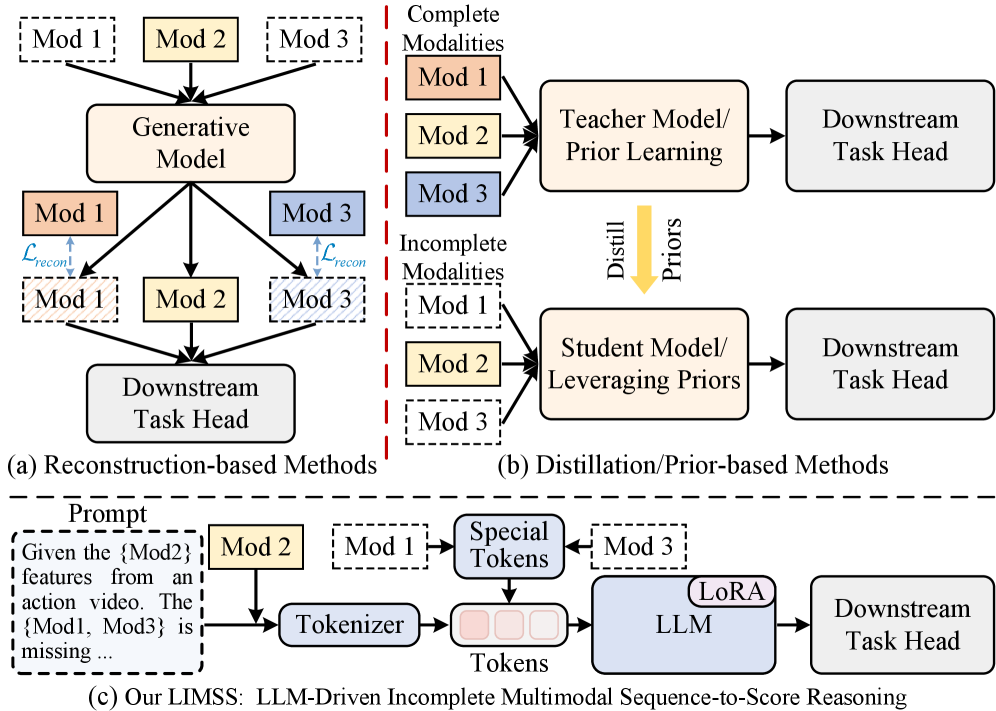
Most missing-modality work makes a quiet assumption: you trained on complete data, learned what a "normal" audio or flow stream looks like, and only lose one at inference. Then you can reconstruct the missing stream, or distill a complete-modality teacher into an incomplete-modality student.
Take the missingness back into training and both tricks weaken. You cannot reconstruct a distribution you never fully saw, and there is no clean complete-modality teacher to distill from if the training set itself is full of holes. The score is a scalar, so a wrong imputation does not announce itself — it just quietly biases the number. To make "how much does missingness hurt" precise, AQA is graded by Spearman's rank correlation between predicted and ground-truth scores: 1.0 is a perfect ordering of performances, 0 is chance. It is a ranking metric, so it punishes exactly the systematic bias a bad guess introduces.
Impute in prompt space, don't reconstruct
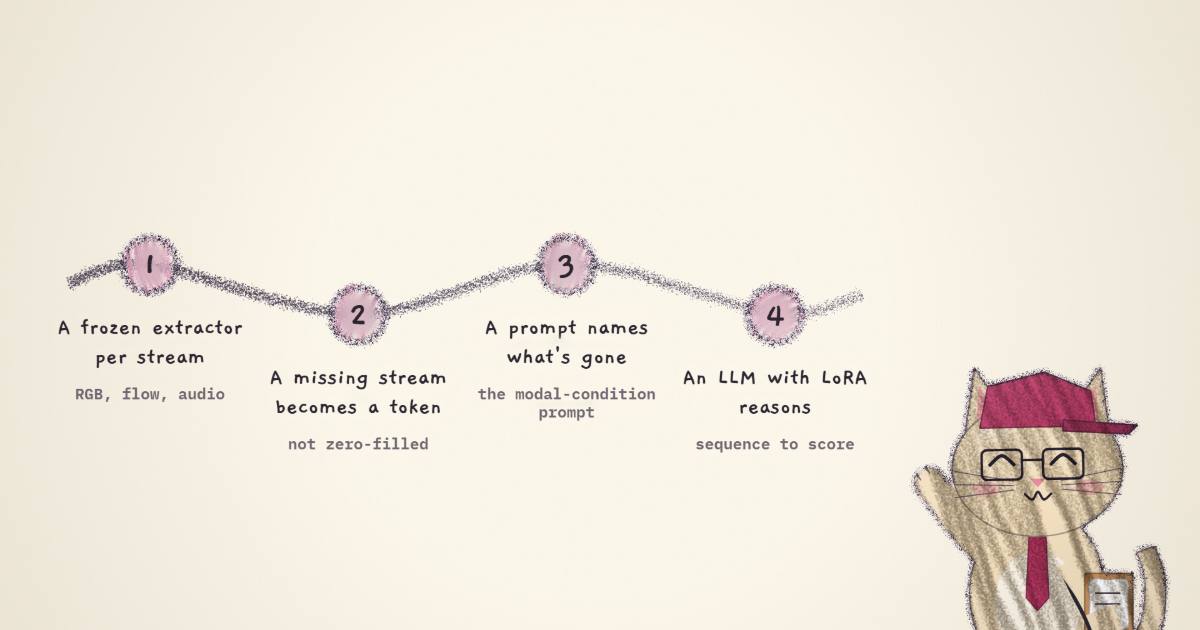
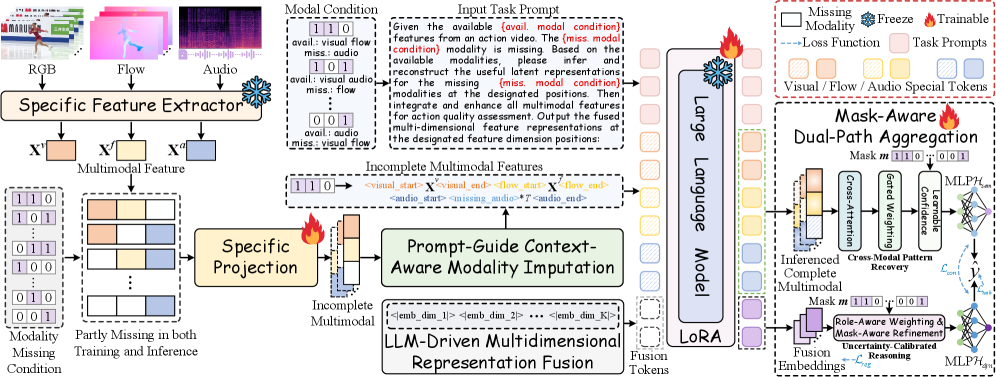
LIMSSR's first move is to stop reconstructing. Each modality gets a frozen feature extractor and a small projection; a missing modality is not zero-filled but replaced with a special token, and the model is handed a text prompt that names which modalities are present and which are gone. The LLM is then asked to infer the missing modality's latent role from the context that remains — role inference, not feature reconstruction.
That distinction is the whole point. A zero-filled slot drags a fixed-slot fusion model toward a wrong answer; a described-absence lets a language model reason about what the gap means. Drop a modality on each side and watch the gap open:
The audio-only case is the tell. A naive fusion model, fed zeros for the two missing streams, collapses to — barely above chance. LIMSSR, told in words that video and flow are gone and asked to reason from audio alone, holds on the same split.
The pipeline
End to end: per-modality features → specific projection → prompt-guided context-aware modality imputation (special tokens + the modal-condition prompt) → an LLM-driven multidimensional representation fusion that packs everything into fusion tokens → a frozen large language model with LoRA doing the sequence-to-score reasoning → a mask-aware aggregation head that emits the score.
Mask-aware dual-path aggregation: don't trust a lucky guess
Reasoning about a missing modality invites a failure mode: the model confidently hallucinates the part it cannot see. LIMSSR's aggregation head is built to suppress exactly that. It runs two paths off the same missingness mask :
- Cross-modal pattern recovery — cross-attention, gated weighting, and a learnable confidence. Strong when modalities are present, shaky when they are not.
- Uncertainty-calibrated reasoning — role-aware weighting and mask-aware refinement that explicitly discounts low-confidence dimensions, so it degrades gracefully.
A learnable-confidence gate blends the two. As modalities drop, the recovery path has little left to cross-attend over, its confidence falls, and the gate shifts weight onto the calibrated path — the one that already distrusts what it cannot verify. Toggle the modalities and watch the gate swing:
That shift is the anti-hallucination mechanism. On FS1000 the full gate cuts mean-squared error from 18.18 (simple fusion) to 14.08, at .
Results
Across every available/missing combination, LIMSSR's predicted scores track the diagonal — the ground truth — more tightly than the multimodal-expert baselines (MoMKE, MCMoE), and it holds up in the settings where they fall apart:
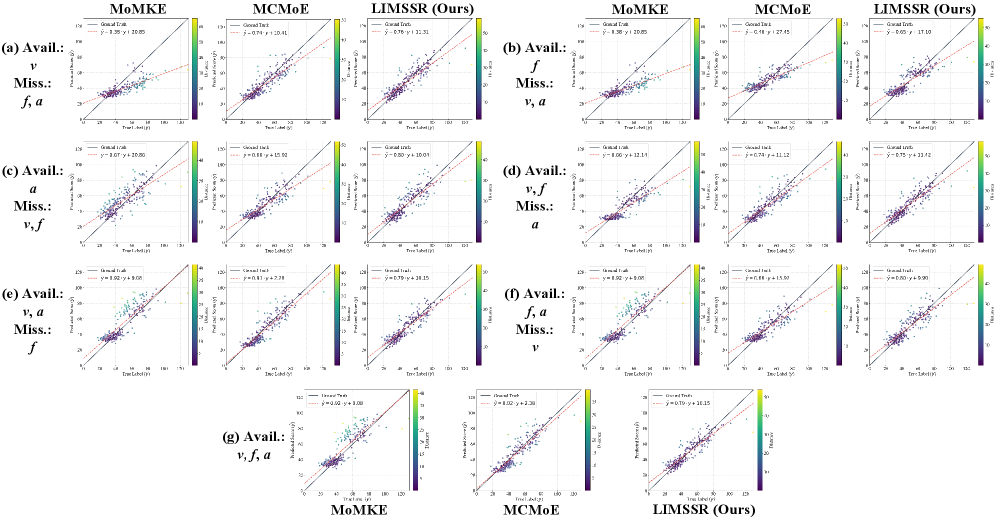
The starkest number is the hardest split — audio only, the two visual streams gone:
With every modality present the margin is smaller but still real ( 0.891 vs 0.819), which is the shape you want: a method that helps most exactly where the problem is hardest, and does no harm when the data is complete.
The take
The reframing is the idea worth keeping. Missing-modality learning has mostly been treated as a reconstruction problem — rebuild the pixels or features you lost. LIMSSR treats it as a reasoning problem: describe the absence in language, let an LLM infer what the missing stream would have contributed, and gate the answer by how much you can trust it. That it works under training-time missingness — the case reconstruction and distillation both struggle with — and lifts audio-only from 0.177 to 0.687 is a good argument that, for messy real-world multimodal data, telling the model what it is missing beats trying to fake what it lost.
Source: "LIMSSR: LLM-Driven Sequence-to-Score Reasoning under Training-Time Incomplete Multimodal Observations" (Huangbiao Xu, Huanqi Wu, Xiao Ke, Yuxin Peng), ICML 2026 spotlight. Numbers (, MSE) are the paper's reported FS1000 results; the interactive diagrams illustrate the mechanism.