2026-07-24 · 11 min · diffusion · image-generation · video-generation · flow-matching · black-forest-labs
A 1:43 narrated explainer, drawn in code. Every number and picture in it is this article's own; the sources are below.
› transcript
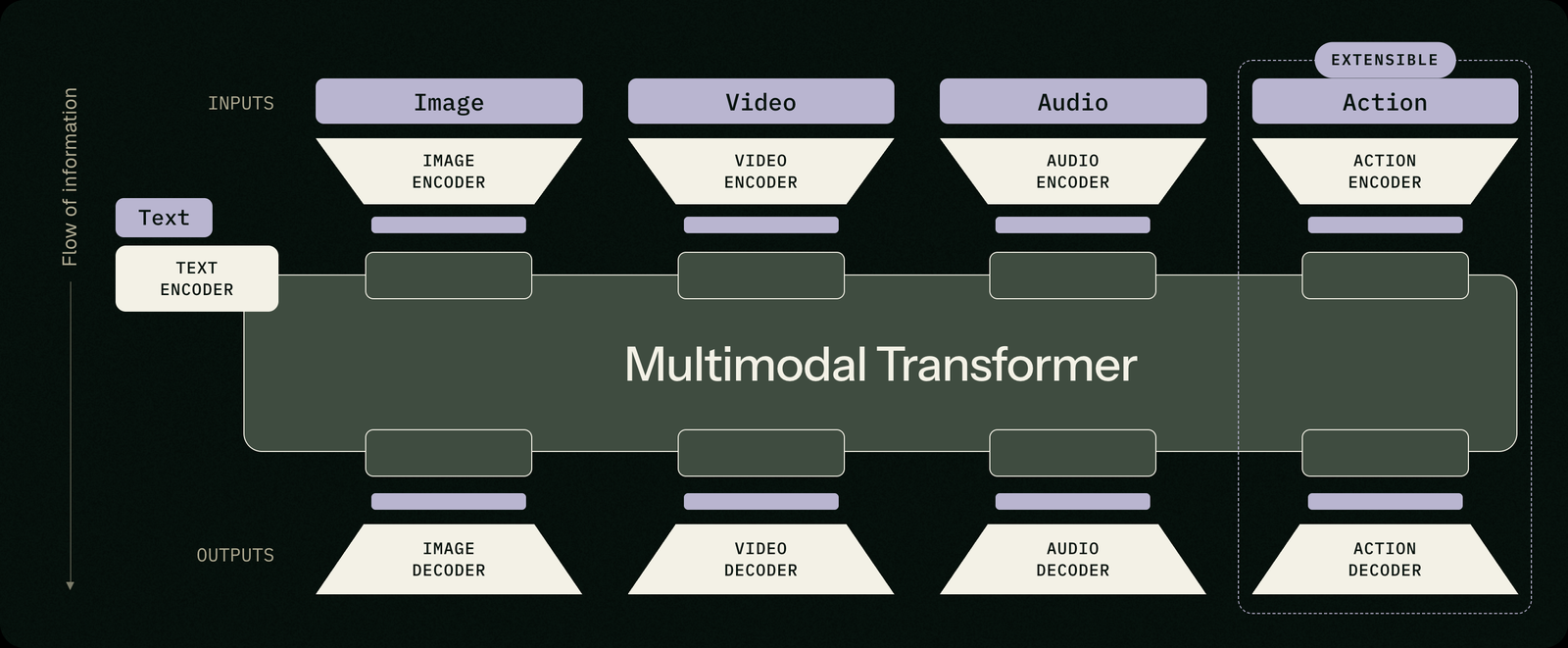
Hi, I'm Oboe! Every FLUX before this was an image model. FLUX 3 makes image, video with sound, and robot action from one backbone. The idea: learn every modality in one model, so each constrains the others. The sound has to match the impact; the motion has to obey the mass. In training, the path from noise to data is a straight line. The network learns the velocity along it. To generate, start from noise and step along the velocity. Each step is a full pass of a huge transformer. If the field is straight, a few steps still land on the data. That's what makes twenty seconds of video tractable. Per-modality attention lets each token see only its own kind: four models in a trenchcoat. Joint attention lets any token see any other. An audio token can attend to the video frame that made the sound. Each modality goes through its own encoder, and all of them become tokens in a single sequence. One multimodal transformer runs over that whole sequence, with a text encoder conditioning it from the side. Shared decoders read each modality back out. Action is just one more lane, marked extensible. In its maker's preliminary tests, raters picked it ninety-three percent of the time over one rival, and fifty-two over another: nearly a tie. Joint attention lets modalities constrain each other; a straight flow makes twenty seconds of it tractable. To recap: a straight flow, one joint sequence, and one backbone for every modality. Every source is in the full article. I'm Oboe. Bye!
Why read this
Nichelast 15%Flow matching and joint multimodal attention explained from first principles around BFL's FLUX 3 announcement, with every result flagged as vendor-reported.
- Widely used
- A new technique
Image & video generationAPI onlyProprietaryPractitioner model
How this was scored
- Is it new?
- 2 of 3: A real new idea, method or capability
- Can I trust it?
- 0 of 3: Restates claims
- Can I run it?
- 1 of 3: API-only, gated or restrictive licence
- Will I understand it?
- 1 of 3: Partial mechanism
- Can I act on it?
- 0 of 3: Nothing to act on
- Will it last?
- 1 of 3: Relevant for months
- Does it affect many?
- 2 of 3: A widely used model, tool or lab release
- Only here?
- 1 of 3: Some original analysis
Score 34 of 100, ranked 556 of 577 rated articles. Each question is answered 0–3 by hand, and a 3 is rare. How articles are scored
Every FLUX before this one was an image model. FLUX.1 was a 12B rectified-flow text-to-image transformer; FLUX.2 scaled the same recipe to a ~32B image-and-editing model. FLUX 3, announced by Black Forest Labs on 2026-07-23, is a different kind of object. It is a single multimodal foundation model that learns jointly from images, video, and audio in one architecture — and then generates all of them, plus robot action, from the same backbone. The framing in the title is deliberate: "Real World Models." BFL is no longer trying to make prettier pictures; it is trying to build a model of how the world looks, moves, and sounds.
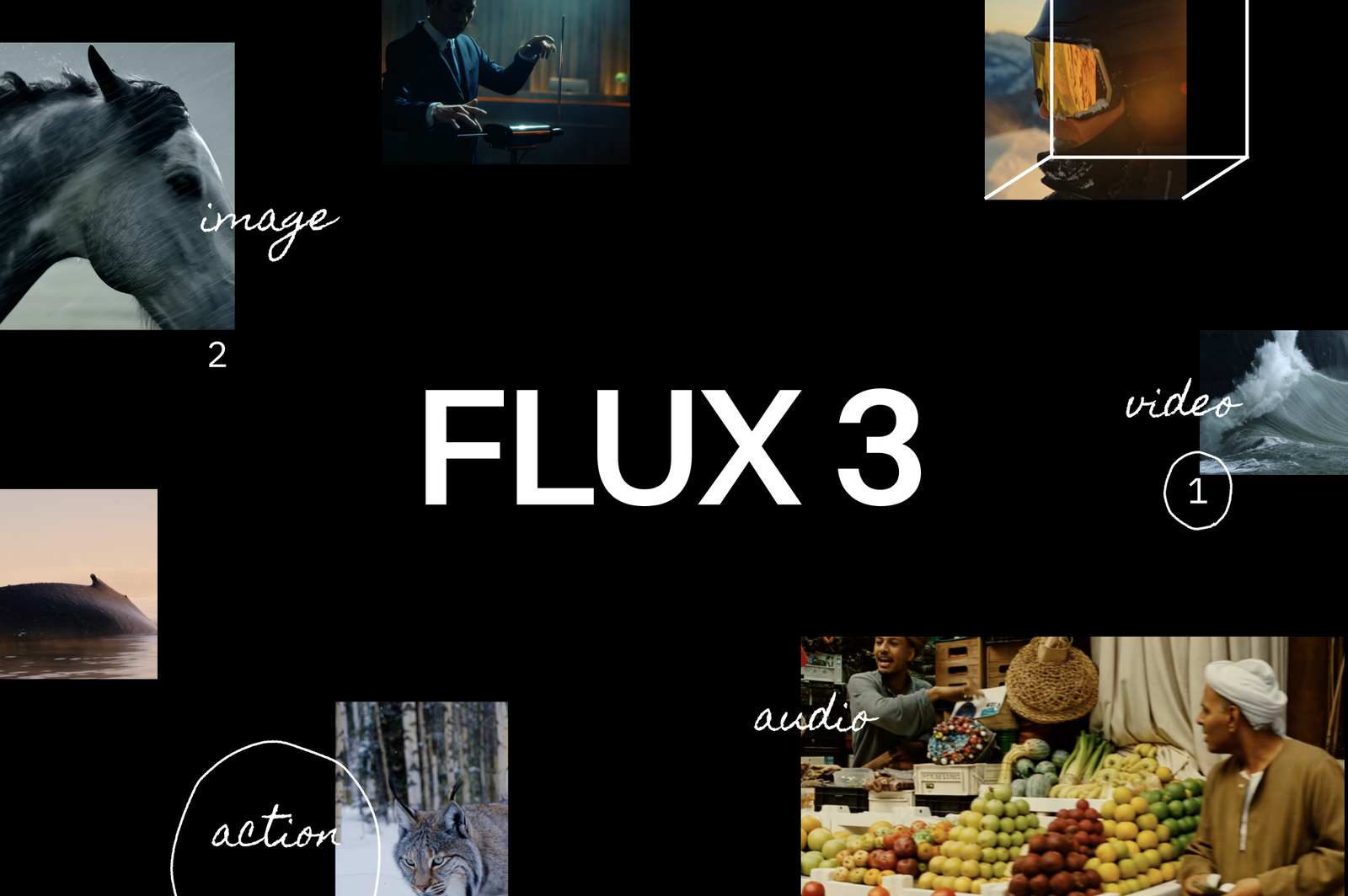
The argument for one model is an information argument, and it is worth stating in BFL's own terms. No single modality is a complete description of reality — each is a lossy projection captured by a different sensor. Images fix spatial structure at one instant; video restores time and reveals physical dynamics; audio exposes causal links between mechanical events and the sounds they make; language ties all of it to goals and instructions. Learn from one projection and you get a good model of that projection. Learn from all of them at once and their mutual constraints teach you more: the sound has to match the impact, the motion has to obey the mass, the future has to follow from the past. The modalities stop being separate problems and start being evidence about one underlying reality.
That is the pitch. Because FLUX 3 shipped as an Early Access capabilities announcement rather than a tech report — no parameter count, no full architecture, benchmarks that are BFL's own — the honest way to cover it is to explain the mechanism it is built on from first principles, show the evidence BFL did publish, and keep the caveats visible. So: two mechanisms first, then the numbers.
Mechanism 1: flow matching, and why few steps is the whole game
FLUX has always been a flow-matching model, and FLUX 3 builds on an approach BFL calls Self-Flow. Flow matching is the cleaner cousin of diffusion, and the idea is simple enough to hold in your head. You want to turn a sample of pure noise into a sample of data. So you define a path between them — for training, literally the straight line — and you train a network to predict the velocity that points along that path. Generation is then just solving an ordinary differential equation: start at noise, and take steps in the direction the velocity field tells you, until .
The subtlety is how many steps. Each step is a full forward pass of a huge transformer, so steps are the cost. And here the geometry of the path matters enormously. If the learned field is straight — a constant velocity, which is what "rectified" flow aims for — then a first-order Euler integrator lands on the data exactly, no matter how few steps you take. If the field is curved, few steps cut the corner and miss the target; the error only closes as you add steps (and cost). Drag the step count and flip the field to feel it:
This is why "straighten the transport paths" has been the central obsession of the whole FLUX / rectified-flow lineage: a straighter field means a few-step sampler that still lands, which means a 20-second video is merely expensive instead of impossible. The trajectory geometry above is the same one the Mage-Flow piece leans on for its 4-step Turbo — few-step generation is a property of the field, not a trick bolted on afterward.
Mechanism 2: one sequence, joint attention across modalities
The second mechanism is how four modalities fit in one model. FLUX 3 sits in the MMDiT lineage — the multimodal diffusion transformer that the Mage-Flow explainer walks through in detail — and the load-bearing idea is that every modality is tokenized into a single sequence, and one attention operation runs over the whole thing. A query token is not confined to its own modality: an audio token can attend to the video frame that produced the sound; a video token can attend to the text that describes the scene. Pick the query's modality below and flip joint versus per-modality attention:
Per-modality attention gives you four models in a trenchcoat. Joint attention is what lets the mutual constraints actually do their work — it is the mechanical form of "the modalities are evidence about one reality." BFL's own diagram makes the shape concrete: shared per-modality encoders feed a single multimodal transformer, shared decoders read it back out, and action is added as one more lane — explicitly marked extensible.
Self-Flow is BFL's method for aligning generation and understanding inside that one backbone, and the one quantitative claim they put behind it is that unifying the two lifts both at once. Their ablation reports lower generation error (Fréchet distance) per modality against a flow-matching baseline, and — more interestingly — faster and higher-climbing success on downstream robot-control tasks when the backbone is finetuned:
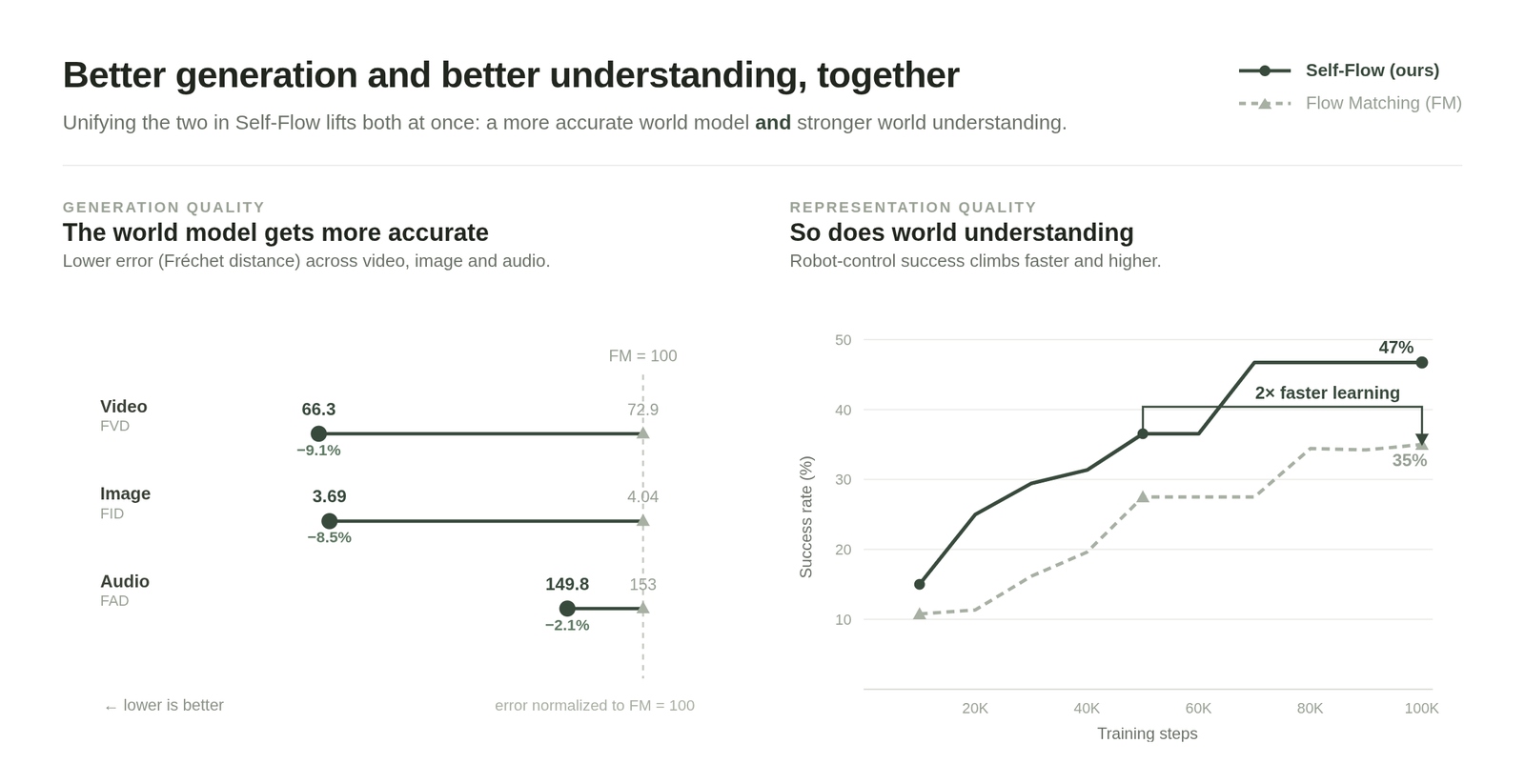
Read that right panel carefully, because it is the real bet: the same weights that generate video are a dynamics-aware prior for physical control. That is the bridge from "content tool" to "world model," and it is the part most worth being skeptical of until there is a paper.
What it actually does: video, with sound
The headline capability in Early Access is video. FLUX 3 generates up to 20 seconds in a single pass, and — the part competitors mostly don't have — every clip comes with native audio, generated jointly rather than dubbed on afterward. The capability list is broad: text-to-video, image-to-video (animate a still or use images as visual references), video-to-video (carry a character from a reference clip into a new scene), keyframe-to-video for controlled transitions, multilingual dialogue, and agentic chaining of clips into multi-shot sequences minutes long with consistent characters. Here is a representative shot from BFL's own reel — a single continuous take of a galloping horse, the kind of coherent physical motion the "world model" framing is really about:
The numbers — and exactly what they are
For the preliminary evaluation, BFL generated 10-second text-to-video clips at 720p with audio and ran pairwise human-preference comparisons against a spread of current video models. These are the results they published — read as "share of comparisons where a rater preferred FLUX 3 over the named model":
Image and action
Image generation and editing are coming a little behind video (Early Access "in the following weeks"). BFL says even mid-training FLUX 3 is a clear step over earlier FLUX on complex-prompt handling and high-accuracy multilingual text rendering — the two things that have defined the modern image race. The sample grid spans photographic, product, painterly, and graphic styles:

The most unusual branch is action. FLUX 3's world understanding is meant to extend to predicting what happens next — and BFL takes two routes to it: native action prediction folded into the model, and using the pretrained video backbone as a dynamics-aware foundation that specialized robot-control models finetune from with little task-specific data. The first partner is mimic robotics, with whom BFL built FLUX-mimic, a video-action model for dexterous manipulation reportedly tested on production tasks at Audi. The bet, again, is that content creation and physical AI run on the same foundation — the claim the right-hand panel of the Self-Flow chart is quietly staking out.
The variants, and what "open" means this time
Everything ships from one underlying multimodal flow-matching model, rolled out in phases behind Early Access gates for safety testing:
| Model | Covers | Access | Status (Jul 2026) |
|---|---|---|---|
| FLUX 3 Video | video + audio, gen & edit | API + private weights | Early Access (now) |
| FLUX-mimic / FLUX 3 Action | action prediction | research & commercial partners | rolling out (mimic robotics) |
| FLUX 3 Image | image, gen & edit | API + private weights | "in the following weeks" |
| FLUX 3 Dev | image + video + audio + action backbone | open weights | promised, not yet released |
That last row is the one to watch. FLUX.1 and FLUX.2 earned their standing partly because BFL shipped
open dev weights the community could actually run; FLUX 3 Dev promises the same for a multimodal
backbone — but as of the announcement it is a promise, and the near-term reality is API and private-weight
access. "Open" is on the roadmap, not on the table yet.
The take
FLUX 3 is the most ambitious repositioning in the open-ish image world this year: from a best-in-class image model to a single flow-matching backbone that treats image, video, audio, and action as one learning problem. The mechanism is sound and well-motivated — joint attention over a unified token sequence is the honest way to let modalities constrain each other, and rectified flow is what makes generating 20 seconds of it tractable. The evidence is thinner than the ambition: preliminary vendor evals on short clips, a Self-Flow ablation without a paper behind it, an open release that is still a promise, and the boldest claim — that a video generator is also a robot-control prior — resting on one chart. If it holds up, "image model" will look like a strangely narrow way to have described what BFL was building. Worth watching the Dev weights and the tech report; until then, admire the direction and keep the caveats.
Source: FLUX 3 — Real World Models (Black Forest Labs, 2026-07-23) and Self-Flow. Architecture, Self-Flow, sample, and benchmark figures are BFL's own, shown for commentary; all evaluations are vendor-reported and preliminary. The flow-matching and joint-attention interactives are mine. Related: Mage-Flow on the MMDiT backbone and few-step Turbo sampling.