2026-06-30 · 9 min · agents · reinforcement-learning · distillation
Why read this
Nichelast 15%Walks through Agents-A1's knowledge-action graph and three-stage routed on-policy distillation; the benchmark numbers are the tech report's, unchecked.
- Open code or weights
- Explained from first principles
Training & RLNeeds a workstation GPUApache-2.0Practitioner model
How this was scored
- Is it new?
- 1 of 3: An incremental tweak
- Can I trust it?
- 0 of 3: Restates claims
- Can I run it?
- 2 of 3: Open code or weights with real limits
- Will I understand it?
- 2 of 3: Mechanism from first principles with figures
- Can I act on it?
- 1 of 3: General advice
- Will it last?
- 1 of 3: Relevant for months
- Does it affect many?
- 1 of 3: A specialist community
- Only here?
- 1 of 3: Some original analysis
Score 38 of 100, ranked 541 of 577 rated articles. Each question is answered 0–3 by hand, and a 3 is rare. How articles are scored
Most of the frontier's agentic gains over the last year came from one move: make the model
bigger. Kimi-K2.6 and DeepSeek-V4-pro are trillion-parameter systems, and they top the
hard agent benchmarks. Agents-A1, from InternScience, makes the opposite bet. It's a
35B Mixture-of-Experts model with only ~3B active parameters per token (it's
initialized from Qwen3.5-35B-A3B), and it lands in the same benchmark band as those 1T
models. Its thesis, verbatim from the tech report: scaling the horizon, not the
parameters.
The chart is the whole argument. Agents-A1 and Qwen3.5-35B-A3B are the same model —
same 35B size, same ~3B active params. The ~18-point vertical gap between them is entirely
the training recipe, and it lifts the 35B student into the band held by models 30× its size.
The question this article answers is: what is "the horizon," and how do you scale it instead
of the parameter count?
Two axes of horizon
"Agent horizon" splits into two things you can grow independently, and Agents-A1 pushes both:
- Long-horizon trajectories — how far a single agent run goes. Agents-A1 is trained on agentic trajectories averaging ~45K tokens (deep-research runs average 44K, coding 48K, scientific reasoning 37K, general agentic 39K; only short instruction-following tasks pull the mean down at ~3K). That's hundreds of think→act→observe steps per task, not a single question-answer turn.
- Heterogeneous abilities — how many kinds of agent the one model can be. Agents-A1 unifies six domains: long-horizon search, engineering, scientific research, instruction following, general agentic tasks, and scientific agentic tasks.
A single long-horizon run looks like this — a chain of tool calls, each with an observation and a verifier outcome that says whether the step actually worked:
The verifier is the load-bearing part. A raw transcript of an agent flailing is not training data; a transcript where every step is checked — did the code converge, does the answer match the cited evidence — is. That check is what turns a 45K-token trace into a sequence of trainable targets. Which is the next problem: where do verified 45K-token trajectories at scale come from?
The knowledge-action graph
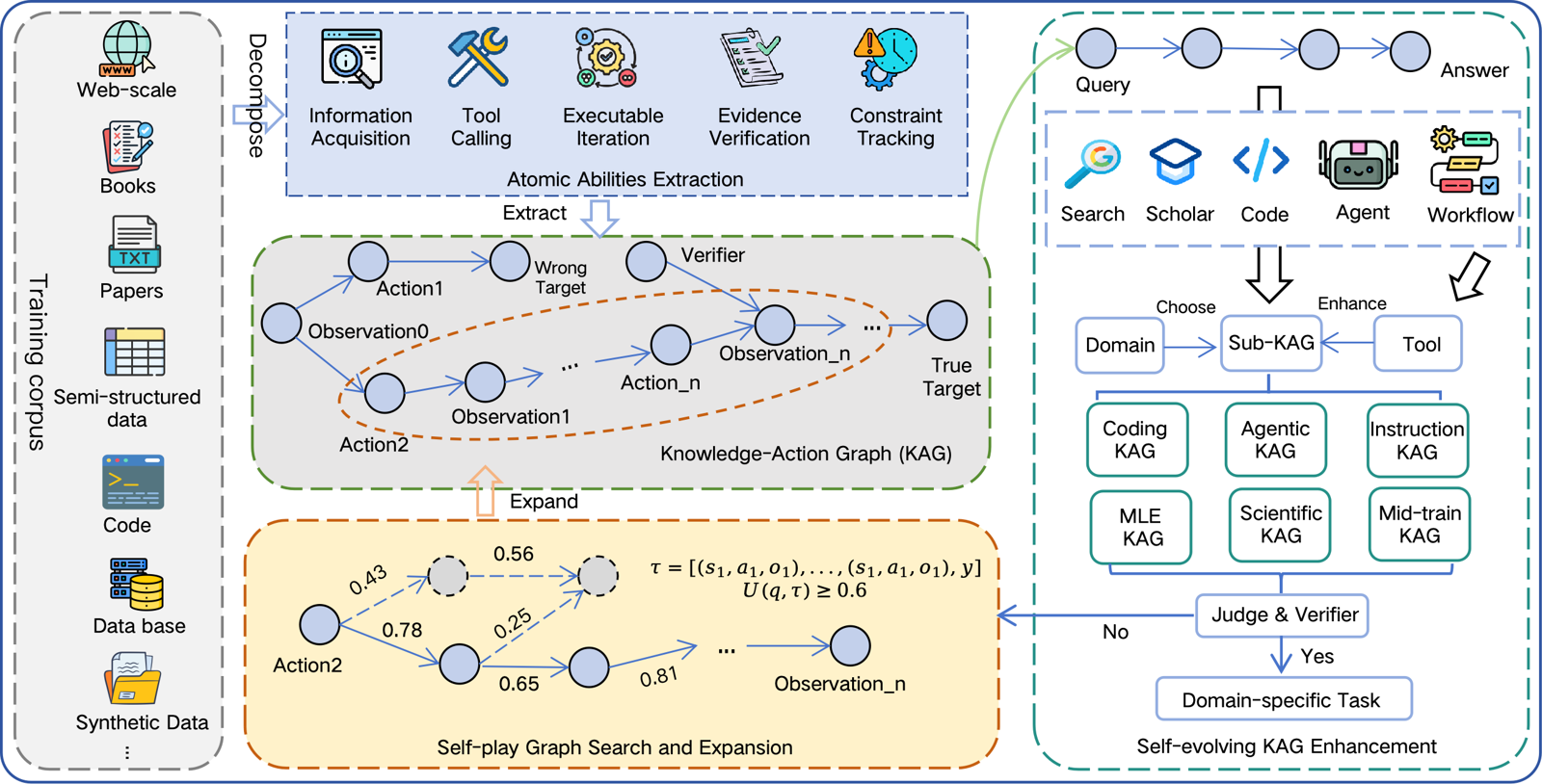
You can't hand-write 100K agent trajectories. Agents-A1's answer is a knowledge-action graph (KAG) per domain — a typed four-tuple
| symbol | what it holds |
|---|---|
| — corpus | evidence chunks, entities, facts, constraints — the domain's grounded knowledge |
| — actions | tool calls, retrieval queries, code edits and executions, reasoning steps |
| — observations | tool returns, retrieved evidence, execution states, intermediate artifacts |
| — verifiers | automatic checks over correctness, evidence support, constraint satisfaction, goal completion |
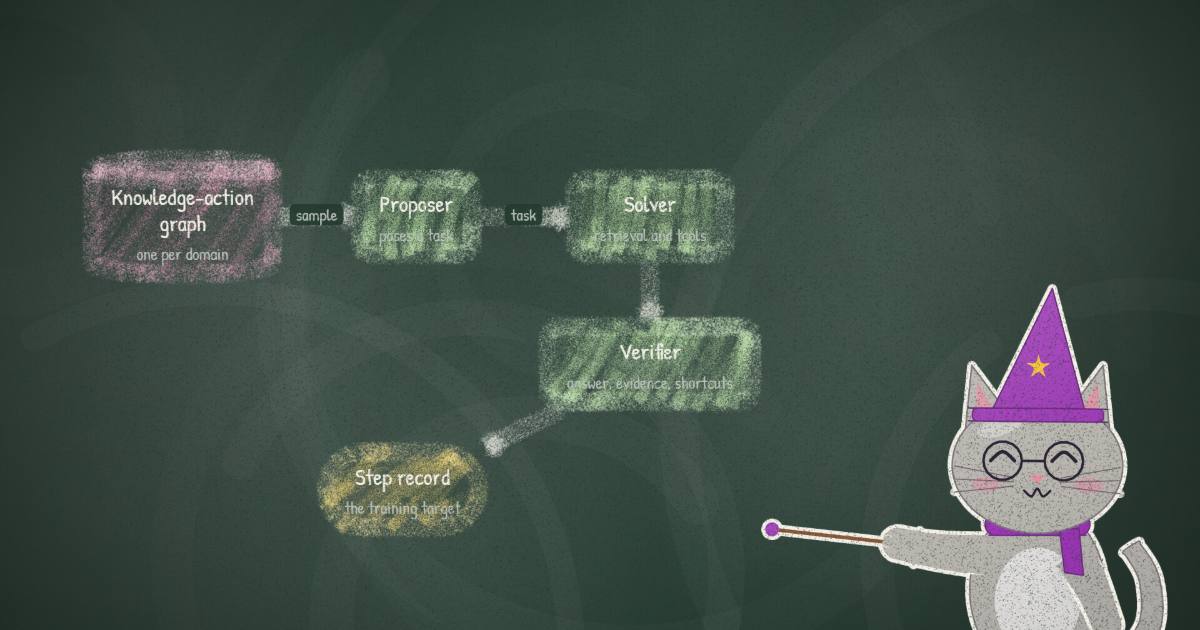
The graph is populated by a proposer–solver–verifier self-play game: a proposer policy samples regions of the graph to pose constrained tasks, a solver attacks them with retrieval and tools, and a verifier checks the answer, the evidence, the execution result, and the trajectory for shortcut-taking. A candidate task is kept only if it's verifiable, valid, process-informative, evidence-covering, and unambiguously specified. Each accepted step is logged as a record — prior state, action, observation, verifier outcome — and that tuple is the trainable target. The data engine and the agent are the same machinery: the graph that grounds the agent's actions is the graph that generates its training data.
The three-stage recipe
With verified trajectories in hand, the model is built in three stages — broaden, specialize, then re-unify:
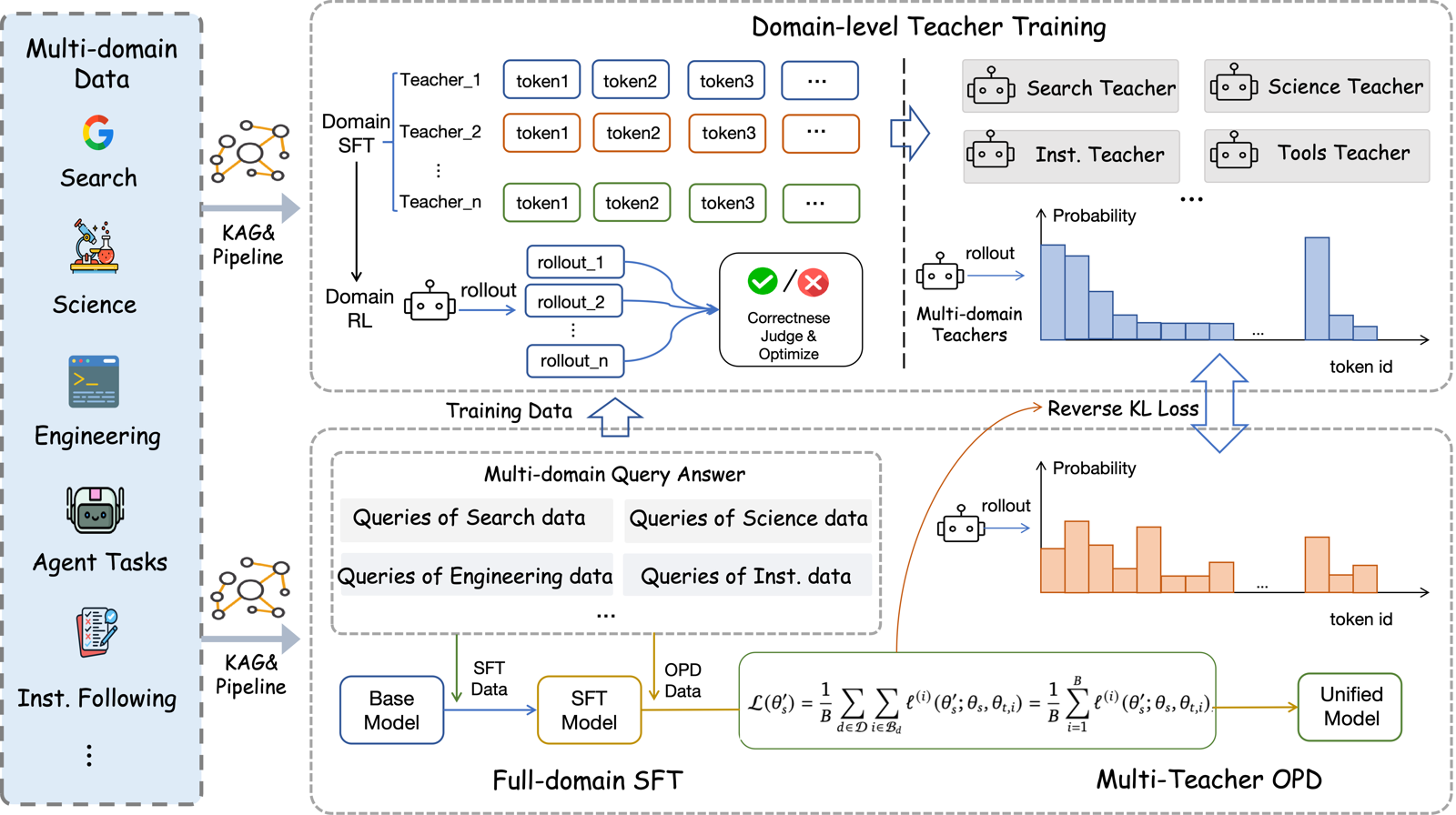
Stages 1 and 2 are familiar: a full-domain SFT pass aligns the base model with broad agent behavior across all domains (~100K trajectories, response-token cross-entropy, one epoch at up to 131K sequence length), then a set of domain-level teachers is trained, each with its own recipe — the search teacher with SFT then GRPO over web-search/read/code tools; the science teacher with reasoning-enhanced then tool-augmented SFT; the instruction-following and tool-calling teachers with their own GRPO setups and reward shaping. Each teacher goes deep where a single generalist would be pulled thin.
Stage 3 is the interesting one, and it's the same idea three separate papers landed on this same week (MOPD and DOPD): on-policy distillation as the way to fuse capabilities. The full name is a mouthful — multi-teacher domain-routed on-policy distillation with salient vocabulary alignment — so here's what each piece means:
- On-policy. The student generates the rollout, and the teacher supervises the student's own tokens — not a fixed teacher transcript. This kills exposure bias: the student learns to recover from the states it actually visits, not the ones a teacher would have.
- Domain-routed. Routing is hard and per-sample: each trajectory carries a domain label, and it's supervised only by that domain's teacher (). No learned per-token gate — the task picks the specialist.
- Salient vocabulary alignment (SVA). At each position, the distillation loss is computed only over the teacher's top- vocabulary — the handful of tokens the teacher actually puts probability on. Both distributions are renormalized onto that support and matched with a forward-KL term. The long low-probability tail, which carries no decision information, is dropped. You align where the capability lives.
- Heterogeneity-aware. Losses are averaged within a domain first, then across domains, so a high-volume domain can't drown out a small one — each active domain gets comparable influence on the update.
The result is one deployable 35B student that inherits all six specialists, with no teacher shipped at inference. If you've read the inference write-up, this is the training-time mirror of the serving-time story: the whole game is getting frontier behavior out of a model small enough to actually run.
The numbers
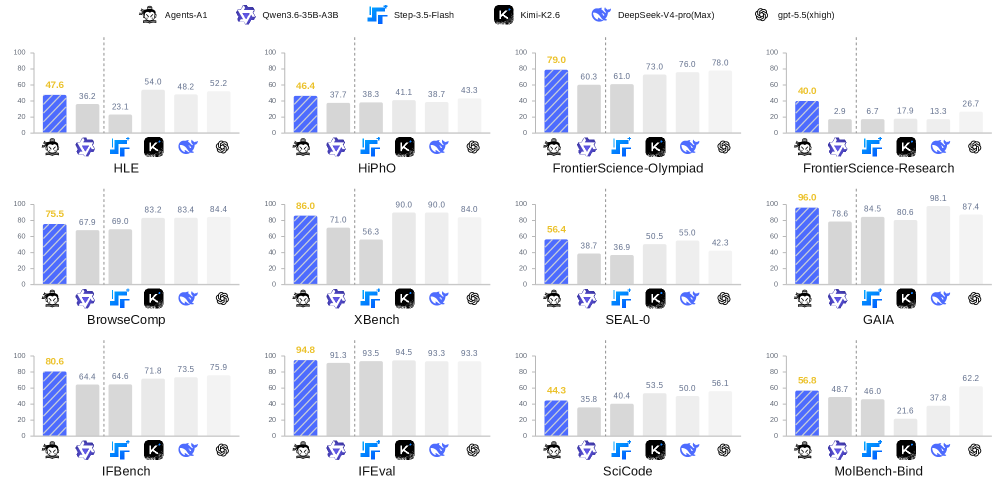
The payoff is parity with — and on several benchmarks, victory over — models ~30× larger. The sharpest case is FrontierScience-Research, where the gap to the trillion-parameter field is not subtle:
The base model scores 2.5; the trained 35B scores 40.0 — above GPT-5.5's 26.7 and more than double the trillion-parameter Kimi and DeepSeek. On long-horizon search, it takes overall SOTA on Seal-0, edging out frontier systems that are far larger:
And on instruction following it leads outright, which matters because it's the capability most likely to degrade when you fuse many domains into one model:
Across the full suite, Agents-A1 takes overall SOTA on six benchmarks (Seal-0, HiPhO 46.4, FrontierScience-Olympiad 79.0, FrontierScience-Research 40.0, IFBench 80.6, IFEval 94.8) and is the best ~35B-class model on most of the rest (BrowseComp 75.5, GAIA 96.0, XBench-DS 86.0, SciCode 44.3, HLE-w/-tools 47.6, MolBench-Bind 56.8). It does not win everywhere — GPT-5.5 still leads pure web search (BrowseComp 84.4) and engineering (SciCode 56.1, MLE-Lite 72.7), and DeepSeek-V4-pro tops GAIA (98.1) and the general-agentic τ²-Bench. The honest summary is parity in the frontier band, with clear leads in science and instruction following — from a model you can serve on a fraction of the hardware.
Running it
Agents-A1 is Apache-2.0 and runs on the standard stack — Hugging Face Transformers, vLLM, or SGLang with OpenAI-compatible endpoints, at a served context of 262K tokens. The release recommends specific sampling for the long-horizon behavior to hold up:
# vLLM / SGLang OpenAI-compatible call
sampling = dict(
    temperature=0.85,
    top_p=0.95,
    top_k=20,
    min_p=0.0,
    presence_penalty=1.1,   # discourages the repetitive loops long agents fall into
)
The presence_penalty is the non-obvious one: long agent rollouts are prone to getting stuck
repeating a failing action, and a mild penalty keeps the trajectory exploring.
The take
What I like about Agents-A1 is that it's an honest systems argument, not a parameter flex. The recipe is the contribution: a knowledge-action graph that makes verified long-horizon data a renewable resource, and an on-policy distillation stage that folds many specialists into one small model without the capability erosion you'd expect. It converges with a clear 2026 theme — on-policy distillation is becoming the default way to integrate capabilities rather than trade them off, and horizon, not size, is where the agentic gains are now coming from.
The caveats are the usual ones for a benchmark-led release: the expert count and MoE routing aren't disclosed, the "trillion-parameter performance" framing rests on benchmark parity rather than a fitted scaling law, and benchmark SOTA is not the same as robustness in a messy production loop. But the direction is the point. If a 35B model with 3B active parameters can be trained to sit in the frontier's agentic band, the interesting frontier stops being how big and becomes how far — how long the horizon, how many the domains, how good the verifiers.
Built on Agents-A1: Reaching Trillion-Parameter Performance with a 35B Agent (InternScience, 2026), the project page, and the model release (Apache-2.0). Benchmark figures are quoted from the tech report and model card.