2026-09-26 · 24 min · reinforcement-learning · agents · open-source · llm · benchmarks · evaluation · explainer
Four days ago this site read the MiMo-V2.6 release and
called its reinforcement-learning kit the part worth keeping: roughly 7,000
graded task environments with their verifiers, a distilled 9B model to start
from, and a GRPO baseline with its metrics printed. It also said I could not
find the kit. It is now in three places. The Hugging Face dataset
XiaomiMiMo/MiMo-V2.6-RL-oss
and the Docker Hub repository
xiaomimimo/mimo-v2.6-rl-oss,
which holds the task images, were both created on 2026-09-25. The training
recipes, and two graders that are not in the dataset, are in a fork of verl at
XiaomiMiMo/verl, last pushed on
2026-09-26. That fork was created on 2026-09-21, the day before my search,
though I cannot tell what it held then. GitHub's repository search leaves forks
out by default, which may be why I missed it.
The repost that spread it said "~7K of the RL environments … across domains like code, cyber, general, music and web dev." That is close. What I want to know is narrower: what exactly is a task here, what grades it, and what would I have to supply to run it. So I pulled every parquet file, all 925 rubric files, one complete knowledge-work environment and the Docker Hub tag list, and I read the five graders line by line. I ran none of Xiaomi's code and pulled no image. Every count below is Measured unless I say Reported.
What an environment is, here
Reinforcement learning for an agent needs three things per task. A prompt: the text the policy sees. An environment: the state it acts on, here a container with a repository, a binary, or a workspace of files. And a verifier: a program that runs after the episode, inspects what the agent left behind, and returns a number, the reward. The policy learns to raise that number, and only that number, so the verifier is the task specification as far as training is concerned.
Every arm in the release trains with GRPO (Group Relative Policy Optimization, from DeepSeekMath). The trainer samples rollouts of the same prompt, a group, grades each one, and scores each rollout against its siblings rather than against a learned value function:
where is rollout 's reward, the group mean, the
group's standard deviation and the advantage that scales rollout 's
gradient. The code, cyber and general recipes set norm_adv_by_std_in_grpo: false, which drops the and leaves ; the web-dev
and music configs keep verl's default and divide. Two consequences matter for
reading the graders. A constant added to every rollout's reward cancels. And a
group whose rollouts all earn the same reward has zero advantage everywhere and
teaches nothing, which is why the code and cyber arms drop such groups
(filter_groups) before the update.
What is in the box
The dataset card is a table and two links. The files say more.
| Domain | Rows | Report's Table 5 | Distinct environments | Images on Docker Hub | Verifier | Needs from you |
|---|---|---|---|---|---|---|
| Code | 2,698 | ~3k | 2,698 | 2,698, median 3.1 GB, 6.68 TB total | hidden tests, exit code | Kubernetes |
| Cyber | 1,000 | ~1k | 1,000 | 1,000, median 0.71 GB, 0.79 TB total | crash-site match | Kubernetes |
| General, knowledge work | 925 | ~1k (with terminal) | 925 | 1 shared, 0.88 GB | rubric: LLM judge + rules | Kubernetes, an LLM judge |
| General, terminal | 64 | 64 | 64, about 0.29 GB each | pytest | Kubernetes | |
| Web dev | 2,093 | ~2k | 1 | 1 shared, 2.63 GB | group-relative vision pick | Kubernetes, a vision judge |
| Music | 1,000 | ~1k, in the text | 0 | none | MIDI human-likeness score | abc2midi |
| Total | 7,780 | ~7k + ~1k | 4,688 | 3,764 tags, about 7.5 TB |
Rows are rows of each domain's parquet, and I checked that every row's task id
is distinct. The report's four domains come to 6,780 against
its "approximately 7k", and music to 1,000 against "approximately 1k", so the
headline counts hold. Every docker_image a row names resolves to a tag through
the dataset's image-mapping.jsonl, all 3,764 of them. The image sizes are
Docker Hub's compressed per-tag figures; shared base layers count once per tag,
so a pull of everything would move less than 7.5 TB; how much less, I did not
measure.
"7K environments" needs one qualification. A web-dev row is a prompt, not an environment: all 2,093 of them run in the same image. A music row is a single turn of text with no environment at all. Counted as distinct places an agent can act, the release is 4,688 environments carrying 7,780 tasks.
The dataset itself is 41,292 files and 12.10 GB (the sum of the listed file
sizes, at commit 639865fd), licensed Apache-2.0. Almost all of it, 41,284
files and 12.08 GB, is the knowledge-work environments. The other four domains
are one parquet each: the code parquet is 13.3 MB because it carries the hidden
tests; music is 135 KB.
Every row follows verl's RLHFDataset schema: prompt (one user message),
data_source, ability, reward_model and extra_info. The
reward_model.ground_truth field is empty in all 7,780 rows. What a verifier
needs travels in extra_info.instance_json, or lives in the environment
directory, the image or the grader's code.
Five graders
The widget below walks one rollout through each grader and then through a GRPO group. The rules are transcribed from the released code; the seven sibling rewards are illustrative values each grader can actually return. The prose after it carries the same content.
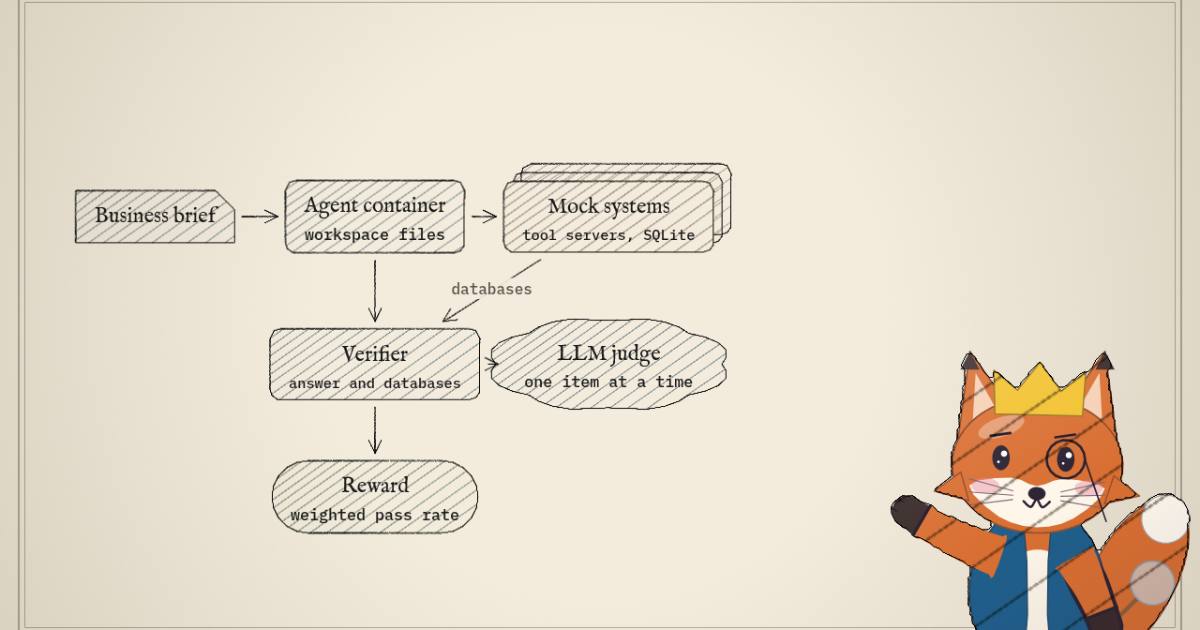
A business brief over a workspace of documents, spreadsheets and slides. 504 environments are in English, 421 in Chinese.
Two containers: the agent's, holding the workspace, and a sidecar serving 3 to 18 mock enterprise systems as MCP servers over SQLite.
A rubric of pass/fail items. An LLM judge reads the final answer for most; Python checks read the databases for the rest. Score = Σ w·s / Σ w.
Every judged item failed and this rollout still scores 0.5, because the untouched databases carry weight 1.0. Inside a group where every sibling also left them alone, that half cancels in r − mean; it only bites a sibling that damaged them.
Code: the tests arrive after the agent leaves
Each of the 2,698 code rows is a GitHub-style issue (median 1,603 characters)
and a container image with the repository checked out at the task's base
commit. The grader is OpenSourceCodeEnvironment in
XiaomiMiMo/MiMo-Agent, the
harness library the verl fork pulls in as a submodule (a fork of
mini-swe-agent v1.9.0, since
largely rewritten). Its reward contract is three steps:
- Reset every path the row's
test_patchtouches back to the captured base commit. git applythe test patch.- Run
test_command; the reward is 1.0 if and only if it exits 0.
The trick is where the tests live. They are not in the image. They ship inside
test_patch, together with the script that runs them: mimo_test_command.sh
appears in all 2,698 patches. In the code's own words, "The patch is applied
only at reward time, so the hidden tests and the script that runs them never
exist while the agent works." Setup also refuses an image whose git history
reaches past the base commit (git rev-list --all --not <base>), because a
reachable future commit is the reference fix sitting in git log. And a patch
that fails to apply is reported as REWARD_TESTBED_CORRUPTED so the trainer can
mask it instead of scoring a wrong answer. Prime Intellect's
365,000-task catalogue withholds grading
material the same way; it is becoming the standard move.
Hidden from the agent is not hidden from the internet, though: the patches sit
in plain text in code.parquet. Anyone evaluating on these repositories later
should assume the tests are in someone's pretraining crawl.
By the file extensions in each test patch (my heuristic, not a field), the set is 1,179 Python tasks, 721 Go, 388 JavaScript, 166 TypeScript, 117 across fourteen other languages, and 127 whose test files carry no extension I mapped. Every row has an 1,800 s verifier limit. The images are the expensive part: median 3.1 GB, largest 13.72 GB, 6.68 TB for the arm.
Cyber: crash in the right function or score zero
The 1,000 cyber rows come from ARVO, a corpus of reproducible OSS-Fuzz vulnerabilities. The prompt is one line naming a sanitizer, a bug type, a function and a file, wrapped in a fixed template. The image carries the source and the sanitizer-instrumented binary; the agent writes a proof-of-concept input and submits it to a small HTTP server that runs as root and executes the binary as a separate unprivileged user with a 60 s limit.
The report explains why this grader exists: "The difficulty is not triggering a
crash, since complex C/C++ projects expose dozens of reachable crash paths, but
triggering the specific vulnerability described." Differential testing against
a fixed binary, as CyberGym does, breaks
when the patch is incomplete; an LLM judge is not repeatable. So the reward is a
string match. The server walks the sanitizer's stack trace, skips frames outside
/src/, fuzzer and sanitizer frames, takes the first project frame, and pays
1.0 only when that function name, the sanitizer and the bug type all equal the
target's. Only the last submission counts. The file named in the prompt is
parsed but not compared.
What the 1,000 contain, by the description line: 683 AddressSanitizer, 235 MemorySanitizer and 82 UndefinedBehaviorSanitizer targets; 388 heap-buffer-overflows and 225 uses of uninitialised memory; 176 projects by top-level source directory, led by nDPI (70), FFmpeg (55) and ImageMagick (52). One thing to know before you split it: there are only 693 distinct task statements. 501 tasks sit in 194 groups that share an identical line, the largest eleven deep, because the same function and bug type recur across commits. Split by statement, not by row, or the validation set leaks.
General: 925 simulated offices and a rubric
This is the richest part of the release and the one the report describes at length.
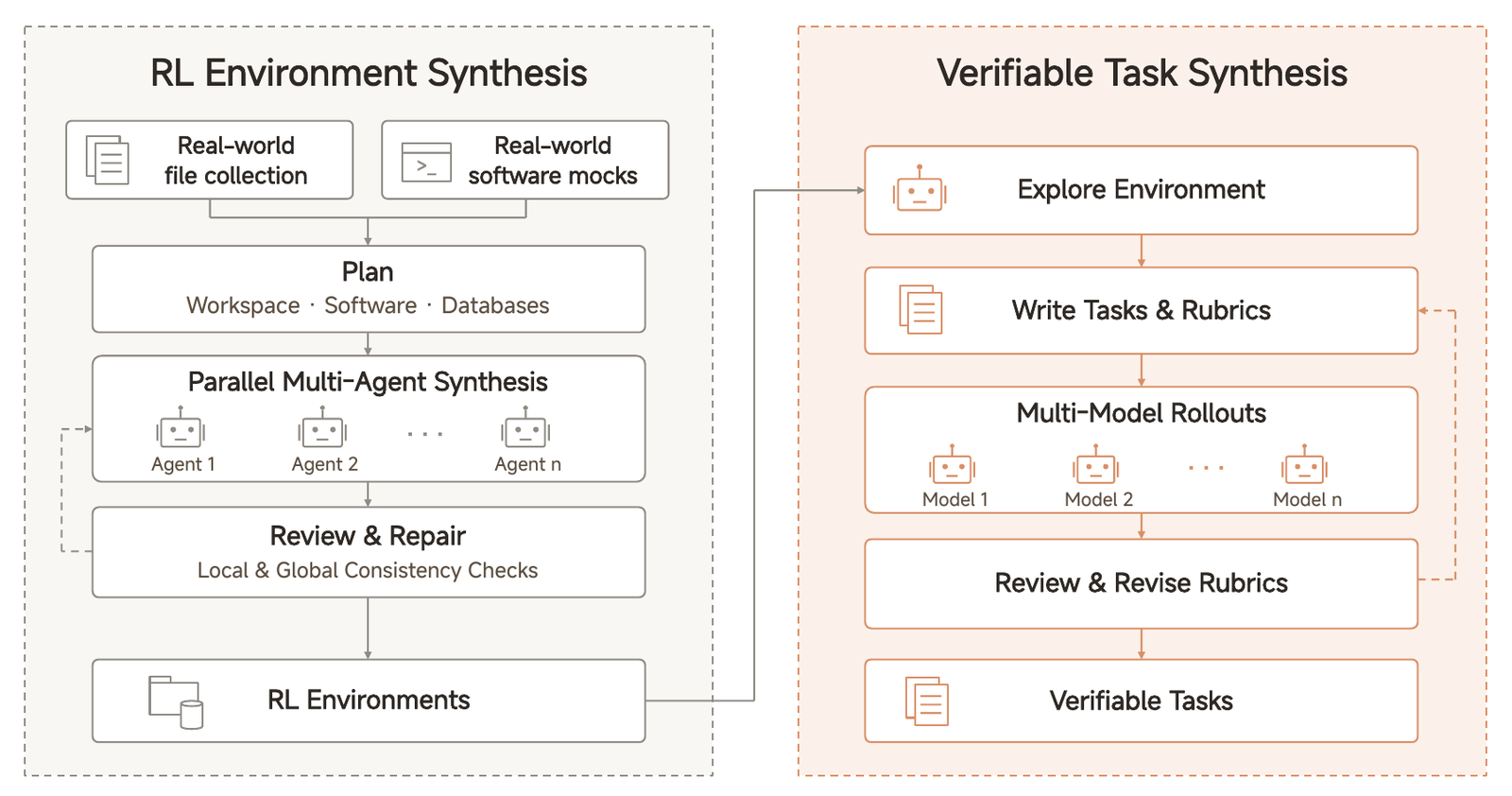
Each of the 925 environment directories under general/envs/ holds a
workspace/ of documents (median 13 files; PDF, CSV, XLSX, DOCX, PPTX), a
system/ of SQLite databases with their schemas, a tools/ directory with one
Python module per mock enterprise system, and the grading files. The directory
names encode an industry and a language: 16 industries from accounting, audit
and tax (157) and finance and insurance (135) down to agricultural co-ops (7),
504 environments in English and 421 in Chinese, and a t1 to t5 tag I read as
difficulty (111, 307, 338, 137 and 32). Between them they mock 6,130 system
instances under 4,343 distinct names, 3 to 18 per environment with a median of
6: workday_hcm, servicenow_irm and yonyou_nc_finance are the most common.
An environment is 23 to 154 files, median 7.3 MB, the largest 450 MB.
manifest.json says how one runs. The pod has two containers. The agent's
container gets the workspace at /work/workspace. A sidecar gets the databases
and the tool modules, starts one MCP server per module on ports 39101 upward,
and the agent reaches them over MCP. After the episode run_verify.py takes the
agent's last message as answer.md, snapshots every database read-only, and
calls the environment's verify.py.
The grader is a rubric in verifier_meta.json. Across the 925 files there are
5,125 items, 2 to 10 per environment (median 5). 4,437 of them (86.6%) are
LLM-judged; 688 are Python rule checks against the databases or deliverable
files. 695 environments have no rule item at all. 722 tasks are read-only; 178
require the agent to change a database, and those are where the rule checks
earn their keep. The judge sees one item at a time with up to 20,000 characters
of extracted evidence per file, and must answer 0 or 1: the prompt says a
partially met item is unmet and missing evidence is a 0. The environment's score
is over the items, with the item's weight
and its verdict.
Two details in that scorer are worth knowing. First, a missing weight counts as 1.0, and 834 of the 925 files set no weights at all. The environment I stepped through in the widget, a Los Angeles property-disposal review, weights its five judged items 0.2, 0.2, 0.25, 0.2 and 0.15 (their sum is 1.0). They ask whether the answer names the current installment deal and excludes the superseded ones, reports the county and city transfer-tax components ($9,141.00 and $37,395.00) with their approved total of $46,536.00, sorts the closing protections into approved and unresolved, states the approved payment split and the all-cash fallback, and concludes that the deal is not ready to close unconditionally. Then the file lists a sanity check that the databases still hold their anchor records, with no weight. It counts 1.0. So a rollout that leaves the databases alone and gets every judged item wrong scores 0.5. Under GRPO that half cancels in whenever the whole group left the databases alone, so it acts as a heavy penalty on tampering rather than as free reward. 202 environments carry such a sanity item; its median share of the weight is 0.2, and in 9 it is half or more.
Second, the judge is yours. verify.py reads the endpoint, key and model from
GA_JUDGE_URL, GA_JUDGE_KEY and GA_JUDGE_MODEL, and the shipped example
fills in gpt-4o-mini. The report says that "During RL, a self-hosted
MiMo-V2.6-SFT model serves as the grader to support stable scoring." That model
is not on the Hub. Whatever judge you pick defines 86.6% of this arm's reward.
If the judge fails, the runner writes no reward rather than a zero, "instead of
training on a false 0", and the trainer masks the rollout.
The other 64 general rows are terminal tasks in the Terminal-Bench format, one
image each. The first asks for a repair to a vendored Snakemake workflow engine;
by category there are 18 software, 18 ML and 15 security tasks. Their tests
travel base64-encoded in the row, are copied in only after the agent exits, and start with an anti-hack guard that zeroes the reward for a
planted conftest.py or sitecustomize.py, or for any protected file whose
hash changed. The limits are 1 CPU, 2,048 MB, no internet and a 900 s agent
budget.
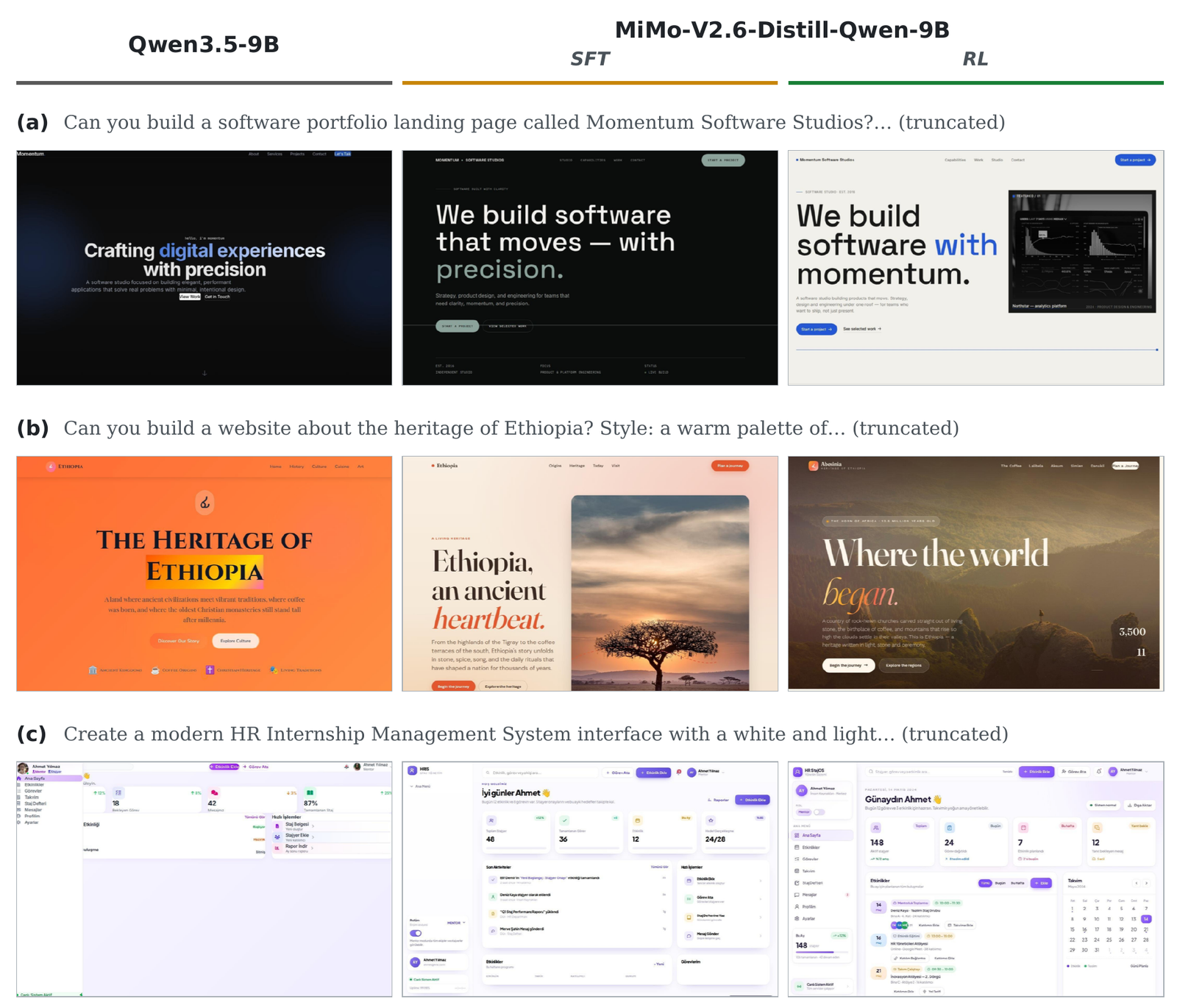
Web dev: rank the siblings, not the page
The 2,093 web-dev rows are website briefs, median 825 characters, 2,076 of them
in English by my character count, all run in one shared image. The dataset
carries no verifier for them. The grader is a service in the verl fork, recipes/design/grader_service,
and it does not score a page on its own. It collects the screenshots of all
eight siblings in a group and asks a vision model, eight times, which pages are
clearly better than the rest and which clearly worse, as an ordinary person
would see them side by side. The eight orders form a Williams Latin square, so
every screenshot appears in every position once; a code comment reports that
this flattened a first-position bias "from ±0.28 to ±0.03 votes".
A second judge call scores how much of the brief the page implements, from 0 to 1, and that becomes a deduction. The reward is
with the query-fit deduction at 0 for a score of 0.9 or more, 0.2 from 0.6, 0.4 from 0.4 and 0.8 from 0.2. Below 0.2 the reward is 0 outright, and so is a page whose scripts throw on load. A net of one vote either way is treated as noise and zeroed. The affine map puts between 0.0667 and 1; neither the shift nor the ÷3 changes which siblings GRPO pushes up.
The consequence is stated in the code: "A single rollout's reward is therefore meaningless in isolation." It is a training signal, not a metric, which is why there is a separate evaluation mode that scores one page absolutely with a single vision call. And the vision model is yours to supply; the service ships with no default model.
Music: well-formed and human-sounding, not what was asked
The 1,000 music rows ask for a piece in ABC notation, a plain-text music format, under explicit constraints. The first one reads, in Chinese: an English country dance in E major, 129 BPM, 4/4, 56 bars, for violin, flute and cello in three voices. The briefs are 504 Chinese and 496 English; 746 are in 4/4, and they ask for one to six voices.
The scorer is recipes/design/music/scorer. It pulls the ABC out of the answer,
renders it to MIDI with abc2midi, and rejects the piece (reward 0) on any
Error line, 10 or more bar-length warnings, a blank line inside the score, or a
MIDI channel that changes instrument. A surviving piece is scored on 18
features in 6 groups: rhythm (weight 0.22), texture (0.20), tonal (0.16),
register (0.16), acoustic (0.14) and structure (0.12). Each feature is scored by
whether it falls inside the 10th to 90th percentile band of a human reference
corpus. That band score is 85% of the reward; the other 15% is Jensen-Shannon
agreement with the corpus's pitch-class, interval and duration histograms.
Nothing in that path reads the brief. The key, tempo, meter, bar count and voice
count are in each row's extra_info, and the parquet builder says what they are
for: "they are also the material for grading instruction-following, which this
scorer does not do." So the music reward pays for a well-formed score that
sounds statistically like human music. A piece in D minor at 60 BPM for solo
piano is scored by exactly the same rules as one that honours the E-major brief,
with no penalty for ignoring it. The report's music result,
45.7 after SFT to 52.5 after RL on an internal benchmark, is measured by
something I cannot see; I would not assume it measures adherence either.
The 9B starting point, and the baseline
MiMo-V2.6-Distill-Qwen-9B
is Qwen3.5-9B after supervised
fine-tuning on MiMo-generated trajectories: 77.4B tokens, of which 27.2B carry
loss, across code, cyber, general and visual work. There is no music in its SFT
mix. It is MIT-licensed and is the only V2.6 checkpoint on the Hub that is not an
"-RL" model. The two that are,
MiMo-V2.6-Pro-RL and
MiMo-V2.6-Flash-RL, are
the shipped post-trained models (the 1.02T and 309B MoEs), named for the run that
produced them; unlike V2.5, no base or SFT checkpoint of either was released.
The report's Table 6 starts GRPO from the 9B SFT checkpoint, separately per domain, and reports every row going up. Reported, not measured:
| Benchmark | Metric | Qwen3.5-9B | 9B SFT | 9B + GRPO | Public? |
|---|---|---|---|---|---|
| SWE-bench Verified | avg@3 | 60.0 | 61.1 | 66.2 | yes |
| SWE-bench Pro | avg@3 | 32.0 | 44.6 | 47.6 | yes |
| MiMo Code Bench (mini) | avg@3 | 19.5 | 51.6 | 59.9 | no |
| MiMo Cyber Bench (mini) | avg@3 | 5.7 | 31.3 | 47.0 | no |
| AutomationBench v1.0.6 | avg@1 | 5.0 | 30.3 | 33.1 | yes |
| Terminal Bench 2.1 | avg@1 | 27.0 | 37.1 | 52.8 | yes |
| Toolathlon-Verified | avg@1 | 25.9 | 35.2 | 38.0 | yes |
| OfficeQA Pro | avg@1 | 9.0 | 19.5 | 24.8 | yes |
| JobBench | avg@1 | 2.6 | 18.3 | 25.2 | yes |
| MiMo General Bench (mini) | avg@1 | 28.5 | 62.2 | 70.6 | no |
| MiMo Visual Coding (mini) | avg@1 | 61.7 | 64.0 | 72.4 | no |
Seven of the eleven rows are public benchmarks you can rerun. The four "mini" sets are internal, described as following "the same task distributions as their corresponding training sets", and none of them is in the release. Neither are the RL-trained 9B checkpoints, so the right-hand column is a target to hit, not a model to download.
What the fork does give you is the reference run, in each arm's launch script:
| Arm | Group size | Prompts per step | Length | Window, tokens | Default cluster |
|---|---|---|---|---|---|
| Code | 16 | 64 | 200 steps | 262,144 | 8 × 8 GPUs |
| Cyber | 16 | 64 | 300 steps | 262,144 | 8 × 8 GPUs |
| General | 8 | 64 | 5 epochs | 262,144 | 4 × 8 GPUs |
| Web dev | 8 | 32 | 1 epoch | 262,144 | 8 × 8 GPUs |
| Music | 8 | 32 | 4 epochs | 116,384 | 8 × 8 GPUs |
The code arm also carries the multi-harness experiment: four "mini" harness
configurations (mini-mimocode, mini-bash, mini-claude-code, mini-codex)
mixed per step by a seeded hash, matching the four training harnesses of the
report's Table 7. That is the "composable mini-harness" the report promised. Table
7 is also a reminder of why harness choice matters: the
same Qwen3.5-9B scores 36.4 on SWE-bench Verified in one harness and 60.6 in
another.
Released, described, missing
| The report says | What is there on 2026-09-26 |
|---|---|
| ~7k tasks in four domains with verifiers | 6,780 rows; verifiers for code, cyber, general and terminal in the data and MiMo-Agent |
| ~1k music tasks | 1,000 rows; the scorer is in the verl fork |
| Visual grading for web dev | the grading service in the verl fork; the vision model is yours |
| An end-to-end RL framework | XiaomiMiMo/verl, branch mimo-oss, with MiMo-Agent and uni-agent as submodules |
| A composable mini-harness | four harness configs and the mixing spec |
| The 9B starting point | MiMo-V2.6-Distill-Qwen-9B, SFT only |
| The training dynamics | the running log on Xiaomi's site, as the report says |
| A self-hosted MiMo-V2.6-SFT grader | not released |
| Domain-specific RL checkpoints of the 9B | not released |
| Four internal "mini" evaluation sets | not released |
| Validation splits | not in the dataset: the cyber script expects rl_mixed_test_182_oss.parquet, the code script a code-val.parquet, and the web-dev example points validation at the training file |
| "Thousands of environments" behind the production run | not released; this is the reproduction kit, as the earlier piece said |
Two of those gaps you can close yourself, at a cost: carve a validation split (by statement, for cyber), and pick a judge knowing it is not the one Xiaomi used. The internal eval sets and the RL checkpoints are what would make a baseline comparable, and those you cannot supply. If your 9B run lands at 64 on SWE-bench Verified instead of 66.2, nothing in the release tells you whether the difference is your cluster, your judge or your luck.
What one arm costs to run
Nothing here runs on a workstation. Every arm but music launches one Kubernetes pod per rollout (the code arm's default ceiling is 1,024 concurrent pods), and the defaults assume four to eight nodes of eight GPUs. The images are the other bill: the code arm alone is 6.68 TB of compressed layers across 2,698 tags, and a GRPO step with 64 prompts × 16 rollouts touches up to 64 of them 16 times over. The knowledge-work and web-dev arms add judge calls: one per judged item in general, up to 10 per rollout; in web dev a query-fit call per rollout and 8 pick rounds per group. Music is the cheap one, a CPU-bound scorer and one binary.
The take
This is a real release, and a more careful one than the dataset card suggests. The code grader keeps the tests out of the pod until the episode ends and refuses images with leaky history. The cyber grader replaces a flaky oracle with a deterministic one and says why. Masking a broken testbed instead of scoring it zero appears in three separate graders. Those are the details that decide whether RL learns the task or the grader, and they are all readable.
The limits are in the same code. Two of five arms are only as good as a judge model you choose, and 86.6% of the knowledge-work reward is that judge's opinion. The web-dev reward has no absolute meaning by design. The music reward ignores the brief. The cyber set repeats its statements. And the baseline cannot be checked end to end, because four of its eleven rows and every RL checkpoint stay in-house. Nearly 4,700 environments with readable graders is still, as far as I know, more than any other lab has released alongside a model. It is just not yet a benchmark.
What would change my mind
4 claims above, and what would falsify each
The release holds 7,780 tasks in 4,688 distinct environments.
Rows counted from the five parquet files at dataset commit
639865fd; environments counted as one per code or cyber image, one per knowledge-work directory, one per terminal image, and one for the shared web-dev image. If Xiaomi pushes more rows, or you count a web-dev prompt as its own environment, the numbers move. A later commit with a different row count settles it.The music scorer does not check the brief's key, tempo, meter, length or voices.
Read from
recipes/design/music/scorer/pipeline.py, whosecompute_scorebuilds its record from the extracted ABC alone, and from the builder's own docstring. If the launch path wrapscompute_scorewith a constraint check I did not find, or a later commit adds one, this is wrong. Scoring two valid ABC pieces that differ only in key against the same brief would show it directly.In s3k_0000, an answer that fails every judged item still scores 0.5.
From
verify.py's sidecar path, which defaults a missing weight to 1.0, and that environment'sverifier_meta.json, whose sanity item has none. If the trainer calls the other path inverify.py, the internalgrade_rubricmodule that is not released and may treat the sanity tier differently, the number changes. The sidecar path is the only one the released runner can reach.The validation splits, internal eval sets, production judge and RL-trained 9B checkpoints are not released.
Checked on 2026-09-26 against the dataset's file list, the XiaomiMiMo model and dataset listings on Hugging Face, and the fork's scripts. As with the environments themselves four days ago, the likeliest way this is wrong is that they land next week.
Measured: row counts, field values and every tally above, from the five parquet
files, image-mapping.jsonl, all 925 verifier_meta.json files and the full
file listing of
XiaomiMiMo/MiMo-V2.6-RL-oss
at commit 639865fd; image counts and sizes from the Docker Hub API for
xiaomimimo/mimo-v2.6-rl-oss;
grader logic read from XiaomiMiMo/verl at
a2ad9f6 and XiaomiMiMo/MiMo-Agent
at 467f0a1, the fork's pinned submodule. Languages for the code set are my
heuristic from test-patch file extensions. Reported: Tables 5, 6 and 7, the
quotes and both figures, from the
MiMo-V2.6 technical report,
and the 9B's training mix from its
model card. I ran
no rollout, pulled no image and executed none of the released code. The trainer
underneath is verl, the open version of
HybridFlow. Previously:
MiMo-V2.6.