2026-08-23 · 16 min · reinforcement-learning · agents · self-improvement
Why read this
Solidtop 85%Explains Ornith's loop that rewards its own tasks, scaffolds and rollouts, reads the uneven generation gains, and names what would tell skill from harness fit.
- Runs on a phone
- A new technique
- Explained from first principles
Training & RLMITPractitioner model
How this was scored
- Is it new?
- 2 of 3: A real new idea, method or capability
- Can I trust it?
- 1 of 3: Spot-checks a few numbers
- Can I run it?
- 2 of 3: Open code or weights with real limits
- Will I understand it?
- 2 of 3: Mechanism from first principles with figures
- Can I act on it?
- 1 of 3: General advice
- Will it last?
- 1 of 3: Relevant for months
- Does it affect many?
- 1 of 3: A specialist community
- Only here?
- 1 of 3: Some original analysis
Score 49 of 100, ranked 469 of 577 rated articles. Each question is answered 0–3 by hand, and a 3 is rare. How articles are scored
Most RL post-training pipelines have three fixed inputs: a set of human-curated tasks, a hand-designed harness that scores them, and a policy that learns against both. Ornith-1.5 makes all three learned, in the same loop, with one reward signal propagated across them.
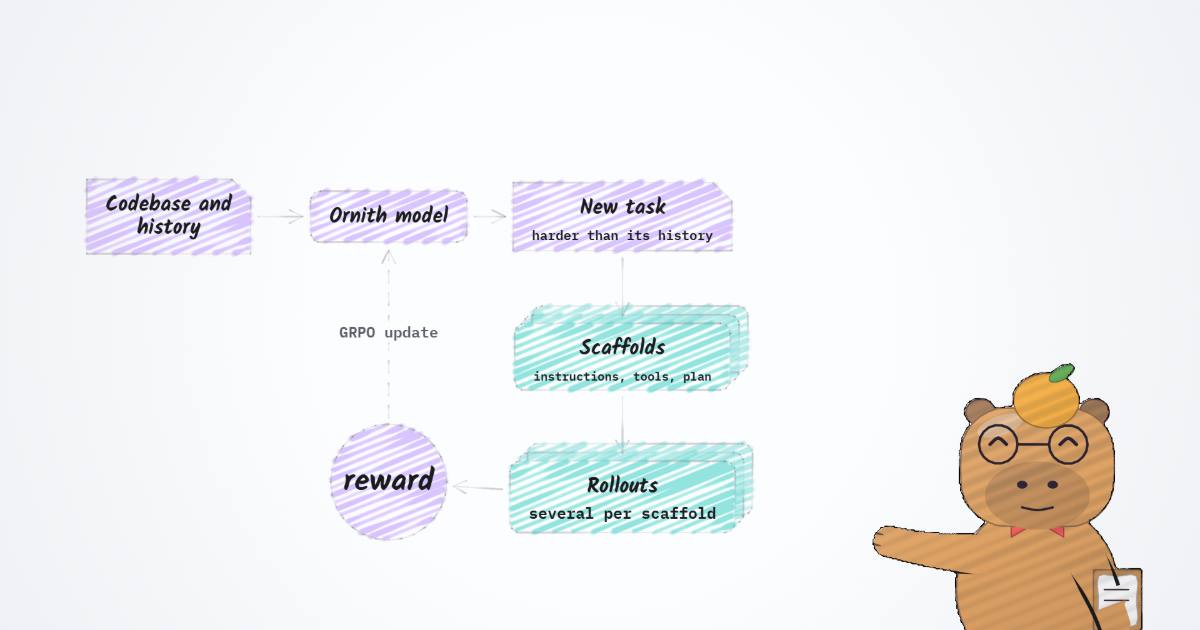
The model proposes new tasks. For each task it generates or refines a scaffold — the instructions, tools, decomposition strategy and orchestration used to attack the problem. Conditioned on both, the policy produces solution rollouts. Reward from the rollout flows back through all three stages, so the system learns to produce better solutions and to generate more useful training tasks and to construct more effective scaffolds. All three are optimized with GRPO.
| Release | Ornith-1.5 · HF collection · Aug 2026 |
| Models | 397B MoE, 35B-A3B MoE, 9B dense — plus a quantized 9B-Mobile for phones |
| License | MIT, with FP8, GGUF, MLX and NVFP4 builds |
| Lineage | extends Ornith-1.0, itself built on Qwen3.5 and Gemma 4 with CPT, mid-training and post-training |
| Flagship | Terminal-Bench 2.1 86.1 · SWE-bench Verified 86.0 · HLE 44.6 · DeepSWE 56.0 |
| Reference | Claude Opus 4.8 scores 85.0 and 85.8 on the first two |
| Protocol | every number averaged over five independent runs, with anti-hacking safeguards |
The loop
Each training cycle is three stages. Given an environment or codebase, high-level instructions about the task type, and the model's own history of what it has already solved, the system proposes progressively harder tasks that go beyond that history — exposing capability gaps and pushing the training frontier outward.
Then for each task it builds a scaffold. Then the policy attempts it. Reward propagates back through all three.
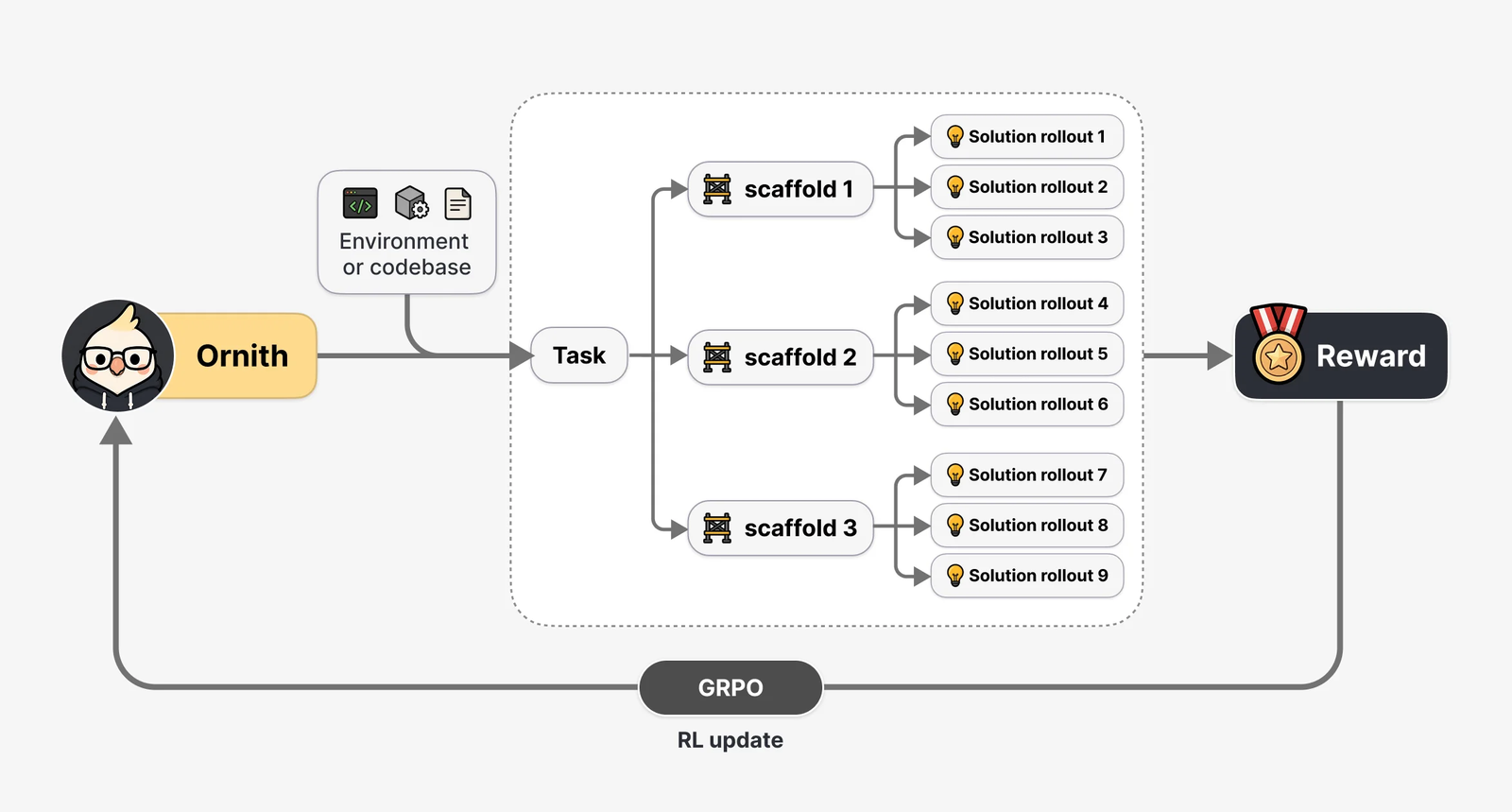
The interesting engineering is in how those rewards are shaped, because a proposer that is rewarded for difficulty will happily generate nonsense.
The task reward is a product, not a sum:
V checks that the generated task and scaffold form a well-defined learning environment: does the scaffold run, do high-confidence solutions pass, do clearly incorrect ones fail, does the evaluation match the specification. It is a hard gate — V = 0 zeroes the whole reward — which is what stops a malformed task from collecting reward simply by appearing difficult.
D estimates difficulty from the model's own rollouts: sample N attempts, compute the empirical success rate p, and reward tasks near a target frontier p* = 0.2 with a Gaussian. Twenty per cent, not fifty, and the reasoning is stated: challenging but still yielding enough successful trajectories for RL to have signal.
N subtracts the maximum similarity against a buffer of previously generated or trained-on tasks.
The self-curricular property falls out of D alone. As the model gets better and starts solving a task more reliably, p climbs past p* and the reward for proposing that task falls — so the generator is pushed toward harder problems without anyone maintaining a schedule. The curriculum evolves because difficulty is measured against the current model rather than against a fixed rubric.
The harness gets its own three-factor product:
H — resistance to evaluator failures, shortcuts and reward-hacking behaviours — is the term I would want to see ablated most, because it is the only thing standing between "the model designs its own grader" and the obvious failure mode.
What it moved
Both generations are reported side by side on the same suite at 397B and 35B, which makes the delta an unusually clean read on what extending the loop to task generation actually bought.
The gains are strikingly uneven. GPQA Diamond, a knowledge benchmark, moves 4.7 points. SWE-bench Multilingual moves 0.7. DeepSWE goes from 8 to 56 at 397B, and from a flat zero to 22 at 35B. Toolathlon-Verified goes from 43.2 to 71.2. Frontier-Bench from 2.7 to 13.5.
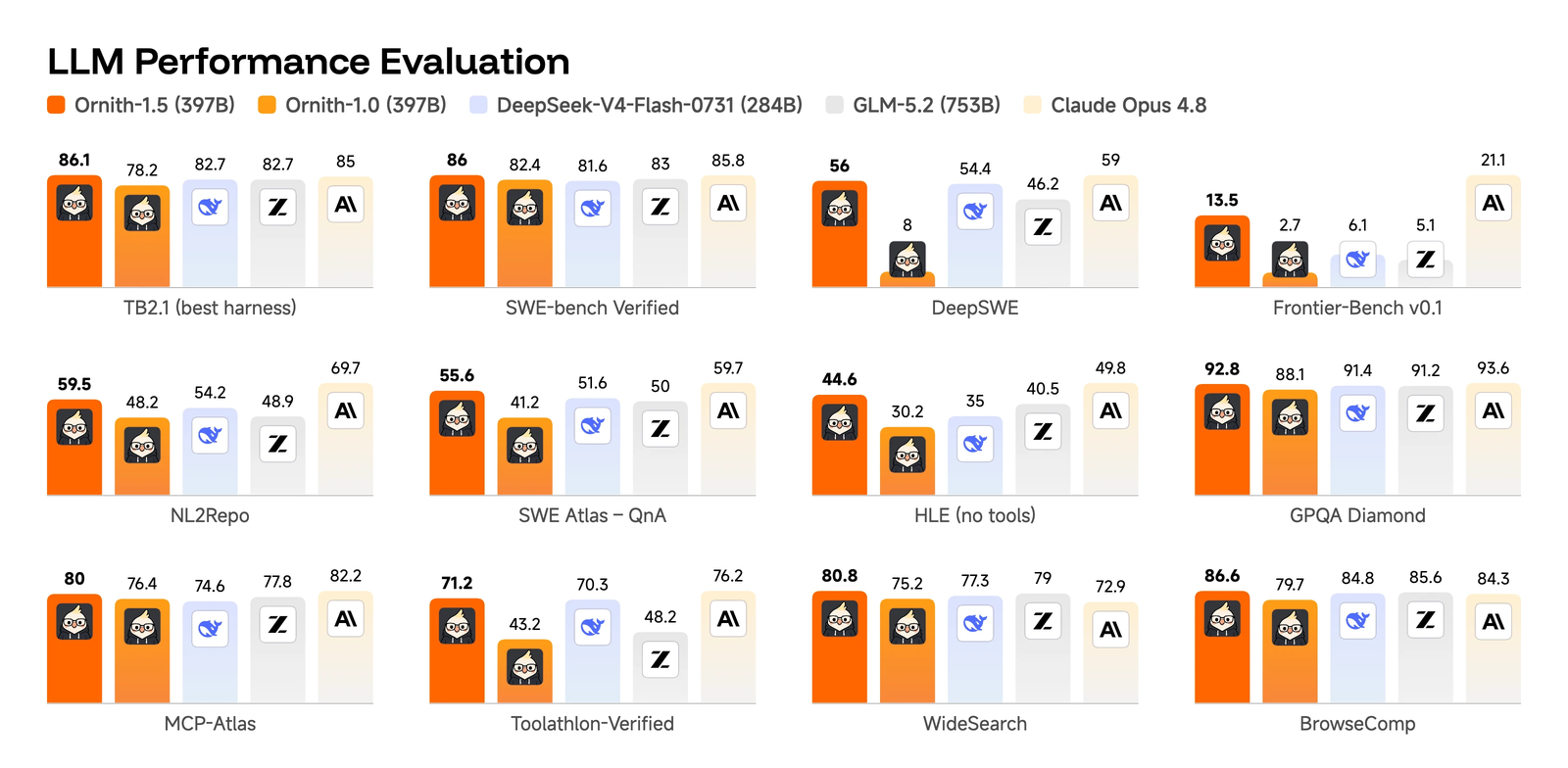
That pattern is exactly what you would predict if a self-generated curriculum mostly buys long-horizon agentic competence rather than knowledge — the tasks it proposes are agentic tasks, the scaffolds it builds are agent scaffolds, and knowledge was never the bottleneck.
It is also exactly what you would predict if a training loop has learned the structure of these particular harnesses. The published numbers cannot separate those readings, and I do not think that is a criticism unique to this release so much as a limitation of the whole genre.
Against the frontier
| Benchmark | Ornith-1.5 (397B) | Claude Opus 4.8 | GLM-5.2 (753B) | DeepSeek-V4-Flash (284B) | Kimi K3 (2.8T) |
|---|---|---|---|---|---|
| Terminal-Bench 2.1 (Terminus-2) | 86.1 | 85.0 | 81.0 | 82.7 | 88.3 |
| Terminal-Bench 2.1 (Claude Code) | 85.2 | 78.9 | 82.7 | 81.8 | — |
| SWE-bench Verified | 86.0 | 85.8 | 83.0 | 81.6 | 86.2 |
| SWE-bench Pro | 65.1 | 68.0 | 62.1 | 64.4 | — |
| SWE-bench Multilingual | 79.6 | 75.7 | 78.4 | 77.9 | — |
| DeepSWE | 56.0 | 59.0 | 46.2 | 54.4 | 67.5 |
| HLE (no tools) | 44.6 | 49.8 | 40.5 | 35.0 | 43.5 |
| GPQA Diamond | 92.8 | 93.6 | 91.2 | 91.4 | 93.5 |
| Toolathlon-Verified | 71.2 | 76.2 | 48.2 | 70.3 | 73.2 |
| BrowseComp | 86.6 | 84.3 | 85.6 | 84.8 | 91.2 |
The claim in the announcement is performance "comparable to Claude Opus 4.8", and on this evidence that is fair rather than inflated — it leads on three of the ten rows above and trails on five, mostly by a couple of points. Against open weights it is more decisive: it beats GLM-5.2, a model nearly twice its size, on nine of ten.
The gap to Kimi K3 on DeepSWE (56.0 against 67.5) and BrowseComp (86.6 against 91.2) is the honest counterweight, and Kimi K3 is a 2.8T model.
The 35B is the one to look at
The flagship result is the headline; the middle rung is the interesting engineering.
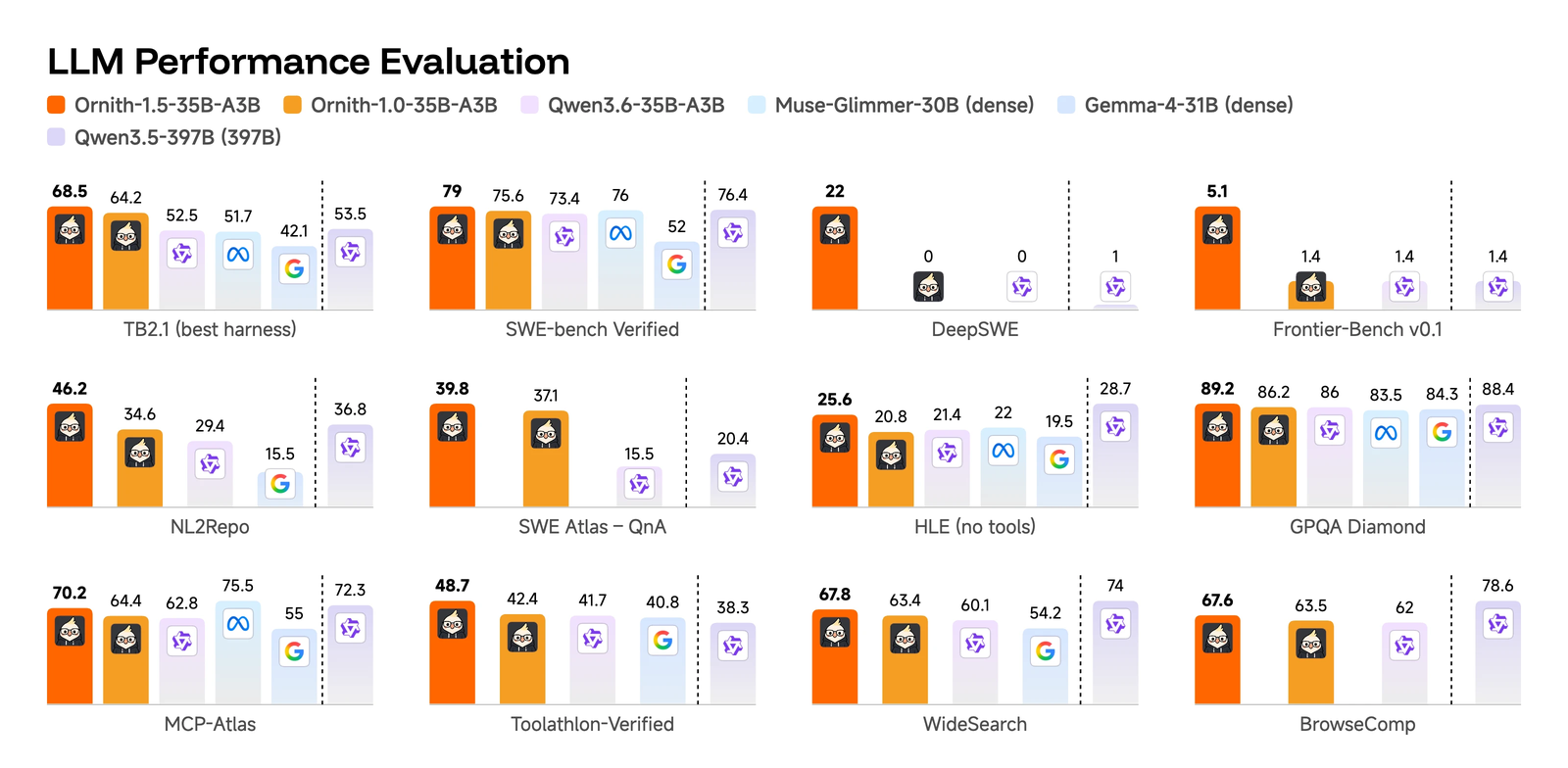
Against its direct architectural peer — Qwen3.6-35B-A3B, same parameter count, same active count — the 35B leads on every coding and agentic benchmark reported, several by more than fifteen points. That is not a scale result and it cannot be explained by a better base model, because it is the same shape.
At the bottom of the ladder, Ornith-1.5-9B reaches 47.0 on Terminal-Bench 2.1 through the Claude Code harness and 70.6 on SWE-bench Verified, with a quantized Mobile build that runs on a phone.
What I would want before believing it
The anti-hacking safeguards are on the evaluation, not the training. The eval protocol is genuinely careful — git history stripped from repo images so the model cannot read prior commits, network access disabled, GitHub and pip blocked for NL2Repo, five runs averaged. That is more rigour than most releases show. But every one of those safeguards protects the benchmark from the model. The loop that generates tasks and harnesses runs upstream of all of it, and H(h), the hack-resistance term, is defined in a sentence and never measured.
A self-generated curriculum has no held-out set by construction. The buffer B that novelty is scored against contains "previously generated or trained-on tasks". If the loop drifts toward the distribution of the benchmarks it is evaluated on — and every incentive in the training signal points that way — the novelty term will not notice, because novelty is measured against the model's own history, not against the eval suite. The DeepSWE jump from 8 to 56 is either a remarkable result or the clearest possible symptom, and nothing published distinguishes them.
σ is unpublished and it sets the whole curriculum. The width of the frontier band decides how much of the difficulty range earns reward at all. A tight σ means a narrow, aggressive curriculum; a loose one means the term barely binds. p* = 0.2 is given and justified; the parameter that determines what 0.2 actually excludes is not.
Ornith-1.0's DeepSWE score was 8, and 0 at 35B. A benchmark where the previous generation scored essentially nothing is the one where the new generation gains most. That could mean the loop unlocked a capability. It could also mean the 1.0 harness could not drive the benchmark at all — a formatting or protocol failure rather than a capability one — and 1.5 fixed the plumbing. Forty-eight points is a lot to attribute to a training loop without saying which.
Why it is still worth attention
Strip the leaderboard and the structural claim is that the three things an RL pipeline treats as fixed inputs are all learnable, and they can be learned against a single reward. Task curation is expensive and human. Harness design is expensive and human. Both are also, obviously, functions the model could approximate — and once they are inside the loop, the curriculum becomes a function of the policy instead of a constant beside it.
Whether that is sustainable or merely self-confirming is the question the field has to answer, and it will not be answered by benchmarks the loop can see. But shipping three scales of it under MIT, with quantized builds down to a phone and eval protocols written out in detail, is the version of the claim that other people can actually check.
Update — 2 October 2026
Ornith shipped draft models for speculative decoding: the ornith-ai/ornith-15-dflash collection, with a DFlash draft for each of the three scales — 9B, 35B-A3B and 397B (all created 20 September — verified). The mechanism is standard speculative decoding with the twist in the draft: DFlash is a lightweight block-diffusion model that proposes a block of tokens in parallel, and Ornith-1.5 then verifies the whole block in a single forward pass instead of decoding one token at a time, keeping only the prefix that matches what it would itself have produced. The output distribution is preserved by construction, so the win is wall-clock, not quality. The card wires it in at num_speculative_tokens: 8 (verified).
The reported figure is "up to 2.54× without any loss in generation quality." Both halves are the publisher's own, not re-run here: the "no loss" is the formal guarantee of rejection-sampling verification, which holds whatever the draft does; the 2.54× is an acceptance-rate measurement and, as with any speculative setup, rides on how predictable the text is and how cheaply the draft runs beside the target.
20 October: the 122B
On 20 October Ornith announced a fourth size, Ornith-1.5-122B, with FP8, NVFP4, GGUF and MLX builds the same day. The release blog was not updated and still lists three scales, so the model card and the post are the only primary sources.
- architecture
- Qwen3_5MoeForConditionalGeneration
- task
- text-generation
- library
- transformers
- license
- mit
- safetensors
- 62 shards
- largest file
- 5.00 GB
- files
- 77
- downloads
- 4.8K
- likes
- 142
Qwen3.5 MoE shape: 48 layers (12 full attention, 36 linear), 256 experts with 8 routed plus 1 shared, 27-layer vision tower. Licence MIT per metadata; no LICENSE file in the repo.
repo last modified 2026-10-21
What it is. Read together, the 62 safetensors headers hold 125,086,497,008 parameters, all BF16 (measured). Without the 0.45B vision tower and the 2.52B multi-token-prediction head, the language model is 122.11B, so the name holds (measured). Each token runs 8 of 256 routed experts plus a shared one in each of 48 layers: 3.62B of routed weight, 4.13B of attention, 0.45B of shared expert, 0.04B of routers and a 0.76B output head. That makes 9.01B active, or 9.77B with the embedding row (reasoned from the measured shapes). It is an A10B model in all but name.
Against its siblings. The three MoE sizes share one Qwen3_5MoeForConditionalGeneration config: the same vocabulary, vision tower, 262,144-token window, and the same hybrid stack in which every fourth layer is full attention with 2 KV heads and the rest are linear attention (see mixture of experts). The diff is width and experts (measured from the configs and headers; active counts reasoned):
| 35B-A3B | 122B | 397B | |
|---|---|---|---|
| Layers (full / linear) | 40 (10 / 30) | 48 (12 / 36) | 60 (15 / 45) |
| Hidden size | 2048 | 3072 | 4096 |
| Routed experts, active | 256, 8 | 256, 8 | 512, 10 |
| Expert width | 512 | 1024 | 1024 |
| Checkpoint total | 35.95B | 125.09B | 403.40B |
| Active per token | 3.45B | 9.77B | 17.35B |
The 122B's config is also, key for key, that of Qwen3.5-122B-A10B, and both checkpoints hold exactly 125,086,497,008 parameters (measured). Asked in a reply whether it is built on Qwen3.5, Ornith answered "yes!" (reported). Like the other two MoE sizes, it is Ornith's loop applied to an existing Qwen3.5 shape, not a new architecture.
Benchmarks (all reported, from the three cards):
| 35B-A3B | 122B | 397B | |
|---|---|---|---|
| SWE-bench Verified | 79.0 | 84.5 | 86.0 |
| SWE-bench Pro | 59.6 | 76.9 | 65.1 |
| SWE-bench Multilingual | 71.4 | 76.4 | 79.6 |
| NL2Repo | 46.2 | 51.2 | 59.5 |
| HLE (with tools) | 33.4 | 48.0 | 56.1 |
| HLE (no tools) | 25.6 | 37.68 | 44.6 |
| MCP-Atlas | 70.2 | 74.6 | 80.0 |
| Toolathlon-Verified | 48.7 | 70.8 | 71.2 |
| WideSearch | 67.8 | 75.2 | 80.8 |
| BrowseComp | 67.6 | 78.5 | 86.6 |
| ClawEval | 72.5 | 79.4 | 81.4 |
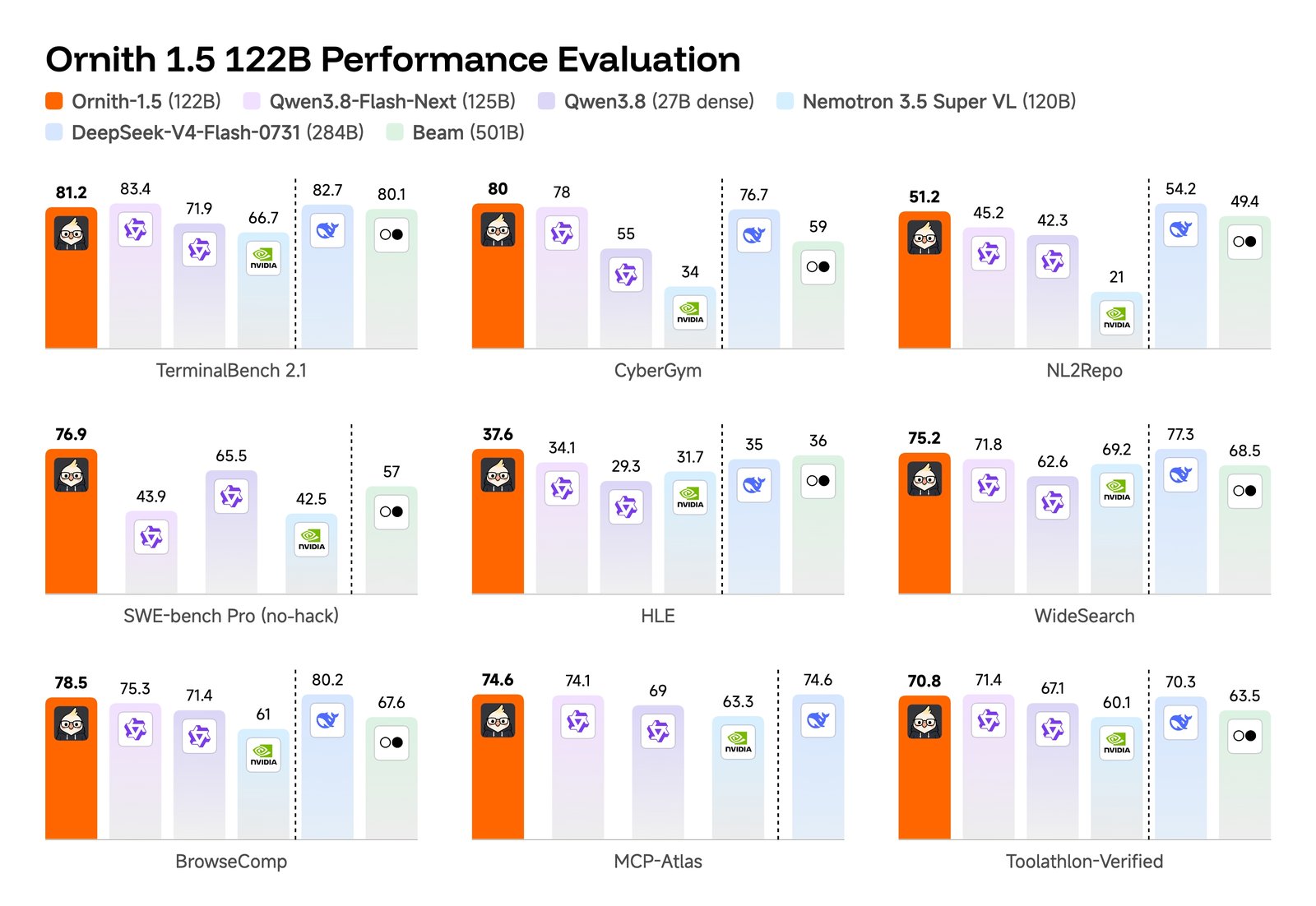
On ten of those eleven rows the 122B lands between its siblings, as a middle size should, and on Toolathlon-Verified it is within 0.4 of the flagship. SWE-bench Pro is the exception: 76.9 is 11.8 points above the 397B and 8.9 above the 68.0 the 397B card gives Claude Opus 4.8 (reasoned). The 122B card labels the row "no-hack" where the others say only "SWE-bench Pro", yet the anti-hacking footnote is word for word the same on all three. A smaller sibling beating its flagship by that much on the hardest SWE suite is either a different protocol or a result that needs explaining, and the card offers neither. Terminal-Bench 2.1 is 81.2 with no harness named (67.8 and 86.1 under Terminus-2 for the 35B and 397B). New rows: CyberGym 80.0 and SciCode 53.8. Gone: DeepSWE, Frontier-Bench and GPQA Diamond. Against DeepSeek-V4-Flash-0731, the one comparator this card shares with the 397B's, the 122B leads on CyberGym and Toolathlon-Verified, ties MCP-Atlas at 74.6, and trails on Terminal-Bench, NL2Repo, HLE with tools, WideSearch and BrowseComp.
The post and the card disagree. Six of the post's eight numbers match the card. Terminal-Bench is 0.813 in the post and 81.2 on the card. The post's HLE of 0.446 is not a 122B number at all: it is the 397B's HLE without tools, where the 122B card says 37.68.
The deployment claims. The post says it runs "on a single NVIDIA DGX card" and the card says "a single 80GB GPU". The BF16 weights alone are about 250 GB (reasoned). The FP8 repository's shards total 132.95 GB and the NVFP4 one's 77.63 GB (measured from the Hub's file listing), so only NVFP4 fits 80 GB, and barely. The hybrid stack helps with the rest: only 12 layers keep a cache, 24,576 bytes a token in BF16, so a full 262,144-token context costs 6.44 GB (reasoned). The card's own vLLM recipe points at the BF16 repository, which does not fit one 80 GB GPU. It also promises "a quantized Ornith-1.5-122B-Mobile variant" for phones; no such repository exists under ornith-ai, and the sentence reads as carried over from the 9B card. And it calls the 122B "the most capable" member, when the 397B beats it on every shared row but one.
Licence. MIT in the repository metadata, as for the other sizes. The metadata's licence link points at a LICENSE file that is not in the repository, which is also true of the 9B, 35B and 397B (measured).
What is new, then, is a size, not a method: the card repeats the blog's description of the loop and discloses nothing about how the 122B was trained. It keeps the vision tower, which Ornith confirmed in a reply (reported) and the headers show (measured).
How I checked. I read the post, its two follow-ups and the first page of replies through the fxtwitter mirror. I range-read the headers of all 62 shards of the 122B, and of every shard of the 35B and 397B, and summed tensor shapes by role: routed experts, shared expert, attention, router, embeddings, vision, multi-token prediction. Active counts take the routed experts at top-k over expert count. I diffed the three config.json files against each other and the 122B's against Qwen3.5-122B-A10B's, parsed the benchmark tables out of the four cards' HTML, summed the safetensors sizes in the FP8 and NVFP4 repositories, and requested each repository's LICENSE and the Mobile repository. I ran nothing: every score above is Ornith's.