2026-10-19 · 18 min · training · gpu · long-context · distributed-training · huggingface
A 1:41 narrated explainer, drawn in code. Every number and picture in it is this article's own; the sources are below.
› transcript
Hi, I'm Quire! Today: how training moves its last per-layer tensor off the GPU, and why the copy can be free. Checkpointing keeps only each layer's input. That input sits idle until backward reaches it. So it can wait in host memory instead. In forward, a checkpointed layer saves just one tensor: its input, the residual stream. A hook copies that tensor to pinned host memory, and the GPU copy is freed. In backward, it is copied back, ideally one layer early, so the recompute finds it waiting. Transformers wraps each checkpoint in save on CPU. Its copies run on the compute stream, so the GPU waits for them. Arctic copies on two side streams and prefetches the previous layer, so the copies run under compute. Here is the formula. One checkpoint is batch times sequence times hidden, two bytes each. Divide by the host link's bandwidth. If that is shorter than the layer's compute, overlap hides it. Worked out for an eight billion parameter model, the synchronous cost shrinks as sequences grow, because attention compute grows faster than the copy. Without offload, memory climbs with every layer in forward. A hill. With checkpoint offload to CPU, the hill is gone. Only the backward spikes remain. The checkpoint is idle between forward and backward. Overlap the copies, and moving it costs almost nothing. Keep the input. Park it on the host. Overlap the copies. Every source is in the full article. I'm Quire. Bye!
Why read this
Notabletop 60%Both implementations read side by side, copy-vs-compute arithmetic per host link, and a CPU run showing exactly which tensors the hook moves.
- Original analysis
- Widely used
- A lasting reference
GPUs, kernels & systemsNeeds datacenter GPUsApache-2.0Practitioner tool
How this was scored
- Is it new?
- 1 of 3: An incremental tweak
- Can I trust it?
- 2 of 3: Measures key facts from files, code or configs
- Can I run it?
- 2 of 3: Open code or weights with real limits
- Will I understand it?
- 2 of 3: Mechanism from first principles with figures
- Can I act on it?
- 2 of 3: A concrete recipe, numbers or comparison
- Will it last?
- 2 of 3: A reference for a year or more
- Does it affect many?
- 2 of 3: A widely used model, tool or lab release
- Only here?
- 2 of 3: A teardown or measurement few others did
Score 66 of 100, ranked 203 of 577 rated articles. Each question is answered 0–3 by hand, and a 3 is rare. How articles are scored
Stas Bekman posted on 16 October that "@huggingface Transformers now allows you to offload activation checkpoints to CPU", and that "it needs more TLC to be faster but it's already amazing". In the same post he pointed at the implementation in Snowflake's Arctic Platform as the "close to 0-overhead" one, because "it uses a separate CUDA stream w/ full overlap w/ compute and prefetch".
I read the Transformers code, the Arctic Platform file, the chapter of Stas's ml-engineering book the post links to, and the Arctic Long Sequence Training paper (ALST), where the feature started. Then I ran the Transformers hook path on a toy model on CPU. Every number below is labelled: measured (I ran it or read it from a file), reported (someone else's figure, not re-run), or reasoned (my arithmetic on the other two).
What checkpointing already saves
In training, backward needs the tensors that forward computed. A transformer layer saves a lot of them: the inputs to every matmul, the norm statistics, the attention outputs, the MLP's intermediate activations. Korthikanti et al. put it at sbh(34 + 5as/h) bytes per layer for a GPT-style layer in 16-bit, where s is sequence length, b the micro-batch, h the hidden size and a the number of heads (Reducing Activation Recomputation in Large Transformer Models, Equation 1; reported). With a fused attention kernel the 5as/h term mostly goes away and 34 bytes per element is left.
Gradient checkpointing throws that away. Each checkpointed layer keeps one tensor, its input, and backward reruns the layer's forward from it to get everything else back. That input is the residual stream, batch x seq x hidden. In bf16 it is 2 bytes per element, against 34 for the full set of activations: checkpointing cuts activation memory per layer about 17-fold (reasoned, 34 / 2). It costs one extra forward per layer.
What is left still grows with depth and with sequence length:
At short sequences this is small. At long ones it is the largest thing on the GPU. The book's own example is Qwen3-8B, 36 layers with hidden size 4096 (both measured from its config.json), at 128K tokens: 36 x 131072 x 4096 x 2 bytes = 36 GiB (reported, and the arithmetic comes out exactly; reasoned). That is 36 GiB on an 80 GB card spent purely on holding layer inputs until backward reaches them.
The idea: these tensors are idle
A layer's checkpoint is written at the start of its forward and read once, at the start of its backward. For layer 1 it sits unread through the rest of forward and nearly all of backward.
So move it. Copy each checkpoint to host memory once forward has used it, and copy it back just before backward needs it. Host RAM is the cheap tier: Stas notes in the replies that "a typical 2TB cpu ram is usually plenty" (reported). GPU memory now holds the checkpoint of only the layer it is working on, so peak memory no longer grows with depth.
ALST shows what that looks like. Figure 7 profiles one forward-backward iteration of Llama-8B at a 32K sequence. On the left, memory climbs with each layer's forward and falls with each layer's backward: a hill. On the right, with offload, the hill is gone.
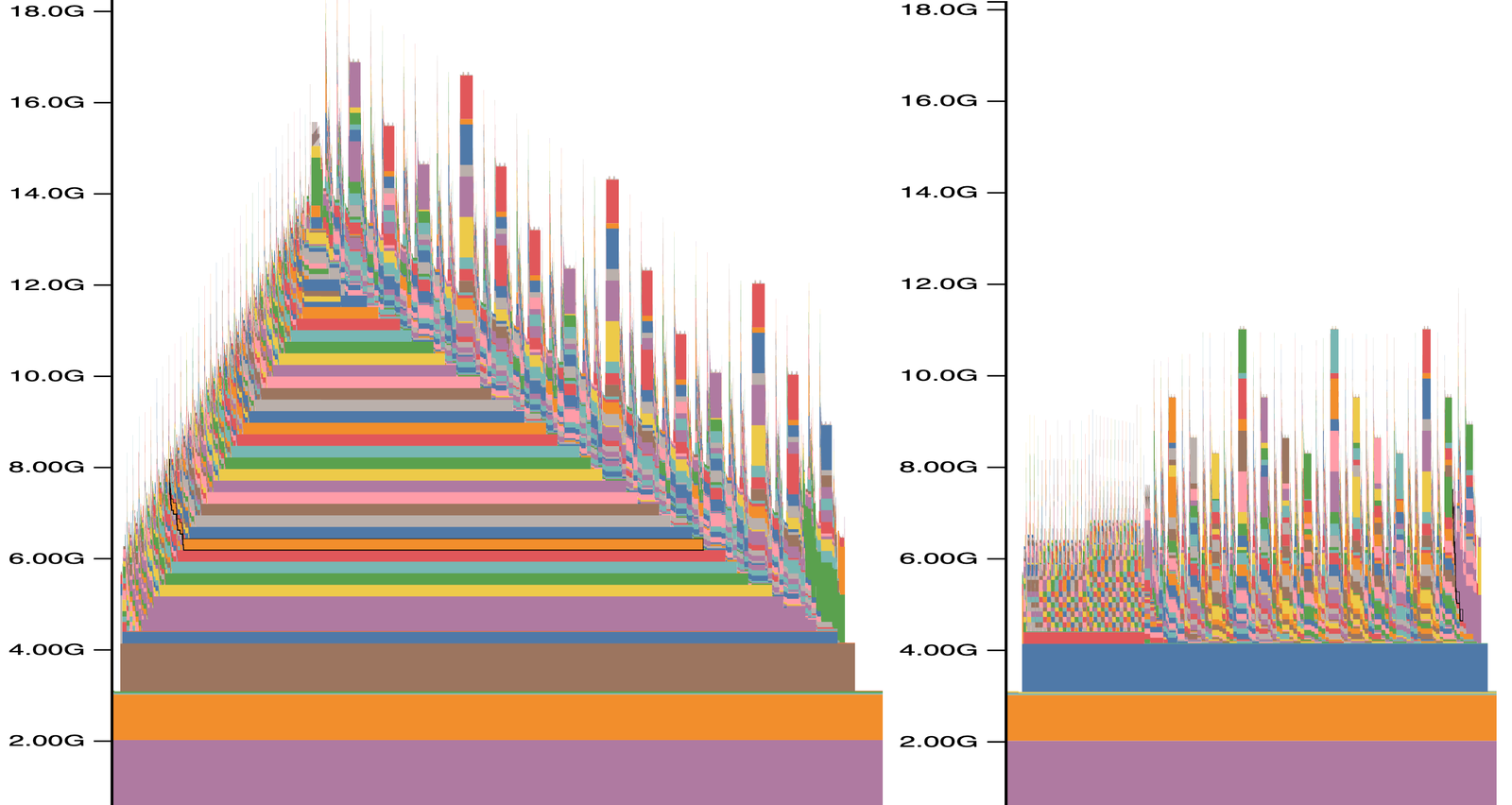
The catch is in the plot too: the spikes on the right, about 11 GB in backward, are a layer's recomputed activations and gradients, which offload does not touch. Offload lowers the peak only if the checkpoints are part of what is held at the peak. The book gives the case where they barely are: Qwen3-1.7B at 32K tokens frees 3.5 GiB after forward, yet its peak drops only from 11.13 GB to 10.16 GB (reported). The 3.5 GiB is 28 x 32768 x 2048 x 2 bytes (reasoned, with 28 layers and hidden 2048 measured from the model's config).
The Transformers implementation: one context manager
The Transformers change is small. Searching the repository's pull requests finds #48444, "Add offload to gradient checkpointing", by Quentin Gallouédec, merged on 1 September (reported; I read the code, not the PR thread). I checked the release tags in a clone: v5.16.0 (26 August) has no save_on_cpu in modeling_utils.py, and v5.17.0 (9 September) does (measured). So the post's transformers>=5.17 is right.
Here is the whole mechanism, from PreTrainedModel.gradient_checkpointing_enable on main:
# src/transformers/modeling_utils.py
if offload:
    device_type = (get_current_accelerator() or torch.device("cpu")).type

    def checkpoint_func(function, *args, **kwargs):
        with save_on_cpu(pin_memory=True, device_type=device_type):
            return checkpoint(function, *args, **kwargs)
else:
    checkpoint_func = checkpoint
torch.autograd.graph.save_on_cpu is a pair of saved-tensor hooks. Whenever autograd saves a tensor for backward inside the context, the pack hook runs instead: it allocates a pinned host tensor of the same shape, copies into it with non_blocking=True, and returns that. When backward needs the tensor, the unpack hook runs tensor.to(device, non_blocking=True).
Why only the layer inputs? Non-reentrant torch.utils.checkpoint first saves the function's inputs with _CheckpointFrame.save_inputs, as ordinary saved tensors, so they pass through the active hook: save_on_cpu. Only then does it enter its own innermost hook, which swallows everything the layer saves internally and recomputes it later. Inputs go to the CPU; internals are never stored.
You turn it on through the Trainer:
args = TrainingArguments(
    gradient_checkpointing=True,
    gradient_checkpointing_kwargs={"offload": True},
)
The Trainer pops offload (and every_n_layers) out of that dict and passes it to gradient_checkpointing_enable(offload=...). Everything else goes to torch.utils.checkpoint.checkpoint. That has a consequence if you call the model method yourself, which I hit below.
The docstring says plainly what it costs: "Both copies run on the compute stream, so the step gets slower." The pack copy is queued on the same CUDA stream as the layer's kernels, so the next layer's kernels wait behind it. The unpack copy is issued at the moment autograd asks for the tensor, with nothing queued ahead of it to hide behind, so backward waits for the whole host-to-device copy. Nothing is prefetched. Each pack also asks the caching host allocator for a fresh pinned buffer.
The Arctic implementation: side streams and prefetch
activation_offload.py in Arctic Platform uses the same entry point, torch.autograd.graph.saved_tensors_hooks(self.pack, self.unpack), wrapped around the whole model's forward. Its module docstring states the precondition: the model must use non-reentrant checkpointing. With reentrant checkpointing, it says, "the block outputs stay retained by the autograd graph, so offloading the inputs frees nothing (measured: identical peak)" (reported). I read the file at the commit the book links and on main; they are identical (measured).
What it adds is scheduling. Read from the code (measured, with the defaults from ActivationOffloadConfig):
- Two side streams.
_ensure_streamscreates an offload stream and a reload stream. Device-to-host copies run on the first and host-to-device on the second, each fenced with a CUDA event, so they run on the copy engines while the compute stream keeps going. - Keep the newest one.
keep_last_ndefaults to 1. When layer n packs its input, the input of layer n-1 starts copying out. The most recent checkpoint stays on the GPU, because it is the first one backward needs. - Prefetch in reverse. Backward unpacks in reverse order. When layer k's checkpoint is pulled,
_prefetch_prevstarts the reload of layer k-1's, so it arrives while layer k recomputes and runs backward. The compute stream waits on the reload event only at the moment it needs the tensor. - Forward never waits. Nothing in forward makes the compute stream wait for the offload.
gpu.record_stream(offload_stream)keeps the caching allocator from reusing the GPU buffer until the copy is done. If the link is slow, the cost shows up as memory, as several checkpoints in flight at once, not as time. - Own pinned pool. A
_PinnedStagingCachehands out pinned buffers rounded up to 64 MiB buckets, so variable sequence lengths reuse the same allocations instead of pinning new memory each step. Tensors under 1 MiB, parameters and aliased views are left on the GPU.
ALST describes the history: its first version "monkey patched torch.utils.checkpoint.CheckpointFunction" and was "not optimized for speed yet - it needs to be switched from direct copy to asynchronous CUDA streams" (reported). The Arctic Platform file is that switch. The Transformers version is closer to the first version: correct and synchronous.
When the copy is free: the bandwidth arithmetic
How much slower is "slower"? Per layer, the checkpoint is b·s·h·2 bytes, and it crosses the host link twice: out in forward, back in backward.
The links, as the ml-engineering book lists them (all reported): PCIe 4 x16 is 31 GBps in one direction, PCIe 5 x16 is 63 GBps, and on an 8x H200 node Stas measured 55.43 GBps host-to-device and 55.06 GBps device-to-host with nvbandwidth. NVLink-C2C between a Grace CPU and its GPU is 450 GBps in one direction, a figure he notes has no official spec behind it.
The compute it has to hide behind is one layer's forward. To first order that is 2 x tokens x (layer parameters) for the matmuls plus 2 x b x s² x (attention width) for causal attention. The sustained rate is whatever your training achieves; ALST's ablation reports 548.7 to 590.6 TFLOPS on H100s at its longest sequences, counted with the Megatron-LM FLOP estimate (reported), and I use 500 below. With checkpointing a step is about four forwards per layer: forward, recompute, and a backward that costs two.
Qwen3-8B has 192,937,984 parameters per layer (reasoned from its config: q and o projections of 4096 x 4096, grouped k and v of 4096 x 1024, and a SwiGLU MLP of three 4096 x 12288 matrices). On PCIe 5 at 55.43 GBps (all reasoned):
| Tokens | Checkpoint per layer | Copy | Forward per layer | Synchronous slowdown |
|---|---|---|---|---|
| 4K | 32 MiB | 0.61 ms | 3.44 ms | 8.8% |
| 32K | 256 MiB | 4.84 ms | 42.88 ms | 5.6% |
| 128K | 1 GiB | 19.37 ms | 382.63 ms | 2.5% |
The synchronous slowdown is two copies per layer over four forwards per layer. Two things follow.
At long sequence the synchronous version is cheap. Copy time grows linearly with sequence length, while attention compute grows with its square, so the ratio improves as the sequence grows. At 128K the copy is about 5% of a layer's forward. That is the regime the feature exists for.
At short sequence, with a small model or a slow link, it is not. Per token, the copy costs 2h bytes and the compute costs about 2 x (layer parameters) FLOPs, and layer parameters grow as h². So the copy-to-compute ratio goes as 1/h: small models pay more. Qwen3-1.7B at 4K tokens is 15.7% slower on PCIe 5 and 28.1% on PCIe 4 (reasoned, same method). A mixture-of-experts layer is worse again, because its compute per token counts only the active experts, while the checkpoint is still the full hidden size.
The overlapped schedule changes what counts. In backward the reload of layer k-1 hides behind layer k's recompute and backward, three forwards' worth of time, so it costs nothing until the copy is three times the forward. In every row of the table above, the overlapped slowdown is 0% (reasoned). That is the sense in which Arctic's version is "close to 0-overhead".
The calculator below runs this model. Pick a model and a link, move the sequence length, and watch the two timelines. "GPUs sharing one link" covers nodes where several GPUs sit behind one PCIe switch or one host memory controller and split its bandwidth.
The model is first order: copies at the full link rate, no HBM contention, no embedding or loss layers, no first-step pinning cost. Real hardware would differ there, and I have no GPU measurement. Stas's post doesn't give a number for the slowdown, and neither the book nor the Transformers docs do either. So "needs more TLC" stands as his judgement, and my table is the arithmetic of why it would be single digits at long sequence and double digits at short.
Pinned memory is not optional
One reply to the post points out that "without page-locked memory those async copies fall back to blocking and the overlap is gone", and Stas confirms that "it's all implemented as pinned memory". Both implementations do it. The reason is how CUDA copies work. A copy engine reads host memory by DMA, which needs physical pages that cannot be paged out. From pageable memory the driver first copies into its own pinned staging buffer and then transfers from there. That makes the call synchronous with the host, and slower than a direct transfer. save_on_cpu(pin_memory=True) and Arctic's torch.empty(..., pin_memory=True) both allocate page-locked buffers directly.
Pinned memory is a hard reservation of physical RAM, and allocating it is slow. Hence Arctic's pool of 64 MiB buckets with an "auto" cap sized from recent steps; Transformers relies on PyTorch's caching host allocator, which reuses freed pinned blocks sized per request.
The host side also has to be big enough. ALST's example is Llama-70B (80 layers, hidden 8192) at a 3M-token sequence split over 32 GPUs with Ulysses sequence parallelism: 915 GiB of CPU memory per node for the offloaded checkpoints alone (reported). The arithmetic reproduces it: 93,750 tokens per GPU x 8192 x 2 bytes x 80 layers x 8 GPUs per node = 915.5 GiB (reasoned). At that scale CPU memory, not GPU memory, sets the limit.
What I ran
The task allowed one exception to "read, don't run": install Transformers and CPU PyTorch in a scratch venv and run a tiny model through the offload path. On a CPU there is no device memory to free, so this is a demonstration of which tensors the hook moves, not of savings. Setup (measured): torch 2.14.1+cpu, transformers 5.20.1, Python 3.12, on a shared 4-core cloud VM, 2 threads, CPU only. The model is a randomly initialised Qwen3ForCausalLM with 8 layers, hidden 512, MLP 2048, 8 query and 4 KV heads, at batch 2 and sequence 2048 in fp32. I wrapped save_on_cpu in a subclass that counts every pack and unpack, and patched it into transformers.modeling_utils.
class spy(save_on_cpu):
    def __init__(self, pin_memory=False, device_type="cuda"):
        super().__init__(pin_memory=pin_memory, device_type=device_type)
        pack, unpack = self.pack_hook, self.unpack_hook
        def counted_pack(t):
            shapes[(tuple(t.shape), str(t.dtype))] += 1
            return pack(t)
        self.pack_hook = counted_pack
        # unpack wrapped the same way
transformers.modeling_utils.save_on_cpu = spy
model.gradient_checkpointing_enable(offload=True)
What came out (all measured):
- Exactly the layer inputs. One step packed 8 tensors, all of shape
(2, 2048, 512)in fp32, 67,108,864 bytes in total. That is exactlyL x b x s x h x 4. Backward unpacked 8. Nothing else went through the hook: the rotarycosandsinreach each layer as keyword arguments, which checkpoint does not save as tensors, and everything inside the layer went to checkpoint's own inner hook. - Same gradients, bit for bit. The loss was 7.029450416564941 in all three modes. The concatenated parameter gradients were bitwise equal between no checkpointing, checkpointing, and checkpointing with offload.
- Checkpointing saves memory; offload on a CPU does not. Peak resident memory of the process was 3,165 MiB without checkpointing, 1,035 MiB with it, and 1,057 MiB with offload on top. On a CPU the "offload" is a host-to-host copy, so there is nothing to free.
- Reentrant mode routes the same tensors. With
use_reentrant=Trueand offload, the hook again packed the same 8 tensors. Whether that frees device memory, which Arctic's docstring says it does not, needs a GPU to check. - Wall-clock time was 22 to 55 seconds a step across modes, and noisy enough on a shared VM that I draw nothing from it.
Two sharp edges turned up on the way.
First, on a machine with no accelerator, offload=True raises RuntimeError: pin_memory=True requires a CUDA or other accelerator backend. Transformers passes device_type="cpu", with a comment that then "there is nothing to copy off a device". But save_on_cpu in torch 2.14.1 decides whether to pin by calling torch.cpu.is_available(), which is true. It only matters for tests and toy runs. My spy passes device_type="cuda", which skips pinning on a machine without CUDA; the hook path is otherwise the library's own.
Second, gradient_checkpointing_kwargs={"offload": True} works only through the Trainer, which pops the key. Pass the same dict to model.gradient_checkpointing_enable(...) yourself and it is forwarded to torch.utils.checkpoint, which fails on the first forward with ValueError: Unexpected keyword arguments: offload. Outside the Trainer, use the keyword argument: model.gradient_checkpointing_enable(offload=True).
Offload the checkpoint, not every activation
One reply asks whether this is worth it "if transfer speed is faster than recomputing activations". Stas's answer is that this is "offload(activation_checkpoint) - not a substitute". The arithmetic says why. Offloading every activation instead of recomputing would move about 34 bytes per element instead of 2, roughly 17 times the traffic (reasoned). In the Qwen3-8B 4K row above, that turns a 0.61 ms copy into about 10 ms against a 3.44 ms forward, so no amount of overlap hides it. He suggests it could pay with selective activation checkpointing, which keeps only the tensors that are expensive to recompute, "but you'd need a lot more cpu memory for that".
Where it sits among the other memory tools: ALST's ablation, run on one node of eight H100s with ZeRO-3, optimizer-state offload and checkpointing already on, measures how far each feature pushes the maximum sequence length (Table 1, reported):
| Features enabled | Max sequence (bs=1) | Iteration time | TFLOPS |
|---|---|---|---|
| Baseline | 32K | 0:00:17 | 231.6 |
| + tiled logits and loss | 160K | 0:02:03 | 514.4 |
| + Ulysses SP for HF | 1.1M | 0:09:24 | 576.1 |
| + tiled MLP (no offload) | 1.2M | 0:11:43 | 548.7 |
| + checkpoint offload (no tiled MLP) | 2.4M | 0:43:30 | 585.8 |
| + both | 3.7M | 1:47:35 | 590.6 |
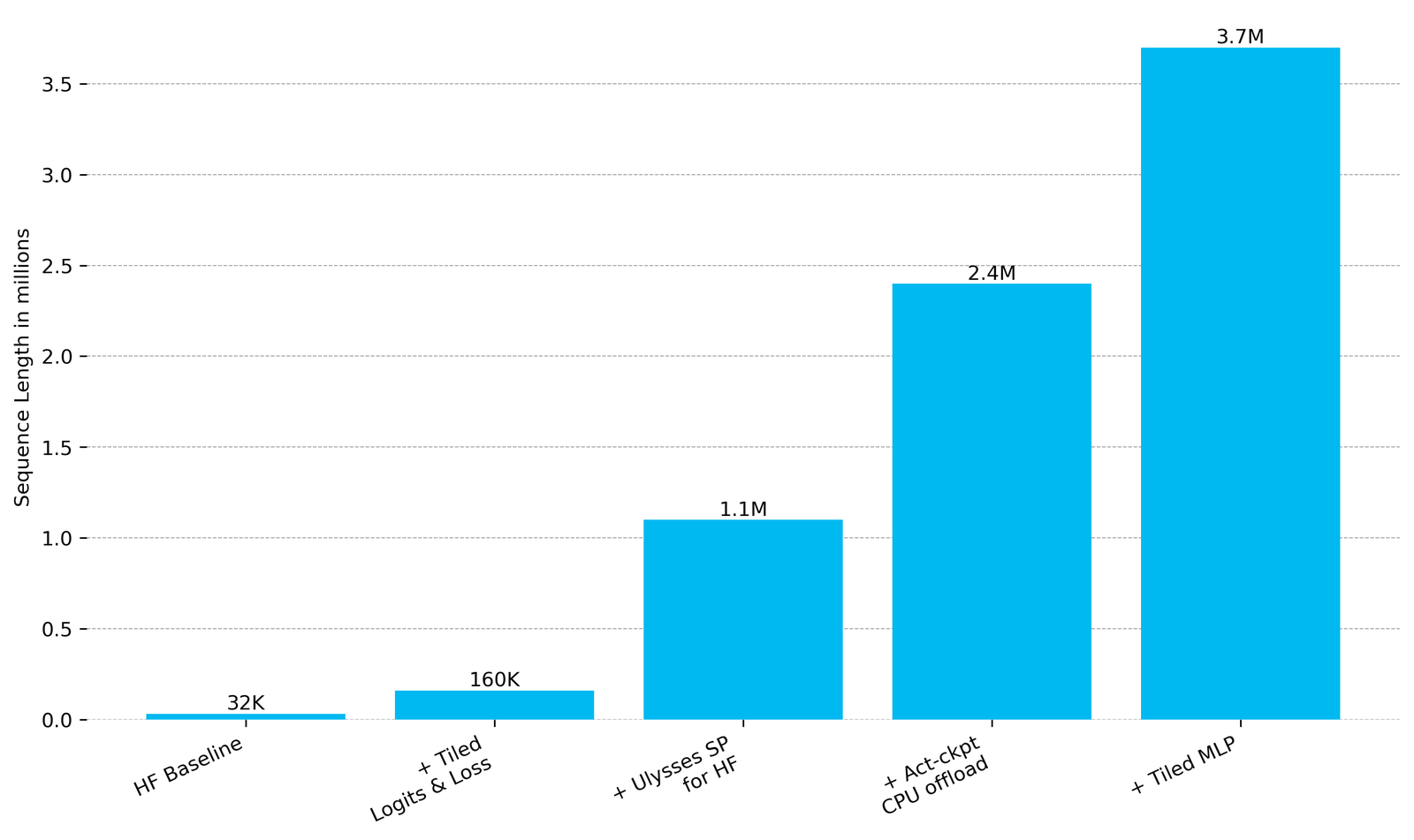
Offload alone takes the Ulysses run from 1.1M to 2.4M tokens, about 2.2 times (reasoned from the table). Tiled MLP alone adds less than 10%, from 1.1M to 1.2M, and becomes useful only once offload has removed the checkpoints. Stas's ranking in the replies follows from this: if offload is close to free, "it's definitely the first thing to go to, before any other offloads or even sharding/tiling computations".
MegaTrain moves weights, gradients and optimizer state to the host and streams layers over three CUDA streams: the same overlap idea at a much larger scale. ZeRO-Offload moves the optimizer. Checkpoint offload moves only the residual stream between layers, so it combines with both. OLMo-core 3 trains with selective activation checkpointing under FSDP, and Zephon in TorchTitan covers the data side of the same kind of TorchTitan run. MAI-Base-2 is a case where fixing memory fragmentation left more room for less recomputation. They are all the same budget, spent differently.
Checking the claims
- Offload in
transformers>=5.17: holds. The code is inv5.17.0, not inv5.16.0, and it ran on my toy model (measured). - "It needs more TLC to be faster": holds as a description of the code: both copies on the compute stream, no prefetch. Nobody publishes how much slower. My estimate is 2.5% to 9% for Qwen3-8B on PCIe 5, more for small models on slow links (reasoned, not measured on a GPU).
- Arctic's "close to 0-overhead": the side streams, event fences and one-layer prefetch are in the code as described (measured by reading). Near-zero overhead follows whenever a reload takes less than three forwards of compute (reasoned). I found no published timing.
- "Any model that supports gradient checkpointing supports it" (the book): holds for the Transformers path, except on a host with no accelerator (measured, torch 2.14.1).
What it costs
Host RAM of L x b x s x h x 2 bytes per GPU, times the GPUs in a node, all of it pinned. On the Transformers path, two full copies per layer per step: single digits at long sequence, double digits for small models at short sequence. On the Arctic path, close to nothing in the regimes above, for a few hundred lines of stream and buffer management. Neither moves a backward peak set by one layer's recomputed activations and gradients. If that is your peak, offload frees memory you were not short of.