2026-08-27 · 16 min · voice-agents · agent-memory · lora · mixture-of-experts · retrieval · speech
Why read this
Notabletop 60%Explains VoiceMem's schema-bounded candidate pool, shows its QLoRA reaches no routed expert, and that arXiv's abstract says 4.29 where the PDF says 1.89.
- Original, source-checked analysis
- A new technique
- Explained from first principles
Agents & harnessesNeeds a workstation GPUResearch paper
How this was scored
- Is it new?
- 2 of 3: A real new idea, method or capability
- Can I trust it?
- 3 of 3: Reproduces the headline result, or shows from primary files it is wrong
- Can I run it?
- 1 of 3: API-only, gated or restrictive licence
- Will I understand it?
- 2 of 3: Mechanism from first principles with figures
- Can I act on it?
- 1 of 3: General advice
- Will it last?
- 1 of 3: Relevant for months
- Does it affect many?
- 1 of 3: A specialist community
- Only here?
- 3 of 3: The only place this analysis exists
Score 64 of 100, ranked 211 of 513 rated articles. Each question is answered 0–3 by hand, and a 3 is rare. How articles are scored
VoiceMem showed up under three names before I had read a single equation. The paper on arXiv is titled Streaming Dual-Brain Memory for Real-Time Interaction — nothing there says QLoRA, MoE, or 35B. The Hugging Face repo I was pointed at is zhifeixie/VoiceMem_MF_Qwen3_6_35B_A3B_Qlora. Its own README opens with a note that the repo it is actually attached to is misnamed and used to be called something else entirely. Three artifacts, three identities, and — this is the part worth taking seriously — genuinely useful engineering underneath all three, once you separate what each one actually claims.
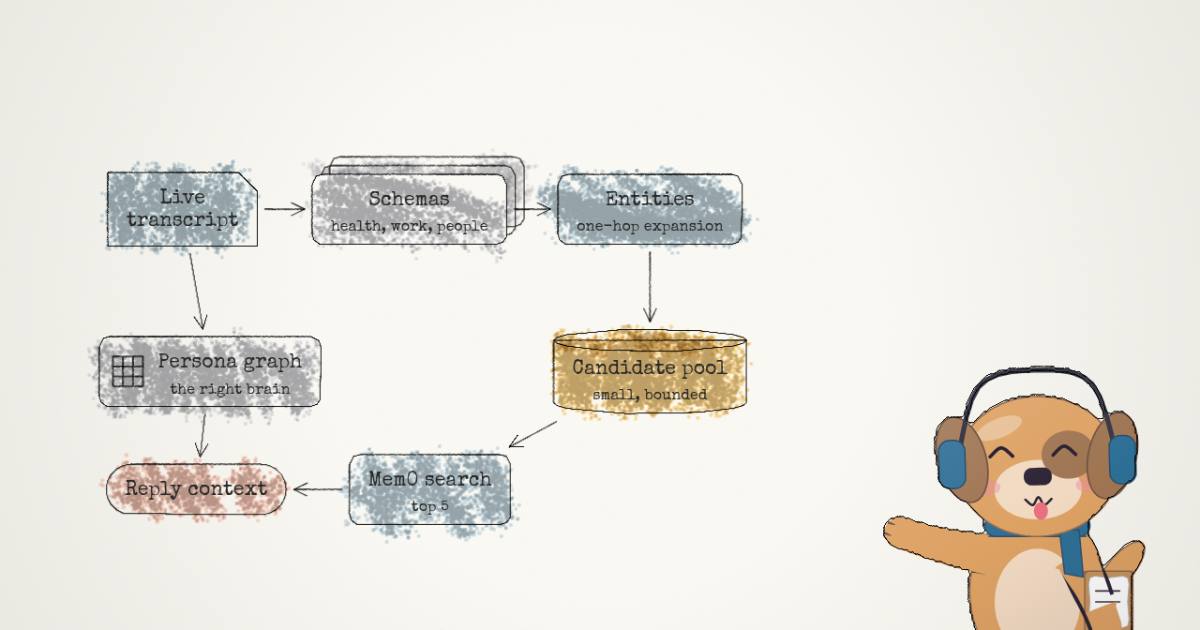
The short version: VoiceMem is a retrieval architecture, not a model. It routes a streaming transcript through a two-level schema/entity index (the "left brain") and a persona graph (the "right brain"), so a backend search — the paper uses Mem0 — only has to rank a small, semantically bounded candidate pool instead of the whole memory store. That's the actual mechanism, and Section 3's equations back it with real numbers: top-5 retrieval at 430 tokens and 134ms, flat across two orders of magnitude in K. The "reply model" I was also asked to dig into — a rank-32 QLoRA adapter on Qwen/Qwen3.6-35B-A3B, a 36B-parameter MoE — is a much smaller and much less-documented piece: it appears exactly once in the paper, as a two-word table footnote, and every architectural detail about it comes from Hugging Face, not the PDF.
| Paper | arXiv:2608.26005 — VoiceMem: Streaming Dual-Brain Memory for Real-Time Interaction, Xie et al. (NTU / NUS / Tsinghua / CUHK), 26 Aug 2026 |
| Mechanism | schema→entity one-hop candidate pool (left brain) + independent/cross-entity persona graph (right brain), both backed by an interchangeable retrieval engine (Mem0) |
| Headline retrieval result | 91.2% on LoCoMo at K=5, 430 tokens, 134ms — vs. Mem0's own default retrieval at 61.68%, 6,956 tokens |
| The "reply model" | zhifeixie/VoiceMem_MF_Qwen3_6_35B_A3B_Qlora — rank-32 QLoRA, Qwen/Qwen3.6-35B-A3B (36.0B params, MoE, 30 linear-attn + 10 full-attn blocks) |
| Trainable surface | 44,954,880 params (verified from the adapter's own safetensors header) — 0.130% of the base tower, 0% of its 256 routed experts |
| Training corpus | zhifeixie/VoiceMem-ChatMem400k — the Hub repo contains a license file and nothing else |
| Checked and holding | "beats Mem0 by nearly 30 points" — confirmed, arithmetic and all |
| Checked and not holding | the abstract's own headline persona number — arXiv's indexed copy says 4.29, the PDF says 1.89 |
What "dual-brain" actually means
Strip the neuroscience framing and Section 3 is a fairly ordinary indexing problem solved carefully. The left brain organizes memory into a two-level graph — schemas for coarse routing, entities for the concrete people/events/concepts underneath them:
Every entity belongs to exactly one schema; edges are one-hop and split into "strong" and "weak" so expansion stays local. Retrieval never touches the full memory store M. It matches the partial transcript against schemas and entities, expands one hop, and only then searches:
That's the whole trick, and it's the same trick a Lucene practitioner would call "query expansion into a filtered index" — the paper's contribution is making it streaming and pairing it with a persistence rule so the index doesn't degrade. As a cluster of entities grows, the paper measures query coherence over a sliding window of sessions —
— and an LLM judge promotes a coherent, over-threshold subcluster into its own schema (Algorithm 1 in the paper). That's the mechanism that keeps a schema from turning into a junk drawer as a user's history grows into the thousands of turns: it splits before it degrades, rather than after.
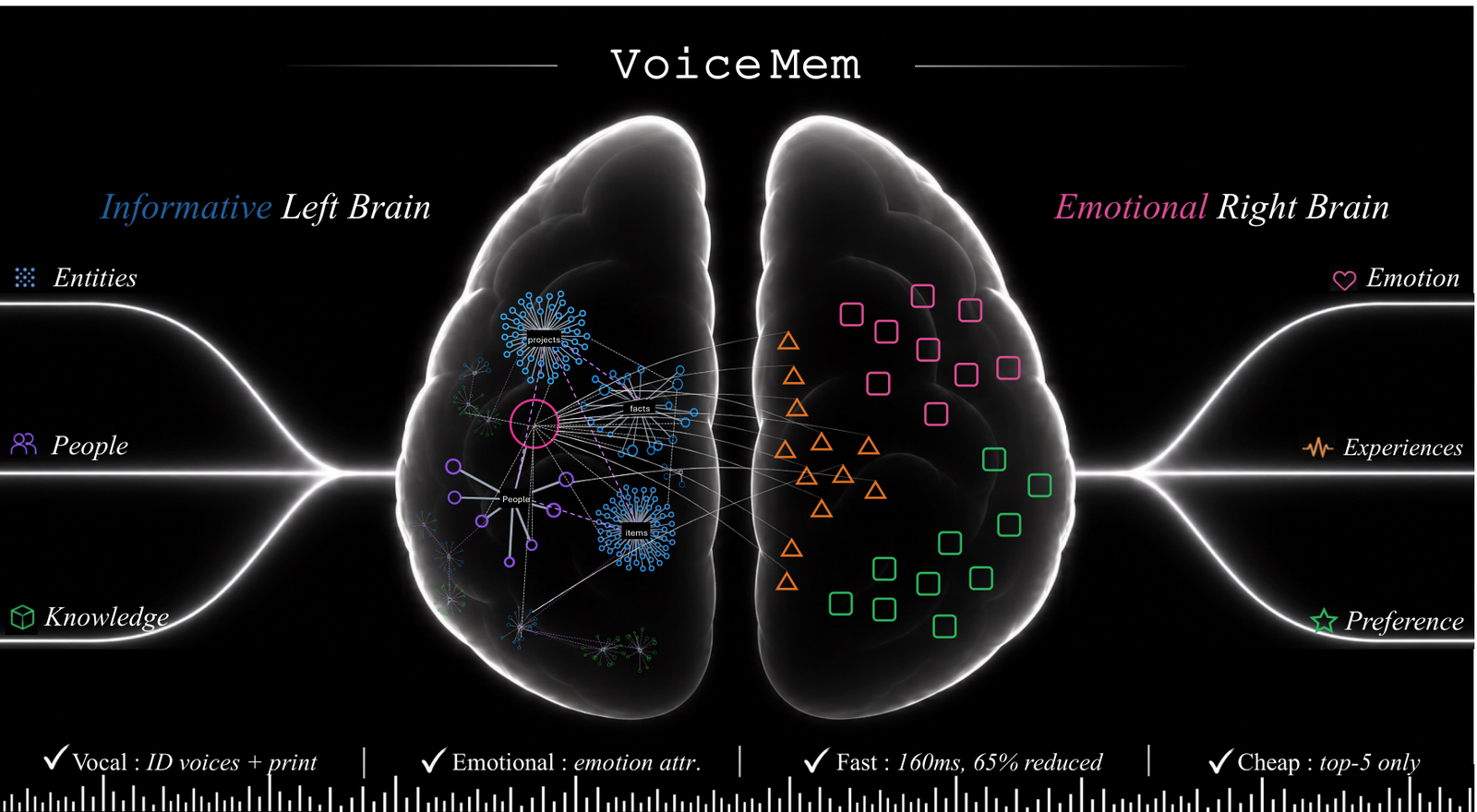
The right brain runs in parallel over a persona graph with two node types — independent nodes for durable traits, cross-entity nodes tied to something in the left brain (so "he feels lonely" and "he feels lonely about Bob" are different, retrievable facts):
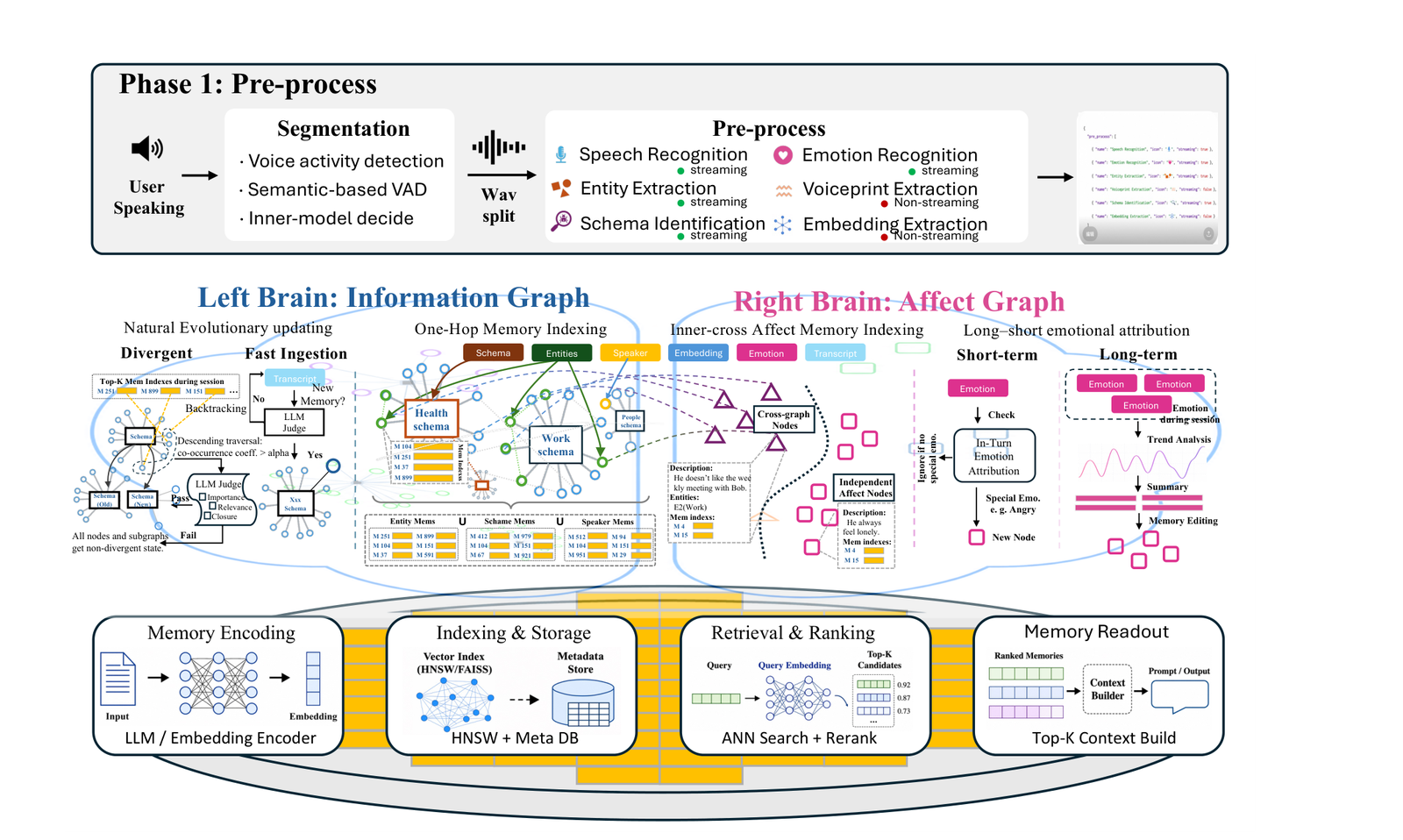
Short-horizon attribution runs per-turn (et = φ(xt), then a graph edit); long-horizon attribution runs per-session, consolidating a sequence of (x, e) pairs into stable independent nodes rather than accumulating every transient emotional blip. The full pipeline — preprocessing, both graphs, four interchangeable backend stages — is one diagram in the paper, and it's worth looking at directly rather than through my redrawing of it:
Why K=5 doesn't need K=30
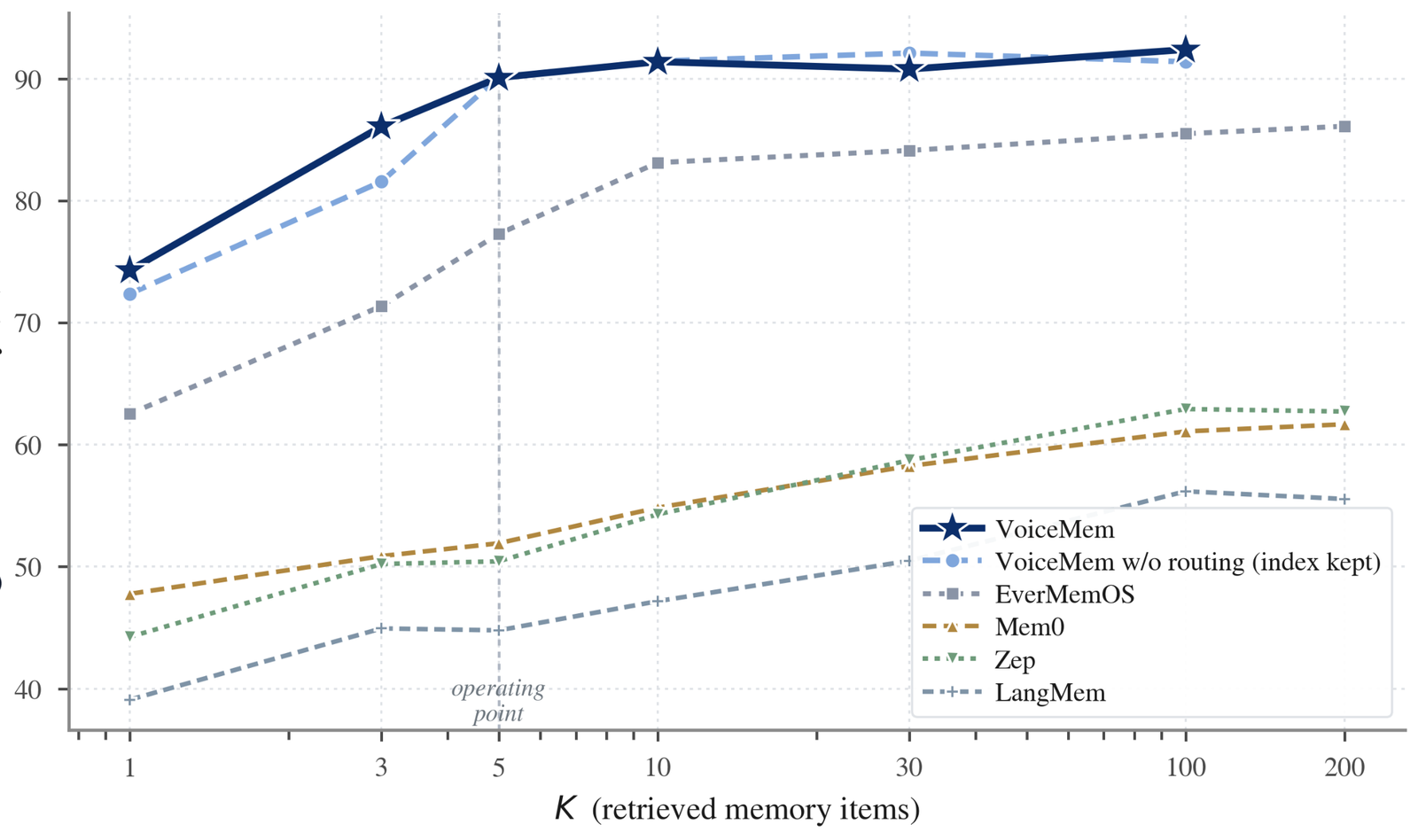
The number the abstract leads with — top-5 beating classical systems at their own larger budgets by "nearly 30 points" — is really a statement about what the candidate pool does to the ranking problem. Section 5.4 gives four real (K, tokens, accuracy) triples on LoCoMo, and they tell a cleaner story stacked together than any one of them does alone:
Sorted by tokens, the order and the accuracy order agree for the top three rows but not the last one: Mem0’s own retrieval spends the most context of any row here and returns the least accurate answers. That is the arithmetic behind the paper’s “nearly 30 points” claim — 91.20 − 61.68 = 29.52 — and it survives a look at Table 4: it is not a cherry-picked K, Mem0 never clears 63% at any budget it was given, per K ∈ {1, 3, 5, 10, 30, 100, 200}.
The routing/no-routing pair is the more useful comparison for the mechanism itself: with the one-hop schema expansion, K=5 and 430 tokens reach 91.2%. Remove it and the ranker still gets there — it just needs six times the candidates and three times the tokens to do it. Routing does not raise the ceiling; it lowers the budget needed to reach it.
The ablation is the useful row here. Turn schema routing off and keep everything else — same backend, same ranker — and VoiceMem still reaches the same accuracy the routed version gets at K=5. It just needs K=30 and three times the tokens to search its way there, because now the ranker is working over the whole one-hop expansion rather than a schema-bounded subset of it. That is a clean, checkable version of "routing doesn't raise the ceiling, it lowers the budget needed to reach it," which is the paper's own phrase for it, and it's a more honest framing of the "beats Mem0" claim than the abstract's version — the ceiling most of these systems can eventually reach with enough budget is closer together than the top-line numbers suggest; what actually separates them is how much you have to spend to get there.
Bounding the candidate pool is also what makes the latency number hold across K, which matters more than the accuracy number for a system whose whole premise is fitting inside a live voice loop:
The three stages are not sequential slack added on top of listening — they overlap it. Speech tail runs streaming ASR, entity/schema matching, and emotion recognition while the user is still talking, so none of it is on the clock. Once VOICEMEM assumes a 200ms pause means a reply is coming, anticipation embeds the query and expands both graphs (Eq. 1 for the left brain, Eq. 5 for the right). Only searching is left, and the paper measures it at 134ms regardless of which K button you press above — schema routing bounds the candidate pool before ranking starts, so a bigger K reranks the same small pool rather than a bigger one.
The paper motivates the whole design against 2-3 second retrieval being normal for the memory systems it compares against — its own stated reason a bolt-on memory engine cannot sit in a live voice loop without the streaming rework.
The three streaming stages (Eq. 8–10 in the paper) overlap listening rather than following it, so only the last ~100ms of the nominal 500ms VAD window is dedicated search time — and the paper measures that search at 134ms, comfortably inside the window even though it slightly overruns its own diagram's stage boundary. What's genuinely nice engineering is why it stays flat: schema routing fixes the size of the pool before ranking runs, so widening K reranks the same small set rather than searching a bigger one. A flat-context system without that bound would see search time grow with K, and most of the baselines in the paper's own comparison do.
The reply model: a QLoRA the paper barely mentions
Section 4.1 describes training three model families into memory-grounded speech models through "online black-box on-policy distillation": Qwen2.5-Omni, Qwen3-Omni, and Step-Audio2-Mini, each distilled from a larger sibling. Qwen3.6-35B-A3B — the base of the adapter this task actually pointed me at — is not one of them. It shows up in the paper exactly once, as a footnote on Tables 1 and 2: "‡: responses generated by our fine-tuned Qwen3.6." No rank, no target modules, no training data description, no mention of LoRA or QLoRA anywhere in eighteen pages. Everything below comes from Hugging Face, not the PDF — I'm keeping the two sourced separately on purpose.
Qwen/Qwen3.6-35B-A3B is a real, popular Qwen release (5.2M downloads on the Hub) and the identical architecture this site has already profiled once, for Ornith-1.5-35B-A3B in the Tiel-Coder piece: 40 blocks, 30 linear-attention (gated-delta-style) and 10 full-attention, 256 experts routed 8-per-token, 2,048 hidden. I re-derived the parameter census independently, straight from the safetensors headers via HTTP range requests (the header is a length-prefixed JSON blob sitting at byte 0, so you never download the weights to read it) — and it reproduces the earlier article's numbers to the last digit: 34,660,610,688 in the language-model tower, 2,946,429,568 active per token. Whatever else differs between these two releases, the base tensor layout is the same file, twice.
adapter_config.json ships a QLoRA with r: 32, lora_alpha: 64, lora_dropout: 0.05, and this target_modules regex:
^(model\.language_model(?=\.).*\.(shared_expert_gate|down_proj|out_proj|
  in_proj_a|in_proj_b|q_proj|in_proj_z|gate_proj|up_proj|in_proj_qkv|
  k_proj|v_proj|o_proj))$
Read that regex and you'd expect it to touch the mixture: down_proj, up_proj, and gate_proj are exactly the names on the 256 routed experts that make up 92.9% of the tower. It doesn't. The base model stores every block's experts as one fused tensor — mlp.experts.down_proj, shape [256, 2048, 512] — not 256 separate nn.Linear submodules, and PEFT's default LoRA attaches to module boundaries, not tensor names. Reaching a fused expert tensor needs PEFT's target_parameters field, which this adapter's config sets to null. So the regex's expert-shaped words describe the shared expert (one small dense MLP per block, always active) and nothing in the sparse mixture.
The regex in this adapter’s target_modules spells out down_proj, up_proj, and gate_proj — the exact names carried by the 256 routed experts, 92.9% of the tower. It still cannot reach them: the base model keeps every block’s experts as one fused tensor (mlp.experts.down_proj, shape [256, 2048, 512]), not 256 separate Linear layers, and attaching LoRA to a fused tensor needs PEFT’s target_parameters field — which this adapter ships as null. So the words match text but not weights.
What is actually reachable is the attention and linear-attention projections plus each block’s shared expert — 1.409 B params, 4.1% of the tower. At the shipped rank 32 the adapter trains 44.95 M of those — 3.2% of what it can reach, 0.130% of the tower it sits on. Drag r to 256, eight times the shipped rank, and it is still only 25.5% of that same reachable slice.
I didn't take PEFT's word for what the regex resolves to — I read the adapter's own adapter_model.safetensors header the same way I read the base model's, and it lists exactly 700 tensors (350 targeted modules × lora_A/lora_B) summing to 44,954,880 parameters, all F32. That's 350 modules across 40 blocks — the four/five attention or linear-attention projections per block, plus the shared expert's three matrices and its gate — and it reproduces the file size on its own: 44,954,880 × 4 bytes = 179.8 MB against the repo's stated "180 MB" and the file's actual 179,929,048 bytes. Every number in the widget above is checkable the same way; none of it is an estimate.
The corpus: 400K of something, in a repo with nothing in it
CHATMEM-400K is described in Section 4.1 as the output of a four-stage loop — synthetic persona/background/event construction, then an iterative "Task & Topic → Scene → Challenge & Strategy → Contrastive Distillation → Verification → SFT Update" cycle that the paper calls SLM-verified online distillation. That's a real, specific pipeline description. What it never states, anywhere in eighteen pages, is what unit "400K" counts — conversations, turns, or samples. The one dataset the paper does give exact stats for is the much smaller human-curated eval split, ChatMem-Bench: 316 questions drawn from 15,314 turns and 53 hours of audio, across 14 categories in four dimensions (Information, Persona, Affective Attribution, Paralinguistics & Environment).
I went to zhifeixie/VoiceMem-ChatMem400k on Hugging Face to resolve it from the data itself. The repo's file listing is .gitattributes, README.md — nothing else. The README is three lines: a YAML front-matter block declaring an Apache-2.0 license, and no description, no dataset card, no schema, no sample rows. There is no dataset here to inspect. The QLoRA model card is upfront about the same gap on the training side — "Training data are not released. Provenance, licenses, and consent status are documented in the code repository before any data release" — and the linked code repository (lang-jiaqi/Voicemem_open) wasn't reachable from this environment to check whether that documentation exists yet. So: I can tell you precisely how the corpus was supposed to be built, and I can tell you precisely that nothing behind either public name — the dataset repo or the code repo's promised docs — currently lets you verify what "400K" means.
Checking the abstract against itself
Both bars on the right are real rows in Table 2 — this isn’t a rounding slip. The gap depends entirely on which generator answers with the retrieved memory. +1.89 holds the generator fixed at GPT-4o-mini, the same model every baseline in the table uses — the fair reading, and the one the PDF’s printed abstract states. +4.29 swaps in VoiceMem’s own fine-tuned reply model, which no baseline gets to use — real, footnoted with a ‡ in the table, but not a memory-quality comparison on its own.
The catch is that arXiv’s indexed abstract — the text behind citation_abstract, the page’s og:description, and what Semantic Scholar and social-card previews show — carries the second number, not the first. Anyone citing the abstract without opening the PDF is citing a different claim than the paper actually prints.
This is the discrepancy I didn't expect to find. arXiv serves two versions of this paper's abstract for the same submission: the HTML /abs page, its og:description, and its citation_abstract metadata all read "improves the aggregate score by 4.29 points over the previous best system." The actual PDF — rendered to an image and read directly off the page, not OCR'd — prints a different number in the identical sentence: "improves the aggregate score by 1.89 points over the previous best system."
Table 2 explains exactly where both numbers come from. MemOS, the strongest baseline, averages 72.27 across eleven persona sub-categories. VoiceMem replying through GPT-4o-mini — the same generator every baseline in the table uses — averages 74.16, a gap of 1.89. VoiceMem replying through its own fine-tuned model instead averages 76.56, a gap of 4.29. Both deltas are real rows in the same table; neither is a typo. But they answer different questions. 1.89 is the matched-generator number: hold the responder fixed and change only the memory system, which is what "the right brain improves persona memory by N points" ought to mean, and it's the number the printed PDF states. 4.29 additionally swaps in a better generator for VoiceMem alone — a real, footnoted comparison, but not evidence about the memory architecture on its own. It's also, of the two, the number arXiv's own indexed abstract shows to Google Scholar, Semantic Scholar, and every social-card preview. Anyone who cites the abstract without opening the PDF is citing the less conservative of the two — through no fault of their own, since arXiv is where the "quotable" text lives.
Two smaller things worth naming plainly rather than letting slide:
The card's own standalone benchmark for this adapter — "AudioMC INFERENCE_MEMORY," 132 conversations, 233 rubric criteria, judged by GPT-4o-mini — doesn't appear anywhere in the paper; it's a model-card-only number I can't cross-check against the arXiv source at all. To its credit, the card doesn't oversell it: checkpoint-3318 satisfies 97 of 233 criteria against GPT-4o-mini's 96, a +0.43 percentage-point edge the card itself calls "a small margin... not evidence of a large capability gain." That's an honest way to report a result this close to noise, and it's the right instinct — I just can't verify the benchmark itself, only that the card doesn't inflate what it found.
Also worth being precise about, since it's easy to assume otherwise from the "voice agent" framing: Qwen3.6-35B-A3B's own config.json declares image_token_id and video_token_id but no audio modality at all. This specific adapter is a text-in, text-out reply model that consumes an already-retrieved memory context (per the model card: "the context is Top-K retrieved memory, not raw conversation transcripts") — the audio path (ASR, voiceprint, emotion recognition) is the separate streaming preprocessing Section 3.3 describes, running upstream and outside this repo entirely.
The ledger
Genuinely good work. The candidate-pool bound in Section 3.1 is a real, checkable idea, not a rebrand of top-K retrieval — the one-hop schema/entity expansion is what keeps K=5 competitive with K=30-100 on other systems, and the paper's own ablation (routing on vs. off, same backend) isolates exactly what it buys: 3x fewer tokens for the same accuracy, not a higher ceiling. The streaming split into speech-tail/anticipation/searching is a sensible way to hide preprocessing latency inside a window the user experiences as silence, and the 134ms search figure surviving flat from K=3 to K=100 is the direct, load-bearing consequence of bounding the pool before ranking. The MMLU-Pro-style discipline of publishing the routing-disabled ablation, rather than only the final number, is the kind of thing worth crediting.
What is convergent, not novel. Schema-then-entity indexing over a vector backend is a fairly standard two-level RAG pattern; the persona graph's independent/cross-entity split is a sensible but not unprecedented way to separate traits from situational affect. None of that is a knock — the paper doesn't claim otherwise, and getting a standard pattern to run inside a 500ms voice-turn budget is real systems work.
What I would watch. Whether ChatMem-400K and its promised provenance documentation actually land in the code repository, since right now "400K" is unverifiable by anyone outside the author group. Whether the QLoRA reply model — genuinely absent from the paper's method section — gets folded into a future revision with the training details the model card is missing. And whether arXiv reconciles its own indexed abstract with the PDF it's serving; a 2.3x discrepancy on the paper's own headline persona number, sitting in the metadata every citation tool reads, is the kind of thing that should get fixed by an errata rather than discovered by someone reading pixels off page 1.
For the retrieval-architecture side of this, TencentDB's agent-memory system and MemHarness are the closer comparisons on this site — both are also memory systems judged on what happens when you check the plumbing rather than the headline table. For the parameter-arithmetic side, Tiel-Coder-35B-A3B and Whittle MoE go through the same "read the tensor shapes, not the config's claims" exercise on sibling Qwen MoE releases, and if the sparse/dense split above was new to you, Mixture of Experts, from scratch builds up why routing works that way at all.