2026-10-23 · 15 min · reinforcement-learning · grpo · post-training · training
A 1:57 narrated explainer, drawn in code. Every number and picture in it is this article's own; the sources are below.
› transcript
Hi, I'm Cleat! Your sampler and your learner never quite agree. Here's why that breaks reinforcement learning. The idea: train only on samples the server recorded, and pull the learner back toward the sampler that drew them. The learner keeps training while the sampler runs weights a few steps old, with its own numerics. The server records every sequence it samples, and gives each one an id. Every scored token must point back to a recorded sequence. Then the loss updates the learner. Its main term is not published. Here is the formula. Each sampled token gets its advantage. Times the push on that token's log probability. And one coefficient. That is the only thing the losses disagree about. Importance sampling follows the ratio, and so does PPO when the advantage is negative. One token can get an enormous step. Bounded coefficients cap that step. A little bias, and the run stays alive. Here is the formula. The docs publish one term: the gap between sampler and learner, on each sampled token. Scaled by a small beta, it keeps the learner near the sampler. In a published study with low precision sampling, the baselines climb, then collapse. And the mismatch between sampler and trainer grows before they fall. In my small simulation, with the sampler thirty-two steps stale, the ratio-following losses collapse. The bounded ones don't. A step that grows with the ratio is what breaks. Bound the coefficient, and watch the sampler to learner gap. Drift gives every token a ratio. Unbounded coefficients blow up. And Stable Reinforce publishes its K L term, but not its core. Every source is in the full article. I'm Cleat. Bye!
Why read this
Solidtop 85%Separates what StableReinforce's docs actually publish from the claim, and measures eight off-policy losses under injected lag and mismatch in a CPU toy.
- Original analysis
- A lasting reference
- A new technique
Training & RLAPI onlyProprietaryResearch tool
How this was scored
- Is it new?
- 2 of 3: A real new idea, method or capability
- Can I trust it?
- 1 of 3: Spot-checks a few numbers
- Can I run it?
- 1 of 3: API-only, gated or restrictive licence
- Will I understand it?
- 2 of 3: Mechanism from first principles with figures
- Can I act on it?
- 2 of 3: A concrete recipe, numbers or comparison
- Will it last?
- 2 of 3: A reference for a year or more
- Does it affect many?
- 1 of 3: A specialist community
- Only here?
- 2 of 3: A teardown or measurement few others did
Score 58 of 100, ranked 401 of 607 rated articles. Each question is answered 0–3 by hand, and a 3 is rare. How articles are scored
On 21 October Tinker's account posted that "Off-policy RL is difficult; runs can suddenly collapse because of async RL staleness or numerical mismatch," and that StableReinforce "keeps your RL runs stable, even when learning drifts from sampling." The link goes to one docs page, StableReinforce (alpha). There is no paper, no blog post and no curve.
I read that page, the rest of Tinker's loss docs, the tinker SDK at commit d4c66fe and the tinker-cookbook at 54b3cb2. The short version: the docs publish one of StableReinforce's terms and the plumbing it needs. They don't publish the term that does the stabilising. So this piece does three things. It derives the off-policy problem from first principles. It writes down exactly what StableReinforce discloses. Then it runs the published losses in a small CPU simulation with the two failure modes injected, so you can see which ones collapse and why.
Labels: measured means I computed it, reported means the publisher's number, reasoned means my arithmetic or inference on the other two.
Why "off-policy" happens to on-policy RL
The objective is the expected reward of the policy you're training, :
That's REINFORCE. is a sampled completion, is its advantage, and for a sequence . The expectation is under , so the samples must come from the same weights you differentiate.
In a real post-training stack they don't, for two reasons.
Staleness. Sampling is the expensive half, so it runs asynchronously. The learner takes optimizer steps while the sampler is still generating with weights from steps ago. Every token in the batch was drawn from , not .
Numerics. Even with , the sampler is a different program. It's an inference engine with its own kernels, batch shapes, reduction orders and often lower precision. Tinker's importance-sampling page points at Thinking Machines' own non-determinism post as the cause. Same weights, different probabilities.
How big is the second gap? Qi et al., Defeating the Training-Inference Mismatch via FP16, sampled DeepSeek-R1-Distill-Qwen-1.5B on AMC and AIME with a 32K budget and compared the two engines' probabilities token by token.
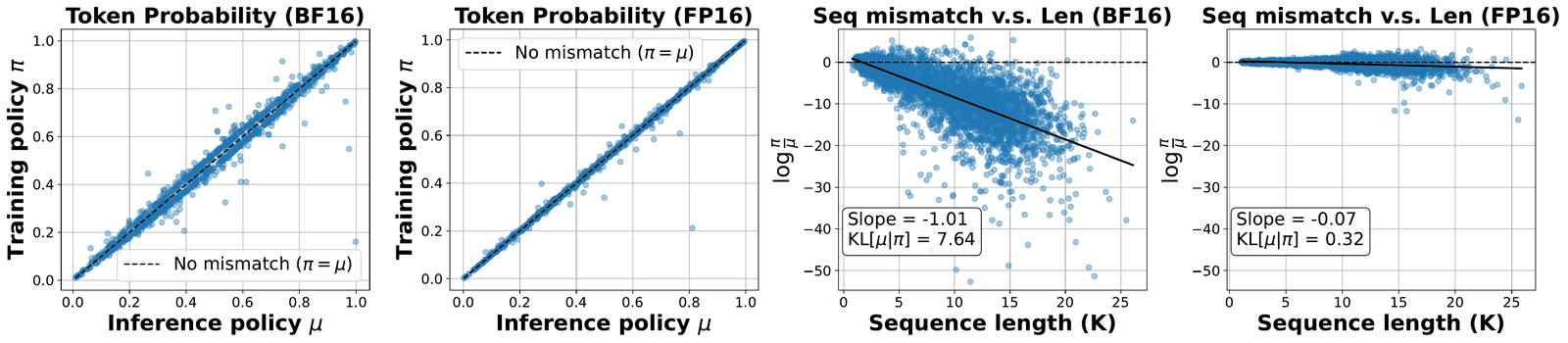
The right-hand panels are the problem in one picture. The per-token disagreement looks harmless on the scatter plot. Summed over 10,000 to 25,000 tokens it is a sequence log-ratio of to in BF16, with a fitted slope of per thousand tokens (reported). A sequence-level importance weight of is not a correction. It's a zero.
The fix everyone reaches for: a ratio
If samples come from , rewrite the expectation:
That's unbiased and it is Tinker's importance_sampling loss: loss = -(exp(target_logprobs - sampling_logprobs) * advantages).sum(). Tinker applies it per token. Define the token ratio .
Every loss on Tinker's list, and every one in the papers below, has the same gradient shape. It differs in one coefficient:
| loss | coefficient | source |
|---|---|---|
| REINFORCE | ignores | |
| IS | Tinker importance_sampling | |
| PPO | if inside the trust region for the sign of , else | Schulman et al.; Tinker ppo, |
| CISPO | MiniMax-M1; Tinker defaults | |
| token TIS | IMPALA lineage; Yao et al. | |
| sequence MIS | , | Liu and Li |
| GSPO | the sequence's geometric-mean ratio, clipped to | Zheng et al. |
GRPO (DeepSeekMath) is PPO's coefficient with a group-relative advantage: sample completions per prompt and set . The cookbook's RL scripts do this centering. DRO, also on Tinker, is a different shape: a REINFORCE term plus .
PPO deserves a closer look, because its clip has a hole. The objective is . For the min clips large . For the product is the more negative term whenever , so the min picks the unclipped term and the coefficient is the raw ratio (reasoned). PPO was designed for small, deliberate policy updates. Under drift the dangerous tokens are exactly the ones the learner likes far more than the sampler did. That's , and if the completion was bad, it is unbounded.
The dial shows one token. With , , and with both IS and PPO assign that one token a step about 55 times its advantage (reasoned, ). CISPO caps it at 4. TIS caps it at 2. MIS drops it. REINFORCE gives it 1. REINFORCE never looks at the ratio, so it can't blow up, and it can't correct for drift either.
That is the whole design space in one line. A coefficient that tracks corrects the bias and inherits the variance. A bounded coefficient trades bias for stability. Tinker's own CISPO page makes the same argument about the lower bound: a floor such as "removes the attenuation importance sampling provides for stale tokens" and can set up "a positive feedback loop" off-policy. It recommends clip_low_threshold=0.0, clip_high_threshold=4.0 (reported).
Evidence the failure is real
Qi et al. ran these corrections on the same 1.5B model and a 1,460-question MATH subset filtered so that every question is solvable, which makes it a sanity test: a sound algorithm should approach 100% training accuracy. Eight A100 80G GPUs, 64 questions with 8 rollouts each, 4 gradient steps per iteration, BF16 sampling against the trainer.
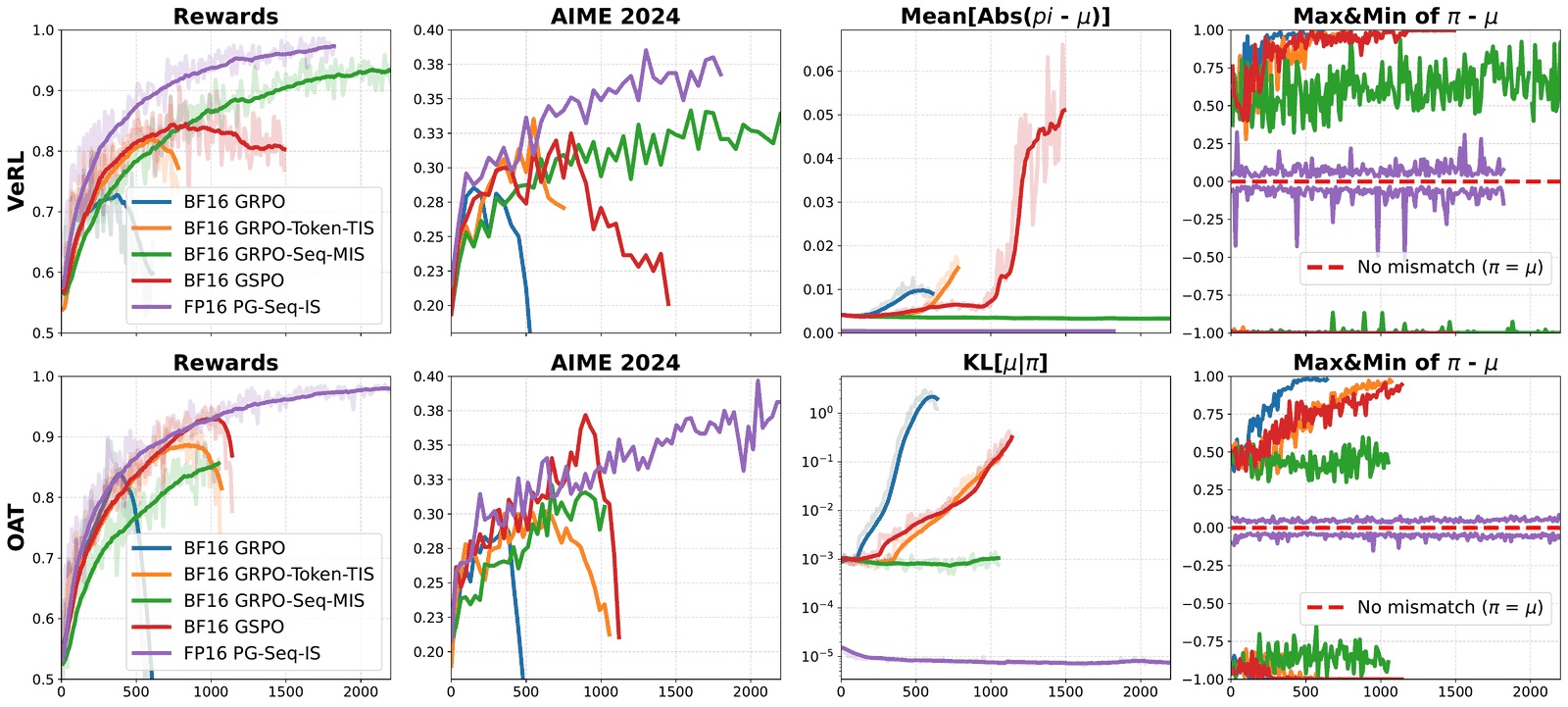
Their numbers (reported): vanilla GRPO peaks at 73% training accuracy in VeRL and 84% in Oat, then collapses. Token TIS lasts longer and collapses after 82% and 88%. Sequence MIS is the only BF16 correction that doesn't collapse, but it tops out at 95% training accuracy and 34% on AIME 2024, against 99% and 39% for plain sequence-level IS in FP16. They also note that every collapsing run shows the mismatch climbing before it collapses. That gives you a warning signal, and it means drift and instability feed each other.
Two lessons carry over to StableReinforce. Bounding the coefficient helps, but each bound costs something. And mismatch is not a fixed nuisance; it grows as the policy sharpens.
What StableReinforce publishes
From the docs page and the SDK, everything that is public:
- license
- Apache-2.0
- branch
- HEAD
- tests
- 49 files
- source
- 1.2 MB
- commit date
- 2026-10-21
by size of tracked source at this commit, file counts in brackets; docs, data and vendored trees excluded
local clone, 2026-10-23 at d4c66fe — branch, commit, commitDate, fileCount, hasTests, languages, license, licenseFile, testFileCount
- It is "a REINFORCE variant", selected with
loss_fn="stable_reinforce". It takes the same tensors as the other RL losses:target_tokens, samplerlogprobs,advantages. It returns the learner'slogprobsand aloss:sumdiagnostic. In the SDK the loss is one more string inLossFnType, next toppo,cispo,droandgspo. The loss itself runs on Tinker's servers. - It needs data recorded at sampling time. You must create the sampler with
record_stability_info=True. Each returned sequence then carries asequence_id. The SDK docstring says only that "the server records stability information for each sampled sequence." The record belongs to the session, expires one day after the last training request that uses it, and can only be trained on in the same session. - Every datum needs provenance. Each training datum must carry
SampledProvenanceSpans that cover whole sampled sequences, and every token with a nonzero advantage must sit under a span whose sequence was recorded. The server checks that the tokens match what was sampled. - It includes a sampler-to-learner KL, not a reference-model KL. The docs say: "the loss uses no reference policy." Per sampled token, with the k1 estimator:
What is not public is the main term: how StableReinforce weights , and what the "stability information" is. The docs claim that "this loss function has led to extremely stable training, even under highly off-policy async RL and low precision numerics" in Thinking Machines' internal post-training. That is reported, and I can't check it: no curve, model, step count or baseline is given.
Reading the KL term
The gradient of is , as the docs say. In the coefficient table it adds to every sampled token, independent of the advantage. That is supervised fine-tuning on the sampler's own outputs at weight 0.01.
In expectation over that gradient equals , because does not depend on . That's the forward, mass-covering KL (reasoned). It punishes the learner for putting near-zero probability on tokens the sampler actually emits, the tail. Note what it does not cover. The tokens that blow up IS and PPO are the other tail, . A pull toward the sampler shrinks drift over time, but on its own it does nothing for a single token with . If StableReinforce survives that token, the main term is doing it.
Compare GRPO's original KL, which pulls toward a frozen reference model. Tinker's loss docs note, citing Zhang et al. and Tang et al., that putting that term in the loss is mathematically inconsistent. StableReinforce's KL has a moving target, the sampler, which is never more than the async lag behind.
What the stability info could be
This part is reasoned, and I'm labelling it as speculation. The client already sends the sampler's per-token logprobs, so the recorded data must be something the client cannot provide. Either it can't see it, or Tinker won't trust it to. Candidates consistent with the API are: the sampler's distribution beyond the chosen token (Tinker already exposes topk_sample_logprobs), the exact sampler weights version (which pins the staleness ), or a server-trusted copy of the logprobs, which the whole-sequence and token-match checks would protect. The provenance rules have a practical consequence that is not speculation: StableReinforce works only on sequences Tinker itself sampled in the same session. You can't feed it rollouts from your own vLLM.
A toy that injects both failure modes
Thinking Machines published no curves, so I built the smallest setup that has both drifts and ran the losses I can write down. This is the run exception for this piece: my own code, CPU only, nice -n 19, single-threaded, on a shared 4-core cloud VM. Two processes took about eight and a half minutes each (measured).
Setup. 32 prompts, 12 positions each, 8 tokens. The policy is shared: logits are a 24-dimensional feature vector per position times one weight matrix, so a huge update on one token moves every prompt. Each prompt has a target token per position, reward is the fraction correct, samples per prompt with a group-mean baseline, one SGD step per batch at learning rate 2.0, 600 steps, 3 seeds.
Staleness. The sampler uses the weights from lag steps ago, 0, 2, 8 or 32.
Numerics. On each sampler build, add Gaussian noise to the sampler's logits, and in a random fraction of entries subtract 6. That creates the tail on purpose. Mild is with 0.5% spiked entries, severe is with 2%.
The core of it, from sim.py:
def coef(loss, A, r, logr_seq, beta):      # per-token c_t on grad log p(x_t)
    if loss == "reinforce":    return np.broadcast_to(A, r.shape).copy()
    if loss == "stable_proxy": return np.broadcast_to(A, r.shape) + beta   # + k1 KL
    if loss == "is":           return r * A
    if loss == "ppo":
        active = ((A > 0) & (r < 1.2)) | ((A < 0) & (r > 0.8))
        return np.where(active, r * A, 0.0)
    if loss == "cispo":        return np.clip(r, 0.0, 4.0) * A
    if loss == "cispo_lo":     return np.clip(r, 0.8, 4.0) * A
    if loss == "tis":          return np.minimum(r, 2.0) * A
    if loss == "mis":
        rho = np.exp(np.clip(logr_seq, -50, 50))[:, None]
        return np.where(rho <= 2.0, rho, 0.0) * np.broadcast_to(A, r.shape)
stable_proxy is not StableReinforce. It is plain REINFORCE plus the one term the docs publish, the k1 sampler KL at . It tests that term alone.
Final reward, the mean of the last 50 steps, averaged over the three mismatch levels and three seeds (9 runs per cell, measured):
| loss | lag 0 | lag 8 | lag 32 | runs ending below 0.9 | max gradient norm |
|---|---|---|---|---|---|
| REINFORCE | 0.984 | 0.978 | 0.938 | 0 of 36 | 3.1 |
| REINFORCE + sampler KL | 0.983 | 0.980 | 0.965 | 0 of 36 | 2.9 |
| IS | 0.970 | 0.623 | 0.552 | 18 of 36 | 1754.8 |
| PPO, ε 0.2 | 0.955 | 0.779 | 0.489 | 17 of 36 | 100.0 |
| CISPO [0, 4] | 0.982 | 0.981 | 0.979 | 0 of 36 | 3.0 |
| CISPO [0.8, 4] | 0.984 | 0.981 | 0.946 | 0 of 36 | 3.3 |
| token TIS, C 2 | 0.983 | 0.981 | 0.979 | 0 of 36 | 2.8 |
| sequence MIS, C 2 | 0.981 | 0.974 | 0.962 | 0 of 36 | 2.7 |
What it shows (measured, on this toy only):
- The unbounded coefficients are the ones that collapse. IS and PPO account for all 35 runs that ended below 0.9. Their largest gradient norms were 1754.8 and 100.0; no bounded loss went above 3.3. The collapses are the shape in Qi et al.'s figure: reward climbs, then a few huge steps knock a shared weight matrix somewhere it doesn't recover from.
- PPO fails even with no lag. One severe-mismatch seed at lag 0 ended at 0.761. That's the negative-advantage hole, triggered by numerics alone.
- Bounding costs a little under heavy lag. Plain REINFORCE loses about 0.05 between lag 0 and lag 32, which is the bias of ignoring the ratio. CISPO and TIS lose almost nothing.
- The sampler KL helped against staleness. At lag 32, REINFORCE plus the k1 term finished at 0.965 against 0.938 without it. The term is cheap and in this toy it pays for itself. It is still not what keeps IS-style losses alive, since it never sees a ratio.
- Tinker's CISPO advice holds up, weakly. Raising the floor to 0.8 costs 0.033 at lag 32 (0.946 against 0.979) and nothing at small lag. That's directional support for their warning. My toy shows no positive feedback loop and no collapse.
What it does not show: anything about StableReinforce's main term, which isn't public. It also doesn't show transformer-scale behaviour. The real mismatch grows as the policy sharpens and lives in 10,000-token sequences, and neither is in a 12-position toy. Take the ranking as an illustration of the mechanism, not a benchmark.
Where this leaves you
If you train on Tinker and your async runs collapse, the published options already cover most of the fix. Use CISPO with the default one-sided clip, or token TIS if you write a custom loss, and log the sampler-learner KL. Qi et al. found that number rises before a collapse. StableReinforce is the vendor's bet that it can do better. It's worth an A/B run against CISPO on your own task, because the vendor offers nothing else to judge it by.
The costs are concrete. It's alpha, and the API "may change." It requires sampling through Tinker with record_stability_info=True in the same session, with whole-sequence provenance on every datum, and records expire a day after their last use. One reply to the launch post asked for exactly the experiment I ran on a toy: vary policy lag and numerical mismatch independently and show how much sample efficiency stability costs. Until Thinking Machines publishes that, "extremely stable" is a claim, not a result.
For the theory of why token-level corrections work at all, see Qwen's first-order formulation of RL with LLMs. For the MoE version of the same mismatch, where the router picks different experts at sampling and training time, see Rollout Routing Replay. For why labs accept staleness in the first place, see Fireworks' distributed RL. For a pipeline that records exactly what the sampler emitted so the learner can compute an honest ratio, see the multi-harness RL capture proxy.