2026-09-19 · 21 min · explainer · inference · speculative-decoding · on-device · systems · kv-cache · linear-attention
On 17 September Inco AI put an inference engine on GitHub under Apache-2.0. It runs on a Mac, it serves exactly two models, and it has no settings. A day later LM Studio shipped it as a backend. The number that travelled was "144 tok/s on an M5 Max", and that number is not in the launch post.
What is in the launch post is 74 tok/s, on a 48 GB M5 Pro, for Qwen3.8-27B, single request, short prompt, reasoning on. Those two figures differ by 1.95×. Two Apple chips differ by 2.00×.
That coincidence is the whole story, and it is checkable, because Splash is the rare release where every input to the arithmetic is published by someone. The tensor shapes are hard-coded in the engine. The quantisation format is nine bytes per sixteen weights, in a function you can read. The acceptance length of the draft model is in a different Inco blog post, measured on benchmarks, for this exact drafter. And Apple publishes the memory bandwidth of every chip it sells.
So: what does a decode step actually read, and does the bus have room for it?
Several numbers are circulating about Splash. Most of them come with a method; the loudest one does not. This is every Qwen3.8-27B throughput figure I could trace to a source, with the conditions attached to it and the memory bandwidth it implies.
| figure | stated where | conditions | implied bandwidth | |
|---|---|---|---|---|
| 74 tok/s | Reported | launch post, Figure 2; repeated by LM Studio | 48 GB M5 Pro, 16-core GPU · Qwen3.8-27B 4-bit · single request · short prompt · reasoning on at medium · 1,024-token output cap · P50 over selected SPEED-Bench coding prompts · measured over HTTP by Inco | 258 GB/s — 84% of the M5 Pro's 307 |
| 54 tok/s | Reported | launch post, Figure 2 | same, at a 32K prompt. A pass now also reads 1.09 GB of int8 KV, so 17.82 GB in total. The drop from 74 is only 27%, which is small for a 32K context, and is the hybrid architecture showing: 48 of the 64 layers hold no KV at all | 200 GB/s — 65% of peak, if acceptance holds at 4.80 |
| 170 tok/s | Reported | launch post, Figure 5 | aggregate across four concurrent short-prompt requests on the same M5 Pro. Four is not arbitrary: SPLASH_MAXIMUM_BATCH_WIDTH is 4, and the decode kernels exist in exactly the M8/M16/M24/M32 shapes that 1–4 lanes of 8 rows produce | 156 GB/s — half the bus. One weight read now serves four lanes, so throughput stops being a bandwidth question |
| 144 tok/s | Reported, no method | launch video; quoted onward as the headline. Not in the benchmark table, not in the README, not in LM Studio's post | "M5 Max" — GPU bin unspecified. No prompt length, no concurrency, no reasoning setting, no output cap, no percentile | 502 GB/s — 109% of the 32-core M5 Max, 82% of the 40-core |
| 4.80 tokens | Reported | DFlash 2 post, Table 4 | mean acceptance length for this exact drafter on Qwen3.8-27B at block size 8, over GSM8K, MATH-500, HumanEval, MBPP and MT-Bench, at the model's default sampling. HumanEval is 4.39 and MBPP 4.79 — the coding-shaped ones, and the closest to what the Splash benchmark prompts with | this is the input to every row above, not an output |
| 19 tok/s | Reported | launch post, Figure 2 | uzu on the same M5 Pro. The post states uzu's Qwen3.8-27B package has no draft, so it is one token per forward pass — the control condition for everything above | 280 GB/s, or 91% of peak, if uzu's 4-bit weights cost the same bytes as Splash's. My byte count caps a draft-free engine at 20.8 tok/s on this chip; uzu measures 19 |
| 24 tok/s | Reported, and awkward | launch post, Figure 2 | Ollama on the same M5 Pro, same model | 354 GB/s at one token per pass — 115% of peak, which is impossible. So Ollama is not decoding one token per pass here: llama.cpp ships DFlash, and Qwen3.8-27B has a native MTP head that Inco's own Table 4 measures at 4.28 |
The 144 tok/s figure is the one being quoted, and it is the only one with no written method attached: it is from the launch video, not the benchmark table. It is also the only one whose feasibility turns on which chip 'M5 Max' means — Apple sells two, at 460 and 614 GB/s, and only the larger one can produce it.
The engine hard-codes the model
Most inference engines take a checkpoint and figure out what it is. Splash does the opposite, and says so in the README: "Its kernels, draft model, and memory plan are specialized for each model it serves. That is why it is fast, and why there is nothing to configure."
This is not marketing abstraction. runtime/model/Qwen3_8.hpp is a struct with
the model in it:
uint32_t layers = 64;
uint32_t hiddenSize = 5120;
uint32_t vocabularySize = 248320;
uint32_t attentionQueryHeads = 24;
uint32_t attentionKvHeads = 4;
uint32_t attentionHeadDimension = 256;
uint32_t intermediateSize = 17408;
uint32_t fullAttentionPeriod = 4;   // every fourth layer, and only those, has a KV cache
fullAttentionPeriod = 4 is the single most consequential line in the file.
Qwen3.8-27B is a hybrid: 16 of its 64 layers run gated attention, and the
other 48 run Gated DeltaNet, a linear-attention layer that carries a
fixed-size recurrent state instead of a growing cache. You can read that out of
the widths too — the attention layers project to 14,336
(6144 + 1024 + 1024 + 6144: queries, keys, values, and an output gate) and the
GDN layers to 16,640.
And the pack format is exact. From runtime/model/WeightStore.cpp:
uint64_t q4PackedBytes(uint32_t outputSize, uint32_t inputSize) {
    uint64_t elements = q4Elements(outputSize, inputSize);
    return checkedWeightMultiply(elements / 16, 9, "Q4 packed byte count");
}
Nine bytes per sixteen weights. Thirty-two bytes of nibbles plus a bf16 scale and a bf16 bias for every group of 64 inputs: 4.5 bits per weight, with no per-tensor exceptions anywhere in the loader. Which means the checkpoint is reconstructible from the header file alone.
Splash hard-codes the model. Qwen3.8-27B's entire geometry is a struct in runtime/model/Qwen3_8.hpp, and the pack format is nine bytes per sixteen weights, so the whole checkpoint can be reconstructed with arithmetic instead of downloaded. It comes to 26.935 billion parameters in 15.155 GB — which is how I know the byte count underneath every throughput claim in this piece is right.
| tensor | shape | bytes each | × | subtotal |
|---|---|---|---|---|
| GDN in-projection | 16,640 × 5,120 | 47.92 MB | 48 | 2.30 GB |
| GDN out-projection | 5,120 × 6,144 | 17.69 MB | 48 | 0.85 GB |
| attention in-projection (q, k, v and the output gate) | 14,336 × 5,120 | 41.29 MB | 16 | 0.66 GB |
| attention out-projection | 5,120 × 6,144 | 17.69 MB | 16 | 0.28 GB |
| SwiGLU gate, up, down | 17,408 × 5,120 twice, 5,120 × 17,408 once | 150.41 MB | 64 | 9.63 GB |
| norms, GDN 4-tap convolutions, decays, time biases | bf16 and fp32 vectors | 0.10 MB on a GDN layer, 0.02 MB on an attention one | 64 | 0.005 GB |
| LM head | 248,320 × 5,120 | 715.16 MB | 1 | 0.72 GB |
| token embedding, also 4-bit | 248,320 × 5,120 | 715.16 MB | 1 | 0.72 GB |
| TARGET TOTAL | 26,935,320,064 parameters at 4.5011 bits | 15.155 GB | ||
| DFlash 2 draft, 5 layers at hidden 5,120 | qkv 6,144 · dynamic 1,280 · attn 4,096 · SwiGLU 17,408 | 187.3 MB | 5 | 0.94 GB |
| draft context projection, reading 5 target layers at once | 5,120 × 25,600 | 73.73 MB | 1 | 0.07 GB |
| selector codebooks, bf16, one predecessor and one successor | 248,320 × 256, twice | 127.14 MB | 2 | 0.25 GB |
| DRAFT TOTAL | no head of its own — it runs the target's | 1.266 GB | ||
| KV cache, int8 with an fp32 scale per token per head | 16 attention layers × 4 heads × 256 | 32.50 KiB per token | 32K ctx | 1.09 GB |
| Gated DeltaNet state, fp32, fixed size whatever the context length | 48 layers × 48 heads × 128 × 128 | 147 MiB per request | read + written every step | 0.31 GB |
The reconstruction lands at 15.155 GB against the launch post's stated "15 GiB of weights" and 1.266 GB against its "1.2 GiB draft" — so the post's weight figure is GB labelled GiB, and its draft figure is GiB. Both are inside rounding of the real numbers. Target plus draft is 16.42 GB against a 17.4 GB Hugging Face package; the balance is the 27-block vision tower, which QwenVision.cpp reads as bf16 rather than Q4 and which comes to 0.93 GB. 15.155 + 1.266 + 0.93 = 17.35. Decode never touches it, so it is not in any byte count in this piece.
It comes to 26,935,320,064 parameters in 15.155 GB, against a launch post
that says 15 GiB. The draft comes to 1.266 GB against a stated 1.2 GiB. And the
Hugging Face package is 17.4 GB, which the two of them do not explain — until
you notice that ops/Vision.hpp carries a 27-block vision tower at hidden 1,152
and QwenVision.cpp reads every one of its tensors as bf16, not Q4. That is
0.93 GB. 15.155 + 1.266 + 0.93 = 17.35.
Everything closes. Which is the point of doing it: from here on, when I say a number of bytes, it is a number I computed rather than one I was told — and the vision tower is deliberately not in any of them, because decode never reads it.
What one step reads
- target, 64 layers
- 14.440 GB — 48 Gated DeltaNet + 16 gated-attention layers, dense SwiGLU, and the 248,320-row LM head. Q4 at 4.5 bits.
- DFlash 2 draft
- 1.266 GB — 5 layers at hidden 5120, the [5120 × 25600] context projection, and 254 MB of rank-256 selector codebooks.
- LM head, again
- 0.715 GB — The draft has no head of its own. It runs the target's [248,320 × 5120] projection, so that matrix is streamed twice per step.
- GDN state r/w
- 0.308 GB — 48 recurrent layers × 48 heads × 128 × 128, in fp32: 144 MiB read and 144 MiB written back, every step, per lane.
Two things in that bar are not obvious.
The first is that the language-model head is read twice. The DFlash 2 draft
has no head of its own — DFlashDraft::addDecode takes the target's
vocabularyProjection as an argument and runs it. That is a reasonable design
(the draft shares the target's vocabulary, so it may as well share the readout),
but it means a 715 MB matrix crosses the bus twice per step, 8.6% of the total,
for a model that is nominally 27B.
The second is the GDN state. Forty-eight recurrent layers, 48 value heads each, a 128 × 128 matrix per head, in fp32 — 147 MiB per request, read and written back every single step. It does not grow with context. At a short prompt it costs the same bytes per step as about 9,000 tokens of KV cache would; at 32K it is less than a third of what the KV costs. That crossover is why Splash's decode rate barely moves between a short prompt and a 32K one.
The decode step is one command buffer
Speculative decoding in Splash is not a feature you enable. The shapes are
compile-time constants in runtime/metal/abi/ExecutionGeometry.h:
#define SPLASH_DRAFT_QUERY_ROWS       8u
#define SPLASH_DRAFT_PROPOSAL_TOKENS  7u
#define SPLASH_TARGET_VERIFY_ROWS     8u
#define SPLASH_MAXIMUM_BATCH_WIDTH    4u
and Runtime.mm states the consequence in a comment: "DFlash has one physical
graph: anchor + seven proposal rows. A shorter output budget only lowers the
token-exact commit count; it never changes the Metal graph shape."
Everything in that frame — rope tables, the draft's embedding gather, the
five-layer draft, the path selector, the verify-input assembly, the target's
embedding gather, sixty-four target layers, top-32 sampling, the accept test,
the GDN state commit and the draft's own state commit — is encoded into one
MTLCommandBuffer and submitted once. The launch post's claim that "the decode
step runs as one unit" is literally one submitCommandAsync call per step.
This is the part that matters for the arithmetic. The bytes do not depend on how many tokens the step emits. Read the bar above, then drag the cut: 16.73 GB buys one token or eight, and it costs the same either way.
It also explains SPLASH_MAXIMUM_BATCH_WIDTH = 4, which otherwise looks like an
arbitrary ceiling for a server. Four lanes of eight rows is 32 rows, and the
decode kernels exist in exactly four shapes —
decode_linear_q4_n128_m16, _m24, _m32 and the unbatched one. The
scheduler's own header says so: "decode dispatches every ready lane immediately
and therefore has only the four real M8/M16/M24/M32 shapes." The batch width is
not a policy. It is the number of kernels they compiled.
The draft is a small model with an unusual selector
The previous piece on DFlash 2 worked out what the selector
does from Inco's blog post. The Metal is now public, and it does exactly that.
draft_select_edges in decode/sampling.metal takes the top 16 candidates at
each of the 7 positions, and for every (predecessor, candidate) pair computes
context[i]   = predecessor_codebook[pred * 256 + dim] * row_hidden[dim];
score       += context[i] * successor_codebook[cand * 256 + dim];
— a trilinear form over a rank-256 embedding of the previous token, a rank-256
projection of the position's hidden state, and a rank-256 embedding of the
candidate. A context-conditioned bigram, scored for all 16 × 16 edges at once.
Then draft_select_dflash walks the seven positions, adding each candidate's
own logit to the edge from whatever it just chose.
That is the fix for the fundamental weakness of drafting a whole block in parallel: the positions are conditionally independent given the prefix, so they produce fluent tokens that do not follow each other. The edge term restores local dependence without making the draft sequential. It costs two bf16 codebooks of 248,320 × 256 — 254 MB, a fifth of the draft. Inco measure the selector and its companion two-tap convolution together at +1.05 tokens per pass over plain DFlash on Qwen3.5-4B, for 1.3% more draft-verify cycle latency.
The draft as a whole is about 1.9 B parameters, 7% of the target's, and 7.6% of the step's bytes. That is the trade the entire engine rests on: pay 7.6% more memory traffic, get 4.8× as many tokens out of the same target pass.
The roof
Now the arithmetic. A step reads 16.73 GB and emits at most 8 tokens, so
where is tokens accepted per pass. That is a straight line through the origin, one per chip, and nothing in the kernels, the scheduler or the draft can put a measurement above its own chip's line.
The value of is not mine to guess: Inco published it, for this drafter, on this model, at this block size. 4.80 tokens averaged over five datasets; 4.39 on HumanEval and 4.79 on MBPP, the two that look most like the coding prompts the Splash benchmark uses.
| rate | on | needs GB/s | of peak |
|---|---|---|---|
| 74 tok/s | M5 Pro | 258 | 84% |
| 144 tok/s | M5 Max, 32-core | 502 | 109% — impossible |
| 144 tok/s | M5 Max, 40-core | 502 | 82% |
At the published 4.80:
- 74 tok/s on the M5 Pro needs 258 GB/s — 84% of its 307 GB/s peak. That is a real number for a well-written bandwidth-bound kernel on Apple silicon, and it is achievable. The claim is not just plausible; it is tight. There is no room in it for a slack byte count, which is itself a check on my arithmetic. (Apple publishes 307 GB/s against the 20-core M5 Pro; Inco tested the 16-core bin, whose bandwidth Apple does not list separately. If that bin is lower, the efficiency is higher than 84%, so the direction only makes the point harder.)
- 144 tok/s needs 502 GB/s. The 40-core M5 Max has 614 GB/s, so that is 82% of peak — the same efficiency as the M5 Pro figure, which is exactly what you would expect if both came off the same engine on the same workload. The 32-core M5 Max has 460 GB/s. 502 is 109% of it. Not "unlikely". Not achievable.
So the 144 figure is almost certainly real, and it is specifically a 40-core M5 Max number. Anyone reading "M5 Max" as the chip in the cheaper configuration will not see it, and no amount of tuning will get them there, because the shortfall is not in the engine.
Two more consistency checks, both of which could have gone the other way:
The ratio. 144 / 74 = 1.946. 614 / 307 = 2.000. A decode path that scales with memory bandwidth to within 2.7% across two chips is a decode path that is bandwidth-bound and very little else. Every kernel in this repository exists to approach the bus, not to beat it.
The control. uzu appears in the same table at 19 tok/s, and the post states uzu's Qwen3.8-27B package has no draft — one token per forward pass. My byte count says a draft-free engine on this chip cannot exceed 20.8 tok/s. uzu measures 19, or 91% of that bound. I did not fit anything to this; it is a number computed from a header file landing on top of a number measured by someone else on hardware I do not have.
The one row that does not fit is Ollama's 24 tok/s, which would need 115% of the M5 Pro's bandwidth at one token per pass. So Ollama is not decoding one token per pass in that row. llama.cpp ships DFlash, and Qwen3.8-27B has a native multi-token-prediction head that Inco's own Table 4 measures at 4.28 accepted tokens. The launch post describes uzu's missing draft but says nothing about Ollama's, and on this evidence Ollama had one.
Why Apple silicon, and why not the M5
The requirement is M3 or newer and macOS 26.4 or later, and neither of those is about the M5.
DeviceCapabilities::validationError() refuses to start unless
appleGpuFamily >= 9 (Apple9 is the M3 generation), the device has unified
memory, and — the interesting one — supportsPlacementSparse. The comment says
what it is for: "Exposes the full logical KV address space while committing
physical memory only for pages in use." macOS 26.4 is the first release where
that is queryable, which is the entire reason for the OS floor.
That is a genuinely Apple-specific mechanism doing genuinely useful work.
Q8PageStorage allocates the KV pool as one placement-sparse buffer covering
the model's full 256K logical context, then maps physical tiles into it 128
pages at a time as the cache grows and unmaps them as it shrinks — the mapping
batch size falls out of Metal's 64 KiB tile alignment against the 4-head scale
buffer, which is the tightest constraint. There is no reallocation, no
fragmentation, and the page table the attention kernel reads never changes
shape.
The unified memory is used for the other half: weights are mmaped MAP_SHARED
and handed to Metal with wrapSharedMemory, so the 15 GB of weights is never
copied and stays file-backed and reclaimable. The comment explaining the
MAP_SHARED choice is the kind you only write after being burned:
"Metal can materialize MAP_PRIVATE file mappings as anonymous dirty pages on
GPU use. Keep immutable weights file-backed and reclaimable."
The kernels do use the matrix hardware, and the reason is worth following. A
decode "GEMV" here is not a GEMV: the eight verify rows make it an 8 × K × N
GEMM, and decode/linear_q4.metal is built on q4_mpp_tile, a Metal
Performance Primitives cooperative-tensor tile, in shapes named _m16, _m24
and _m32 for two, three and four lanes. At M = 8 the Q4 matmul does about
28 FLOPs per byte of weight; at M = 32 it does 114. That is the whole economic
argument for speculative decoding restated as arithmetic intensity — and it is
why the four-lane aggregate in the table above needs only 156 GB/s, half the
bus, while the single-lane figure needs 84% of it.
What is not doing the work is the M5's headline feature. The M5 generation
puts a Neural Accelerator in every GPU core, and Splash's device policy branches
on appleGpuFamily and gpuCoreCount, never on anything newer than Apple9.
The evidence is in the two rates themselves. Going from a 16-core M5 Pro to a
40-core M5 Max is 2.50× the GPU cores and 2.00× the memory bandwidth.
The measured throughput ratio is 1.95×. Decode on this engine tracks the
memory controller, not the shader count, and an M5 is not what it needs.
The model is doing half the work
Splash's most impressive number is not a throughput figure. It is 282 ms to first token on a cached 32K prompt, against oMLX's 2,049 ms. And the second is that sixteen concurrent 32K requests fit on a 48 GB machine where a general-purpose memory policy took nine.
Both of those are the hybrid architecture as much as the engine.
A KV page in Splash is 32 tokens, int8, with an fp32 scale per token per head: 32.5 KiB per token, across 16 attention layers. If Qwen3.8-27B ran attention in all 64 layers at these head dimensions it would be 130 KiB per token, and the sixteen-request demonstration — sixteen separate 32K contexts is 17.4 GB of KV, on top of 16.4 GB of weights and draft, which is already 34 GB of a 48 GB machine — would need 70 GB of KV alone and would be flatly impossible. The memory plan is good work. It is good work on a problem the model made four times smaller.
The engine's own contribution to cache reuse is the part that is easy to miss:
a recurrent layer has no cache to hit. Restoring a 32K prefix in a hybrid model
means restoring the KV pages and the GDN state at that exact boundary, or
replaying 48 layers of recurrence from scratch. Splash snapshots it — 147 MiB
per cached prefix, in CompositeStateLayout::cachedBytes, sitting in RAM next
to the pages. That is what the launch post means by "cache reuse covers the
recurrent layers too instead of replaying them", and it is the reason the
number is 282 ms rather than 96 seconds.
The sixteen-request claim, then, is a budgeting result, not a throughput one — those sixteen requests decode four at a time. The post is careful about this in a way the retellings are not, and adds a line that most vendors would have cut: "We did not test whether another engine could be configured to do the same."
Exact, up to top-32
The acceptance test in decode/sampling.metal is the standard speculative
sampling one, u·q < p with a residual max(p − q, 0) draw on rejection, so
the output distribution is the target's. With one structural caveat: the target
contributes 32 candidates per row and the draft 16, and a token outside
those sets looks up as probability zero.
This is less alarming than it sounds, and the design is careful. The target's 32 probabilities are computed as "temperature over its first top_k entries, truncated by top_p, renormalized" — the exact distribution the caller asked for. A token outside the caller's top-k has probability zero in the requested distribution too, so the truncation costs nothing, and the sampling is exact.
The cost is moved to the API. MAX_TOP_K is 32, top_k is mandatory when
sampling, and server/protocol.py returns a 400 reading "top_k in [1,32] when
sampling is enabled". You cannot ask Splash for untruncated sampling, or for
top-k above 32, on any model, ever. Given that the default is Qwen's recommended
20, most callers will never notice — but it is a real constraint that appears in
neither the README nor the launch post, and if you are porting an eval harness
that sweeps top-k, it will stop you.
What is actually open
Apache-2.0, and it is not a gesture: 319 files, the complete Metal kernel set, the scheduler, the paged KV pool, the memory governor, the OpenAI and Anthropic server, the launcher, the tests, the benchmarks, and the kernel auto-tuner. This is the engine, not a wrapper around a binary.
Three things are not in it, and they are the three that would let you use it on your own model:
- The packer. Splash loads
splash-packed-q4; there is no tool here that produces one.DEVELOPMENT.mdstates it plainly — "ordinary HF weights need conversion" — and the converter is not published. Your fine-tune cannot run on Splash unless Inco packs it. - The draft. DFlash 2 training is not here; only the loader for its output.
- The kernel agents. The post credits "our in-house kernel agents" for
writing and tuning the Metal. The
.metalfiles are the agents' output; the agents are not in the repository.
And the launch benchmark is not reproducible from the repo. dev/benchmarks/
contains a Splash-vs-Splash HTTP regression harness that compares two Splash
binaries in ABBA order — useful, honest, and not the thing that produced the
oMLX, Lily, uzu and Ollama columns. Neither the cross-engine harness nor the
selection of SPEED-Bench prompts is published, so the entire "2×" claim has to
be taken on trust or re-run from scratch.
CONTRIBUTING.md is candid about the governance too: the repository is "a
mirror of our development branch, published as a single commit per release",
force-pushed, and pull requests cannot be merged. Apache-2.0 means you can fork
it, ship it, and sell it. It does not mean you can contribute to it.
Shipped in LM Studio, with an asterisk worth one sentence
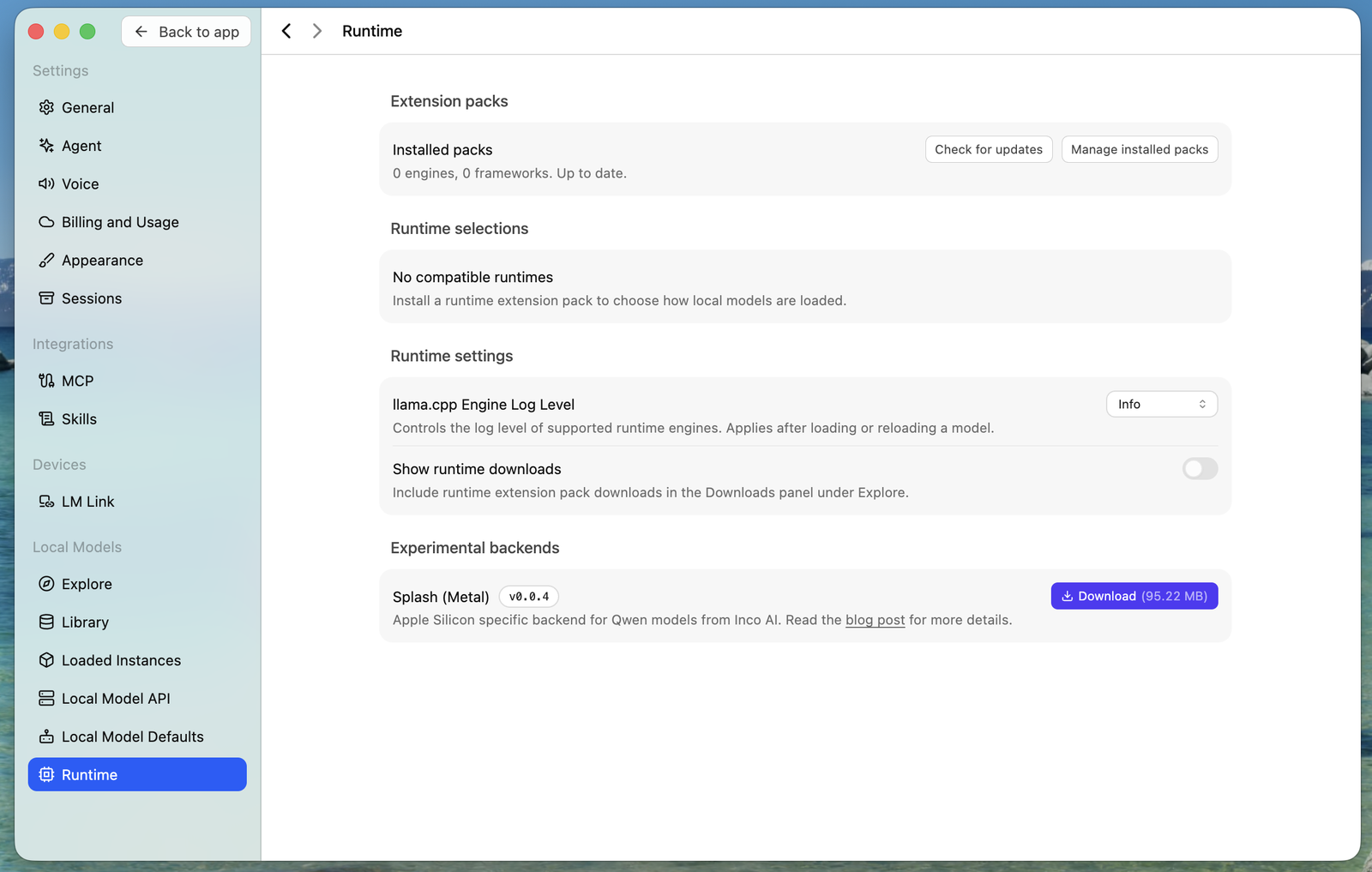
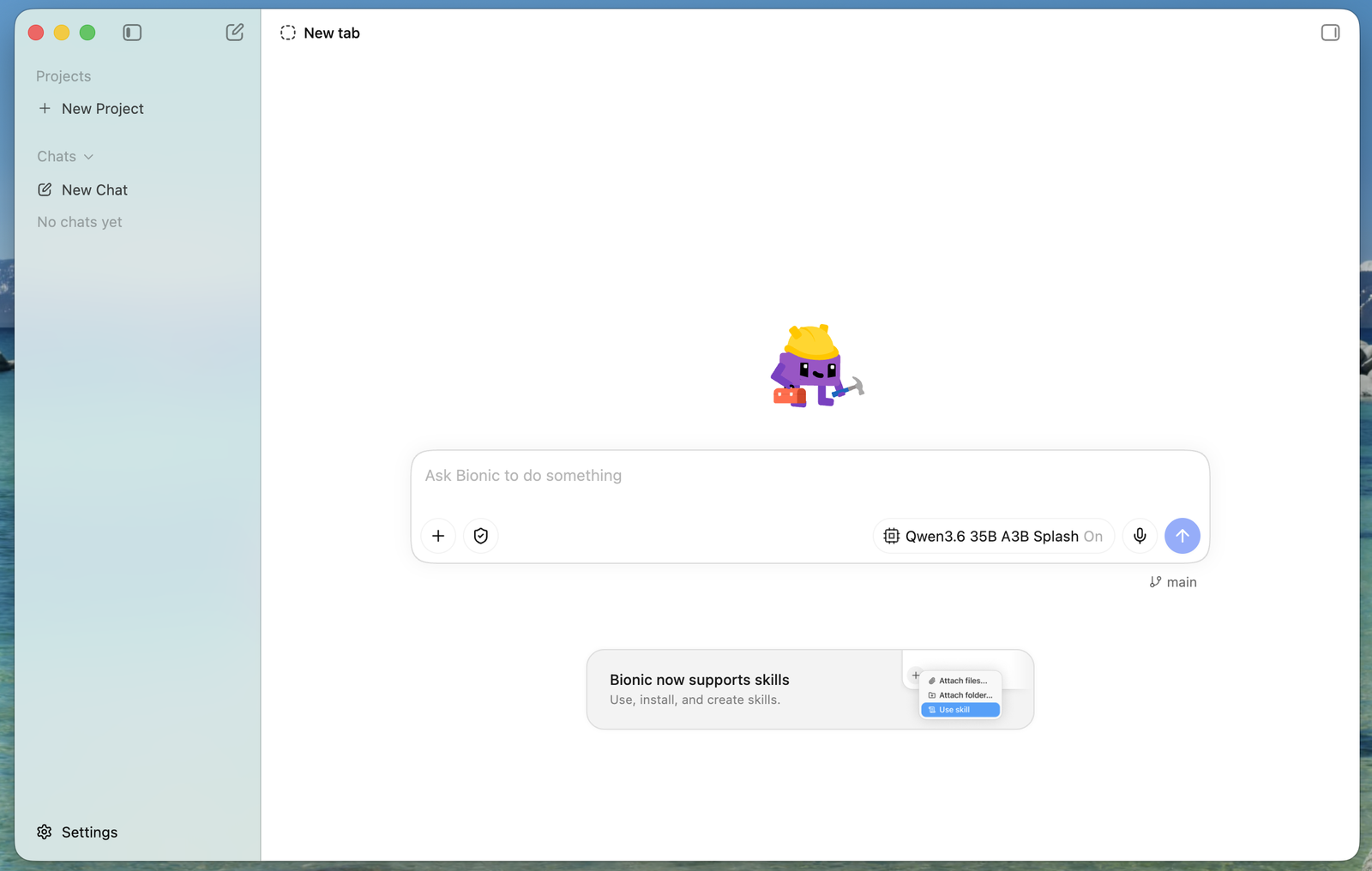
The partnership is real — LM Studio integrates Splash as a selectable runtime, downloads it from the Runtime pane, and picks up the same two Hugging Face packages. "Day zero" is doing a little work in the launch post (LM Studio's post is dated the following day, and it requires Bionic 1.1.5 or newer), but the integration exists and is the fastest route to trying this without Homebrew.
What deserves credit
Three things in this release are published against their author's interest, and they are the reason I believe the rest of it.
The prefill section says the quiet part: "reading a large repository cold is still expensive for every engine we tested, ours included." 96 seconds to first token on a cold 32K prompt is in their own table, in a post whose headline is about speed.
The methodology section pre-empts the objection: "Because each engine ran at its own recommended settings, these are end-to-end comparisons. They show the combined effect of specializing the engine for its model, not the contribution of any one part." That is precisely the right caveat on a set of bar charts that would otherwise read as kernel benchmarks.
And the DFlash 2 post benchmarks its own drafter against the model's native MTP head, and publishes that MTP beats the community DSpark drafter by 0.66 tokens on Qwen3.8-27B. A vendor selling a drafter did not have to run that column.
Against that, one omission: the number that actually travelled is the one without a method. 144 tok/s appears in a video, on an unspecified chip, and by the time it reaches an aggregator it has lost the model, the quantisation, the prompt length, the concurrency and the reasoning setting. The written benchmark is careful enough that the video did not need to be loose.
The best thing about the engine is that it made this checkable at all. Splash
exposes splash_draft_acceptance_ratio on /metrics. Anyone who owns the
hardware can settle every estimate in this article in about ninety seconds:
splash serve --model incoai/Qwen3.8-27B-Splash
# run a coding prompt, then:
curl -s 127.0.0.1:8000/metrics | grep -E 'acceptance|decode_tokens_per_second'
What would change my mind
6 claims above, and what would falsify each
One Splash decode step for Qwen3.8-27B reads 16.73 GB, so decode throughput is bounded by bandwidth ÷ 16.73 GB × tokens accepted per pass.
Every input is in the repository. Recompute
q4PackedBytes(o, i) = o·i/16·9over the shapes inQwen3_8.hppandDFlashDraft.hpp, and check whether the draft really runs the target'svocabularyProjectionrather than one of its own. If the total is materially below 16.73 GB — a cheaper head path, weights that stay in cache across layers, anything I have missed — then every efficiency figure in this piece is too high and the claims have more headroom than I say. If it is materially above, 74 tok/s on an M5 Pro is the number that stops being possible, and I have made an arithmetic error rather than found one.144 tok/s is a 40-core M5 Max number and cannot be produced on the 32-core bin.
Run
splash serveon a 32-core M5 Max and decode a short coding prompt, single request, reasoning on. If it clears roughly 132 tok/s — the 460 GB/s ceiling at the published acceptance length — then either the step reads fewer bytes than I compute or the acceptance is better than Inco's own 4.80, and the "impossible" call is wrong. The tell issplash_draft_acceptance_ratioon/metrics: tokens per pass is1 + 7 × ratio, and anything much above 5.2 would rewrite the ceiling.Splash on this workload accepts about 4.6–4.8 tokens per verification pass, which is where my efficiency figures come from.
curl 127.0.0.1:8000/metrics | grep splash_draft_acceptance_ratioafter a real agent session. If it reads meaningfully below 0.51 — under 4.6 tokens per pass — then 74 tok/s implies more than 90% of the M5 Pro's theoretical peak, which no real kernel sustains, and my byte count is too large. If it reads above 0.63, the engine has more headroom than I credit it with and the bandwidth story is less tight than I claim.Ollama's 24 tok/s in the launch table cannot be one token per forward pass.
Re-run Ollama's Qwen3.8-27B on a 48 GB M5 Pro with any speculative or MTP path explicitly disabled and measure short-prompt decode. If it still reaches 24 tok/s at one token per pass, it is moving fewer than 12.8 GB per token, which would mean its quantisation is materially smaller than Splash's 4.5-bit pack — and my assumption that the two engines read comparable bytes, which also underpins the uzu check, is wrong.
Splash's sampling is exact for the requested distribution, and the top-32 cap costs nothing but expressiveness.
Set
temperature=1.0, top_k=32and draw a few hundred thousand tokens from a fixed one-token prompt through Splash, and the same through a non-speculative reference on the same weights. Compare the empirical distributions. A significant divergence would mean the truncated accept test is not preserving the target distribution the way I readsparse_residual_sampleas doing, and the caveat is a correctness bug rather than an API limit.The M5's per-core Neural Accelerators are not what makes Splash fast; the memory controller is.
Compare decode throughput on an M4 Max (546 GB/s, no per-core Neural Accelerator) against a 32-core M5 Max (460 GB/s, with one), on the same model and prompt. If the M5 Max wins despite 16% less bandwidth, decode is getting real work out of the matrix hardware and my reading of the Q4 tile kernels as bandwidth-bound is wrong. Splash requires M3 or newer, so this experiment is available today.